

Key takeaways
• Seven model families do almost all the real work. Convolutional autoencoders, two-stream optical flow, 3D CNNs, ConvLSTM, weakly-supervised MIL (RTFM), self-supervised transformers, and CLIP-style vision-language models cover every production scene we ship.
• Published AUC lies to you by 5-15 points. RTFM scores 84.3% on UCF-Crime in the lab; a fresh venue gets high-70s to low-80s. Chase the alert-to-true-positive ratio, not the leaderboard.
• Edge-first is the architecture, not an optimization. On a Jetson, camera-to-alert runs 40-80 ms; a cloud-only round-trip runs 500-2000 ms and fails a dispatch SLA. Edge also keeps raw frames on the device, which is the cleanest privacy posture.
• Real builds ensemble three or four models, not one. A detector plus an autoencoder plus a VLM with a 2-of-3 vote roughly halves false alarms versus the single best model.
• The EU AI Act clock just moved. The June 2026 Digital Omnibus pushed high-risk obligations for biometric systems from August 2026 to December 2, 2027. Non-biometric anomaly detection stays out of the high-risk tier entirely.
Why Fora Soft wrote this guide
We have built video surveillance and AI multimedia products since 2005, across 250+ delivered projects. Anomaly detection is the engine inside any video anomaly detection software stack, and it is the part of a surveillance build where the model choice quietly decides whether operators trust the system or mute it by week two. Pick wrong and you ship a wall of false alarms; pick right and a night-shift operator catches the one event that mattered.
Our VALT platform runs anomaly detection alongside the recording layer for 770+ US organizations and 50,000+ users in courtrooms, police interrogation rooms, and medical-training centers. That is where we learned the difference between a model that wins a benchmark and a model that survives a chain-of-custody audit. The seven families below are the ones we actually reach for, with the trade-offs we have paid for in production.
This is the compressed version of the model-selection conversation we have with clients every month: which models earn their place, where each one breaks, the benchmarks worth trusting in 2026, and how to assemble a stack that holds up on your venue instead of on someone else's test set. If you want the surveillance-applications overview first, read our computer vision for video surveillance primer, then come back here for the model detail.
Picking the right anomaly detection model for your build?
Thirty minutes with a senior engineer who has shipped surveillance AI in courtrooms, hospitals, and retail. Bring your scene types and your latency SLA; we will tell you what we would build.
What counts as an anomaly in surveillance video
An anomaly is any event a model flags as far enough from “normal” to deserve a human look: a fall, a fight, a wrong-way runner, an abandoned bag, a person where nobody should be at 3 a.m. The hard part is that “normal” is different for every camera, so the useful question is never “which model is best” but “which model fits this scene, this data, and this latency budget.”
Detectors learn normal in one of three ways, and that choice drives everything downstream. Reconstruction models learn to rebuild normal frames and flag whatever rebuilds badly. Prediction models learn what the next frame should look like and flag surprises. Classification models learn from labels — frame-level, clip-level, or a single tag per video — and score how anomalous a window looks. The rest of this guide is really about matching those learning styles to your constraints.
Before you reach for a model, answer four things: do you have labels, what is your latency budget, are the anomalies action-like or scene-like, and how many venues will you cover. Every recommendation below is a function of those answers. The map in Figure 1 is the fastest way to see where each model lands; each family builds on the pixel-level frames covered in our digital video foundations explainer.
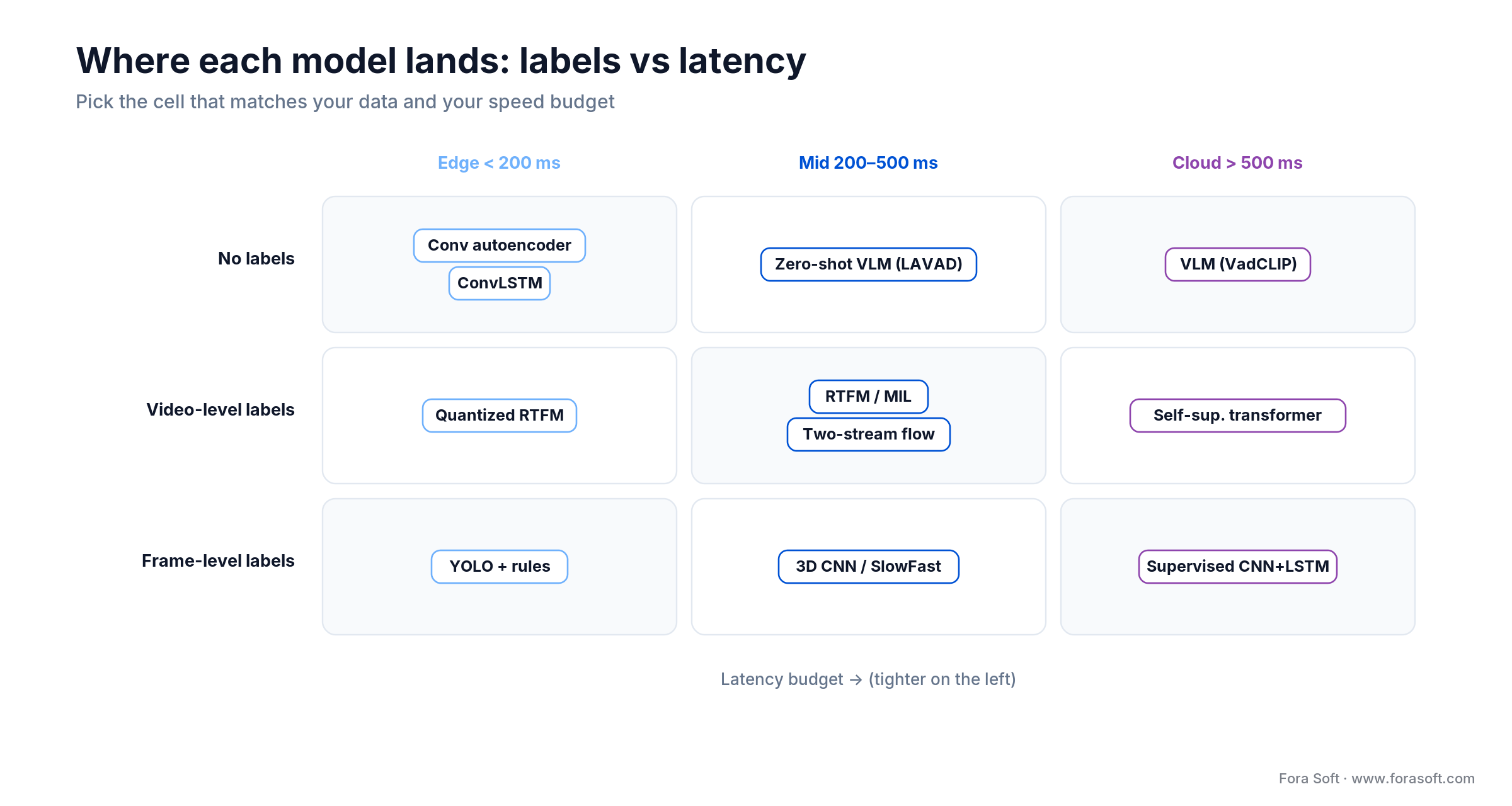
Figure 1. Where each model lands by label requirement and latency budget. Start in the cell that matches your data and speed.
Model 1: Convolutional autoencoders
A convolutional encoder squeezes each frame into a small latent code and a decoder rebuilds it. Train only on normal footage from one camera; anything that reconstructs badly gets flagged. No labels, tiny model, 15-30 ms on a Jetson Nano-class board. It is the fastest way to a scene-specific detector, and it is where we start most single-camera builds.
The catch is the ceiling. On in-the-wild benchmarks a plain autoencoder tops out around 70-80% AUC, it drifts when lighting or weather changes, and it stays quiet on subtle anomalies that still reconstruct cleanly. Great baseline, weak finale.
Reach for a convolutional autoencoder when: you have one fixed camera, no labels, and need a working baseline this week from two weeks of normal footage.
Model 2: Two-stream optical-flow networks
Two CNNs run in parallel: one on the raw RGB frame (appearance), one on optical flow between frames (motion). Fuse them and you get the classic answer for motion-driven anomalies — running, fighting, crowd surges, wrong-way movement — that single-frame methods miss. The motion stream is a complementary signal that reliably adds 5-8 points to an ensemble.
Optical flow is not free: it costs 20-40 ms per frame to compute, and the approach struggles on PTZ cameras and very fast motion where the flow field gets noisy. On fixed cameras watching for movement, it earns its keep.
Reach for a two-stream network when: the anomalies you care about are motion-driven and your cameras are fixed, not pan-tilt-zoom.
Model 3: 3D CNNs and SlowFast
Swap 2D convolutions for 3D ones that span space and time. C3D, I3D, and SlowFast capture how an action unfolds — the wind-up before a punch, the arc of a falling body — instead of judging one frame at a time. I3D pretrained on Kinetics is still the feature extractor sitting under most weakly-supervised methods, so even when you do not deploy a 3D CNN directly, you are probably using its features.
The cost is GPU-only inference at 200-400 ms per 8-frame clip and expensive training. You buy accuracy on action anomalies with compute and latency.
Reach for a 3D CNN when: anomalies are action-like, you have a GPU at inference time, and 3-10 second windows capture the events you care about.
Model 4: ConvLSTM prediction networks
A convolutional encoder feeds an LSTM that predicts the next frame; prediction error flags the anomaly. It sits between a plain autoencoder and a full 3D CNN — cheaper than 3D, more time-aware than per-frame methods — and it runs comfortably on an edge GPU like a Jetson Orin NX for continuous 5-30 second monitoring.
It is less sturdy than a transformer on messy in-the-wild data and harder to scale past a few dozen frames of context. For steady edge monitoring where you want some memory without the 3D bill, it is a sensible middle.
Reach for ConvLSTM when: you want sequence modeling on an edge GPU without paying the full 3D CNN latency.
Model 5: Weakly-supervised MIL (RTFM)
Multiple Instance Learning treats each video as a bag with one label — anomalous or normal — and lets frames inherit it probabilistically, so you never label individual frames. RTFM (ICCV 2021) added temporal feature-magnitude learning with self-attention and is still the reference: 84.30% AUC on UCF-Crime and 97.21% on ShanghaiTech with I3D features.
You pay for that accuracy with 6-8 GB of VRAM at training time and domain specificity: an RTFM trained on campus footage does not transfer cleanly to a parking lot or a retail floor. When you have clip-level labels and GPU-efficient inference matters, it is the most reliable pick on this list. It is also the deep dive in our companion piece on machine learning algorithms for anomaly detection.
Reach for weakly-supervised MIL when: you have video-level labels (“this clip contains a fight”), a GPU, and action-like anomalies.
Model 6: Self-supervised video transformers
Pretrain a transformer with masked autoencoding on tens of thousands of unlabeled clips, then fine-tune on a small labeled set. This is the 2024-2026 inflection: the labeled-data bottleneck mostly goes away, in-the-wild accuracy climbs, and attention maps give you a handle on explainability. ViViT and TimeSformer split spatial and temporal attention to keep long contexts affordable.
The bill is 300-800 ms inference, a mandatory GPU, and interpretability that is harder to reason about than a CNN plus LSTM. When in-the-wild accuracy is the headline number and labels are scarce, transformers are the strongest answer.
Reach for a self-supervised transformer when: in-the-wild accuracy is the KPI, labeled data is thin, and you have GPU at inference time.
Model 7: Vision-language models (VadCLIP, LAVAD)
CLIP-style models learn a joint image-text space, so anomalies can be described in plain language instead of hard-coded. VadCLIP (AAAI 2024) reaches 88.02% AUC on UCF-Crime with only video-level labels; LAVAD does zero-shot detection with no task training at all. The newest variants generate a short text reason for each alert, which is worth real money in a compliance audit.
VLMs carry the highest inference cost (roughly 80-300 ms per frame on a recent GPU) and usually need self-hosting so raw frames never hit a third-party API. In exchange you get cross-venue generalization, zero-shot coverage of anomaly types you never trained on, and alerts an operator can actually read.
Reach for a vision-language model when: you need cross-venue generalization, explainable alerts, or user-defined anomaly queries by text.
The seven models compared
Here is the whole field on one screen. Treat the AUC column as a relative ordering, not a promise: these are published numbers, and your venue will land several points lower. The “where it wins” column is the one that should drive your shortlist.
| Model | Labels needed | UCF-Crime / ShanghaiTech | Latency | Where it wins |
|---|---|---|---|---|
| Conv autoencoder | None | ~70-80% AUC | 15-30 ms | Single fixed camera, zero labels |
| Two-stream optical flow | Frame or video | ~78-85% AUC | +30-60 ms | Motion-driven anomalies |
| 3D CNN / SlowFast | Frame or video | ~80-88% AUC | 200-400 ms | Action anomalies, GPU on hand |
| ConvLSTM | None / video | ~78-85% AUC | 100-300 ms | Edge sequence monitoring |
| Weakly-supervised MIL (RTFM) | Video-level only | 84.3% / 97.2% AUC | 80-150 ms | Clip labels, GPU-efficient |
| Self-supervised transformer | Few labels | ~85-92% AUC | 300-800 ms | Best in-the-wild accuracy |
| Vision-language (VadCLIP) | None / clip | ~88-90% AUC | 80-300 ms | Cross-venue, explainable alerts |
Benchmarks worth trusting in 2026
Five datasets carry most of the signal. UCF-Crime (1,900 real surveillance videos, 128 hours, 13 crime types, video-level labels) is the standard hard test; CLIP-based methods lead it in the high-80s. ShanghaiTech has frame-level ground truth and RTFM-class methods clear 97%. XD-Violence adds synchronized audio and is scored in average precision, which is the right benchmark for multimodal detectors. Avenue covers pedestrian loitering and wrong-way motion. MSAD (2024) is the honest one: 14 distinct scenes built to test cross-venue generalization, where methods that hit 95% on ShanghaiTech routinely fall to the mid-80s.
The gap between those two numbers is the whole game. Figure 2 shows it directly: the solid bar is roughly what a new venue gets, the lighter cap is the published ceiling. Design for the solid bar.
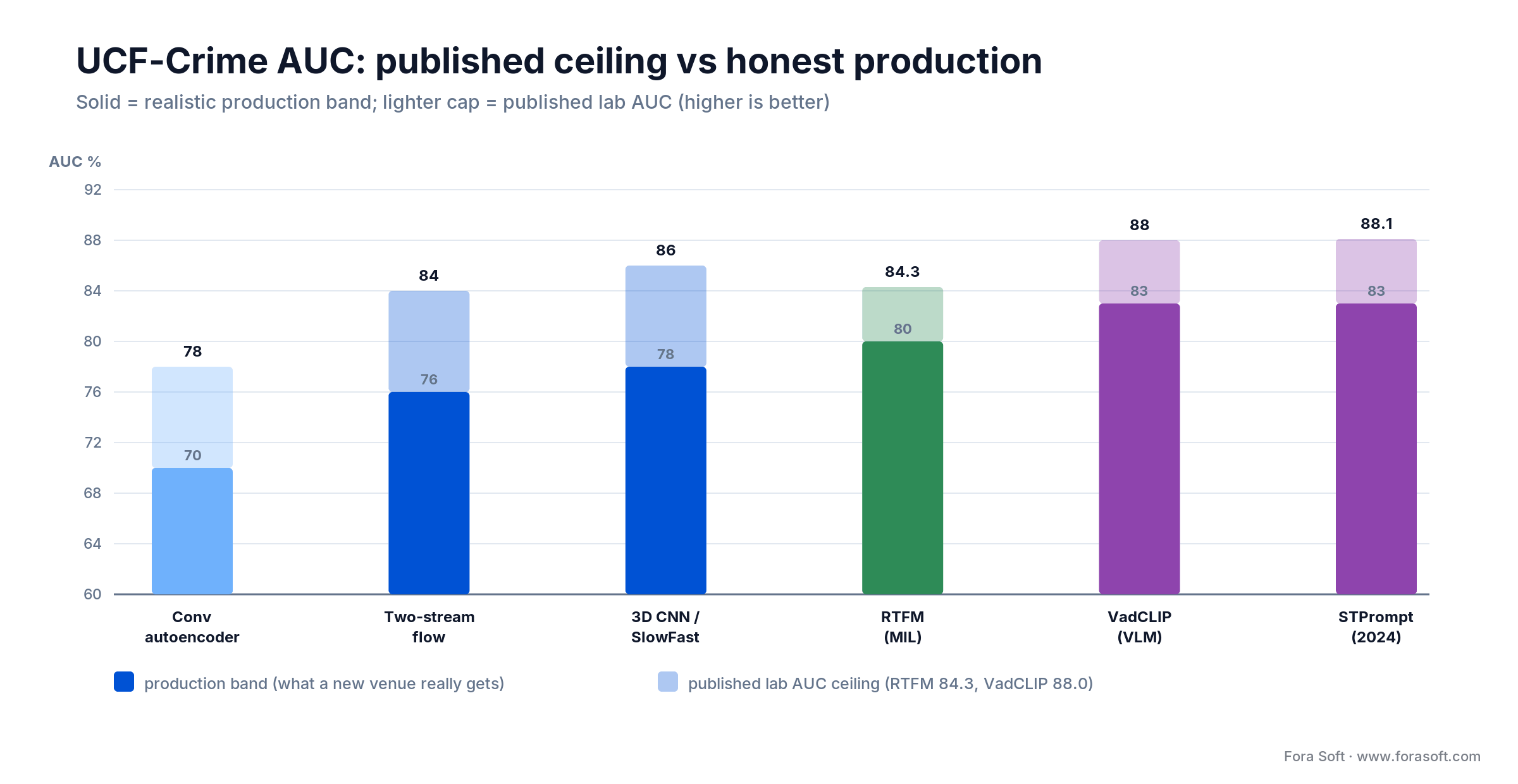
Figure 2. UCF-Crime AUC by method: solid = realistic production band, lighter cap = published lab AUC. Plan for the floor.
Edge, cloud, and why real stacks ensemble
Where do these models run? In 2026 the default is edge-first, and it is not a close call. On a Jetson Orin NX with a properly compiled model, camera-to-alert is 40-80 ms. The same workload as a cloud-only pipeline — RTSP to encoder to cloud inference and back — runs 500-2000 ms once you measure honest network round-trip. Police dispatch and automated door or lock triggers need sub-200 ms, so cloud-only simply fails the SLA. Figure 3 puts the two side by side.
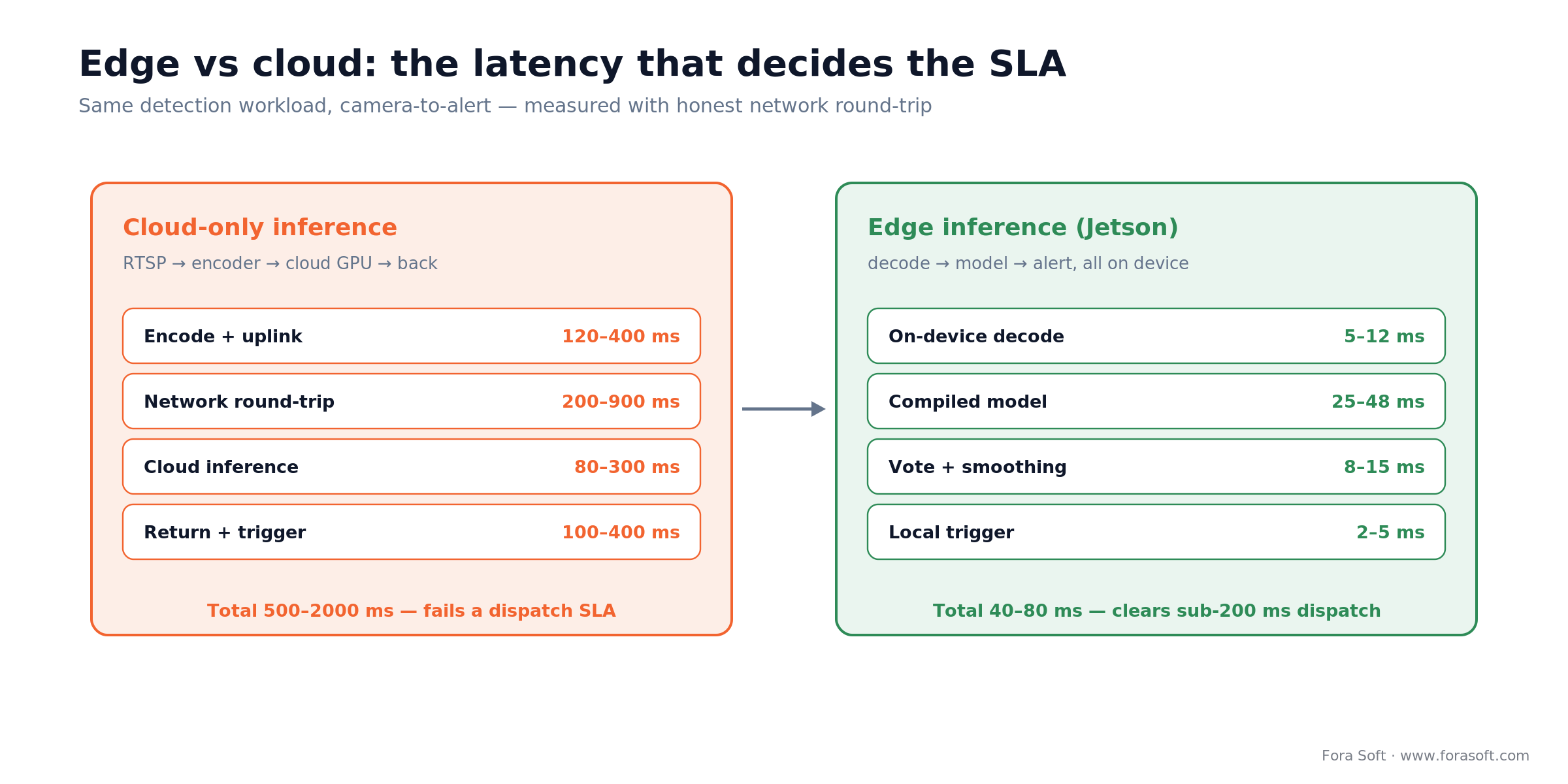
Figure 3. Edge versus cloud, same workload. Cloud-only round-trips land 500-2000 ms; on-device inference clears sub-200 ms dispatch.
Edge also collapses bandwidth from 4-8 Mbps per 1080p stream to 50-200 Kbps of metadata, which decides whether a 200-camera site works on the uplink you actually have. And it turns the compliance conversation from “document your data flow” into “raw frames never leave the device.” We walk through the trade-offs in detail in our edge AI vs cloud AI comparison.
The second architecture decision is that no single model wins across every scene, light level, and anomaly type. Production stacks we ship combine a detector (YOLO-class, for explainable zone rules a prosecutor can follow), a scene-specific autoencoder (for novel anomalies the labeled stack never saw), and either an RTFM or a VLM (for cross-venue coverage). A 2-of-3 consensus vote across those families roughly halves false alarms versus the single best model, at the cost of 30-80 ms. Figure 4 shows how the pieces fit.
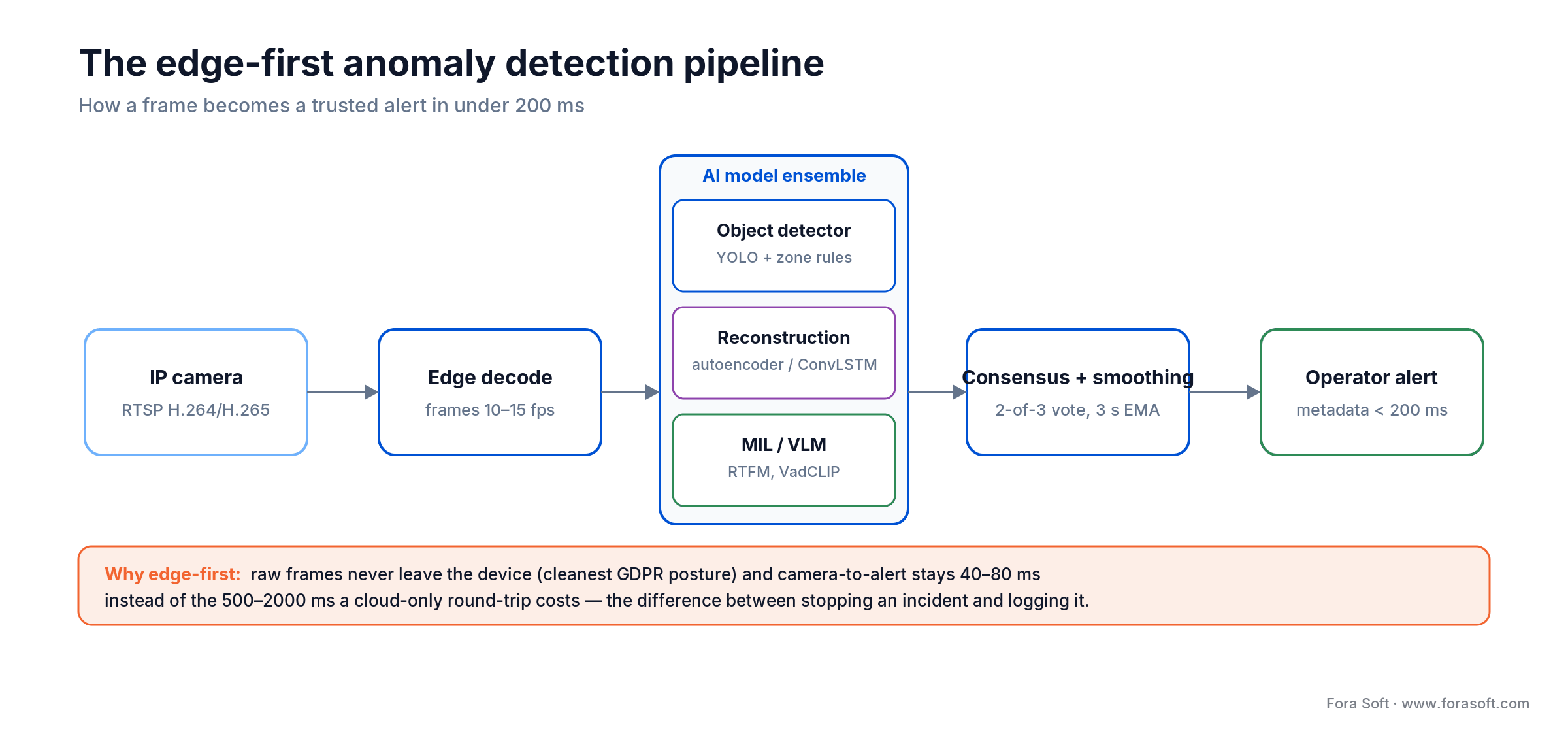
Figure 4. The edge-first pipeline: a frame becomes a trusted alert through decode, an ensemble, a 2-of-3 vote, and smoothing in under 200 ms.
The hardware layer
Model family maps onto silicon cleanly. The Jetson Orin Nano Super (US$249, 67 TOPS) runs autoencoders, YOLO detectors, and quantized ConvLSTM at 1-3 cameras per device — the default for cost-sensitive SaaS surveillance. The Jetson Orin NX (16 GB, now 157 TOPS after the JetPack Super update) is the comfortable home for RTFM with I3D features, two-stream flow, and quantized transformers at 3-5 cameras. The Jetson AGX Orin (up to 275 TOPS) is the right call for VLM-class workloads at the edge or 10+ camera clusters running full ensembles. For fanless smart cameras at volume, a Hailo-8 (26 TOPS, under 3 W) runs YOLO and quantized autoencoders.
Need a second opinion on your model stack?
We run two-week architecture audits that pinpoint the biggest false-positive sources and the single model swap that buys the most accuracy for the least engineering.
Mini case: the VALT anomaly stack
VALT runs in courtrooms, medical-training facilities, and law-enforcement interrogation rooms. The constraints are unforgiving: many concurrent HD streams, audio-video sync tight enough that a half-second drift can wreck a court exhibit, encrypted transport, role-based access, and export under chain-of-custody rules. Anomaly detection has to add value without ever muddying an evidentiary record.
Our stack there ensembles three of the seven families: a YOLO-class detector for zone and behavior rules a prosecutor can read, a scene-specific autoencoder trained on two weeks of normal footage per camera for novel events, and a quantized RTFM-derived detector for the action anomalies we have clip labels for. A 2-of-3 vote and a 2-second temporal smoother feed the operator UI, and every alert carries which model fired and which features it weighted.
The number the client cared about: false alarms dropped from the mid-teens per camera per day to under two, while detection on the events that matter — an unconscious person, an unauthorized entry, a physical altercation — held above 90%. The build passed a courtroom-scrutiny audit precisely because each alert was traceable to a model and a reason. Want the same teardown on your stack? Grab a 30-minute slot and we will walk through where your false-positive budget is going.
What a custom build actually costs
Let us run the arithmetic on a realistic job: a 60-camera retail chain that wants edge anomaly detection with an operator dashboard. Group cameras 4 per device on Jetson Orin NX, so 60 cameras need 15 devices. At roughly US$600 per module that is US$9,000 of edge hardware, plus about US$120 per site in mounts and networking. Hardware is rarely the number that scares people. For the five-year view — where edge overtakes per-camera SaaS pricing, and what the ONVIF metadata path into your VMS costs in integration time — see our video surveillance anomaly detection deployment playbook.
The engineering line is where budgets live or die. A single-family edge MVP — one model, on-device inference, a dashboard — realistically runs US$40k-120k, and hardening it for production adds another US$50k-150k. A full three-family ensemble with multi-site support and compliance documentation typically lands US$200k-500k. We use Agent Engineering to compress the engineering line by 30-50%, so the same scope quotes lower and ships faster than a hand-built equivalent; if a number ever feels padded, ask us to show the breakdown.
Two ongoing numbers matter more than the build cost: expect US$13-30 per camera per month on a sensible edge-first architecture, and treat cost per true-positive alert (target under US$0.50) as the metric that tells you whether the system is actually paying for itself.
Want a straight cost read on your scope?
Send us your camera count, scene types, and latency target. We will come back with a conservative build estimate and the monthly run-rate, no survey phase.
Pick your model in five questions
Five questions get you to a shortlist faster than any benchmark table. Answer them in order and the model almost picks itself; Figure 5 turns the first four into a flowchart you can hand to a teammate.
1. How many labels do you have? None points to an autoencoder or a zero-shot VLM. Video-level labels bring RTFM and MIL into play. Frame-level labels — rare in the real world — open up supervised CNN-plus-LSTM or a transformer.
2. What is the latency budget? Sub-200 ms forces edge-light models: autoencoder, ConvLSTM, or YOLO plus rules. Above 500 ms puts transformers and VLMs on the table.
3. Are the anomalies action-like or scene-like? Action (fighting, falling, running) rewards 3D CNNs, two-stream flow, and RTFM. Scene (loitering, abandoned objects, zone incursion) rewards a detector plus an autoencoder plus a VLM.
4. Single venue or cross-venue SaaS? One fixed venue is hard to beat with a scene-specific autoencoder. Many venues demand a VLM or a self-supervised transformer that generalizes.
5. What is your compliance posture? Strict EU or BIPA exposure means a non-biometric stack (autoencoder, RTFM, YOLO) and self-hosted VLMs rather than third-party APIs touching raw frames.
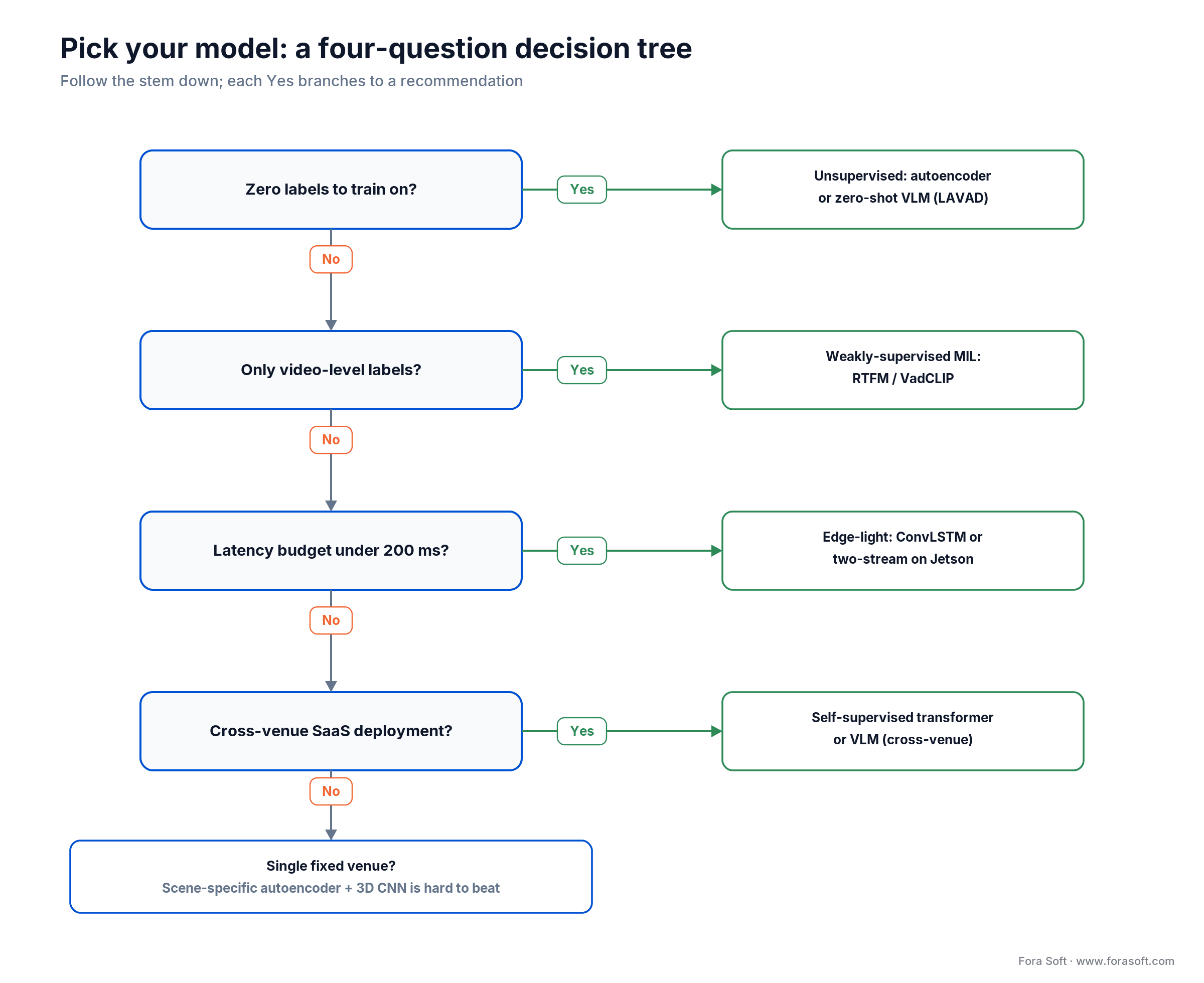
Figure 5. A four-question decision tree: labels, then latency, then cross-venue needs point you to a model family.
False-positive tactics that actually work
Whatever model you pick, lab accuracy drops 10-15 points in production, and the gap shows up as false alarms. Five tactics close most of it, and they matter more than another point of AUC.
1. Temporal smoothing. Run a 3-5 second exponential moving average on the anomaly score before you trigger. It removes 30-50% of single-frame glitches for 50-100 ms of added latency.
2. ROI masking. Mask reflections, tree movement, signage, and HVAC shadows. Five minutes of per-camera setup cuts 40-60% of false positives in exposed scenes.
3. Multi-model consensus. Require two of three models to agree before firing. It roughly halves false positives at 3x the inference compute — usually the best trade in the whole system.
4. Operator-tunable thresholds. Per-shift sensitivity sliders beat any global default. Night-shift and day-shift operators set them differently, and they are right to.
5. Scene-class routing. A different model per scene class (parking, hallway, retail, perimeter) buys 5-10% AUC over one universal model. Our field notes on detecting anomalies in surveillance footage go deeper on tuning.
Compliance: EU AI Act, BIPA, GDPR
Anomaly detection that uses biometric data — facial recognition, gait, pose — is classified high-risk under the EU AI Act. The timeline just changed, and it is worth getting right: the Digital Omnibus, given final Council approval on 29 June 2026, postponed the standalone high-risk obligations for biometric systems from August 2026 to 2 December 2027. Transparency duties still apply from August 2026. That deferral is breathing room, not a reprieve — the risk-management, data-governance, logging, and human-oversight requirements are still coming.
Non-biometric anomaly detection — loitering, crowd density, zone incursion, unusual motion — stays outside the high-risk tier, which is exactly why most B2B surveillance products we ship deliberately live there. It is the difference between a conformity assessment and a normal launch.
Two more regimes shape the design. Illinois BIPA imposes per-violation statutory damages for processing biometric identifiers without written consent, so the right pattern is jurisdiction-aware routing that disables face, pose, and gait features in BIPA states. GDPR Article 9 makes biometric data special-category processing, where edge inference plus a documented Data Protection Impact Assessment is the cleanest path you can ship.
When not to build your own
Honesty sells better than a pitch, so here is when not to hire us. Skip a custom model if you run under 80 cameras and your anomalies are industry-standard — an off-the-shelf VMS like Verkada, Eagle Eye, or Avigilon will beat a custom build at that scale. Skip it if your latency tolerance is one to two seconds and operators only need a dashboard. Skip it if your venues are so varied you cannot collect even two weeks of normal footage per camera class. If a packaged AI video surveillance product covers you, buy it.
Build custom when anomaly detection is a product differentiator, when sub-200 ms latency or on-device privacy is non-negotiable, when your anomaly definitions are domain-specific, or when compliance rules out cloud processing. That is the zone where a tuned ensemble pays for itself, and it is the work we take on.
FAQ
What is the best video anomaly detection software model in 2026?
There is no single winner. On benchmarks, RTFM leads weakly-supervised detection (84.3% AUC on UCF-Crime, 97.2% on ShanghaiTech) and VadCLIP-style vision-language models reach the high-80s with explainable alerts. In production, the best result comes from an ensemble of three families with a consensus vote, not any one model.
Can you run video anomaly detection without labeled data?
Yes. A convolutional autoencoder trained on two weeks of normal footage per camera needs no labels and ships a credible scene-specific detector. Zero-shot vision-language methods like LAVAD detect without any task-specific training. Both are realistic starting points for a new venue.
Is RTFM still the reference for weakly-supervised anomaly detection?
It remains very competitive at 84.3% AUC on UCF-Crime and 97.2% on ShanghaiTech, and it is GPU-efficient. Newer CLIP-based methods edge ahead on zero-shot and cross-venue settings, but RTFM is still the most reliable pick when you have video-level labels.
How do vision-language models like VadCLIP and LAVAD work?
They use a CLIP-style joint image-text space, so frames are compared against natural-language anomaly descriptions such as “person running” or “person carrying a ladder.” LAVAD is fully zero-shot; VadCLIP fine-tunes with clip-level labels. Both generalize across venues and produce more explainable alerts than purely visual models.
Should you use one model or an ensemble?
For anything mission-critical, an ensemble. A typical production stack combines three families (for example a detector, an autoencoder, and RTFM or a VLM) with a 2-of-3 consensus vote, which cuts false positives roughly in half versus the single best model for 30-80 ms of extra latency.
What latency should you target for a real-time anomaly alert?
Under 200 ms camera-to-alert for police dispatch and automated response; under 500 ms for operator alerting in retail or campus security. Cloud-only pipelines routinely run 500-2000 ms with honest network round-trip, while edge inference on a Jetson Orin NX typically delivers 40-80 ms.
Is anomaly detection compliant with the EU AI Act?
Non-biometric detection (loitering, crowd density, zone incursion, unusual motion) generally sits outside the high-risk tier. Biometric-based detection is high-risk; under the June 2026 Digital Omnibus its standalone obligations were deferred to 2 December 2027, though transparency duties apply from August 2026. Most B2B products stay non-biometric on purpose.
How much does a custom anomaly detection build cost?
A single-family edge MVP realistically runs US$40k-120k, with another US$50k-150k to harden for production. A three-family ensemble with multi-site support and compliance documentation typically lands US$200k-500k. Agent Engineering compresses the engineering line by 30-50%.
What to read next
Surveillance
Video Surveillance Anomaly Detection in 2026
Models, architectures, and the production KPIs behind a real anomaly stack.
Algorithms
ML Algorithms for Anomaly Detection
The algorithm-by-algorithm deep dive underneath the seven model families here.
Edge
Edge AI vs Cloud AI Video Surveillance
Where detection should run, and how edge pipelines hit sub-200 ms latency.
Cameras
Automated Anomaly Detection in Security Cameras
The end-to-end engineering playbook with edge architecture and cost models.
Computer vision
AI Video Surveillance with YOLO and DeepSORT
How the detector layer of an ensemble is built and tuned in practice.
Ready to ship anomaly detection operators trust?
Choosing among the seven video anomaly detection software models comes down to your labels, your latency budget, your scenes, and your compliance posture — not the leaderboard. The strongest builds in 2026 ensemble three or four families on a clean edge-first architecture, treat false positives as the primary metric, and design for the EU AI Act from day one.
If you are scoping a build, moving off a cloud VMS, or stuck in false-alarm purgatory, we have shipped enough surveillance AI to skip the survey and go straight to the architecture. Start with our video surveillance development work or talk to the engineers who would build it.
Let us pressure-test your anomaly detection stack
Thirty minutes, one senior engineer, no fluff. Bring an architecture diagram or a vendor quote and we will tell you what we would build instead.