From smart text chatbots to natural voice AI, we build custom assistants that that speaks your users’ language, literally
We develop conversational AI: text chatbots, voice assistants, or omnichannel AI solutions, powered by the latest NLP and speech technologies.
No matter the size or complexity of your project, we’ll take it on and get it done. No excuses.
We create natural, context-aware assistants using OpenAI, GPT-5, Dialogflow, and LangChain for chat or voice, across web, mobile, and smart devices.
We integrate Speech-to-Text and Text-to-Speech using ElevenLabs, Whisper, or Google Speech APIs, delivering assistants that listen, respond, and handle real-world conversations.
Run your AI assistant anywhere: web apps, mobile apps, WhatsApp, Telegram, Slack, or call centers. We ensure low latency, high availability, and real-time analytics with AWS, GCP, or Azure infrastructure.
We build conversational AI systems that understand user input, process intent, and respond naturally – in text or voice.
Here’s how a typical AI assistant we develop works:
A user sends a message in chat or speaks through a microphone. In voice scenarios, audio is captured in real time inside a mobile app, web app, smart device, or phone call.
If the input is voice, we use Speech-to-Text (STT) to convert audio into text. This allows the AI to understand what the user said, even with accents or background noise.
The text goes to an AI model such as GPT-5, Dialogflow, or a custom NLP pipeline. The system detects intent, extracts key data, and understands context from previous messages.
The assistant connects to your backend systems: CRM, database, booking engine, payment system, or internal tools. It can fetch data, create records, or trigger workflows.
The AI creates a helpful response based on user intent, conversation history, and your business rules. This can be:
If the channel is voice, the response is converted into natural audio using Text-to-Speech (TTS). Users hear a human-like voice instead of robotic playback
Result: a smart assistant that feels natural, responds fast, and actually helps users get things done.
Our AI chatbot and voice assistant architecture is designed for scalability, low latency, and reliable integrations.
A typical AI chatbot and voice assistant includes the following layers:
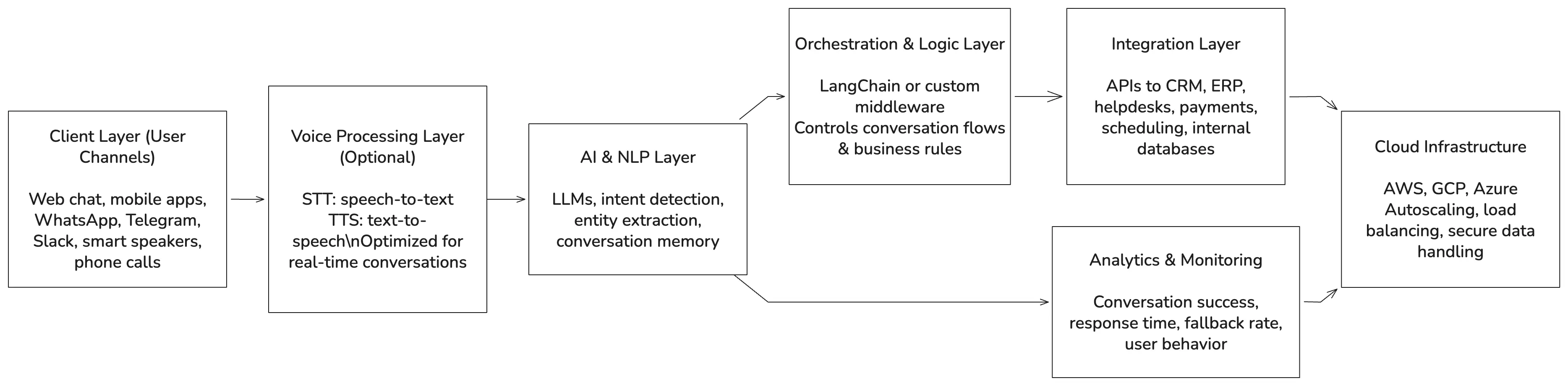
Result: This modular setup allows your assistant to grow from a simple chatbot into a full enterprise-grade conversational AI platform.
Where users interact with the assistant: Web chat widgets, mobile apps, WhatsApp, Telegram, Slack, smart speakers, or phone calls.
For voice assistants, we add:
This layer is optimized for real-time conversations with minimal delay.
Runs speech recognition (STT), language models (LLMs), text-to-speech (TTS), and vision models.
We use tools like LangChain or custom middleware to control conversation flows, apply business rules, and connect the AI to external systems.
Secure APIs connect the assistant to CRMs, ERPs, payment systems, helpdesks, scheduling tools, or internal databases. This allows the AI to perform real actions, not just chat.
We track conversation success rate, response time, fallback rate, and user behavior. These insights help improve both AI performance and business outcomes.
Hosted on AWS, GCP, or Azure with autoscaling, load balancing, and secure data handling to support thousands of simultaneous users.
For phone calls and in-app voice conversations, we add real-time Speech-to-Text (STT) and Text-to-Speech (TTS) to make AI voice assistants truly interactive.
What This Enables:
Low Latency, Natural Flow
We optimize the pipeline so conversations feel smooth, with minimal delay between user speech and AI response.
This turns traditional call flows into intelligent, voice-driven conversations instead of rigid “press 1, press 2” menus.
Conversational AI works best where users need fast help, hands-free interaction, or automated support at scale.
If your business involves repetitive conversations, support requests, or booking flows, an AI chatbot or voice assistant can automate a large part of that workload.
Custom AI Chatbot & Voice Assistant apps for every case. Secure, scalable, and packed with smart features – built by the pros who started it all.

Have an idea? We’ll turn it into a fully working app – from design and backend to launch and support.

Got a product that needs more speed, stability, or features? We’ll make it stronger and ready to scale.

Struggling with unfinished or broken code? We’ll step in, clean it up, and get your project back on track.
💬 AI Chatbot Upgrade
Improve existing bots with better NLP, new channels, or voice capability.
~$2,400
from 2 weeks
🤖 Custom AI Chatbot Build
Build a text or voice assistant from scratch, integrated with your CRM or backend.
~$8,000
from 1 month
🧠 Advanced Conversational AI
Multilingual, omnichannel voice + chat AI powered by GPT-5, LangChain, or Dialogflow.
~$30,000
from 3 months
Perfecting AI chatbot & voice assistant apps since day one – reliable custom solutions that deliver real value.
Senior developers, QA, UI/UX designers, analytics – all in-house. We think like product owners, not just coders.
Over 250 completed projects, 99% Job Success on Upwork, and 5.0 on Clutch. Results you can trust.
Get the scoop on AI, advanced models, and custom development – straight talk from the top devs
We create customer support bots, sales assistants, IVR systems, HR bots, healthcare chatbots, and smart voice agents for both web and mobile.
Our stack includes OpenAI (GPT-5 and other models), Dialogflow, TensorFlow, PyTorch, Whisper, and more, along with speech recognition, TTS, and NLP tools for natural conversation.
Yes, we specialize in hybrid AI assistants that switch seamlessly between text and speech, adapting to user preferences or platform requirements.
Basic chatbots take 2–4 weeks; advanced, multi-language, or voice-enabled assistants may take 2–3 months.
Absolutely. We integrate with CRMs, ERPs, helpdesk tools, and APIs, from Salesforce and HubSpot to Twilio or custom platforms.

You get a realistic estimate, technical recommendations and next steps. Free, no obligations.


