
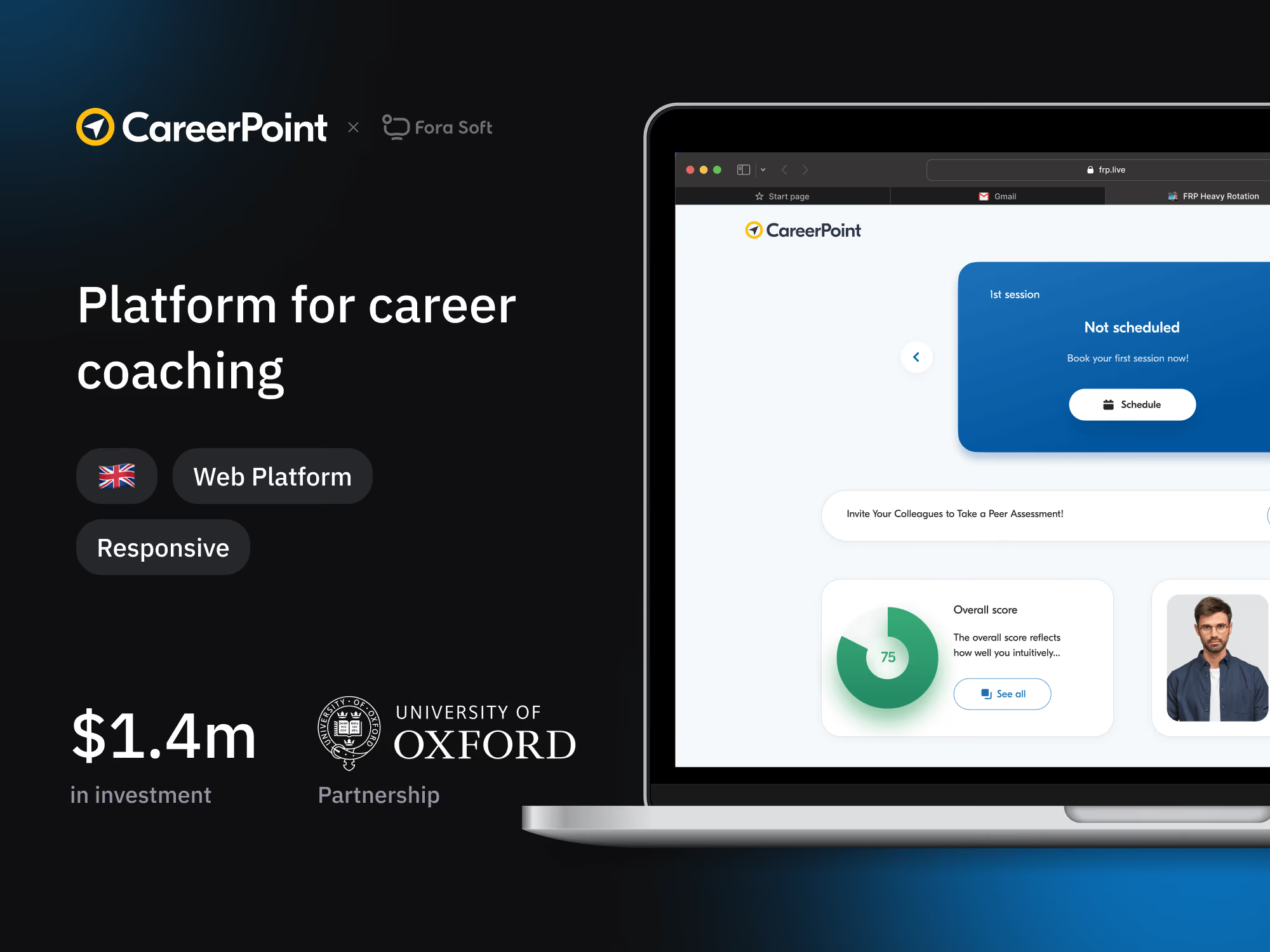
Career Point is an AI-driven career coaching platform built with the University of Oxford. Fora Soft shipped the first production version in three months, in time for the team to close a $1.4M round. This is the coaching platform development playbook behind it: what we built custom, what we integrated, and how the same pattern applies to any assessment-led marketplace.
Every early-stage platform makes the same bet: prove enough of the product to close the next round before the runway ends. Career Point’s version was harder than most. They needed a working AI coaching product, an Oxford-branded assessment, a coach marketplace, scheduling, live sessions, course delivery, and progress tracking, all in one platform, in 90 days. Coaching is a real market, not a niche: it sits at about $4.23B in 2026 and is forecast to reach $12.2B by 2036 (Future Market Insights, 2026), with corporate buyers making up roughly half of demand. Getting to market fast mattered.
Key takeaways
- 90-day MVP. Integrate-first architecture compressed a six-month build into three by leaning on Calendly, Zoom, and MindTools instead of rebuilding their surface area.
- Oxford-anchored credibility. The career assessment, co-developed with University of Oxford research, is the moat. The AI layer routes users to coaches and courses off the assessment result.
- $1.4M raised on the MVP. A live, revenue-generating platform was evidence of demand credible enough to close institutional investment.
- Lean stack. React/Next.js front end, Node.js/Express APIs, MongoDB for flexible schemas, socket.io for real-time coach–student chat.
- Transferable playbook. Ship the assessment, integrate the rest, AI-match the coach. The same pattern works for executive coaching, career services, and talent development.
At a glance: the case in 60 seconds
| Dimension | Detail |
|---|---|
| Client | Career Point, an AI-driven career coaching platform |
| Partner | University of Oxford (research collaboration behind the assessment) |
| Engagement | Full product MVP: discovery, design, build, launch |
| Timeline | 3 months from kickoff to first paying users |
| Core stack | React.js, Next.js, Node.js, Express, MongoDB, socket.io |
| Integrations | Calendly (booking), Zoom (live sessions), MindTools (learning content), Stripe (payments) |
| Commercial outcome | $1.4M investment secured post-launch |
| Fora Soft role | End-to-end product partner: architecture, build, launch support |
Table 1. The Career Point engagement at a glance.
The client and the Oxford collaboration
Career Point set out to rebuild the career-coaching experience around a research-grade assessment instead of the self-help personality quizzes that fill the market. The founding team worked with researchers at the University of Oxford to co-develop an assessment grounded in academic career-development frameworks. Not a generic Big-Five knock-off, but a tool that maps a user to their current career stage and names the specific gaps blocking the next move.
The Oxford collaboration gave the product two things competitors can’t copy: a scientifically credible intake, and a defensible brand anchor. From an architecture standpoint, our job was to take that assessment and build everything downstream from it (the AI matching layer, the coach marketplace, the session flow, the course delivery, the progress tracking) into one coherent experience.
The challenge: a credible MVP before the funding window closed
Career Point came to us with a hard constraint. They needed a live, revenue-generating product inside three months. Investors had shown interest but wanted traction, not a slide deck. Without a working platform, the round would dry up.
The scope that would satisfy investors was still large:
- A user onboarding flow built around the Oxford-developed assessment
- AI-based recommendations for coaches and learning paths
- A coach marketplace with profile pages, availability, and booking
- Live video coaching sessions with session notes
- A library of learning content (tests, articles, videos, podcasts)
- Student progress tracking visible to both student and coach
- Payment collection and coach payouts
Doing all of that from scratch in 90 days would have taken a team of about 15 engineers. Career Point had budget for a tight, senior team. So the architecture had to do the heavy lifting.
Our approach: integrate before you build
Our core decision in discovery was simple: don’t rebuild anything that already exists as a reliable API. Scheduling, video conferencing, and learning content are huge surface areas with mature vendors. Rebuilding them in 90 days would be vanity work. We’d burn weeks replicating Calendly’s booking logic or Zoom’s rostering and still ship an inferior version.
Instead, we structured the platform as an orchestration layer over a few trusted services, and spent the saved time on the parts nobody else could build.
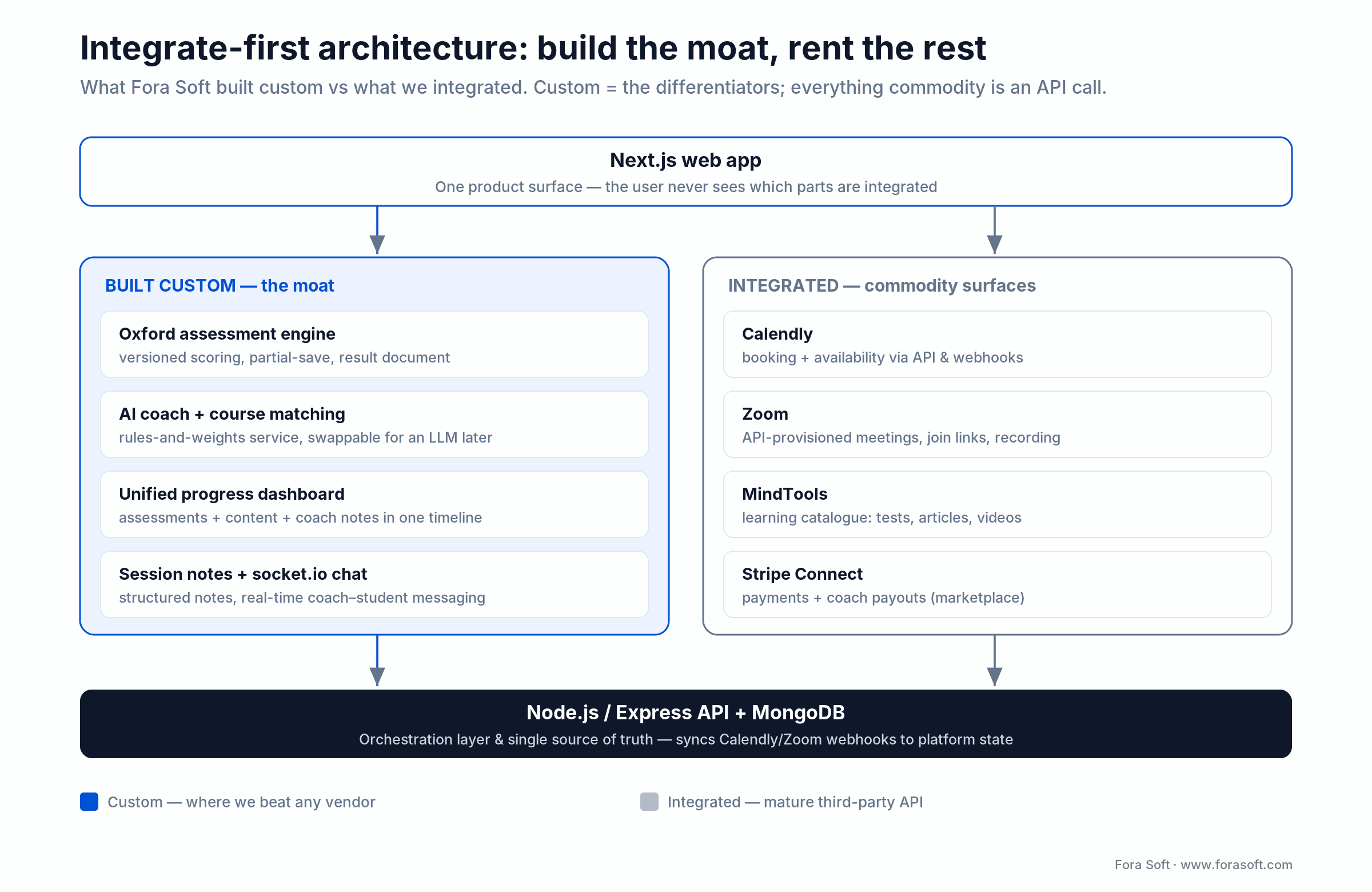
Figure 1. Build the differentiated surfaces, integrate the rest. The custom moat sits on the left; commodity services on the right.
| Surface | Built by us | Integrated |
|---|---|---|
| Assessment | Full custom: Oxford questionnaire, scoring, results page | — |
| Coach matching | Full custom: AI recommendation logic, coach profiles | — |
| Session booking | Thin wrapper with our UI | Calendly |
| Live video sessions | Launch + context handoff | Zoom |
| Session notes | Full custom: per-session editor, student visibility | — |
| Learning content | Wrapper, progress tracking | MindTools |
| Real-time chat | Full custom: socket.io | — |
| Auth & payments | Standard Node.js auth | Stripe |
Table 2. Build the differentiated surfaces; integrate the rest.
This is the same principle we apply across our portfolio. The customer-visible differentiator was always the Oxford assessment plus the AI matching. Everything else was table stakes, and building table stakes from scratch on a 90-day clock isn’t brave. It’s self-defeating.
Reach for integrate-first when: your differentiator is a specific product surface (an assessment, a matching model, a workflow), scheduling and video are commodities to your users, and you have a hard deadline. If the call experience itself is the product, that math flips (see the decision tree below).
The user flow, end to end
From the user’s side, Career Point is a five-step flow. The architecture makes each step feel native even though several stages call out to third parties.
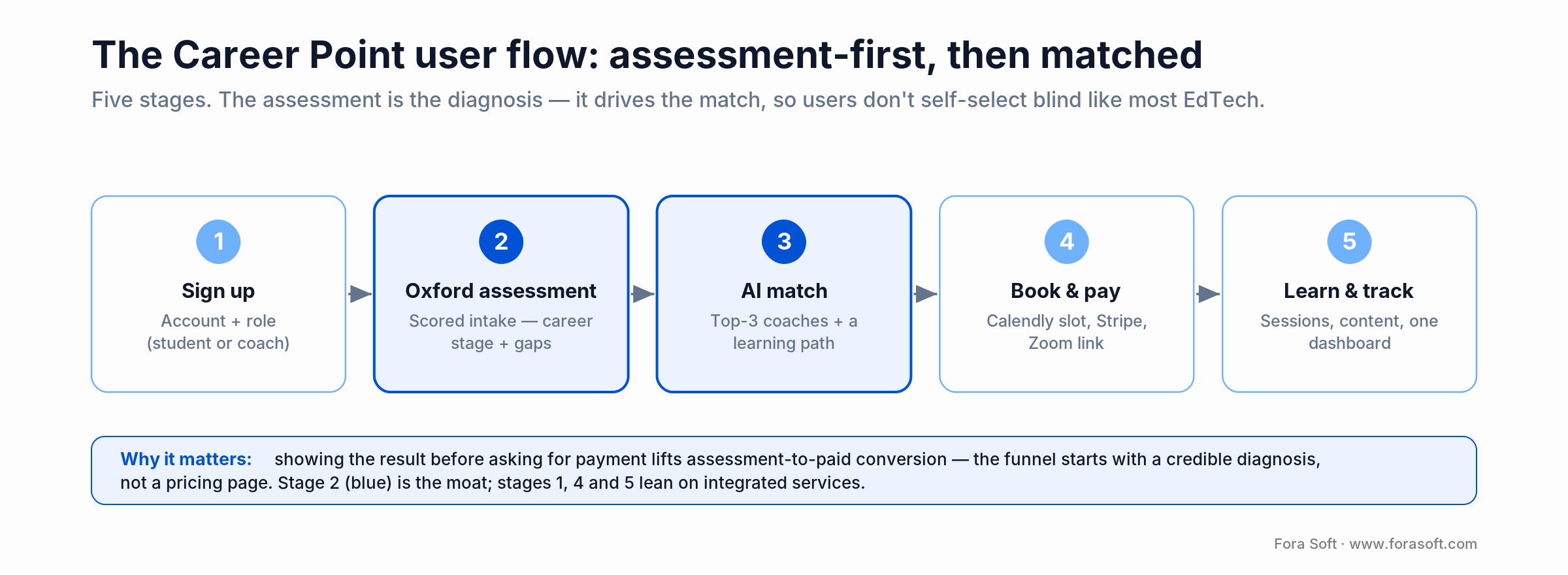
Figure 2. The assessment-first flow. The diagnosis drives the match, so users don’t self-select blind like most EdTech.
- Sign up. Account creation, role (student or coach), profile basics.
- Take the Oxford assessment. A structured questionnaire developed with University of Oxford researchers. It outputs a career-stage score and a set of development priorities.
- Get AI-driven recommendations. Off the assessment result, the platform proposes the three best-fit coaches and a curated learning path from MindTools content.
- Book a session. Pick a coach, choose a slot from their Calendly availability, pay, and get a Zoom link.
- Learn and track. Attend sessions, work through content, and watch a single dashboard where test scores, course completions, and coach notes accumulate.
The assessment-first ordering matters. In most EdTech products the user has to self-diagnose what they need before they sign up. Career Point inverts that. The assessment is the diagnosis, and the AI matches the intervention to the result. Better experience, stronger funnel.
The Oxford-developed career assessment
The assessment is the heart of the product. The questionnaire content came from the Career Point and Oxford research collaboration. Our job was to build the engine that delivered it, scored it, and routed the user into matching and learning without friction.
A few implementation decisions that look small but mattered a lot:
- Save progress after every answer. Drop-off on long assessments is brutal, so we persist partial results. A user who starts on mobile during a commute can finish on desktop that evening.
- Show the result before asking for payment. Users who see their career-stage result first convert to paid coaching at much higher rates than users asked to pay before seeing anything.
- Versioned scoring. The Oxford team iterates on the scoring model, so we versioned the scoring function. Historical results stay stable and research outputs stay comparable over time.
- Result as a document, not just a number. Each result is saved as a readable summary (strengths, gaps, focus areas) so coaches have a shared starting point from session one.
AI-based coach and course matching
Once a user finishes the assessment, the platform routes the result through a matching layer that proposes the best-fit coach and a starting learning path. In the first version this was a rules-and-weights system calibrated against coach metadata and MindTools content tags, not an LLM-based recommender. That was deliberate. For an MVP, deterministic matching is easier to reason about, easier to explain to users, and easier to debug when edge cases surface.
The matching layer weighed four signals:
- Career-stage score from the assessment, matched against coach specializations (early career, mid-career, senior executive).
- Development priority areas, matched to coach expertise tags (leadership, technical growth, career pivot).
- Language and geography, basic filters on coach availability.
- Session history, weighting past coaches a returning user rated well.
We kept the matching layer as a separate service so a later version can swap deterministic logic for an LLM-based recommender without touching the rest of the platform. That’s how we recommend teams start any AI feature: deterministic first, learn the data and the edge cases, then layer in the probabilistic model once the problem is well understood.
Integrations: Calendly, Zoom, MindTools
The three integrations did most of the heavy lifting. Each one covered a scope area that would otherwise have been a multi-week build.
Calendly, scheduling
Each coach links a Calendly account to their Career Point profile. When a student books, they book a Calendly event type with platform context (student ID, assessment summary) passed through webhook metadata. We receive the webhook, enrich the event with platform data, and trigger the Zoom and notification flows. Students never leave Career Point’s UI, and coaches manage availability with a tool they already know.
Zoom, live video sessions
We chose Zoom over a WebRTC SDK on purpose. Career Point’s users are mid-career professionals who already have Zoom installed. Building a custom video chat (covered in our video chat build-vs-buy guide) would have been a 3–4 week detour for zero differentiation. The platform creates Zoom meetings server-side through the Zoom API, embeds join links in the dashboards, and stores the meeting ID so session notes reconcile against the canonical session record. Later versions added recording when the coach chose to enable it, the same record-and-review pattern behind a one-way video interview platform.
MindTools, learning content
Career Point didn’t need to originate learning content. MindTools has a deep catalogue of tests, articles, videos, and podcasts for professional development. We integrated the catalogue, surfaced it through our UI, and tracked progress in MongoDB so the learning dashboard shows one consolidated view of assessments, MindTools completions, and coach-prescribed exercises.
Integration principle: treat every third party as a capability, not a UI. Call their APIs, consume their webhooks, keep the user inside your product. Done right, users can’t tell which features are integrated and which are native, which is exactly the point.
The coach and student workflow
The most valuable thing Career Point built beyond the assessment was the connected coach-and-student workflow. Students see every assessment result, every session note, and every course completion in one timeline. Coaches see the same timeline for each of their students, annotated with their own notes.
Three mechanics make it feel effortless:
- Structured session notes, not free text. Coaches record the topic, action items, and links to recommended content. The structured shape lets the student dashboard surface “your coach recommended this article” automatically.
- Real-time chat via socket.io. Between sessions, students message coaches for follow-ups. Low-latency delivery, typing indicators, read receipts, the standard chat primitives.
- Progress visualization. The unified dashboard pulls from three sources (assessments, MindTools activity, coach notes) and shows movement over time. This became the thing users screenshot and share, the feature that feels like the product.
The tech stack and why
The stack was chosen for speed and team velocity, not resume-driven novelty. Against a funding-window clock, boring and battle-tested beats clever every time.
| Layer | Choice | Why |
|---|---|---|
| Frontend | JavaScript, TypeScript, React.js, Next.js | Server-rendered marketing pages, client-rendered dashboards, type safety across the stack. |
| Backend API | Node.js, Express.js | Shared language with the front end, huge ecosystem, fast iteration. |
| Real-time | socket.io | Chat between coaches and students; light pub-sub for dashboard updates. |
| Database | MongoDB | Flexible schema for assessment versions, coach profiles, session notes; scales well for document-heavy reads. |
| Scheduling | Calendly API + webhooks | Mature booking UX, coaches already know it, zero onboarding friction. |
| Video | Zoom (API-provisioned meetings) | Ubiquitous client install, no app-download friction, reliable on enterprise networks. |
| Learning content | MindTools integration | Deep catalogue, high-quality content, avoids building an LMS. |
| Payments | Stripe Connect | Industry standard, supports coach payouts for a marketplace. |
Table 3. The Career Point stack, layer by layer.
The architecture at a glance
Architecturally, Career Point is a Next.js app for the user-facing product, backed by an Express API service that orchestrates the integrations. MongoDB is the single source of truth; socket.io runs alongside the API for real-time chat. Calendly and Zoom webhooks feed the API to keep platform state in sync with external events.
The flow in words:
- User visits the Next.js app, signs up, takes the assessment.
- Next.js submits each answer to the Express API, which persists to MongoDB; scoring runs when the final answer arrives.
- The matching service queries MongoDB for coaches tagged to the user’s career stage and returns a ranked list.
- User picks a coach; the API calls Calendly for availability; user selects a slot; Calendly confirms; a webhook returns to the API.
- The API calls Zoom to create a meeting, stores the meeting ID against the session record, and pushes notifications.
- The session happens on Zoom. Afterward the coach posts notes to the API, visible in the student dashboard.
- The learning tab shows MindTools content; completion events webhook back to update progress.
None of this is novel, and that’s the point. It’s deliberately conservative: a Node.js / MongoDB / React stack wired to three well-documented APIs. The novelty sits entirely at the product layer, in the Oxford assessment, the matching logic, and the unified dashboard.
The 3-month timeline, week by phase
| Phase | Weeks | Outcomes |
|---|---|---|
| Discovery & scope lock | 1–2 | Requirements workshop, integrate-vs-build decisions, architecture diagram, sprint plan |
| Foundations | 3–4 | Auth, user model, MongoDB schema, Next.js scaffold, CI/CD |
| Assessment engine | 4–6 | Oxford questionnaire UI, scoring, results page, versioned persistence |
| Matching & coach marketplace | 6–8 | Coach profiles, matching logic, coach dashboard |
| Integrations | 7–10 | Calendly, Zoom, MindTools, Stripe Connect, webhooks, error handling |
| Dashboard & chat | 9–11 | Unified progress dashboard, socket.io chat, session notes |
| Polish, soak, launch | 11–12 | QA pass, load check, beta onboarding, public launch |
Table 4. Twelve weeks from kickoff to public launch.
Phases ran in parallel where possible. Integrations started as soon as the assessment engine was stable enough to pipe real data into the matching logic. Running workstreams in parallel instead of in sequence is what collapses a six-month build into three.
What does coaching platform development cost?
A coaching platform MVP typically runs $20k–$40k for a full-featured build and upward of $40k once serious AI or custom assessment logic is involved (2026 industry benchmarks). Career Point sat in the AI-heavy tier and still shipped in three months, because integrate-first cut the non-differentiated work. The number that actually moves your budget isn’t the hourly rate. It’s how many weeks you spend rebuilding things you could have rented.
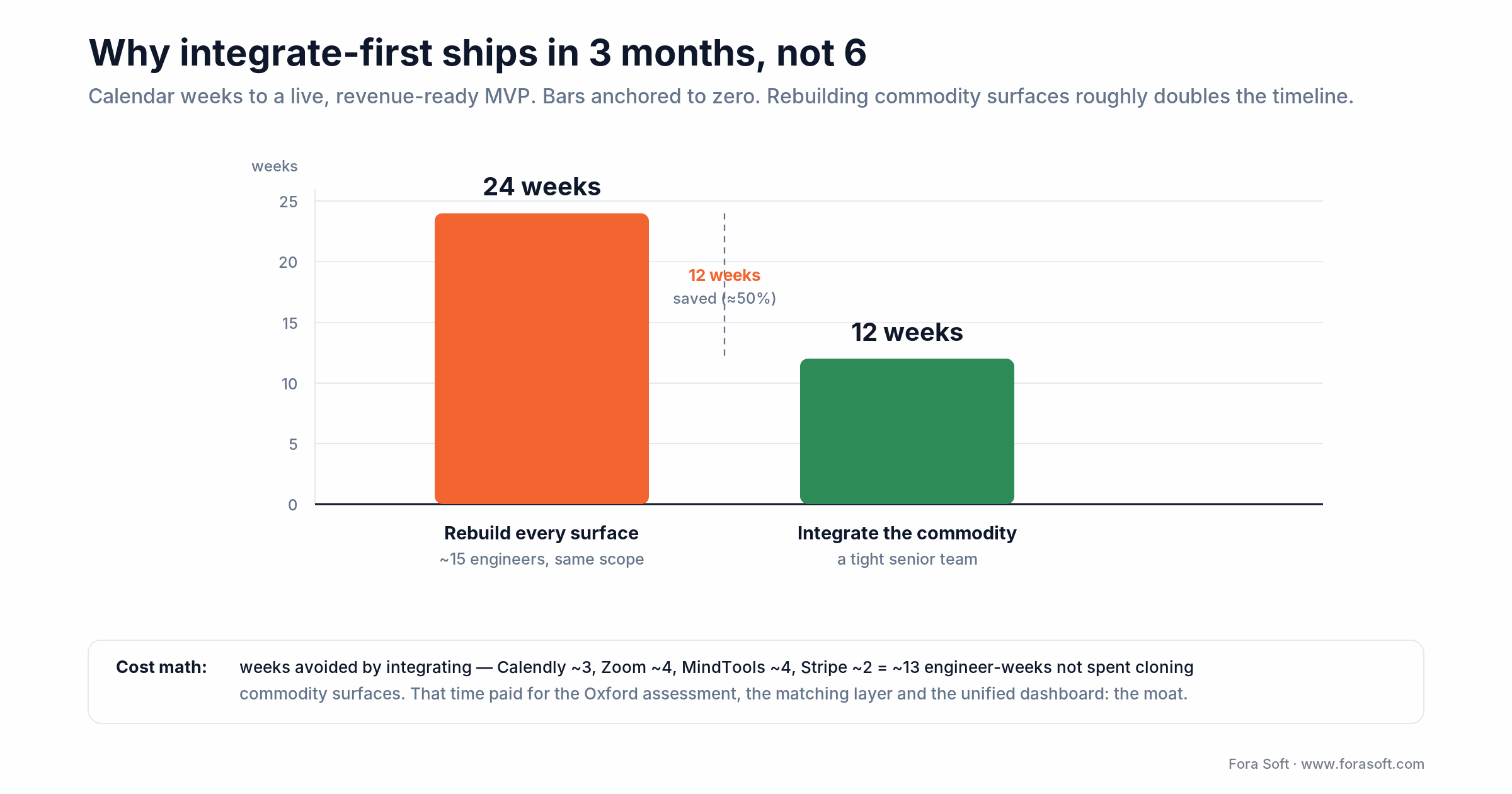
Figure 3. Weeks to a live MVP. Rebuilding commodity surfaces roughly doubles the timeline, and time is the real cost driver.
Here’s the arithmetic we ran with Career Point. Rebuilding scheduling, video, learning content, and payouts from scratch is roughly 13 engineer-weeks of work: about 3 weeks for a Calendly-grade booking system, 4 for a Zoom-grade video layer, 4 for a content library, and 2 for marketplace payouts. At a tight senior team that’s the difference between a 24-week build and a 12-week one. We spent the 12 weeks we saved on the assessment engine, the matching layer, and the dashboard, the parts investors actually paid to see.
| Build path | Typical 2026 range | Time to live |
|---|---|---|
| Off-the-shelf SaaS (BetterUp, CoachHub) | Per-seat subscription, no build | Days to weeks |
| Basic MVP, few integrations | $10k–$20k | 2–3 months |
| Full-featured MVP (Career Point tier) | $20k–$40k | ~3 months |
| AI-heavy / custom assessment logic | $40k+ (scoped per feature) | Scoped in discovery |
Table 5. Coaching platform development, by path (2026 benchmarks). Agent Engineering typically brings our ranges below a standard agency quote.
We estimate conservatively. Fora Soft uses Agent Engineering to compress the non-differentiated code further, so our ranges tend to come in below a typical agency quote. If we’re unsure of a number, we don’t quote it until we’ve scoped your integrations. Coaching platform development cost is mostly a function of how much you insist on building yourself.
Want a real cost and timeline for your platform?
Send us your feature list and your deadline. We’ll mark what to integrate versus build, then give you a scoped range, not a vague hourly rate.
Common mistakes when building a coaching platform
We see the same avoidable errors sink coaching and marketplace MVPs. Most of them come from spending the budget in the wrong place.
- Rebuilding video before you have users. A custom WebRTC stack is months of work and ongoing ops. Unless the call experience is your moat, start with Zoom or an embed and revisit later.
- Leading with an LLM. An LLM recommender you can’t explain or debug is a liability at MVP stage. Deterministic matching first; add the model when you have data to train on.
- Asking for payment before showing value. Career Point shows the assessment result first. Gating the result behind a paywall tanks conversion.
- Authoring content you could license. Building an LMS and a content pipeline is a company in itself. If content is a supplement, integrate a catalogue like MindTools.
- No consolidated dashboard. Scores in one tab, sessions in another, notes in email. The single timeline is what makes users feel progress. Skipping it guts retention.
Rule of thumb, the 3-month MVP test: if a founder can’t name the one thing their product does that no commodity SaaS does, they’re not ready to build. Career Point passed on day one (“Oxford-backed career assessment”). That single sentence drove every scope decision, and every scope cut, for twelve weeks.
Career Point vs off-the-shelf coaching platforms
If you just need to run a coaching program, an off-the-shelf platform (BetterUp, CoachHub, and similar) may be the right call. Custom coaching platform development earns its cost when you own a differentiator that no SaaS will build for you. Here’s the honest comparison.
| Priority | Off-the-shelf platform | Custom build (Career Point pattern) |
|---|---|---|
| Time to a running program | Days to weeks | 2–3 months to a real MVP |
| Proprietary assessment / IP | Not yours; vendor-owned | Fully yours, the moat |
| Branding & UX control | Constrained by the vendor | Complete |
| Coach marketplace economics | Vendor takes a cut | You set the take rate and payouts |
| Fundraising story | “We use a SaaS” | “We own the platform and the data” |
| Ongoing cost | Per-seat subscription forever | Build once, then hosting + iteration |
Table 6. When a coaching platform build beats a subscription, and when it doesn’t.
The tell is ownership. If your edge is an assessment, a matching model, or marketplace economics, a subscription platform can’t give you that, and investors know it. If you just need coaching delivered, don’t build. Buy.
Outcomes: $1.4M raised, validated market
With a live, revenue-generating platform and early traction, Career Point went into fundraising with concrete evidence instead of a pitch-deck narrative. The result: $1.4M secured to fuel the next phase, more coaches, deeper AI in the matching layer, and geographic expansion.
What the MVP validated:
- The Oxford-anchored assessment converts anonymous visitors into paying clients at a rate that justifies paid acquisition.
- Users finish the full assessment at meaningfully higher rates than generic personality quizzes, because the result feels credible and actionable.
- Coaches will list on a platform that delivers pre-qualified, assessment-screened leads, so the supply-side economics work.
- The integrated stack (Calendly, Zoom, MindTools) feels native enough that session-to-retention tracks with mature platforms.
Building an AI-coaching or assessment-led product?
Bring your differentiator and your deadline. In 30 minutes we’ll sketch the architecture, name the integrate-vs-build calls, and give you a realistic cost and timeline range.
Five lessons for AI coaching MVPs
The Career Point engagement crystallized five principles we now apply across coaching, assessment, and marketplace builds.
1. Anchor the product in something that can’t be duplicated. For Career Point it was the Oxford research collaboration. Every AI coaching product competes with the same LLMs; what rivals don’t have is a credible, research-backed assessment. The moat sits in the intake, not the inference.
2. Integrate the commodity stuff. Scheduling, video, payments, learning content are all commodities in 2026. Every week rebuilding one is a week not spent on your differentiator. Integrate first; build only where you beat the vendor.
3. Start deterministic, add probabilistic later. First-version matching was rules-and-weights, not an LLM. Deterministic systems are easier to debug, explain, and rely on. Swap to ML once the problem is well understood, and keep the service boundary so the swap is painless.
4. Ship one dashboard that consolidates everything. The dashboard pulling assessment results, MindTools progress, and coach notes into one view was the feature users screenshot and share. Consolidation is underrated product work.
5. Run a funding-window plan. When the engagement has a hard funding deadline, scope is the lever. Cut ruthlessly. The point isn’t to ship the perfect platform. It’s to ship the platform that closes the next round so you can build the perfect one later.
When to build like Career Point (and when not to)
The Career Point pattern (assessment-first, AI-matched, integrated marketplace) translates well to a set of adjacent product shapes. It’s the right starting blueprint when:
- Your moat is a credible intake (assessment, diagnostic, profiling) rather than the AI itself.
- You’re running a two-sided marketplace where one side (coaches, tutors, advisors) needs simple scheduling and session primitives.
- Customers expect a video surface but don’t care which tool provides it.
- The market is mature enough that content libraries can be integrated instead of authored.
- You’re fundraising against a deadline and need a live platform, not a prototype.
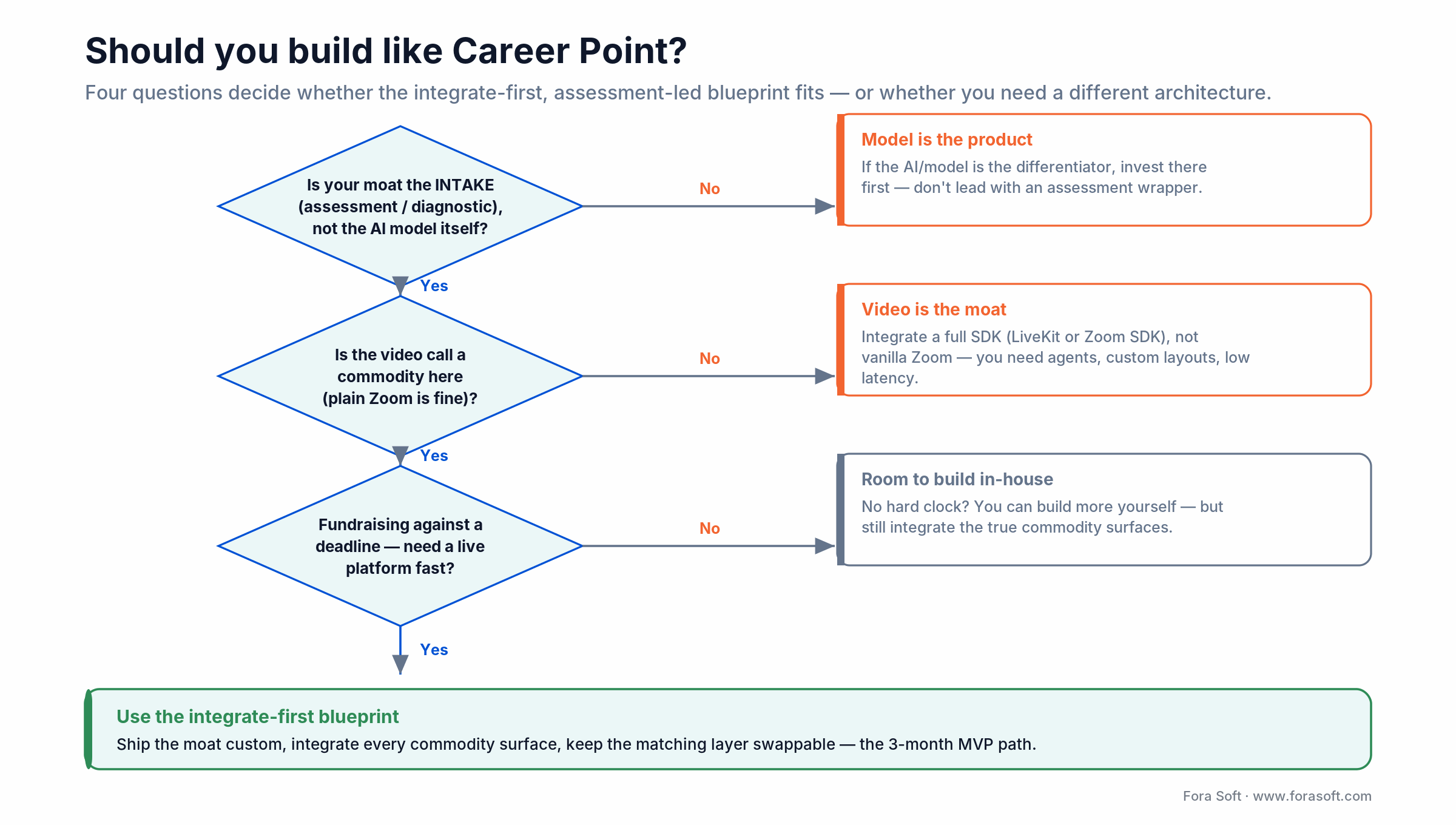
Figure 4. Four questions decide whether the integrate-first blueprint fits, or whether you need a different architecture.
Where we’d recommend a different architecture:
- Video is the moat. If your differentiator is the call itself (interactive teaching, AI agents in the room, live avatars), integrate a full SDK like LiveKit rather than wrapping Zoom.
- Enterprise compliance is day one. If HIPAA, SOC 2, or data residency is required before launch, a Zoom SDK or Whereby Embedded (build-vs-buy trade-offs) beats vanilla Zoom.
- Content must be original. If the learning content is the product, a MindTools-style integration won’t cut it. You’ll need an LMS and an authoring pipeline.
Reach for a dedicated build team when: you’ve validated the moat and need to move fast without hiring in-house. Our dedicated development team and AI integration services scope exactly this kind of assessment-led, AI-matched platform.
FAQ
How did you actually build a coaching platform in three months?
By integrating every commodity surface instead of building it. Scheduling went to Calendly, live video to Zoom, learning content to MindTools, payments to Stripe. That freed the team to spend twelve weeks on the real differentiators: the Oxford assessment engine, the AI matching logic, and the unified dashboard. Ruthless scope discipline plus senior engineers equals a 3-month MVP.
How much does coaching platform development cost in 2026?
A full-featured coaching platform MVP typically runs $20k–$40k, and AI-heavy builds with custom assessment logic start around $40k and climb with scope (2026 industry benchmarks). The biggest lever is how much you rebuild versus integrate. We scope integrations first, then quote, and we don’t publish a number we’re not confident in.
Is the AI a large language model?
Not in the first version. The MVP used deterministic rule-and-weight matching driven by the Oxford assessment output. That kept the early system easy to reason about, explain, and debug. The architecture isolates the matching layer so an LLM-based recommender can be swapped in later once the data is rich enough to train against.
Why Zoom instead of a custom WebRTC video chat?
Because the video call isn’t where Career Point differentiates. Users are mid-career professionals who already have Zoom. A custom WebRTC surface would have cost 3–4 weeks for zero perceived benefit. If a future version needs AI agents in the call or custom layouts, migrating to a video SDK starts to make sense. Our video chat build-vs-buy article covers the framework.
How was the Oxford collaboration structured?
The client worked with University of Oxford researchers on the assessment content and scoring methodology. Fora Soft’s role was to implement that assessment as a production-grade experience: a versioned scoring engine, persistent partial results, readable summary documents, and clean handoff to the matching layer. Academic rigor on the intake, production engineering on the delivery.
What would you do differently if you built it in 2026?
A few things. We’d add an AI session summarizer via a LiveKit agent so coaches save time on note-taking. We’d use our Agent Engineering practice to compress the non-differentiated build further. And we’d surface a conversational AI co-pilot to help students interpret their assessment result in plain language before the first coach session.
Why MongoDB instead of PostgreSQL?
The data shape favored flexibility: assessment versions evolve, coach profiles carry variable metadata, and session notes are structured-but-evolving documents. MongoDB made schema changes cheap during the 90-day build and scaled well for document-heavy dashboard reads. For products that need complex transactional joins or strict relational integrity, we’d pick PostgreSQL.
Can Fora Soft build a similar platform for us?
Yes. Fora Soft is a software development company that has shipped 250+ products since 2005, including assessment-driven marketplaces, coaching platforms, and AI-matching products across career services, executive coaching, talent development, and EdTech. A typical engagement starts with a 1–2 week discovery to scope integrations and build-vs-buy calls, then a 10–16 week build, compressed further for AI-heavy products by our Agent Engineering practice. Book a 30-minute call and we’ll map your scope.
What to read next
AI Agents
LiveKit AI Agents: A Business Guide
How AI voice agents in calls are reshaping coaching, support, and sales.
Voice AI
LiveKit Voice AI: The Engineer’s Playbook
The 2026 reference for building human-sounding voice agents.
Build vs Buy
Build vs Buy a Video Chat Platform
The four paths (white-label, SDK, open source, custom) and when each wins.
Migration
Switching From a Video SDK to a Custom Platform
When migration off Twilio or Agora actually pays off.
Architecture
Building a Video Streaming App: Tech Considerations
VOD, live, and conferencing trade-offs, in one reference.
Need a 3-month MVP like this one?
Career coaching, executive development, or a different assessment-driven marketplace: we’ll scope it, architect the integrate-vs-build trade-offs, and ship. See how we work on our dedicated team and video streaming pages, then book a call.

