

Key takeaways
• VALT is a 12-year case study in video surveillance software development done right. Fora Soft built it in 2013 as a basic local VMS; today it is a SaaS platform serving 770+ client organisations and 50,000+ active users across US law enforcement, healthcare simulation labs, and child advocacy centres.
• The platform earned its growth. The company behind VALT, Intelligent Video Solutions, hit $1M in sales in its launch year and crossed $8M within five years — and was named the 4th fastest-growing tech company in Wisconsin in 2019. All of it built on continuous rebuilds, not a single big bang.
• The architectural lesson is brutally simple. Off-the-shelf CMSs (Drupal 6) and dying tech (Flash) work for a v1 but cap your ceiling fast. Migrating early to Symfony, HTML5, ONVIF, automated tests, mobile apps, and a private cloud is what opened up the next 10×.
• HIPAA, FERPA, evidence-grade chain-of-custody and 100% point-and-click usability are non-negotiable in regulated verticals. The features that look obvious on a demo (bookmarks, PDF reports, CD/DVD burn, role-based access) are exactly the features that win RFPs.
• If you’re building a video surveillance product, copy the trajectory, not the v1. The decision framework, vertical playbooks, and pitfalls below are the ones we use on every kickoff call — including with prospects who want to look more like VALT and less like a clone of Verkada.
Why Fora Soft wrote this playbook
VALT is one of our longest-running products. We started it in 2013 as a small local-network VMS for one client; the platform passed $1M in sales before the year was out, and we’ve been continuously scaling it for over a decade as part of 20+ years of shipping software. Today VALT serves 770+ organisations and 50,000+ active users — US police departments capturing interrogation evidence, HIPAA-compliant medical schools recording simulation labs, and child advocacy centres conducting forensic interviews. The full case is on the VALT project page.
This article is the version of the story we’d tell on a kickoff call: not just “here’s what we shipped”, but the architectural and product decisions that made each leap possible — what we’d do the same and what we’d do differently if we started today. If you’re scoping a video surveillance software development project of your own, it’s the most useful thing we can hand you.
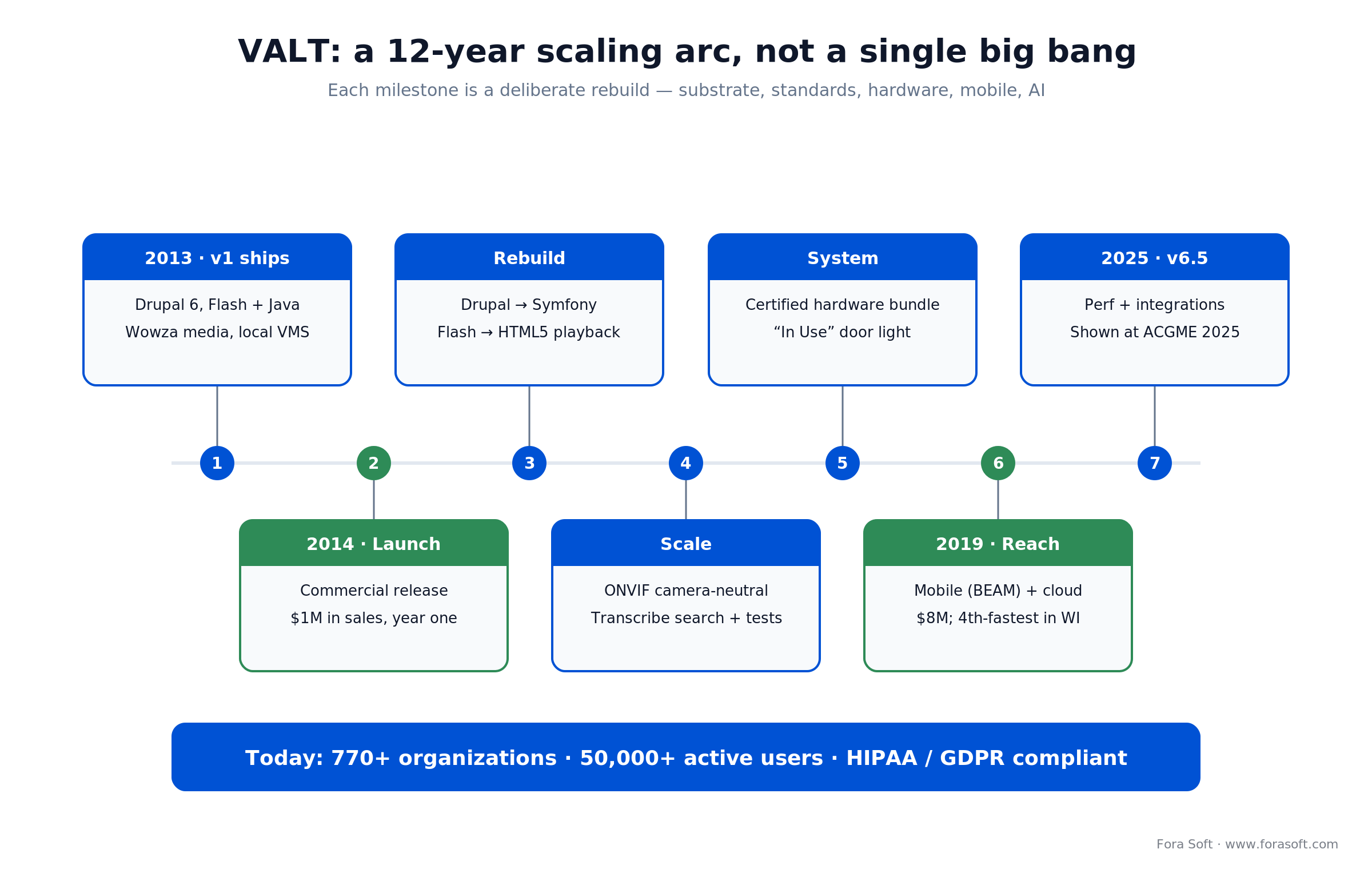
Figure 1. VALT’s 12-year scaling arc — each leap is a deliberate architectural rebuild, not a single big bang.
Building a VALT-style platform of your own?
Tell us your verticals, target deployment size, and compliance regime. Inside 48 hours we’ll come back with a 12–16-week MVP plan, a defensible budget, and the architectural traps we’d steer you around — free, no obligation.
What VALT actually does in 2026
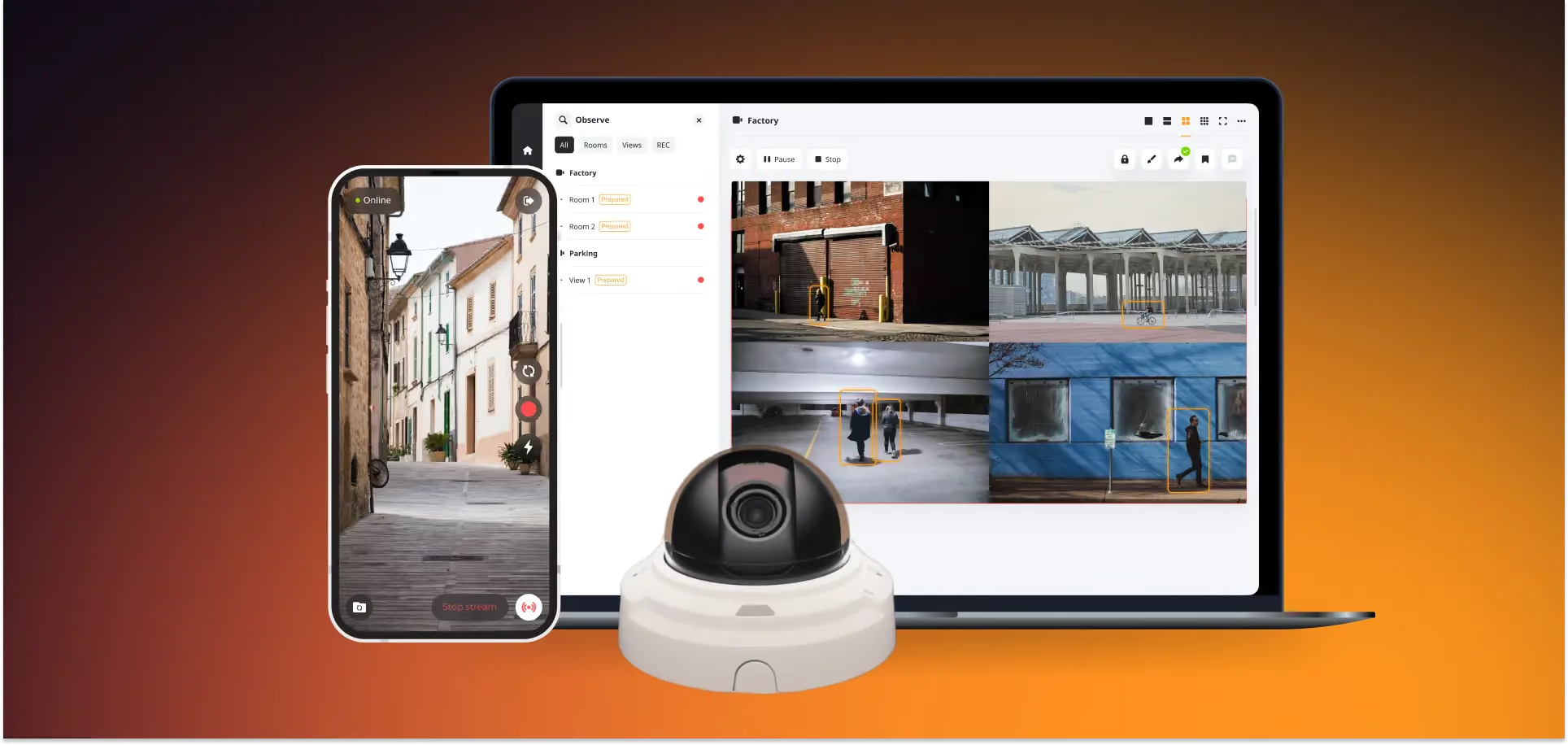
VALT is now a browser-based video surveillance SaaS with optional on-prem deployment. A single operator can monitor up to 9 Full-HD IP cameras on one screen, pan-tilt-zoom them, push-to-talk into the room, and create scheduled or one-click recordings with frame-accurate audio/video sync across multiple cameras and microphones. The interface is the canonical “trains in 10 minutes” UI — modular, with role-based menus that hide what each user shouldn’t see. The current release, VALT 6.5 (2025), added performance and integration work; the platform was shown at the 2025 ACGME Annual Educational Conference.
Three specific features keep it on RFP shortlists: annotations, markers, and PDF report export (you mark a moment during a live interview, the marker is searchable, the PDF is admissible); SSL + RTMPS encryption with LDAP and SSO integration (HIPAA, FERPA, child-protection compliance); and CD/DVD burn plus mobile upload for evidence handoff between agencies.
The numbers that matter
Most case studies hand-wave the metrics. Here are the ones that buyers actually care about.
| Metric | Value | Why it matters |
|---|---|---|
| Year shipped | 2013 v1, 2014 commercial launch | 12+ years of compounding investment |
| Client organisations | 770+ | Distribution beyond a single hero customer |
| Active users | 50,000+ | Real concurrency the architecture has to absorb |
| Annual revenue | $1M yr 1 → $8M by yr 5 (est. $5–25M today) | Sales scale that justifies continuous rebuilds |
| Recognition | 4th fastest-growing tech company in Wisconsin (2019) | External proof of trajectory |
| Concurrent cameras per screen | 9 Full-HD per operator view | Operator productivity multiplier |
| Time to train a new operator | ~10 minutes | UX as competitive moat |
Three verticals VALT serves — and what each demands
1. Law enforcement — interview & evidence management. Detectives observe interrogations from a separate room, mark key moments, generate PDF reports, and burn evidence to CD/DVD for handoff. The hard requirements are chain-of-custody, tamper-evidence, hardware-controlled recording switches, and zero-friction operator UI when an interview is on the clock.
2. HIPAA-compliant medical education & simulation labs. Faculty supervise PhD candidates running patient consultations or simulation scenarios; supervisors must see only their own students; students must never see other students’ sessions. Permission control, scheduled recording, scaling to many cameras and concurrent users, and HIPAA-grade audit logs are non-negotiable.
3. Child advocacy centres — forensic interview recording. A child is interviewed once, calmly, with the rest of the team observing remotely. Recordings move to police, prosecutors, and CPS. The platform has to be invisible to the child, secure end-to-end, and produce admissible evidence. Real-world deployments don’t forgive Flash crashes or Java applets.
Reach for a purpose-built regulated-vertical VMS when: your buyer is a police department, an academic-medical simulation lab, or a child advocacy center — the moment evidence, per-user permissions, and audit trails are in the bid, a generic camera dashboard stops qualifying.
Version 1.0 — the lessons from a basic launch (2013–2014)
The original brief was modest: a local-network VMS with a website for live camera feeds. We built it on Drupal 6 for the application layer, Wowza Streaming Engine for media, and Flash + Java applets for browser playback — standard 2013 stack, hostile to the eyes of a 2026 reader. Two challenges shaped the architecture and still apply today.
Challenge 1: camera diversity. A working VMS has to talk to every IP camera the customer already owns. We integrated ONVIF — the camera-interoperability standard — from day one, and that single decision is what made VALT viable in any vertical without forcing a hardware refresh. The 2026 ONVIF playbook is in our ONVIF profiles guide.
Challenge 2: PTZ usability. Operators don’t want raw pan-tilt-zoom controls during a live interview. We added named PTZ presets (“Door”, “Workstation”) and a scheduled-recording engine that switched cameras between presets automatically (“Door 9–10am, Workstation 10am–5pm”), plus a “talk” feature so a supervisor could speak into the room without entering it. Result: at the end of v1 the system already shipped customisable recording rooms, multi-camera grid, role-based access, scheduled recording, PTZ presets, and two-way audio.
Lesson. Drupal got us live. It also became the ceiling. By the end of v1 it was clear that off-the-shelf CMSs are great accelerators for the first 6–12 months and exactly the wrong substrate for a serious product line.
The Symfony + HTML5 migration — the rebuild that changed the trajectory
Two parallel migrations defined the next phase of VALT. We moved the application off Drupal 6 onto Symfony, and we moved the playback off Flash and Java applets onto HTML5. The Symfony move bought us a real PHP framework with proper services, routing, and testing. The HTML5 move bought us a future: by the time Adobe announced Flash’s end-of-life and browsers started disabling it, VALT was already past it.
The migration was painful. Early HTML5 video had inconsistent codec support, unreliable autoplay, and missing low-latency primitives. We invested anyway, and that early-adopter discipline is what made the rest of the platform’s growth possible. The point is not Symfony or HTML5 specifically; it’s the willingness to rebuild the substrate when the substrate becomes the constraint.
Text search across recorded video and an automated test pyramid
As VALT’s customers accumulated thousands of hours of footage, the next bottleneck became findability. We added a text-search feature backed by Amazon Transcribe speech-to-text — users type a phrase and jump to the exact moment in a recording where it was spoken. For interrogation evidence, simulation review, and forensic interviews, that single feature took the time to find a clip from “hours” to “seconds”.
In parallel we built out an automated test pyramid: unit tests on the core services, integration tests on the recording and search engines, end-to-end tests on the operator UI. By the time the customer base passed a few hundred installations, automated tests were the only thing keeping every release in production-grade shape. We’ve since baked the same discipline into our wider spec-driven agentic engineering approach.
Hardware expansion — turning a software product into a sellable system
A pure-software VMS leaves the customer to figure out cameras, network, storage, and recorders. VALT’s next leap was to productise the hardware bundle — certified camera lists, recommended NVRs, microphone setups, and the physical “In Use” door light that flips on automatically when an interview starts so nobody walks in. That “real-world” integration is invisible in a demo and definitive in an RFP.
If you’re building any video surveillance product, plan for the hardware story early; the buyer who imagines themselves installing it usually decides on the install confidence, not the feature list. Our broader take is in the scalable VMS engineering decisions playbook.
Mobile apps and feature compounding
VALT shipped native mobile apps, including the BEAM companion app for smartphones and tablets: a field upload flow (officers in the field upload smartphone footage straight into a case, with metadata and chain-of-custody preserved) and a review app (admins and supervisors can review, mark, and approve recordings on the go). Mobile pulled new use cases out of the SaaS that the desktop product alone couldn’t serve, especially around evidence collection.
Around the same time we built out the analytics dashboard, scheduling enhancements, two-click reports, and the private cloud service so customers could choose self-host or VALT-hosted SaaS. Each addition compounded; by year five, no individual feature defined the product, but the combination made VALT extremely hard to displace.
VALT’s architecture today — layer by layer
Modernised across multiple rebuilds, the current platform looks like this. For the vendor-neutral view of how any modern VMS is assembled, see our 2026 VMS buyer & builder playbook.
| Layer | VALT’s choice | Why |
|---|---|---|
| Camera ingest | ONVIF Profile S/T over RTSP | Vendor-neutral; Axis (preferred), Hanwha, Bosch. For US law enforcement, NDAA Section 889 rules out Hikvision and Dahua |
| Media server | Wowza-class engine + HTML5 playback | Multi-protocol publish, recording, transcoding |
| App backend | Symfony (PHP) services | Mature, testable, easy to extend |
| Frontend | HTML5 + JavaScript modular UI | No installs; trains in 10 minutes |
| Search | Speech-to-text + full-text index | Hours of video reduced to seconds of search |
| Auth & access | LDAP, SSO, granular role-based access | HIPAA / FERPA / law-enforcement audit |
| Encryption | SSL + RTMPS in transit, AES at rest | Compliance baseline |
| Mobile apps | Native iOS + Android | Field upload, on-the-go review |
| Deployment | Self-host or VALT-hosted SaaS / private cloud | Customers pick OpEx vs CapEx vs sovereignty |
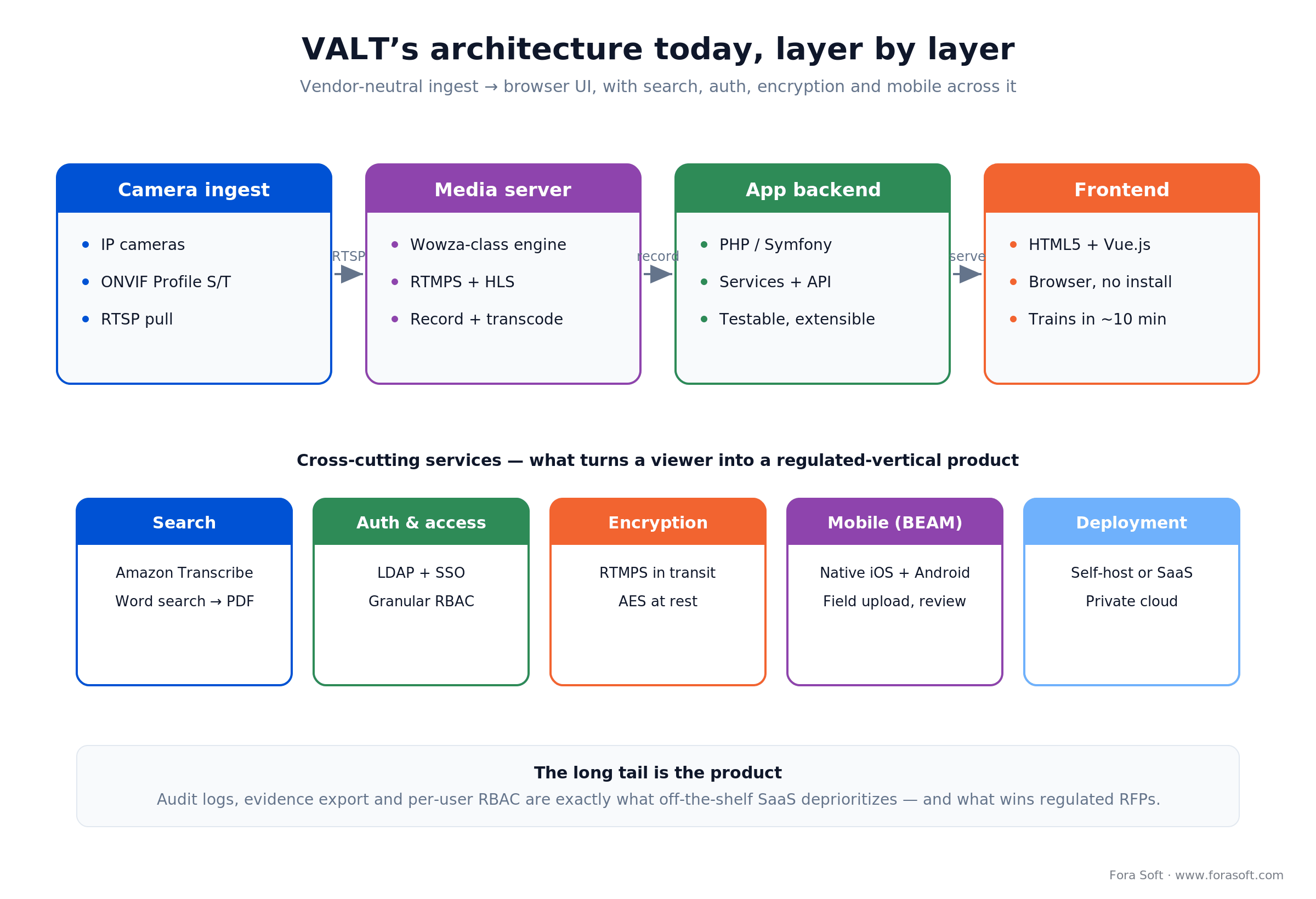
Figure 2. VALT’s architecture today, layer by layer — vendor-neutral ingest through browser UI, search, auth, encryption and mobile.
Reach for an architecture like VALT’s when: you sell into regulated verticals where browser-only deployment, RBAC, audit logs, and PDF/CD evidence export are part of the bid — and you need to stay vendor-neutral on cameras.
Need a HIPAA / law-enforcement-grade VMS scoped honestly?
We’ve done it three times across regulated verticals. Send us your camera count, vertical, and compliance regime — we’ll send back a 12–16-week MVP plan and the trade-offs we’d push back on.
Why off-the-shelf platforms hit a ceiling in regulated verticals
Off-the-shelf SaaS like Verkada, Avigilon Alta, Eagle Eye Networks, or Spot AI are excellent for generic surveillance. They run into limits the moment a buyer says “we need court-admissible evidence with a tamper-evident hash chain”, “we need RBAC at the level of per-student permissions”, or “we need a HIPAA BAA, not a generic DPA”. The features the regulated buyer cares about — signed PDF reports, role-based hiding of recordings, scheduled multi-camera recording with PTZ presets, evidence export to physical media — are exactly the long tail no commodity SaaS prioritises.
VALT’s win is that we treated the long tail as the product, not as plugins. If your roadmap is regulated-vertical, you’ll meet the same ceiling and need the same answer — the kind of work our video surveillance development team does day in, day out. If it’s generic surveillance, off-the-shelf is the saner call. For the step-by-step build, see our custom VMS development guide.
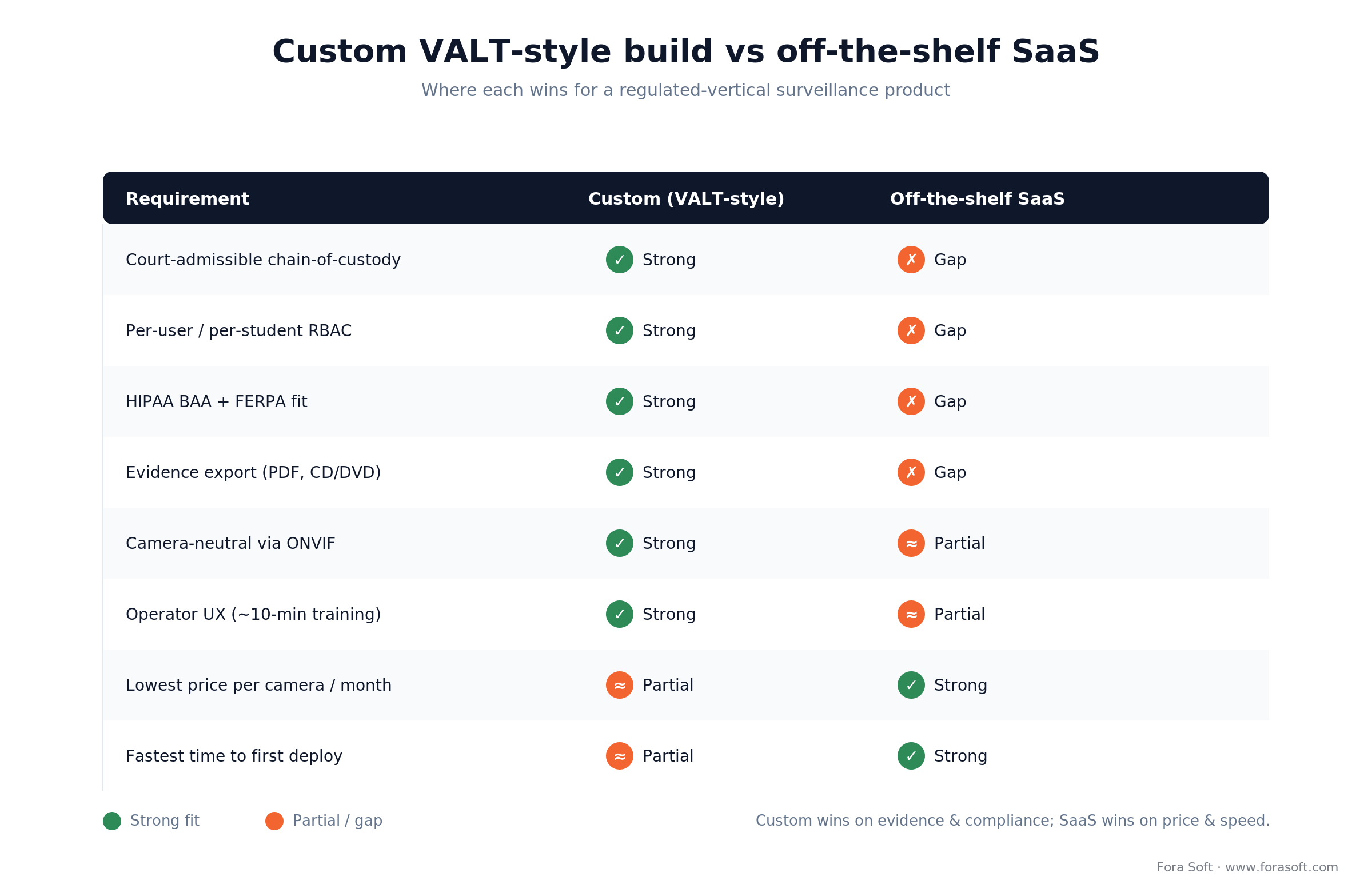
Figure 3. Where a custom VALT-style build wins over off-the-shelf SaaS — and where it does not. Green = strong fit, orange = gap.
Security & compliance — what regulated verticals demand in 2026
HIPAA (US healthcare). Encryption in transit and at rest, role-based access, audit logs, BAAs with any sub-processor, retention policies, breach-notification flow. Patient simulation and consultation video qualify as PHI when identifiable.
FERPA / COPPA (US education and minors). Student records under 18 trigger FERPA disclosure rules; under-13 child material adds COPPA. School and academic-medical deployments need explicit consent flows and granular permission control.
Law enforcement evidence chain-of-custody. Tamper-evident hashing of recordings, immutable audit trail, who-watched-what logs, signed PDF reports, exportable to CD/DVD or evidence locker. The bar is set by court admissibility, not best-practice white papers.
EU GDPR + AI Act. Lawful basis for biometric video, DPIAs for high-risk processing, deletion endpoints, EU residency where required. Adding facial recognition or audio analytics moves you into AI-Act high-risk territory and demands a risk-management process from day one.
Reach for evidence-grade chain-of-custody when: recordings can end up in court. You need tamper-evident hashing, an immutable who-watched-what trail, and signed PDF or physical-media export — a “we log to Postgres” answer fails the security review that decides the deal.
A decision framework — copy VALT’s playbook in five questions
Q1. What vertical are you selling into? Regulated (police, healthcare, child advocacy, education) → design RBAC, audit logs, encryption, evidence export from day one. Generic surveillance → cheaper to start with.
Q2. How big does the system have to scale? Single site < 30 cameras → off-the-shelf or hybrid. Multi-site, hundreds of cameras, thousands of users → designed for scale, not retrofitted.
Q3. Browser-only or installed? Browser-only is the right answer for nearly every modern VMS — zero install, fast onboarding, easy update path. Native installs only for offline / air-gapped deployments.
Q4. What hardware story do you ship with? A certified camera list, recommended NVRs, install guide, and an “In Use” light tells the buyer you’re a system, not a beta. Plan it.
Q5. Self-host or SaaS or both? The biggest market is “both”. Customers in different verticals will pick differently; design for it from week one rather than re-doing the deployment model in year three.
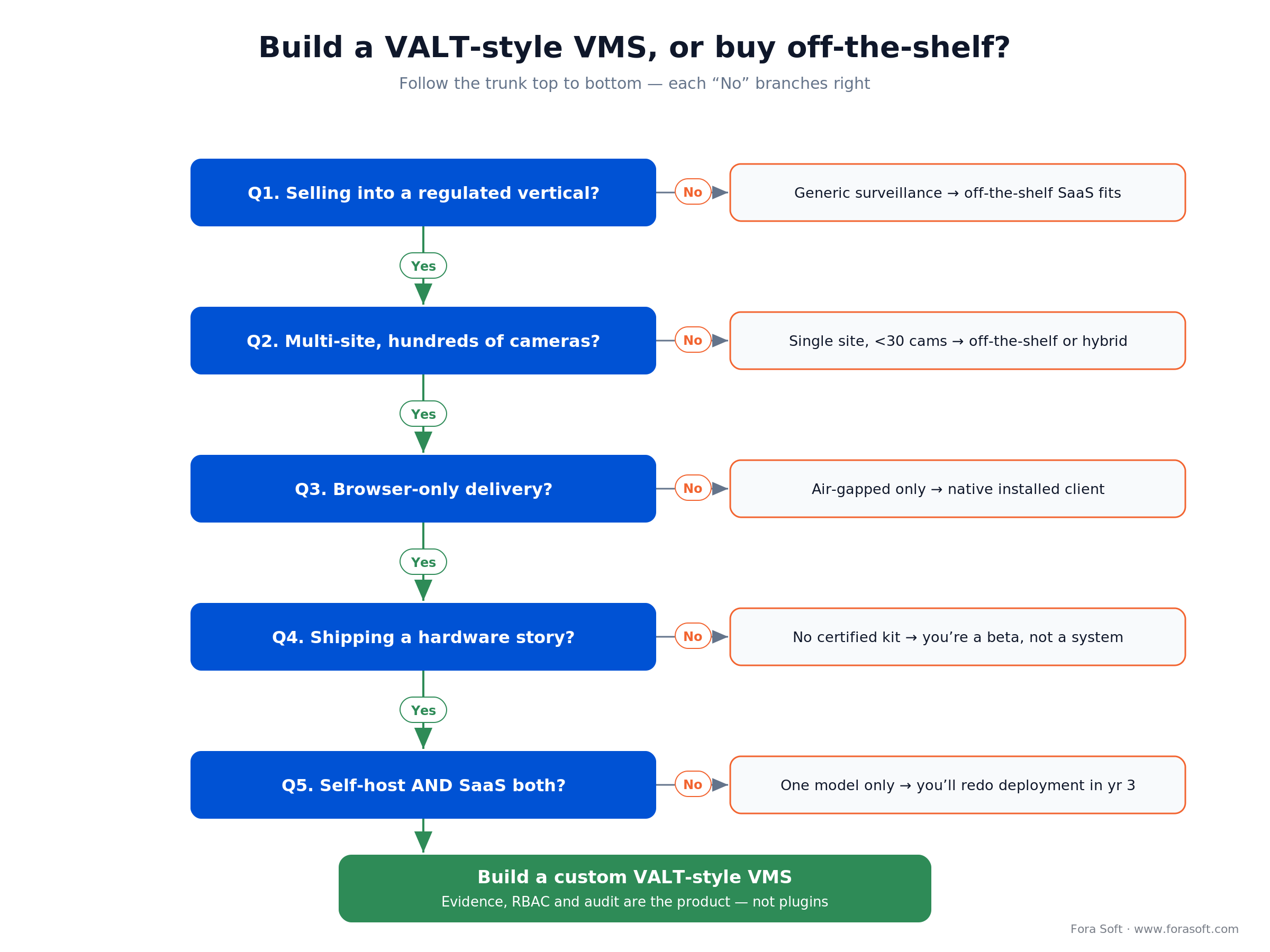
Figure 4. A five-question build-vs-buy decision tree for a video surveillance product — follow the trunk top to bottom.
Five pitfalls we’ve seen kill VMS products
1. Building on a CMS forever. Drupal, WordPress, or generic CMSs work for v1. They become the constraint by month 18. Plan the migration before it’s urgent.
2. Camera vendor lock-in. Hard-coding to one vendor’s SDK kills your TAM. ONVIF or RTSP-first is the rule.
3. No real audit log. “We log to Postgres” is not an audit log. You need immutable, tamper-evident, exportable trails or your law-enforcement deal evaporates at security review.
4. Treating UX as cosmetic. The training time on the operator UI is the single largest cost driver for the customer. A 10-minute training story wins over a 2-day one every time, regardless of feature parity.
5. Skipping mobile until year three. Field upload, on-the-go review, push-notification incident alerts — these are not nice-to-haves anymore. Plan the mobile apps in year one even if you ship them in year two.
KPIs — what to measure once you launch
Quality KPIs. Stream uptime ≥ 99.5%. Recording success rate ≥ 99.9% (you cannot lose evidence). Operator UI training time ≤ 30 minutes. Audio/video sync drift < 100ms across multi-camera recordings.
Business KPIs. Onboarding time per new site < 2 weeks. Concurrent organisations served at 99.5% uptime. Net retention > 110% on multi-year contracts. Win rate on regulated-vertical RFPs.
Reliability KPIs. P95 backend latency < 500ms. Search latency < 5s on 24-hour recordings. Mobile app crash-free sessions ≥ 99.5%. Failover from a downed media server < 90s. Storage is the quiet budget-killer, and it is driven by your codec choice — the digital-video foundations primer in our Learn hub explains why H.264 vs H.265 moves the retention bill.
When NOT to copy the VALT playbook
VALT’s shape works for regulated verticals where evidence, audit, and operator training are real differentiators. It does not work as well for consumer doorbell-cam plays, smart-home dashboards, or hyperscale public-cloud surveillance where commodity SaaS like Verkada or Eagle Eye Networks dominates the price-per-camera-per-month conversation. If your buyer cares more about “cheapest cloud” than “admissible in court”, copy a different model. Our broader vendor sweep is in the curated list of video surveillance development companies.
Want VALT-grade engineering on your video surveillance product?
12 years of continuous rebuilds, 770+ deployments, and a senior team that knows where every architectural shortcut bites later. Tell us about your product and we’ll come back with a plan inside 48 hours.
What we’d add today — the 2026 AI roadmap for VALT-class systems
If we were starting VALT in 2026, three AI capabilities would be in v1, not v6. Speaker diarisation and named-entity extraction on top of speech-to-text turns “text search” into “jump to every moment Detective Smith asked about the bank”. Anomaly detection on the video stream catches incidents the operator missed — we wrote a sister piece on anomaly detection models for video surveillance. Auto-summarisation turns a 90-minute recording into a 30-second briefing for the next shift, with timestamps and confidence scores.
For a parallel case study of an AI-first VMS, see our Mindbox playbook; together with VALT it bookends the regulated-vertical (VALT) and AI-first (Mindbox) ends of what we build.
Reach for AI features on day one when: your recordings are already searchable transcripts. Speaker diarisation, anomaly detection, and auto-summarisation ride on data VALT-class systems already capture, so they are cheaper to add early than to bolt on at v6.
FAQ
How long did it take to scale VALT from v1 to industry leader?
Years, not months. v1 shipped in 2013, commercial launch in 2014; the platform grew to 770+ organisations and 50,000+ users, crossing $1M in sales in year one and $8M within five years. The growth was made of half a dozen specific architectural rebuilds, two mobile apps, a private cloud, and continuous feature compounding — not a single big bang.
Is VALT cloud-only or can it be deployed on-prem?
Both. VALT runs as a SaaS on its own private cloud and as a self-hosted on-prem install for customers with data-residency or air-gap requirements. The same code base supports both deployment models — a deliberate architectural choice we’d repeat on any modern VMS build.
Why not pick a SaaS like Verkada or Eagle Eye instead of building?
For regulated verticals (police evidence, HIPAA medical training, child advocacy) the off-the-shelf SaaS market doesn’t cover the audit, evidence-export, RBAC, and HIPAA / FERPA requirements out of the box. VALT’s differentiation is precisely the layers a generic SaaS doesn’t bother to build. If your vertical is generic surveillance, by all means buy SaaS — see our custom vs SaaS surveillance comparison.
What cameras does VALT support?
Any ONVIF Profile S/T camera. In practice, deployments lean heavily on Axis (the certified-vendor preference) and Hanwha. For US law-enforcement sites, NDAA Section 889 rules out Hikvision and Dahua, so plan the certified-vendor list around it. Vendor neutrality through ONVIF is what made VALT viable in customer environments where the cameras were already installed before we showed up.
How long does it take to ship a VALT-class MVP today?
12–16 weeks for a focused MVP with browser playback, ONVIF ingest, recording, RBAC, scheduled rules, and the first vertical’s compliance baseline. We use spec-driven agentic engineering to compress that timeline; adding mobile apps, full search, or AI features takes another 4–8 weeks each.
How is the “text search across video” actually built?
Speech-to-text on the audio track produces timestamped transcripts; transcripts are indexed in a full-text search engine; the operator UI maps a hit back to the exact frame in the recording. VALT’s word search runs on Amazon Transcribe today; a greenfield build in 2026 might also weigh Whisper or Deepgram, with Elasticsearch or Meilisearch for the index and speaker diarisation plus entity extraction to make queries far more powerful than raw text matches.
Who owns the source code in a project like this?
The client. Every Fora Soft engagement is work made for hire with all IP assigned to the client; the GitHub org is theirs from week one. That’s exactly how VALT’s parent company has been able to build a 12-year compounding asset on top of our work.
Can you build a similar product for our vertical?
Yes. The architecture, compliance baseline, and operator-UX patterns transplant cleanly into adjacent verticals — corrections, security operations centres, transit hubs, casinos, banks, university research labs, telehealth simulation. Bring us a one-page brief and a 30-minute call and we’ll come back with a tailored 12–16-week plan. Book it here.
What to Read Next
Sister case
Mindbox — Real-Time Incident Detection
The AI-first companion case to VALT — 99.5% face ID, 500K daily ANPR plates, 50+ deployments.
Architecture
Scalable Video Management Systems in 2026
The 5 engineering decisions that decide whether a VMS scales past 500 cameras.
Features
12 Essential Features of Modern VMS Software
A scoreable shortlist of the features any AI-VMS should have on an RFP.
Standards
ONVIF Profiles in Security Systems
Why ONVIF matters and which profiles you need to ask cameras for.
Vendors
Top Video Surveillance Development Companies
A vendor watchlist updated quarterly with strengths, weaknesses, and the right shortlist.
Ready to scale your own video surveillance product?
VALT’s 12-year arc is one specific story, but the video surveillance software development playbook underneath it is reusable. Pick a substrate that won’t cap you. Migrate before the substrate becomes the constraint. Stay vendor-neutral on cameras through ONVIF. Treat operator UX as competitive moat. Bake compliance and audit logs in from day one. Add mobile early. Compound features patiently. The reason VALT crossed 770+ organisations and $8M+ in annual sales isn’t a single decision; it’s the cumulative effect of choosing right at every fork.
If your product is at fork three or fork eight, that’s exactly the conversation our 30-minute scoping call is for — we’ll bring the VALT and Mindbox lessons, our agent-engineering workflow, and 20+ years of shipping real-time video products. You bring the cameras, the verticals, and the constraints.
Want a partner who has done this for 12+ years?
Tell us about your video surveillance product, vertical, and target deployment size. Inside 48 hours we’ll come back with a 12–16-week MVP plan, a defensible budget, and the architecture trade-offs we’d push back on — free, no obligation.

