


Key takeaways
• Custom AI video surveillance replaces pixel-watching with decision-making. Modern systems detect threats, generate alerts in under 500ms at the edge, and cut operator false-positive noise by 30–50% versus motion-only baselines.
• Build vs buy: off-the-shelf wins until you need proprietary analytics, on-prem data, or tight integration. Verkada, Eagle Eye, Rhombus and Spot AI cover generic needs. Custom wins when compliance, scale or vertical logic is the differentiator — usually past ~150–250 cameras.
• Edge + cloud hybrid is now the default architecture. Jetson / Coral at the camera for 10–50ms inference, a VMS in the middle, and cloud for model retraining and cross-site analytics.
• Face recognition is high-risk under the EU AI Act and regulated by BIPA, CCPA and GDPR. Privacy-by-design is architectural — retrofitting it late is what kills projects at procurement.
• Typical 50-camera AI deployment: $150–$300k first-year TCO, with operations at 60–70% of 5-year cost. Custom builds pull ahead at 500+ cameras where SaaS per-seat pricing compounds.
Why Fora Soft wrote this playbook
Fora Soft is a software development company with 250+ projects shipped since 2005 and about 50 in-house engineers. We have built video-heavy software the whole time, including surveillance and video-management systems. Our longest-running one, V.A.L.T., is a multi-camera recording and observation platform now running inside 770+ U.S. organizations with 50,000+ users — law enforcement, medical education and behavioral research. This guide is the opinion we actually give on a Monday-morning scoping call.
We ship with Agent Engineering: our senior engineers run AI coding agents across analytics, VMS integration, edge deployment and alert routing in parallel, under human review. In practice that compresses a 50-camera AI rollout from a classical 5–7 months to roughly 3–4 months at the same quality bar. You can see the delivery side on our video surveillance service page and our AI integration service.
The article does four things: it positions AI video surveillance in 2026, maps the real build-vs-buy trade-off, prices operations honestly, and hands you a decision framework so your next security RFP is shorter than the last one.
Planning an AI surveillance rollout?
Book a 30-minute scoping call and we’ll map your cameras, site topology and compliance scope to the right stack — no upsell.
What changed in surveillance between 2020 and 2026
Three shifts turned “CCTV” into “AI video surveillance”. The system your RFP described in 2020 is not the system buyers ask for today.
1. Detection moved from motion to meaning. Motion detection drowned control rooms in false positives. Modern models classify objects (person, vehicle, backpack, weapon), behaviour (loitering, running, falling) and context (crowd density, PPE presence, plate match) in real time.
2. Compute moved to the edge. NVIDIA Jetson, Google Coral and modest mini-PCs now run 10 FPS YOLO-class inference on 4K streams at the camera. The result: sub-50ms latency, WAN traffic cut by 60–80%, and no unnecessary raw-video egress.
3. Regulation tightened. The EU AI Act entered into force in 2024, and its bans on certain biometric practices applied from 2 February 2025; most other high-risk obligations phase in through 2026–2027. BIPA, CCPA/CPRA and sector rules layer onto GDPR. Compliance now shapes architecture, not just paperwork.
The AI video surveillance market in 2026
Research houses disagree on the exact number, but the direction is unambiguous: AI-enabled video surveillance is a multi-billion-dollar market in 2026 growing at roughly 20–30% CAGR through 2030. Retail leads on adoption, manufacturing and logistics grow fastest, and smart cities plus critical infrastructure drive the largest public deployments.
Three signals worth acting on:
- Cloud-first is still the majority of deployments, but edge and hybrid are the fastest-growing sub-segment, because latency-sensitive verticals (factories, transport, medical) cannot tolerate round-trips to cloud analytics.
- Retail analytics turned into a revenue line, not just a cost line. Heat-mapping, conversion and dwell-time data now sell into marketing budgets, doubling the business case for AI on existing cameras.
- Operational KPIs beat vanity metrics. Buyers care about mean-time-to-alert, false-positive reduction and operator fatigue — not megapixel counts. Your pitch should, too.
Core AI capabilities that actually move the needle
Pick the four or five that match your vertical. Stacking more models does not improve accuracy — it amplifies alert fatigue.
Object and person detection
YOLO (v8/v11) is the current default, with RetinaNet and DETR-family detectors as alternatives. Good tuning delivers 85%+ precision and 90%+ recall on person and vehicle classes in typical CCTV scenes, though real numbers drop with bad angles and lighting. Add weapon detection (handgun, knife, long-gun) for schools, banks and transport hubs, and expect lower recall there — it needs human-in-the-loop review.
Behaviour and anomaly detection
Hybrid CNN + RNN models, vision-language encoders or weakly-supervised MIL classifiers flag loitering, falling, fighting and running-in-a-restricted-zone with minimal frame-level labelling. We walk through seven production-grade approaches in our anomaly detection models guide.
Face recognition (carefully)
Top algorithms in NIST’s FRVT/FRTE evaluations score very low miss rates on cooperative subjects, but demographic error spread is real and must be audited per subgroup. Under the EU AI Act, remote biometric identification in public space is high-risk and, in some cases, prohibited. Use it only where legally justified, run a DPIA, and configure per-subgroup thresholds.
License plate recognition (ANPR)
Edge-accelerated ANPR reads plates reliably at low-to-moderate speeds with commodity Jetson hardware. Use cases: parking, logistics yards, school gates, low-volume tolling. Accuracy falls off fast with motion blur and steep angles, so camera placement matters more than the model.
PPE and safety compliance
Helmet, vest, mask, glove and fall-protection detection at line speed for construction, manufacturing, food processing and healthcare. Usually the highest-ROI model in industrial settings, because it converts to measurable workplace-safety metrics leadership already tracks.
Crowd analytics and heat-mapping
Crowd density, queue length, dwell time. This sells twice — once to security (crowd-surge prevention), once to operations and marketing (store layout, staffing).
Intrusion and virtual perimeters
Geofence polygons drawn on the camera frame, triggered by class-specific detections (person enters, vehicle crosses). Far more precise than PIR or motion boxes, and easy to re-author per shift.
For an edge-to-cloud deep dive on real-time inference design, see our real-time ML for security anomalies guide, and the fundamentals in our video surveillance learning track.
Reference architecture: edge, VMS, cloud
Every production AI surveillance stack we ship has the same four planes:
- Camera plane. ONVIF / RTSP IP cameras — Axis, Hanwha, Hikvision, Dahua, or bring-your-own. Prefer H.265 and dual-stream so analytics get 720p while storage keeps 4K.
- Edge compute plane. Jetson Orin Nano / NX / AGX or Coral TPU, one box per 4–16 cameras. Runs detectors, pose estimation and ANPR at 10–30 FPS on 15–60 W.
- VMS plane. Milestone XProtect, Genetec Security Center, Avigilon or Axxon Next for commercial; Frigate, Shinobi or ZoneMinder for open-source. Handles storage, playback, user roles and event routing.
- Cloud plane. Model retraining, cross-site analytics, long-term archive and tenant admin. AWS Rekognition, Google Vertex AI Vision, Azure Video Indexer or self-hosted inference on Kubernetes.
Glue it together with an event bus (MQTT, Kafka or NATS), structured logging into your SIEM (Splunk, QRadar, Microsoft Sentinel) and an alerting layer that routes to SOC, access control and mobile apps.
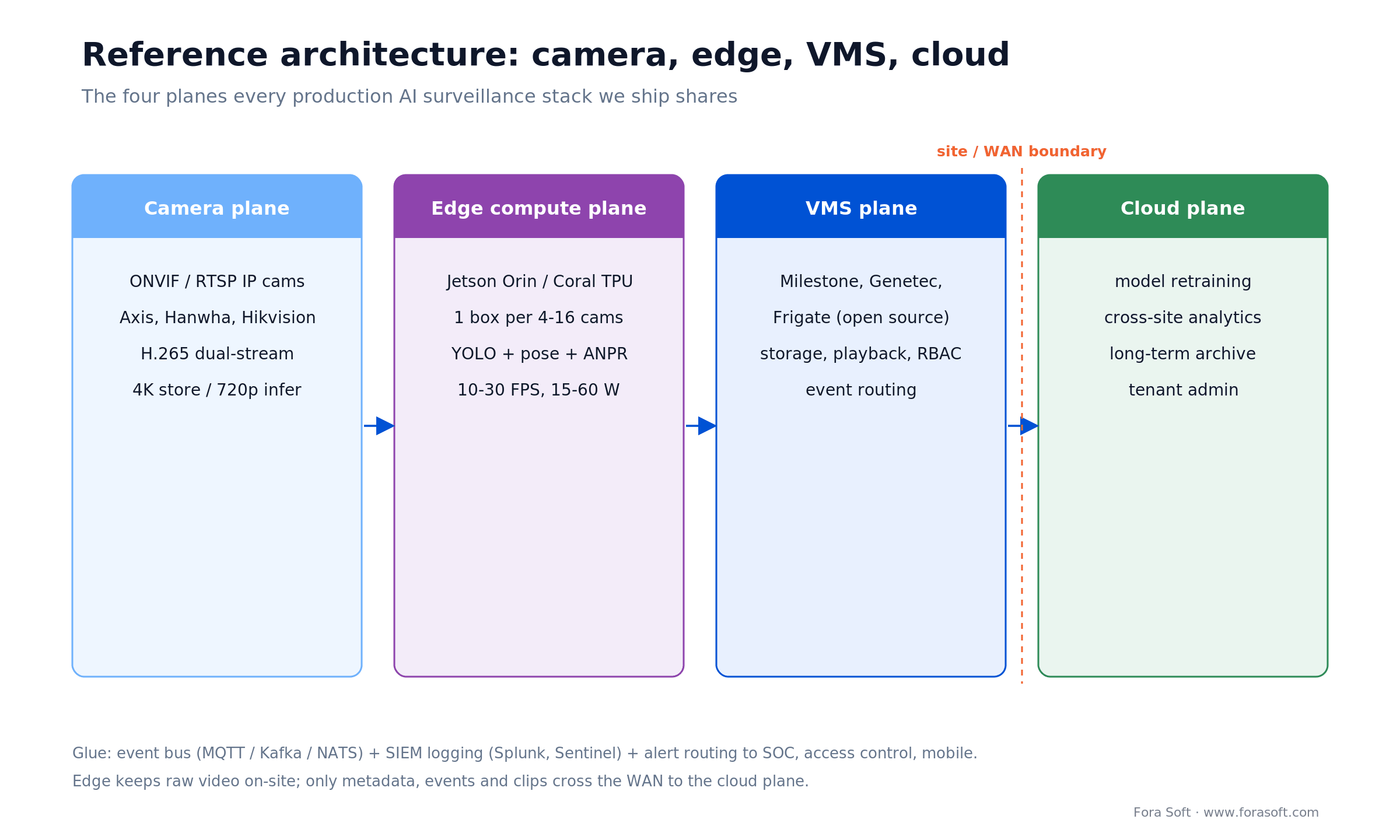
Figure 1. Reference architecture — edge keeps raw video on-site; only metadata, events and clips cross the WAN.
For a complementary view on multi-camera intercom and IoT integration, see our IoT intercom systems guide.
Edge vs cloud: where inference belongs
| Dimension | Edge (Jetson/Coral) | Cloud |
|---|---|---|
| Inference latency | 10–50 ms | 500–2000 ms |
| Bandwidth to WAN | Metadata + clips only | Full stream 4–16 Mbps/cam |
| Privacy posture | Raw video stays on-site | Requires DPA + region lock |
| Cost at scale | Capex + 3–5 yr amortisation | $45–$200/cam/month |
| Model updates | OTA push, stage-wise | Instant, vendor-managed |
| Offline resilience | Continues, alerts queue | Fails closed |
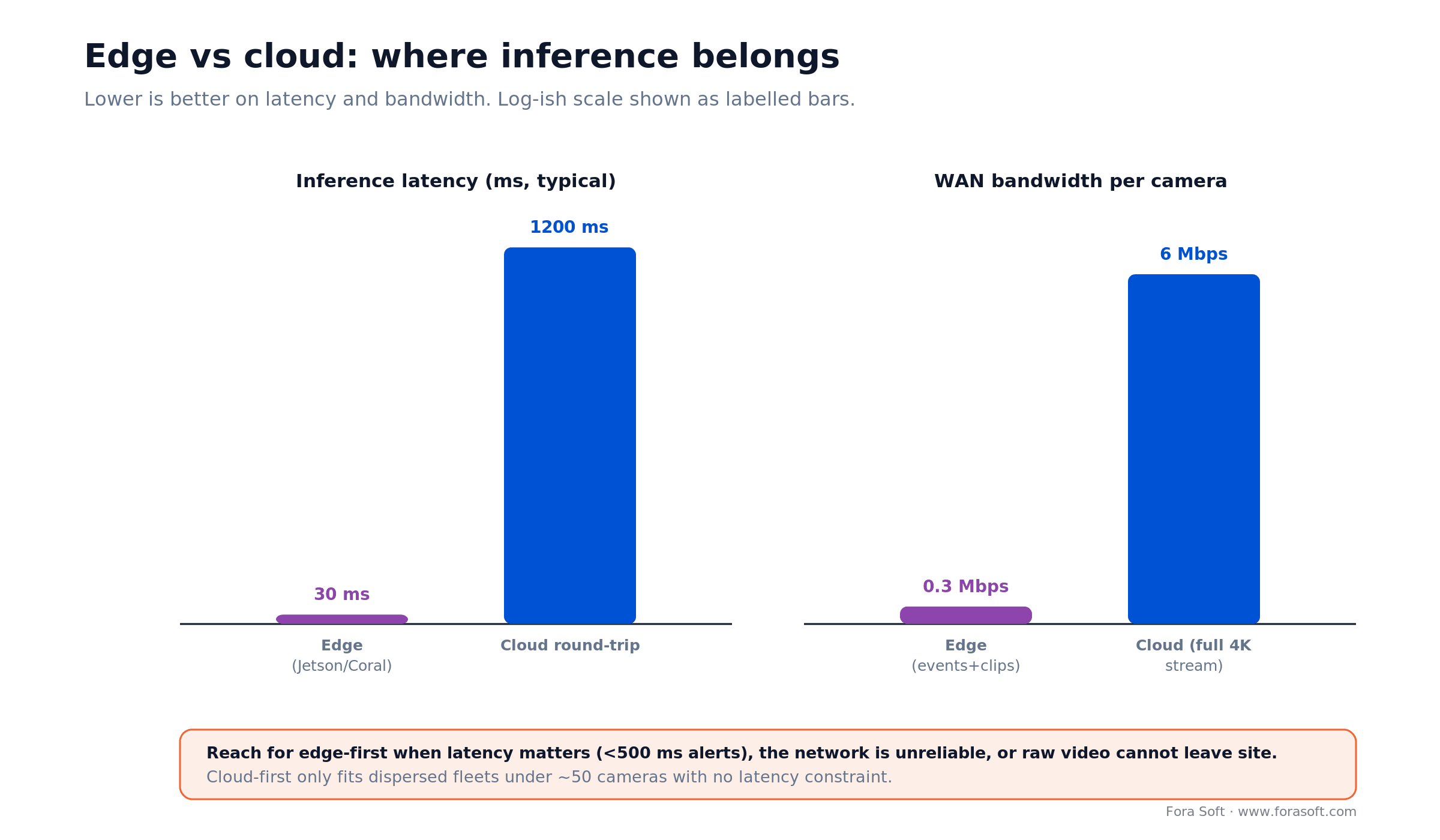
Figure 2. Edge inference wins on both latency and WAN bandwidth; cloud wins on managed model updates and elastic retraining.
Reach for edge-first when: latency matters (<500ms alerts), the network is unreliable, or raw video cannot leave the site. Cloud-first is only right for dispersed fleets of <50 cameras without latency constraints.
Build vs buy: Verkada, Eagle Eye, Rhombus, Spot AI — or custom
SaaS surveillance platforms solved the “I have 20 cameras and no IT team” problem. They do not solve the “I have 800 cameras across six sites and unique analytics” problem. Know where you sit before you sign.
| Platform | Model | Typical price | Best for | Gaps |
|---|---|---|---|---|
| Verkada | Proprietary HW + cloud | License per cam/yr | Mid-market, multi-site | Lock-in, limited custom logic |
| Eagle Eye | ONVIF-friendly cloud | $20–60/cam/mo | Bring-your-own cameras | Fewer native analytics |
| Rhombus | HW + cloud | $50–200/cam/mo | Retail, campuses | Vendor lock-in |
| Spot AI | AI overlay on existing cams | $50–200/cam/mo | Fast AI retrofit | Analytics breadth limited |
| Genetec / Milestone | Enterprise VMS + AI plugins | License + services | Enterprise, government | Heavy integration cost |
| Custom (VALT-style build) | Open stack + custom ML | Capex + T&M | Unique analytics, scale, compliance | Higher upfront investment |
Reach for custom when: you run 200+ cameras, sit in a regulated industry (healthcare, law enforcement, banking), own proprietary analytics that you resell as an upgrade, or you cannot lock your data to a vendor cloud.
Privacy, compliance and the EU AI Act
Compliance architecture is now a feature, not a footer. Get it wrong and the project dies at procurement.
| Regulation | Who must comply | Key rule | Architecture impact |
|---|---|---|---|
| GDPR | EU-facing deployments | Face is biometric special category | EU data residency, DPIA, DPA |
| EU AI Act | Any EU user | Remote biometric ID is high-risk | Conformity assessment, testing, logging |
| BIPA | Illinois (US) | Written consent for biometric capture | Consent flow, per-subject opt-out |
| CCPA/CPRA | California | Disclosure at capture, opt-out | Signage, DSR pipeline |
| HIPAA | US healthcare PHI areas | BAA required, encrypted storage | Role-based access, audit trail |
| UK Surveillance Code | UK public / private | Proportionality, necessity | Retention limits, ICO audit trail |
Practical privacy-by-design primitives: face blurring before persistence, a 30-day default retention window, tenant-segmented storage, a data-subject-request pipeline, an immutable audit log of every model inference, and a written bias-audit cadence. Each of these is a cheaper architectural choice than a lawsuit.
Design rule: decide what you are legally allowed to store before you choose where inference runs. On-prem-only retention plus edge inference is the cleanest posture for regulated verticals; if legal counsel signs off on cloud, add region-locking and a DPA on day one, not at audit time.
Cost model: what a 50 / 500 / 5,000 camera deployment really costs
Use these as planning anchors, not guarantees. Operations represent 60–70% of 5-year TCO — your procurement deck should lead with that number.
| Scale | Hardware | Storage + cloud | Software/license | First-year TCO |
|---|---|---|---|---|
| 50 cameras (small enterprise) | $15–75k | $50–100k | $30–50k | $150–300k |
| 500 cameras (mid-market) | $150–750k | $400k–$1M | $300–500k | $1.5–3M |
| 5,000 cameras (enterprise / city) | $1.5–7.5M | $3–5M | $1–2M | $10–20M |
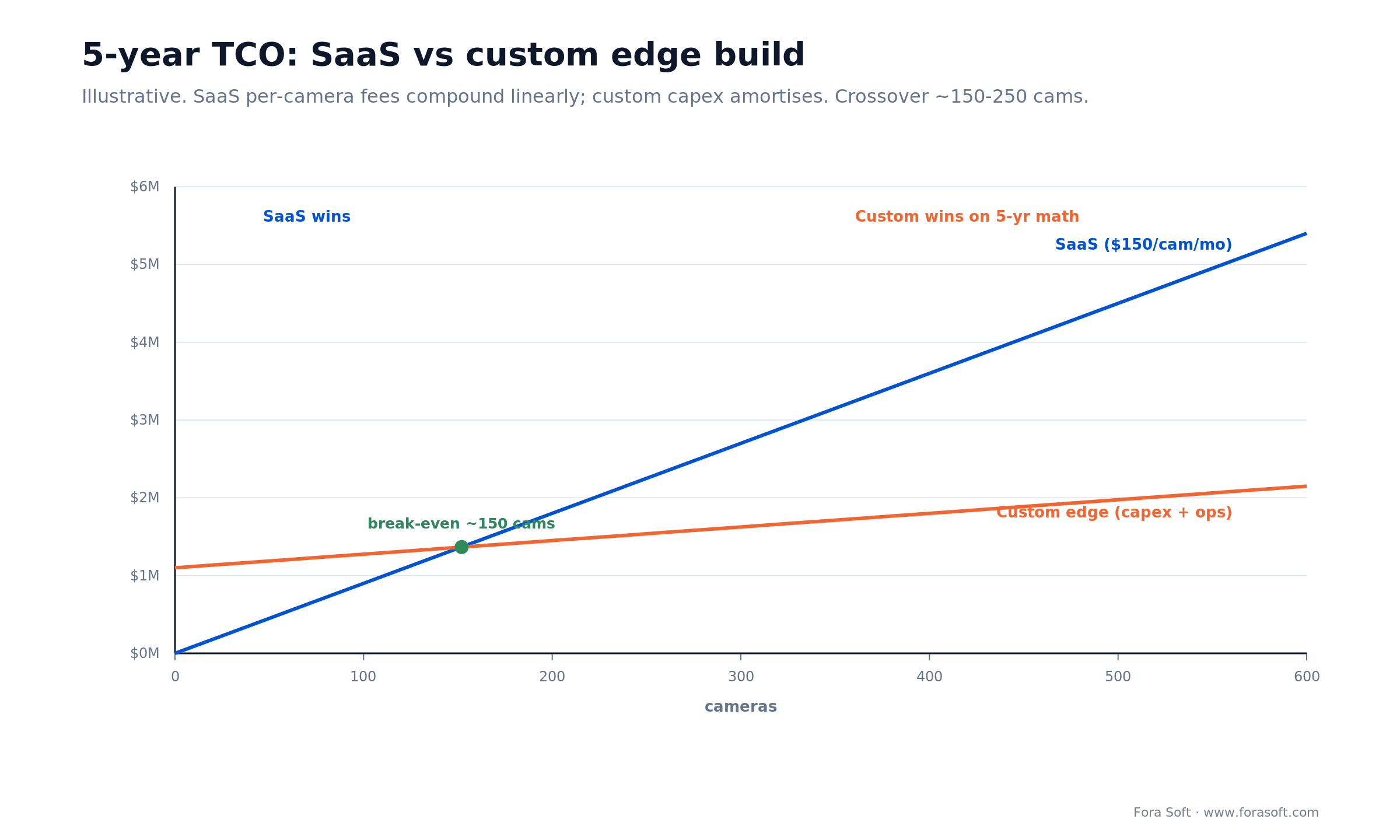
Figure 3. Illustrative 5-year TCO. SaaS per-camera fees compound linearly; a custom edge build front-loads capex, then amortises.
Worked example — 500 cameras over 5 years.
Take a mid-to-high SaaS rate of $150/cam/month (Rhombus and Spot AI sit in the $50–200 band): 500 × $150 × 12 × 5 = $4.5M, and you own no hardware at the end. A custom edge build might run ~$1.1M capex (edge boxes, cameras, VMS, integration) plus ~$0.35M/year to operate = 1.1 + (0.35 × 5) = ~$2.85M over the same window — roughly a 35% five-year saving, and you keep the hardware and the data. The saving is real but rate-sensitive: at a cheaper $60/cam/month tier the SaaS bill drops to $1.8M and buying wins outright. That is the whole point — run your own numbers, because below ~150 cameras or on a low SaaS tier the arithmetic flips.
Want a realistic TCO for your camera count?
Send us your camera count and sites — we’ll come back with a one-page cost model, free.
Mini case: V.A.L.T., the VMS credential behind this playbook
V.A.L.T. is a SaaS video recording and observation platform by Intelligent Video Solutions. We built it from scratch and have been their sole development team for 10+ years. It runs across 770+ U.S. organizations with 50,000+ users — medical education and simulation labs, law-enforcement interview rooms, child-advocacy centers and behavioral research. It is HIPAA and GDPR compliant.
To be precise about what V.A.L.T. is: it is a multi-camera recording and observation VMS, not an AI anomaly-detection product. It streams and records HD video from fixed IP cameras and smartphones, drives PTZ presets, supports push-to-talk and motion-triggered capture, runs scheduled and recurring recordings, and secures transit with encrypted RTMPS. Word search locates spoken words inside recorded video via Amazon Transcribe and exports PDF reports. Permissions are strict enough for law-enforcement interview rooms; recordings are auditable enough for medical-training review.
Why it matters for a custom AI build: the hard parts of V.A.L.T. are the exact primitives an AI surveillance platform reuses — multi-camera sync at scale, role-based access that survives an audit, scheduled/continuous recording without dropped frames, encrypted transit and retention controls. Bolt a detection and alerting layer onto that spine and you have AI surveillance; skip the spine and your clever model has nowhere reliable to run. Book a 30-minute call and we’ll sketch a similar path for your camera footprint.
Integrations that always show up in RFPs
A great analytics engine that cannot talk to the rest of the security stack loses procurement. Every production project we ship speaks at least five of these:
- Access control — Genetec, Brivo, LenelS2, SALTO (door release on identity match).
- Alarm and intrusion — Bosch, Honeywell, DSC via webhook or MQTT.
- Intercoms and IP telephony — SIP / RTP bridging to the VMS, video-doorbell webhooks.
- SIEM — Splunk, QRadar, Microsoft Sentinel with structured CEF / JSON events.
- Digital signage — real-time occupancy displays from the analytics event bus.
- BI / ERP — Tableau, Power BI dashboards for heatmap, dwell time and shrinkage.
ONVIF Profile S/T is the baseline standard; ONVIF Profile M is emerging for analytics metadata and is worth asking suppliers about today.
A decision framework — pick custom in five questions
Answer these before you commit to a SaaS renewal or a custom build. Two or more answers pulling toward the right-hand column and the math usually favours a build.
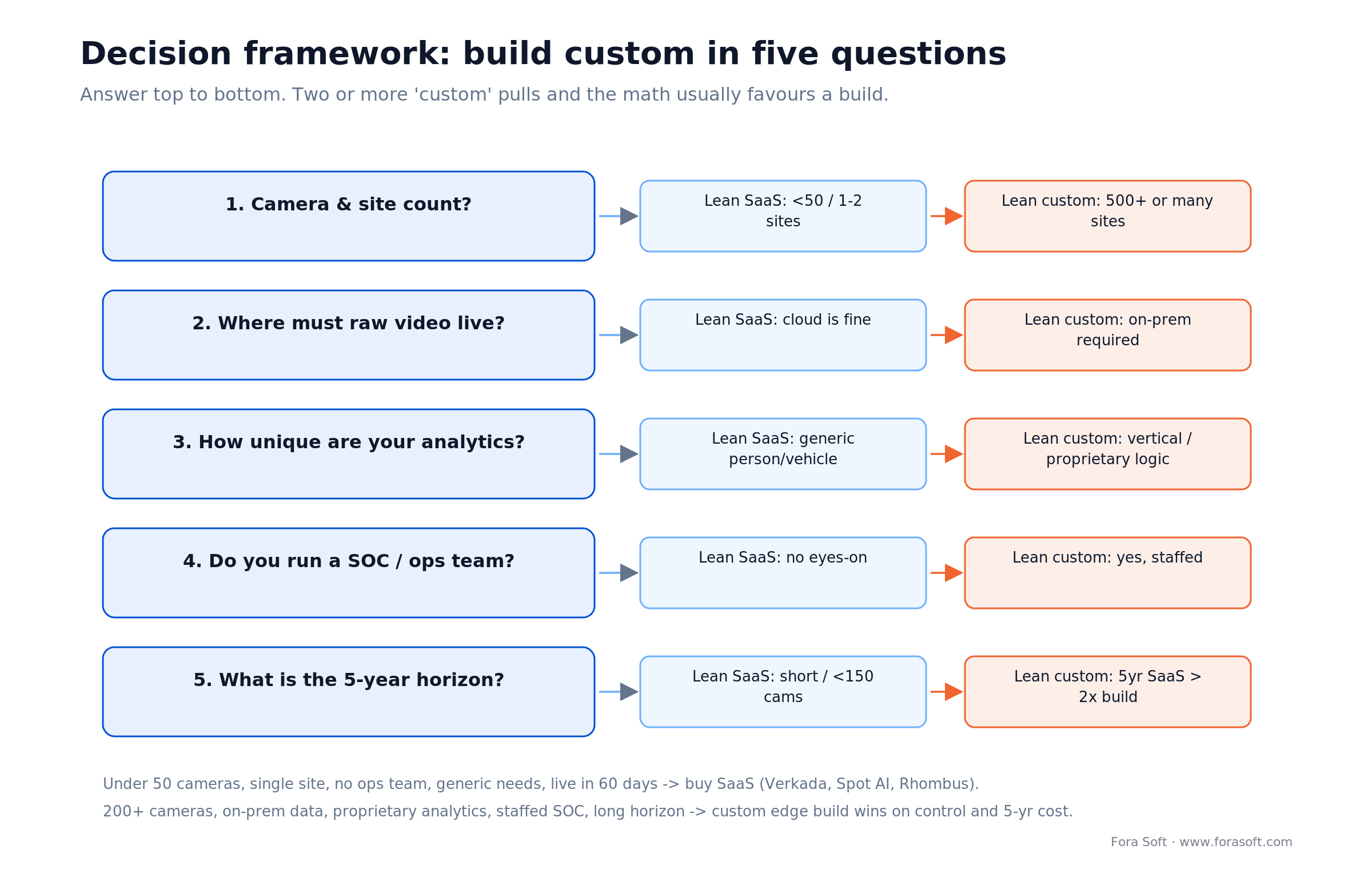
Figure 4. Five questions that decide build vs buy. Lean-SaaS answers on the left; lean-custom answers on the right.
1. How many cameras and how many sites? Under 50 cameras at one or two sites, SaaS is almost always cheaper. 500+ cameras or regulated industries tilt the math toward custom.
2. Where does raw video have to live? If on-prem is a hard compliance requirement (law enforcement, healthcare, certain government), cloud-first SaaS is off the table.
3. How unique are your analytics? Generic person/vehicle detection is commodity. Vertical logic — hospital workflow monitoring, casino chip tracking, factory loss prevention — justifies a custom build, because SaaS will not ship it for you.
4. Do you have a SOC or on-call security ops team? Custom operations need eyes-on. Without them, false-positive rate matters more than raw accuracy; a managed SaaS with decent defaults beats a superior custom system nobody tunes.
5. What is the 5-year horizon? Vendor pricing compounds. If 5-year SaaS TCO exceeds 2x a custom build (common at 500+ cameras), custom wins on math alone.
A realistic timeline: from RFP to live
Buyers underestimate integration and overestimate the model. Here is how a 50-camera custom build actually sequences with our Agent Engineering delivery. Dates are working weeks, not calendar promises.
| Phase | Weeks | What ships |
|---|---|---|
| Discovery & site survey | 1–2 | Camera map, network audit, compliance scope, KPIs |
| Architecture & model selection | 2–3 | Edge/cloud split, VMS choice, model shortlist, DPIA |
| Core build (edge + VMS) | 4–8 | Ingest, detectors, alert routing, RBAC, storage |
| Integration & tuning | 2–4 | Access control, SIEM, false-positive tuning, bias audit |
| Pilot & go-live | 2–3 | Operator training, runbook, phased rollout |
That is roughly 3–4 months end to end. A classical team on the same scope typically lands at 5–7 months, mostly because integration and tuning do not parallelise well by hand.
How Agent Engineering changes the build economics
The historical argument against custom was simple: it costs more and takes longer than buying. Agent Engineering narrows both gaps. Our senior engineers drive AI coding agents to generate integration adapters, VMS plugins, edge-deployment scripts and test suites in parallel, then review and harden every line. The model work — choosing detectors, tuning thresholds, running bias audits — stays firmly with humans, because that is where the risk lives.
What that changes in practice: the integration long-tail (the part that usually blows timelines) compresses, so a custom build lands closer to a SaaS rollout on schedule while keeping the control and 5-year cost advantage. We are honest about the limits — agents accelerate plumbing, not judgement. A weapon-detection threshold or a face-recognition legal call is still a human decision, and we treat it that way. See how the delivery model works on our AI integration service page and the engineering fundamentals in our AI for video engineering track.
Five pitfalls we see on AI surveillance projects
1. Shipping without a bias audit. Face and person detectors trained on imbalanced datasets misidentify under-represented subgroups far more often. Run a per-subgroup FNIR / FPIR audit before you go live and re-run it quarterly.
2. Tuning for accuracy, ignoring alert fatigue. 92% precision still fires 8 false positives per 100 events. Across 500 cameras that buries the SOC. Tune for operator fatigue (<5 alerts/camera/day is our working rule) using scene-aware baselines.
3. Bandwidth surprises. A 4K camera at 30fps is 8–16 Mbps. 100 of them saturate a gigabit uplink. H.265 dual-stream and edge-side pre-filtering are not optional — they are the architecture.
4. Letting a SaaS vendor own the footage. When your contract ends, so does your access to historical video. Require exports in open formats from day one; it is the single cheapest insurance clause in the deck.
5. Skipping the operator UX. An operator who cannot dismiss, pin, review and share an alert in under three seconds will stop using the system. Spend the week designing the alert card — it earns back months of adoption.
KPIs that actually matter
Quality KPIs. Detection precision ≥ 85% and recall ≥ 90% on target classes. Face-recognition FNIR < 0.3% with a sub-5-point spread across demographic subgroups. Alert latency < 500ms at the edge, < 2s via cloud.
Business KPIs. Mean time to alert (MTTA) < 2s from event to SOC screen. Verified-incident lift ≥ 30% versus a motion-only baseline. Operator alert fatigue < 5 actionable alerts/camera/day. Time-to-resolution trending down month over month.
Reliability KPIs. Camera uptime ≥ 99.5%, recording success ≥ 99.9%, edge-node watchdog recovery < 60s. A data-integrity audit (hash ladder on archives) that passes 100%.
When not to build custom AI surveillance
Sometimes the SaaS cheque is the right answer. We push clients off custom when:
- Under 50 cameras, single site. SaaS TCO and ops cost are hard to beat.
- No security ops team. Managed services bundle monitoring you cannot afford to run in-house.
- Generic analytics will do. If motion + person detection + line crossing is enough, you do not need a custom ML pipeline.
- You need it live in 60 days. A Verkada or Rhombus rollout fits that window; a custom build does not.
FAQ
How much does a custom AI video surveillance system cost?
Typical first-year TCO is $150–$300k for 50 cameras, $1.5–$3M for 500 cameras, and $10–$20M for a 5,000-camera city deployment. Operations are 60–70% of 5-year cost, so build the business case around ops, not hardware.
Should we run AI at the edge or in the cloud?
Edge-first is the 2026 default for latency, privacy and bandwidth. Keep the cloud for model retraining, long-term archive and cross-site analytics. Pure cloud only makes sense for small fleets with relaxed latency needs.
Is face recognition legal for my use case?
It depends on jurisdiction. Under the EU AI Act, remote biometric identification in public space is high-risk or, in some cases, prohibited. In the US, BIPA and CCPA require explicit notice and sometimes consent. Talk to counsel, perform a DPIA, and in many deployments consider non-biometric alternatives.
Which cameras work with custom AI systems?
Any ONVIF Profile S/T camera with RTSP output. Axis, Hanwha, Hikvision, Dahua and Bosch all work. Prefer dual-stream and H.265 so analytics run on 720p while storage keeps 4K, which cuts both bandwidth and CPU.
How accurate are modern object detectors?
Well-tuned YOLO-class models deliver 85%+ precision and 90%+ recall on person and vehicle classes in typical CCTV scenes. Weapon detection sits lower but is still useful with human-in-the-loop review. Accuracy depends heavily on camera angle, resolution, lighting and the class you are detecting.
Can we integrate AI analytics with our existing Milestone or Genetec VMS?
Yes. Both platforms have plugin SDKs and event APIs. We regularly bolt custom analytics onto Milestone XProtect or Genetec Security Center via ONVIF, WebSocket or their native SDKs without replacing the VMS.
How long does a 50-camera rollout take?
SaaS (Verkada, Spot AI): 2–6 weeks. Custom edge + custom analytics: 3–4 months with our Agent Engineering approach, 5–7 months with a classical team. Integration with existing access control and SIEM adds 2–4 weeks.
What open-source VMS options are worth considering?
Frigate is our default for small-to-medium edge deployments — TensorFlow / Coral, MQTT, Home Assistant integration, an active community. Shinobi and ZoneMinder cover larger installs with more manual ops. All three replace paid VMS only when you have the ops capacity to match.
What to Read Next
Models
Top 7 Anomaly Detection Models for Video Surveillance
Deep-dive into the ML architectures behind modern alerts.
Real-Time
Real-Time Anomaly Detection in Video Surveillance
How to shave latency from seconds to milliseconds at scale.
System Design
AI-Based Anomaly Detection Surveillance System
End-to-end architecture reference for operations teams.
Automation
Automated Anomaly Detection on Security Cameras
What automation earns and where it still needs human eyes.
Intercom
IoT Intercom Systems: Smart Building Security
How intercoms plug into a modern AI surveillance stack.
Ready to level up your security stack
Modern AI video surveillance is less about cameras and more about the software between them. Edge inference has matured, regulation has tightened, and the 2026 winners pair the right models with clean compliance and an operator UX that does not burn out SOCs. Whether your answer is SaaS, custom or hybrid, the decision is not a camera-brand beauty contest — it is a TCO and risk exercise.
If you are sizing a build, retrofitting AI onto existing cameras, or untangling a stalled rollout, the next step is a 30-minute scoping call. We will leave you with a clearer architecture, a realistic budget, and a list of five decisions you can make this week.
Let’s build your AI video surveillance system
Fora Soft ships custom AI surveillance with Agent Engineering — faster, cost-aware and production-ready. 250+ projects since 2005, and V.A.L.T. across 770+ organizations back it up.

