

Key takeaways
• An IoT intercom system is a five-tier stack: door station → SIP/WebRTC media plane → cloud or on-prem SFU → mobile + web apps → access-control / BMS / video-surveillance integrations. Get one tier wrong and the whole product feels broken.
• Buy the hardware, build the software. 2N, Akuvox, DoorBird, Hikvision and Dahua dominate door stations; SaaS players like ButterflyMX, DOOR (formerly Latch) and Brivo own the multifamily niche. Custom software wins above ~5,000 doors, in regulated verticals, or when you want a brandable mobile app.
• Mobile-first call delivery is the #1 feature buyers measure. Push-to-ring must stay under 2 s and answer time under 8 s. That requires native iOS CallKit + PushKit and Android ConnectionService — standard FCM/APNs alone is not enough.
• Edge AI cuts cloud bills and keeps face data inside the building. An Nvidia Jetson Orin Nano Super ($249 / 67 TOPS) or a Hailo-8 runs face recognition, LPR and package detection at <100 ms with 60–70% less cloud bandwidth and dramatically simpler GDPR / BIPA / CCPA compliance.
• A custom IoT intercom MVP ships in 14–20 weeks for $90–180k. A white-label or enterprise platform with SaaS billing, 24/7 SLA and regulatory audits is a 5–12 month, $180–700k engagement. Hardware adds $400–$1,500 per door.
Why Fora Soft wrote this playbook
Fora Soft has built real-time video and communication software since 2005 — 250+ shipped projects, 50 in-house engineers. Our most relevant case study for IoT intercom buyers is Nucleus, an on-prem WebRTC + SIP communication platform serving 5,000+ businesses with 600 million call minutes per month under SOC II, GDPR and HIPAA constraints. The same media stack that powers Nucleus drives our intercom deployments: the protocols, the failover modes, the security patterns.
For secure remote video signing and audit-trail flows we built ProVideoMeeting, a video conferencing platform with AES encryption, SMS + photo MFA, and an immutable transaction log. We’ve published deep dives on secure intercom systems, cloud intercom systems, custom intercom software and WebRTC + SIP integrations. When we quote an intercom build, our real-time communication engineering is the part clients lean on hardest.
This guide is the same decision tree we walk new clients through during scoping. It covers protocol choice, hardware shortlist, on-device vs cloud AI, mobile call delivery, cybersecurity, compliance and budget. Read it end to end if you’re evaluating a partner; jump to the vendor matrix if you just need to pick hardware and SaaS.
Building or upgrading an IoT intercom platform?
30 minutes with a senior engineer who has shipped real-time intercom and access-control infrastructure at 600M+ call minutes a month. We’ll review your architecture, recommend a stack, and quote a build.
The state of IoT intercom systems in 2026
Five forces reshaped the IoT intercom market between 2024 and 2026. Each one should drive a concrete decision in your stack.
1. Matter made intercoms a first-class device. Door locks have been Matter-supported for years, but the big change is newer: intercoms and doorbells became first-class Matter device types in Matter 1.5 (November 2025), refined in the camera-focused Matter 1.5.1 (March 2026). Thread border routers in iPhone, Apple TV and HomePod give every iOS resident a low-power mesh gateway out of the box. The open gap in 2026 is controller support catching up to the new device types.
2. Edge AI ate the cloud face-recognition bill. An Nvidia Jetson Orin Nano Super ($249, 67 TOPS) or a Hailo-8 (26 TOPS) runs face recognition, license plate recognition and package detection on the door station itself at <100 ms. Bandwidth drops 60–70% versus cloud inference, and face data never leaves the building — a large simplification for GDPR / BIPA / CCPA.
3. OSDP secure channel became the access-control default. The Open Supervised Device Protocol (SIA OSDP, standardized as IEC 60839-11-5) added encrypted, supervised reader-to-controller communication, displacing the 30-year-old unencrypted Wiegand wiring that most enterprise procurements now reject outright.
4. SaaS pricing wars commoditized multifamily. ButterflyMX, DOOR (formerly Latch), Swiftlane and 2N pulled per-door pricing from $30–$60/mo down to $8–$20/mo. That hardened the choice for sub-1,000-door buildings: SaaS wins on speed and total cost. Above ~5,000 doors, custom white-label still wins on per-unit economics.
5. Cybersecurity went from afterthought to RFP requirement. The Claroty Team82 disclosure of 13 vulnerabilities in the Akuvox E11 intercom — including an unauthenticated remote camera/mic activation — made buyers ask hard questions about firmware cadence, default credentials, RTSP exposure and audit logs. “Hardened by default” is now table stakes.
Seven use cases worth designing for
1. Multi-tenant residential. The biggest market by unit count. Apartment lobby door station + per-unit mobile app, package locker integration, visitor PIN codes, intercom-to-elevator destination dispatch. ButterflyMX and DOOR own this segment in the US; 2N and Comelit dominate the EU.
2. Commercial office lobby. Receptionist desk + visitor self-service kiosk + employee mobile-credential entry. Common integrations: Envoy / SwiftConnect for visitor management, Brivo / Verkada for access control, Slack / MS Teams notifications when a visitor arrives.
3. Gated community. One door station per gate, multiple residents per gate, license plate recognition for known cars, mobile QR codes for guests. The hardest UX challenge: rural LTE-only connectivity demanding aggressive offline-mode design.
4. Package locker / smart parcel. Amazon Hub, Parcel Pending, ButterflyMX Package Room. Couriers authenticate via QR or PIN, drop the package, the resident gets notified, then retrieves it with biometric or app. Often bundled with the intercom hardware contract.
5. Smart parking. LPR-driven garage entry, validation kiosks, integration with parking-management SaaS (FlashParking, PassportLabs). Common pitfall: low-light LPR accuracy — spec a 2MP IR camera with 940 nm illumination minimum.
6. Hospitality. Hotel guest-room access, contactless check-in, in-room intercom to the front desk. Heavy integration with PMS (Opera, Mews, Cloudbeds). The UX bar is high — guests will not learn a new app.
7. Healthcare and senior living. Medical-grade access control, HIPAA-compliant audit, fall-detection cameras, panic-button integration. The compliance burden is the highest of any vertical; partner only with vendors that have BAAs ready and audited cloud.
Reference architecture — the five-tier stack
Every modern IoT intercom platform breaks into five tiers. Get the boundaries right and you can swap any single layer — a different door station vendor, a different cloud, a new mobile SDK — without rewriting the rest.
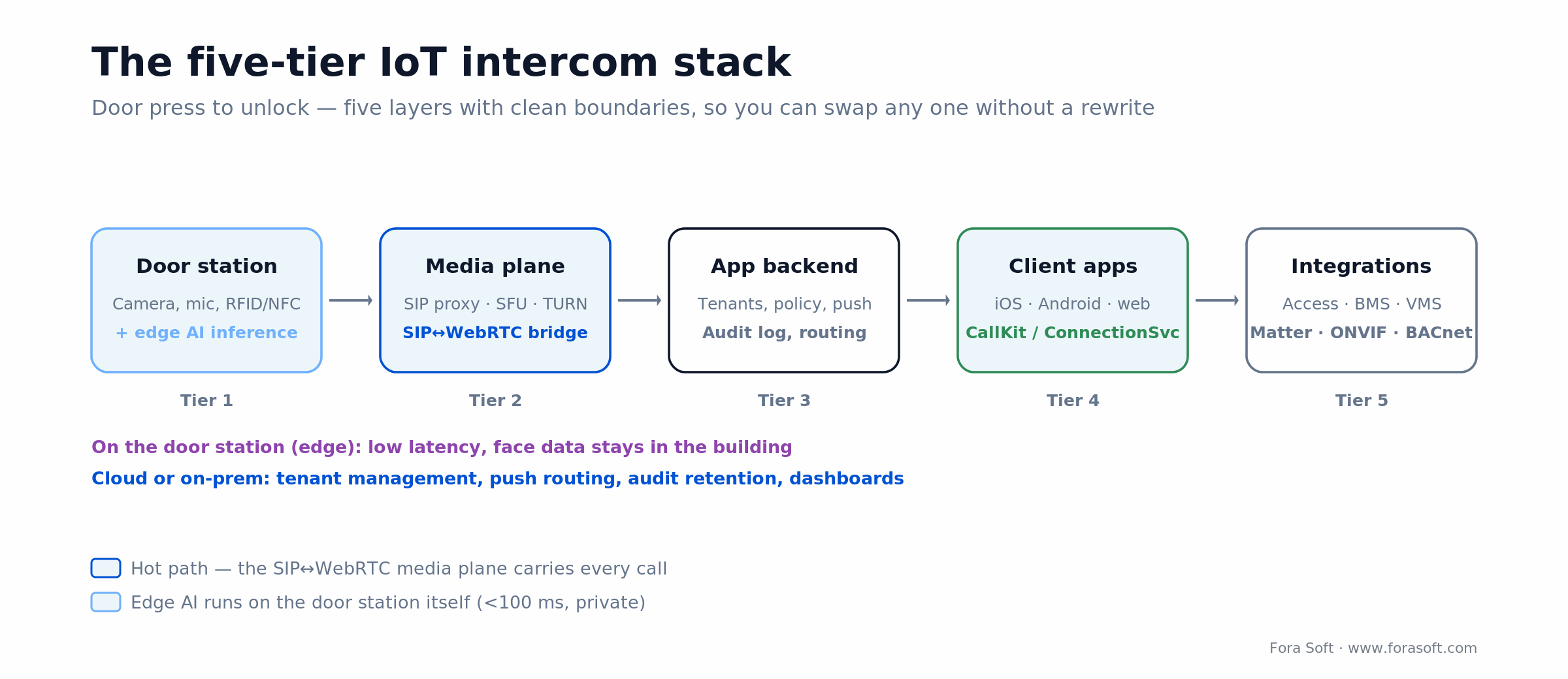
Figure 1. The five tiers of an IoT intercom system, with the SIP↔WebRTC media plane as the hot path and edge AI living on the door station.
| Tier | Components | Protocols | Typical vendors |
|---|---|---|---|
| Door station | Camera, mic, speaker, RFID/NFC, edge AI | SIP, RTSP, ONVIF, OSDP, MQTT | 2N, Akuvox, DoorBird, Comelit, Hikvision |
| Media plane | SIP proxy, SFU, TURN, codec transcode | SIP/WebRTC bridging, SRTP | FreeSWITCH, Asterisk, LiveKit, Janus |
| Application backend | Tenant DB, access policy, push routing, audit log | REST + WebSocket + gRPC | AWS / GCP / Azure native, custom Go / Node / Python |
| Client apps | iOS, Android, web admin, building staff console | CallKit, PushKit, ConnectionService, FCM/APNs | Native Swift / Kotlin; React for admin |
| Integrations | PMS, BMS, PSIM, video surveillance, Matter / HomeKit | BACnet, Modbus, KNX, Matter, ONVIF | Brivo, Verkada, Genetec, Milestone, HomeKit, Alexa |
Boundary discipline is the whole game. The on-device versus cloud question shows up at every tier. We default to a hybrid: edge AI on the door station for latency and privacy (face match, LPR, tailgating, package detection), with cloud for tenant management, push routing, audit retention and dashboards. Pure cloud has lower hardware cost; pure on-prem has lower running cost and simpler compliance — pick by vertical, and keep the tier boundaries clean so no single vendor can lock you in.
Vendor matrix — door stations and SaaS platforms head to head
| Vendor | Type | Best for | Hardware $ | SaaS $/mo | Strength | Weakness |
|---|---|---|---|---|---|---|
| 2N (Axis) | Door station + cloud | Integrator-friendly, on-prem SIP | $700–$1,500/door | $5–$15 | Open APIs, deep SIP, Axis backing | UI dated; premium hardware price |
| Akuvox | Door station + cloud | Budget multi-tenant, Matter-ready | $400–$900/door | $3–$10 | Price, broad device range | E11 had 13 CVEs (Claroty 2023); vet firmware |
| DoorBird | Door station | High-end residential, HomeKit | $700–$1,800/door | Free | German build quality, HomeKit | No multi-tenant SaaS |
| Comelit | Door station + cloud | EU multi-tenant residential | $600–$1,300/door | $5–$12 | Strong EU dealer network | Less third-party API depth |
| ButterflyMX | SaaS multifamily | US apartment buildings | $1,500–$2,500 + install | $8–$15 | Best resident UX, package room | US-centric, vendor lock-in |
| DOOR (ex-Latch) | SaaS access + intercom | New-construction multifamily | $1,000–$2,000 lock | $10–$20 | Smart-lock + intercom in one | Limited customization; mid-rebrand |
| Brivo | SaaS access control | Mid-market commercial | $300–$700/door reader | $8–$20 | Largest cloud access ecosystem | Intercom is an add-on, not core |
| Verkada | Surveillance + access SaaS | Enterprise unified physsec | $1,500–$3,500/door | $15–$30 | Single pane for cameras + access | Premium pricing, US-first |
| Swiftlane | SaaS + face access | Office + residential mid-market | $1,200–$2,200/door | $10–$20 | Face-recognition access, modern UX | Smaller installer network |
| Custom (Fora Soft style) | BYO hardware + custom cloud + branded apps | 5,000+ doors, regulated, white-label | $400–$1,200/door (BYO) | ~$0.5–$5 marginal | Full control, brand equity, IP | $90k–$700k upfront |
Custom build vs SaaS — when does each pay off
For sub-1,000 doors and a typical multifamily portfolio, ButterflyMX or DOOR will out-ship anything you build. The economics are obvious: $8–$20 per unit per month, no engineering overhead, mature mobile apps, a well-known vendor.
Custom-built software wins above ~5,000 doors, in regulated verticals, or when the brand and IP matter. The chart below shows where the line sits and what pushes you across it.
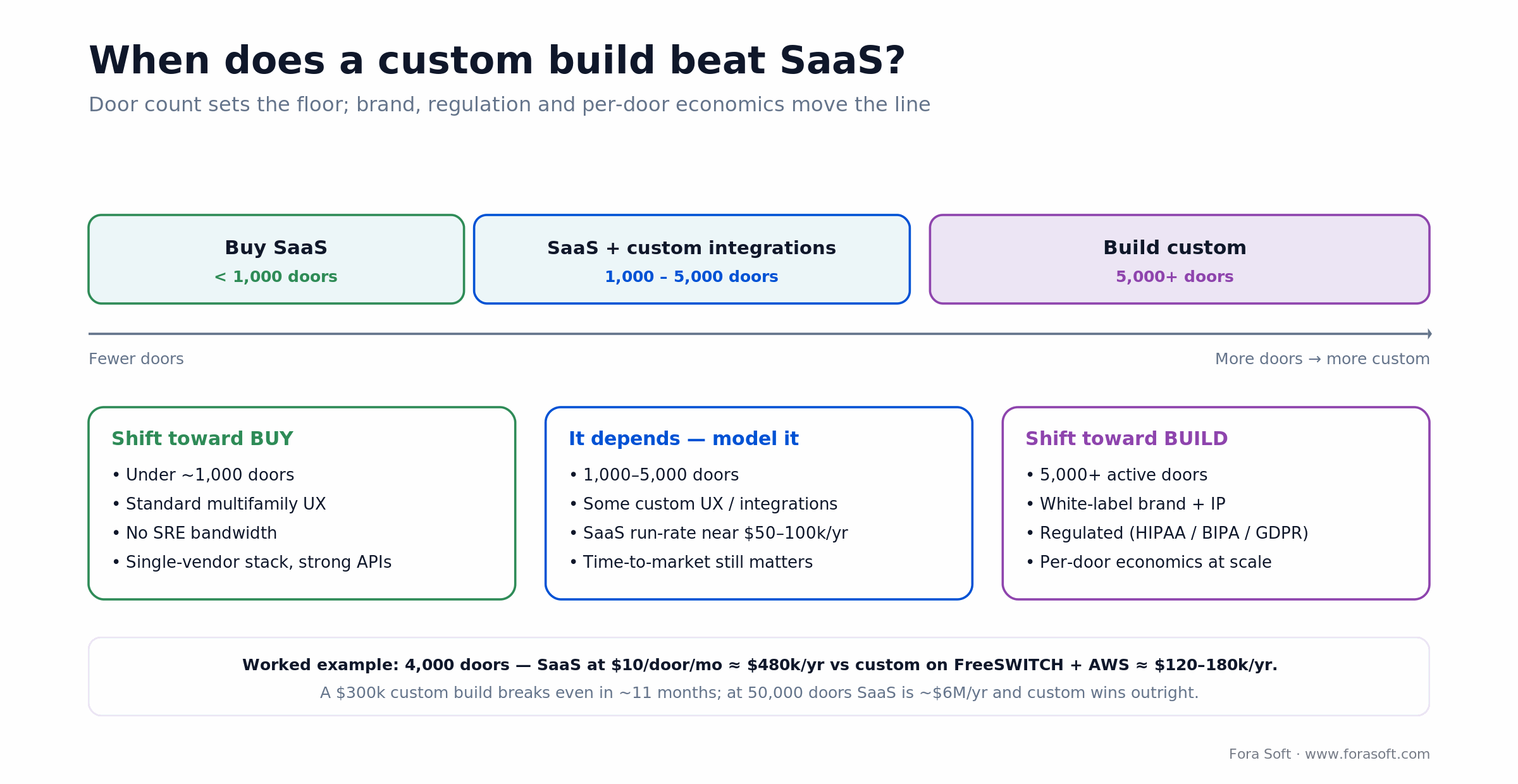
Figure 2. Door count sets the floor; brand, regulation and per-door economics move the build-vs-buy line.
Three concrete scenarios where we’ve seen the numbers swing toward custom:
1. White-label resale. A real estate brand or PropTech wants a branded mobile app with their logo, their tariff plans, their analytics. SaaS won’t white-label below enterprise pricing; custom is the only route.
2. Regulated industries. Healthcare (HIPAA), schools (FERPA + COPPA), defense (CMMC). Most SaaS players don’t hold the relevant attestations; custom + a vetted cloud account is the safer path.
3. Per-door economics at scale. Past a few thousand active doors, the annual SaaS subscription dwarfs a self-hosted FreeSWITCH run-rate, and the gap compounds every year. We’ve helped clients cut their per-door run-rate 60–80% by migrating to a custom platform with the same UX.
Reach for custom-build when: you operate >5,000 doors, you need brand-and-IP ownership, you’re in a regulated vertical, or your cloud-bill projection on SaaS exceeds $50–$100k/year. Below that bar, buy hardware and layer SaaS — the day-one speed is worth more than the marginal savings.
AI at the door — features that move the needle in 2026
The AI that matters in an IoT intercom system is the AI that runs on the door station. Edge inference keeps latency low, keeps face data inside the building, and keeps working during a cloud outage. Cloud is for the jobs that need scale and context, not for recognizing your own residents.
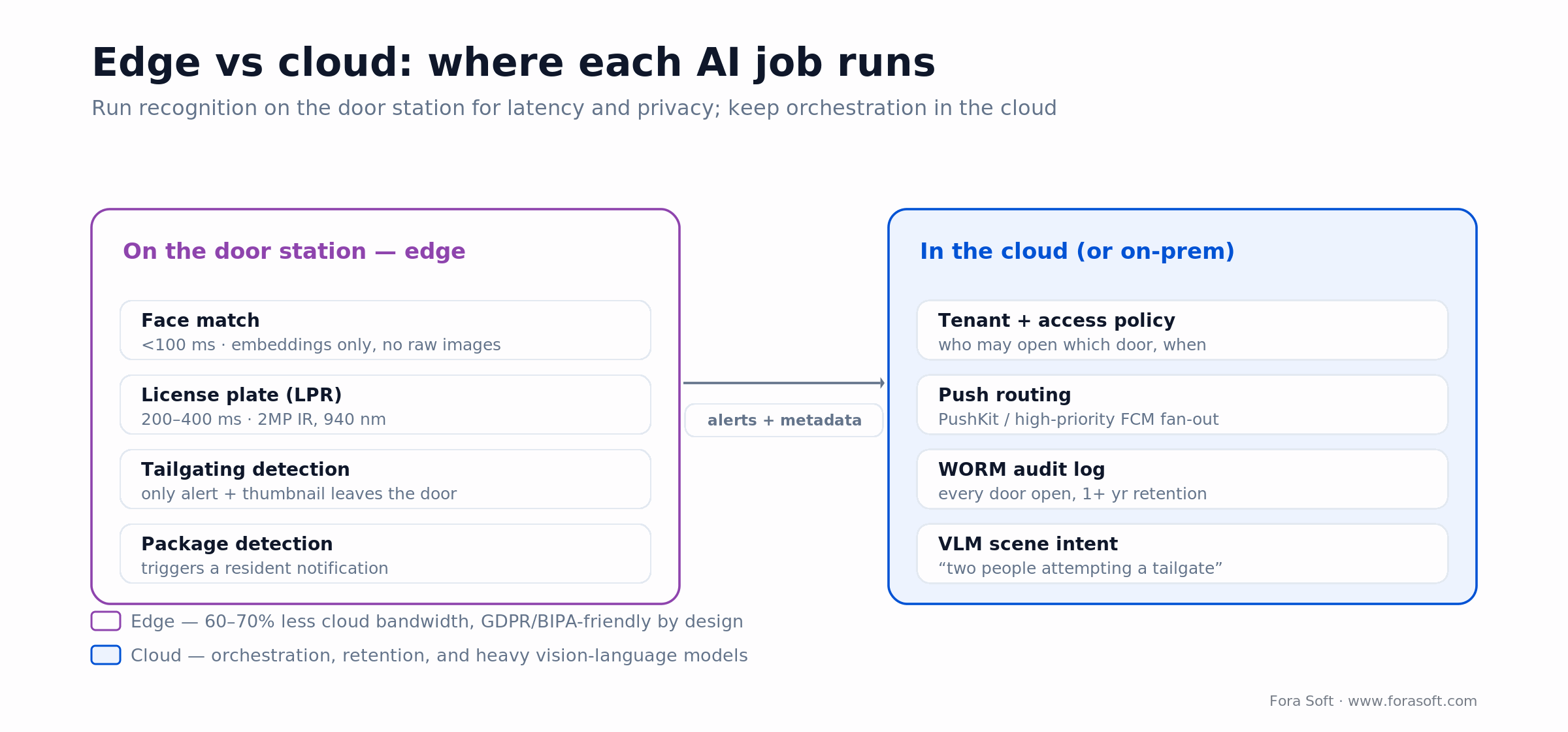
Figure 3. Recognition runs on the door station; only alerts and metadata cross to the cloud for orchestration and retention.
Face recognition. Modern models hit 98–99% accuracy on cooperating subjects under good lighting, in the lab. At the door, lighting drift and angle drop that, so on-site tuning during commissioning matters more than the model brand. Run it on the door station via Jetson Orin Nano Super, Hailo-8 or a Coral TPU; cache the embeddings, never the raw images. (Note NIST’s FRTE benchmarks report 1:1 verification, not door conditions — treat vendor accuracy claims as a ceiling, not a promise.)
License plate recognition (LPR). 92–97% accuracy depending on plate format and lighting. Spec a 2MP IR camera with 940 nm illumination and dedicated LPR firmware (HikCentral, OpenALPR, Survision). Latency budget: 200–400 ms after capture.
Tailgating detection. Reduces unauthorized follow-through entries by 40–60% in our benchmark deployments. The detection model runs on the edge; the cloud receives only the alert payload and a thumbnail.
Package detection. 85–95% precision identifying parcels in the lobby or at the door. Triggers a resident notification, optionally pings building staff for retrieval.
Vision-language models for intent. Where 2026 pulls ahead of simple object detection: GPT-4o-class VLMs in the cloud (or compact on-device variants) describe a scene in natural language — “person carrying a large package, looking for a label,” “two people in hoodies attempting a tailgate.” That gives you contextual alerting a bounding box can’t express. Keep the raw video on the edge; send the VLM a still or a short clip only on a triggered event.
Voice agents at the door. The OpenAI Realtime API drops STT + LLM + TTS round-trip to 200–400 ms, enabling a real conversation with a virtual concierge before a resident is connected. We covered the full pattern in our OpenAI Realtime + WebRTC + SIP integration guide, and the underlying computer-vision work is our AI integration practice.
Behavioral anomaly detection. Time-of-day pattern learning catches unusual access attempts (a 3 am visitor at a residential unit, repeated PIN failures). Pair it with a hold-and-confirm action so the system never auto-denies without a human in the loop. False denials hurt UX worse than a marginal security gain. For the deeper pipeline, see our video anomaly-detection models write-up.
Stuck choosing hardware, SaaS, or custom build?
Send us your door count, vertical and integration list. We’ll come back within two business days with a hardware shortlist, a build-vs-buy recommendation, and a budget range — no obligation.
Mobile call delivery — the make-or-break feature
Every IoT intercom buyer asks the same first question on a demo: “How long from button press to my phone ringing?” If the answer is more than 2 seconds, the demo is over. Most teams under-build this layer because they assume FCM (Android) and APNs (iOS) are enough. They aren’t.
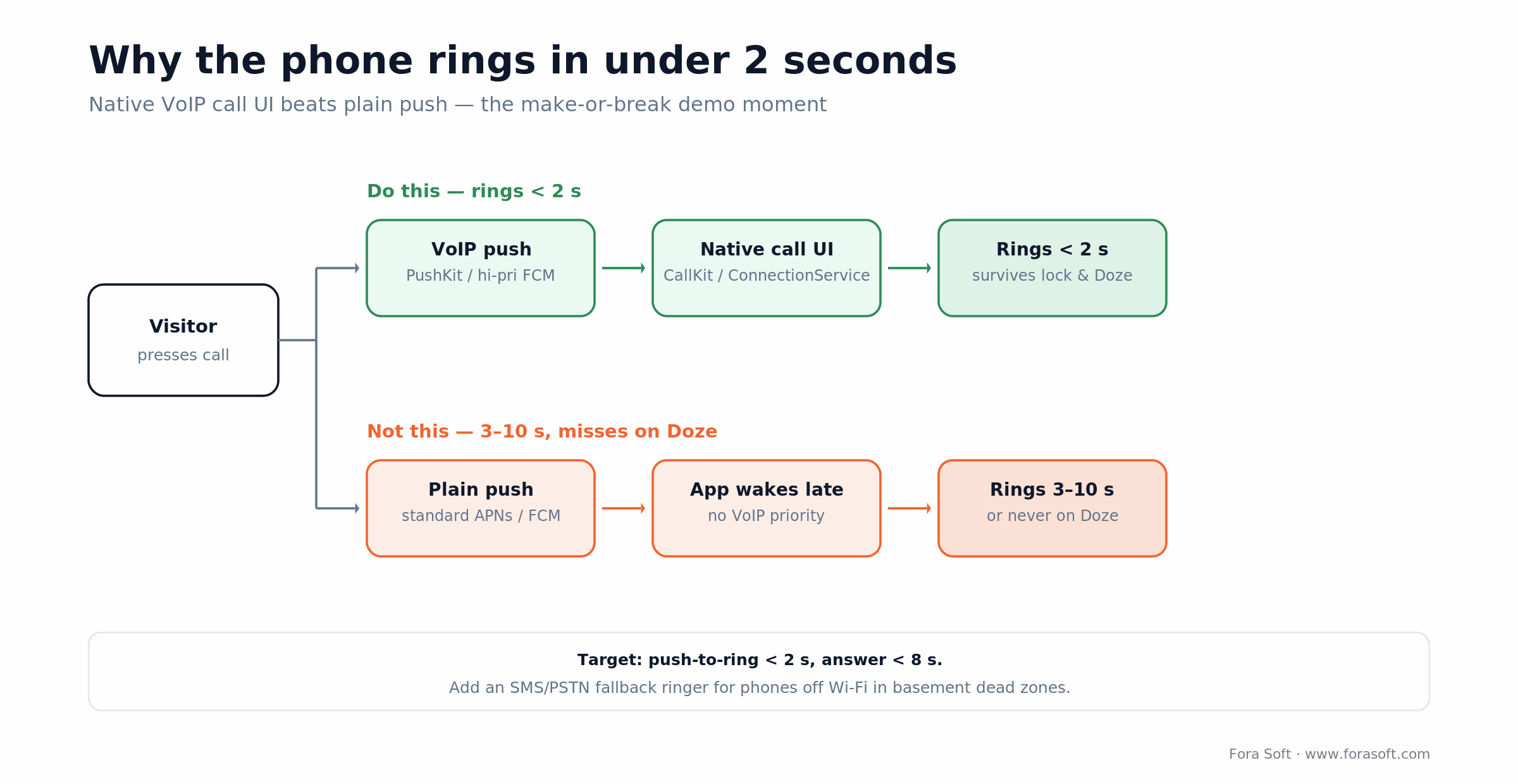
Figure 4. Native VoIP call UI rings in under 2 s; plain push takes 3–10 s and misses entirely on Doze-mode Android.
iOS — CallKit + PushKit. Use a VoIP push (PushKit) so the system wakes the app even from a terminated state. Hand off to CallKit so the call shows in the native call UI, integrates with Bluetooth headsets and CarPlay, and survives a Lock Screen press. Standard remote notifications add 3–10 seconds of delivery latency, which is unacceptable for a doorbell.
Android — ConnectionService + high-priority FCM. Mark the data message priority: high so Doze and App Standby can’t delay it. Implement ConnectionService for full-screen incoming-call UI on Android 8+. Prompt for a battery-optimization opt-out on first launch.
Network resilience. Spec a fallback ringer over SMS or PSTN for residents whose phones are off Wi-Fi. Some buildings still have basement-level dead zones; an SMS that says “visitor at door, tap to call back” saves the day.
The 2-second rule. Push-to-ring under 2 s, answer under 8 s. Build the native call UI from sprint one — retrofitting CallKit and ConnectionService into a notification-based app late is where intercom projects quietly blow their timeline. If a vendor demos a 5-second ring and calls it “fine,” that is the tell that the call layer was an afterthought.
Cybersecurity — the hardening checklist
Public intercom vulnerabilities turned cybersecurity into an RFP requirement, not a nice-to-have. The flagship case: Claroty Team82 disclosed 13 flaws in the Akuvox E11 in 2023, including missing authentication for a critical function (CVE-2023-0354, CVSS 9.1) and unauthenticated remote camera/mic activation (CVE-2023-0348). Hikvision’s CVE-2021-36260 — an unauthenticated command-injection RCE — is the classic example of why RTSP and HTTP must never face the public internet. The minimum viable hardening posture in 2026:
1. Per-device credentials, no defaults. Every door station gets a unique admin password rotated at provisioning. No factory defaults shipped to production. Mutual TLS for device-to-cloud auth.
2. TLS 1.3-only. Disable TLS 1.0/1.1 and weak ciphers; enforce HSTS on all admin endpoints. RTSP and HTTP exposed to the public internet are unacceptable.
3. WORM (write-once-read-many) audit log. Every door open, every credential change, every admin login goes into an append-only log with 1+ year retention. Required for SOC 2, ISO 27001 and most insurance audits.
4. Staged OTA rollout with auto-rollback. Push firmware to 1% of devices, observe error metrics for 24 hours, then fan out. Auto-rollback on a defined health-check failure threshold.
5. Quarterly pen-test. External red-team engagement on every major release. A public bug bounty for the mobile app and admin web. An annual third-party SOC 2 Type II audit if you target enterprise.
Compliance — GDPR, BIPA, CCPA, HIPAA
GDPR (EU). Face data is special-category personal data (Art 9) — processing requires explicit opt-in consent, a documented retention period (we recommend ≤ 24 months), and a Data Protection Impact Assessment before launch. On-device matching avoids most of the burden because biometric templates never leave the building.
BIPA (Illinois). The strictest US biometric law — written consent, a public retention/destruction policy, and a private right of action with $1,000 (negligent) to $5,000 (intentional) per violation. The 2024 SB 2979 amendment made repeated collection by the same method a single violation rather than one-per-scan, and on April 1, 2026 the Seventh Circuit held that limit applies retroactively — a real reduction in exposure, but consent flows still need an Illinois-licensed review before you ship.
CCPA / CPRA (California). Mandates opt-out, deletion-on-request, and a clear privacy notice. Less aggressive than BIPA but still requires audit-ready records.
HIPAA (US healthcare). Required when the intercom serves a healthcare facility. Sign BAAs with your cloud, your face-recognition vendor, and any third party that processes PHI. Audit logs must remain 6 years.
Watch the EU AI Act if you sell into Europe. Biometric identification and categorization sit in the AI Act’s high-risk Annex III. The compliance deadline for high-risk systems was pushed to 2 December 2027 under the 2026 “Digital Omnibus,” and real-time remote biometric identification for law enforcement has been prohibited since February 2025. Door face-recognition access is squarely in scope — another reason on-device matching with explicit consent is the safe default.
Smart home and Matter integration
Matter turned intercoms and doorbells into first-class device types in 1.5 (November 2025), refined in the camera-focused 1.5.1 (March 2026). Akuvox, Aqara, Schlage and Yale ship Matter-native products today, and Thread border routers in iPhone, Apple TV and HomePod give residents a built-in low-power mesh. The catch in 2026 is controller support: the device types exist before every hub fully speaks them, so pilot the exact controller your residents use.
HomeKit. Apple’s native experience: the door station shows up under Home, video preview in Notification Center, push-to-call rings the iPhone like a FaceTime call. Use HomeKit Secure Video for camera footage if you want Apple to handle encrypted storage.
Google Home + Alexa. A multi-vendor reality — most deployments need both. The Action APIs are mature; expect 2–4 sprints to certify both integrations.
SmartThings + Tuya. Important for emerging markets and B2B2C platforms that white-label hardware. Tuya in particular dominates Asia and parts of Eastern Europe; designing in Tuya compatibility from day one cuts go-to-market time in those regions.
Cost model — what an IoT intercom platform actually runs
Numbers below are conservative because we use Agent Engineering to scaffold the SIP/WebRTC media plane, mobile boilerplate and admin web. Legacy shops typically quote 30–50% higher. For market context: estimates vary widely by scope — from ~$3.1B for narrow “video intercom devices” in 2026 (Research and Markets) to ~$44B for the broad video intercom market growing 14.1% a year (The Business Research Company).
| Project profile | Initial build | Timeline | Hardware $/door | Monthly infra |
|---|---|---|---|---|
| SaaS integration (BYO door station) | $15–30k | 4–6 weeks | $400–$1,500 | SaaS $8–$20/door |
| Custom MVP (100–500 doors) | $90–180k | 14–20 weeks | $400–$1,200 | $1.5–5k |
| White-label SaaS platform (1–5k doors) | $180–350k | 5–8 months | $400–$1,200 | $5–15k |
| Enterprise (5k+ doors, regulated) | $300–700k | 6–12 months | $500–$1,500 | $15–60k |
Worked example: 4,000 active doors. SaaS at $10/door/month is $480k/yr ($40k/mo × 12). Custom on FreeSWITCH + AWS IoT Core runs ~$120–180k/yr including SRE time. Against a ~$330k/yr saving, a $300k custom build breaks even in roughly 11 months. Scale to 50,000 doors and the SaaS bill is ~$6M/yr — custom wins outright.
KPIs every IoT intercom platform should track
Quality KPIs. Ring delivery time (target <2 s, hard cap 4 s). Answer time (target <8 s, hard cap 15 s). Door open success rate (>99.5%). Two-way audio MOS (>4.0). Face-recognition false-reject rate (<3% on enrolled subjects).
Business KPIs. Active resident percentage (>80% of unit count). Visitor PIN issuance rate (a leading indicator of mobile-app engagement). Package retrievals via app (a proxy for habit formation). Support tickets per 1,000 doors per month (<3 is healthy).
Reliability KPIs. Door station uptime (>99.9% per device). OTA update success rate (>98% per rollout). Cloud SFU p95 call-setup latency (<500 ms). Crash-free user rate on the mobile app (>99.9%; baseline 99.5%, elite 99.93%+ — see our iOS optimization playbook).
Mini case — how Nucleus scales secure communication for 5,000+ businesses
Situation. A growing enterprise communication client needed an on-prem WebRTC + SIP platform supporting voice, video, screen share, SMS, and intercom-style door integration. Constraints: SOC II + GDPR + HIPAA, deployable inside customer data centers, branded mobile apps, predictable per-user pricing.
Plan. Sprints 1–3 stood up the FreeSWITCH-based SIP / WebRTC bridge with mutual TLS and the audit-log pipeline. Sprints 4–7 built the iOS and Android apps with CallKit + ConnectionService for sub-second call delivery. Sprints 8–12 added the BMS / video-surveillance integration layer and the per-tenant admin console.
Outcome. Today Nucleus serves 5,000+ businesses with 600 million call minutes per month, holds SOC II + GDPR + HIPAA attestations, and runs with zero major outages across the deployment fleet. The same building blocks — mutual TLS, CallKit, FreeSWITCH SFU bridge, WORM audit log — power our intercom engagements, and the surveillance-fusion patterns come straight from VALT, our HIPAA video platform used by 770+ US organizations and 50,000+ users. Want a similar assessment?
A decision framework — pick your IoT intercom stack in five questions
1. How many doors and how soon? <500 doors, ship in 90 days → ButterflyMX or DOOR. 500–5,000 doors, custom mobile UX → SaaS + custom integrations. >5,000 doors, white-label → build it.
2. Vertical? Multifamily residential → SaaS. Office / commercial → Brivo + your IDP. Healthcare / education / defense → custom + audited cloud + signed BAAs.
3. AI use cases? Visitor face recognition + tailgating + LPR → edge inference on Jetson / Hailo / Coral. Just intercom calling and PINs → cloud-only is fine.
4. Smart-home integrations? HomeKit + Matter mandatory → spec the door station with native Matter or use a known compatible vendor (Akuvox, DoorBird, Schlage). Optional → ship a third-party Home / Alexa skill in v2.
5. Compliance burden? EU customers → design for GDPR from day one (on-device face match, EU data residency, DPIA, EU AI Act high-risk track). Illinois multifamily → explicit BIPA consent flow. US healthcare → HIPAA + BAA chain. Otherwise CCPA opt-out is the floor.
Five pitfalls that wreck IoT intercom programs
1. FCM/APNs without CallKit / ConnectionService. Standard push delivers in 3–10 s, sometimes worse on Doze-mode Android. Buyers will think the system is broken. Build the native call UI from sprint one.
2. RTSP exposed to the public internet. The default factory setting on Hikvision, Dahua and many OEMs — and the root of CVE-2021-36260. Hardening rule: RTSP is internal-only; mobile clients use authenticated WebRTC over TURN.
3. Cloud face recognition for residents. Sending raw video to a cloud face API to check known residents is a GDPR / BIPA disaster waiting to happen. Run face match on the door station; cache embeddings only.
4. Skipping LTE / 5G fallback. Wired LAN goes down. Spec a cellular modem on the door station with a sane data cap and a heartbeat that fails over within 30 seconds. Test it by pulling the ethernet mid-call during acceptance.
5. No staged OTA + auto-rollback. A bad firmware push to 10,000 door stations on a Friday afternoon is an operational disaster. Always stage 1% → 10% → 100% with health checks and a rollback trigger.
Want a fixed-fee quote for your IoT intercom build?
Share your door count, hardware preference and integration list. We’ll come back with a vendor shortlist, milestone plan and price — usually well below legacy-shop quotes because Agent Engineering scaffolds the SIP/WebRTC, mobile and admin layers for us.
When NOT to build a custom IoT intercom platform
Below 1,000 doors. SaaS economics dominate. Buy hardware from 2N or Akuvox, layer ButterflyMX / DOOR / Brivo on top, ship in 4–8 weeks.
Below 200 active residents per building. The marginal cost of a SaaS subscription is far less than the engineering required to maintain a custom platform.
Single-vendor stack with strong APIs. If 2N or DoorBird + HomeKit cover your use case, building parallel software earns nothing.
No SRE bandwidth. A custom intercom platform needs ongoing operational love — firmware staging, CVE monitoring, mobile app reviews. If your team can’t budget at least one full-time engineer per 1,000 active doors, stay on SaaS.
FAQ
How much does a custom IoT intercom platform cost?
A custom MVP for 100–500 doors lands at $90–180k of engineering and ships in 14–20 weeks. A white-label SaaS platform for 1–5k doors is $180–350k over 5–8 months. Enterprise (regulated, >5k doors) starts at $300k. Hardware adds $400–$1,500 per door.
SIP vs WebRTC — which protocol should the intercom use?
Use both. SIP is the lingua franca of door stations and PBXs (2N, Akuvox, Comelit, Cisco). WebRTC is the lingua franca of modern mobile apps and browsers. Bridge them with FreeSWITCH or Asterisk on the media plane, run SRTP end-to-end, and you keep both ecosystems happy.
Should face recognition run on the door station or in the cloud?
On the door station for residential and any GDPR / BIPA / HIPAA-sensitive scenario. Edge inference on Jetson Orin Nano Super, Hailo-8 or Coral hits sub-100 ms latency, runs offline during cloud outages, and keeps face data inside the building. Cloud face recognition is acceptable only for one-shot visitor screening with explicit consent.
What’s the right hardware brand to standardize on?
For mid-market multifamily we default to 2N (open APIs, mature SIP, Axis-backed) or Akuvox (cheaper, Matter-ready, but vet firmware after the E11 CVEs). For high-end residential and HomeKit, DoorBird. For enterprise unified physsec, Brivo readers + Verkada cameras. For the EU residential market, Comelit. Always pilot two vendors before committing to a portfolio.
How fast must the mobile app ring after a button press?
Under 2 seconds is the target; 4 seconds is the hard ceiling. Above that, buyers and residents perceive the system as broken. Hitting that target on iOS requires PushKit + CallKit; on Android it requires high-priority FCM + ConnectionService. Standard FCM/APNs alone can take 3–10 s and frequently fails on Doze-mode Android.
How do I make my intercom Matter-compatible?
Intercoms became a first-class Matter device type in 1.5 (Nov 2025), refined in 1.5.1 (Mar 2026). Either pick a door station that ships with Matter native (Akuvox, Aqara, Schlage are first to market) or run a Matter bridge on a Raspberry Pi / Linux gateway that translates between your stack and the Matter device tree. Plan 4–8 sprints for certification including the CSA test suite, and confirm your target controller already supports the intercom type.
What about cybersecurity — how do I avoid the next CVE?
Five non-negotiables: per-device credentials with no factory defaults, mutual TLS for device-to-cloud, TLS 1.3 only on admin endpoints, a WORM audit log with 1+ year retention, and staged OTA with auto-rollback. Add a quarterly external pen-test and an annual SOC 2 Type II audit if you target enterprise. The Akuvox E11 and Hikvision CVE-2021-36260 cases both trace back to skipping these basics.
When does building beat buying SaaS?
Roughly above 5,000 active doors, in regulated verticals, when the brand and IP are strategic, or when the SaaS subscription run-rate exceeds $50–$100k/year and would compound for years. Below that bar, ButterflyMX, DOOR, Brivo and Verkada will out-ship anything you build.
What to read next
Security
Secure Intercom Systems — Hardening Checklist
Encryption, MFA, OTA staging, audit logging — the security baseline every modern intercom must meet.
Cloud intercom
Cloud Intercom Systems Explained
Architecture patterns, vendor comparisons and the buy-vs-build math behind cloud-native door entry.
Real-time AI
OpenAI Realtime API with WebRTC, SIP and WebSockets
Sub-200 ms voice + video pipelines that bridge browsers, telephony and AI agents at the door.
AI surveillance
Industrial Video Surveillance AI — 5 Advanced Benefits
PPE detection, intrusion analytics, anomaly alerts — how AI surveillance pairs with intercom access control.
IoT + surveillance
Integrating IoT with Video Surveillance Software
Sensor + camera + access fusion patterns for smart-building security at multi-site scale.
Ready to ship an IoT intercom platform users actually trust?
In 2026 the right IoT intercom system is a five-tier architecture: door station + SIP/WebRTC media plane + cloud backend + native mobile apps + integrations. Buy your hardware from 2N, Akuvox or DoorBird; layer SaaS like ButterflyMX or DOOR on small portfolios; build custom above 5,000 doors or whenever brand, IP or compliance dictates. Hit the <2 s ring delivery, >99.5% door-open success and <3 tickets / 1k doors / month KPIs and the rest of the product follows.
If you’re evaluating an IoT intercom build — multifamily resident UX, commercial lobby, gated community, hotel, healthcare or white-label resale — we’ve done it at enterprise scale. We’d rather show you how the pieces fit in 30 minutes than write another paragraph. Explore our custom software development work, or dig into the engineering in our AI for video engineering course.
Let’s scope your IoT intercom build
A 30-minute call with a senior engineer who has shipped real-time intercom and access control at 600M+ call minutes per month. Bring your door count and integration list — we’ll come back with a stack, milestones and price.

