

Key takeaways
• A cloud intercom system moves entry control from a physical-only model to defense-in-depth: encrypted media, central identity, remote patching, and an audit trail no paper log can match.
• The real risk is not weak ciphers, it is credential and account compromise. The 2021 Verkada breach exposed ~150,000 cameras through an admin password found online, not a broken algorithm.
• Most vendor guides get the standards wrong. TLS 1.3 mandates only AES-128-GCM; PSTI is UK law, not EU; EN 303 645 is an ETSI standard. We cite the primary sources so you can check us.
• Cloud wins on encryption, patching, revocation, and audit; on-premise still wins on data residency and offline operation. Both truths matter when you choose.
• Vet a vendor on account security, signed firmware updates, immutable logs, and a current SOC 2 Type II report, not on a spec sheet that lists AES-256 and stops there.
Why we wrote this cloud intercom security guide
Fora Soft has built video and real-time communication platforms since 2005, 250+ projects with a team of 50 in-house engineers. Security-grade video is not a side gig for us. We are the sole development team behind VALT, a video platform used by 770+ US organizations and 50,000+ users under HIPAA, and we have shipped comms systems that carry audit and compliance requirements into regulated buildings.
That work taught us where cloud entry systems actually break. It is almost never the encryption. It is a leaked admin password, a phone app that trusts the network, or firmware that shipped with a default login and never got patched. So this guide does two things most vendor pages skip: it names the eight benefits that genuinely raise your security posture, and it points at the real failure modes with cited breaches and the correct standards.
If you are evaluating a cloud intercom vendor or scoping a custom build, read this as the checklist we would use ourselves. Every number carries a year and a source. Where the honest answer is "no reliable data exists," we say so instead of inventing a percentage.
What is a cloud intercom system?
A cloud intercom system is a networked door-entry device, camera, microphone, speaker, and an electric lock, whose calling, access rules, video storage, and management all run through a hosted backend instead of a box in the building. Residents and staff answer the door and grant entry from a phone app anywhere; administrators set who can enter which door and when, from a single dashboard.
The shift that matters for security is architectural. A legacy intercom is a closed loop: a wire from the door station to an in-unit handset, plus a lock. A cloud intercom is an internet-connected computer running embedded Linux, a media stack (usually WebRTC), and a cloud agent. That opens the door to central identity, remote patching, and full logging, and it also adds an attack surface the old buzzer never had. The rest of this guide is about capturing the upside without inheriting the downside. For a broader feature-level view, see our companion piece on cloud intercom software benefits and applications.
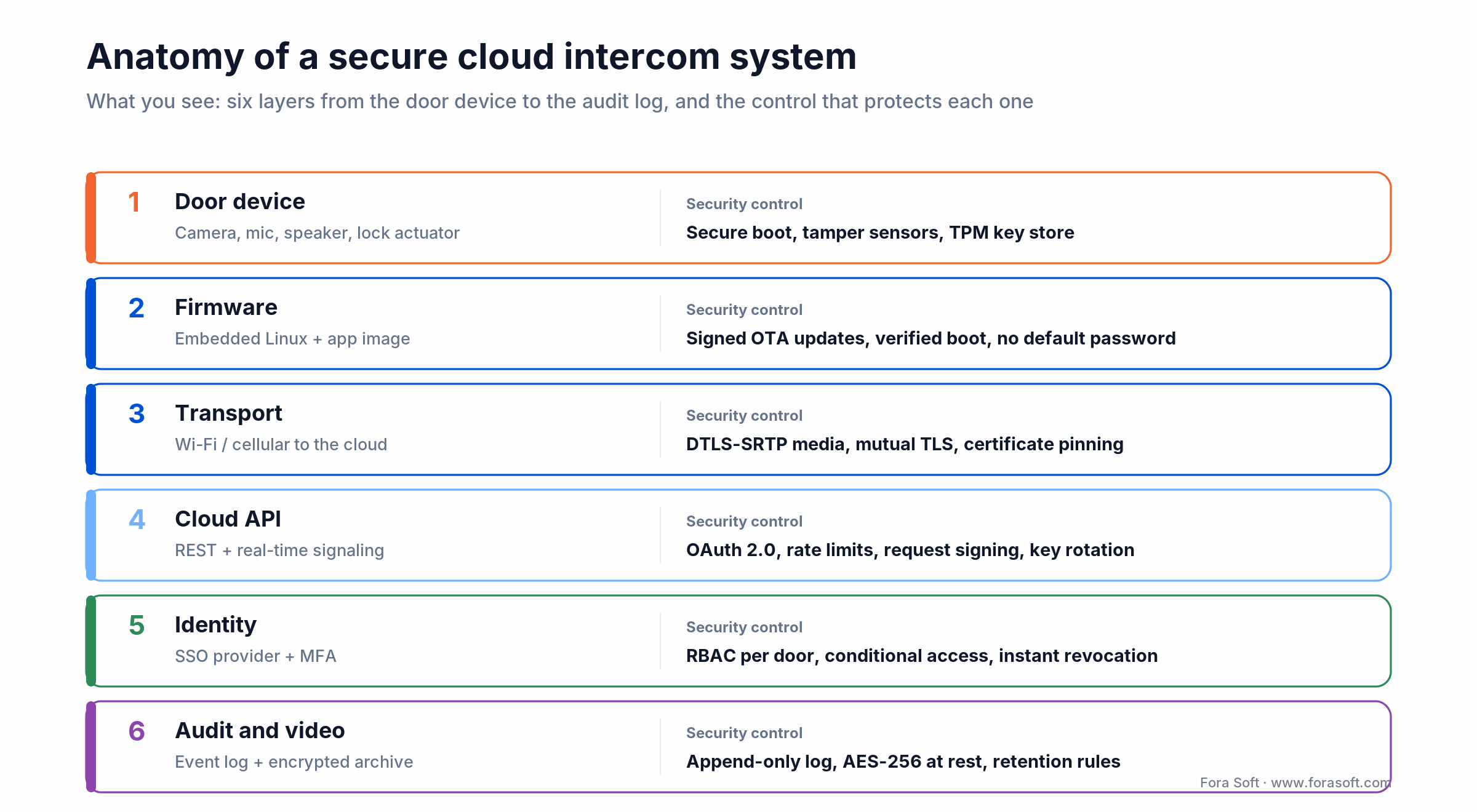
Figure 1. The six layers of a secure cloud intercom, and the control that protects each one.
Why cloud intercom security matters more in 2026
Because the intercom is now a computer on your network, and computers get attacked. Three shifts changed the calculus.
The attack surface grew. Modern intercoms run embedded Linux, an open media stack, and cloud protocols. That broadens exposure from physical tampering alone to firmware exploits, API abuse, and supply-chain risk, the same class of problems that hit every other connected device.
Regulators stopped accepting "it's physically secure." The UK PSTI Act took effect on 29 April 2024 and bans default passwords on connected devices. GDPR Article 32 requires encryption and tested safeguards for personal data, which door video plainly is. Auditors now want demonstrable, logged controls.
Remote operation widened the threat model. Legacy intercoms required you to be at the building. Cloud systems grant remote entry to anyone with the app, a huge convenience that turns weak or shared credentials into a building-wide risk.
How big is this market? Honestly, nobody agrees. MarketResearchFuture pegs the 2025 video-intercom-device market near USD 5.3B, while The Business Research Company reports USD 37.82B for 2025 and Grand View Research lands in between, a spread of nearly 10x depending on how each firm draws the boundary. Treat it as a mid-single-digit-to-tens-of-billions market growing at low-double-digit CAGR (2025 data), and ignore anyone who quotes a single precise figure as gospel.
The real threat model: two breaches worth studying
Before the benefits, sit with the failures, they tell you what to defend. Two documented incidents reframe where cloud intercom risk actually lives.
Verkada, March 2021. Attackers reached live feeds of roughly 150,000 cloud cameras, in hospitals, schools, jails, and corporate offices, using a Super Admin username and password that had been exposed publicly online. No cipher was broken. It was a credential-hygiene failure at the account layer, which is exactly where cloud entry systems are most exposed.
Akuvox E11, 2023. Security firm Claroty documented 13 vulnerabilities in a popular smart intercom. The worst, CVE-2023-0354 (CVSS 9.1), left the device's web server reachable with no authentication at all; a companion flaw let an attacker activate the camera and microphone remotely. CISA issued advisory ICSA-23-068-01, and several issues were still unpatched at disclosure. That is the firmware-and-supply-chain risk in one case study. You can read Claroty's full write-up if you want the technical detail.
The lesson from both: the headline cipher matters far less than identity, account hygiene, and a vendor's patching discipline. Keep that lens as you read the eight benefits.
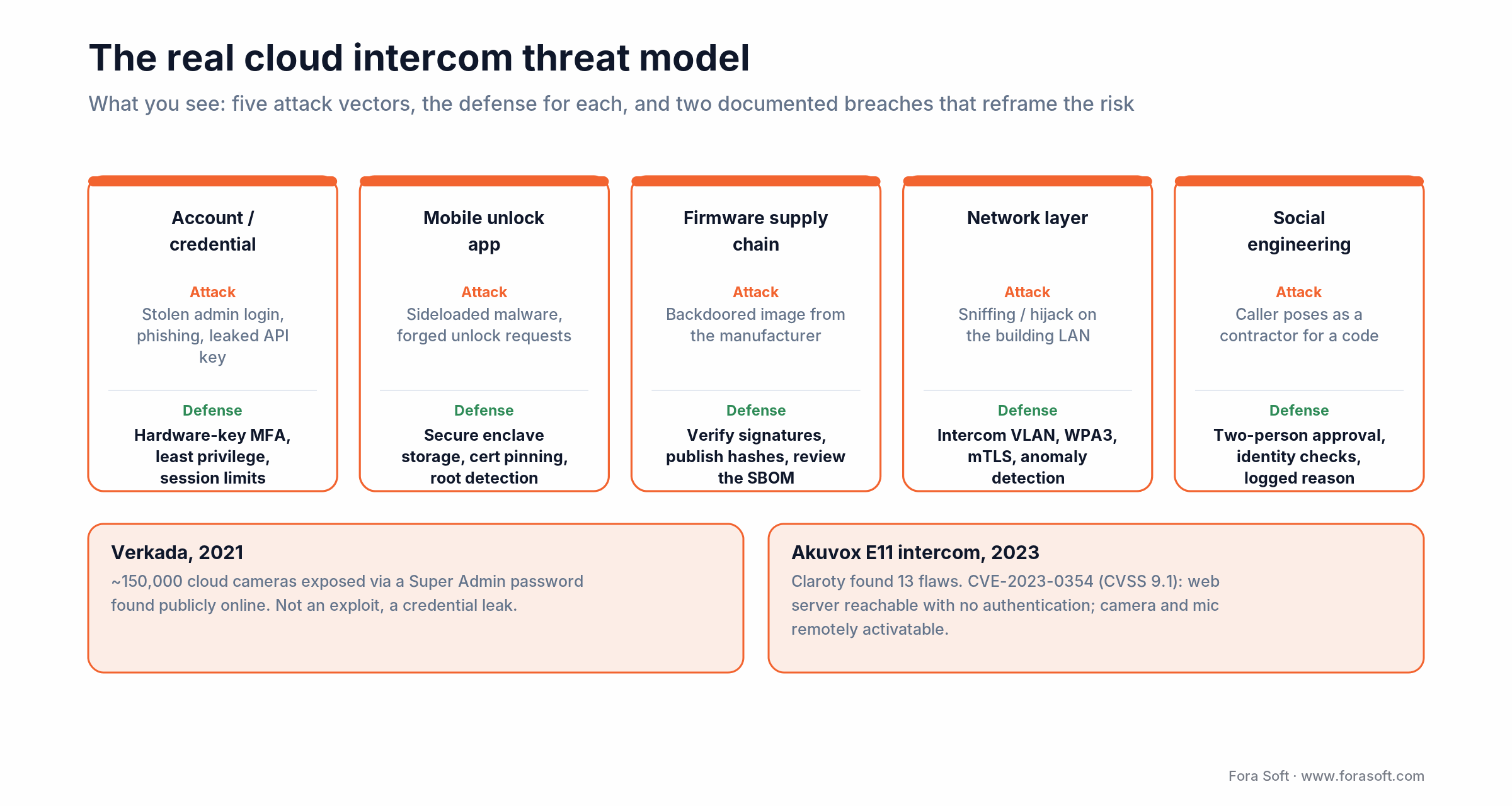
Figure 2. Five attack vectors, the defense for each, and the two breaches that reframe the risk.
Benefit 1 — Media encrypted in transit (DTLS-SRTP)
Every WebRTC-based cloud intercom encrypts audio and video in transit by design. The WebRTC specification (RFC 8827) mandates DTLS-SRTP for all media, there is no API to send an unencrypted stream. That alone beats the analog or unencrypted-IP intercoms that transmit audio in the clear.
Here is where accuracy matters, because most vendor pages overstate it. Signaling rides over TLS. In TLS 1.3 (RFC 8446), the only mandatory-to-implement cipher suite is TLS_AES_128_GCM_SHA256; AES-256-GCM is a "should," not a "must." For media, the DTLS-SRTP profile every implementation must support is SRTP_AES128_CM_HMAC_SHA1_80, with AEAD suites like AES-GCM supported and preferred where available. Perfect forward secrecy comes from ephemeral key exchange, so a later key compromise does not retroactively decrypt past calls.
One honest caveat: "encrypted in transit" is not the same as "end-to-end encrypted." When media flows through a cloud media server (an SFU), the server can see it unless the vendor ships insertable-streams E2EE. If a salesperson says "end-to-end," ask exactly where the keys live and who can decrypt at the server.
Reach for encrypted media when: you record door calls for audit, you share a building LAN with other tenants, or you need to show a GDPR Article 32 assessor that personal data is protected on the wire. Ask the vendor which exact suites they run, not just "bank-grade encryption."
Benefit 2 — Centralized identity, RBAC and MFA
Cloud intercoms bind entry to an identity, not a key. They connect to your identity provider (Okta, Microsoft Entra ID, Google Workspace) and enforce role-based access control, one source of truth for who can enter which door, when, and from where.
Role-based access control (RBAC). Define roles like "Building manager," "Delivery, 9am–5pm," or "Tenant, Unit 42." Each role maps to specific doors and time windows. When someone leaves, revoke their role once and it propagates to every door in about a minute. On a legacy system you walk to each door to re-key or reprogram it.
Multi-factor authentication (MFA). Remember Verkada: the account layer is the soft target. Enforce MFA on every administrator account, and prefer hardware security keys over one-time codes for the accounts that can open doors or delete logs. This is the single highest-impact control on the list.
Conditional access. Deny entry if the requesting device is not enrolled, if the account just logged in from a new country, or if the request falls outside policy. Legacy PIN pads and shared badges offer none of this.
Reach for RBAC and MFA when: you have more than 50 people, you run multiple sites, or you need to prove access grants were explicit and revocable, the norm in healthcare, finance, and government buildings.
Benefit 3 — Automatic over-the-air firmware updates
Cloud intercoms patch themselves over the air. When a serious vulnerability lands, an OpenSSL CVE, a media-stack bug, a signed firmware image reaches every device in hours, not the months a field-service rollout takes. The Akuvox case is the counterexample: flaws that sit unpatched because updating means visiting each unit.
A disciplined update pipeline has four parts. Devices report their firmware version on a regular heartbeat, so stale units are visible. Updates are cryptographically signed, so a hijacked network cannot inject a malicious image, the device verifies the signature before installing. Rollouts are staged (a small percentage first, watched, then widened), so a bad build is caught before it bricks a fleet. And delta patching sends only the changed bytes, which keeps bandwidth sane across large deployments.
This is also a compliance control. The UK PSTI Act and the ETSI EN 303 645 baseline both expect a defined security-update support period and no default passwords, requirements a signed-OTA pipeline satisfies directly.
Reach for automatic OTA when: you run more than a handful of doors, you cannot dispatch a technician per patch, or you operate somewhere a known exploit must close within hours rather than the next maintenance quarter.
Benefit 4 — Tamper and offline detection
A compromised intercom is worse than a broken one: it quietly lets the wrong people in. Cloud systems catch this because every device is monitored continuously instead of sitting in the dark.
Heartbeats. Each device sends a signed health signal on a short interval, firmware version, hardware state, and a challenge-response that proves it has not been cloned. Miss a couple of intervals and the system raises an alert instead of failing silently.
Physical tamper sensors. Case-open switches and accelerometers detect someone prying at the unit. On a tamper event the device logs a signed timestamp and drops into a restricted mode that requires human approval before it releases a door.
Offline resilience with reconciliation. If the network drops, a well-designed device still authenticates entries against cached credentials for a bounded window. When it reconnects, every offline entry is reconciled against the central log, and any that used a grant revoked during the outage is flagged. Legacy systems that lose power simply stop; they have no sensors and no reconciliation.
Want a security review of your intercom stack?
Bring your current architecture and the doors you need to cover. In 30 minutes we will map the gaps, account hygiene, firmware, logging, compliance, and give you an honest next step. No deck, no obligation.
Benefit 5 — Immutable audit logs and forensic video
Every entry attempt, granted or denied, is logged with proof of authenticity. That is the difference between "someone came in at 3am" (a suspicion) and "Alice released Door 42 at 03:15:47 UTC with her hardware key, from an enrolled phone geolocated in the lobby" (evidence).
Append-only trail. Logs write to storage with no delete permission, not even for administrators (for example, an object store with a legal-hold or object-lock mode). Each entry is signed, so tampering is detectable. Contrast the Verkada lesson: if a compromised admin can quietly erase logs, the trail is theater.
Forensic video. Door video is stored encrypted at rest (AES-256 is table stakes here) with per-segment hashing, so you can later demonstrate that a clip was not edited. This is the same discipline we hold ourselves to on VALT's regulated video workloads.
Retention that enforces itself. Set a rule, say, delete door video after 30 days except for denied attempts, and the system applies and logs it. GDPR's storage-limitation principle (Article 5) wants exactly this, and an auditor can verify deletions happened on schedule rather than on request.
Benefit 6 — AI visitor screening with liveness detection
Cloud intercoms can screen visitors before anyone buzzes them in. Done responsibly, it pairs face matching with liveness detection so a printed photo or a screen replay does not fool the door. Face detection can run on the device itself, so raw frames never leave the building unless matched, a privacy-by-design default.
Now the honest part, because this is where marketing runs ahead of reality. Liveness is a subset of presentation-attack detection, standardized under ISO/IEC 30107-3, and independent labs certify conformance, ask a vendor for that, not a slogan. And face recognition carries measurable demographic bias: NIST's landmark study (NISTIR 8280, 2019) found false-positive rates varied by factors of 10 to 100 across demographic groups in many algorithms, with the highest false positives for West and East African, East Asian, and Native American faces in US-developed systems. For access control, a false positive means an impostor gets in. That is why a human approval step for unknown or edge-case faces is non-negotiable.
You will see competitors claim AI screening "cuts unauthorized access 40–60%." We looked; there is no credible primary source for that figure, so we will not repeat it. What is documented: industry surveys consistently rank tailgating (people following an authorized person through the door) as a top physical-access weakness, which is precisely what visitor screening plus a logged entry event addresses.
If AI screening is central to your build, our team scopes these systems end to end, see our AI integration services, and the engineering deep-dives in our AI-for-video learning track.
Reach for AI screening when: you run high-traffic entries and want to reduce tailgating, but only with certified liveness (ISO/IEC 30107-3), a bias review, and a human in the loop for anything the model is unsure about.
Benefit 7 — Zero-trust remote entry with time-bounded codes
Cloud intercoms grant entry on demand without any shared secret, no spare key, no static PIN taped under the desk. Access is issued as a one-time code that expires, or as a role that only applies inside a defined window.
One-time entry codes. A manager taps "let John in the front door." The system issues a code valid for five minutes and that door only, delivered to John by SMS. The code is stored as a hash, checked once, and burned. It cannot be reused, and it never becomes a permanent credential floating around a group chat.
Time-bounded roles. Grant a contractor entry to one door on Tuesdays and Thursdays, 9am to 5pm. The device holds an NTP-synced clock and enforces the window locally, so it stays correct even if the network hiccups.
Real-time revocation. Change your mind and the grant is gone at the next device check-in, within about a minute. A legacy key or shared PIN cannot be recalled, once it leaks, your only option is re-keying every affected door.
Benefit 8 — Compliance mapped to the real rules
A good cloud intercom makes compliance a configuration exercise rather than an engineering project, provided you and the vendor cite the rules correctly. Most pages do not, so here is the accurate map.
| Rule | What it actually requires | Ask the vendor |
|---|---|---|
| GDPR (EU) | Article 32: encryption and tested safeguards. Article 5: storage limitation (retention). | EU data residency? Configurable retention with deletion logs? |
| UK PSTI | UK law, effective 29 Apr 2024: no default passwords, published vuln-disclosure contact, stated update period. | Unique per-device credentials? Where is your disclosure policy? |
| ETSI EN 303 645 | ETSI consumer-IoT baseline (not the EU Cybersecurity Act): 13 provisions incl. no defaults, keep software updated. | Do you self-declare or hold a lab assessment against it? |
| EU CRA | Cyber Resilience Act: in force 10 Dec 2024; main obligations from 11 Dec 2027 for connected products. | What is your CRA readiness plan for hardware sold into the EU? |
| SOC 2 Type II | Independent attestation that controls operated over 3–12 months, incl. physical/surveillance controls. | Can we see a current report under NDA (not "in progress")? |
| CCPA / CPRA | "Reasonable security" for California residents; SOC 2 is commonly used as evidence. | Do you support opt-out of biometrics and deletion requests? |
Note what we did not claim: that any single vendor "is compliant" out of the box. Compliance is a shared responsibility. The platform gives you the controls; you still configure retention, residency, and access policy to your obligations.
Cloud vs on-premise: where each wins and breaks
Is cloud strictly more secure than on-premise? No, and any guide that says so is selling. Cloud wins decisively on encryption, patch speed, revocation, remote entry, and audit integrity. On-premise still wins on data residency (everything stays on-site), on operation during an internet outage, and on a smaller attack surface (no cloud account to phish). The honest answer is that a well-run cloud system beats a neglected on-prem one on the controls that get exercised daily, while a locked-down air-gapped system wins where connectivity itself is the risk.
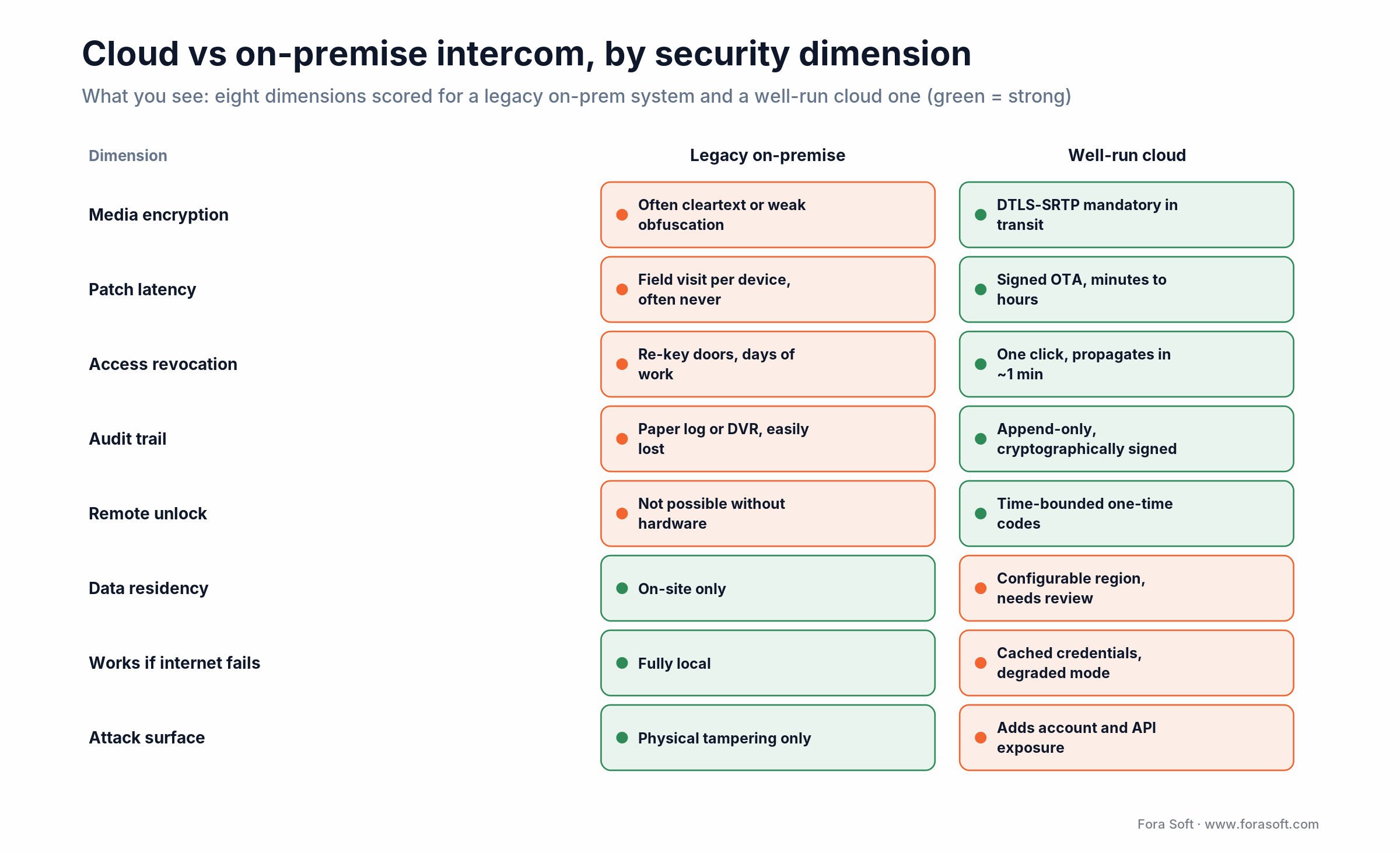
Figure 3. Eight security dimensions scored for legacy on-premise versus a well-run cloud deployment.
How to vet a cloud intercom vendor
Not all vendors deserve the keys to your building. Run this checklist before you sign, and treat the red-flag answers as disqualifying.
| Area | What to ask | Red flag |
|---|---|---|
| Account security | Can we enforce MFA and hardware keys on admin accounts? | MFA is optional, or admins share one login. |
| Firmware updates | Are updates signed? How fast do you ship a critical patch? | "Quarterly," or updates require a site visit. |
| Audit logs | Are logs append-only? Can an admin delete them? | Admins can delete logs, or retention is 30 days only. |
| Attestation | Do you hold a current SOC 2 Type II? EU data centers? | "Working on SOC 2," or US-only with no residency option. |
| Disclosure | Where is your vulnerability-disclosure policy? | None published, or they threaten researchers. |
| Exit | Can we export logs and video, and does the door still work if you fold? | No export, or the device bricks without the cloud. |
Reference architecture of a secure cloud intercom
Here is what a production-grade, security-first cloud intercom looks like end to end. Figure 1 shows the layers; the table below names the controls we hold each layer to on real builds.
| Layer | Component | Security controls |
|---|---|---|
| Device hardware | Camera, mic, speaker, lock actuator | Secure boot, tamper sensors, TPM-backed key store |
| Firmware | Embedded Linux + app image | Verified boot, signed OTA, no default password |
| Transport | Wi-Fi / cellular, NTP clock | DTLS-SRTP media, mutual TLS, certificate pinning |
| Cloud API | REST + real-time signaling | OAuth 2.0, rate limits, request signing, key rotation |
| Identity | SSO provider with MFA | RBAC per door, hardware keys, conditional access |
| Audit and video | Event log + encrypted archive | Append-only log, AES-256 at rest, retention automation |
What a secure cloud intercom costs
Security reads like a cost center until you count the labor a cloud system removes. Let us do the arithmetic for a 50-door site over three years. These are illustrative ranges, not a quote, treat them as the shape of the math, then get real numbers for your build.
A legacy path pays for hardware (roughly $30k), plus field-technician patch visits (say four visits a year across the site, landing near $45k over three years), plus re-keying and lost-key replacement (~$20k), plus manual compliance-audit labor (~$9k). That is about $104k over three years, and most of it is recurring labor.
A cloud path pays a bit more upfront for smarter hardware (~$35k) and a subscription (~$27k over three years), but field patch visits and re-keying go to roughly zero, and audit labor shrinks (~$3k) because reports export in minutes. That is about $65k, and break-even lands inside year two. The point is not the exact figure; it is that the cloud model converts unpredictable field labor into a predictable subscription.
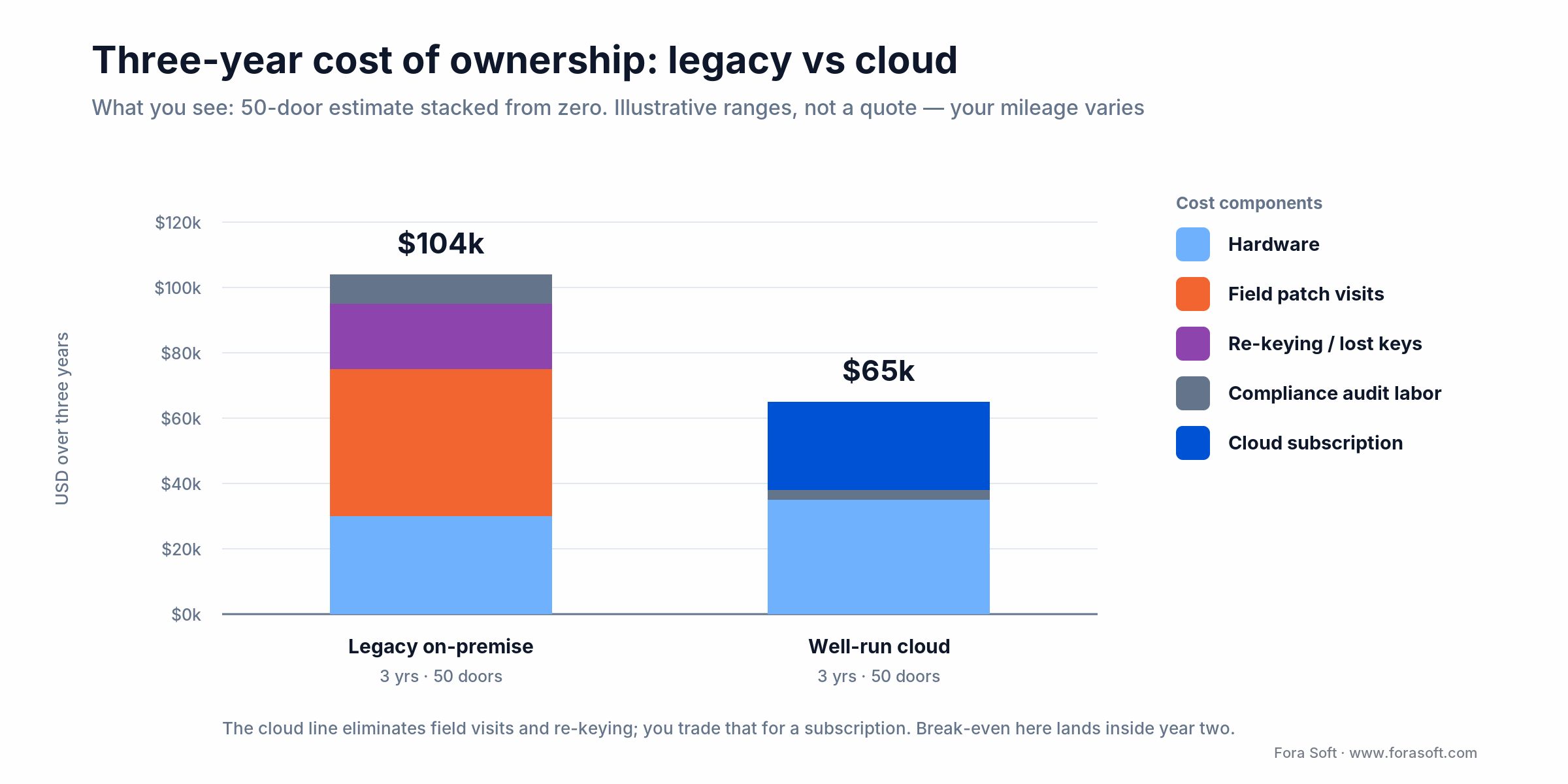
Figure 4. Illustrative three-year TCO. The cloud line trades field labor for a subscription.
Want a TCO model for your buildings?
Send us your door count and current setup. We will build the three-year comparison against a cloud deployment and show where break-even lands for you, using conservative, Agent-Engineering estimates, not inflated ones.
Mini case: security-grade video at national scale
The situation. The controls in this guide, encrypted media, immutable logs, RBAC, retention that self-enforces, are the same ones that make regulated video defensible. We have run them in production for over a decade on VALT, a video capture-and-management platform used across US organizations with strict privacy obligations.
The plan. As VALT's sole development team, we built it around the audit-first discipline an intercom deployment needs: role-based access to recordings, encrypted storage, retention policies mapped to each organization's rules, and a trail that survives scrutiny. The engineering is not glamorous, it is the boring rigor that holds up when a compliance officer or a court asks who accessed what, and when.
The result. VALT serves 770+ US organizations and 50,000+ users under HIPAA, with the sort of access logging and retention control that a cloud intercom in a hospital or courthouse demands. When we scope an entry system, this is the bar we design to. If your building carries similar obligations, book a 30-minute call and we will map your requirements to a concrete architecture.
For teams weighing a mobile-first build, our guide to Android smart intercom systems covers the device side, and custom intercom software development walks through the build path.
A decision framework in five questions
Cloud, hybrid, or on-premise? Answer these five and the pick usually falls out.
- Do you need remote entry and multi-site management? If yes, cloud or hybrid. Pure on-premise cannot do it without bolt-ons.
- Are you under GDPR or a data-residency mandate? If yes, insist on a configurable region or a hybrid model that keeps video on-site.
- Can you tolerate a door that depends on connectivity? If not, require a device that authenticates entries offline and reconciles later.
- Do you have the in-house team to run patching and DR yourself? If not, a managed cloud service beats self-hosting a "private cloud" you cannot maintain.
- Is anything about your entry flow genuinely non-standard? If yes — unusual integrations, bespoke workflows, regulated audit — a custom build on a solid platform pays off. If no, buy a proven product.
Three or more answers pushing toward "custom" or "regulated" is usually where a partner like us earns its keep. One or two: start with an off-the-shelf product and revisit in a quarter.
When a cloud intercom is the wrong call
Honesty sells better than hype, so here is when we would tell you to skip cloud, or at least go hybrid.
- Air-gapped or classified sites. If policy forbids the building talking to the internet, a cloud dependency is a non-starter. Go on-premise and accept the manual patching burden.
- Connectivity is unreliable and offline mode is not enough. A remote site with flaky links and no tolerance for degraded operation is a poor fit for a cloud-first door.
- A single door, no compliance need, no remote requirement. A basic wired intercom is cheaper and has a smaller attack surface. Do not add a cloud account you then have to secure.
- You cannot commit to account hygiene. If nobody will own MFA and credential rotation, cloud shifts your risk to the account layer — the exact failure that hit Verkada.
FAQ
Is a cloud intercom less secure than an on-premise system?
Not inherently. A well-run cloud system usually beats a neglected on-premise one because it encrypts media, patches automatically, and logs everything. The catch is that cloud adds an account layer that must be protected with MFA and hardware keys. On-premise wins on data residency and offline operation. The real risk in both is misconfiguration, not the architecture.
What is the single most important cloud intercom security control?
Multi-factor authentication on administrator accounts, ideally with hardware security keys. The 2021 Verkada breach exposed ~150,000 cameras through an admin password found online, no cipher was broken. Protecting the accounts that can open doors or delete logs matters more than any encryption spec.
Is cloud intercom video end-to-end encrypted?
Usually not in the strict sense. WebRTC mandates encryption in transit via DTLS-SRTP, but when media passes through a cloud media server (an SFU) the server can decrypt it unless the vendor implements insertable-streams end-to-end encryption. If a vendor claims E2EE, ask exactly where the keys live and whether the server can ever see plaintext.
Does a cloud intercom still work if the internet goes down?
A well-designed one keeps working in a degraded mode: it authenticates entries against cached credentials for a bounded window and reconciles the events when connectivity returns. Fire codes also require an emergency release that works without power or network, a physical key, master code, or hardwired button, logged separately. Ask the vendor to demonstrate offline behavior before you buy.
What does UK PSTI mean for intercom hardware?
The UK Product Security and Telecommunications Infrastructure Act took effect on 29 April 2024. It bans universal default passwords on connected devices, requires a published vulnerability-disclosure contact, and requires transparency about the minimum period of security updates. Note it is UK law, not EU, the EU equivalent path runs through the Cyber Resilience Act, whose main obligations apply from December 2027.
How reliable is facial recognition on a door camera?
Good enough to assist, not enough to trust blindly. NIST's 2019 study (NISTIR 8280) documented demographic bias, with false-positive rates varying by 10 to 100 times across groups in many algorithms. For access control a false positive means an impostor gets in, so always pair face matching with certified liveness detection (ISO/IEC 30107-3) and a human approval step for unknown faces.
What happens to my system if the vendor goes out of business?
You should be able to export your audit logs and video, and the device should keep working as a standalone intercom with a local code or key. Confirm both in the contract before signing: data portability and a documented offline fallback. A device that bricks without the cloud is a business-continuity risk, not just a security one.
Should we buy a product or build a custom cloud intercom?
Buy if your needs are standard and a proven product covers them, it is faster and cheaper. Build when you have non-standard integrations, bespoke workflows, or regulated audit requirements that off-the-shelf systems handle poorly. Our companion guide on custom intercom software walks through the decision, and we are happy to give an honest read on which side of the line you fall.
What to read next
Features
12 Must-Have Video Intercom Features in 2026
The buyer-side feature checklist for any intercom project.
Cloud intercom
Cloud Intercom Software: Benefits and Applications
The broader benefits view that pairs with this security deep-dive.
Devices
Android Smart Intercom Systems in 2026
The device and OS side of a modern intercom build.
Build
Custom Intercom Software: A 2026 CTO Playbook
The path from requirements to a shipped custom platform.
Video security
Secure Cloud Video Management
Encryption, retention, and compliance for stored video.
Ready to build a secure cloud intercom?
The eight benefits here are not theory. Encrypted media, central identity with MFA, signed OTA updates, tamper detection, immutable logs, careful AI screening, time-bounded entry, and correctly-mapped compliance are the controls that separate a defensible entry system from a liability. Get the account layer right and you have already dodged the failure that hit the biggest names in the category.
If you are choosing a vendor or scoping a build, we can help you avoid the traps in this guide and design to the bar we hold on our own regulated video work. Bring your door count, your compliance obligations, and your current setup.
Let's design a secure cloud intercom for your buildings
A 30-minute call with engineers who have shipped security-grade video under HIPAA. We will map your requirements to a concrete, honestly-estimated architecture.

