

Key takeaways
• A modern smart intercom system is Android underneath. Akuvox, BAS-IP, ButterflyMX, DNAKE, Comelit and DoorBird all ship customized AOSP on Rockchip, Allwinner or MediaTek chips. Your real decision is which one to license, white-label, or replace with a custom build.
• The category moved from device to platform. Buyers now expect property-management sync (Yardi, RealPage, AppFolio) and smart-lock control (Yale, August, Schlage). A standalone door camera with an app loses to an integrated property-tech stack every time.
• NDAA rewrote the shortlist. Hikvision and Dahua are off the table for any federal-adjacent property after the FCC tightened the Covered List in October and December 2025. Axis-owned 2N, Aiphone, ButterflyMX and Ubiquiti are in.
• Latency and integrations decide the experience. WebRTC calling lands at 100–300 ms door-to-phone; SIP-only over the cloud sits at 800–1,200 ms and feels broken. PoE hardware with a redundant on-prem relay is the production default.
• Realistic build budgets. A focused PoC runs $5–15k; an MVP with mobile, cloud and 2–3 PMS integrations $40–120k; multi-property production $200–800k/yr. Our Agent Engineering workflow compresses those timelines and lands us below legacy system-integrator quotes for the same scope.
Why Fora Soft wrote this guide
We've shipped real-time video, AI and surveillance products since 2005 — 250+ delivered projects, 50 in-house engineers, a 100% job-success score on Upwork. A smart intercom system sits at the exact intersection we've lived in for two decades: low-latency RTP, embedded firmware, mobile clients, and an on-prem-plus-cloud topology that can't drop a call when someone's standing at the door.
Two projects are worth naming, because they map directly onto intercom work. On VALT — a video platform used by 770+ US organizations and 50,000+ users for police interrogations, courtrooms and medical training — we synchronized nine simultaneous IP-camera feeds with AI analytics. On NETCAM we built the Android and iOS clients that pull live IP-camera video on flaky networks. This guide is what we tell property-tech founders, smart-building integrators and OEMs who are choosing between a white-label device and their own platform.
What is a smart intercom system?
A smart intercom system is an IP-connected door station that places a live video call to a resident's phone, verifies who is at the entrance, and releases the door over the network — instead of buzzing a wired handset in a hallway. The door unit is a small networked computer (almost always Android) with a camera, microphone, speaker and a relay that drives the lock. The "smart" part is the software behind it: a mobile app, cloud recording, access logs, and integrations with the building's other systems.
The practical difference from a legacy analog intercom is that everything is data. A visitor press is an event you can route, log and act on; a face at the door is a video stream you can record and search; a lock is an API call you can audit. That's why the buying decision has shifted from "which door station has the clearest picture" to "which platform integrates with the stack I already run."
Building or licensing a smart intercom platform?
Bring your hardware shortlist, the integrations you need, and a rough budget. We'll spend 30 minutes mapping a stack and giving you an honest estimate — no slide deck, no obligation.
The 2026 smart-intercom market
Estimates vary by how firms draw the boundary, so treat the number as a range, not a point. MarketResearchFuture puts the 2026 video-intercom-devices market near $5.0B; Mordor Intelligence's narrower device-only cut is closer to $3.1B; Research and Markets reports a 14.1% CAGR for the same category. The honest read: a mid-single-digit-billion market growing high single digits to low double digits, depending on scope (2026 data).
The drivers matter more than the headline figure. Most new US multifamily buildings ship with an intercom, condo associations are retrofitting at scale, and offices are consolidating lobby, parcel and access into one console. The category is moving from "door camera with an app" to property-tech platform: visitor pre-screening, parcel detection, smart-lock control, audit trail, multi-property dashboards. That's where Android earns its place — the open AOSP stack is what makes those integrations cheap to build.
Why Android specifically
Open AOSP, no OS license. Vendors customize Android 10–13 into a vertical OS. You get the Linux kernel, the camera2 API, the audio HAL, GPIO drivers and SIP libraries (PJSIP) without paying for Windows IoT or a proprietary RTOS.
Cheap, mature silicon. Rockchip RK3399/RK3568 ($15–40), Allwinner A64/H6 ($10–25), MediaTek MT8395, and Snapdragon for the premium tier. All have stable AOSP forks, tested kernels, and reference boards from a dozen ODMs, so hardware bring-up isn't a science project.
On-device AI. TFLite, NCNN and MNN run face, parcel and object detection on the SoC NPU at 10–30 FPS with no cloud round-trip. Edge inference is the difference between a 200 ms parcel alert and a 1.5 s one.
Standards, everywhere. SIP for signaling, ONVIF Profile S/T for streaming, RTSP for transport, MQTT for events. Native Android libraries cover all four. Pair that with WebRTC on the cloud side and you have a complete platform. If you're weighing where video and inference should physically run, our breakdown of edge AI versus cloud AI for video surveillance covers the trade-off in depth.
The feature set buyers expect in 2026
Here's the short version of what a serious buyer or builder now treats as table stakes. Miss a row and the product reads as last-generation.
| Layer | Must-have | Why it matters |
|---|---|---|
| Hardware | 1080p–4K camera, IP65, IR night vision, PoE | Outdoor-grade reliability on a single cable run |
| Calling | WebRTC mobile call under 1 s door-to-phone | Anything slower and visitors give up |
| Access | NFC, Bluetooth, QR, mobile-app entry | Covers resident, visitor and delivery flows |
| AI | Parcel detection 85–92%, tamper alerts | Concrete, defensible features buyers test |
| Recording | 7–30 day cloud retention + edge cache | Forensics plus offline resilience |
| PMS integration | Yardi / RealPage / AppFolio sync | Tenant and visitor data stay in one place |
| Smart locks | Yale, August, Schlage Encode Plus | Replaces the key-fob fleet |
| Compliance | GDPR / BIPA / NDAA aware by default | Litigation and procurement risk if ignored |
For the feature-by-feature deep dive that pairs with this, see our companion piece on must-have video intercom features in 2026.
Vendor matrix: 8 platforms worth shortlisting
The matrix below is how we'd triage a shortlist. NDAA posture, OS openness, cloud model and white-label freedom are the four axes that actually change a build decision. Prices are device MSRP ranges in 2026; SaaS is separate where noted.
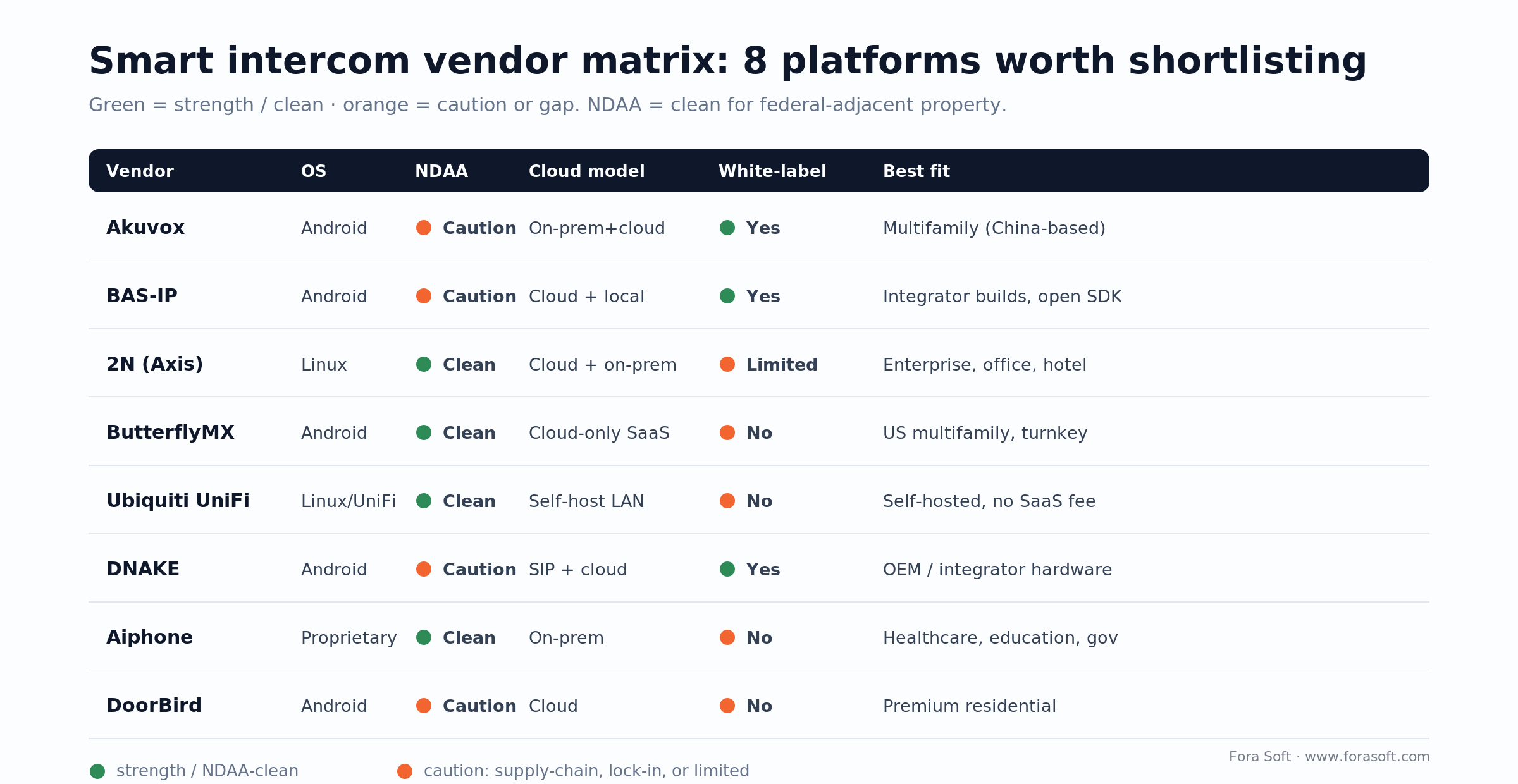
Figure 1. Eight smart intercom platforms scored on the four axes that change a build decision.
| Vendor | OS / device price | NDAA | Sweet spot |
|---|---|---|---|
| Akuvox | Android, $180–400 | Caution | Multifamily, white-label (China-based) |
| BAS-IP | Android, $150–350 | Caution | Integrator-first, open SDK |
| 2N (Axis) | Linux, $300–600 | Clean | Enterprise, office, hotel |
| ButterflyMX | Android, $400–700 + SaaS | Clean | US multifamily, cloud-first turnkey |
| Ubiquiti UniFi | UniFi OS, $200–400 | Clean | Self-hosted, no mandatory SaaS fee |
| DNAKE | Android, $150–350 | Caution | OEM / integrator SIP hardware |
| Aiphone | Proprietary, $200–450 | Clean | Healthcare, education, government |
| DoorBird | Android-based, $300–450 | Caution | Premium residential |
Two 2026 notes. First, Ubiquiti's UniFi UA-Intercom is the interesting new entrant: door release runs on the local LAN with no mandatory cloud contract, and Ubiquiti is a US-listed vendor, which makes it the easy NDAA-clean, self-hosted pick. Second, Akuvox, DNAKE and BAS-IP are excellent hardware, but they're China-based; they aren't on the FCC Covered List like Hikvision, yet a federal-adjacent buyer should still run supply-chain diligence before specifying them. Hikvision and Dahua intercoms are absent on purpose — specifying them today buys a rip-and-replace inside three years.
Reach for Akuvox, BAS-IP or DNAKE when you want white-label-friendly Android hardware to rebrand and program against an SDK; reach for ButterflyMX when you want a turnkey US multifamily SaaS; reach for Ubiquiti UniFi when you want NDAA-clean, self-hosted hardware with no SaaS lock-in; reach for 2N or Aiphone when you need an enterprise, NDAA-clean device for an office, hotel or institution.
Buy, white-label, or build?
Three paths, and the right one depends entirely on who you're selling to. Buying is for operators of a single property who just need a working system. White-labeling is for integrators and small OEMs who want their brand on proven hardware without owning firmware. Building is for product companies whose differentiation lives in software the vendor roadmap will never ship.
The middle path is where most of our clients land, and it's underrated. License Akuvox, BAS-IP or DNAKE hardware, use their SDK, and build the SaaS, mobile and integration layer yourself. You skip the 5–9 month firmware slog, you keep the IP in the parts that differentiate, and you ship faster than waiting on a vendor's backlog. The one rule: prove the SDK does what the datasheet claims before you commit — test the SIP stack, the relay control and the AI hooks in week one.
Reach for white-label-plus-custom-software when you're an integrator or OEM shipping to other buyers, you need your own brand and dashboard, and off-the-shelf SaaS can't meet your integration or compliance requirements — but full custom firmware would burn budget you'd rather spend on the app.
Reference architecture for an Android intercom platform
The architecture we ship has four layers, and the point of the design is to keep real-time signaling separate from bulky recording and event traffic so you can scale them independently.
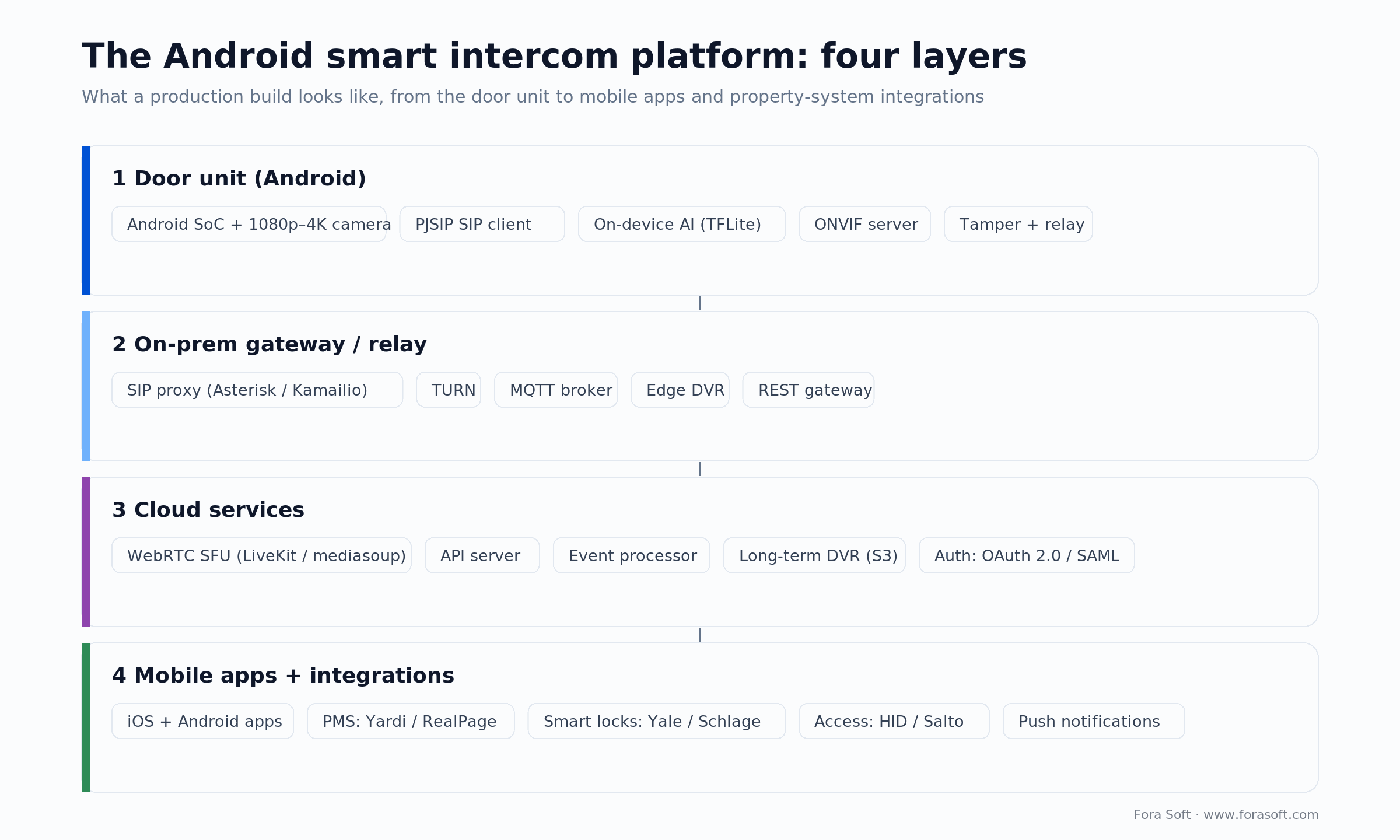
Figure 2. The four-layer stack, from door hardware to mobile apps and property-system integrations.
1. Door unit. Android SoC, 1080p–4K camera, audio codec, tamper sensor, lock relay. The embedded app runs the SIP client (PJSIP), local AI inference (TFLite), an ONVIF server, and a thin local database for the last 48 hours of events.
2. On-prem gateway / relay. SIP proxy (Asterisk or Kamailio), TURN, an MQTT broker, edge DVR, and a REST gateway for property-system integration. It costs $300–1,500 per site and cuts call latency from 800–1,200 ms (cloud-only) to 100–200 ms.
3. Cloud services. WebRTC SFU (LiveKit, mediasoup or Janus), API server, event stream processor, long-term recording (S3 or Blob), auth (OAuth 2.0, SAML for property managers), and the mobile-app back-end with push. Failover and model retraining live here.
4. Mobile plus integrations. iOS (CallKit-native UX) and Android apps; PMS integrations (Yardi, RealPage, AppFolio); smart-lock APIs (Yale, August, Schlage Encode Plus); access-control overlays (HID, Salto, Genetec); visitor platforms. The patterns that make the mobile client reliable are the same ones in our guide to building mobile apps for IP cameras.
Protocols and SDKs that earn their keep
SIP (RFC 3261) via PJSIP handles call signaling between the intercom and the gateway. WebRTC carries the device-to-mobile leg, because 100–300 ms beats SIP-over-the-cloud's 800–1,200 ms. ONVIF Profile S/T lets third-party VMS clients (Milestone, Genetec) discover and integrate the intercom on the LAN. MQTT 3.1.1 pushes events — button press, motion, tamper, parcel detected — into the property-tech stack. RTSP moves recorded streams; REST plus webhooks wire up PMS, lock and access-control systems.
If you're scoping a custom build, that short list covers roughly 95% of integrations. The rest is glue code, and the glue is where schedules slip — budget for it honestly. If WebRTC and SIP are new to your team, our video streaming fundamentals course covers the transport concepts these protocols rest on.
Need a custom AOSP build or a PMS integration?
We've built embedded Android apps, on-prem gateways, mobile clients and SaaS dashboards across smart-building stacks. Tell us where the gap is and we'll close it.
Calling latency: the number that makes it feel broken
Door-to-mobile latency is the one metric a visitor feels in their body. Under about 300 ms the call feels live; past 800 ms people assume it failed and press the button again. The call path decides which side of that line you land on.
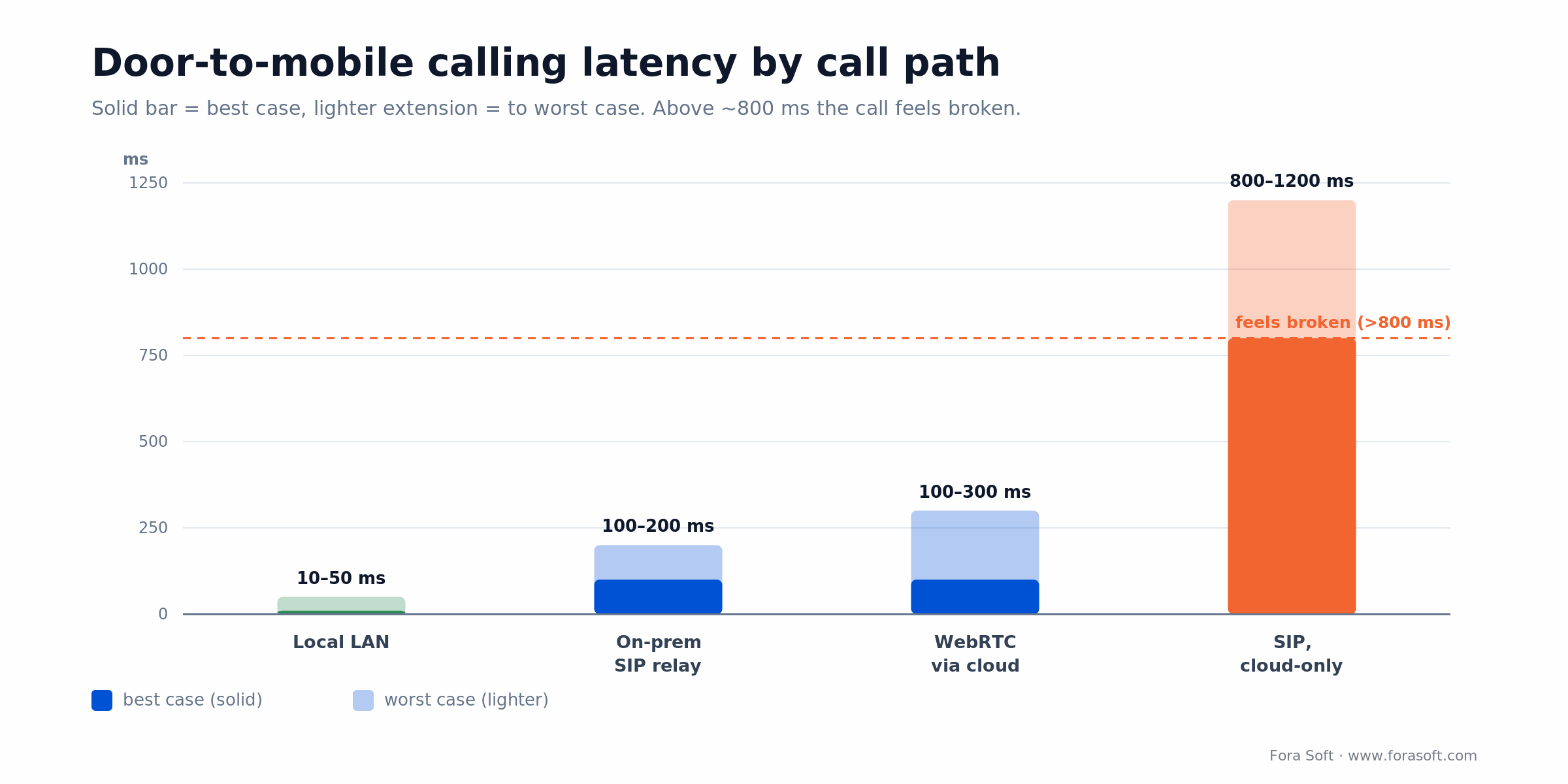
Figure 3. Measured door-to-mobile latency by call path; above the dashed line the call feels broken.
Here's the math that drives the design. A cloud-only SIP path routes every packet up to a data center and back: register, INVITE, media relay, and the round-trips stack to 800–1,200 ms. Put a small on-prem relay in the building and the media leg stays local — 100–200 ms — while the cloud only handles signaling and failover. WebRTC on the device-to-phone hop lands at 100–300 ms because it negotiates the shortest path directly. The production default we ship is on-prem gateway plus cloud failover: sub-second on a good day, still connected on a bad one.
Smart-lock and PMS integrations
Integrations are where a smart intercom system stops being a doorbell and starts being infrastructure. Two families matter: locks and property-management software.
Smart locks. Yale Connect and August expose REST APIs; Schlage Encode Plus uses Z-Wave and needs a coordinator hub. Each lock vendor adds 1–3 weeks of development. If you need multi-vendor support, delegate to an access-control abstraction (HID Origo, Salto) so you're not maintaining N one-off integrations forever.
Property-management software. Yardi, RealPage, AppFolio and Buildium are the ones buyers ask about. Their APIs change roughly quarterly, so budget 2–4 weeks per integration and treat version pinning and contract tests as non-negotiable. This is the single most common place a rollout stalls, because teams scope it as "a couple of days."
Reach for an access-control abstraction layer when you support more than two lock or credential vendors — HID Origo or Salto lets you add the third without doubling your integration maintenance, and it keeps credential logic out of the door firmware.
Compliance: GDPR, BIPA, EU AI Act, NDAA, fair housing
Compliance isn't a footer on the spec sheet; it decides whether you can sell to whole categories of buyer. Get these five right from sprint one.
GDPR. Visitor video is personal data. Default retention 14 days, 30 maximum; signage at the door; a DPIA on file; a signed DPA with the cloud processor; and a working data-subject access endpoint.
EU AI Act. Real-time remote biometric identification in publicly accessible spaces has been prohibited since 2 February 2025 (narrow law-enforcement exceptions) under Article 5, with fines up to €35M or 7% of global turnover. Other facial recognition counts as high-risk; those obligations were pushed from August 2026 to 2 December 2027 under the Omnibus deal of 7 May 2026. Don't design around the old August 2026 date — it moved.
Illinois BIPA. Face geometry is biometric data, so you need explicit written consent before collection and a documented retention and destruction policy. The August 2024 SB 2979 amendment limited repeated collection of the same identifier to a single recovery (not per-scan), and in April 2026 the Seventh Circuit held that limit applies retroactively — though Illinois state courts haven't uniformly resolved it. Still: don't enable facial recognition by default in Illinois.
NDAA. Federal contractors and federally adjacent properties cannot procure Hikvision, Dahua, Hytera, Huawei or covered subsidiaries. The FCC tightened equipment authorization in an October 2025 fact sheet and expanded the Covered List again in December 2025. White-labeling doesn't escape it — a US-sounding brand can be Hikvision or Dahua at the hardware layer, so verify the FCC ID.
Fair housing. The US Fair Housing Act forbids using facial recognition or behavioral profiling to screen or deny housing. Use recognition for visitor convenience only, with explicit opt-in, and keep it out of any tenant-approval flow.
Cost model: PoC, MVP, production rollout
These are ranges, not quotes — but they're the ranges we'd defend in a scoping call. The log scale in the chart keeps the small PoC visible next to a multi-property production line.
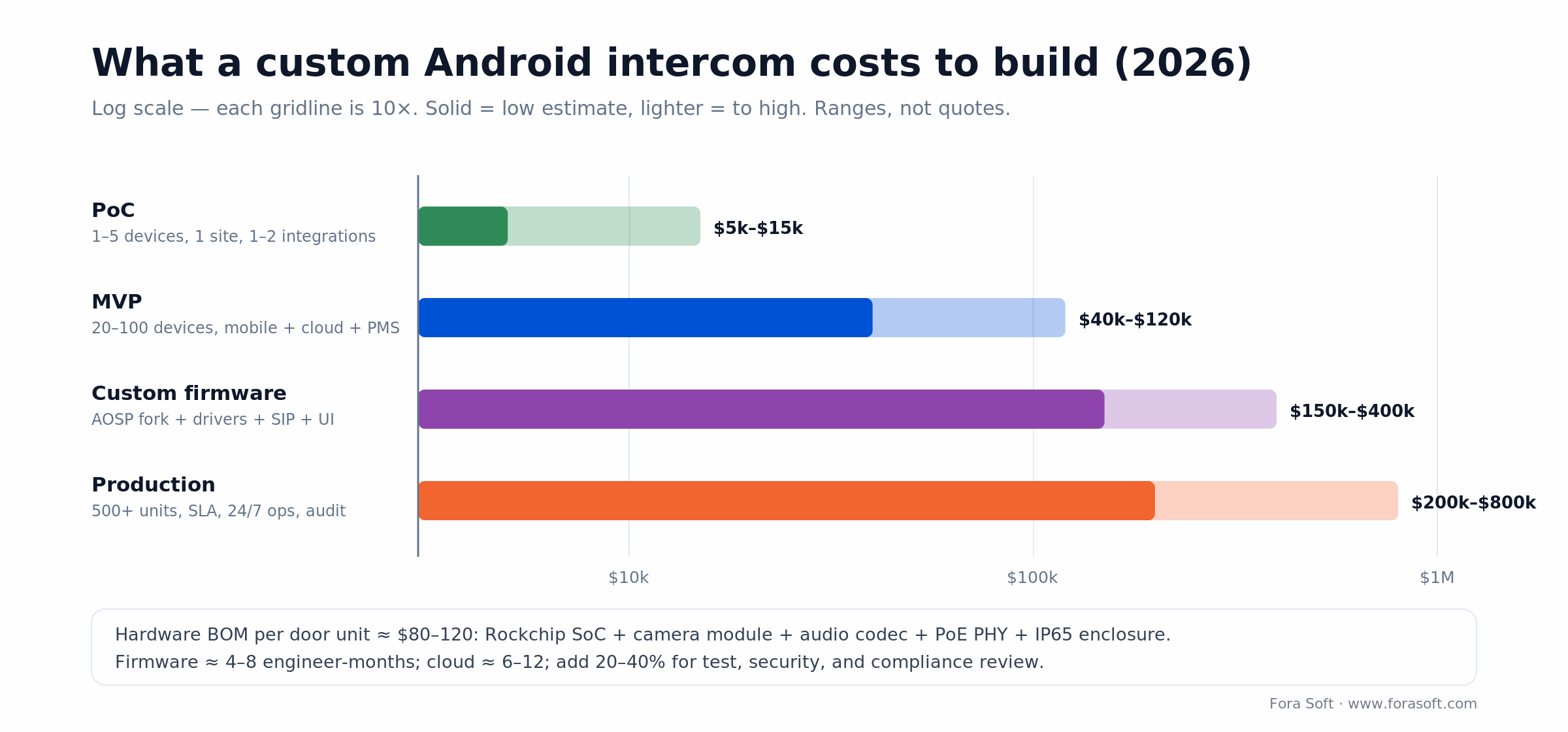
Figure 4. Build cost by stage on a log scale; solid bar is the low estimate, lighter is the high end.
| Stage | Scope | Cost | Timeline |
|---|---|---|---|
| PoC | 1–5 devices, 1 site, 1–2 integrations | $5–15k | 4–6 weeks |
| MVP | 20–100 devices, mobile + cloud + PMS | $40–120k + $1.5–8k/mo | 3–6 months |
| Custom firmware (own hardware) | AOSP fork + drivers + SIP + UI | $150–400k | 5–9 months |
| Production (500+ units, multi-region) | SLA, 24/7 ops, compliance audit | $200–800k/yr | Ongoing |
The hardware BOM for a custom door unit lands around $80–120 (Rockchip SoC, camera module, audio codec, PoE PHY, enclosure). Firmware is 4–8 engineer-months; cloud is 6–12; add 20–40% for testing, security and compliance review. Our quotes come in below legacy system-integrator vendors for the same scope because Agent Engineering compresses the integration and DevOps phases — not because we cut corners on validation.
Mini case: sub-second video access at surveillance scale
The situation. VALT, a video platform for police interrogations, courtrooms and medical training, needed operators to pull live video from many rooms at once, on demand, without the multi-second lag that plagues cloud-only surveillance. The failure mode is the same one an intercom faces: if the live view stalls, the person watching stops trusting the system.
The plan. We built a hybrid topology — local capture and relay for the real-time leg, cloud for storage, search and cross-site access — and synchronized nine simultaneous IP-camera feeds with AI analytics running against the streams. The exact split we recommend for an intercom's on-prem gateway plus cloud failover came out of this work.
The result. VALT now serves 770+ US organizations and 50,000+ users under HIPAA, with Fora Soft as the sole development team for over a decade. That's the reference we lean on when a founder asks whether sub-second, always-on video access holds up in production. If that's your question too, grab a 30-minute call and we'll walk through the topology.
KPIs to track from day one
Quality. Door-to-mobile call latency P95 under 1 s; SIP registration under 2 s after boot; mobile cold-call startup under 3 s; parcel-detection accuracy above 85%; false-tamper rate under 0.5% per 1,000 hours.
Business. Push-notification delivery above 98% within 5 s; first-call answer rate above 90% during business hours; PMS-sync success above 99% per change event; integration burden under 5% of total operations time.
Reliability. Platform uptime 99.5–99.95%; failover to the secondary gateway under 5 s; full audit-log replay for any retained event; firmware-rollout success above 99% per device.
A decision framework in five questions
Answer these five and the path picks itself.
| Your priority | Pick |
|---|---|
| One property, want it working now | License ButterflyMX or Ubiquiti UniFi; stop here |
| Federal-adjacent, must be NDAA-clean | 2N, Aiphone or Ubiquiti; verify FCC IDs |
| Your brand, minimal firmware work | White-label Akuvox/BAS-IP + custom software |
| Differentiation lives in software | Build the SaaS + mobile + integration layer |
| Own hardware, full control, at scale | Custom AOSP firmware on your own board |
If two rows describe you, you're probably on the white-label-plus-custom-software path — and that's the one where a scoping call saves the most money, because the trap is over-building firmware you could have licensed. We do that triage for free; our video surveillance practice exists for exactly this kind of build.
Reach for a custom AOSP firmware build when you're shipping your own hardware at volume, you need control over the OS image and update pipeline, and no white-label SDK exposes the camera, relay or AI hooks you depend on — otherwise license the hardware and keep your budget on software.
Five pitfalls that wreck rollouts
1. Assuming AOSP scales like desktop Linux. Vendor-customized AOSP is locked to specific kernels and SoCs. Switching hardware or bumping the OS major version usually means a 4–8 week firmware recompilation across the fleet. Plan the upgrade pipeline before you ship the first 100 units.
2. Cloud-only because it sounds cheaper. $15–50/mo per device feels small until you hit 100+ devices, where recording storage, event processing and SIP signaling add $500–3k/mo. An on-prem gateway (about $1.5k one-time) breaks even in 6–12 months and fixes latency at the same time.
3. Treating NDAA as a later problem. A Hikvision intercom saves $2–3k up front and disqualifies you from every federal-adjacent property. State-level restrictions keep spreading. Buy clean from day one.
4. Skipping integration tests in the PoC. Yardi and RealPage APIs change quarterly; lock APIs change less but drag in VPN-side relays. Budget 2–4 weeks per PMS or lock vendor, not two days.
5. Sloppy consent UI. GDPR and BIPA enforcement keeps accelerating. Facial-recognition consent has to be granular, logged and versioned inside the app, not buried in terms. Bake the consent state into the database from sprint one, or you'll retrofit it under legal pressure later.
When you should NOT build a custom intercom
If you run a single property, want a working video door system, and don't need PMS integration or your own brand, license one of the vendors above and move on. Custom firmware and a custom SaaS only pay back when you're shipping a product to other buyers — an OEM, an integrator, a multi-property operator — or you have integration and compliance needs off-the-shelf can't meet.
The honest failure case for a custom build is the founder who wants "our own intercom" for a portfolio of a few dozen doors. The economics don't work at that size; the white-label-plus-software path gets you 90% of the differentiation for a fraction of the cost. We'll tell you that on the call rather than take the bigger project.
FAQ
What is a smart intercom system?
It's an IP-connected door station that video-calls a resident's phone, verifies the visitor, and releases the door over the network. The door unit is a small Android computer with a camera, mic, speaker and lock relay; the smarts are the app, cloud recording, access logs and integrations behind it.
How much does a custom smart intercom system cost to build?
A PoC runs $5–15k (4–6 weeks). An MVP with mobile, cloud and 2–3 PMS integrations is $40–120k (3–6 months). Full custom firmware on your own hardware is $150–400k (5–9 months). Production at 500+ units lands $200–800k/year ongoing.
What's the best smart intercom system for an apartment building?
For US multifamily, ButterflyMX is the turnkey cloud-first pick; Akuvox and BAS-IP are strong white-label choices for integrators; Ubiquiti UniFi suits operators who want to self-host with no SaaS fee. Match the choice to your PMS and whether you need your own brand.
Can I upgrade an old Aiphone or analog intercom to a smart system?
Usually yes, with a retrofit door unit and a relay tie-in to the existing lock and door-release wiring. The video and calling move to IP; the physical release can stay. Budget a site survey first — older buildings hide surprises in the door-strike wiring.
Can I integrate Yale, August, or Schlage smart locks?
Yes. Yale Connect and August expose REST APIs; Schlage Encode Plus uses Z-Wave and needs a coordinator. Each vendor adds 1–3 weeks of development. For multi-vendor support, delegate to an access-control abstraction (HID Origo, Salto) instead of maintaining separate integrations.
What latency should I plan for door-to-mobile calling?
On-prem SIP relay: 100–200 ms. Cloud-only SIP plus WebRTC: 800–1,200 ms. Local LAN call: under 50 ms. Most production deployments run an on-prem gateway plus cloud failover to balance cost, latency and resilience.
Are Hikvision and Dahua intercoms still safe to deploy?
Not for federal-adjacent properties or any project that may bid on government work. NDAA Section 889 prohibits them, and the FCC tightened the Covered List in October and December 2025. Treat them as non-viable for new deployments, and check FCC IDs on white-label hardware.
Does facial recognition require explicit consent?
Yes, under GDPR, the EU AI Act and Illinois BIPA. It has to be opt-in, granular, logged, and stored as state in the database, not just in terms and conditions. Most NDAA-clean vendors disable facial recognition by default and require an explicit enable.
What to read next
Features
12 Must-Have Video Intercom Features in 2026
The buyer-side feature checklist for any intercom build.
Mobile
Build Powerful Mobile Apps for IP Cameras
The mobile-client patterns that pair with Android intercoms.
Architecture
Edge AI vs Cloud AI for Video Surveillance
The latency math behind sub-second door-to-phone calling.
Cloud
Android Cloud Video Management: 2026 Build Guide
The cloud back-end patterns behind multi-site video access.
Trends
2026 Android Video Surveillance Trends
Five AI features reshaping mobile-first surveillance and intercoms.
Ready to ship a smart intercom system that scales?
Pick the device by NDAA posture and SDK depth, run an on-prem gateway plus cloud failover for sub-second calling, treat PMS and smart-lock integrations as first-class features, and bake GDPR, BIPA and NDAA into the architecture from sprint one. The Android stack does the rest.
If you'd rather not run that matrix alone, that's the call we like to take. Bring your hardware shortlist, your integrations and your scale targets. We'll bring 20+ years of real-time video and AI delivery and an estimate we can defend line by line.
Let's scope your smart intercom build
Bring requirements, integrations and rough numbers. We'll come back with an architecture, a clear shortlist and a quote we can defend.

