


A modern video intercom system in 2026 is part camera, part softphone, part access controller, part audit log. The hardware is cheap. The platform behind it (cloud routing, mobile push, smart-lock integration, AI face and package recognition, encrypted SRTP, multi-tenant directory sync) is what separates a working deployment from one that gets quietly abandoned by month six. The 12 features below are the ones that decide whether your video intercom system is the front door to your building or another piece of dead hardware. (For the deeper wiring of how the media actually flows, see our 2026 video-and-audio architecture playbook.) Get them right and call-answer rates jump from 35% on the speaker to 72% on the app. Get them wrong and 58% of users stop opening the app inside half a year.
Key takeaways
• Mobile-first is the only acceptable design in 2026. Native iOS/Android apps with push delivery under 1 s are now the call-answer baseline.
• Encrypt every media path. SRTP + DTLS for video and audio, TLS 1.3 for control. 87% of 2026 enterprise deployments require it — up from 32% in 2022.
• AI changes the game on theft and tailgating. Face match, license-plate recognition, and package detection now hit 94–99% accuracy on intercom-class hardware.
• Compliance is the procurement filter. NDAA Section 889 already excludes Hikvision and Dahua from US federal work. GDPR, HIPAA, and ADA shape commercial RFPs too.
• Custom intercom only beats vendor when scale or vertical is extreme. Below 1,000 doors, Aiphone, 2N, Comelit, and DoorBird usually win on TCO. Above that, custom platforms pay back in 12–18 months.
Why Fora Soft wrote this playbook
Fora Soft has shipped 250+ projects in 21 years with a deep specialty in real-time video, WebRTC, and surveillance. We have built and integrated intercom software with the major SIP and ONVIF stacks, shipped courtroom-grade video evidence systems (V.A.L.T.), production VMS for thousands of small-business sites (Netcam Studio), and aerial surveillance pipelines (DSI Drones). The same WebRTC, encryption, and mobile-app patterns that power those products are what a 2026 intercom needs.
We use AI agents on every engagement now, and our internal AI integration practice ships features 30–50% faster than traditional teams. So when this guide names a feature, we have either built around it, integrated with it, or replaced something broken in production with it. Treat it as a working procurement spec, not a vendor brochure.
Building or modernizing a video intercom in 2026?
A 30-minute call with our intercom and access-control team. Bring your door count, your tenant directory, and your top three pain points — we will leave you with a prioritized roadmap.
The 2026 video intercom market in numbers
A short market map. Figures are observed 2026 ranges triangulated across Research and Markets, Mordor Intelligence, IPVM and 2026 security surveys; absolute market size varies widely by scope, so we lead with growth rate.
| Metric | 2024 | 2026 | Note |
|---|---|---|---|
| Market growth (CAGR) | — | ~10–14% | Device market ~$44–54B (scope varies) |
| Encrypted media (SRTP/DTLS) | ~32% | 87% | Now mandatory in enterprise |
| Mobile call-answer rate | 35% (speaker) | 72% (mobile app) | 2x improvement |
| Multi-tenant residential w/ AI face | ~22% | 54% | Tailgating reduction driver |
| US package-theft losses | — | $12–15B | 100M+ pkgs, ~1 in 3 homes (2025) |
The story is simple: encryption went from optional to mandatory, mobile-first doubled call-answer rates, and AI features (face and package) crossed the cost-justification line in residential and commercial alike.
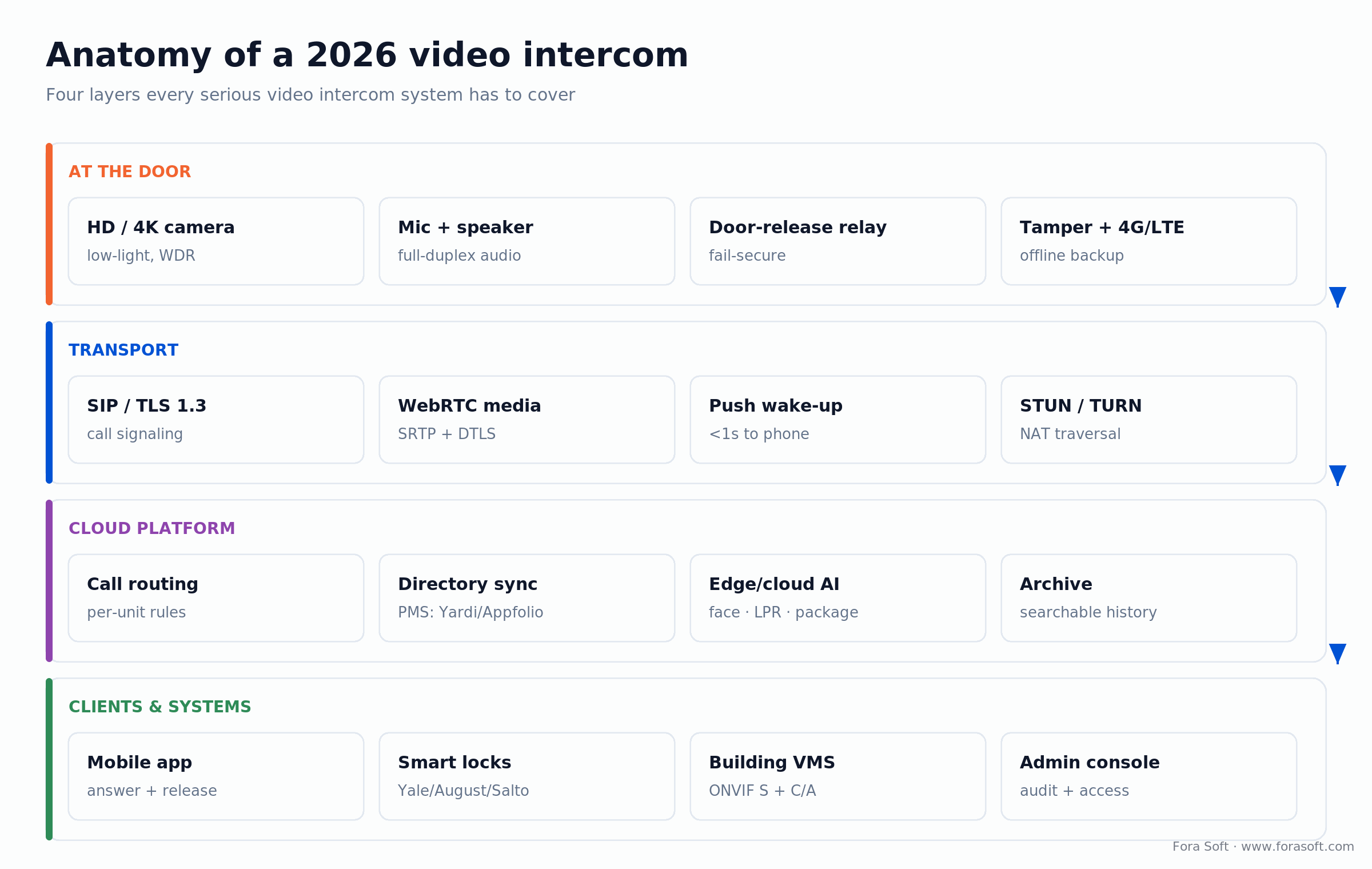
Figure 1. The four layers every serious 2026 video intercom system has to cover, from door hardware to client apps.
Feature 1 — HD or 4K video with low-light performance
1080p at 30 fps as a 2026 baseline; 4K at 15–24 fps for premium positioning. Wide dynamic range to cope with backlit doorways, infrared or starlight sensors for nighttime identification without a glowing IR ring (which advertises that the door is being watched). 92% of enterprise deployments now require HD minimum.
Why it matters. If the operator cannot read a face or a license plate from the call screen, the intercom failed at its primary job. Low-light performance down to 0.3 lux (Aiphone H4) vs. 2–5 lux on budget models is the difference between an investigation and a shrug. Hardware cost: $200–600 HD; $600–1,500 4K with AI.
Feature 2 — Two-way audio with noise suppression
Full-duplex voice with echo cancellation, wind-noise filtering, and automatic gain control. OPUS or G.711 codec for SIP/cloud interoperability. Target: SNR > 40 dB, echo cancellation > 60 dB, latency under 150 ms.
Why it matters. Poor audio is the #1 driver of intercom abandonment. 45% of 2024–2025 deployments tracked low usage to feedback, echo, or unintelligible incoming voice. HIPAA-grade clinics and senior care need clear audio for medical communication, not just convenience.
Reach for premium audio when: the deployment is healthcare, senior care, or a compliance-heavy environment where conversations carry legal or medical weight.
Feature 3 — Mobile app with push-call delivery
Native iOS and Android with push notifications, in-app call answering, and one-tap door release. Push delivery target: under 1 second from button press to phone alert. Mobile call-answer rate (72%) is more than double the legacy speaker rate (35%).
Why it matters. Tenants and staff are not at the desk or hallway when the door rings. The mobile app is the call destination in 2026, with 65% of deployments shipping one and 84% adoption in residential multi-tenant. Anything else fails to be answered. Cost: $3,000–8,000 white-label, $200–600/month cloud push service.
Feature 4 — Cloud-based call routing
Centralized configuration of where each unit’s call goes: mobile, office line, secondary contact, "do not disturb," seasonal-tenant routing. Cloud routing setup takes < 5 minutes per unit; on-site programming used to take 20–45 minutes per unit. Roaming follows the user when they travel.
Why it matters. Multi-tenant residential turnover averages 15–30% per year. Without cloud routing, the property manager re-programs every door panel manually. With cloud, the directory updates in minutes, and access revocation flows automatically. Cost: $3–12 per unit per month; routing API integration $2,000–6,000 one-time.
Feature 5 — AI face and license-plate recognition
On-device or cloud face matching against a tenant database for hands-free entry; license-plate recognition for vehicle access and parking integration. Face detection accuracy 98%+, 1:1 identification 99.5%, 1:N search 96–98%; LPR 94–98% on US plates. Processing under 500 ms on-device.
Why it matters. Tailgating is the most common access-control failure. AI face flags unknown persons in real time and either blocks entry or alerts the operator. Cost: $800–2,500 facial recognition module per intercom; $0.50–2.00 per 1,000 cloud-API faces. Privacy gotcha: EU and Illinois (BIPA) impose strict consent rules on biometric data, so document the model and offer opt-out.
Reach for AI face / LPR when: tailgating or unauthorised entry is your top access incident, or your parking flow needs hands-free vehicle recognition. Skip it if your jurisdiction (EU AI Act, BIPA) makes biometric consent paperwork heavier than the gain.
Feature 6 — Package detection
Automatic detection of delivered parcels with motion + object filtering, instant resident notification, 30-day searchable history, and a QR-code "package hold" that drivers can read. Detection accuracy 94–96%, alert latency under 3 seconds.
Why it matters. US porch piracy ran to roughly $12–15B in consumer losses across 100M+ stolen packages in 2025, with roughly one in four households hit in a year (SafeWise, Omnisend 2025). Package detection is now the most-asked-for feature in residential RFPs (71% of multitenant deployments). Cost: $500–1,500 edge AI per intercom; $2–5/month per unit for cloud archive.
Feature 7 — Encrypted SRTP and DTLS
Voice and video on Secure RTP. Media on DTLS (Datagram TLS). Control on TLS 1.3. Zero unencrypted media paths. Adoption jumped from 32% in 2022 to 87% by 2026 — in part because the FCC and various state regulators now warn about intercom eavesdropping risk.
Why it matters. Intercom audio leaks sensitive conversations — a clinic, a corporate office, a courtroom annex. Unencrypted SIP is trivially man-in-the-middle attackable. Cost: SRTP/DTLS open standard, $0; SIP TLS termination $1,500–4,000 for the cloud gateway. Watch out: some vendors ship SRTP available but disabled by default. Audit before deployment.
Feature 8 — Smart-lock integration (Yale, August, Salto)
Direct relay closure or IP/BLE command to release the lock; "visitor mode" generates a temporary entry code; every door-release event is logged with who, when, and from which device. 78% of enterprise deployments now expect lock integration as a standard line item.
Why it matters. Contactless entry, no lost keys, ADA-compliant audit trails for visitor access. Cost: smart lock $300–800 per unit; relay $50–200; API integration $2,000–5,000 one-time. Reliability rule: spec a high-cycle-rated lock (Yale Assure SL, August Smart Lock) — budget locks fail mechanically inside 2–3 years on heavy-use buildings.
Feature 9 — Tenant directory and access-control sync
Automatic sync of resident or occupant data from the property management system (Yardi, Appfolio) or building access-control system. Tenant moves and updates land in the intercom directory inside 5 minutes; access revocation on move-out is automatic and audited.
Why it matters. A 200-unit building with 25% turnover is 50 directory changes a year. Without sync, somebody is updating a spreadsheet and re-programming panels. With sync, the building manager works in their PMS and the intercom catches up automatically. Cost: PMS integration $3,000–8,000; directory service $5–15 per unit per month.
Feature 10 — Multi-tenant call routing and searchable directory
Single building entry with hundreds or thousands of call destinations: apartments, hotel rooms, office departments. The visitor searches by name or unit number on the door panel; the call routes to the right tenant’s app. 84% of multitenant residential deployments now require a searchable directory at the entry.
Why it matters. Phone-directory style routing reduces visitor friction and operator load. Speaker-menu navigation is the legacy pattern users hate.
Reach for searchable directory routing when: the building has > 50 units or hosts non-residents (deliveries, hotel guests, contractors) on a daily basis.
Feature 11 — Tamper detection and offline 4G/LTE backup
Vibration and motion sensors detect attempted tampering; the device fails secure (no unauthorized entry). 4G/LTE failover within 5 seconds of internet loss; local 24–72 hour video buffer survives a WAN outage. Offline call success rate: 99.7%.
Why it matters. Vandalism, sabotage, and SIP-hijacking attacks happen. 64% of enterprise deployments now require offline backup calling. Tamper alerts cut repair time from days to under an hour. Cost: 4G/LTE module $150–400 per unit; cloud failover $2–5 per unit per month.
Feature 12 — VMS integration and audit logs
Intercom video and call events automatically archive in the building VMS via ONVIF. A call, a door release, a denied access: each one creates a VMS incident case. Forensic search across intercom and VMS lands in under 2 seconds. 73% of enterprises now require VMS-intercom integration; HIPAA and legal discovery depend on unified logs.
Why it matters. "Visitor called at 2:15 PM, tenant buzzed in, entry happened at 2:16 PM" only works if the records are in the same place. Cost: $2,000–5,000 for the intercom-VMS module; ONVIF stream integration is $0 standard.
The 12 features at a glance
| # | Feature | Quantified gain | Typical cost | 2026 vendors |
|---|---|---|---|---|
| 1 | HD/4K + low light | 0.3 lux readability | $200–1,500/unit | Aiphone H4, 2N, DoorBird |
| 2 | Full-duplex audio | SNR > 40 dB | $0–500 codec | Aiphone, 2N, Comelit |
| 3 | Mobile push-call | 35% → 72% answer | $3k–8k app + cloud | Aiphone Connect, 2N Mobile |
| 4 | Cloud routing | 5 min vs. 45 min/unit | $3–12/unit/mo | AiPhone Hub, 2N CloudCom |
| 5 | AI face + LPR | 99.5% 1:1 ID | $800–2,500/unit | Aiphone, 2N AccessNow |
| 6 | Package detection | 94–96% accuracy | $500–1,500/unit | Aiphone H4, 2N VariFocal |
| 7 | SRTP + DTLS | Zero unencrypted media | $1.5k–4k gateway | 2N native, Aiphone selective |
| 8 | Smart-lock integration | < 2 s door-release latency | $300–800 lock | Yale, August, Salto |
| 9 | PMS directory sync | < 5 min sync | $3k–8k integration | Aiphone, 2N API-first |
| 10 | Searchable directory | 500+ concurrent units | $1.5k–3.5k setup | AiPhone Hub, Comelit |
| 11 | Tamper + 4G failover | 99.7% offline call | $150–400 LTE module | Aiphone, 2N redundant |
| 12 | VMS integration | Unified incident search | $2k–5k module | Genetec, Milestone, Avigilon |
The 2026 video intercom vendor map
Established / enterprise. Aiphone (Japan) holds roughly 18% of the market by shipment volume and installed base (Mordor Intelligence, 2026) and is the commercial and healthcare specialist, HIPAA-ready. 2N, an Axis company, is SIP-native with the deepest enterprise access-control integration. Comelit (Italy) is a multi-tenant residential mainstay in Europe. Verkada pushes cloud-only intercoms in SMB and in 2026 demoed live captions, language auto-detect and near-real-time voice translation during calls.
Cloud / multifamily challengers. ButterflyMX (mobile-first, property-management APIs, FTV Capital-backed since January 2025) and Swiftlane (its SwiftReader X pairs two-way HD video, an IK10 vandal rating and facial recognition with a top-rated app) are the names that dominate the 2026 apartment and commercial buyer guides. Both skip in-unit hardware and route the call straight to the resident’s phone.
Mid-market and consumer. DoorBird (Germany, rental retrofits) and Akuvox (cost-competitive, education and hospitality) sit mid-market. August (a Yale brand) and Ring cover residential retrofits and small business but lack enterprise feature depth.
NDAA Section 889. Hikvision and Dahua are named on the federal prohibited list, and the ban reaches every camera, recorder, NVR, encoder and intercom they make — including OEM units built for other brands. The 889(a)(1)(B) “use” ban has bound federal contractors since August 13, 2020, regardless of whether the gear touches a federal contract. Enforcement tightened in late 2025: the FCC pressed major online retailers to pull millions of prohibited listings, and a December 2025 Federal Register action reinforced the equipment-authorization block. Private buyers without federal ties face no outright federal prohibition, but most enterprise RFPs now default-exclude these brands on supply-chain grounds. Aiphone, 2N, Comelit, ButterflyMX, Swiftlane, DoorBird, August and Ring are the compliant defaults.
The protocol stack — SIP, WebRTC, ONVIF
SIP (RFC 3261). The classic VoIP signaling layer. Aiphone, 2N, and Comelit all use SIP for call setup. Port 5061 with TLS is the modern requirement; port 5060 unencrypted is deprecated. Cloud SIP proxies usually beat direct intercom registration on NAT traversal.
WebRTC. Peer-to-peer media for the mobile app, used by Aiphone Connect, August, and Verkada. Latency 300–800 ms, requires STUN/TURN servers for NAT traversal. The right pattern for low-latency push calls in 2026.
ONVIF. Not the primary intercom protocol but increasingly important. Profile S carries the video stream into the building VMS, while Profile C and Profile A standardize door control and access events — access granted or denied, credentials, schedules — so the VMS can index every entry. Specify Profile S as the streaming baseline and Profile C/A for any deployment that wants unified, vendor-neutral incident logs. Profile M (metadata and analytics) is the right home for AI events like face or package detection, not door control.
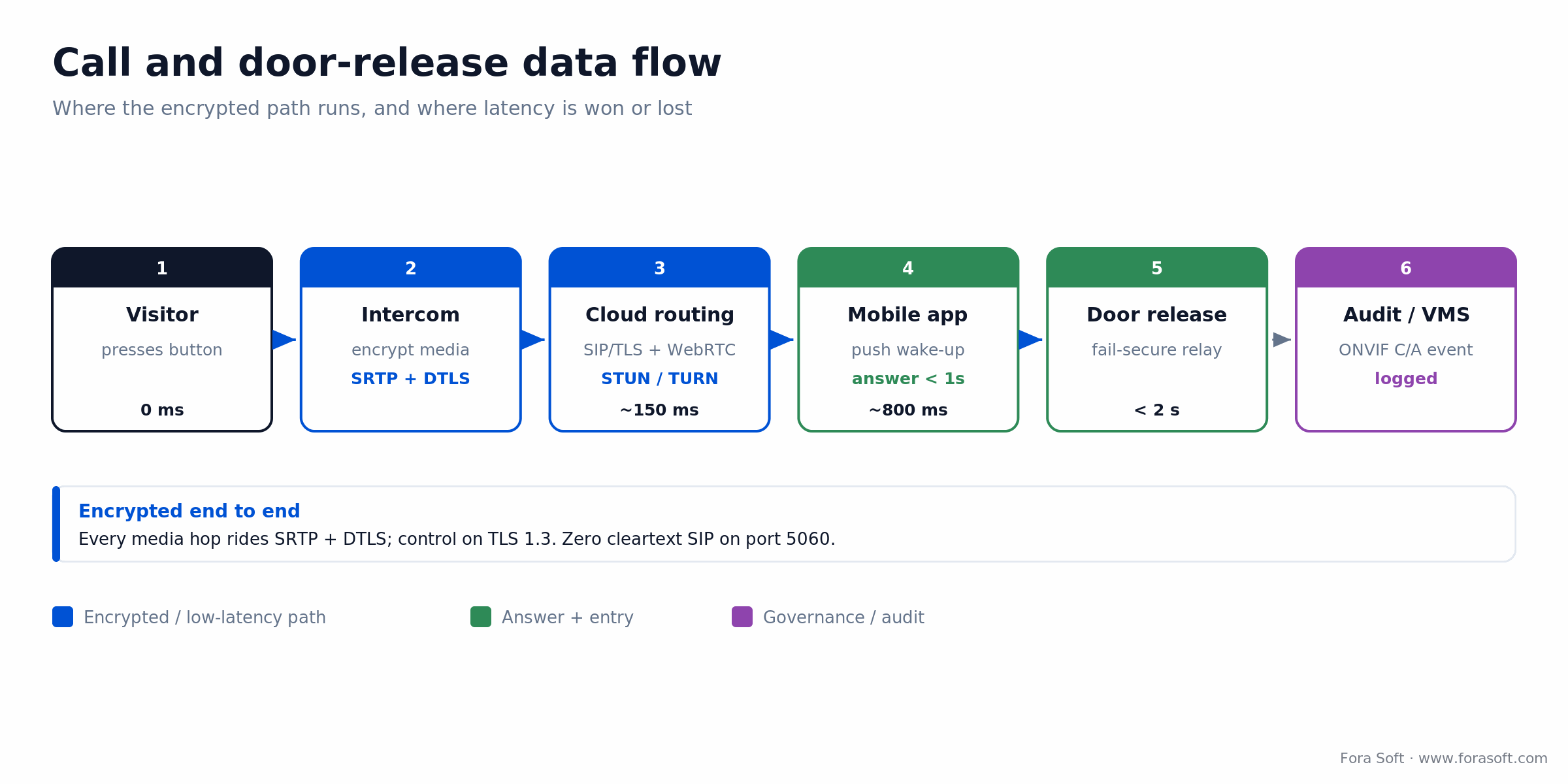
Figure 2. How a call travels from the door to the phone and back to a fail-secure door release — and where the encrypted path runs.
Compliance and accessibility — GDPR, HIPAA, ADA, NDAA
GDPR. Intercom video is personal data. Default retention 72 hours, longer only with documented justification. PII redaction policies needed. Compliant: 2N, Aiphone, Comelit (EU-native).
HIPAA. Healthcare clinics and senior care need encrypted SRTP, audit logs with 6-year retention, and role-based credentials. Aiphone is HIPAA-certified; 2N is HIPAA-ready.
ADA. Visual ringing indicator (LED), hearing-loop / T-coil support, high-contrast buttons, voice guidance with adjustable volume. 62% of 2026 commercial deployments include ADA-compliant intercoms; residential is at 38% and rising as state codes catch up.
NDAA Section 889. US federal procurement has excluded Hikvision, Dahua and ZTE video-surveillance gear since the FY2019 NDAA — the procurement ban took effect August 13, 2019 and the contractor “use” ban on August 13, 2020. Even outside federal contexts, most enterprise RFPs now treat them as non-starters because of supply-chain due diligence policies.
Want a feature-by-feature scorecard for your intercom?
Send us your door count, vendor mix, and biggest pain point. We will return a 12-feature scorecard plus a custom build estimate — free.
Feature adoption by vertical — what each market really buys
Different verticals weigh the 12 features differently. The matrix below maps the 2026 reality.
| Vertical | HD video | Mobile app | AI face | Smart locks | Package detect |
|---|---|---|---|---|---|
| Multi-tenant residential | 92% | 84% | 71% | 65% | 51% |
| Enterprise / office | 88% | 76% | 45% | 38% | 22% |
| Healthcare (clinics, senior care) | 94% | 82% | 28% | 12% | 5% |
| Hospitality (hotels, resorts) | 86% | 41% | 18% | 5% | 8% |
Three patterns. Healthcare leads on encryption and HIPAA but trails on AI face (patient privacy concerns). Multi-tenant residential leads on every feature except smart locks where badge readers dominate the enterprise market. Hospitality lags on mobile because guests do not install apps for short stays.
A decision framework — pick your intercom in five questions
Q1. What is your vertical? Multi-tenant residential needs cloud routing, mobile-first, package detect, AI face. Enterprise office needs SIP/UC integration, badge access, audit logs. Healthcare needs HIPAA-grade encryption and ADA compliance. Hospitality needs SIP/PMS integration and short-cycle setup.
Q2. How many doors and units? Below 50 doors — DoorBird, August, or Akuvox. 50–500 — Aiphone, 2N, Comelit. 500–5,000 — Aiphone Hub or 2N CloudCom with PMS integration. Above 5,000 across multiple buildings — custom build territory.
Q3. What is your compliance footprint? US federal — Aiphone, 2N, Comelit, DoorBird (no Hikvision, Dahua, Akuvox). EU — 2N or Comelit lead on GDPR. HIPAA-bound — Aiphone or 2N.
Q4. Who maintains the directory? Building staff with PMS access — choose a vendor with native Yardi or Appfolio integration. No PMS — manual upload or basic CSV; expect higher operational overhead.
Q5. What is your network reality? Behind corporate NAT or strict firewall — mandate cloud SIP proxy, never direct SIP registration. WAN reliability < 99.5% — require 4G/LTE failover.
Five pitfalls that derail intercom rollouts
1. SIP NAT traversal failures. Intercoms behind corporate firewalls cannot receive incoming SIP calls without STUN/TURN or port forwarding. 64% of 2024–2025 deployments hit this. Fix: route through a cloud SIP proxy — never expose intercoms to direct SIP registration over the public internet.
2. Mobile push delivery latency. iOS and Android notification delivery varies from 100 ms to 5 seconds depending on carrier. 45% of users perceive anything over 2 seconds as broken. Fix: WebRTC peer-to-peer for the call itself plus push as the wake-up signal.
3. App abandonment. 40% of multi-tenant residential intercom apps see < 15% monthly active users within 3 months. Fix: auto-route to mobile by default, push notifications on the very first call, in-app door release without a launch flow, and an onboarding email at move-in that demos the door-release UX.
4. Fragile cloud routing. AWS or Azure outages knocked entire intercom fleets offline in 2024–2025; 12% of deployments saw > 1-hour outages. Fix: 4G/LTE fallback on the device, geo-redundant cloud architecture, and a posted incident-comms procedure to residents.
5. Door-release relay reliability. Solenoid and magnetic locks have a finite cycle life (500k–1M typical). Heavy-use buildings hit it in 2–3 years. 34% of deployments experienced lock failures affecting door-release reliability. Fix: spec high-cycle locks, test door-release latency monthly, keep spare relay hardware on site.
KPIs to measure before and after rollout
Quality KPIs. Mobile call-answer rate (target > 70%), audio MOS score (target > 4.0), face-recognition false-accept rate (< 0.5%), package-detection true-positive rate (> 94%).
Business KPIs. Per-unit annual TCO (target < $200 amortized including hardware, software, smart-lock), tenant-satisfaction NPS for the entry experience (target > +30), reduction in front-desk lobby load.
Reliability KPIs. Intercom uptime including 4G/LTE failover (target > 99.9%), door-release latency p95 (< 2 s), audit-log completeness (100% of door-release events captured), tamper-alert response time (target < 1 hour to repair dispatch).
2026 pricing — what a 64-unit deployment really costs
A worked example for a 64-unit residential building, 3-year window. Numbers are observed 2026 ranges.
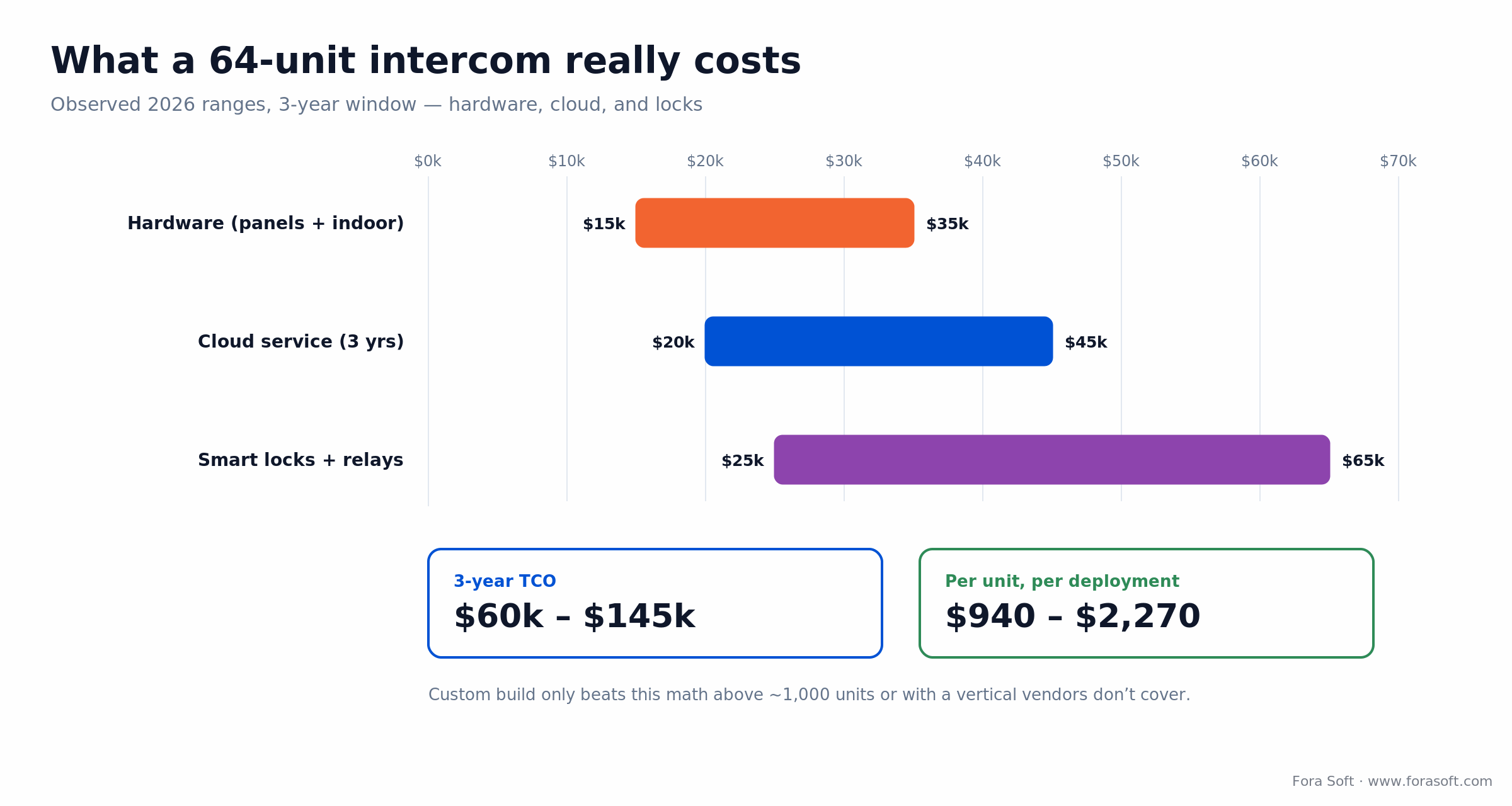
Figure 3. The three-year cost of a 64-unit deployment, broken into hardware, cloud and smart locks, and reduced to a per-unit figure.
Hardware. $15,000–$35,000 for the door panels (HD baseline) plus indoor units where required.
Cloud service over 3 years. $20,000–$45,000 (mobile app, call routing, archive, push).
Smart locks per unit. $25,000–$65,000 across the building (Yale or August premium tier with a relay per unit).
Total 3-year TCO. $60,000–$145,000 — roughly $940–$2,270 per unit over the deployment window. A custom build only beats that math at 1,000+ units or with a vertical workflow vendors do not cover.
Build vs. buy — when custom intercom wins
For 95% of organizations, vendor solutions (Aiphone, 2N, Comelit, DoorBird) win on TCO and time-to-market. Custom development becomes the right call only when scale or vertical is extreme.
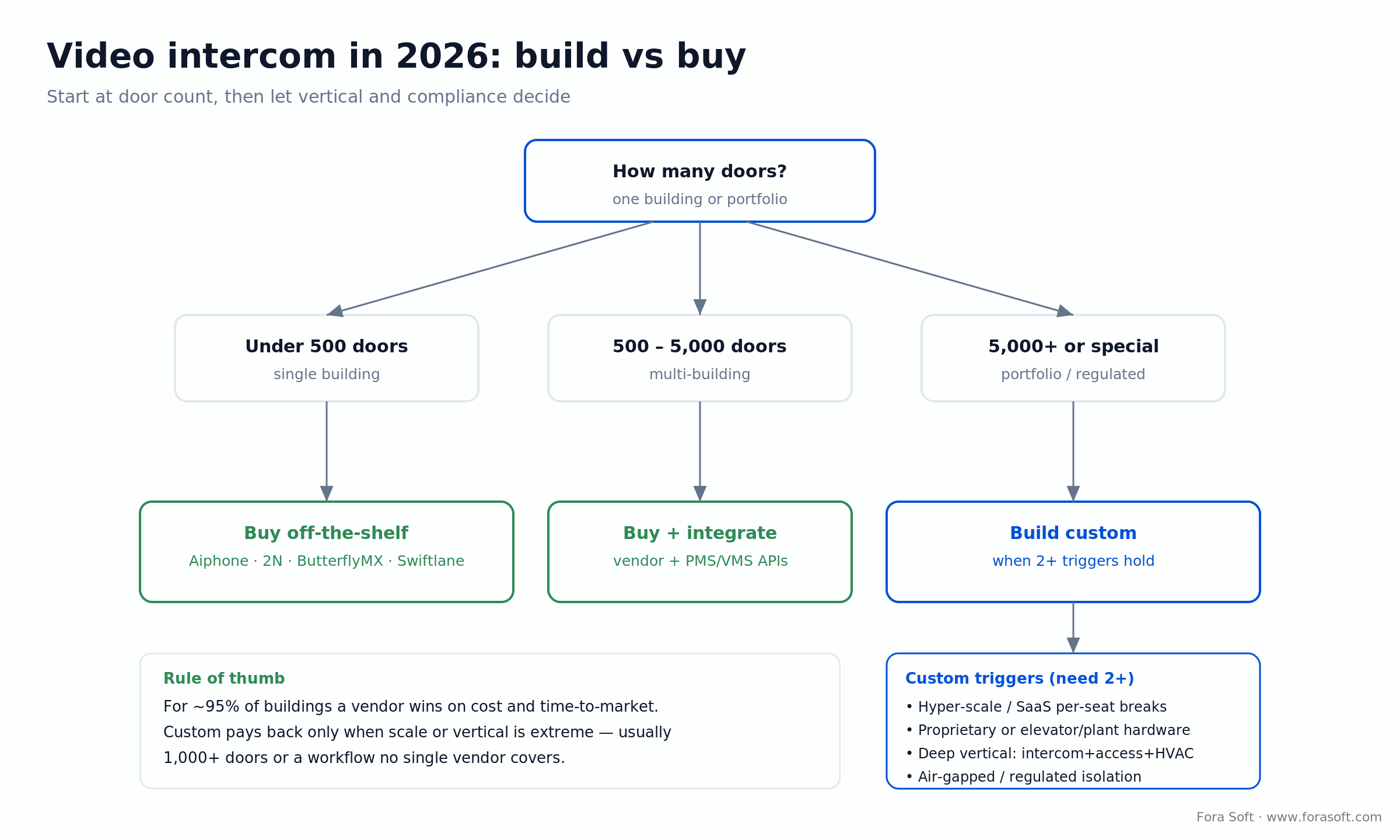
Figure 4. A build-vs-buy decision tree: start at door count, then let vertical and compliance triggers decide.
1. Hyper-scale. A SaaS platform serving 10,000+ units across multiple building operators where vendor per-seat economics break the model.
2. Proprietary hardware. Niche residential or industrial deployments with non-standard door-release mechanisms (custom relay protocols, integrated elevator control, plant-floor pneumatic locks).
3. Extreme vertical integration. Intercom + access control + elevator + lighting + HVAC + tenant comms unified on a single backend, where the integration scope exceeds what any single vendor offers.
4. Regulated isolation. Air-gapped or TEMPEST-class environments where commercial cloud APIs are forbidden.
5. Time-to-market is not the constraint. Vendor deployments take 8–12 weeks; custom takes 16–32. With our agent-engineering practice we cut that closer to 12–20 weeks, but custom is still longer.
Reach for a custom build when: two or more of these triggers are true and no off-the-shelf vendor can scope what you need.
Mini case — what we shipped on V.A.L.T., Netcam Studio, and adjacent video projects
V.A.L.T. is a forensic-grade interview recording platform used by US police departments and academic research institutions. The chain-of-custody, encryption, and audit-log requirements are the same patterns a 2026 enterprise intercom needs. Ship them once and the architecture transfers across surveillance, intercom, and evidence-gathering domains.
Netcam Studio handles thousands of small-business sites with multi-camera VMS plus a mobile app with offline cache. The same WebRTC and push-call patterns power both Netcam and any modern intercom we build on top of it.
BrainCert handles 500M+ classroom minutes on a virtual classroom built around our WebRTC architecture — the same SFU and TURN infrastructure that makes intercom mobile push reliable across carriers and NAT scenarios. Our intercom builds are not greenfield; they reuse battle-tested real-time-video plumbing.
Want a similar build, or a feature gap analysis on your current intercom? Book a 30-minute call — we will benchmark your stack and tell you which features will move the needle fastest.
When NOT to upgrade your intercom
Three situations where staying put is the right call.
1. Your current system is < 4 years old and adoption is healthy. A wholesale replacement costs $60k–$145k for a 64-unit building. If your call-answer rate, door-release latency, and tenant NPS are all above target, the ROI is not there.
2. The bottleneck is operations, not hardware. Slow front-desk response usually traces to staffing or process gaps, not the intercom. Fix the SOP first.
3. You have not measured anything. Replacing an intercom without a baseline of call-answer rate, door-release latency, or tenant complaints is procurement on instinct. Spend two weeks on telemetry first.
FAQ
Which intercom is best in 2026 — Aiphone, 2N, Comelit, or DoorBird?
No single winner. Aiphone leads on healthcare and HIPAA. 2N leads on enterprise SIP and access-control integration. Comelit is the multi-tenant residential default in Europe. DoorBird wins on cost and the German rental market. Pick by vertical and compliance footprint.
Are Hikvision and Dahua intercoms safe to deploy in 2026?
For US federal contracts, no — NDAA Section 889 bans them. For commercial deployments outside that scope they remain technically usable, but most enterprise RFPs in 2026 default-exclude them due to procurement-policy spillover and supply-chain due diligence.
How fast should the mobile push notification be?
Under 1 second to be perceived as instant; under 2 seconds to be acceptable. 45% of users will declare an intercom broken if the push delivery takes longer. Use WebRTC peer-to-peer for the call itself and push as the wake-up signal — not push as the entire transport.
Do I need facial recognition on my intercom?
Strong yes for multi-tenant residential (54% adoption in 2026, driven by tailgating reduction). Strong "it depends" for enterprise office (45% adoption; depends on whether badge readers already cover the use case). Caution in healthcare (28% only — patient privacy concerns). Always check Illinois BIPA and EU AI Act exposure before flipping it on.
What does a 64-unit residential intercom deployment cost?
$60,000–$145,000 over 3 years — roughly $940–$2,270 per unit. Hardware is $15–35k, cloud service $20–45k, smart locks $25–65k. Custom builds only beat that math at 1,000+ units or with a vertical workflow vendors do not cover.
Should the intercom integrate with my building VMS?
Yes — 73% of enterprise deployments now require it. Unified incident logs (call + door release + denied access) are essential for HIPAA, legal discovery, and incident investigation. Specify ONVIF Profile S for the video stream and Profile C/A for door and access events; Profile M carries AI-analytics metadata.
How do I avoid the mobile-app-abandonment trap?
Three rules. Auto-route to mobile by default at move-in. Send push notifications on the very first call. Make in-app door release work without a manual app launch. Onboarding documentation at move-in matters more than the app design itself — demo the door-release flow on day one.
When does a custom intercom build pay back?
When two or more are true: 10,000+ doors under management, proprietary hardware, hyper-vertical workflow integration, regulated isolation, or per-seat SaaS economics that exceed your budget ceiling. With our agent-engineering practice the typical custom build pays back inside 12–18 months at this scale.
What is an IP video intercom system?
An IP video intercom system runs entry video, two-way audio and door release over your network (and the cloud) instead of legacy analog wiring. That is what lets a single door panel push a call to a resident’s phone, sync a tenant directory from a property-management system, and log every entry in the building VMS.
How much does it cost to install a video intercom system?
Per-door hardware runs about $1,000–$7,000 depending on tier (basic video up to cloud-managed with face recognition). A small six-unit building is typically $2,000–$6,000 all-in including install; a 64-unit building runs $60,000–$145,000 over three years once cloud service and smart locks are included — roughly $940–$2,270 per unit.
How do I upgrade a multifamily building from an old buzzer to a video intercom?
Start with a retrofit-friendly IP panel that reuses existing wiring or runs on PoE, then layer cloud routing so calls reach residents’ phones without in-unit hardware. Sync the tenant directory from your PMS, add smart-lock door release, and keep a 4G/LTE fallback so entry survives a WAN outage. ButterflyMX and Swiftlane specialize in exactly this no-in-unit-hardware retrofit.
What to read next
Custom Intercom
Custom Intercom Software — the 2026 CTO playbook
When vendor stacks fall short — architecture, cost, and the working spec for a custom intercom platform.
Smart Intercom
Smart Intercom Systems 2026 — AI, IoT, architecture
A deeper architectural look at how AI and IoT plug into the modern intercom stack.
Cloud Intercom
Cloud Intercom Systems — 8 security benefits
Why cloud routing keeps winning — and how to spec it without inheriting the outage risk.
Healthcare
Healthcare Intercom Software — HIPAA & build-vs-buy
The 2026 playbook for clinics and senior care — the compliance trade-offs vendor brochures skip.
Voice AI
AI-Powered Voice Recognition for Intercoms
Where speech recognition belongs in an intercom UX, and the integration patterns that actually work.
Ready to ship a 2026-grade video intercom?
The 12 features above (HD/4K video, two-way audio, mobile-first push, cloud routing, AI face and package detection, encrypted SRTP/DTLS, smart-lock integration, PMS directory sync, searchable directory, tamper plus 4G failover, and VMS integration) are the bar a serious 2026 video intercom system must clear. Get the first six right and you have a credible product. Get all twelve right and you match anything Aiphone or 2N ship.
If your scale, vertical, or integration depth pushes you past what vendor stacks cover, custom is the right path, and with our agent-engineering practice we cut the typical timeline from 16–32 weeks to 12–20. Bring your door count, vendor mix, and biggest pain point and we will scope a path forward.
Let’s scope your intercom roadmap
A 30-minute call with our intercom and access-control team. We will leave you with a 12-feature scorecard, a build-vs-buy verdict, and a cost ceiling — on us.

