

Smart intercom systems used to be a doorbell with a button. In 2026 they run as building-access platforms: AI face and voice recognition, mobile and cloud control, IoT integration with locks and elevators, package logistics, visitor analytics, and audit-grade event logs. The hardware is a thin client now; the value lives in the software.
This playbook is the practical version for property-tech teams, hardware OEMs and building-management product owners deciding what to build versus buy. It covers the architecture, the AI that pays off, the compliance you cannot skip, and the pitfalls Fora Soft has worked through on real projects since 2005.
Key takeaways
• Smart intercom systems are access platforms. Door entry, mobile keys, cloud admin, IoT triggers, video and AI. Treat the system as a software product, not a peripheral.
• AI delivers measurable wins. Face and voice recognition cut unauthorised entry, semantic video search speeds incident response, and predictive maintenance reduces device downtime.
• Privacy is product-defining. The EU AI Act, GDPR and US state laws like Illinois BIPA already restrict biometric capture. Build consent, retention and on-device processing in from day one.
• WebRTC is the right call layer. Sub-second latency, browser-native, NAT-friendly. It is the same stack we ship in mission-critical video products like VALT.
• Build for the integrations, not the doorbell. The moat is plug-in support for property management, identity providers, smart locks and visitor systems.
Why Fora Soft wrote this playbook
Fora Soft has shipped video- and AI-heavy products since 2005 — 250+ projects across 50 in-house engineers. That includes Netcam Studio (a successor to WebcamXP for live IP-camera management) and VALT, a video platform used by 770+ US organizations across law enforcement, child advocacy and healthcare, with 50,000+ users and HIPAA obligations. Access control, recorded evidence and real-time video have to coexist in those products, exactly as they do in a smart intercom.
We have also published a deep cluster on intercom-specific topics: core features, integrating video and audio, cloud benefits, and voice recognition. This guide is the strategic top of that funnel: what to build, why, and in what order. Our video surveillance and AI teams live in this problem space.
Building a smart intercom or building-access platform?
Tell us your hardware story, target users and integration list. We come back with a build-vs-buy plan and a phased roadmap.
The one-page answer: what a modern smart intercom does
A 2026 smart intercom system covers six capability buckets. Plan them separately: build the ones that differentiate you, integrate the rest.
- Real-time audio and video. A WebRTC call from the door panel to a phone or desk app, with two-way HD video and clean duplex audio.
- Mobile and cloud control. Residents and tenants answer, release the door and review history from a phone, anywhere.
- AI access. Face, voice, plate or QR recognition for hands-free entry; anomaly detection for tailgating and forced entry.
- IoT integration. Smart locks, elevators, lighting, HVAC and alarm panels, all triggered from intercom events.
- Visitor and package logistics. Pre-authorised codes, package lockers and courier flows.
- Compliance and audit. Encrypted recordings, immutable logs and role-based access for property managers.
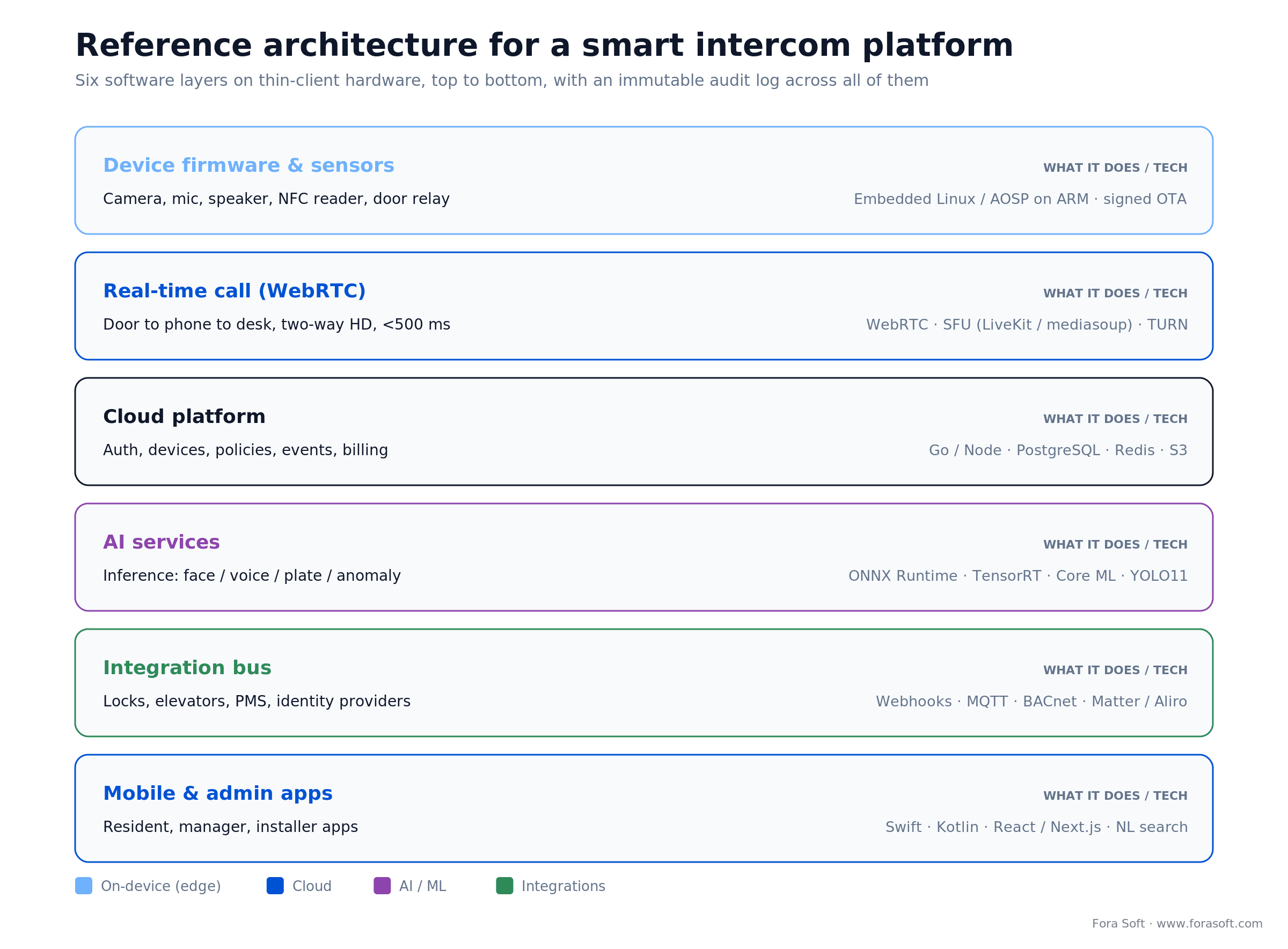
Figure 1. The six software layers of a smart intercom platform on thin-client hardware, with an audit log spanning all of them.
Reach for a custom intercom platform when: you are an OEM that needs to differentiate beyond hardware, a property-tech company building software across thousands of buildings, or your compliance regime demands full evidence ownership.
From doorbells to building-access platforms
A clean way to scope your product is to place it on the four generations of intercom and decide where you want to land.
| Generation | Core feature | Connection | Software role |
|---|---|---|---|
| Gen 1: analogue audio | Buzz, talk, buzz | Wired, on-premises | None |
| Gen 2: video intercom | See visitor + talk | Wired, on-premises | Embedded firmware |
| Gen 3: IP & mobile | Mobile answer + door release | IP, cloud-assisted | Mobile + admin app |
| Gen 4: AI access platform | Recognition + IoT + analytics | Cloud-native, hybrid edge | Full SaaS platform |
Most differentiated products in 2026 sit firmly in Gen 4, with a Gen 3 fallback for older hardware fleets. For the Android-first buyer’s angle, see our Android smart intercom guide.
The AI capabilities that actually move the needle
1. Face recognition for hands-free entry. A resident walks up and the door opens. Top algorithms in NIST’s 1:1 verification testing (FRTE/FRVT, 2025) miss well under 1% of true matches in good conditions, but accuracy drops with pose, low light and aging. A lab score is not a doorway guarantee, so pair it with a fallback credential and run the model on-device.
2. Voice biometrics and natural language. Voice-triggered entry, spoken commands (“let in the delivery”), and AI-summarised intercom history (“who came by today”).
3. Anomaly detection. Tailgating, forced entry, loitering and package theft are all detectable from the same video feed by computer-vision detectors (YOLO11-class models, released 2024–2026). Lower-stakes than face ID, higher operational impact.
4. License-plate recognition. For garage entry and visitor management, ALPR is mature, fast and licence-friendly.
5. AI-summarised event search. “Show me delivery activity Tuesday afternoon” or “all entries in the last hour”: semantic search over events, transcripts and visual tags. This is the same architecture we ship inside VALT for forensic review.
6. Predictive maintenance. Devices report sensor and uptime data; ML models flag likely failures so a property manager swaps a panel before it dies.
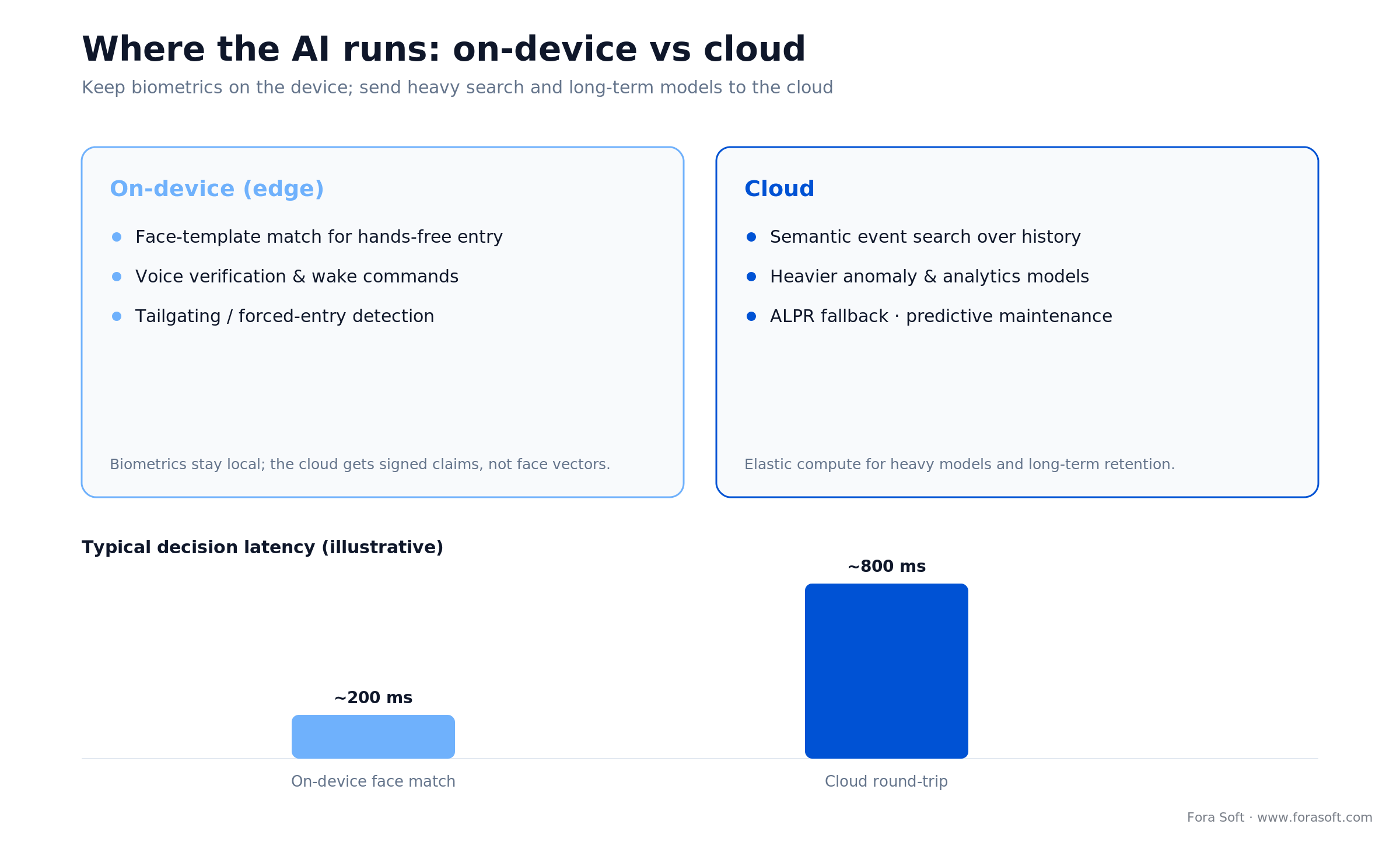
Figure 2. Split the AI: low-latency biometrics stay on the device; heavy search and anomaly models run in the cloud.
Reach for on-device biometrics when: you serve a jurisdiction with biometric-privacy law, you need sub-second entry, or you want to remove the cloud as a failure mode for the front door.
Reference architecture for an AI smart intercom platform
A clean platform separates device, edge, cloud and integration concerns. The shape below (mirrored in Figure 1) has held up across multiple Fora Soft client builds.
| Layer | Responsibility | Typical tech | AI features |
|---|---|---|---|
| Device firmware | Camera, mic, speaker, NFC, relay | Embedded Linux / AOSP on ARM, RTOS | On-device face/voice templates |
| Real-time call | Door ↔ phone ↔ desk app | WebRTC + SFU, TURN, STUN | Noise suppression, echo cancellation |
| Cloud platform | Auth, devices, policies, events, billing | Go/Node, PostgreSQL, Redis, S3 | Recognition fallback, ML pipelines |
| AI services | Inference layer | Triton, ONNX Runtime, Core ML | Face / voice / plate / anomaly |
| Integration bus | Locks, elevators, PMS, IdP | Webhooks, MQTT, BACnet, Matter/Aliro | Rule engine + ML triggers |
| Mobile and admin | Resident, manager, installer apps | Swift, Kotlin, React, Next.js | AI search, NLP commands |
| Audit log | Immutable event store | Append-only DB, SIEM forwarder | Anomaly alerting |
The core technology stack
Real-time call. WebRTC. Pair it with a battle-tested SFU (LiveKit, mediasoup, OvenMediaEngine, or a Pion-based custom server) and a TURN cluster (coturn, Eyeball Networks, Twilio TURN) for hostile networks. Keep glass-to-glass under 500 ms.
Device runtime. Embedded Linux or AOSP on ARM is the default. Android Things was discontinued in 2022, so do not design around it. Containerise where the SoC allows (BalenaOS, Mender) so OTA updates stay sane.
Connectivity and retrofit. Plan for three wiring realities: IP over PoE for new construction (one cable carries power and data), Wi-Fi with an LTE fallback where pulling cable is impractical, and 2-wire retrofit adapters for older buildings where rip-and-replace kills the deal. The wiring you support decides which buildings you can win, so pick the panels and bridges early.
Cloud platform. Node or Go services on Kubernetes; PostgreSQL for state, Redis for queues, S3 for media; Cognito, Auth0 or Keycloak for identity.
AI inference. Run biometrics on-device where privacy matters, using the accelerator on the panel: Apple Neural Engine, NVIDIA Jetson Orin Nano Super ($249, 67 TOPS, 2025) or a Hailo-8 module. Push heavier models like semantic search and anomaly detection to the cloud, and keep ONNX as your portable format. For the deeper patterns, our AI for video engineering track goes layer by layer.
Integrations. A thin abstraction over locks, elevators and PMS APIs (Salto, Allegion, Brivo, Yardi, RealPage; note that Latch rebranded to DOOR in 2025). Spend your time here. Integrations are the moat.
Reach for WebRTC over SIP when: you are building new, want browser and mobile clients with no plugins, and need sub-second two-way media. Keep SIP only where a legacy PBX or telecom bridge forces it.
Privacy, biometrics and compliance
Smart intercoms now sit inside several regulatory regimes at once. Design for the strictest one you serve.
- EU AI Act. Real-time remote biometric identification in public spaces by law enforcement is banned under Article 5 (in force since 2 February 2025, with narrow exceptions). The Article 50 transparency duties covering biometric categorisation and emotion recognition apply from 2 August 2026; the high-risk obligations that catch most biometric access systems were deferred to 2 December 2027 under the 2026 Digital Omnibus.
- GDPR. Biometrics are special-category data (Article 9). Consent and data-minimisation are mandatory, and a DPIA is required for any biometric feature.
- Illinois BIPA and US state laws. BIPA requires written consent before biometric capture and carries statutory damages of $1,000–$5,000 per violation. A 2024 amendment (SB 2979) limited repeat-scan liability to a single recovery, and in April 2026 the Seventh Circuit held that change is not retroactive. Texas CUBI and Washington add their own rules.
- Retention. Recordings should default to short retention (7–30 days) with explicit override, and biometric templates should be stored apart from raw imagery.
- On-device first. Where possible, run biometrics on the device itself; the cloud then sees signed claims, not face vectors.
Need a privacy-first AI intercom design?
We have built biometric and video products under HIPAA, GDPR and chain-of-custody rules. A 30-minute review usually exposes the riskiest design choices early.
IoT integration: locks, elevators, sensors
A modern intercom is the trigger node for an entire building. The integration list looks similar across multifamily, commercial and hospitality:
- Smart locks. Salto, DOOR (formerly Latch), August, Yale, Schlage and Allegion via vendor APIs or BLE.
- Elevators. Destination-dispatch APIs (KONE, Otis, Schindler) and BACnet for older systems.
- Property management. Yardi, RealPage, Entrata, AppFolio for resident-roster sync, billing and work orders.
- Identity. Okta, Microsoft Entra ID (formerly Azure AD) and Google Workspace SSO for staff; passwordless mobile credentials for residents.
- Alarm and CCTV. ONVIF for cameras; manufacturer SDKs for alarm panels.
- Voice assistants. Alexa for Hospitality, Google Assistant and Apple HomeKit for residential.
Two 2025–2026 standards cut the integration tax. Matter 1.5 (November 2025) added a first-class door-lock-with-camera device type, so a Matter controller can manage the panel. Aliro 1.0, published by the Connectivity Standards Alliance in February 2026 and backed by Apple, Google and Samsung, standardises the mobile credential at the door itself: one phone-as-key experience across readers from different vendors. Matter handles remote control; Aliro handles the tap-to-enter.
Build a normalised integration bus with a thin per-vendor adapter. New vendors then take days, not months.
Reach for an integration bus when: you expect more than two lock or PMS vendors over the product’s life. A per-vendor adapter behind one internal API keeps the core service clean and makes the next integration a days-long task.
Build vs buy vs OEM
Most teams choose between three paths. The honest match depends on your business model, so walk the decision tree in Figure 3.
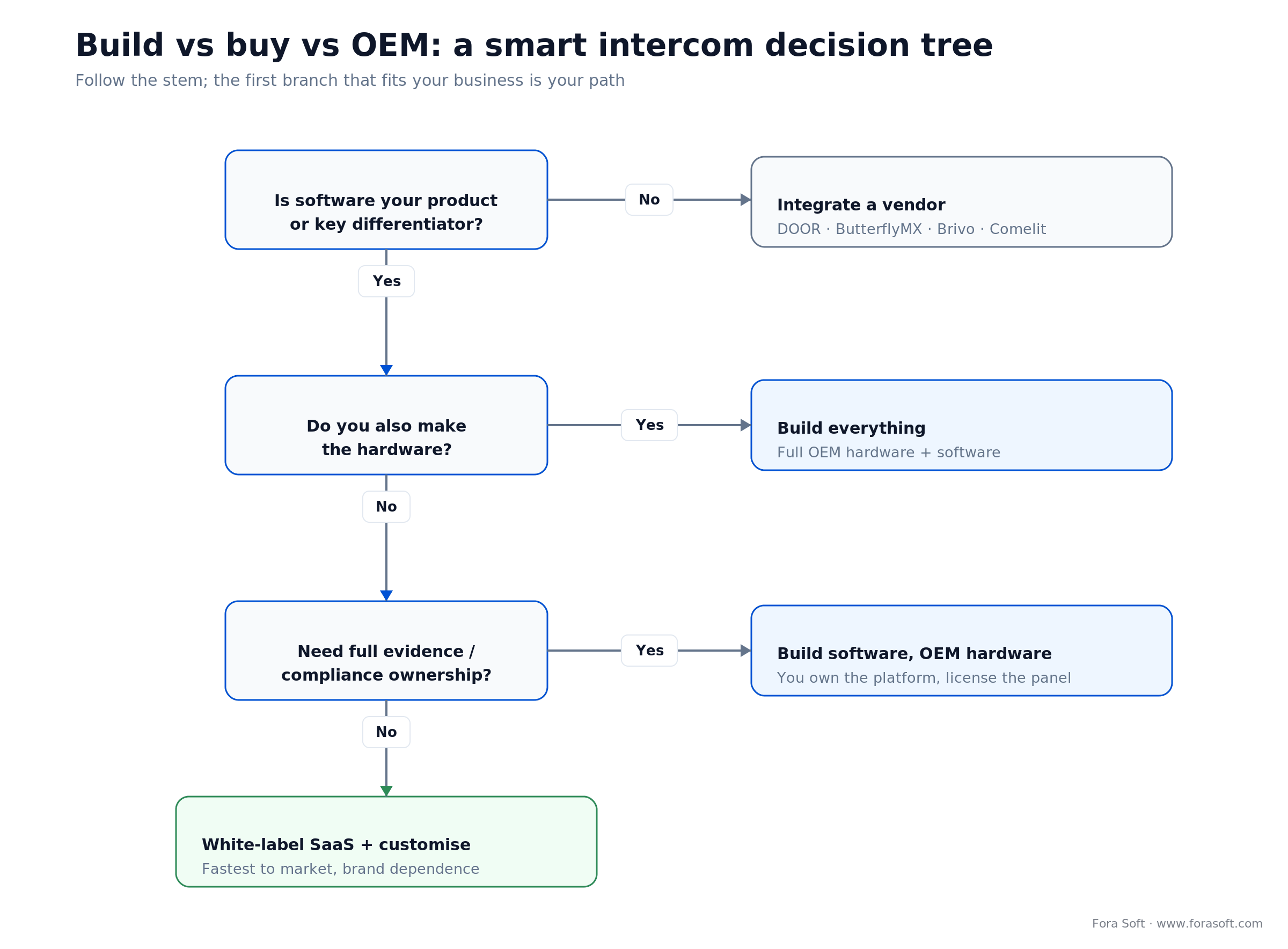
Figure 3. Build vs buy vs OEM: the first branch that matches your business is usually your path.
| Path | When it fits | Cost shape | Watch out for |
|---|---|---|---|
| Build everything | Hardware OEM with software ambitions | High upfront; low marginal | Maintenance debt over time |
| Build software, OEM hardware | Property tech / SaaS | Mid upfront; OEM royalties | OEM lock-in |
| Resell + customise | Integrators, MSPs | Low upfront; per-unit margin | Limited differentiation |
| Pure white-label SaaS | Hospitality / multifamily groups | Subscription per door | Brand and roadmap dependence |
Vet vendor firmware before you buy: Claroty’s Team82 reported 13 vulnerabilities in Akuvox’s E11 smart intercom, including CVE-2023-0354 (CVSS 9.1), an unauthenticated information leak. A cheap panel with weak firmware becomes your liability the day it ships.
Cost model: what a custom intercom platform really costs
Numbers are directional and assume a focused team using Agent Engineering, so we aim to land below the industry average. If your scope expands, so does the budget.
| Bucket | Scope | Year 1 range | Year 2+ |
|---|---|---|---|
| Software platform | Cloud, mobile, admin, WebRTC, AI | $200k–$400k | $120k–$200k |
| Device firmware | Linux/Android, OTA, AI on-device | $80k–$180k | $40k–$80k |
| Integrations | Locks, lifts, PMS, IdP, alarms | $50k–$120k | $30k–$60k |
| Compliance & security | DPIA, SOC 2, pen test | $30k–$80k | $25k–$60k |
The build-vs-buy math turns on door count. Take a 2,000-door portfolio on a per-door SaaS at $15/door/month: that is $30,000/month, or $360,000/year, forever. A custom platform might cost $500,000 to build in year one, then roughly $180,000/year to run. Cumulative custom spend ($500k, then $680k, then $860k) passes below cumulative SaaS spend ($360k, $720k, $1,080k) around the end of year two, as Figure 4 shows. Below a few hundred doors the SaaS wins; above a couple of thousand, ownership does.
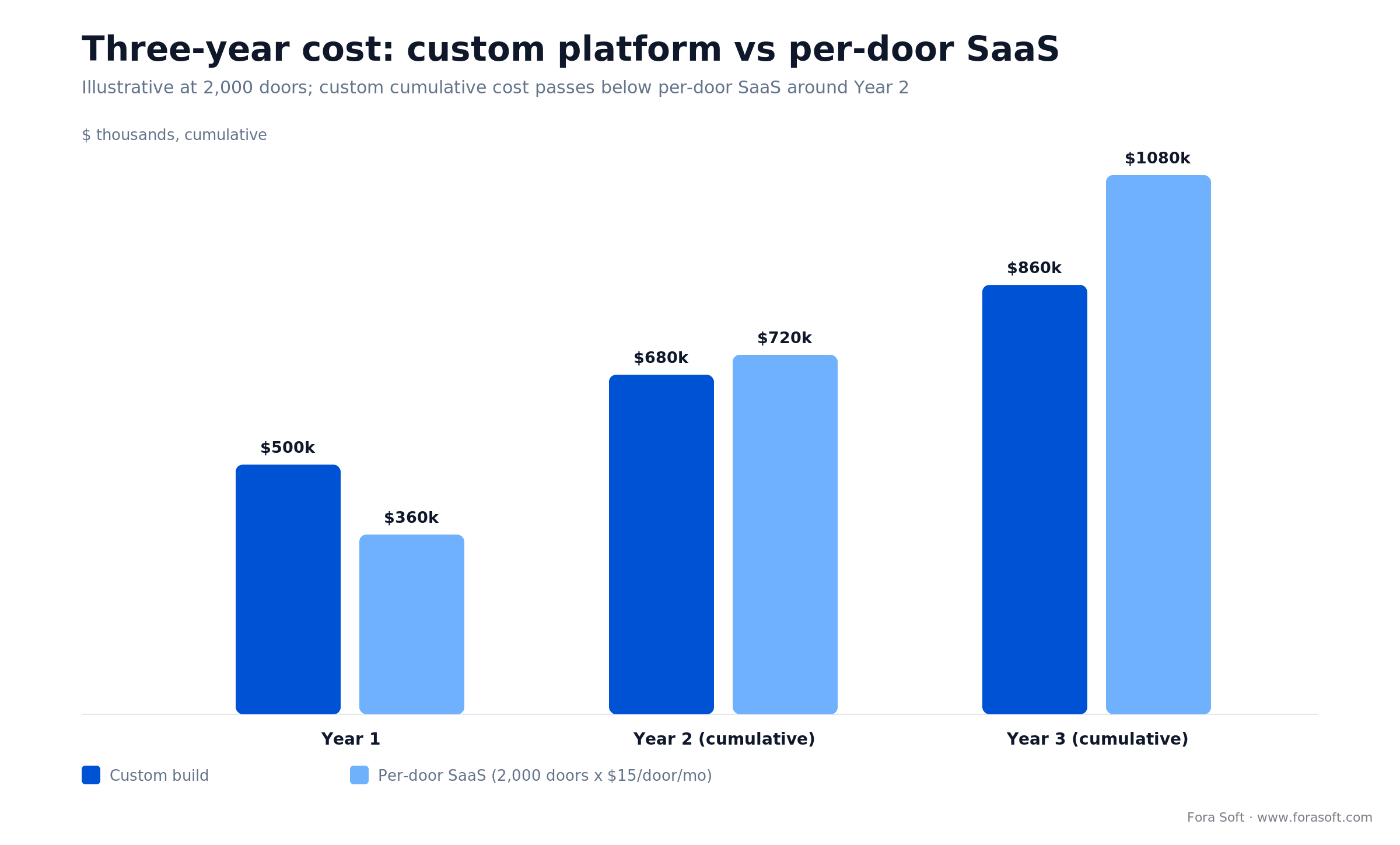
Figure 4. Cumulative three-year cost at 2,000 doors: custom ownership overtakes per-door SaaS around year two.
Timeline from prototype to deployment
A focused team can ship a usable smart-intercom MVP in a quarter and a production platform in 6–9 months.
| Phase | Weeks | Outputs |
|---|---|---|
| Discovery & HW pick | 2–3 | Reference hardware, wireframes, threat model |
| MVP | 8–12 | WebRTC call door ↔ phone, door release, simple admin |
| AI features | 6–10 | Face / voice / plate / anomaly |
| Integrations | 6–12 | Locks, lifts, PMS, IdP, alarms |
| Pilot rollout | 4–8 | 10–50 buildings, runbooks, SLAs |
Mini case: video, AI and chain-of-custody from VALT
Situation. VALT is a video platform used by 770+ US organizations across law enforcement, child advocacy and healthcare, with 50,000+ users. Investigators need to retrieve specific moments from hours of recorded interviews, and the chain of custody has to hold up in court.
Plan. We layered AI-driven transcript search, automatic chapter generation, anomaly detection and tamper-evident audit logging. The same pattern transfers cleanly to smart intercom systems: identity-bound events, encrypted recordings, and signed admin actions.
Outcome. Review time dropped sharply, evidence quality held up under court scrutiny, and the architecture became reusable across other regulated video products. We brought the same playbook to Netcam Studio, where IP cameras and intercom-style triggers had to coexist. Want a similar assessment for your access product? Book a 30-minute call.
Five pitfalls that derail smart intercom projects
1. Treating it as a hardware project. The hardware is six months of work; the platform is years. Resource it accordingly.
2. Cloud-only biometrics. Sending face vectors to the cloud creates regulatory risk. Run biometrics on-device whenever feasible and ship signed claims to the cloud.
3. Skipping OTA discipline. A device fleet without rolling, signed, reversible OTA is a future disaster. Set this up before any AI feature lands on hardware.
4. Tight coupling to one PMS or lock vendor. Integrations are the moat, so build them as a bus, not as branch logic in the core service.
5. No QoE telemetry. Intercom calls fail in invisible ways: partial audio, slow first frame, NAT issues. Without telemetry you debug in the dark; with it you fix systemic issues fast.
A decision framework in five questions
Q1. Are you a hardware OEM, a property tech / SaaS, or an integrator? The answer reframes everything else.
Q2. What jurisdiction defines your strictest user? The EU, US states with biometric law, or regulated industries. Design for that bar.
Q3. Which integrations are non-negotiable in year one? Three is realistic; ten kills your velocity.
Q4. How will residents authenticate? Mobile credential, NFC card, PIN or biometric. Pick a primary and a backup.
Q5. Who owns support? A consumer-facing intercom needs 24/7 support; a B2B integrator product can lean on partners.
KPIs worth tracking
1. Quality KPIs. Call connect rate, glass-to-glass latency p50/p95, recognition false-accept and false-reject rates, and OTA success rate.
2. Business KPIs. Revenue per door per month, churn per property, time to deploy a new building, and integration time per vendor.
3. Reliability KPIs. Cloud uptime, mean time to detect a device offline, mean time to restore, and security-incident frequency.
2026 trends in smart intercom
Mobile credentials win over cards. Apple Wallet, Google Wallet and the new Aliro 1.0 standard replace plastic across new buildings.
On-device biometrics by default. Privacy regulation makes cloud face recognition the exception, not the rule.
AI assistants for property managers. Natural-language queries over event history (“who came in after 9pm last week?”) replace dashboard scrubbing.
Touchless everywhere. Hands-free entry for residents, employees and deliveries.
Hospitality and healthcare verticals split off. Hotels and hospitals each get specialised intercom platforms with deep PMS and EHR integrations.
When NOT to build a custom intercom platform
Three signals say integrate an existing vendor (DOOR, formerly Latch, Brivo, ButterflyMX, DoorBird, Comelit cloud) instead of building.
- Your fleet is under a few thousand doors and you have no plan to differentiate the software.
- You don’t have an in-house engineering team that can own the platform for 3+ years.
- Your customers are happy with a vendor’s feature set and roadmap.
Custom intercom is a strategic investment. Build when the platform is the product; integrate when it is a feature.
Stuck between integrating DOOR and building your own?
We review your fleet, integrations and roadmap and tell you honestly which path saves more pain over five years.
Implementation checklist for the first 90 days
A pragmatic checklist for any team starting a smart intercom project.
- Pick reference hardware and lock the OTA approach in the first two weeks.
- Set up TURN/STUN and run a real WebRTC call across hostile networks before any UI work.
- Threat-model biometrics and recordings; run a DPIA before any face feature ships.
- Build the integration bus and ship with two integrations live, not promised.
- Instrument every call, every door release and every recognition event with telemetry.
- Plan a 10–50 building pilot before scaling to thousands.
FAQ
What makes a smart intercom different from a regular video doorbell?
A smart intercom is a multi-tenant, multi-device platform with admin tooling, integrations and AI, not a single home device. It connects buildings, residents, staff and vendors with audit trails and policy controls a doorbell never needs.
Should face recognition run on the device or in the cloud?
On the device whenever feasible. It reduces regulatory exposure under GDPR and BIPA, removes a network failure mode, and keeps entry under a second. The cloud receives signed claims (“Resident X verified”), not raw biometrics.
Which protocol should I pick for the live call?
WebRTC. It is an open standard, native in browsers and mobile, with sub-second latency and reasonable operating cost. SIP is fine if you must bridge a legacy PBX, but it is not a competitive choice for new builds.
How do I handle GDPR for video recordings?
Default to short retention (7–30 days), document your lawful basis, run a DPIA, encrypt at rest, and expose a clear data-subject-request flow. Treat biometric templates separately from raw video and explain the processing in your privacy policy.
Can a smart intercom integrate with our existing access-control system?
Yes, through vendor APIs (Brivo, Lenel, Genetec, Salto KS) or, for older systems, OSDP/Wiegand bridges. Matter 1.5 and Aliro 1.0 are standardising this further. Most projects have a clear vendor list within a week of discovery.
How much does a smart intercom system cost to build?
A custom software platform typically runs $200k–$400k in year one, with device firmware and integrations on top. At 2,000 doors, ownership tends to beat a per-door SaaS around year two; below a few hundred doors, the SaaS is cheaper.
How long does a real deployment take?
About 3 months for an MVP, 6–9 months for a production platform with integrations and AI features, and 12+ months when you also own the hardware. Timelines compress when scope is disciplined and Agent Engineering accelerates the work.
What is the biggest hidden cost?
Field support. A connected device fleet generates real-world tickets, from bricked devices to network issues and OTA failures, that pure SaaS teams never face. Plan for it in your operating model from day one.
What to read next
Features
Intercom software features
A practical breakdown of must-have features for modern intercom platforms.
Engineering
Integrating video and audio
How to ship a reliable two-way video intercom: the WebRTC fundamentals.
Cloud
Cloud intercom benefits and applications
Why cloud-native intercom platforms beat on-prem alternatives in 2026.
AI
AI intercom voice recognition
How voice biometrics and natural language change the intercom UX.
Architecture
IoT intercom systems in 2026
Architecture, vendors, costs and compliance for IoT-connected intercoms.
Ready to ship a smart intercom platform that earns its keep?
In 2026 a smart intercom is a software product first and a piece of hardware second. Get the WebRTC stack right, run AI on-device by default, design for privacy regulation from day one, invest in integrations as the moat, and instrument everything so you can ship for years without surprises.
Fora Soft has shipped video, AI and access-grade products for two decades. If you are weighing a custom smart intercom platform, we can save you weeks of dead-end research and get you to a confident plan in a single call.
Ready to scope your smart intercom roadmap?
Tell us your product vision, target customers and integration list. We come back with a phased plan and a realistic budget.

