

Key takeaways
• The video intercom devices market is ~$50.8B in 2025, heading toward ~$85B by 2030 (Mordor, ~11% CAGR). Video intercom software is the layer taking share as IP and cloud-native systems eat proprietary hardware, and interoperability is now the buying criterion.
• Cloud TCO runs 25–35% under on-prem across five years. But cloud-only breaks when the internet does, so a hybrid that keeps local SIP fallback is the production default.
• Face recognition is a compliance decision, not just a feature. GDPR Art. 9 and Art. 22 apply now; the EU AI Act treats a biometric intercom as high-risk, with the full dossier due 2 Dec 2027 (Digital Omnibus), not August 2026.
• Mobile push latency is the top UX complaint. Sub-2-second answer on residents’ phones is the bar; miss it with plain notifications and people stop answering the door.
• Fora Soft ships cloud video products for a living. WebRTC work since 2012, 250+ projects since 2005, and shipped intercom systems like our Doorbell App (a SIP-to-WebRTC bridge) and Netcam Studio.
Why Fora Soft wrote this playbook
Fora Soft has shipped video-first software since 2005, across 250+ projects. We built Netcam Studio, a video surveillance product with roots in WebcamXP, one of the earliest IP-camera apps. We ship WebRTC and SIP systems for clients every week (see our WebRTC services and realtime voice integration guide). One of those was a Doorbell App: a LiveKit SIP-to-WebRTC bridge that rings any SIP intercom straight through to a resident’s phone and releases the door over DTMF, with no vendor lock-in. We also built Doma.ai, a browser-based video intercom for a property-management platform used by 4,305+ management companies across 40+ cities, where a resident sees the door feed and opens it from a phone browser with no app to install.
This is the playbook we use when a PropTech founder, a building integrator, or a security-platform CTO asks: “What does a modern video intercom product look like, what does it cost to build, and where do teams get it wrong?” You’ll get the reference architecture, the protocol picks, honest AI-feature sanity, the 2026 compliance timeline, a real cost model, and a five-question decision framework. If you only need the buy-vs-build answer, jump to the decision framework.
Related reading: IoT + video surveillance architecture, our Video Streaming learning track.
Planning a video intercom product or a smart-building rollout?
Tell us your deployment (residential, commercial, multi-tenant) and we’ll sketch architecture and cost in a 30-minute call.
What changed: from buzzer to cloud
Three shifts drove the last five years. First, PoE and IP cameras turned the door station into a general-purpose computer. Second, WebRTC and SIP trunking let a call reach any phone anywhere, not just the wired monitor inside the apartment. Third, edge AI (face recognition, package detection) dropped in price to the point where residents now expect it by default.
So a modern video intercom is four products in one front panel: a video product, an access-control product, an IoT device, and a compliance artifact. Building it as “a doorbell with a camera” is how these projects die.
The 2026 market snapshot
The video intercom devices and equipment market is worth about $50.8B in 2025 and is forecast to reach $85.2B by 2030, a 10.9% CAGR (Mordor Intelligence, 2025). North America holds the largest share; Asia-Pacific grows fastest. The number that matters for a build decision is the mix shift underneath that headline: IP and cloud-native systems are taking share from analog and proprietary hardware, and interoperability (SIP, ONVIF, Matter) is now what buyers screen for.
| Metric | 2025 | 2030 (forecast) | Source / note |
|---|---|---|---|
| Video intercom devices & equipment | $50.8B | $85.2B | Mordor Intelligence 2025, 10.9% CAGR |
| Regional leaders | North America #1 | APAC fastest | Mordor Intelligence 2025 |
| Architecture shift | IP + cloud rising | cloud-native mainstream | interoperability is the buying criterion |
| Face-recognition entry | premium tier | broader mid-tier | gated by 2026–2027 EU AI Act posture |
| Call-answer latency target | < 2 s | < 1.5 s | WebRTC glass-to-glass, mobile app |
One caveat on market numbers: analyst scopes differ wildly. Mordor sizes “devices & equipment”; narrower “video intercom software” or “IP video door phone” slices come in far smaller. Use the trend (double-digit growth, IP and cloud taking share), not any single headline dollar figure, to justify a build.
Reference architecture for a modern video intercom
Five logical tiers, with clean seams between them. Blur two tiers together and you pay for it at integration time.
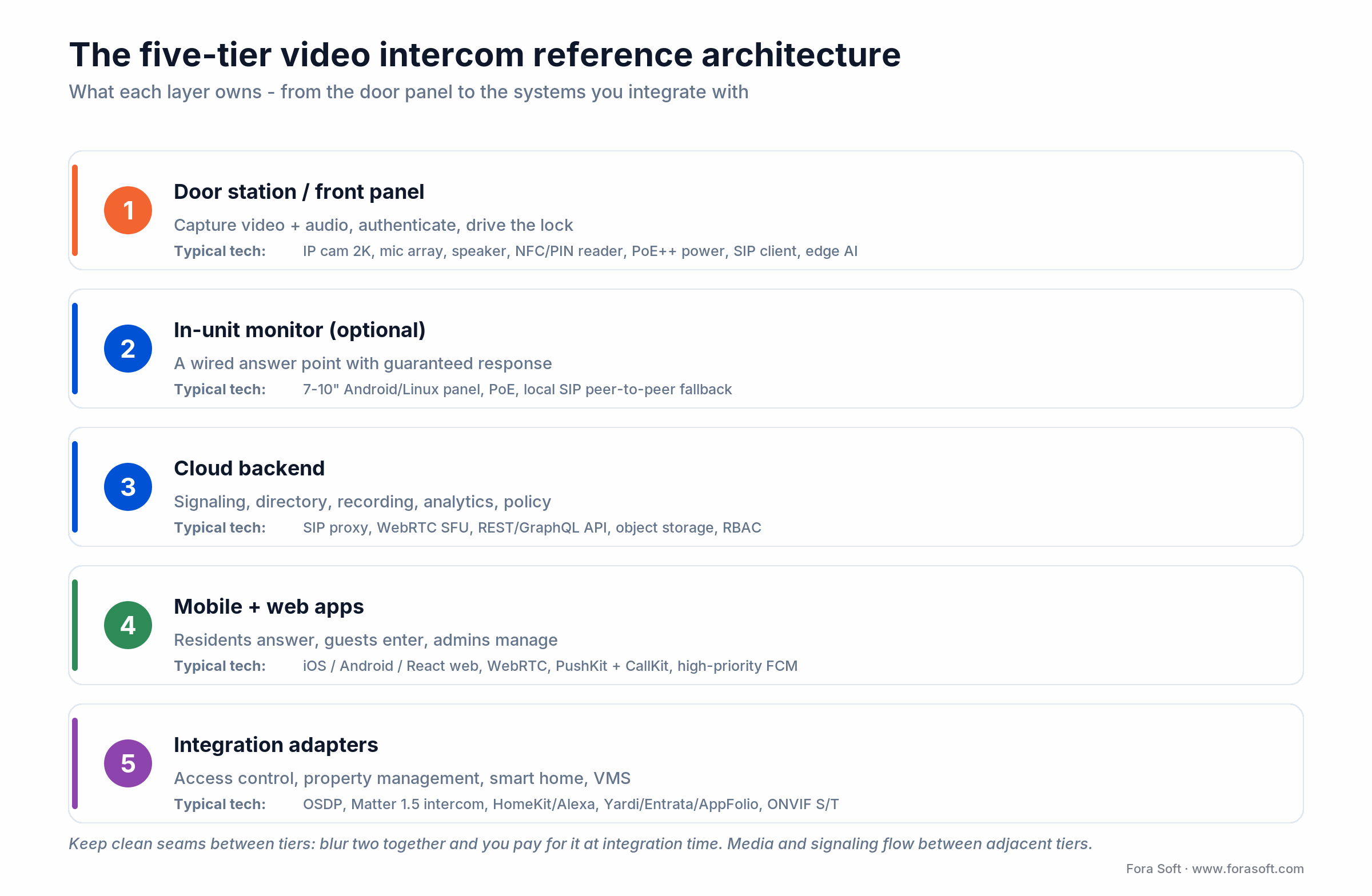
Figure 1. The five-tier reference architecture: door station, in-unit monitor, cloud backend, apps, and integration adapters.
| Tier | Responsibility | Typical tech |
|---|---|---|
| 1. Door station / front panel | Capture video + audio, authenticate, drive lock | IP cam (2K), mic array, speaker, NFC/PIN, PoE++ power, SIP client, edge AI |
| 2. In-unit monitor (optional) | Wired answer point, guaranteed response | 7–10” Android/Linux panel, PoE, local SIP fallback |
| 3. Cloud backend | Signaling, directory, recording, analytics | SIP proxy, WebRTC SFU, REST/GraphQL API, object storage, RBAC |
| 4. Mobile & web apps | Residents answer, guests, admin dashboard | iOS / Android / React web, WebRTC, PushKit / CallKit, FCM |
| 5. Integration adapters | Access control, PMS, smart home, surveillance | OSDP, Matter 1.5 intercom, HomeKit, Alexa, Yardi/AppFolio/Entrata, ONVIF |
Reach for a cloud-native architecture when: you’re a SaaS, an ISV, or a property-manager-facing product. Reach for a hybrid with a local NVR when you sell into buildings with strict uptime or privacy needs (luxury residential, government, regulated healthcare).
Transports: SIP, WebRTC, and when to use each
Two call-delivery paths are in common use. Most serious products run both, for different endpoints, and bridge them in the backend.
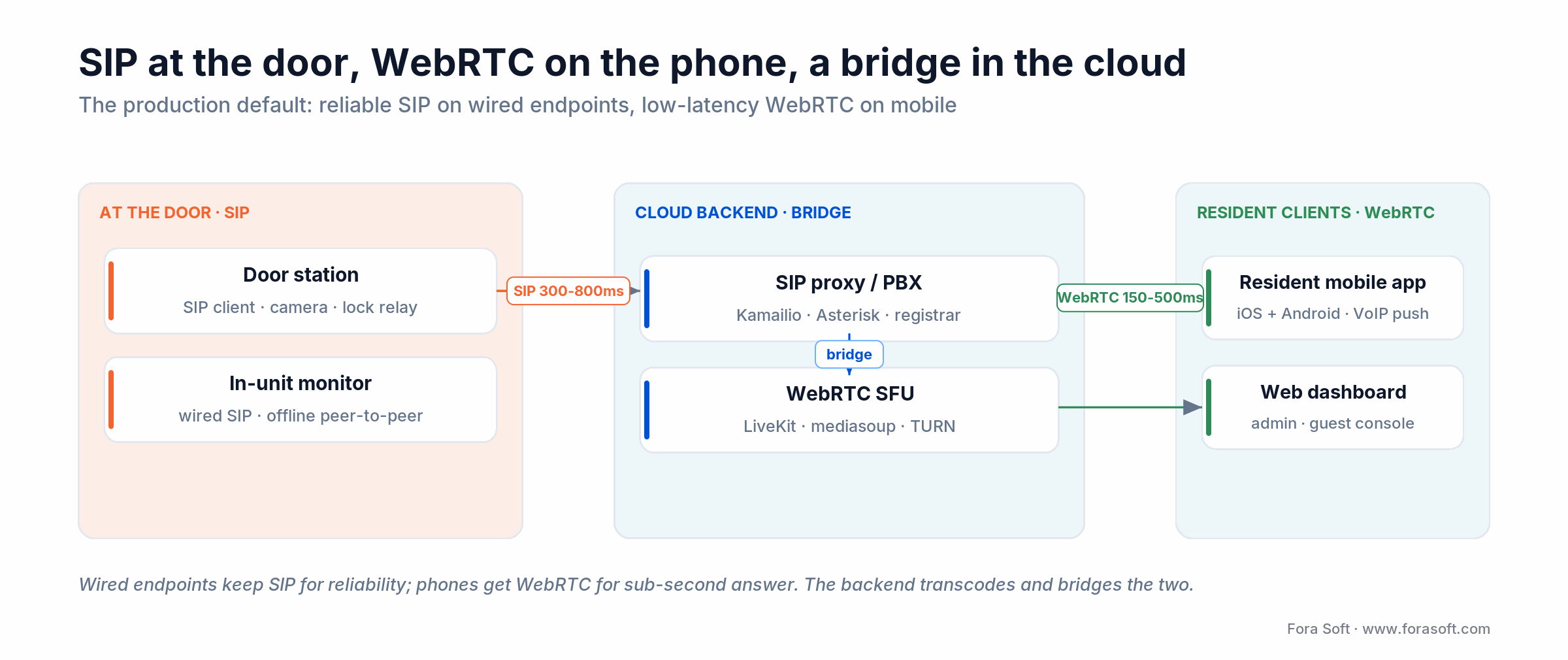
Figure 2. SIP keeps wired door stations reliable; WebRTC gives phones sub-second answer; the cloud backend bridges the two.
| Dimension | SIP | WebRTC |
|---|---|---|
| Best for | Door station, in-unit monitor, landline phones | Mobile app, web dashboard, property-manager console |
| Latency | 300–800 ms | 150–500 ms |
| NAT traversal | STUN / TURN + SIP ALG headaches | Built-in ICE + TURN |
| Codecs | G.711 / G.729 / Opus; H.264 | Opus + VP8/VP9/H.264 |
| When to bridge | Landlines, legacy PBX, some door stations | Anything browser- or mobile-native |
The common pattern: door stations and in-unit monitors talk SIP to your backend; mobile and web clients talk WebRTC; the backend bridges. That buys you the reliability of SIP on the door and the latency of WebRTC on the phone. Our Doorbell App did exactly this with a LiveKit SIP-to-WebRTC bridge, so any SIP door station works without swapping hardware.
Reach for SIP-first when: your endpoints are wired door stations, in-unit panels, or landlines that must survive an internet outage. Reach for WebRTC-first when: the answer point is a phone or a browser and every 100 ms of glass-to-glass latency shows.
AI features that residents actually use
Not every “AI” feature earns its panel space. These four land in real deployments.
1. Face recognition with liveness / anti-spoof
Hands-free entry for authorized people. On curated photos, the top algorithms in NIST’s FRTE 1:1 test (updated Aug 2025) hit vanishingly low false-non-match rates. The honest caveat: those are visa- and border-quality images, not a door camera shooting a backlit face at night. Budget a fallback path (PIN, fob, app entry) and mandatory anti-spoof, because a printed photo defeats a detection-only model. Depth or IR liveness is the floor, not a nice-to-have.
2. Package / delivery detection
Solves the top pain point in multi-tenant buildings. A classifier that tells people from packages, vehicles, and pets cuts nuisance push notifications sharply and opens a porch-piracy alert path. It runs on-edge on the door station, so it works even when the uplink is flaky.
3. QR / one-time PIN entry
Best for delivery drivers and short-term guests. Generate a time-boxed code in the resident’s app, deliver it by SMS or email, and let the camera scan the QR at the door. No shared PINs, no forgotten codes, and a full audit trail.
4. Video voicemail + missed-call clip
Nobody answers every time. When no resident picks up, record 30 seconds around the button press and notify. This one feature is often the difference between “we love it” and “we turned it off.”
Reach for on-device face recognition when: latency and privacy both matter (embeddings stay on the panel, no cloud round-trip). Push it to the cloud only for heavier reasoning like visitor-intent classification, and never auto-deny entry on model output alone.
The protocol stack — what you’ll touch
| Protocol / standard | Role | Watch-out |
|---|---|---|
| SIP (RFC 3261) | Call signaling | Disable SIP ALG on customer routers or expect one-way audio |
| WebRTC | Browser / mobile media | Run your own TURN server; don’t rely on public relays |
| ONVIF Profile S / T | Surveillance integration | Essential for multi-vendor, optional for single-vendor |
| PoE+ (802.3at) / PoE++ (802.3bt) | Power the door station (25–90 W) | Budget IR LEDs + heater + PTZ; long runs derate |
| Matter 1.5 / 1.5.1 | Smart-home interoperability | Intercom is a first-class device type since Matter 1.5 (Nov 2025); the gap is controller support, not the spec |
| OSDP / Wiegand | Access-control readers | OSDP Secure Channel encrypts; Wiegand is plaintext and spoofable |
| APNs VoIP Push / FCM | Wake mobile on incoming call | iOS CallKit + PushKit only; never a regular push for ringing |
The one that trips teams up most: Matter. As of Matter 1.5 (finalized Nov 2025), “intercom” is a defined device type alongside cameras and video doorbells, and Matter 1.5.1 (Mar 2026) refined its signaling and added integrated chimes. So “wait for the spec” is the wrong mental model. The real wait is on controllers: Apple Home, Google Home, and Alexa are rolling out Matter camera and intercom support at their own pace.
The 2026 vendor map
A short map of the players we see in live deployments and where each sits in the value chain.
| Vendor | Best for | Watch-outs |
|---|---|---|
| Aiphone (IX / IXG) | Commercial + residential, well-integrated to major VMS | Hardware cost, slower cloud roadmap |
| Akuvox | Face-recognition-heavy deployments, mid price | Firmware quality varies by SKU; vet CVE history |
| 2N | Strong SIP compatibility, PBX-friendly | Premium price |
| DoorBird | Small-building and single-family | Cloud-tied features, API depth varies |
| Comelit / Siedle | European builds, 2-wire retrofit paths | Slower cloud roadmap, higher integration cost |
| ButterflyMX / Swiftlane / Latch | Multi-tenant residential SaaS | Coupled hardware + SaaS; margin pressure on ISVs building alternatives |
If you’re a building integrator, this is a shortlist. If you’re an ISV building your own product, it’s a competitive map: the SaaS players (ButterflyMX, Swiftlane) own the resident app and the recurring revenue, which is exactly the layer you’d be fighting for.
Reach for a SaaS incumbent when: you manage a handful of buildings and want a resident app tomorrow. Reach for a custom build when: intercom is core to your product, you need to own the app, AI, and data, and you have a credible path to hundreds of buildings.
Need a second opinion on build vs buy for your intercom stack?
Send us your target deployment and the vendors you’re weighing; we’ll give you a straight read in a 30-minute call.
Integrations that actually close deals
For B2B multi-tenant products, five integrations consistently separate a demo from a signed contract.
1. Property management (PMS). Yardi, Entrata, AppFolio, Buildium. Resident directories, move-in/move-out automation, lease-status sync. Skip this and expect to lose to a vendor that has it.
2. Access control. Salto, Brivo, Kisi, LenelS2, HID. OSDP Secure Channel, not Wiegand. One credential set for door, elevator, and amenities.
3. Smart home / voice. HomeKit, Alexa, Google Home, Matter. Residents want the door to ring on their kitchen speaker, not only in a single app.
4. Surveillance / VMS. ONVIF Profile S/T into Milestone, Genetec, Eagle Eye. Share the door feed with the existing security platform instead of adding another operator tab.
5. Delivery platforms. Amazon Key, UPS, FedEx, Instacart. One-time QR codes or short-lived tokens for couriers, never a shared building code.
What’s coming in the next 18 months
Voice-AI concierge at the door. OpenAI Realtime and similar models (see our realtime voice guide) are already shipping in pilots as “AI receptionists.” Visitors state their purpose; the model handles delivery, guest, and service-worker cases without waking a resident.
Matter intercom maturity moves to the controllers. The spec already defines intercom (Matter 1.5, Nov 2025; refined in 1.5.1, Mar 2026). The next 18 months are about Apple Home, Google Home, and Alexa shipping consistent support, at which point answer-the-door-from-a-smart-speaker stops being a project and becomes a checkbox.
EU AI Act obligations land in two waves. Article 50 transparency duties (disclose AI interaction, label synthetic media) became enforceable on 2 Aug 2026. High-risk obligations for biometric systems, an intercom’s face-recognition feature included, were deferred to 2 Dec 2027 by the Digital Omnibus (Regulation (EU) 2026/1744, in force 27 Jul 2026). Plan for the dossier now; you have runway, not a reprieve.
5G fixed-wireless as primary uplink. For buildings without fiber, 5G FWA plus an LTE failover is becoming the default WAN. Design the backend for dual-path uplinks.
Mini case: a cloud-first video intercom without ripping out the panels
Situation. A property operator ran a decade-old 2-wire audio intercom across a 200-apartment portfolio. Residents ignored it, deliveries piled up, and complaint tickets came in weekly. They wanted one system (web admin, resident mobile app, cloud directory, delivery access) without pulling the existing audio panels on day one.
The plan. Weeks 1–2: retire-and-replace audit, a PoE lobby door station, and a 2-wire bridge for the in-unit panels. Weeks 3–5: cloud backend, SIP proxy, and a resident mobile app with VoIP push. Weeks 6–7: opt-in face-recognition enrollment, one-time QR for deliveries, and PMS directory sync. Weeks 8–10: pilot, UX tuning, and a phased rollout across two buildings. The SIP-to-WebRTC bridge pattern from our Doorbell App carried straight over.
Outcome. Delivery-related tickets fell sharply, median answer time on residents’ phones landed at 1.6 seconds against a sub-2-second goal, and the five-year TCO came in well under the incumbent on-prem bid. Want a similar assessment of your stack? Book a 30-minute call and we’ll walk your options.
Cost model: hardware + software + integration
| Line item | Residential 50 units | Commercial 200 doors | Notes |
|---|---|---|---|
| Door stations (hw) | $1,200–4,000 | $40k–120k | $400–2,500/door by feature tier |
| Cabling + labor | $3k–8k | $30k–80k | New PoE pulls at $50–200/drop |
| Cloud / SaaS | $400–1,200/mo | $2k–5k/mo | $8–25 per door/month at scale |
| Integration (PMS, access) | $2k–6k one-time | $6k–20k one-time | Yardi / Entrata / AppFolio / custom |
| Custom SaaS build (MVP) | n/a | $120k–280k | 16–24 weeks; Agent Engineering trims the scaffolding |
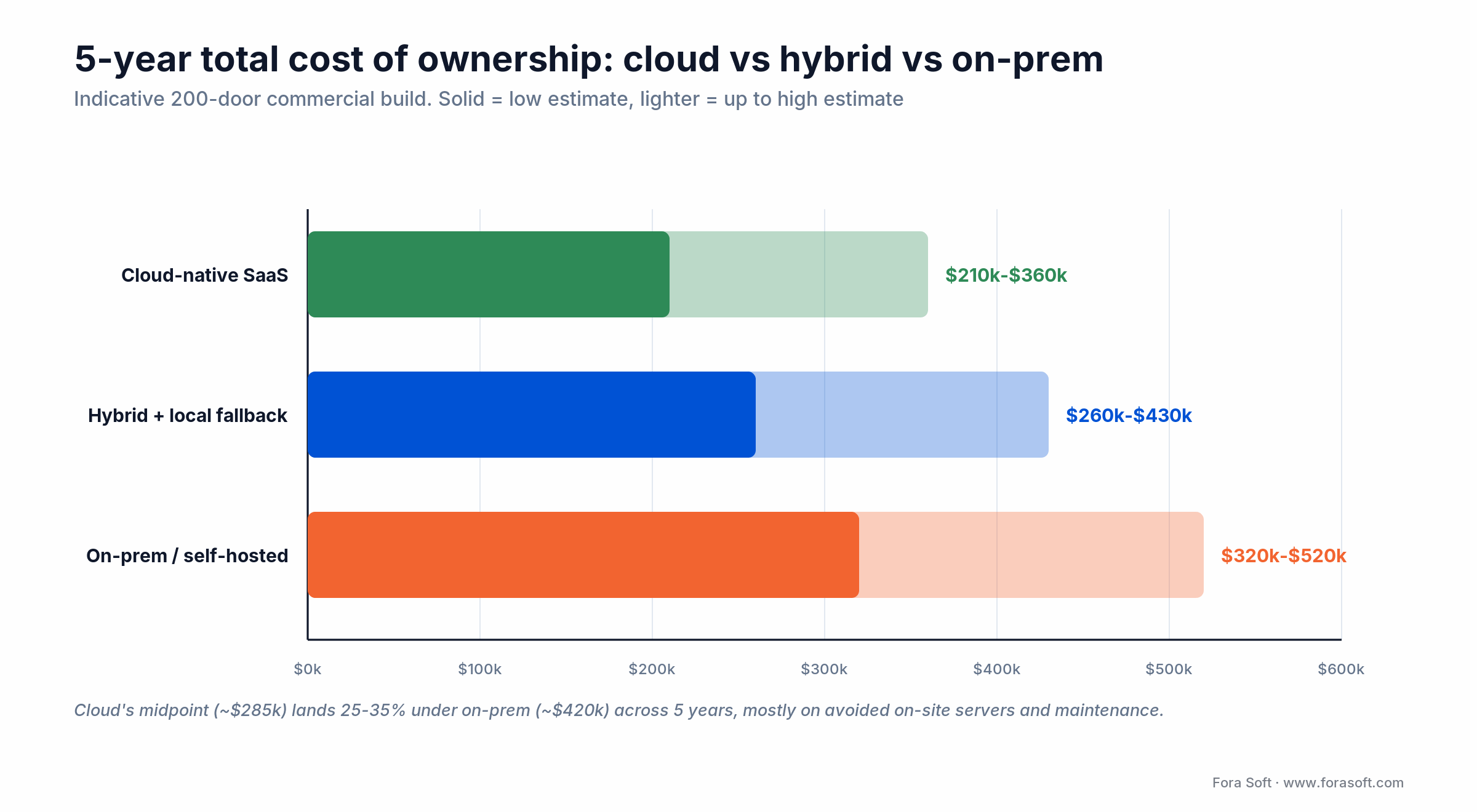
Figure 3. Five-year TCO for a 200-door build: cloud-native runs roughly 25–35% under on-prem, mostly on avoided on-site servers.
For an ISV building the SaaS itself (not just deploying one), the meaningful row is the custom build. Our Agent Engineering practice typically trims the timeline on heavily pattern-based work: the SIP proxy, push gateway, device provisioning, and directory-sync scaffolding. We keep estimates conservative; if a number isn’t defensible, we don’t quote it.
Want a realistic MVP scope and cost for your intercom software?
Send us your target deployment size and compliance region and we’ll come back with a phased plan and a rough number in a 30-minute call.
A decision framework in five questions
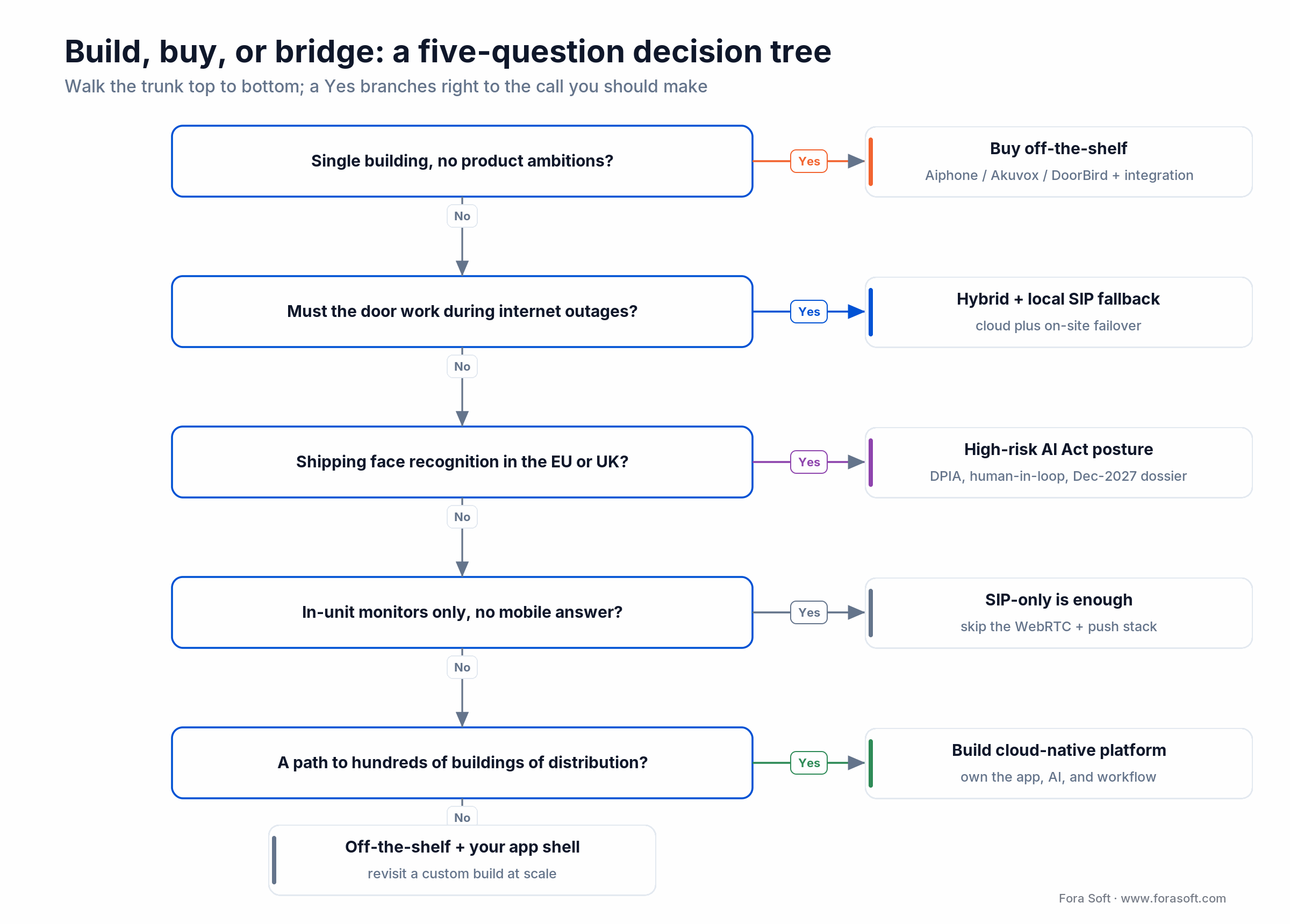
Figure 4. Build, buy, or bridge: walk the trunk top to bottom; a Yes branches to the call you should make.
Q1. Is this a product or a deployment? Product (your SaaS, many buildings): cloud-native, multi-tenant, ISV-grade. Deployment (one building, internal): off-the-shelf Aiphone / Akuvox / DoorBird plus integration.
Q2. What’s your uptime requirement? If tenants tolerate “delivery-only” behavior during internet outages, cloud-only is fine. If building access must always work, hybrid with local SIP fallback is mandatory.
Q3. What’s the compliance region? EU/UK: DPIA, GDPR Art. 22, and a high-risk EU AI Act posture (dossier due Dec 2027). US: state-level (IL BIPA, TX CUBI, CA CCPA/CPRA). Your legal posture decides whether face recognition ships at all.
Q4. What’s the existing wiring? PoE Cat6 in every riser: greenfield is easy. 2-wire legacy: budget a bridge or a phased rip-and-replace. Luxury residential accepts the disruption; budget rental usually doesn’t.
Q5. Where does the call go? In-unit monitors only: SIP-only is enough. Mobile apps: WebRTC + VoIP push. Landlines: a SIP trunk to PSTN. Most modern deployments answer all three at once.
Five pitfalls we see sink video intercom projects
1. SIP NAT-traversal black holes. Symmetric NAT plus SIP ALG eats a chunk of calls on residential ISPs. Run a TURN server, disable ALG at provisioning, and test from live routers before declaring victory.
2. Mobile push delivery delays. Android’s Doze and iOS throttling can turn a 200 ms round-trip into eight seconds. Use VoIP-class push (iOS PushKit + CallKit, Android high-priority FCM), not regular notifications.
3. PoE budget exhaustion. 25 W PoE+ covers a basic station; add IR LEDs, a heated touchscreen, and a PTZ motor and you’re into 60–90 W PoE++ (802.3bt). Spec it at the switch or pick wall-powered variants.
4. Skipping the offline mode. The cloud goes down; the door still has to work. Local SIP peer-to-peer between door and in-unit monitor, plus events queued for sync on recovery, are non-negotiable in production.
5. Shipping face recognition without a DPIA. In the EU, GDPR Art. 22 means a denied-entry decision can’t be solely automated, and the AI Act adds high-risk documentation duties by Dec 2027. Ship with a DPIA, an opt-out, and human review, or don’t ship.
KPIs to track from day one
Quality KPIs. Call-answer latency P95 on mobile (target < 2 s), face-recognition true-positive rate (> 99%), false-reject rate (< 0.5%), package-detection precision (> 92%).
Business KPIs. Monthly answer-rate per resident (> 75%), delivery-ticket volume trend (month-over-month down), face-recognition opt-in rate (benchmark 40–60%), and time-to-provision a new unit (< 10 minutes self-serve).
Reliability KPIs. Door-station uptime (> 99.9%), push-delivery success (> 98%), offline-mode fallback success (> 99.5%), and PMS integration-sync lag (< 5 minutes).
Security, compliance, and accessibility
GDPR + EU AI Act. Face data is special-category under GDPR Art. 9, and Art. 22 blocks a solely-automated denied-entry decision. On top of that, the EU AI Act treats biometric identification as high-risk: Article 50 transparency duties are already enforceable (2 Aug 2026), and the full high-risk obligations were deferred to 2 Dec 2027 by the Digital Omnibus. Keep a DPIA on file, require consent, and put a human in the loop for denials.
US biometric privacy. Illinois BIPA carries a private right of action (statutory damages per violation; SB 2979 in 2024 limited them to a single recovery per person). Texas CUBI, Washington HB 1493, and California CCPA/CPRA all impose duties on biometric capture. Written consent, disclosure, data minimization, and audit logs are non-negotiable.
Accessibility (ADA + EN 301 549). Audio and visual feedback on the door station, tactile buttons, hearing-loop support, and color-contrast compliance in the app. In new commercial builds the inspector may actively check.
Fire code + egress. Door hardware must fail-safe open on power loss where fire code requires it. Your software cannot block egress, not even for unpaid rent.
When NOT to build your own video intercom product
You’re deploying to one building. Pick off-the-shelf: Aiphone, Akuvox, DoorBird, 2N. Integrating to your PMS is a project; the hardware and firmware are not.
You need a product in three months and have never built real-time video. Partner or OEM. Building the SIP + WebRTC + mobile-push stack from scratch on that timeline is a false economy.
Your target market is tiny. Build-to-own pays back only if you’re serving hundreds to thousands of buildings. Below that, margins don’t cover custom firmware and compliance.
FAQ
Can I reuse my building’s 2-wire intercom wiring?
Not directly for IP video — the bandwidth isn’t there. Two options: a 2-wire-to-IP bridge (Comelit and Akuvox sell retrofit kits), which works but adds latency and cost; or rip-and-replace with Cat6 + PoE in a phased upgrade. Bridge first if budget or disruption tolerance is low, then replace.
How long does installation take?
Single-door commercial: 2–4 hours. A 50-unit residential building: 2–4 weeks including PMS integration and resident onboarding. A 200+ door multi-building rollout: 6–10 weeks with phased go-live. Most schedule risk is in the PMS and access-control integration, not the door hardware.
What happens when the internet goes down?
If you designed for offline, local SIP between door and in-unit monitor still works, queued entry events fire when connectivity returns, and cached resident directories stay valid. Remote mobile answering stops. Cloud-only products go dark entirely, which is why they don’t belong in a production building.
Is a biometric intercom “high-risk” under the EU AI Act, and when do the rules bite?
Yes. Face recognition is biometric identification, which the EU AI Act classifies as high-risk. Article 50 transparency duties are enforceable from 2 Aug 2026; the full high-risk obligations (documentation, human oversight, conformity) were deferred to 2 Dec 2027 by the Digital Omnibus. GDPR Art. 9 and Art. 22 apply now regardless.
Does Matter support intercoms yet?
Yes. Matter 1.5 (finalized Nov 2025) defines intercom as a device type alongside cameras and video doorbells, and Matter 1.5.1 (Mar 2026) refined its signaling and added integrated chimes. The remaining gap is controller support — Apple Home, Google Home, and Alexa are rolling it out at their own pace.
What’s a realistic hardware budget per door?
About $400–600 for an entry-level IP station, and $1,500–2,500 for a premium multi-tenant panel with touchscreen and face recognition. Cabling and labor add $50–200 per drop. Cloud or SaaS runs $8–25 per door per month at scale.
Why are mobile notifications slow or sometimes missed?
Two reasons: OS background throttling and non-VoIP push categorization. On iOS use PushKit + CallKit for immediate wake-up; on Android use high-priority FCM. Regular notifications can be delayed 5–30 seconds by the OS, which kills the door-answering experience.
How long does it take to build the SaaS platform itself?
An MVP in 16–24 weeks if you lean on mature door-station hardware and focus your build on the cloud backend, mobile apps, directory, and integrations. A full production platform with face recognition, PMS integrations, and compliance posture: 30–40 weeks. Agent Engineering trims the scaffolding and adapter work.
What to Read Next
Surveillance
Integrating IoT with Video Surveillance Software
The neighboring domain: reference architecture for IoT video surveillance.
Intercom
Commercial Intercom System: The 2026 Software Playbook
The buyer-and-builder guide for commercial-grade intercom software.
Voice AI
OpenAI Realtime + WebRTC / SIP / WebSockets
The voice-AI layer that makes an intercom conversational in 2026.
Testing
How to test WebRTC stream quality
Measuring glass-to-glass latency, MOS, and freeze rate — the metrics that matter.
Services
Fora Soft video surveillance development
What we build and how — Netcam, VALT, and related deployments.
Ready to ship a video intercom residents actually use?
Three moves cover most of the risk. Pick hybrid cloud with a local SIP fallback so the door still works when the internet doesn’t. Spend your latency budget where residents feel it: mobile push and WebRTC answer. Ship face recognition only with the full compliance scaffolding, because the EU AI Act now classifies it as high-risk and residents will ask.
If you’re building a product, the architecture above is the starting blueprint. If you’re deploying one, use it as the shortlist of questions to hand your vendor. Either way, real-time video products live or die on the details under the hood.
Talk to the team behind 250+ video and real-time products
Thirty minutes, your architecture on a whiteboard, and a walk-away plan for your video intercom product or integration — whether we build it together or not.

