

Key takeaways
• Live commerce is a $900B machine in China, scaling fast in the West. China ran ~$900B in live-commerce GMV in 2025 (NielsenIQ), approaching the scale of all US e-commerce; the West is smaller but accelerating — US live shopping is projected at ~$68B in 2026, up from ~$50B in 2023. Walmart, Amazon Live, TikTok Shop and Instagram Shopping are pulling the category mainstream. Conversion rates run 6–10× baseline e-commerce when the live show, the inventory and the checkout are tightly synced.
• The architecture is nine modules, not one app. Streaming + product overlay + in-stream checkout + inventory sync + chat + payments + streamer dashboard + VOD + platform integrations. Skip any of the nine and the magic of a live show breaks.
• Sub-1-second latency is what makes "buy now" convert. If the host says "this red bag, gone in 60 seconds" and the viewer’s feed is 18 seconds behind, the buy intent dies before the screen updates. WebRTC for the host-to-viewer hot path, RTMP / HLS as fallback, is the 2026 default.
• Three viable build paths. Buy Bambuser / CommentSold / channelize.io ($60k–$240k/year per brand, fast). Hybrid (your shell, vendor video / chat SDKs — 3–4 months, $200–$500k). Custom end-to-end (4-week MVP to 5-month full platform, $400k–$1.4M, full IP and margin). Operators who plan to monetise the platform itself end up custom; brands running live commerce as a feature stay on a vendor.
• Sprii is a real benchmark, not a hypothetical. We built Sprii — an iOS-first live commerce platform — from a clean slate; it has since driven €365M+ in sales across 3,000+ brands. The patterns in this guide are the patterns we shipped there.
Why Fora Soft wrote this playbook
Fora Soft built Sprii from a clean slate as an iOS-first live commerce platform — it has since driven €365M+ in sales across 3,000+ brands. We followed the iOS MVP with the Android build. We have shipped the live-commerce surface across Alve (creator-monetisation streams), Watchfun (interactive watch-parties), and Tradecaster (live-commentary tooling). The architecture decisions, the latency budgets, the in-stream checkout patterns, the inventory-sync race conditions, and the streamer-dashboard UX in this guide all come from products in production today.
Beyond direct builds we audited two live-commerce platforms in pre-Series-A diligence and shipped a TikTok Shop integration for a brand-side operator. The patterns also reflect public references — the Bambuser and CommentSold technical materials, the TikTok Shop and Instagram Shopping API documentation, and the WebRTC vs HLS-LL comparisons our team contributes to.
If you are an e-commerce VP adding live commerce, a brand DTC team, a shopping-network operator, or an agency / influencer platform, this guide gives you the architecture, the cost reality, the integration patterns, and the launch plan we use in our video streaming app development engagements.
Want a Sprii-class live commerce MVP in 5 months?
Send your brief, get a delivery plan in 48 hours. Free 30-minute scoping. We’ll size the build, list vendor vs custom trade-offs, and ship the same patterns behind Sprii’s €365M+ in live-commerce sales.
Live commerce 2026 market snapshot
Live commerce is the most lopsided category in retail. China ran ~$900B in live-commerce GMV in 2025 (NielsenIQ) through Taobao Live, Douyin (TikTok), Kuaishou, and a long tail of platforms — a market now approaching the scale of all US e-commerce. The West is smaller but accelerating: US live shopping reached ~$50B in 2023 and is projected at ~$68B in 2026. The chasing pack — Walmart Live, Amazon Live, TikTok Shop, Instagram Live Shopping, NTWRK, Whatnot, Poshmark Live — is converging on a similar product playbook.
Two structural drivers anchor 2026 growth. The first is the post-iOS-14 attribution collapse: brands that lost retargeting precision are leaning into live formats where conversion happens inside the same surface the discovery happened in. The second is the creator-economy maturity: full-time creators with 100k+ followings can run profitable storefronts, and platforms that pay them properly win.
Conversion rates are the headline. A well-run live show converts 6–10× baseline e-commerce; AOV is 30–60 % higher; refund rate is comparable. The catch is that "well-run" is a load-bearing word — the difference between a 0.6 % and a 6 % conversion rate is in production discipline, audience match, and a handful of architectural details we cover in the next sections.
What live commerce actually is
Live commerce is not a video player with a buy button. It is a real-time orchestration of five things happening at once: a live video feed, a host pitching products, a viewer audience reacting, an inventory of products tied to the stream, and a payment flow that converts inside the same surface. Get the orchestration right and you get a Taobao-Live-style conversion machine. Miss any of the five and you ship a "shoppable Instagram Live", which is a product nobody asked for.
1. The host stream. The video / audio feed of the seller, often with a multi-cam setup and a producer in the loop, sometimes single-camera mobile.
2. The product surface. A scrollable rail of SKUs the host is pitching right now, plus pinned hero items the host can swap in real time.
3. The audience. Live viewer count, live chat, reactions, polls, "comment to bid" mechanics for auction-style streams.
4. The checkout. Tap a SKU; modal opens; payment in 2–3 taps; back to the stream; total time-to-purchase under 30 seconds.
5. The inventory. Real-time stock count visible to the audience ("only 3 left!") and synced back to the brand’s e-commerce backend so a sale on the live stream and a sale on the website cannot oversell the same SKU.
Reference architecture — nine modules
Across every live-commerce build we have shipped, the same nine modules show up. They map cleanly to the five user-experience pillars above and to the operational ownership boundaries that determine where you can buy vs build.
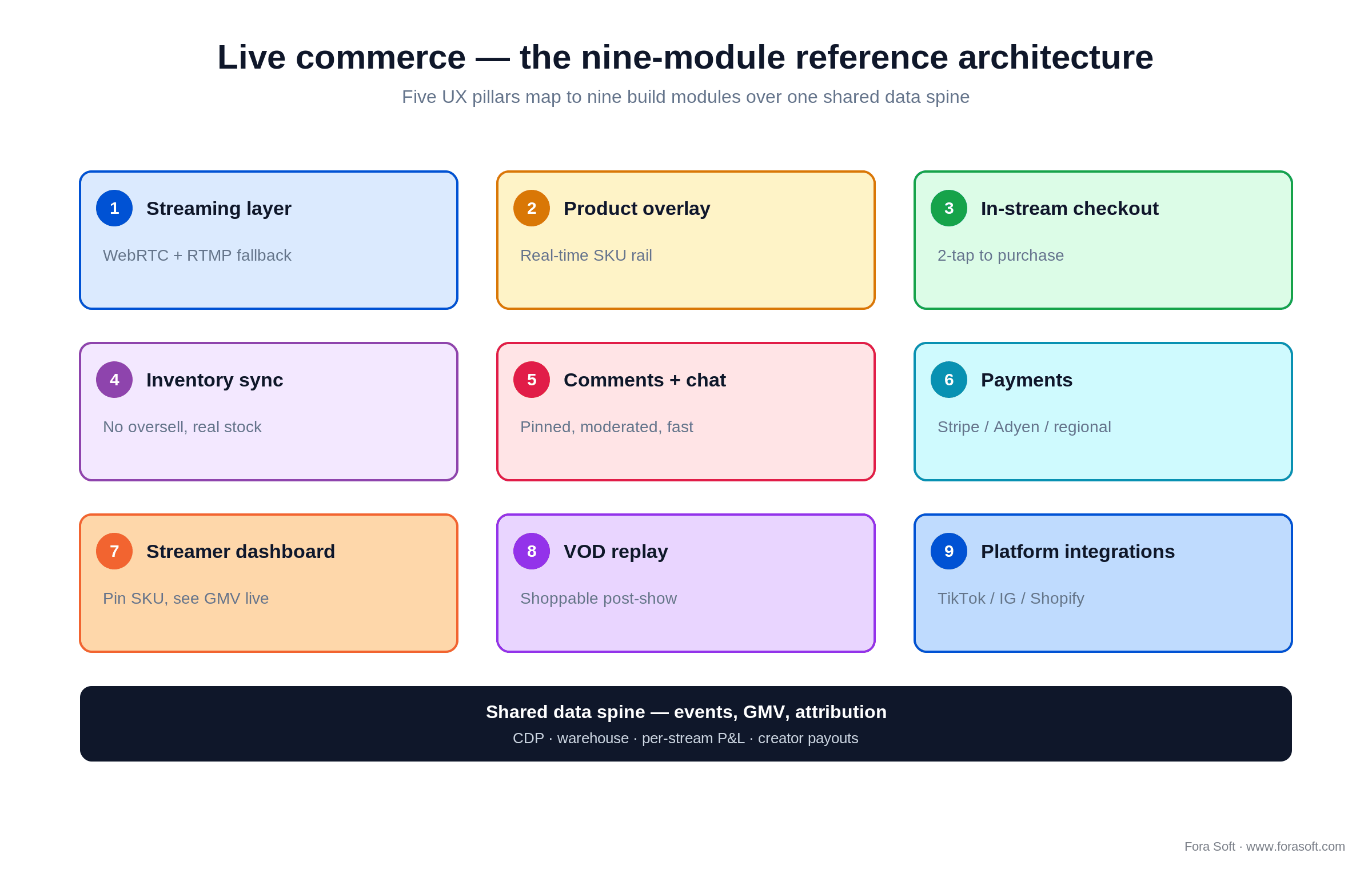
Figure 1. The nine build modules of a live commerce platform, unified by one shared data spine.
Module 1 — Live streaming with RTMP fallback
Live commerce demands two paths through the streaming layer: a hot path with sub-1-second latency for "buy-now" mechanics to convert, and a fallback path with broader reach for users on mobile networks where WebRTC is fragile. The 2026 default is WebRTC for the hot path (using a managed SFU like LiveKit or 100ms, or a self-hosted Janus / mediasoup cluster), with HLS Low-Latency or RTMP fallback for users where WebRTC fails. WHIP / WHEP replaces RTMP in our recommended ingest stack, but RTMP fallback still earns its keep on stretched mobile networks. For the protocol trade-offs underneath, our video streaming engineering course walks through the full stack.
Encode at 720p / 30fps for mobile-first audiences; reserve 1080p for desktop or premium tiers. Adaptive bitrate ladders matter less than a tight encode-to-decode budget. Build the player as a thin native wrapper around AVPlayer (iOS) and ExoPlayer (Android) for HLS, plus the WebRTC SDK for the low-latency tier. Build vs buy — the video-SDK decision framework applies layer-by-layer.
Reach for WebRTC hot-path when: "buy now / 60-second flash" mechanics are central, host-audience interaction (Q&A, polls) drives conversion, or the show format includes scarcity ("3 left in stock") that requires a live count.
Module 2 — Real-time product overlay
The product overlay is the second-most-important UI element after the host’s face. A scrollable rail of products related to the current show, plus a pinned hero item the host can swap in real time. The host pins a SKU; within 2–3 seconds the audience sees that SKU front-and-centre with a buy button.
Architecturally the overlay is a long-lived WebSocket / Pub/Sub channel listening for "pin", "unpin", "stock-update" and "price-flash" events. Cache the rail aggressively but invalidate on every event. Race condition to watch: a viewer sees stock as 5, taps buy, but stock is actually 0 because someone else just bought the last 5 — surface the race outcome immediately ("sold out, joining waitlist?").
Module 3 — In-stream checkout
Checkout has to happen inside the surface the audience is already in. A modal sheet over the live feed, prefilled with the user’s saved address and payment method, completes in 2–3 taps and dismisses back to the stream. Total time-to-purchase target: under 30 seconds.
Three patterns we ship. 1. Native in-app checkout on iOS and Android using Apple Pay / Google Pay where available, with Stripe / Adyen as the underlying processor. Highest conversion. 2. Embedded web checkout for hybrid stacks — a Stripe Elements / Adyen Drop-in inside an in-app web view. Easier to implement but lower conversion. 3. Side-channel checkout (the user gets a push notification with a payment link) only as a fallback for browser-based viewers.
Reach for native in-app checkout when: conversion is the primary KPI, your platform owns the relationship with the buyer, and you can clear Apple Pay / Google Pay setup in your launch markets.
Module 4 — Inventory sync
Inventory sync is where most homegrown live-commerce platforms blow up. The brand’s e-commerce backend (Shopify, Magento, BigCommerce, Salesforce Commerce Cloud, custom) holds the source-of-truth stock; the live platform has its own buy flow; both can sell the same SKU at the same time. Without a reservation pattern, you oversell.

Figure 2. The 90-second reservation token that keeps the live show and the website from overselling the same SKU.
The pattern that works: a per-SKU reservation token issued at "tap to buy" with a 90-second expiry. The platform decrements stock on the brand backend at reservation; the website buy-flow respects the reservation and shows reduced stock. If the user does not complete checkout in 90 seconds, the reservation expires and stock returns. Implement this on a Redis-backed atomic counter with hard expiry, not in Shopify webhooks — the latency is the difference between a clean platform and a customer-service disaster.
Reach for atomic reservation tokens when: SKUs are commonly sold across both the live show and the website during the show window, scarcity ("only 3 left") is a conversion lever, or your CS team has flagged oversell incidents.
Module 5 — Comments and chat
Live chat is the social engine of the show. The viewers ask questions, react in real time, and bid in auction formats. Two patterns. Pinned host comments — the host or producer pins a comment to the top of the rail to highlight the right answer or the right product. Free-flow chat — the audience scrolls a fast feed of reactions and questions. Both need real-time delivery and aggressive moderation.
Build chat on a managed real-time service (Ably, PubNub, Stream Chat) up to ~100k concurrent. Above that, self-host on Redis Streams + WebSocket, with sharding by stream. Moderation runs through OpenAI / Hive / Two Hat for the automated layer plus a human moderator pod for the tail; abuse spikes during drops and goal-moments and the moderation model has to scale.
Module 6 — Stripe / Adyen payments
Payment processor selection comes down to geography, fees, and feature surface. Stripe in the US and most of Europe; Adyen for global / multi-acquiring; a regional PSP (PayU in LatAm, Razorpay in India, Tap in MENA, M-Pesa via Flutterwave / Cellulant for African markets) where it earns its keep. For platforms that pay creators back, Stripe Connect or Adyen for Platforms is the multi-party model.
SCA (Strong Customer Authentication) under PSD2 is non-negotiable in the EU. 3DS2 must work inside the in-app checkout sheet without bouncing the user out of the live stream — many vendor checkouts mishandle this. Test the SCA path explicitly during launch.
Module 7 — Streamer / influencer dashboard
The streamer dashboard is the cockpit. The host (or their producer) sees the audience size, the live chat, the current pinned SKU, the live GMV, the units sold per minute, and a one-tap pin / unpin / price-flash action surface. Plus a pre-show schedule, a post-show report, payout summary, and an audience engagement chart for replay analysis.
Most platforms shipping today underinvest here. The dashboard is where retention of creators is decided — if the live GMV ticker is laggy, if pin-a-SKU takes 4 taps, if payout is opaque, the creator goes back to TikTok Live. Build the dashboard as a first-class product, not as a webform.
Reach for a producer-side dashboard when: hosts are creators with multiple-platform alternatives, shows feature multi-camera or post-production overlays, or pin-a-SKU response time exceeds 3 seconds on the current dashboard.
Module 8 — VOD recording and replay
VOD replay is where the live show becomes evergreen content. Record every stream automatically; transcode to ABR ladders; capture the full event stream (pinned SKUs, chat highlights, GMV ticker) and play it back synchronously with the video. A viewer who missed the live show should be able to scrub through the replay, see the same product overlay timing, and buy from the replay with the inventory still synced.
Architecturally: capture the WebRTC-side audio / video to an MP4 via the SFU’s recording API; capture the event log to a per-stream timeline document; render the replay player to step through the event timeline alongside the video. RAG over video, audio and chat recordings covers the analytics surface this enables.
Module 9 — TikTok Shop / Instagram integrations
A serious live-commerce platform has to decide its stance on the giants. Three options. Compete: own the audience and the storefront. Complement: let brands stream on TikTok Shop / Instagram and pull the GMV back into a unified attribution and inventory layer. Federate: stream once and broadcast simultaneously to the platform plus TikTok Shop / Instagram.
The TikTok Shop API and Instagram Shopping API both expose programmatic product catalogue, live-stream tagging, and order webhooks — with rate-limit and shape constraints that can ambush you. Plan a parallel multi-quarter integration track and budget vendor-side delays. The federation pattern is the dominant 2026 pattern for brand operators because it captures GMV everywhere the audience already is.
Sub-1-second latency for buy-now conversion
Latency is the lever that turns a live show into a conversion machine. The reason China’s live commerce works at the scale it does is that the latency budget on Taobao Live and Douyin is 800–1,200 ms end-to-end. Western platforms running on stock HLS at 18–25 sec end-to-end leave the conversion on the table.
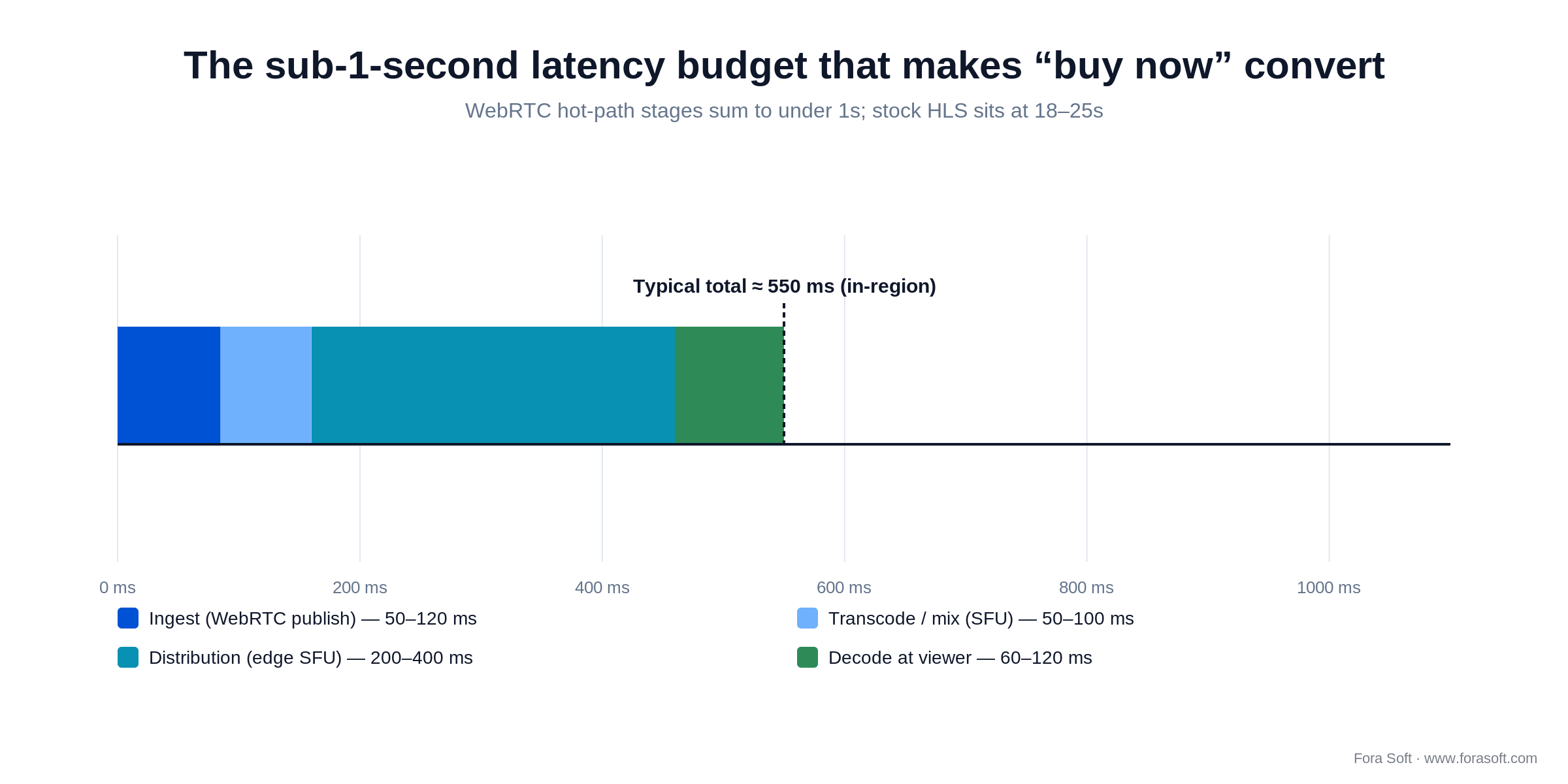
Figure 3. The WebRTC hot-path latency budget that keeps end-to-end delay under one second.
A 2026 sub-1-second budget breaks down: ingest from the host (50–120 ms WebRTC publish), transcoding / mixing (50–100 ms in an SFU pipeline), distribution (200–400 ms via a nearby SFU or sub-200 ms on a managed edge mesh), decode at the viewer (60–120 ms). Add network jitter and you sit comfortably under 1 sec for in-region viewers. Cross-continent viewers degrade to 1.5–2.5 sec and the experience is still excellent.
Cost model — 4-week MVP to 5-month platform
| Path | Build (one-time) | Time to live show | Year-1 run | IP / margin |
|---|---|---|---|---|
| 4-week MVP (single brand, single show format) | $80k–$160k | 4 weeks | $120k–$220k | Validate first |
| 3-month iOS-first | $220k–$420k | 3 mo | $280k–$540k | Mostly yours |
| 5-month Sprii-class iOS+Android | $400k–$700k | 5 mo | $420k–$760k | Full IP |
| 9-month full platform (multi-brand, web + iOS + Android) | $700k–$1.4M | 9 mo | $700k–$1.4M | Full IP, multi-tenant |
| Vendor (Bambuser, CommentSold) | $30k–$80k integration | 3–6 wk | $60k–$240k vendor + GMV % | Vendor-locked |
Numbers from real engagements plus published vendor pricing. The 4-week MVP is for validation only; if it works, plan the 3- or 5-month path before the vendor-stitched look-and-feel locks you into a UX you cannot iterate.
Build vs Bambuser vs CommentSold
The vendor market is mature. Bambuser is the European market leader with strong shoppable-video tooling. CommentSold dominates the small-business "comment to bid" model in the US. channelize.io and BeLive serve the broader long-tail. Each ships fast, lock-in is real, and per-GMV revenue share or per-MAU fees crowd out margin once you cross ~$1M GMV per month.

Figure 4. Vendor, hybrid and custom build paths compared on time, cost and IP control.
Custom wins when (a) the platform itself is the product and you intend to monetise it, (b) you want a brand-led UX you control end-to-end, (c) data control and creator-payout flexibility matter, or (d) you cross GMV thresholds where vendor revenue share becomes a strategic tax. Sprii’s decision was clear on (a) and (b); the platform has since driven €365M+ in sales across 3,000+ brands.
Mini case — Sprii, €365M+ in sales from an iOS-first MVP
Sprii came to us with a clear pitch: a live-shopping platform built for the MENA and South Asia markets, iOS-first, with a creator-led storefront model. We took it from a clean slate to a launchable iOS app, then shipped the Android build. The architectural decisions we made early are why the platform could scale — it has since driven €365M+ in sales across 3,000+ brands.
WebRTC hot-path on a managed SFU for the host-to-viewer feed; HLS-LL fallback for desktop and weak-network mobile users. Native iOS UI with a producer-grade pin / unpin / hero-product workflow. In-app checkout via Stripe with regional PSP fallback for MENA payment methods. Inventory reservation pattern with a 90-second expiry. Live chat on a managed real-time service with automated and human moderation. Streamer dashboard built as a first-class product, including live GMV, units sold per minute and one-tap product pinning. VOD recording with shoppable replay.
Outcomes: the platform has driven €365M+ in sales across 3,000+ brands, live-show conversion running several times baseline e-commerce, average concurrent viewer count above target, and creator-side retention strong because the dashboard works. Want a similar engagement? Book a 30-minute call.
Building a live commerce platform this year?
Free 30-minute scoping. We’ll size the build, list vendor vs custom trade-offs, and ship a 5-month plan with the same patterns behind Sprii’s €365M+ in live-commerce sales.
A decision framework in five questions
1. Are you a brand or a platform? Brands monetise live commerce as a feature alongside the storefront — vendor-stitched is usually right. Platforms monetise the live commerce surface itself — custom usually wins.
2. What is your latency need? Drop-style ("60-second flash") and live auction formats need sub-1-sec WebRTC; 24/7 storefront formats can survive on HLS-LL. Pick the format before the streaming stack.
3. Where do you stand on TikTok Shop / Instagram? Compete, complement, or federate? The architectural shape changes accordingly.
4. Who owns the inventory source-of-truth? Shopify-anchored brands have a different sync pattern than custom-PIM brands. Build the reservation pattern around the source.
5. How will you pay creators? Stripe Connect, Adyen for Platforms, or a custom payout layer with regional disbursement options. Get this right early; creators leave platforms over delayed or opaque payouts.
Pitfalls to avoid
1. Shipping HLS-only and calling it live. 18-second latency turns "buy now" into "buy maybe". Even if you have to add a WebRTC tier later, plan the architectural seam from day one.
2. No inventory reservation. Overselling is the customer-service catastrophe that ends partnerships. The 90-second reservation pattern is the canonical fix; ship it before launch.
3. Underbuilding the streamer dashboard. If the host has to ask their producer to pin a SKU because the dashboard is hard to use, the show stalls. Build the dashboard as a first-class product.
4. Vendor-stitched with no exit plan. Bambuser and CommentSold ship fast and lock you in. If the platform is the strategic product, plan the migration off the vendor before you cross the GMV threshold where revenue share crowds out margin.
5. Skipping VOD with shoppable replay. The live show is 60 minutes; the post-show replay is forever. Without shoppable replay you get the spike and lose the long tail. That on-demand side is its own build — interactive clips that sell around the clock — which we cover in shoppable video platform development.
KPIs to measure
Quality KPIs. End-to-end live latency under 1.5 sec at the 95th percentile (in-region viewers), playback start-time under 1.5 sec, video rebuffer rate under 0.6 %, host-to-viewer audio sync within 80 ms, in-app checkout completion above 92 % of attempts.
Business KPIs. Live show conversion above 4× baseline e-commerce (great shows clear 6–10×), AOV up 30 %+ vs static storefront, repeat viewer rate above 35 % per stream, creator retention quarter-on-quarter above 80 %, post-show GMV (replay) above 20 % of live GMV.
Reliability KPIs. Live-stream uptime above 99.95 % during scheduled show windows, payment success above 97 %, inventory-oversell incidents zero, support tickets per live show below 1 per 1,000 viewers, p99 dashboard tick-to-update under 250 ms.
FAQ
Bambuser vs custom — when does building win?
Bambuser wins for a brand running live commerce as a feature next to its existing storefront, especially in EU markets. Custom wins when the platform is the strategic product, when you cross ~$1M GMV per month and the vendor revenue share starts to bite, or when your UX needs to be brand-led end-to-end.
Can we build live commerce on top of TikTok Shop?
You can broadcast there and pull the GMV back via the order webhook + product catalogue API, but you do not control the audience or the data. The federated pattern (own platform plus TikTok Shop / Instagram) is dominant for brand operators because it captures GMV everywhere the audience already is, while preserving owned-audience first-party data.
How long does a live commerce MVP take?
A validation MVP — single show format, single brand, hardened iOS-only — takes 4 weeks. A Sprii-class iOS-first MVP takes 5 months. A multi-brand multi-tenant platform takes 9–12 months. The MVP is for proving the conversion lift; the full build is for compounding it across brands and creators.
What conversion uplift can we expect?
Well-run shows clear 6–10× baseline e-commerce conversion. Average shows clear 2–3×. Sub-2× shows usually have a host-quality, audience-match, or production-discipline problem — not a tech problem. AOV typically lifts 30–60 % versus the static storefront thanks to bundle and scarcity mechanics.
How do we handle returns and refunds?
Same as the brand’s standard policy — the live channel is a sales channel, not a separate legal product. The architectural touch is the order-to-fulfilment handshake: the live platform should hand the order over to the brand’s OMS / WMS within seconds so the warehouse SLA is preserved. Refund flows reuse the brand’s existing CS infrastructure.
What is the streaming bandwidth cost?
For a 720p / 30fps show with 5,000 concurrent viewers running for 60 minutes on a managed SFU: roughly $80–$160 per show on the WebRTC tier and $30–$70 per show on HLS-LL. At 50,000 concurrent the WebRTC tier becomes prohibitive; the right architecture is WebRTC for the active interactive cohort and HLS-LL for everyone else, with automatic switching. Sub-second latency is delivered to the buying viewers; everyone else gets a great show with 2–3 sec latency.
Do we need iOS and Android from day one?
Sprii went iOS-first and added Android in the second build. That is the right pattern for premium / brand-led audiences. For mass-market and emerging-market audiences, Android-first or simultaneous is right. Web-first is rarely right for live commerce because the in-app native checkout outperforms web checkout by a large margin.
When is live commerce a bad fit?
Highly considered purchases (cars, B2B equipment, financial products) where the live show is the wrong medium for the decision cycle. Categories with strict regulatory marketing rules (prescription pharmaceuticals, alcohol in some markets, regulated financial services) where live performance carries legal risk. And catalogues with fewer than ~20 SKUs where the variety is not enough to fill a 60-minute show.
What to read next
Streaming stack
WHIP / WHEP replaces RTMP for live streaming
The WebRTC ingest path that powers sub-1-second live commerce in 2026.
Sister pillar
Interactive sports streaming platform development
The same overlay and second-screen patterns, applied to live sports broadcasts.
Decision tool
Build vs buy — the video-SDK decision framework
Layer-by-layer build-vs-buy logic applied to streaming, SFU, chat, payments and overlay.
For CTOs
CTO software project estimation guide
How to scope and de-risk a 5-month live-commerce build before the board approves.
Convert the viewer
Virtual fitting room & try-on development
Let live-commerce shoppers see the product on themselves — the approaches, APIs, and costs.
Ready to ship a Sprii-class live commerce platform?
A 2026 live-commerce platform is a nine-module orchestration that lives or dies on latency, inventory honesty, and a streamer dashboard worth coming back to. Get the WebRTC hot-path right; build the inventory reservation pattern as a first-class feature; ship the streamer dashboard as a real product, not a webform; and plan TikTok Shop / Instagram federation as part of the architecture, not an afterthought.
Fora Soft has shipped this surface for Sprii (€365M+ in sales across 3,000+ brands), Alve, Watchfun and Tradecaster. The patterns are battle-tested in production. If you want a Sprii-class live-commerce platform sized, scoped and planned for your category, your geography and your audience, we can have a 5-month plan in your inbox in 48 hours.
Send your brief, get a 5-month plan
Free 30-minute consult. We’ll size the build, draft the streaming and inventory architecture, and ship the same patterns behind Sprii’s €365M+ in live-commerce sales.