Key takeaways
• Interactive features turn a sports streaming platform into a second revenue surface. Standard live inventory sits at $20–30 CPM; interactive and CTV formats reach $50–80, with interactive units carrying 20–50% premiums (2026). The win is a new surface, not just a bigger number.
• Latency sets the menu. In-stream betting and watch-party sync need sub-second delivery (WebRTC via WHIP/WHEP, standardized as RFC 9725 in 2025). Polls tolerate 5–7 s. On a 10–30 s HLS feed, every real-time feature breaks.
• Watch parties are the hardest feature. Cross-device drift under ~50–100 ms is the bar, and the big platforms retreated: Prime Video and Disney+ dropped native watch parties in 2023–24. Shipping one that retains users is a real differentiator.
• Betting has three depths. Bet-slip handoff ships in ~8 weeks with zero licensing; a full transactional sportsbook is 9–15 months and a licensed entity per state. Do not confuse them.
• MVP in 4–6 months; StreamLayer-class in 12–18. Pick scope by monetization horizon, not engineering ambition. We built StreamLayer, so these numbers come from shipping, not slideware.
Why interactive sports streaming wins in 2026
Interactive sports streaming platform development in 2026 is really a monetization decision, not a feature wishlist. Interactive features win because they add a second way to earn from the same stream, and the math now makes that non-optional. Global sports media-rights spending hit about $62.6B in 2024, up roughly 12% year over year (SportBusiness, 2024), while subscriber growth has flattened. Standard live ad inventory at $20–30 CPM cannot carry rights deals of that size on its own.
The second surface is where the money is. Premium live-sports CTV inventory runs $50–80 CPM in 2026, and interactive or event-triggered formats carry 20–50% premiums on top (R-Advertising, 2026). Polls, predictions, watch parties, bet-slip handoffs and shoppable overlays each open a revenue line that a passive feed does not have. The sports streaming platform market itself was $33.93B in 2024 and is projected to about $68.3B by 2030 (Grand View Research, 12.6% CAGR).
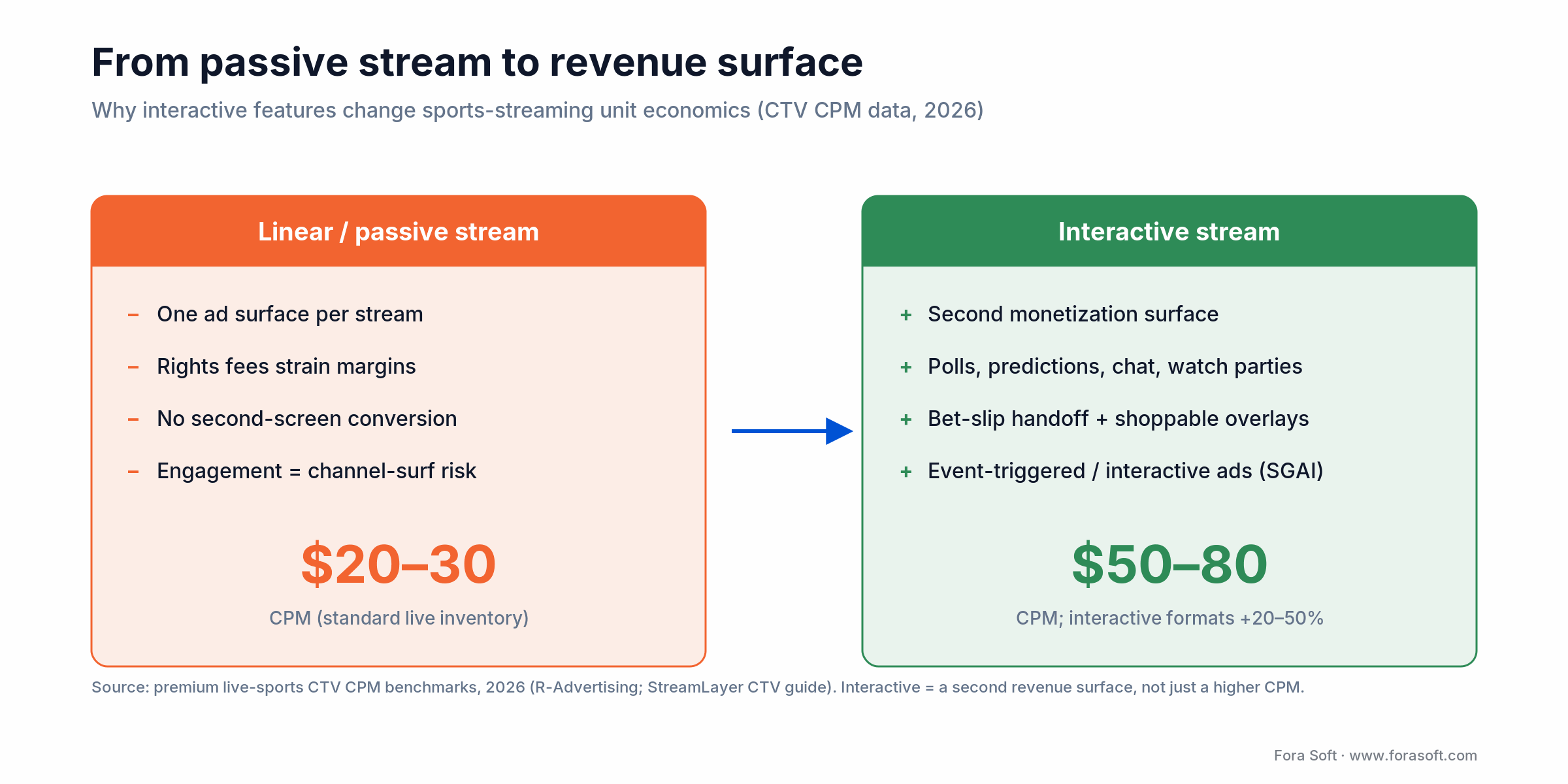
Figure 1. The economic case in one picture: interactive features add a second revenue surface, not just a higher CPM.
Here is the catch: none of it works on a slow feed. A viewer cannot bet on the next pitch when the “next pitch” happened 15 seconds ago. Sub-second delivery is infrastructure now, not a feature flag, and WHIP and WHEP sit underneath every interactive deployment we ship. This guide covers which features matter, the architecture, the latency budget, the betting and compliance reality, real cost ranges, and where these projects usually fail.
Scoping interactive features for your sports stream?
Send us your platform and target features. We return a one-page architecture, a cost forecast and a 12-week shipping plan in 48 hours, free.
The seven interactive features that matter
Seven feature families cover almost every interactive sports product, and they differ sharply in cost, latency demand and revenue. Ship them in the order that matches your monetization model, not the order that demos best.
Watch parties. Synchronised playback across friends’ devices, with chat, voice and reactions. Sub-100 ms cross-device drift is required for reaction-aware moments. The hardest feature here, and the one most audits fail on.
Polls and prediction games. “Will this drive end in a touchdown?” Sponsor-branded, gamified, leaderboard-driven. The cheapest interactive feature to ship and the highest click-through for sponsors.
Real-time stats overlays. Shot maps, win probability, expected goals, in-game trends. The data plane is third-party (Sportradar, Genius Sports, Stats Perform); the rendering is your code.
In-stream betting. Bet-slip handoff to a sportsbook, or full transactional integration. Two very different scopes, covered in the betting section below.
Shoppable video. Buy the jersey or the drink the player just used. Tap-to-cart inside the stream, checkout handed off to e-commerce.
Multi-angle and alternate feeds. Switch camera angles, alternate audio (home crowd vs commentary), in-car cameras for racing. Switching without a visible delay is the bar.
AR/VR overlays. Shot trajectories in AR, gyro-driven immersive views, in-venue AR. A premium tier that almost always belongs in phase two.
Reference architecture for interactive sports
The architecture splits into a video plane, a sync layer and three side planes (interactive, data, commerce) that feed a multi-platform client. Keeping them separate is what lets you A/B test overlays without re-encoding video and swap a data vendor without touching playback.
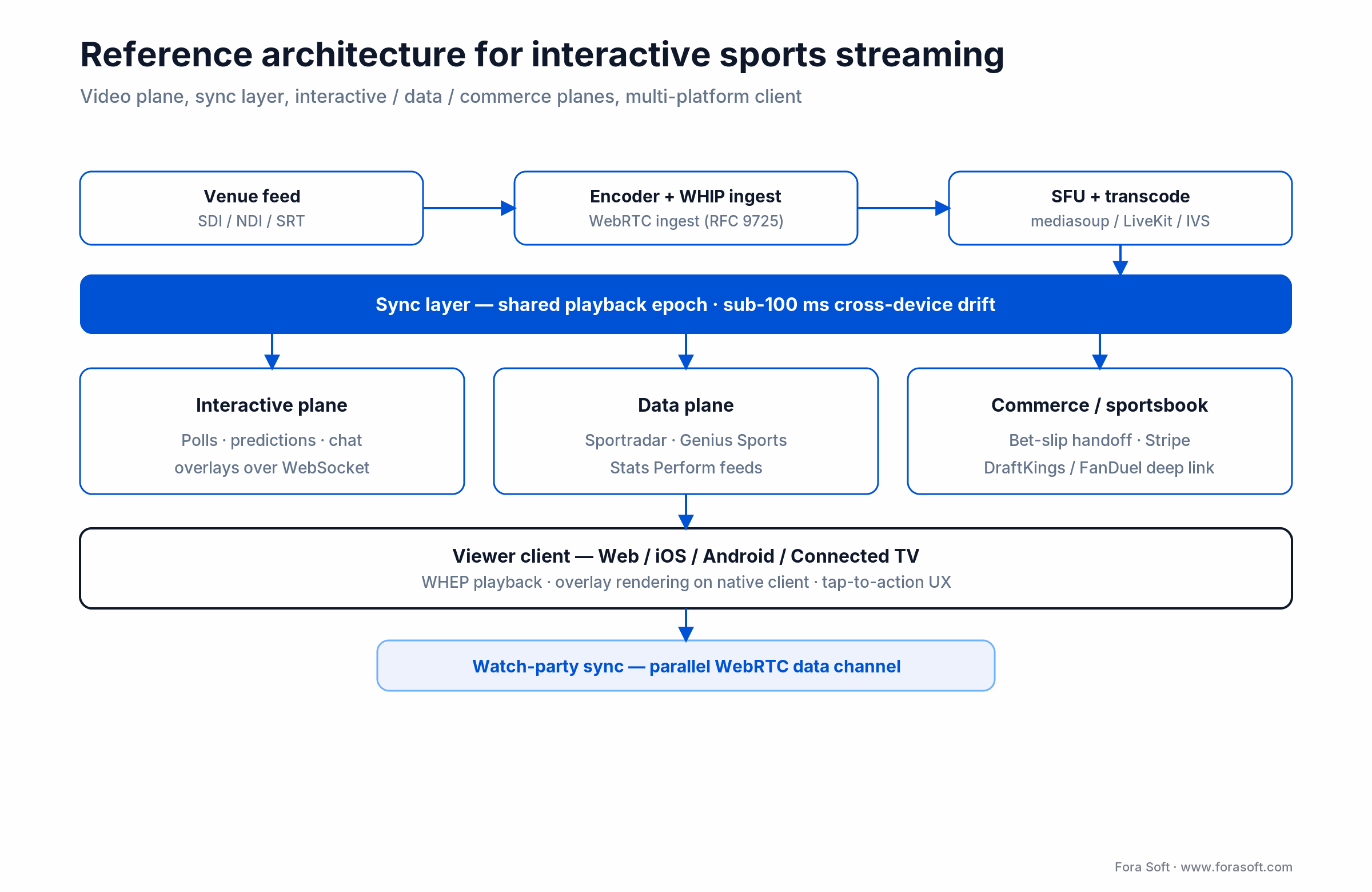
Figure 2. Reference architecture: WHIP ingest, SFU, a shared-epoch sync layer, three side planes, and a WHEP client.
Video ingest uses WHIP, the WebRTC-HTTP ingest protocol standardized as IETF RFC 9725 in 2025; playback uses its counterpart WHEP. Between them sits an SFU (mediasoup, LiveKit or Amazon IVS) that forwards streams without mixing. The sync layer stamps a shared playback epoch so devices agree on “now.” The interactive plane pushes polls and overlays over WebSockets; the data plane pulls stats and odds; the commerce plane handles bet-slip handoff and checkout. If the codec and delivery basics are new to your team, our Learn primer on what digital video actually is covers the foundations, and our note on scaling video streaming to a million viewers covers the SFU mesh.
Latency budget: which feature needs what
Latency decides the feature menu before any code is written. Dolby OptiView’s 2026 tiers put standard streaming at 10–30 s, low latency at 5–7 s, ultra-low near 1 s, and real-time under 1 s. Betting and watch-party sync live only in the real-time tier; polls are fine in low latency; mass broadcast can sit at the top.
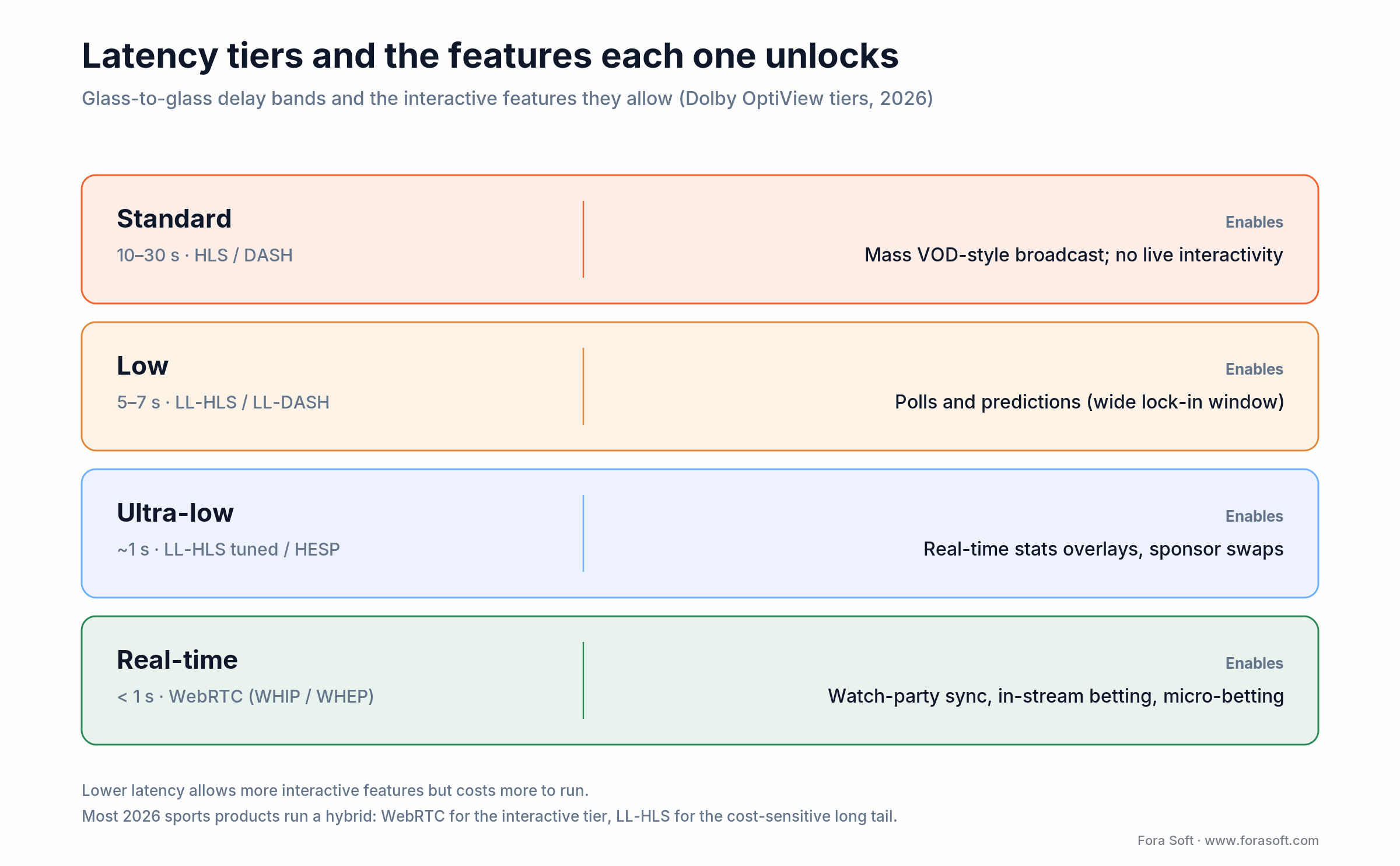
Figure 3. Latency tiers and the interactive features each one allows, from HLS at the top to WebRTC at the bottom.
The practical rule: pick the tier per feature, then run a hybrid. WebRTC (WHIP/WHEP) serves the interactive tier; low-latency HLS serves the cost-sensitive long tail. Here is the budget we design to:
| Feature | Required latency | Transport |
|---|---|---|
| Watch-party sync | < 100 ms cross-device drift | WebRTC + shared epoch |
| In-stream betting | < 1 s glass-to-glass | WHIP + WHEP |
| Real-time stats overlay | < 500 ms data sync | WebSocket data + WHEP video |
| Polls / predictions | < 5–7 s (lock-in window) | LL-HLS acceptable |
| Shoppable tap | < 300 ms response | REST API call |
Watch parties and the sync problem
A watch party is the hardest interactive feature because the enemy is not video quality, it is drift. Two friends watching a goal, one cheering 0.8 s before the other, have a worse experience than two friends watching apart. The bar is cross-device drift under 100 ms, ideally under 50 ms.
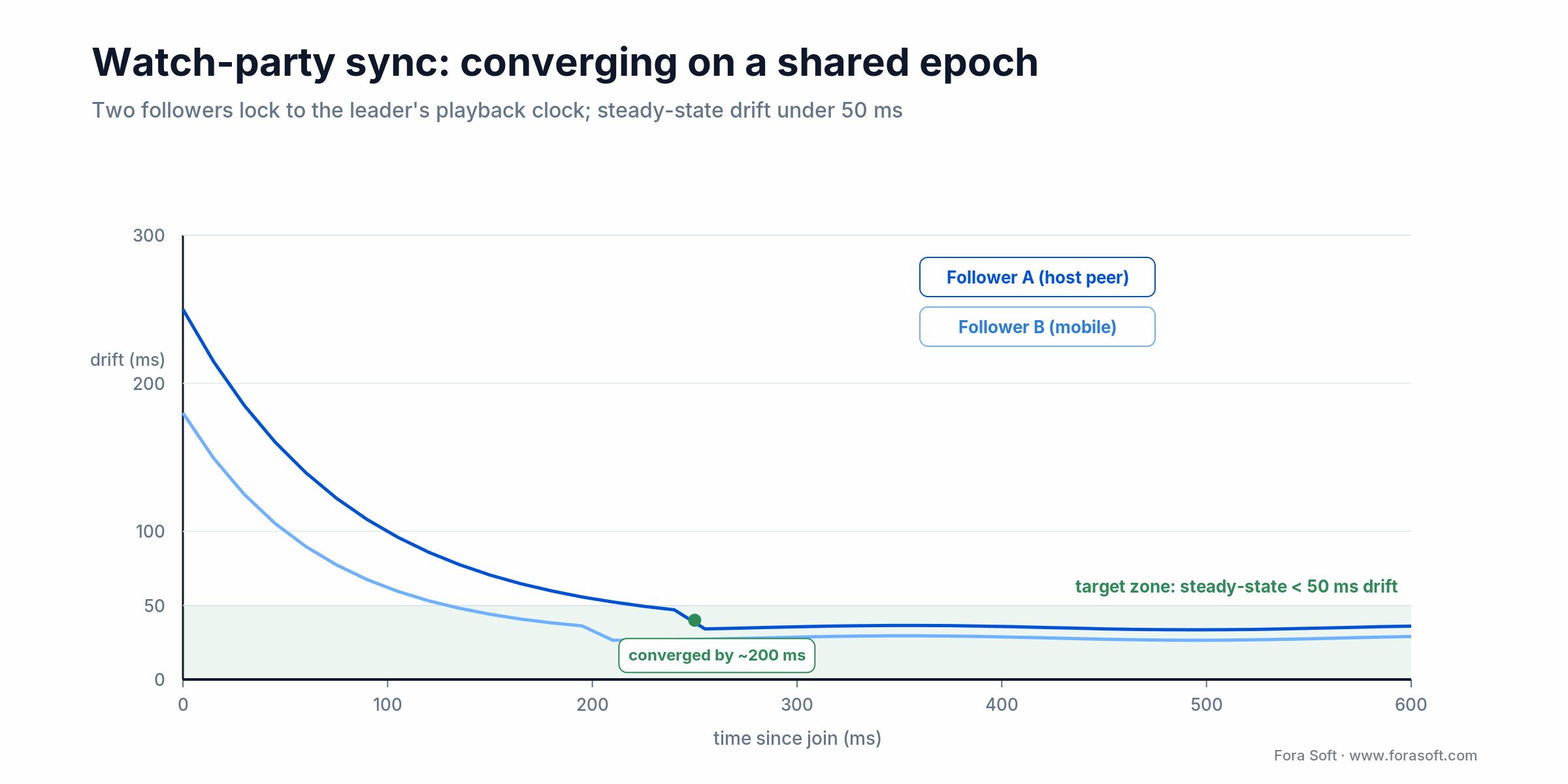
Figure 4. Shared-epoch sync: two followers lock to the leader’s playback clock and converge to under 50 ms drift within ~200 ms.
Independent playback fails. If each device fetches the same WHEP stream on its own, jitter buffers and decoder timing produce 200–800 ms of drift. Synchronisation has to be explicit: one device is the leader, the others subscribe to a shared epoch over a side channel and target leader_pts + offset, nudging buffer and playback rate by ±3% to converge. That gets you convergence inside ~200 ms and steady-state drift under 50 ms. Run voice chat on a separate WebRTC peer mesh; do not push it through the broadcast SFU, because the congestion profiles differ.
Worth knowing before you build: the big platforms pulled back. Amazon dropped Prime Video Watch Party around April 2024 and Disney+ retired GroupWatch in 2023–24; Hulu kept a watch-party mode and Apple SharePlay. That retreat is the opportunity. A sync layer that actually holds under load is a differentiator, and it pairs naturally with a fan-engagement platform for teams and leagues.
In-stream betting: three integration depths
In-stream betting comes in three depths with wildly different scopes and compliance loads. Get this classification right and you avoid the most expensive mistake in the category. For context on the regulatory map, legal US sports betting now covers 39 states plus DC as of 2026 (Missouri went live in December 2025), with about 31 offering statewide mobile (AGA, 2025), and live in-play wagering is roughly 62% of the online sports-betting market (Mordor Intelligence, 2025).
Bet-slip handoff (~8 weeks). The viewer taps “bet on this,” your platform pre-fills a slip and deep-links to the sportsbook (DraftKings, FanDuel, BetMGM) with an affiliate ID. You take referral revenue, hold no money and carry no licensing. This is the StreamLayer pattern and the right first step for most products.
Embedded sportsbook UI (4–8 months). Sportsbook content renders inside your app through a vendor SDK, but the wager still settles through the licensed entity. The viewer never leaves; you share revenue. Genius Sports BetVision and Sportradar 4Sight are the reference vendors.
Full transactional integration (9–15 months). Your platform is the sportsbook: gambling licence per jurisdiction, KYC/AML, responsible-gambling controls, geofencing, payments and dispute resolution. The biggest scope, the biggest revenue, and a licensed legal entity in every state you operate.
Compliance is not optional even at the handoff tier: real-time geolocation (not IP), 21+ age verification and per-state ad rules apply the moment betting appears on screen. Same-game parlays now drive roughly 35–40% of gross gaming revenue at major US books (2025), so the bet types you surface matter to the economics.
Prediction markets and the 2025 league deals
Prediction markets are the 2025–26 wildcard, and they change how you should think about “polls” and “predictions.” The short version: exchange-style contracts (Kalshi, Polymarket) are regulated federally by the CFTC, not by state gaming boards, and leagues moved fast. The NHL signed deals with both Kalshi and Polymarket in October 2025, the first major league to do so; UFC/TKO, MLB and MLS followed with Polymarket, and the Chicago Blackhawks became the first US team to sign with Kalshi in December 2025.
Why it matters for a build: a “predict the next play” feature that pays out real money can be reclassified as a regulated event contract. Polymarket alone did about $1.94B in sports trading volume in 2025. The CFTC-versus-state-sportsbook question is actively contested, so if your prediction feature touches money, scope it with counsel and keep the free-to-play and real-money paths cleanly separated in the architecture.
Shoppable video and server-guided ads
Shoppable video is tap-to-cart inside the stream. The pattern is a timestamped product manifest tied to moments in the broadcast: the player renders a hot-spot or sidebar, a tap fires an add_to_cart against your commerce system, and checkout hands off to Shopify or Stripe. Identity has to survive a device handoff so the cart and bet history follow the viewer from TV to phone.
Server-guided ad insertion (SGAI) is the monetization partner here. It uses SCTE-35 markers to signal ad opportunities and resolves them at the manifest level, which suits low-latency and interactive live far better than fully server-side stitching. The IAB Tech Lab formalized SGAI and pause-ad standards in late 2025. For a deeper build view of the commerce side, see our guide to live commerce platform development.
Real-time stats and the data providers
The data plane is almost always third-party, and picking the vendor early shapes latency and licensing. Stats Perform runs real-time streaming proven at 500,000+ concurrent viewers with sub-second latency; Sportradar operates 650,000+ live streams a year with its emBET in-stream betting product; Genius Sports powers immersive in-play betting through BetVision. The overlay rendering is your code, but the feed, the odds and the official-data rights come from one of these three.
Choose on three axes: latency (does the feed keep pace with a sub-second video tier), official-rights coverage for your leagues, and cost. A mismatch here is silent until launch, when the stats overlay lags the play by two seconds and the illusion of “live” collapses.
What Amazon, ESPN and DAZN ship now
The majors set the 2026 bar, and it is a useful reference for scoping. Amazon’s NBA on Prime, launched in October 2025, bundles opt-in FanDuel bet tracking, an “Odds View,” an AI “Rapid Recap” that builds a personalised highlight reel in under two minutes, Multiview, and the “Prime Vision” alternate feed. ESPN Bet and DAZN push similar media-plus-betting integrations.
A mid-size player cannot match their concurrency, but most of the features are replicable: bet-slip handoff, multiview, prediction widgets and an AI recap are all achievable on a focused budget. What needs their scale is the raw distribution, not the interactivity. Build the sports streaming platform that fits your audience and lean on WebRTC for the real-time tier.
Cost and timeline buckets
Costs scale with scope in fairly predictable buckets. The ranges below assume a senior team with WebRTC and sports-streaming experience; a generalist team will run higher and slower.
| Scope | Timeline | Range |
|---|---|---|
| MVP: polls + chat + watch party | 4–6 months | $200–$400k |
| + stats overlays + bet-slip handoff | +3 months | +$120–$200k |
| + multi-angle + shoppable | +3 months | +$150–$250k |
| Full StreamLayer-class stack | 12–18 months | $1.2M–$2.0M |
We use Agent Engineering and 20 years of pattern reuse, so we typically deliver toward the lower end of each range. When a number is not defensible for your exact scope, we say so rather than guess.
Want a latency audit of your current sports stream?
We run a one-week glass-to-glass measurement across regions, devices and feature surfaces, then return a ranked fix list for a sub-second target.
Build vs buy: SDKs versus custom
There are four honest ways to ship interactive sports, and the right one depends on whether interactivity is a feature or the product. An SDK gets you to polls and watch parties fast but is hard to differentiate; a custom build is slower but nobody can copy it from a vendor catalogue.
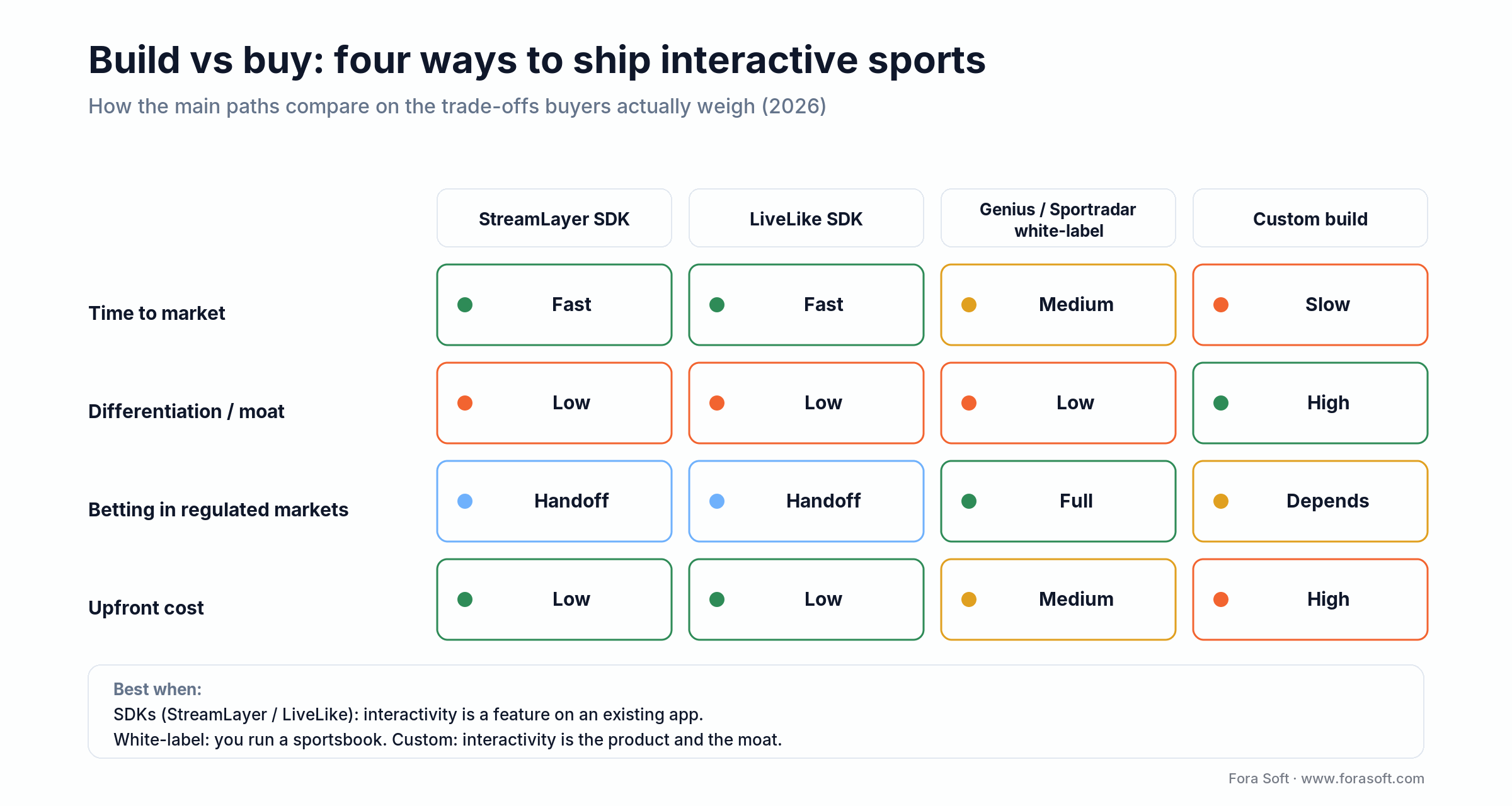
Figure 5. Build vs buy: how the four main paths compare on time to market, differentiation, betting depth and cost.
Reach for an SDK add-on (StreamLayer) when: you have an existing OTT app and want polls, predictions and watch parties bolted on in 8–12 weeks without rewriting your video stack.
Reach for a fan-engagement SDK (LiveLike) when: you want a broad, proven engagement toolkit (used by Sky Sports, WarnerMedia, Canal+) and treat interactivity as a feature layer over your existing player.
Reach for white-label (Genius Sports BetVision, Sportradar 4Sight) when: you operate a sportsbook and need video-plus-betting in a regulated market without building the data and odds pipeline yourself.
Reach for a full custom build when: interactivity is the core product, you have multi-platform reach (web + iOS + Android + CTV), and owning the experience end to end is the moat.
Mini case: building StreamLayer
Fora Soft built StreamLayer from inception, an interactive sports-streaming platform whose engagement layer has served NBC, CBS, Red Bull, Chelsea FC, Coca-Cola and Sony Music. StreamLayer has raised about $14.1M in total (Tracxn), and Las Vegas Sands made a strategic investment in 2022. The engineering numbers below come from that build, not from a vendor deck.
The architecture that made it work: a real-time WebRTC and transcoding mesh feeding iOS, web and Connected TV; interactive overlays rendered on the native client rather than baked into the video, so platforms can A/B test creative without re-encoding; watch-party sync over a parallel WebRTC data channel; and cross-platform identity that survives a device handoff. Server-guided ad insertion handles sponsor swap-outs.
The lesson we carry into every interactive build: separate the planes, render overlays on the client, and treat sync as a first-class problem from day one. If you want a similar build scoped for your platform, book a 30-minute call and we will walk your stack. Our related work includes WorldCastLive, Tradecaster and Perspire TV, and we build these end to end through our video and audio streaming software development service.
A decision framework in five questions
Q1. Is your revenue mostly ad-supported, subscription or hybrid? Ad-supported gains the most from interactive CPM lift; subscription gains retention; hybrid gets both. This decides which features to build first.
Q2. Do you control rights end to end, or license from a league? Rights holders restrict what you can overlay. Read the contract before scoping in-stream betting or shoppable overlays.
Q3. What is your target latency? If you cannot get under 5 s glass-to-glass, betting and watch parties are non-starters. Fix the latency floor with WHIP/WHEP first.
Q4. Which jurisdictions are you in? US betting is state by state; the EU is per-country; some markets ban in-stream betting outright. Map jurisdictions before scoping money features.
Q5. How many platforms? Web only is cheapest; web + iOS + Android + CTV is full-stack. Each platform roughly doubles the client-tier cost.
Pitfalls to avoid
Building interactive on top of HLS. A 10–30 s feed breaks every real-time feature. Polls land late, watch parties drift, odds go stale. Move the interactive tier to WHIP/WHEP and keep HLS for the cost-sensitive long tail.
Skipping the sync layer. Devices drifting independently is the number-one watch-party bug. Implement explicit shared-epoch synchronisation on day one, not as a later fix.
Mixing voice and broadcast through one SFU. Voice needs different congestion control than broadcast video. Run a separate WebRTC peer mesh for voice and mix in the client, not on the server.
Underestimating betting compliance. A bet-slip handoff is weeks of engineering and zero licensing; a full sportsbook is 12+ months and a licensed entity per state. Treating them as one project sinks the budget.
Treating prediction features as harmless polls. A predict-the-play feature that pays real money can be reclassified as a regulated event contract. Keep free-to-play and real-money paths separated, and scope the real-money path with counsel.
KPIs worth measuring
Quality. Glass-to-glass latency p50 under 1 s, p95 under 2 s. Watch-party drift p95 under 100 ms. Stream join time under 800 ms. Freeze rate under 0.3%.
Business. Average view duration versus baseline, interaction rate (polls and predictions per session), CPM uplift on interactive ad units, watch-party joins per 100 stream starts, and for betting, bet-slip handoff click-through and conversion to wager.
Reliability. SFU peak-hour CPU under 70%, sync-layer message delivery at 99.9%, sponsor overlay render success at 99.5%, and encoder-reconnect recovery under 3 s.
When not to add interactivity
Linear free-to-air, ad-supported. If you cannot raise CPMs because the advertiser pool is fixed or regulated, interactivity adds cost without revenue.
VOD-first products. Watch-after-the-fact does not benefit from sub-second latency. Polls and watch parties on a recorded game are possible but rarely worth the build.
A sportsbook that just needs video. If you already run a sportsbook and want to add streams, white-label (Genius BetVision, Sportradar 4Sight) is faster than custom. Build custom only when interactivity itself is the product.
Frequently asked questions
How fast can we add interactivity to an existing OTT app?
With a drop-in SDK (StreamLayer, LiveLike): 8–12 weeks to polls, predictions and watch parties. A custom build of the same scope is 4–6 months. The SDK path is faster but harder to differentiate; custom is slower but unique.
Do we need WHIP/WHEP, or is low-latency HLS enough?
For polls and predictions, LL-HLS at 5–7 s is fine because the lock-in window is wider than the latency. For watch parties or in-stream betting, sub-second is required and WHIP/WHEP (RFC 9725) is the answer. Most products run a hybrid: WebRTC for the interactive tier, LL-HLS for the free tier.
Can we add betting without becoming a licensed sportsbook?
Yes. Bet-slip handoff deep-links to a licensed sportsbook and pays you a referral fee, with no money flow or licensing on your side. You take on licensing only if you run full transactional betting yourself.
What about prediction markets like Kalshi and Polymarket?
They are CFTC-regulated event contracts, a different legal track from state-licensed sportsbooks, and several leagues signed deals in 2025. If your prediction feature pays real money it may be treated as a regulated contract, so separate free-to-play from real-money and involve counsel.
How do watch parties stay in sync?
One device is the leader; followers subscribe to a shared playback epoch over a side channel and adjust buffer and playback rate by a few percent to converge. Target convergence within ~200 ms and steady-state drift under 50 ms. Run voice on a separate WebRTC mesh.
Which data provider should we use for stats and odds?
Sportradar, Genius Sports and Stats Perform are the three majors. Choose on latency (must keep pace with a sub-second video tier), official-rights coverage for your leagues, and cost. The overlay rendering stays your code.
How hard is Connected TV support?
Roku, Fire TV, Apple TV, LG webOS and Samsung Tizen each have their own WebRTC story. tvOS and modern Android TV are good; older webOS and Tizen need a fallback to LL-HLS for video with overlays rendered separately. Plan an extra 2–3 months for full CTV reach.
What does interactive sports streaming cost to build?
An MVP with polls, chat and watch party runs $200–$400k over 4–6 months. A full StreamLayer-class stack is $1.2M–$2.0M over 12–18 months. Bet-slip handoff adds about eight weeks; a full transactional sportsbook is a separate 12-month-plus project.
What to read next
Streaming
WHIP and WHEP for modern stacks
The transport layer underneath every interactive sports stream.
Scale
Scale to 1M viewers
Multi-region SFU mesh and origin-shield patterns.
Engagement
Fan engagement platforms for sports teams
The engagement side of interactive sports, for teams and leagues.
Commerce
Live commerce platform development
How the shoppable-video and checkout side is built.
Ready to ship interactive sports?
Interactive features convert sports streaming from a cost centre into a growth surface, but only if the latency floor is right. Nail sub-second delivery with WHIP/WHEP first, then layer in polls, watch parties, stats, betting handoff and shoppable overlays in the order your monetization model rewards.
MVP scope ships in 4–6 months; StreamLayer-class scope in 12–18. Bet-slip handoff opens sportsbook revenue in about eight weeks; a full transactional sportsbook is a 12-month-plus project with real regulatory weight. Pick scope by monetization horizon, and do not confuse the two betting paths.
Want StreamLayer-class interactivity on your platform?
Send us your platform and target features. We return a one-page architecture, a scope and a 12-week shipping plan in 48 hours, free.
01Why interactive sports streaming wins in 2026
02The seven interactive features that matter
03Reference architecture for interactive sports
04Latency budget: which feature needs what
05Watch parties and the sync problem
06In-stream betting: three integration depths
07Prediction markets and the 2025 league deals
08Shoppable video and server-guided ads
09Real-time stats and the data providers
10What Amazon, ESPN and DAZN ship now
12Build vs buy: SDKs versus custom
13Mini case: building StreamLayer
14A decision framework in five questions