


Key takeaways
• Building a video streaming platform is mostly decisions, not code. The early choices — SFU vs MCU, ingest protocol, monetization model, content moderation policy — lock in 80% of your eventual cost and product fit.
• Most founders die in the same five places. Underestimating CDN cost. Picking the wrong realtime protocol. Skipping moderation. Scaling chat before scaling video. Burning runway on features users don’t want.
• The MVP is smaller than you think. A live streaming MVP for 100–500 viewers, with chat and basic monetization, ships in 8–12 weeks with the right team. Anything bigger means you’re building a v2 instead of a v1.
• Realtime video is unforgiving. 500 ms of added latency feels like a lag in conversation. 5% packet loss makes calls drop. 1,000 concurrent viewers is a totally different system from 10,000.
• Pick your partner before you pick your stack. The team you build with shapes every architectural decision below. Get this one right and the rest gets easier.
Why Fora Soft turned the “build a streaming platform” quest into a playbook
A while back we built a small text-based quest game where you play a founder building a video streaming platform from scratch. Every choice you make — protocol, codec, hosting, monetization, moderation — pushes the story toward a successful launch or a spectacular faceplant. It was fun. It was also weirdly accurate. The decisions in the game are the decisions we walk founders through every week.
This article turns the quest into the actual playbook for how to build a video streaming platform without joining the casualty list. We’ve been building video and audio streaming platforms since 2005 — 250+ projects, 99% Upwork success rating. The proof is in production: Sprii (Europe’s leading live shopping platform, €365M+ in sales, 3,000+ brands), Worldcast Live (HD concert streaming, sub-second 0.4–0.5 s latency at 10,000 concurrent viewers on custom WebRTC), Vodeo (a Netflix-style iOS VOD app with 100K+ users for Janson Media), BrainCert (a WebRTC LMS with 100K+ customers and 500M+ classroom minutes), and TransLinguist (the NHS-UK framework serving 30,000+ interpreters across 75+ languages). If you want the end-to-end theory alongside this playbook, our video streaming course walks the whole pipeline.
Below is the founder’s decision tree we wish we’d had when we started. Every chapter is a choice you’ll have to make. Get them right and your platform launches, scales, and pays for itself. Get them wrong and you join the casualty list.
Building a video streaming platform from scratch?
We’ve shipped streaming products since 2005. A 30-minute call usually saves 6 weeks of false starts.
Chapter 1: What kind of video product are you actually building?
Three categories cover 95% of the streaming products we’ve shipped. Pick the wrong one and your architecture is wrong.
Live one-to-many. Concerts, esports, live shopping, sports, conferences. One presenter, thousands or millions of viewers. Latency tolerance: 2–8 s (LL-HLS, MoQ). Scaling pattern: edge CDN.
Live many-to-many. Video conferencing, telehealth, virtual classrooms, courtrooms, live commerce with audience interaction. Sub-500 ms latency required (WebRTC). Scaling pattern: SFU clusters.
VOD with social. YouTube-style. User-uploaded video, comments, recommendations, monetization. Latency tolerance: hours (HLS). Scaling pattern: storage + CDN + ML.

Figure 1. The category you pick decides your protocol, latency budget, and scaling pattern before you write a line of code.
Reach for live one-to-many when: the audience watches; the presenter doesn’t need realtime feedback. Lower compute cost per viewer, fewer infrastructure gotchas.
Chapter 2: Pick your realtime protocol
Wrong protocol = wrong product. There are essentially four to choose from in 2026.
| Protocol | Latency | Best for | Trade-off |
|---|---|---|---|
| WebRTC | 100–500 ms | Conferencing, telehealth, live commerce | Hard at scale; SFU complexity |
| LL-HLS | 2–8 s | Sports, esports, live shopping (one-way) | Higher latency; CDN-friendly scale |
| MoQ (Media over QUIC) | 1–3 s | Next-gen sub-second one-to-many | New, fewer mature SDKs |
| HLS / DASH | 10–30 s | VOD, traditional broadcast | No realtime feel |
Our deeper guide on this layer: how to scale realtime video streaming to 1 million viewers. For MoQ specifically, see our MoQ application architecture deep-dive, and track the spec itself in the IETF MoQ transport draft.
Reach for WebRTC when: any participant needs to be heard speaking back. Conferencing, telehealth, live commerce with audience interaction. Sub-500 ms is the bar.
Chapter 3: SFU or MCU (or P2P)?
For multi-party realtime video, you have three architectures.
P2P (peer-to-peer). Up to 4 participants. Each peer sends video to every other peer. No server cost — but bandwidth and CPU on the user’s device blow up past 4 participants.
SFU (Selective Forwarding Unit). 5–50 participants comfortably; 100+ with simulcast and clever orchestration. The server forwards encoded streams — no transcoding. The 2026 default for almost every multi-party video product. LiveKit, MediaSoup, Janus, Pion, Jitsi. Picking the topology and the media server is the first thing our WebRTC architecture team settles on a new build.
MCU (Multipoint Control Unit). Server transcodes all streams into a single composite. Useful for older clients or low-bandwidth viewers, but compute cost per session is 5–10× an SFU. Niche in 2026. The W3C WebRTC spec is the standard all three build on.
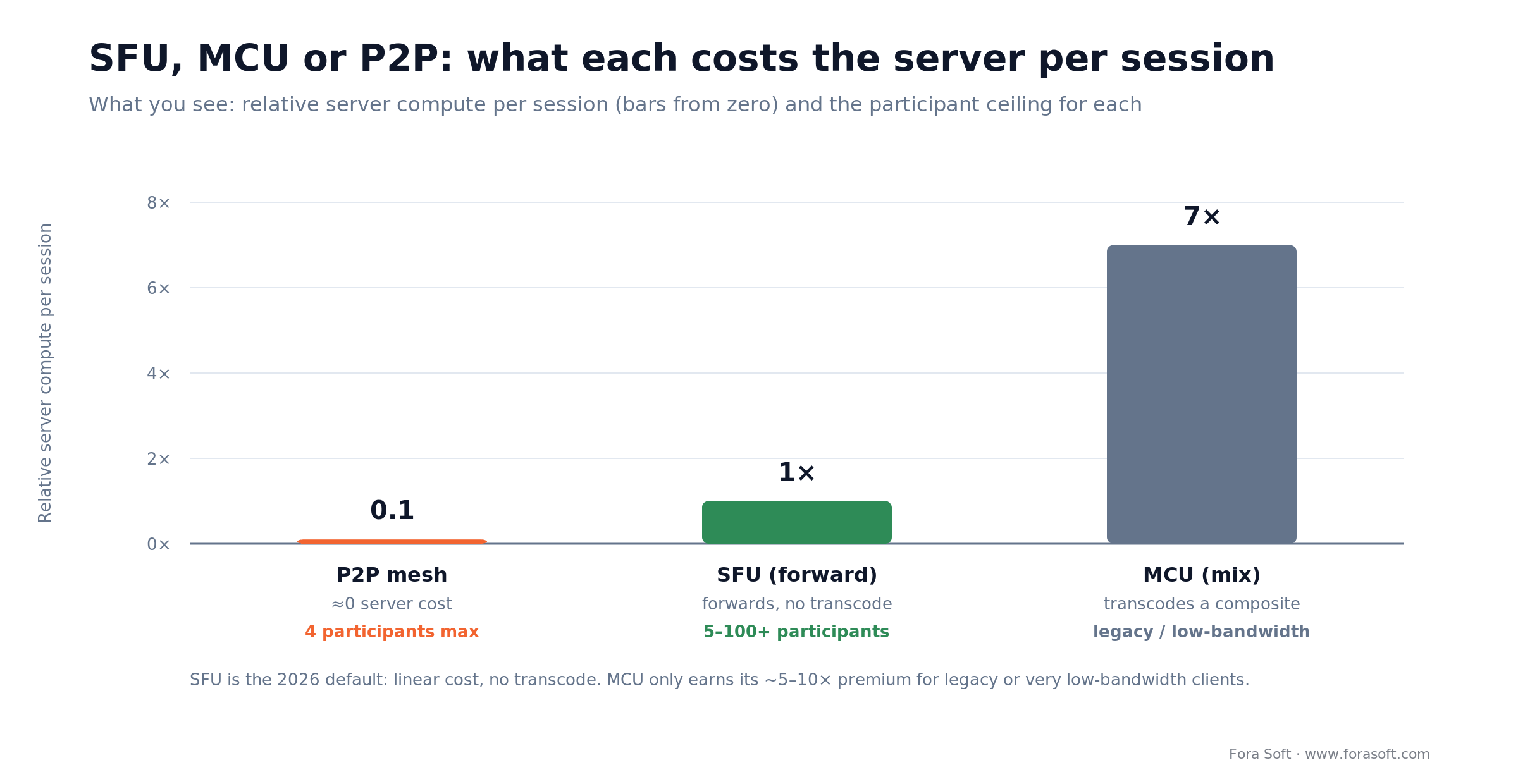
Figure 2. Server compute per session: P2P offloads to devices (and dies past 4 peers), the SFU forwards at linear cost, the MCU pays a 5–10× transcode tax.
Reach for an SFU when: 5–100 simultaneous participants and you want manageable scaling cost. The default for almost every conferencing, telehealth, classroom, or live-commerce product in 2026.
Chapter 4: The cost trap most founders fall into
CDN egress is the #1 cost surprise for first-time video founders. Per the AWS CloudFront price sheet, tier-1 CDNs charge roughly $0.05–0.10/GB; one viewer watching a 1080p stream for an hour at 5 Mbps consumes ~2.25 GB — that’s $0.11–0.23 per viewer-hour, just for egress. The arithmetic: 5 Mbps × 3600 s ÷ 8 = 2,250 MB.

Figure 3. One 1080p viewer-hour becomes 2.25 GB, then dollars. At 10,000 viewers for a two-hour show that’s ~45 TB — the number that blows up unmodeled budgets.
Three moves cut this dramatically.
1. Adopt H.265 or AV1. 30–50% bitrate savings vs H.264 at the same perceptual quality. The royalty-free AV1 codec (Alliance for Open Media) is the 2026 endgame here; the CDN bill drops proportionally.
2. Use commodity CDN providers. Bunny, Gcore, and Cloudflare are 30–70% cheaper than AWS CloudFront for raw egress. Tier-2 CDN with geo-fallback often outperforms tier-1 marketing-name CDN at a fraction of the cost.
3. Adaptive bitrate that’s actually adaptive. Many MVPs ship with the highest-bitrate ladder set as the default. Tune the ladder so 60% of viewers serve from the 720p rendition by default and step up only on confirmed bandwidth.
Chapter 5: Where do the SFU and the encoders run?
Three viable hosting models in 2026.
Bare metal at Hetzner. The cost-effective default for SFUs running 100+ concurrent rooms. AX-series and EX-series machines run $50–200/month and handle 50–200 concurrent SFU sessions each. Typical scale-out hosts 10K+ concurrent viewers across 5–15 machines.
Managed cloud (AWS, GCP, DigitalOcean). Easier ops, 3–5× the cost. Pick this if you have minimal SRE bandwidth or you’re scaling up and down faster than Hetzner can keep up with.
Managed video platforms (Agora, 100ms, LiveKit Cloud). Fastest path to MVP. Per-minute pricing usually breaks even with self-hosted at ~10K monthly active users; above that, self-hosted wins by 5–10×.
Reach for Hetzner bare metal when: you’re past 10K monthly actives, your team has SRE bandwidth, and shaving 70% off your hosting bill is worth a 2-week migration project.
Stuck on hosting or protocol choices?
We’ve made these calls on production deployments at every scale. A 30-minute call usually settles them.
Chapter 6: How will the platform make money?
Five monetization patterns dominate. Most successful platforms combine two or three.
Subscription (SVOD). Netflix model. High lifetime value, predictable revenue. Hard to bootstrap without strong content or community.
Pay-per-view (TVOD). Concerts, sports, premium events. Spiky revenue. Worldcast Live is a good example of TVOD at scale.
Ad-supported (AVOD). YouTube, Twitch. Lower per-viewer revenue but unbounded reach. Requires moderate scale to matter (> 100K MAU).
Live commerce. Sprii ships this at scale: streamers sell directly during live broadcasts, platform takes a percentage. Highest unit economics for streaming products in 2026.
B2B / SaaS. White-label streaming for enterprise customers. Per-seat or per-stream pricing. Highest gross margin, longest sales cycles.
Chapter 7: Moderation will make or break you
Almost every founder underestimates this. By month 6, content moderation is either consuming 30% of engineering and ops bandwidth or driving customers off the platform — sometimes both.
Three layers we always build.
1. Real-time AI screening on video, audio, and chat for nudity, weapons, hate speech, and PII. Lightweight ONNX models on the SFU edge.
2. Operator dashboard with one-click pause, kick, ban, and report. Audit logs on every action. SLAs for response time on critical reports (target < 5 minutes).
3. User-facing reporting that’s easier than the in-app camera. Friction is the enemy — if it takes more than 3 taps to report a stream, viewers won’t.
Chapter 8: The MVP trap
A live streaming MVP for 100–500 viewers, with chat and basic monetization, ships in 8–12 weeks with the right team. Every feature beyond that doubles the timeline. Three rules survived contact with reality across our last 20 projects.
1. Don’t build the v2 of an unproven product. Multi-streaming to YouTube and Twitch in week 4 is a sign you’re solving a problem you don’t have yet.
2. Pick boring infrastructure. Postgres, Redis, S3-compatible storage, an SFU you can read the source of. Boring scales; novel doesn’t.
3. Defer transcoding pipelines. Adaptive bitrate ladders, AV1, HDR, ultra-low-latency mode — all real concerns at scale, all defer-able to v2. The MVP ships at one resolution, one bitrate, one codec.
Chapter 9: The 2026 reference stack we keep deploying
When we have full architectural authority, the stack we converge on for new live-video products in 2026 looks like this.
Realtime layer. LiveKit or MediaSoup as the SFU; Janus or Pion if the team has Go preferences. WebRTC for sub-500 ms; LL-HLS or MoQ for one-to-many at scale.
Backend. Node.js or Go for the API; Postgres for primary data; Redis for ephemeral state and rate limiting; ClickHouse or BigQuery for analytics.
Frontend. React or React Native (mobile); LiveKit or Mediasoup-client SDK; Tailwind for styling; Tanstack Query for state.
Hosting. Hetzner bare metal for the SFU and encoders; AWS or GCP for managed services (RDS, S3, IAM); Cloudflare or Bunny for CDN.
AI / ML. ONNX runtime for moderation models; OpenAI or Anthropic for transcription, summarization, content moderation enrichment; Whisper for self-hosted ASR.
Mini case: Worldcast Live, sub-second HD concerts at 10,000 viewers
Situation. A concert business needed to stream live HD shows where performers in different cities play together in real time, and fans pay per show. That’s the brutal combination: sub-second latency and broadcast-scale audience, which normally trade off against each other. LL-HLS gives you scale but adds seconds of delay; naive WebRTC gives you the delay budget but falls over at audience size.
Plan. We built Worldcast Live on a custom WebRTC + Kurento architecture: sub-second latency held at 0.4–0.5 s, five-channel audio, 1.5 Gb/s for true HD, and dynamic quality that steps down for weak connections instead of dropping the stream. Full-duplex two-way streaming lets remote performers actually jam together. Monetization shipped as pay-per-view tickets, donations, and ad placement; a white-label Multiple Venue Streaming plugin syncs one live stream across partner sites at once.
Result. The platform sustains 10,000 concurrent viewers at sub-second latency — the trade-off most teams can’t hold at once. It now runs paid concerts, festivals, and hybrid corporate events, with an AR companion app (Unimerse) for live fan engagement. That’s what it looks like when you build a video streaming platform around the one constraint that actually matters for the use case. Want a similar 14-week plan?
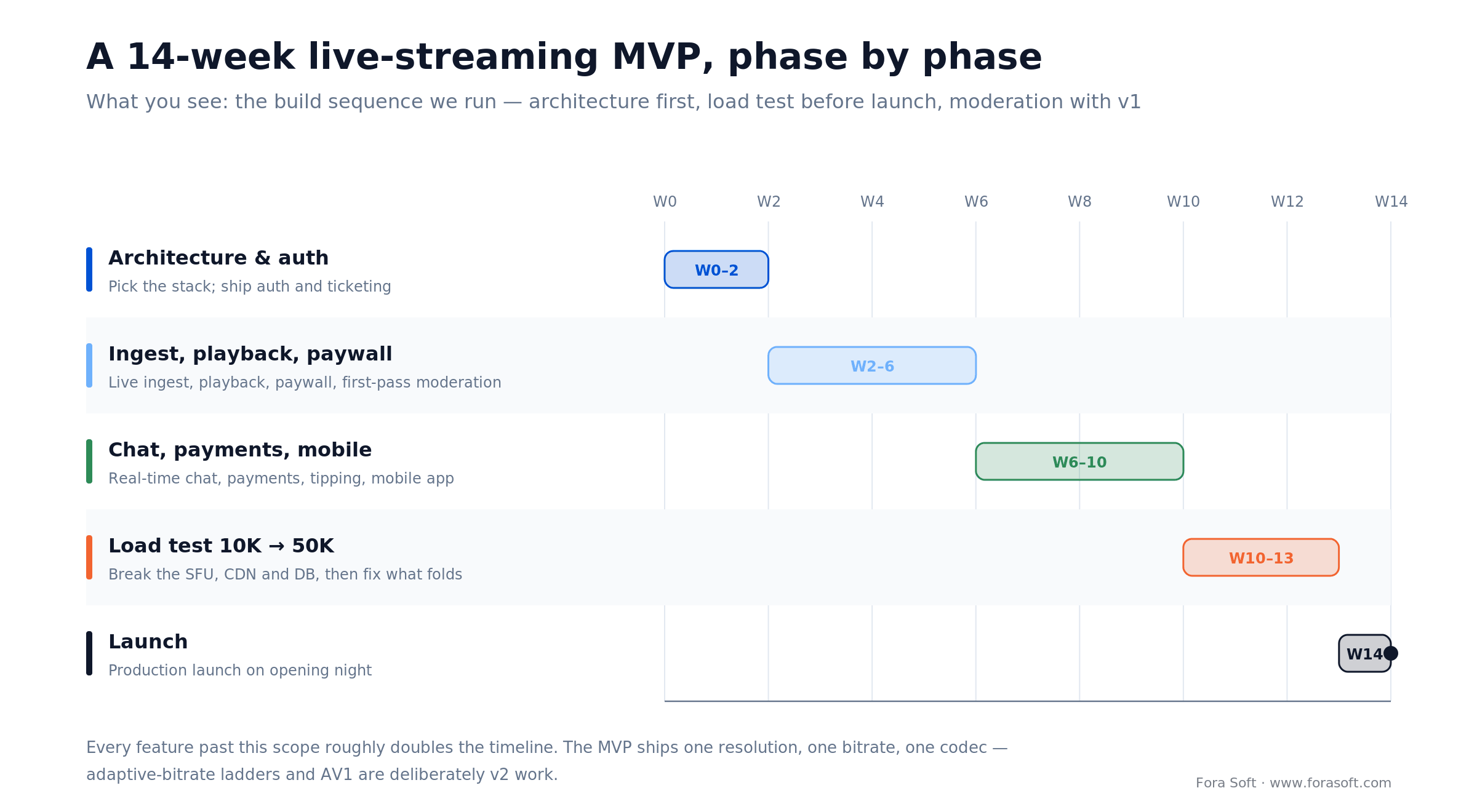
Figure 4. The 14-week build sequence we run for a live-streaming MVP — architecture first, load test before launch, moderation shipped with v1, not month six.
Five pitfalls we keep seeing on first-time streaming products
1. CDN egress shock. Founders forecast revenue but not bandwidth cost. Every 1,000 viewer-hours of 1080p is ≈ $100 of egress on AWS, ≈ $30 on Bunny.
2. Wrong protocol for the use case. Building telehealth on HLS is a guarantee of frustrated patients. Building live shopping on WebRTC at audience scale is a guarantee of out-of-control hosting bills.
3. Skipping moderation until it’s a crisis. Plan for moderation in week 1, not month 6. Operator dashboard, AI screening, and user reporting need to ship with the MVP.
4. Building chat before video is stable. Chat scaling is its own animal — Redis, fan-out, presence. Don’t fight that battle while video is still flaky.
5. Hiring solo developers for the realtime layer. WebRTC and SFU work has a steep learning curve. A senior engineer with shipping experience is worth 3 mid-levels figuring it out.
A decision framework: pick your starting stack in five questions
Q1. What’s your latency tolerance? < 500 ms: WebRTC. 1–5 s: LL-HLS or MoQ. > 10 s: HLS / DASH.
Q2. How many simultaneous active speakers per session? 1: one-to-many (LL-HLS). 2–100: SFU. 100+: SFU + simulcast + clever orchestration.
Q3. What’s your funding runway? < 6 months: managed video platform (Agora, 100ms). 6–18 months: hybrid — managed for v1, migrate to self-hosted for v2. > 18 months: self-host from day one.
Q4. What’s your monetization model? Subscription / TVOD: ticketing and paywall first. AVOD: ad SDK, audience scale. Live commerce: cart integration, payments, tipping.
Q5. Build solo or with a partner? Solo founders: pair with an experienced agency for the realtime layer. Funded startup: hire a senior engineer plus an agency for spike capacity. Enterprise: build a full in-house team.
KPIs to track once the platform is live
Quality KPIs. Stream-start time (target < 3 s); rebuffering ratio (target < 0.5%); video bitrate at P50 (track which rendition viewers actually serve from); audio MOS score on multi-party calls (target > 3.8).
Business KPIs. Cost per viewer-hour (target < $0.05 at scale); ARPU; conversion from free to paid; live-show attendance vs replay; daily and monthly active users.
Reliability KPIs. Uptime per service (target > 99.9%); SFU pod CPU at peak (under 70%); CDN cache hit ratio (> 90%); incident response P50 (< 15 minutes from alert to triage).
When NOT to build a custom video streaming platform
Three scenarios where we tell founders to use someone else’s rails.
You don’t need realtime. If your product works on YouTube embeds or Vimeo, ship there first. Validate demand. Build infrastructure when you outgrow it.
You’re a content business, not a tech business. Vimeo OTT, Mux, and Daily.co are perfectly fine for media companies whose moat is the content, not the player.
Your team has zero realtime experience. Realtime video is a specialty. A 3-month delay shipping the wrong thing usually costs more than the agency fees would.
How to benchmark your platform before launch
Marketing demos lie by curation. Build a load-test rig that hits 5× your forecast peak and run it for an hour. Measure four things.
Concurrent capacity. Where does the SFU break? Where does the CDN break? Where does the database break?
Mean stream-start time at scale. Cold-start times balloon when 1,000 viewers click play simultaneously. Measure P50, P95, P99.
Recovery from chaos. Kill a node. Inject 5% packet loss. Drop 30% of viewers and reconnect them. Does the system recover or pile up?
FAQ
How long does it take to build a video streaming platform from scratch?
A live streaming MVP for 100–500 viewers with chat and basic monetization ships in 8–12 weeks with the right team. A full-featured platform handling 10K+ concurrent viewers, multi-tenant features, and full moderation runs 14–26 weeks. Worldcast Live and Vodeo were both delivered in this 14–26 week range.
What does a custom video streaming platform cost to build?
An MVP runs $60K–180K with a focused team. A scaled v1 with mobile apps, monetization, moderation, and analytics is typically $200K–600K. Full-featured platforms handling 100K+ concurrent viewers and complex monetization land $500K–1.5M. Operating costs at the $0.02–0.05 per viewer-hour range with a self-hosted Hetzner + commodity-CDN setup. With Agent Engineering we’re routinely at the lower end of these ranges.
Managed platform like Agora, or build your own SFU?
Managed platforms (Agora, 100ms, LiveKit Cloud) are the fastest path to MVP and break even with self-hosted at roughly 10K monthly active users. Above that, self-hosted on Hetzner with LiveKit, MediaSoup, or Janus typically wins by 5–10× on TCO. The hybrid path — managed for v1, migrate to self-hosted for v2 — is what we recommend most often.
WebRTC or HLS — which one should I pick?
WebRTC for any product where viewers need sub-500 ms latency — conferencing, telehealth, live commerce with audience interaction. LL-HLS or MoQ for one-to-many live streaming at audience scale (sports, esports, concerts). HLS or DASH for VOD and traditional broadcast. Mismatching is the most common founder mistake.
How do I keep CDN costs under control?
Three moves: adopt H.265 or AV1 for 30–50% bitrate savings; use commodity CDN providers (Bunny, Gcore, Cloudflare) instead of AWS CloudFront; and tune the adaptive bitrate ladder so most viewers serve from a 720p default and step up only on confirmed bandwidth. Together these typically cut CDN spend 40–70%.
Do I need content moderation from day one?
Yes. Real-time AI screening, an operator dashboard, and easy user reporting need to ship with the MVP. By month 6, moderation is the dominant ops burden on every consumer-facing live platform we’ve shipped. Plan for it in week one, not month six.
What’s the difference between an SFU and an MCU?
An SFU forwards encoded streams without transcoding; cost scales linearly with participants and is dramatically cheaper than an MCU. An MCU transcodes all streams into a single composite, useful for low-bandwidth viewers or legacy clients but 5–10× more expensive per session. SFU is the default for almost every multi-party video product in 2026.
Can I solo-build a video streaming platform as a non-technical founder?
Realistically, no — not a custom one. The realtime layer has a steep learning curve and unforgiving production realities. Non-technical founders are best served by either (a) starting on a managed platform like Mux or Daily.co, or (b) partnering with an agency that has shipped multiple streaming products. We’ve done this with non-technical founders many times across 250+ projects since 2005; the pattern is well-trodden.
What to read next
Architecture
Scale video streaming to 1 million viewers
WebRTC, CDN, and MoQ architectures — the layer the rest of the product sits on.
Streaming
Building Cross-Platform Audio & Video Streaming Apps in 2026
Cross-platform audio and video streaming apps: the 2026 challenges and solutions map.
Streaming
Building applications with Media over QUIC
The transport layer replacing HLS for sub-second live in 2026.
Hiring
When to hire a WebRTC development company
Build vs hire for the realtime layer of your platform.
LiveKit
Building multimodal AI agents with LiveKit
Adding voice and vision intelligence to your live video product.
Ready to play founder for real?
The text-based quest game was a fun way to feel the decision tree of building a streaming platform. The chapters above are the real version. Get the protocol right, the SFU choice right, the moderation policy right, the cost model right, and the partner right — and the rest is a 14-week build sprint with a working product at the end.
If you want a sanity check on which path fits your idea — or a 14-week plan to ship the MVP — we’ll do the work with you, starting with MVP planning that fixes scope, monetization and launch order. Twenty years of multimedia engineering, 99% Upwork success rating, Agent Engineering for faster delivery. Bring your idea; we’ll bring the architecture.
The handbook · 7 volumes
Fora Soft Video Engineering Handbook
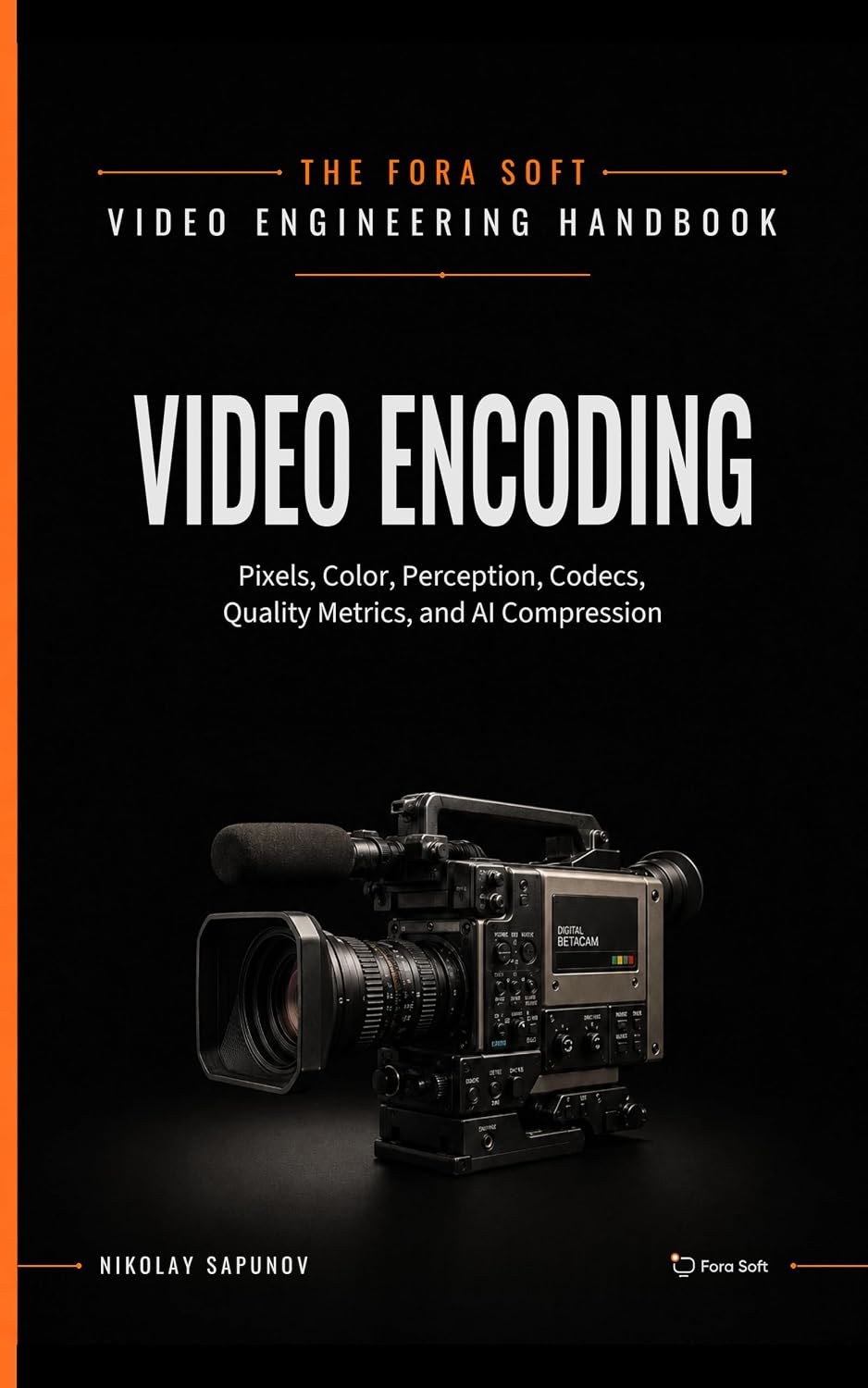
The quest ends where your real architecture choices begin: protocol, SFU, CDN bill. We wrote a seven-volume handbook covering the whole video stack; start with Volume 3 for WebRTC, SFU topologies, CDN caching and the economics of delivery, then read Volume 2 for RTMP, SRT and HLS ingest and Volume 1 for codec and bitrate choices. Written by Nikolay Sapunov, CEO at Fora Soft.
Browse the handbook on Amazon →7 volumes · 9,000+ pages · Kindle & paperback
Want to ship a custom video streaming platform?
We’ll scope it, price it, and ship it — from MVP through 1M-viewer scale, with the moderation, monetization, and AI you need to win.
Bonus: the team you actually need to ship a streaming MVP
A focused 8–12 week MVP runs with a small team:
1. A senior backend engineer with WebRTC or LL-HLS experience — this is the make-or-break hire.
2. A frontend or mobile engineer who’s shipped video before.
3. A QA engineer with a real-device test rig (network shaping, packet loss simulation).
4. A part-time product manager / founder who can answer trade-off questions in < 24 hours.
5. A part-time DevOps engineer for the SFU cluster + observability.

