AI agents + senior multimedia engineers cut WebRTC and LiveKit development from 80-120 hours to 35-40 hours per component — with full human oversight for sub-500ms latency, HIPAA/GDPR compliance, and zero quality trade-offs.
We help CTOs and engineering leads ship custom video conferencing, telehealth, e-learning, and live streaming platforms that perform under real-world load — backed by 600+ projects delivered since 2005.
We combine autonomous AI agents with senior WebRTC, LiveKit, and Kurento engineers to handle the full development cycle for real-time video and audio systems. You get faster delivery without the risks that come with pure AI or traditional outsourcing.
Our approach uses structured agentic workflows — requirements decomposition, architecture planning, AI code generation, automated testing, and deployment — all bounded by human-defined guardrails. This keeps latency under 500ms, ensures scalability, and produces software that drives user engagement and revenue.
No generic code. No hallucination risks. Just working, maintainable platforms built by a team that has shipped 600+ real-time video projects over 20 years — from ProVideoMeeting (1K+ concurrent) to Worldcast Live (10K+ viewers).
AI agents generate initial WebRTC/LiveKit code, test cases, and signaling logic in hours instead of days. Senior engineers set boundaries for peer connections, ICE/TURN configuration, and network variability — delivering MVPs like our LiveKit Video Chat in under 2 weeks.
Every agent output passes mandatory senior review for latency edge cases, SRTP/DTLS security, and HIPAA/GDPR compliance — catching issues early and reducing defects by up to 25%. Proven across CirrusMED (40+ states), Nucleus (SOC II), and V.A.L.T (770+ police departments).
Modular agent teams handle backend logic, SFU/MCU media server configuration, multi-region deployment on AWS/Azure/GCP, and ongoing optimization. Scales from MVP to 100K+ concurrent users — as proven with Worldcast Live, BrainCert (1M+ learners), and Sprii (72K+ events).

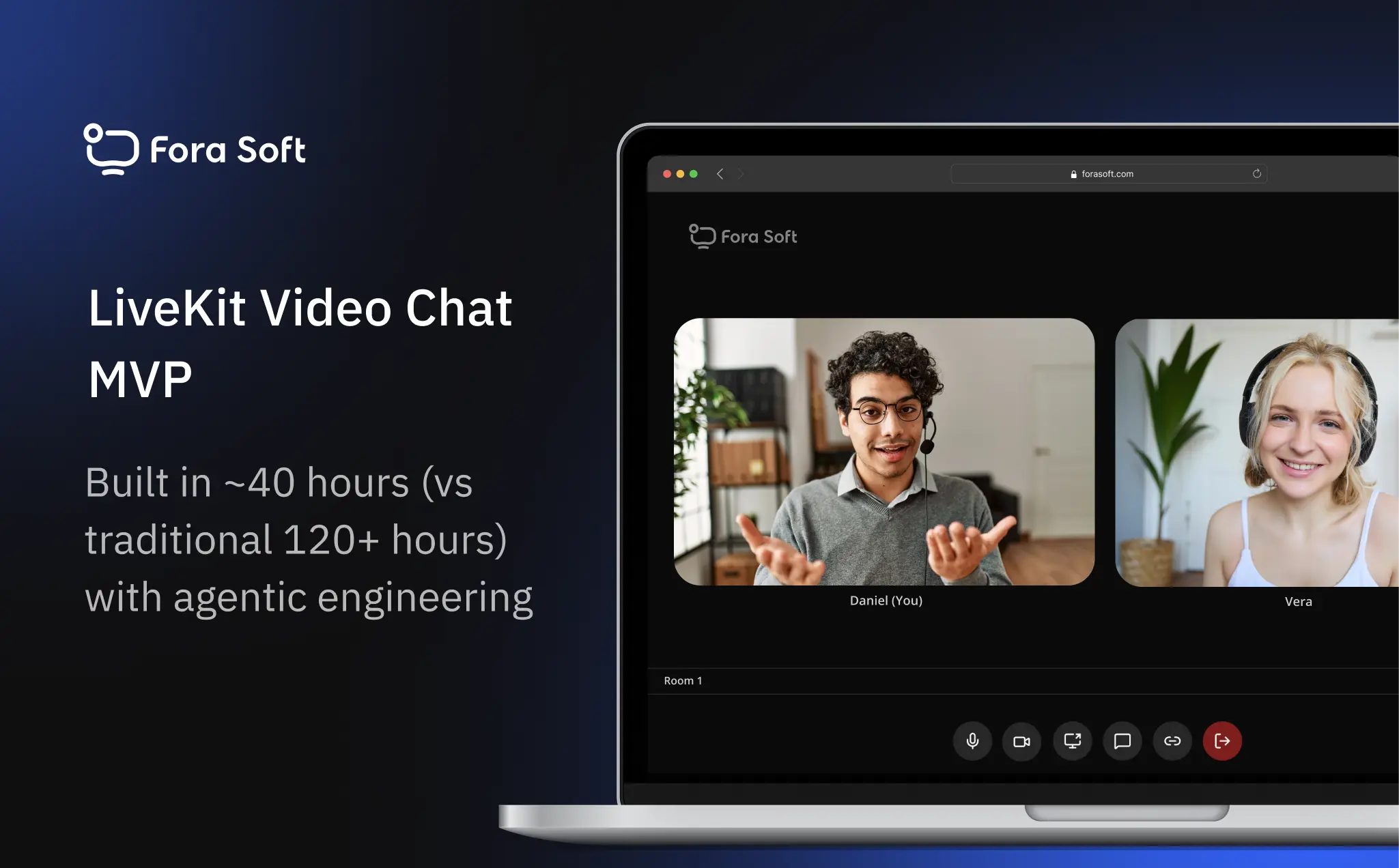

Agentic engineering lets specialized AI agents execute repetitive and complex tasks while experienced developers stay in control of production streaming architecture, latency-critical decisions, and final validation.
The result: video streaming features that launch faster and perform reliably from day one.
Here’s the exact process we follow for every project:
We decompose your requirements into bounded, agent-safe tasks with clear latency targets, compliance requirements (HIPAA, SOC II, GDPR), device matrices, and acceptance criteria — informed by 600+ prior streaming deployments.
Multi-agent teams draft scalable architectures using your chosen stack (LiveKit, WebRTC, Kurento) with SFU/MCU topology, signaling protocols, STUN/TURN configuration, and multi-region CDN planning — all reviewed by senior architects.
Agents generate WebRTC/LiveKit code, handle peer connections, SRTP/DTLS encryption, and integrate real-time features (screen sharing, recording, AI transcription) — under strict human-defined limits with mandatory code review gates.
Senior engineers validate sub-500ms latency, SRTP/DTLS security, HIPAA/GDPR compliance, and production edge cases. Every agent output passes human review before merging — catching hallucinations and vulnerabilities before they reach production.
Agents run thousands of test scenarios covering ICE connectivity, TURN fallback, packet loss recovery, and cross-browser compatibility. We validate against real network conditions on AWS, Azure, and GCP before any production deployment.
Production deployment with built-in observability, real-time metrics dashboards, AI-assisted anomaly detection, and 24/7 monitoring. Full knowledge transfer and optional long-term support as your platform scales.
Projects that traditionally take 80-120 developer hours for core video chat components now complete in 35-40 hours of expert oversight. The platform ships faster, costs less to maintain, and scales without rework.
We design modular, secure architectures where agents accelerate delivery and humans guarantee reliability. Every layer prioritizes sub-500ms latency, fault tolerance, and compliance.
Start with an MVP and scale to enterprise-grade systems with millions of concurrent streams. The same architecture supports telemedicine, e-learning, surveillance, and Internet TV without redesign.
Agentic Engineering is ideal when you need a custom real-time video platform that goes beyond off-the-shelf tools — delivered 2-10× faster with AI agents handling repetitive tasks while senior engineers own architecture and quality.
Custom agentic engineering for video streaming at every stage — from MVP prototypes to enterprise-grade platforms. AI-accelerated development with human oversight, built by a team with 600+ projects since 2005.

Build your real-time video platform from scratch with agentic acceleration — WebRTC/LiveKit architecture, AI-driven code generation, and production deployment. 2-10× faster than traditional development with 600+ projects as proof.

Upgrade existing video platforms with agentic workflows — add simulcast/SVC, AI transcription, noise suppression, or scale from hundreds to 100K+ concurrent users. Agent-assisted refactoring cuts upgrade timelines by 2-3×.

Rescue stalled or broken video projects with AI-accelerated code audits, performance optimization, and architecture fixes. We’ve rescued dozens of streaming projects — fixing latency issues, ICE/NAT problems, and scaling bottlenecks.
Have a specific project in mind? Share a short brief and we will respond with scope, budget range, and timeline.
We take security, compliance, ethics, and reliability seriously — especially in real-time video and audio systems where latency, privacy, and trust matter most. Agentic engineering accelerates development, but only when built on strong foundations. We apply strict human oversight, bounded autonomy, and proven multimedia practices to deliver platforms that perform reliably while meeting regulatory and ethical standards.
Our approach minimizes risks that come with autonomous agents, like unintended behaviors, hallucinations in code generation, or security gaps, by keeping humans in control of critical decisions. This ensures your video streaming project stays secure, compliant, and dependable from prototype to production.
We implement WebRTC standards with mandatory end-to-end encryption for media streams. LiveKit and Kurento integrations include secure token authentication and access controls, preventing unauthorized access even during agent-driven development.
For telemedicine, e-learning, or enterprise use cases, we design with HIPAA eligibility (including BAA support via LiveKit Cloud) and full GDPR alignment. Agents handle routine tasks within predefined boundaries; humans review all compliance-sensitive elements like data flows and audit logs.
AI agents generate code and tests quickly, but we mandate senior engineer review for every latency-critical or security-related output. This catches potential hallucinations, flawed logic, or vulnerabilities before they reach production, maintaining sub-500ms performance without shortcuts.
Agents operate within strict limits: no unrestricted tool access, mandatory escalation for high-impact actions, and comprehensive logging of decisions. This follows emerging 2026 governance trends (NIST-aligned frameworks, OWASP guidelines) to reduce risks like agent hijacking or policy drift.
Every agent action logs reasoning, data used, and outcomes — creating traceable records for audits or debugging. In regulated domains, this transparency proves decisions align with your policies and ethical standards.
We test against network variability, edge cases, and load spikes early and often. Agent-assisted testing covers thousands of scenarios; human validation ensures the system holds up in production — no surprises during live events or patient consultations.
We prioritize fairness, privacy, and accountability. Agents never handle sensitive decisions (e.g., access controls) without oversight. We avoid biased outputs in AI features like noise suppression or analytics by using diverse training data and regular human checks.
This combination lets us deliver 2-3× faster (for complex multimedia features) without compromising what matters most: user privacy, regulatory compliance, ethical integrity, and rock-solid reliability.
Clients in healthcare, education, and broadcasting trust us because we build systems that work securely — and stay that way.
Startup 💡
Core WebRTC/LiveKit video features with agentic acceleration: peer connections, screen sharing, chat, recording. AI agents handle boilerplate; engineers ensure sub-500ms latency. MVP in 1.5-2 weeks.
from
$2,000
from 1.5 weeks
Growth 🚀
Advanced integrations: SFU/MCU media servers, AI transcription, noise suppression, ABR streaming, multi-device optimization, and analytics dashboards. Supports 1K-10K+ concurrent users. 1-2 month delivery.
from
$6,400
from 1 month
Enterprise 🏢
Enterprise-grade architecture: multi-region deployment, cascading SFU, HIPAA/SOC II/GDPR compliance, AI-enhanced analytics, and 99.9% uptime SLA. Supports 100K+ concurrent users. 3-6 month delivery with ongoing optimization.
from
$20,000
from 3 months
Ready for a realistic timeline and cost breakdown tailored to your video streaming needs? We offer free SRS and a code audit for existing projects.
Building WebRTC, LiveKit, and Kurento platforms since 2005 — from ProVideoMeeting (1K+ concurrent) to Worldcast Live (10K+ viewers) to CirrusMED (HIPAA telehealth in 40+ states). Now accelerating delivery with agentic engineering.
Senior WebRTC engineers, AI orchestration architects, SFU/MCU specialists, DevOps, QA, and UI/UX designers — all in-house, working as a true extension of your team with full human oversight on every agent output.
Over 250 projects delivered, 2-10× faster delivery with agentic workflows, sub-500ms latency achieved, 99% Job Success on Upwork, and 5.0 on Clutch. Results you can trust.
Straight answers on live video, latency, and scalability
We deliver custom WebRTC platforms, LiveKit-based video systems, Kurento media servers, live streaming backends, HIPAA-compliant telehealth apps (CirrusMED, MyOnCallDoc), e-learning platforms (BrainCert, Scholarly), enterprise collaboration tools (ProVideoMeeting, Nucleus), and AI-enhanced multimedia platforms — all 2-10× faster through structured agentic workflows with human oversight.
Yes. AI agents handle rapid prototyping and integration of features like real-time transcription (LiveKit agents), noise suppression, computer vision, and viewer analytics. Our senior engineers fine-tune for sub-500ms latency and production accuracy — proven with Meetric (25% higher close rates) and VocalViews (800K+ participants).
Startup MVPs start from $2,000 (1.5-2 weeks). Growth-stage platforms with advanced integrations from $6,400 (1-2 months). Enterprise systems with compliance and multi-region scaling from $20,000 (3-6 months). We provide detailed estimates after a free consultation — transparent and value-focused.
Mandatory human oversight at every critical gate ensures sub-500ms latency, catches AI hallucinations and security vulnerabilities, and validates HIPAA/GDPR compliance. Our 20-year track record across 600+ real-time video projects — from CirrusMED to Worldcast Live — proves this approach works at scale.
Our 6-step agentic workflow (decomposition → orchestration → AI coding → human review → automated testing → deployment) cuts timelines by 2-10×. Core video chat components that took 80-120 hours now complete in 35-40 hours of expert oversight. Full platforms launch in weeks instead of months.
Every project includes monitoring setup, real-time dashboards, and AI-assisted anomaly detection. We offer ongoing agent-accelerated improvements, performance optimization, and dedicated support. Many clients maintain 5+ year partnerships as their platforms scale from MVP to enterprise.
You get 2-3× faster delivery for complex multimedia features and 4-10× faster for common components (signaling, chat, screen sharing). Lower total cost with fewer bugs reaching production (25% defect reduction). Same or better code quality and maintainability — because senior engineers still own architecture, security, and final decisions.

You get a realistic estimate, technical recommendations and next steps. Free, no obligations.


