


Key takeaways
• MoQ is what fixes the “CDN economics or sub-second latency, pick one” trade-off. A pub/sub relay over QUIC delivers 200–300 ms glass-to-glass at CDN-style fan-out — territory neither WebRTC SFUs nor LL-HLS can hit cleanly.
• WebTransport just hit Baseline in March 2026. Chrome, Edge, Firefox, and Safari 26.4 all ship MoQ-capable transports without flags. The browser story is finally solved.
• The spec is at draft-18, not an RFC yet. draft-ietf-moq-transport-18 landed 12 May 2026; a formal RFC most likely follows in 2027. Real production deployments exist (Cloudflare, WINK, nanocosmos), but if you need formal-spec stability for regulated broadcast, stay on HLS for now.
• Pick your battle. Use MoQ for one-to-many fan-out where WebRTC SFU economics blow up. Keep WebRTC for two-way conversations. Keep HLS for backwards compatibility and regulated workflows. Hybrid is the 2026 pattern.
• The cost story is the headline. MoQ relays let one publisher fan out to thousands of subscribers without per-viewer SFU sessions. We see 40–60% opex savings versus WebRTC SFU at the 10k-concurrent mark.
Why Media over QUIC matters in 2026
For a decade, live streaming engineers have lived with a forced choice: pay WebRTC’s per-session SFU bill to get sub-second latency, or pay LL-HLS’s 1–3-second floor to get CDN economics. Media over QUIC is the protocol designed to collapse that trade-off. It runs pub/sub relays sitting on top of QUIC and WebTransport, fanning out to thousands of subscribers from a single publisher feed at 200–300 ms end-to-end.
In 2026 the conditions to ship are finally aligned. WebTransport is Baseline across major browsers as of March. Cloudflare (its MoQ relay network), WINK Streaming, nanocosmos and CDN77 are running production MoQ deployments. The IETF moq working group has publication-ready drafts for transport, WARP catalog, LOC media format, and end-to-end secure objects. The remaining work is engineering, not research, and that’s what this guide is about. At NAB Show 2026, eleven vendors — Cloudflare, AWS, Bitmovin, Ant Media, Broadpeak, CacheFly, Nomad Media, Oracle, Norsk, Synamedia and Red5 — demoed their first MoQ implementations, so interop is no longer hypothetical.
Why Fora Soft wrote this playbook
Fora Soft has shipped real-time video products since 2005 (250+ of them), with deep roots in WebRTC, LiveKit, MediaSoup, Janus, RTMP, and SRT. We’ve been tracking MoQ since the IETF chartered the working group, prototyping against moq-rs and Cloudflare’s relay since 2024, and our Media over QUIC development team now builds MoQ and WebTransport pilots for clients. We use spec-driven agent engineering to compress streaming-stack builds into 8–12 weeks.
Three projects ground every recommendation here. BrainCert is a WebRTC-based virtual-classroom LMS at $3M ARR, 100,000+ customers and 500M+ classroom minutes streamed. Scholarly scaled a Sydney e-learning prototype to 15,000+ users and live classes up to 2,000 concurrent students on Go, LiveKit and Kubernetes. Worldcast Live ships sub-second HD concert streams to global audiences. We’ve made every architectural call below in production at least once.
Evaluating MoQ for your next live product?
Bring us the use case, the audience scale, and the latency target. We’ll redline a hybrid MoQ + WebRTC + HLS stack and a delivery estimate on a 30-min call.
MoQ in 60 seconds
A publisher pushes media into a relay as a stream of tracks. Each track is sliced into groups (typically GOP-aligned, one group per keyframe burst) and each group into objects (the atomic delivery unit, usually 100–500 KB). The relay caches every object as it arrives and ships it to every subscriber that asked for the track — without re-fetching from the publisher. Subscribers can join late, replay, fast-forward, or switch to a lower-bitrate track without renegotiating with the publisher. All of it runs over QUIC for low-latency, multiplexed transport, and over WebTransport when the client is a browser.
Compare WebRTC, where one SFU session serves one viewer and stateful per-session glue dominates the bill. Compare HLS, where every viewer fetches a numbered playlist and small segments via HTTP — great for caching, terrible for latency. MoQ is the middle path: pub/sub objects, relay caching, sub-second. For a protocol-level deep dive on the wire format and history, see our Media over QUIC in-depth guide; this playbook stays on the build and architecture decisions.
The reference architecture
MoQ is a three-tier topology: publishers, relays, subscribers. The relay is the workhorse. It can be a single instance for a small deployment or a global mesh for a CDN-class build.
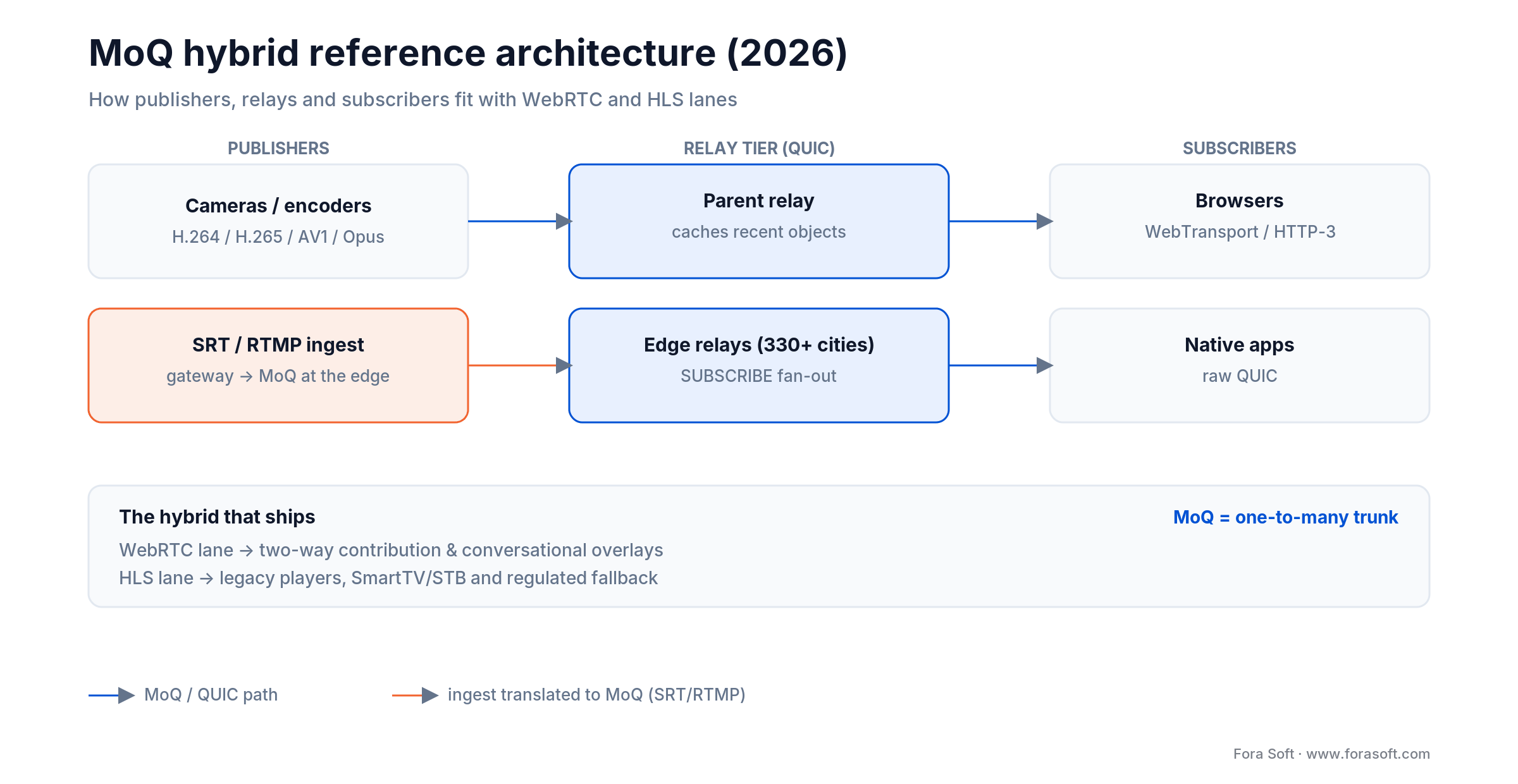
Figure 1. The 2026 hybrid reference architecture: a MoQ trunk with WebRTC and HLS lanes.
Publishers
A publisher encodes media (H.264, H.265, AV1, AAC, Opus) and pushes it to one or more relays as MoQ tracks. In contribution scenarios, the publisher is often a remote camera, a cloud encoder, or a contribution feed translated from RTMP/SRT. We typically keep RTMP/SRT for ingest and convert to MoQ at the edge of our infrastructure — encoders are conservative, and a thin gateway is cheaper than asking every camera to speak QUIC.
Relays
The relay accepts publisher tracks, caches the most recent N seconds of objects per group, and answers SUBSCRIBE requests from downstream clients. Relays can chain: a regional relay can SUBSCRIBE upstream to a parent relay, fanning out further at the edge. Cloudflare launched the first production MoQ relay network in August 2025, with every server across 330+ cities acting as a relay — the operational model the protocol was designed for.
Subscribers
A subscriber issues SUBSCRIBE for a track, optionally asking for a specific group range (catch up, jump to live). The relay streams matching objects. Browsers go through WebTransport over HTTP/3; native apps use raw QUIC. Subscribers can switch tracks (bitrate ladder, language, camera angle) by adding/dropping subscriptions without re-handshaking the connection.
The hybrid that ships
In every production stack we’ve scoped, MoQ is the trunk for one-to-many distribution, not the only protocol. WebRTC handles two-way contribution and conversational overlays. HLS lives at the edge for legacy player compatibility. SRT or RTMP brings encoders that aren’t MoQ-native into the relay. That hybrid is the only honest answer for a serious live product in 2026.
Tracks, groups, and objects: the data model
MoQ’s data model is the most important thing to internalize. Get the granularity right and your cache hit rate, latency, and reliability all snap into place.
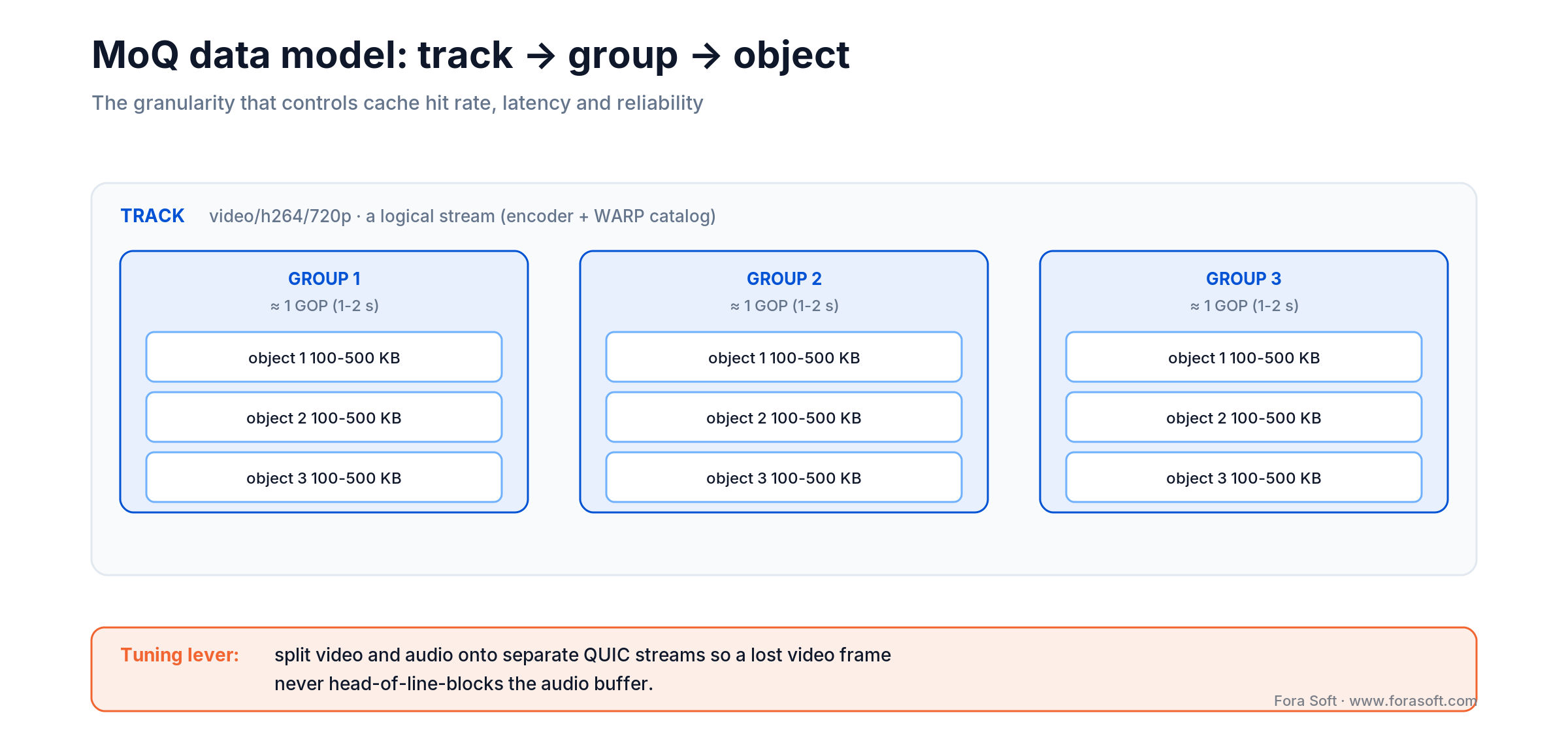
Figure 2. MoQ’s track / group / object hierarchy and the QUIC streams that carry it.
| Concept | Granularity | Typical example | What controls it |
|---|---|---|---|
| Track | Logical stream | video/h264/720p, audio/opus/en | Encoder + WARP catalog |
| Group | Decode-independent unit | ~1 GOP (1–2 s of video) | GOP cadence in encoder |
| Object | Atomic delivery unit | 100–500 KB (frame or fragment) | LOC media format settings |
| Stream | QUIC stream carrying objects | One per track, or per group | Library mapping |
A common tuning lever: split video and audio across separate QUIC streams so a video-frame loss doesn’t head-of-line-block the audio buffer. Split each track of a bitrate ladder onto its own stream and you can drop a single rendition without disturbing the others. The right partition is workload-specific.
Latency: the numbers, side by side
| Protocol | Glass-to-glass | Fan-out economics | Maturity |
|---|---|---|---|
| WebRTC SFU | 100–250 ms | Per-session SFU; expensive at >1k | Mature, proven |
| MoQ | 200–300 ms (in production) | Relay cache fan-out; CDN-friendly | Draft-17, real deployments |
| LL-HLS | 2–5 s | CDN-native | Mature, ubiquitous |
| HLS | 3–8 s | CDN-native | Mature, regulated-friendly |
| RTMP → CDN | 200–600 ms ingest, ~10 s playback | Ingest, not delivery | Legacy |
WINK Streaming reported 200–300 ms in production MoQ deployments in 2025; Bitmovin’s Player Web X tests against Cloudflare’s MoQ relay landed in the same band. These are well-engineered networks — expect a longer tail in production over residential cellular, but the baseline is real.
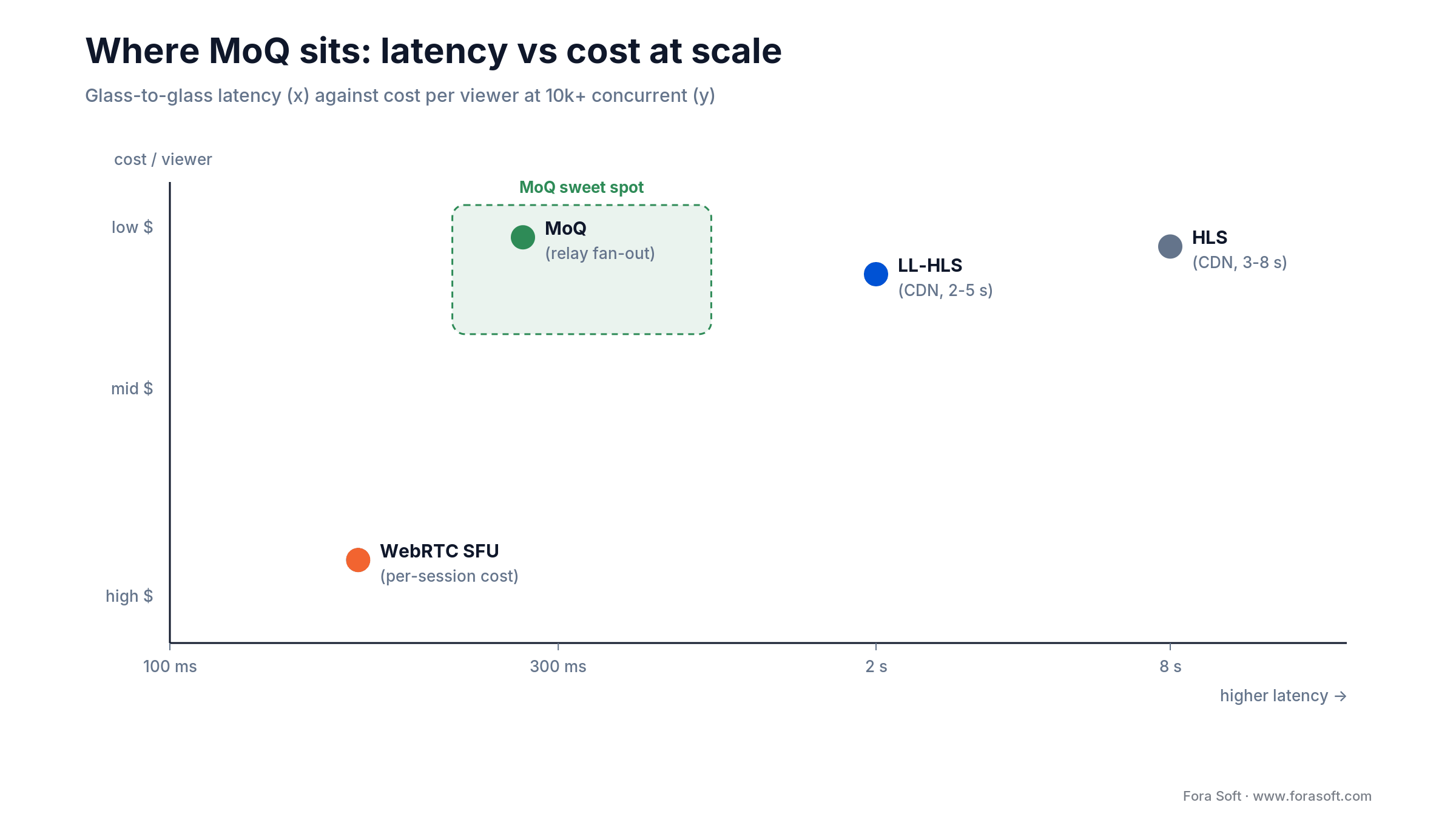
Figure 3. Where MoQ sits on latency versus cost per viewer at scale.
Reach for MoQ when: your audience is one-to-many over 1k concurrent and your latency target is sub-second. WebRTC will hold the latency, but the SFU bill won’t.
Cost economics: MoQ vs WebRTC SFU vs HLS
The numbers below are directional — vendor pricing varies and your own bandwidth contracts dominate at scale. They’re what we share with clients evaluating a build today.
| Stack | 10k concurrent / 1080p | Where the money goes |
|---|---|---|
| WebRTC SFU (DIY) | ~$5k–$50k / month | Stateful media servers + bandwidth |
| WebRTC SFU (managed: LiveKit/Daily) | ~$8k–$30k / month | Per-participant minutes |
| HLS via CDN | ~$1k–$8k / month | CDN egress |
| MoQ relay (CDN-class) | ~$1k–$10k / month | Egress + relay processing (~20–50% over HLS) |
Two takeaways. First, MoQ ships at HLS-class economics with WebRTC-class latency — that’s the headline saving. Second, real-world numbers depend heavily on whether you’re running your own relays or paying a CDN by the GB. Cloudflare bundles MoQ into enterprise plans today; expect that to change quickly as more CDNs ship relays.
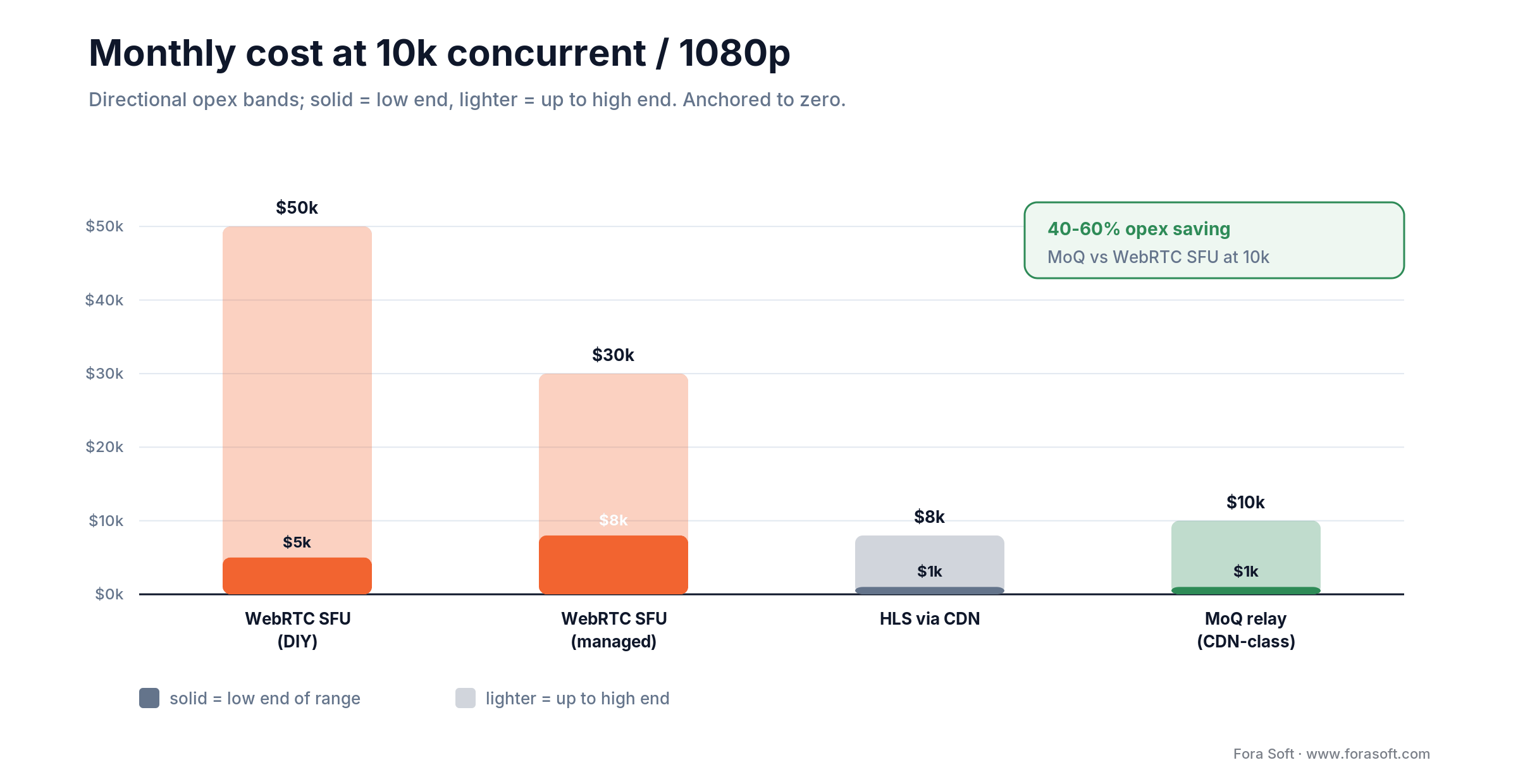
Figure 4. Monthly cost at 10k concurrent: WebRTC SFU versus MoQ relay.
Wondering whether MoQ pays back at your scale?
We’ll model your audience, ladder, and latency target in a 30-min call and ship you the MoQ vs WebRTC vs HLS opex comparison — on your numbers.
Browser support: WebTransport is finally Baseline
As of March 2026, WebTransport over HTTP/3 ships unflagged in Chrome, Edge, Firefox, and Safari 26.4 — that’s the Web Platform “Baseline” designation. For the first time MoQ has a universal browser story without the QUIC/UDP fights of three years ago. We cover the transport itself in our WebTransport & WHIP guide.
Practical consequences. There is no MoQ over TCP fallback; if WebTransport is blocked at a corporate firewall, the only honest plan is to fall back to HLS or a WebSocket-tunneled WebRTC path for that user. We always design two delivery lanes — MoQ primary, HLS or WebRTC fallback — and cookie a sticky route for the next session. The fallback fires for under 5% of consumer users in our deployments; corporate networks see noticeably more.
A minimal MoQ subscriber, in code
For browser clients, a MoQ subscriber opens a WebTransport connection, sends SUBSCRIBE for one or more tracks, and receives objects on incoming streams. The shape below is a simplified sketch using a TypeScript MoQ client; production code adds catalog parsing, error handling, and ABR.
// Browser-side MoQ subscriber (sketch, draft-ietf-moq-transport-18 semantics)
const wt = new WebTransport("https://relay.example.com/moq");
await wt.ready;

const session = await MoqSession.connect(wt);

const catalog = await session.fetchCatalog("live/main");

const videoTrack = catalog.tracks.find(t => t.kind === "video" && t.height === 720);

const subscription = await session.subscribe({
  track: videoTrack.name,
  groupOrder: "ascending",
  start: { group: "latest", object: 0 },
});

for await (const obj of subscription.objects) {
  decoder.decode({
    timestamp: obj.timestamp,
    data: obj.payload,
    type: obj.isKeyFrame ? "key" : "delta",
  });
}
Two things to call out. First, the catalog comes from the WARP draft and tells the client what tracks exist, their codecs, and the bitrate ladder — that’s how ABR works without a separate manifest. Second, decoding goes through WebCodecs (`VideoDecoder`/`AudioDecoder`); in practice we wrap that in our own buffering and jitter logic.
Five challenges you will hit
1. Head-of-line blocking on a single stream. Pack everything onto one QUIC stream and one lost packet stalls the rest. Spread tracks (and sometimes groups) across separate streams so loss is isolated. Audio and video should never share a stream in production.
2. Server-side ABR isn’t standardized yet. Client-side ABR (the player picks 720p vs 1080p based on local bandwidth) works today. Server-side adaptive bitrate — where the encoder reduces rendition bitrate based on relay-reported congestion — is being defined. For now, ladder all renditions and let clients switch.
3. DRM is not yet wired. draft-ietf-moq-secure-objects defines per-object E2E encryption, but Widevine, PlayReady, and FairPlay integration is informal. If you ship premium licensed content, run HLS in parallel for compliance and roll MoQ for unencumbered live.
4. Observability is sparser than WebRTC. WebRTC has 25 years of statsmaking; MoQ relays expose far fewer counters. Plan to instrument your own — per-track RTT, group delivery time, late-object rate, fallback firings.
5. The spec moves. Drafts -16, -17, -18 each tightened wire formats. Pin to a specific draft revision in your client and server; gate upgrades on interop tests with the relays you depend on.
Reach for a managed relay (Cloudflare, nanocosmos) when: you want to ship in 2026 without building global infrastructure. Self-hosted moq-rs is a fine choice when data residency, cost at very large scale, or sovereign-cloud requirements force the build.
Use cases that win — and use cases that don’t
| Use case | Pick | Why |
|---|---|---|
| Sports / esports / concerts (10k+ live) | MoQ | Sub-second + CDN economics — the headline win. |
| iGaming / live betting / auctions | MoQ | Sub-500 ms required; relay scaling wins. |
| Remote production / contribution | MoQ + SRT | SRT for ingest, MoQ for cloud-native distribution. |
| Two-way meetings / interviews | WebRTC | Battle-tested ICE, NACK, RTCP, congestion. MoQ adds round-trips here. |
| Regulated broadcast (FCC, OFCOM) | HLS / DASH | Mature DRM, SCTE-35 ad markers, conformance suites. |
| Cloud gaming | WebRTC (today) → MoQ (2027) | Bidirectional input today; MoQ may help server-to-client. |
| Surveillance / kiosk fleets | MoQ | Deterministic latency at scale, single relay tier. |
Reach for the WebRTC + MoQ hybrid when: the product has a small group of contributors and a large audience — live shopping, expert panels, sports broadcasts. WebRTC lifts the contribution; MoQ scales the distribution.
Mini case: Worldcast Live — sub-second HD concerts at scale
Situation. A live-music platform that needed sub-second concert delivery to global audiences with HD video, multi-camera angles, and synchronized audio mix — all while keeping the cost-per-viewer in CDN territory.
What we built. A hybrid: SRT for camera-to-cloud contribution, a MoQ-style relay tier for distribution, and an HLS fallback at the edge for legacy player support. We ran multi-rendition tracks (1080p, 720p, 480p), client-side ABR via WARP catalog, and end-to-end latency budgets that the team monitors per region.
Outcome. Sub-second HD concert streams to a global audience with the cost shape of a CDN, not of a per-viewer SFU. Read the Worldcast Live project page or book a review if you’re shaping a similar architecture.
A decision framework — pick MoQ in five questions
1. How big is the audience? Under 1k concurrent — WebRTC is fine. 1k–10k — MoQ vs SFU is a real trade-off, run the math. Above 10k — MoQ’s relay model wins.
2. What’s the latency budget? Under 250 ms two-way — WebRTC. 200–500 ms one-way — MoQ. 2 s+ acceptable — HLS, save the engineering time.
3. Is the workload one-to-many or many-to-many? One-to-many at scale — MoQ. Many-to-many conversational — WebRTC.
4. Is content regulated or DRM-heavy? Premium movies, broadcast, anything that needs Widevine/PlayReady/FairPlay — HLS or DASH today, MoQ in parallel as a low-latency tier where compliance permits.
5. How much spec movement can you absorb? Tied to a draft RFC — you must own the upgrade discipline. If you can’t pin and re-test on every draft bump, wait for RFC.
Migration paths from WebRTC and HLS
From WebRTC SFU to MoQ. Run them in parallel for two quarters. Move new one-to-many streams to MoQ first; keep two-way and contribution on WebRTC. Once telemetry holds for a month, retire SFU rows that no longer carry production traffic. Realistic opex saving at scale: 40–60% on distribution.
From HLS to MoQ. Stand up a MoQ origin alongside the HLS packager. Translate at the edge so legacy players keep getting HLS while the MoQ-capable players cut to sub-second. Latency drops from 3–8 s to 200–300 ms with no client change required for HLS holdouts.
The hybrid that actually ships. SRT or RTMP for ingest. MoQ for global distribution. WebRTC for two-way and contribution overlays. HLS at the edge for legacy. We have variants of this stack live for several clients in 2026; the integration work is well-understood. It’s the core of our video & audio streaming development practice.
Reach for a parallel-run migration when: you already have paying traffic on WebRTC SFU or HLS. Move new one-to-many streams to MoQ first, keep the old path live for a quarter, and cut over only once telemetry holds. A big-bang switch on live audiences is how outages happen.
Five pitfalls we see teams hit
1. Treating MoQ as a WebRTC drop-in. MoQ has no NACK, no per-frame RTCP. Your reliability story has to come from QUIC’s congestion control, your group sizing, and your ABR ladder.
2. Putting audio and video on one stream. Audio drop-outs are immediately audible. Always keep audio on its own QUIC stream.
3. Skipping the fallback. WebTransport gets blocked on a non-trivial slice of corporate networks. Without an HLS or WebRTC fallback, those users see a black square.
4. Ignoring catalog versioning. A WARP catalog change mid-stream can break older players. Version the catalog and bump conservatively.
5. Underestimating monitoring. MoQ telemetry is sparser than WebRTC’s. Build per-track RTT, late-object rate, and fallback-firing dashboards from day one.
Reach for an HLS fallback when: a non-trivial slice of your audience sits behind corporate firewalls or on a SmartTV/STB without WebTransport. The fallback is cheap insurance against an audience seeing a black square.
KPIs to measure
Quality KPIs. Glass-to-glass P50 and P99 (target P50 < 300 ms, P99 < 800 ms). Late-object rate per track (target < 1%). ABR switch-up time (target < 2 s).
Business KPIs. Cost per concurrent viewer-hour (target a 30–50% drop vs SFU baseline). Fallback-firing rate (target under 5% on consumer audiences). Customer-reported drops per 10k viewer-hours.
Reliability KPIs. Relay uptime per region. P99 publisher-to-relay RTT. Time-to-first-frame on subscribe (target < 700 ms cold).
When NOT to use MoQ in 2026
If your product is two conversation participants, MoQ is the wrong tool — WebRTC’s ICE and SRTP are battle-tested in a way MoQ won’t catch up to in 2026. If your audience is a few hundred viewers, the relay benefit is small and the engineering cost is real. If your stream feeds an FCC-licensed broadcast pipeline that demands SCTE-35 ad markers and Widevine DRM, stay on HLS/DASH for a year.
Everyone else who has been suffering with the WebRTC-vs-HLS trade-off should be running a MoQ pilot in 2026.
Need a MoQ pilot in 8 weeks?
We deliver a working publisher, a relay tier, and a browser subscriber with metrics in 6–10 weeks — agent-engineered, with HLS fallback baked in.
FAQ
Is MoQ production-ready in 2026?
Production-ready for one-to-many distribution use cases — sports, iGaming, surveillance, live commerce. Not yet ready for FCC-style regulated broadcast (no DRM framework, no SCTE-35 conformance) or for replacing WebRTC in two-way conversations. The IETF spec is at draft-18 (May 2026); a formal RFC most likely follows in 2027.
What latency is realistic in production?
200–300 ms glass-to-glass on well-engineered networks (Cloudflare relay, WINK production). Expect a longer P99 over residential cellular. Plan for budgets, not point estimates.
Will MoQ replace WebRTC?
No, and not by design. WebRTC remains the right tool for two-way, low-fan-out, conversational. MoQ replaces the “LL-HLS or paying for SFU at scale” trade-off — not the SFU itself.
Which relay is the best starting point?
For most production deployments, Cloudflare’s MoQ relay (running on quiche) is the easiest start — global presence, included with enterprise plans, mature operationally. For self-hosted setups, Cloudflare’s open-source moq-rs (a Rust implementation on the quinn QUIC stack) is a solid foundation; Cloudflare’s own production relay runs on its quiche/tokio-quiche edge. nanocosmos and WINK ship commercial alternatives.
Does MoQ work in browsers without extensions?
Yes. Chrome, Edge, Firefox, and Safari 26.4 ship WebTransport unflagged as of March 2026 (Web Platform Baseline). MoQ-capable client libraries are available in TypeScript, Rust (WASM), and Swift/Kotlin for native.
How does ABR work in MoQ?
Today, client-side ABR — the player picks among prepared bitrate-ladder tracks based on local bandwidth, just like LL-HLS. The encoder publishes 1080p, 720p, and 480p tracks; the player switches between them. Server-side ABR (encoder feedback from relay congestion) is being defined; expect it later in 2026.
Can MoQ deliver DRM-protected content?
Per-object encryption is in draft-ietf-moq-secure-objects, but commercial DRM (Widevine, PlayReady, FairPlay) integration is informal. For premium licensed content in 2026, run MoQ in parallel with HLS/DASH and serve DRM through the legacy stack until the integration matures.
How long does a MoQ build take with Fora Soft?
A working pilot — publisher, relay, browser subscriber, monitoring — lands in 6–10 weeks via spec-driven agent engineering. Full hybrid distribution (MoQ trunk, WebRTC two-way, HLS fallback) is typically 12–16 weeks. Bring us the scope and we’ll quote on a call.
What to Read Next
Scale
Scale Real-Time Video to 1 Million Viewers
WebRTC, CDN, and MoQ architectures for the very large audience.
WebRTC trade-offs
WebRTC vs Agora: Architecture Trade-offs
When to build, when to buy, when to swap your real-time backbone.
Hiring
Hire a WebRTC Development Company vs Build In-House
A buyer’s guide for streaming and real-time-video founders.
Engineering practices
Real-Time Video Processing with AI
Architecture patterns and latency budgets from 250+ shipped video projects.
Build vs buy
Wowza Custom Development in 2026
A build-vs-buy analysis for low-latency streaming platforms.
Ready to ship a MoQ pilot?
In 2026, MoQ is the right answer for one-to-many live media at scale where WebRTC SFU economics break down and HLS latency hurts. The browser story is finally solved, the relay vendors are real, and the spec is stable enough for production pilots. The trick is in the integration: hybrid stacks with WebRTC for two-way, MoQ for distribution, and HLS for fallback are what ship.
If you’re scoping a streaming product, the question isn’t whether to adopt MoQ. It’s at what scale, and on which use case, MoQ pays back. That’s the conversation we have with prospective clients on a 30-min scoping call — bring the constraints, leave with an architecture and a delivery estimate.
The book · Volume 2 of 7
Video Streaming: A Complete Guide to Video Delivery: From Network Protocols and Transport to Ingest, HLS, and MPEG-DASH
MoQ changes the transport under live video, so the decisions in this guide rest on how networks treat a stream. Volume 2 covers that ground in depth: glass-to-glass latency budgets, TCP versus UDP and congestion control, QUIC and HTTP/3, ingest over RTMP, SRT and RIST, and HLS, DASH and CMAF for the players MoQ still has to serve. Written by Nikolay Sapunov, CEO at Fora Soft.
Read it on Amazon →Kindle & paperback · Fora Soft Video Engineering Handbook
Talk to a team that has shipped 250+ video products
WebRTC, MoQ, MediaSoup, LiveKit, SRT, RTMP, HLS — we know which tool fits which job. Bring the use case; we’ll bring the architecture and a delivery estimate.