

.avif)
Key takeaways
• “Agora alternative” almost never means “build everything.” Most teams move one lane, usually to LiveKit or Daily, and keep the rest. We’ll show you which lane fits your numbers.
• On raw cost, the first stop is LiveKit, not a custom build. At 500k HD video minutes/month, Agora video runs about $2,000/mo. LiveKit Scale sits inside its 1.5M included minutes at $500/mo flat. Custom only wins on cost at very high, steady volume.
• Custom WebRTC is a control decision, not a savings hack. You reach for it when compliance, lock-in, or a specialized feature matters, not because the compute undercuts a managed bill.
• Twilio Video did not shut down. Twilio reversed the end-of-life on 21 October 2024, so it’s a supported, standalone product in 2026. If you already run it, staying is a valid option.
• Lock-in is the underrated line item. Agora’s RTM signaling, token format, and SDK bindings make an exit a real project. Wrap signaling behind your own interface early and every future move gets cheaper.
Build versus buy comes up with every vendor in this space. All vendor comparisons, one page.
Why teams look for Agora alternatives in 2026
Agora works. That’s not the question. The real question, the one that lands in our inbox most weeks, is whether the price, the lock-in, and the feature shape still fit where the product is heading. A founder watches the monthly bill climb with every new cohort. A CTO reads Agora’s Conversational AI Engine pricing, does the math on 50,000 minutes of voice agents, and starts typing “agora alternatives” into a search box.
Here’s the trap in most of what comes back: it’s written by a competing SDK, and every listicle ranks its own product first. So this playbook does the opposite. We ship on Agora and we build custom WebRTC every quarter, so we don’t care which one you pick. We care that it matches your minute volume, your users’ geography, your compliance bar, and the size of your team. Bring those four numbers and the decision gets simple.
Why Fora Soft wrote this playbook
Fora Soft has built real-time video since 2005: 250+ projects across WebRTC, Agora, LiveKit, mediasoup, Janus, Wowza, and now MoQ, delivered by 50+ in-house specialists. We’re an Agora development partner and a long-standing custom-WebRTC shop, and we use spec-driven agent engineering to keep either path fast.
Four projects ground everything below. BrainCert is a custom WebRTC + HTML5 virtual classroom that has delivered 500M+ real-time classroom minutes at 99.995% uptime and grew to $3M revenue. Our Agora Flexible Classroom build ships an embeddable classroom — video, whiteboard, screen share, collaborative playback — in a week on Agora’s network, which is proof we run their SDK in production, not just talk about it. Scholarly runs live classes for up to 2,000 concurrent students on LiveKit, Go, and Kubernetes. And Alve.chat monetizes per-minute 1:1 video on self-hosted Janus, past 100k Android installs. We’ve felt the trade-offs on all four stacks, and that’s the view we’re handing you.
Not sure which Agora alternative fits your numbers?
Bring your monthly minutes, latency target, and compliance constraints. We’ll model managed vs custom and hand you a delivery estimate on a 30-min call.
The 60-second answer: your Agora alternatives
Short version: you have five realistic moves off Agora, and only one of them is “build it yourself.” LiveKit Cloud is managed SFU on open standards, the cheapest managed lane and the default swap for most teams. Daily and 100ms are managed platforms with flat per-minute pricing and a fast migration. Custom WebRTC on mediasoup, Janus, or self-hosted LiveKit gives you full control and compliance you own. Twilio Video is still alive if you already run it. And a hybrid keeps Agora where it’s genuinely best, say mainland China, while you move the rest.
Pick by minute volume, geography, compliance, and team size. The decision tree later in this piece boils it down to five questions. The map below is the shape of the whole decision.
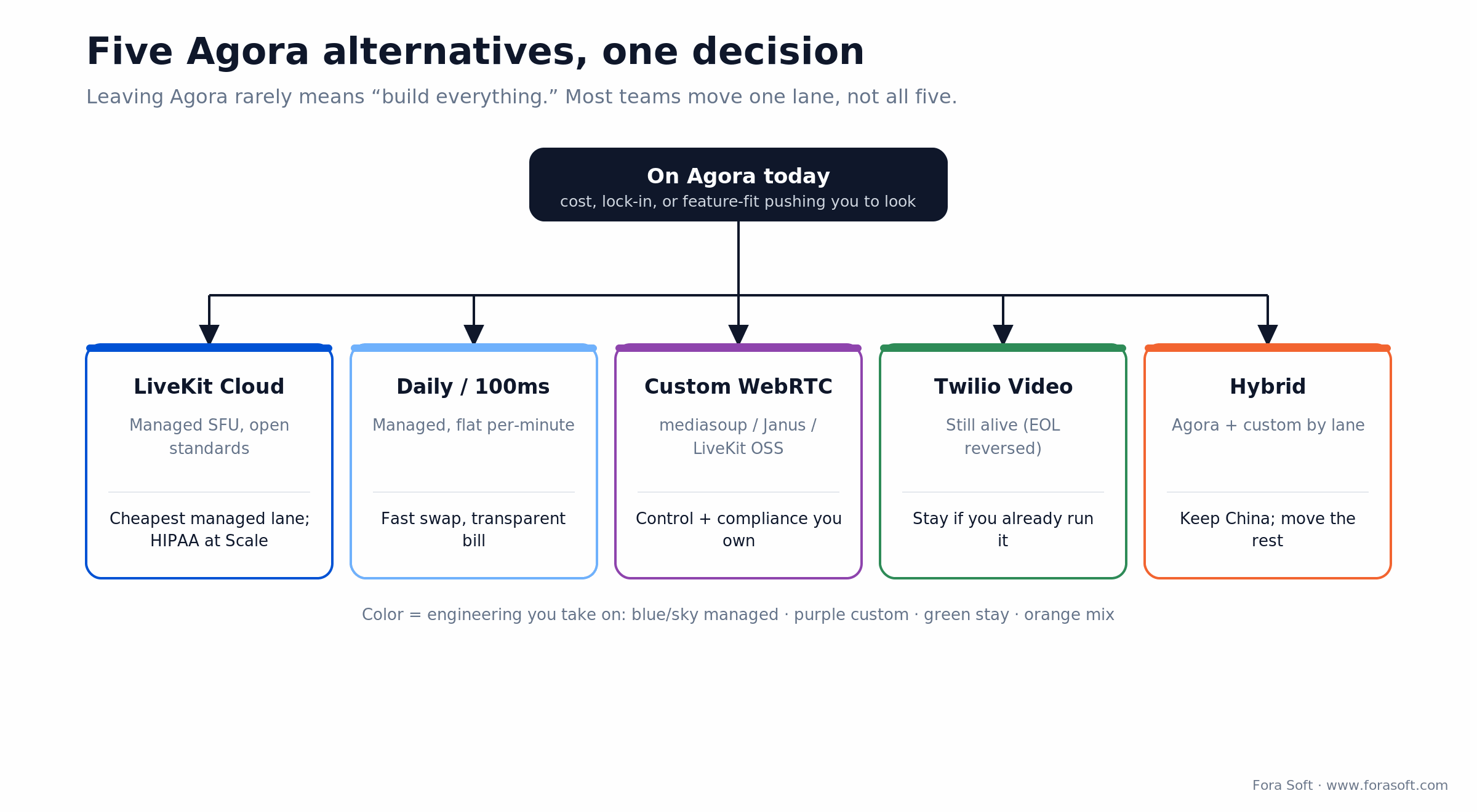
Figure 1. The five realistic moves off Agora. Most teams change one lane, not the whole stack.
One note before the numbers. If your comparison is specifically Agora versus LiveKit on price, we wrote a dedicated cost breakdown: see LiveKit vs Agora: 2026 cost analysis. For the full list of Agora alternatives with 2026 per-minute prices, see our separate guide. This piece is the wider build-vs-buy view.
Agora pricing vs the alternatives in 2026
Start with list prices, then read past them. Per-minute rates dominate the marketing. The hidden costs, meaning recording per gigabyte, messaging, AI add-ons, and regional egress, are what actually double a bill at scale.
| Provider | Audio | HD video | 2026 notes |
|---|---|---|---|
| Agora | $0.99 / 1k min | $3.99 / 1k participant-min | 10k free min/mo shared; Conversational AI Engine $0.10/min after 300 free; recording & RTM billed separately. |
| LiveKit Cloud | included in tier | Ship $50/mo, Scale $500/mo | Scale includes 1.5M participant-min, then $0.0004/min; HIPAA + data residency at Scale. |
| Daily | ~$0.001 / participant-min | $0.004 / participant-min | 10k free min/mo; recording $0.01349/min, HLS $0.03/min — flat and transparent. |
| 100ms | $0.001 / participant-min | $0.004 / participant-min | 10k free conferencing + 10k streaming min/mo; quote-based at scale. |
| Custom SFU (Hetzner-class) | N/A | ~$500–$1,000/mo infra for ~500k min | Included egress, no per-GB tax; you staff the media-ops. |
Two things jump out. Agora’s HD video ($3.99 per 1,000 minutes) and Daily/100ms ($0.004 per minute) are almost the same on paper, so a plain per-minute swap doesn’t save much. The real gap is LiveKit’s tier model: Scale’s 1.5M included minutes mean many teams pay a flat $500/mo where Agora would bill four times that. Verify the live numbers yourself, since Agora’s pricing page and LiveKit’s both change.
Reach for a managed platform when: minute volume is unpredictable, you don’t have a media-ops engineer, and time-to-market beats per-unit cost. That describes most products at launch, and LiveKit is usually the cheapest way to say yes.
The honest crossover: managed, LiveKit, or custom
Does a custom build ever beat managed on cost? Yes, but much later than the “build it and save” crowd claims, and almost never against LiveKit. Plot cost against monthly minutes and the story is clear.

Figure 2. Per-minute managed pricing rises with every minute; LiveKit Scale is a near-flat floor; a custom SFU is a high fixed base that only pays off far to the right.
The per-minute crowd (Agora, Daily, 100ms) climbs in a straight line, roughly $4 per 1,000 HD video minutes. A custom SFU is a high flat line: cheap compute, but ops-dominated. Loaded, a media-ops engineer is $50k–$120k a year, and that salary swamps the server bill. A self-hosted stack runs roughly $60k–$120k all-in in year one, a half-time hire at the low end and a full media-ops engineer at the high end, whether you push 200k minutes or 2M.
Do the arithmetic at 500k HD video minutes a month. Agora video: 500,000 × $3.99 / 1,000 = about $2,000/mo before recording and AI add-ons, roughly $24k a year. Daily and 100ms land near the same $2,000. LiveKit Scale? Those 500k minutes sit inside its 1.5M-minute allowance, so it’s $500/mo flat, about $6k a year. A custom SFU is still $60k+ a year because the ops salary hasn’t moved. The per-minute lines don’t overtake a fully-staffed custom build (about $120k a year, the flat line in the chart above) until roughly 2.5M minutes a month; a leaner half-time build (~$60k a year) is overtaken sooner, near 1.3M. Either way LiveKit stays well under both.
So the honest read: if you’re leaving Agora to save money, your first stop is LiveKit or Daily, not a data center. Custom earns its keep for control, compliance, and lock-in avoidance, which is exactly what the next three sections are about.
Latency: SD-RTN vs regional WebRTC
Agora’s pitch is its network. SD-RTN is a software-defined real-time network across 200+ data centers with proprietary routing, and Agora claims a median edge latency around 76 ms with a worst case under 400 ms. Read that as a best-case story, not a guarantee. The win shows up on bad networks, not good ones.

Figure 3. Typical vs worst-case glass-to-glass latency. A well-tuned regional WebRTC SFU beats Agora’s median; Agora’s edge is the tail.
A well-engineered custom SFU hits sub-100 ms inside one region and 100–250 ms multi-region. LiveKit Cloud, running standard WebRTC across regions, lands in the same range. So for collaboration, telehealth, or webinars, a custom or LiveKit build matches Agora on felt latency. Where Agora pulls ahead is the tail: users scattered across emerging-market mobile networks, where last-mile routing dominates. That’s a real edge for live shopping and esports with a global consumer base, and mostly irrelevant if your users sit in North America and Europe.
Reach for SD-RTN (Agora) when: your audience is spread across mobile networks in regions where you can’t place your own edge. That’s where Agora’s routing earns its premium instead of just charging for it.
Features: what’s in the box, what you bolt on
Agora’s value is bundling: noise suppression, transcription, and a voice-agent engine ship inside the SDK. The alternatives unbundle that — you pick best-of-breed AI and wire it in. Sometimes that’s more work; often it’s better quality and no per-feature markup.
| Capability | Agora | LiveKit Cloud | Custom WebRTC |
|---|---|---|---|
| AI noise suppression | Built-in | Krisp / AI-coustics | Krisp or open models |
| Real-time transcription | Built-in (premium) | Speechmatics / AssemblyAI / OpenAI | Whisper, vendor-agnostic |
| AI voice agents | Conversational AI Engine, $0.10/min | Native Agents framework | OpenAI / Claude / Gemini SDKs |
| Real-time messaging | Built-in RTM | Data channels | MQTT / Redis / custom |
| Recording & storage | Cloud + on-prem (paid) | Included on Scale | FFmpeg pipeline + S3 |
| Compliance (HIPAA/SOC 2) | Available, premium | Scale tier ($500/mo) | Yours to design |
| Mobile SDKs | Mature, opinionated | Open, well-maintained | libwebrtc + your code |
The pattern: Agora is fastest to a working demo; the open stack is where you control quality and cost of each AI feature. If voice agents are the whole point of your product, compare Agora’s $0.10/min engine against a LiveKit Agents build before you commit. We walk through that math in our LiveKit real-time AI meeting-assistant guide.
Weighing bundled Agora AI against a best-of-breed build?
Tell us the feature — noise suppression, transcription, or a voice agent — and the volume. We’ll price both paths and show you where the quality and cost actually land.
Vendor lock-in: the hidden line item
Agora’s greatest strength and its biggest risk are the same thing: the SDK is opinionated. RTM signaling is proprietary. Token formats are Agora-specific. Native mobile bindings hook into platform code that doesn’t map cleanly to another provider. That’s real switching cost. We scope an Agora→LiveKit migration at 4–8 weeks, and about 3 on simple cases with agent engineering.

Figure 5. What’s Agora-specific (orange, rewrite on exit) versus what’s open WebRTC and moves with you (green).
The portable side is standard WebRTC: JSEP, SDP, ICE/STUN/TURN, the usual codecs, your app and data model. Move those to LiveKit or a self-hosted mediasoup cluster and the client barely notices. We don’t tell founders to architect for a hypothetical migration on day one, because that over-invests. We do push one cheap habit: put a thin signaling interface between your app and the provider. Then swapping the backend is a change, not a rewrite.
Reach for a signaling abstraction when: you’re about to ship a regulated or government-adjacent product on a managed SDK. The day you need to move media in-house, you’ll be glad the client doesn’t care who’s behind the interface.
Compliance and geography, including China 2026
Agora is GDPR-compliant, offers US data residency, and has the strongest mainland-China connectivity story among Western-listed providers. That matters more in 2026: China’s Cybersecurity Law amendment took effect 1 January 2026, adding AI-governance rules, heavier penalties, and broader extraterritorial reach. If you serve mainland China at scale, Agora’s in-country deployment is a genuine differentiator, and often the reason a hybrid stack keeps Agora for that one lane.
For US healthcare and government, LiveKit’s Scale tier ships HIPAA eligibility and regional data residency at $500/mo. Custom WebRTC inherits whatever compliance posture you design, and that’s the right answer when residency rules forbid third-party media servers outright, as they do for parts of defense, classified-adjacent work, and some pharma. You can’t outsource a control you’re legally required to hold.
Reliability and SLAs
Agora publishes 99.9% uptime, and its status history is mostly clean with occasional regional incidents. LiveKit Cloud and Daily run comparable managed-cloud SLAs, on par once you exclude niche regions. There’s no reliability reason to fear a managed alternative over Agora.
Custom WebRTC reliability is bounded by your ops discipline, full stop. A multi-region mediasoup cluster with health checks, region failover, and predictive capacity hits managed-cloud uptime when it’s built by a team that’s done it before. When it isn’t, you learn about failover at 2 a.m. during your launch. The risk-adjusted call for most teams: managed for the first 12–18 months, custom only once minute volume justifies a dedicated media-ops hire.
Side-by-side benchmarks
One table to hold the comparison in your head. Numbers are 2026 list data and typical engagement figures; your mileage varies with cost shape and geography.
| Metric | Agora | LiveKit Cloud | Custom WebRTC |
|---|---|---|---|
| Median edge latency (claim) | ~76 ms | ~100–200 ms | ~100–250 ms |
| Worst-case global | <400 ms (claim) | ~400–600 ms | ~500–800 ms |
| 500k HD min/mo cost | ~$2,000 + add-ons | ~$500 (in Scale allowance) | ~$500–$1k infra + ops |
| China connectivity | In-country deployment | No native presence | Plan and pay for it |
| Lock-in | High (RTM, tokens, SDK) | Low (open standards) | None — you own it |
| Time-to-MVP | ~1–2 weeks | ~2–3 weeks | ~6–10 weeks |
Pick your Agora alternative in five questions
Answer these in order. The first one that gives a hard constraint usually decides it.
1. What’s your monthly minute volume in 12 months? Under 100k — any managed platform wins on total cost. 100k–1.5M — LiveKit Scale is the value sweet spot. Well above that with a predictable shape — custom or hybrid enters the conversation.
2. Where are your users? Heavy mainland-China presence — Agora keeps the cleanest in-country story, so a hybrid may be right. Western markets only — LiveKit, Daily, or custom is fine.
3. What compliance bar applies? HIPAA or SOC 2 — LiveKit Scale or custom on a compliant cloud. Sovereign or residency rules that forbid third-party media — custom on infrastructure you own.
4. How much AI do you need on day one? Turnkey noise suppression and transcription now — Agora or LiveKit Agents. A domain-tuned, bring-your-own model — custom WebRTC plus an open AI stack.
5. How big is your team? Two founders and a contractor — managed, no debate. Five engineers with a media-ops lead — custom or self-hosted LiveKit is reasonable. If nobody owns media-ops, that answer is your answer.
| Your priority | Pick |
|---|---|
| Fastest launch, small team | LiveKit Cloud or Daily |
| Lowest managed bill at scale | LiveKit Scale |
| Mainland-China users | Agora (often hybrid) |
| Sovereign / residency compliance | Custom WebRTC you own |
| Domain-specific AI features | Custom WebRTC + open AI stack |
Migration recipes: LiveKit, custom, and Twilio
Two common exits off Agora, plus the Twilio question. Both Agora exits start the same way, by abstracting the signaling first, and both should run old and new stacks side by side before you cut over.

Figure 4. Two ways off Agora, stage by stage. The signaling rewrite is the hard part in both, so do it first, behind an interface.
Agora → LiveKit (managed to managed). Typically 4–8 weeks, about 3 on simple cases. Hard parts: the signaling rewrite (Agora RTM to LiveKit data channels), token regeneration, and the mobile SDK swap. Run shadow traffic for 2–4 weeks, keep Agora warm as rollback, then ramp.
Agora → custom WebRTC (managed to self-hosted). Typically 8–12 weeks. Stand up mediasoup or Janus on Hetzner, GCP, or AWS; build signaling on WebSocket or MQTT; wire AI (Whisper, Krisp) and recording (FFmpeg + S3); add health checks and region failover. Plan a 4–6-week parallel run before you decommission Agora. If your comparison is really Daily, our Daily.co alternatives guide covers that swap in detail.
What about Twilio? Ignore the old “Twilio Video is dead” headlines. Twilio announced an end-of-life, then reversed it on 21 October 2024. Programmable Video is a supported, standalone product in 2026 with no shutdown date. If you already run Twilio Video, staying put is legitimate. If you want out anyway, our Twilio Video migration guide maps the options.
Reach for a parallel run when: the migration touches paying customers. Cut over a small slice of traffic, watch P99 latency and reconnect rate, then graduate. Never flip the whole base on launch day.
Mini case: a custom WebRTC classroom at 500M+ minutes
Situation. BrainCert set out to build the first WebRTC + HTML5 virtual classroom: no managed SDK, full control of the live-class experience, and a compliance surface (SOC 2, ISO 27001, HIPAA, GDPR, PCI DSS) that a generic platform couldn’t cover out of the box.
What we built. A custom WebRTC stack from the ground up: regional SFU placement, adaptive bitrate, recording, and a signaling layer designed so future backend changes wouldn’t force client rewrites. AI features like transcription and analytics went in through vendor-agnostic services, so the team can swap providers without touching the media path.
Outcome. 500M+ real-time classroom minutes delivered across 10 data centers at 99.995% uptime, 100k+ customers, four Brandon Hall awards, and $3M revenue, on infrastructure the client fully owns. That’s the case for custom when it’s made honestly: not “it’s cheaper,” but “we control the experience, the compliance, and the roadmap.” Read the full BrainCert project page, or book a 30-min review if your numbers look similar.
Five pitfalls we see teams hit
1. Buying on day-one minutes, not year-three minutes. Managed pricing scales with your success. Forecast on the trajectory, then pick the platform whose curve you can live with. That’s usually where LiveKit’s allowance wins.
2. Choosing custom because “it’s cheaper.” Cheaper compute is not cheaper engineering. A media-ops lead is $50k–$120k loaded, and that salary, not the server bill, decides custom’s true cost.
3. Hard-coding to Agora RTM. Wire signaling straight to the provider and the next migration becomes a rewrite. A thin abstraction on day one is a few days of work that saves weeks later.
4. Skipping a load test before launch. Managed or custom, your specific call pattern has a cost and quality curve nobody can predict from a pricing page. Test it on real traffic before the press release.
5. Treating AI features as commodities. Noise suppression and transcription quality swing hard by domain. Medical audio isn’t call-center audio. Benchmark on your own recordings, not the vendor demo.
Reach for a hybrid stack when: different lanes have different needs: Agora for the voice agent shipping in four weeks and the China audience, custom or LiveKit for the high-volume webinar lane. You’re allowed to not pick just one.
KPIs to measure
Quality KPIs. P50 and P99 glass-to-glass latency by region. Audio mean opinion score, target above 4.0 on the 5-point scale. A subjective video-quality score logged after each session.
Business KPIs. All-in cost per minute, meaning the managed bill plus AI add-ons plus storage plus ops, not just the headline rate. Peak concurrent participants. Cost per acquired customer attributable to the call experience.
Reliability KPIs. Uptime against SLA. Reconnect rate per session. Time to recover after a regional incident, which is the number that separates a managed platform from an under-staffed custom build.
When NOT to leave Agora
Honest counter-position: plenty of teams should stay. If your minute volume is under 100k a month, your team is small, your users are scattered across emerging-market mobile, and Agora’s bundled AI matches your shopping list, then stay. The engineering you’d spend rewriting signaling is better spent on product, and the bill isn’t hurting yet.
The conversation only gets interesting when one of those changes: you cross into serious volume, you hire a media-ops engineer, your audience consolidates into regions you can serve yourself, or you need an AI feature Agora doesn’t ship. Until then, a good managed platform, Agora included, is the right amount of engineering. If you want a second opinion on whether you’ve hit that line, our Agora development team will tell you straight.
Want a build-vs-buy verdict on your actual numbers?
We’ll model Agora, LiveKit, Daily, and custom WebRTC against your minute forecast and hand you a written recommendation — not a sales pitch — in a 30-min call.
FAQ
What is the best Agora alternative in 2026?
For most teams, LiveKit Cloud — it’s managed SFU on open standards, with an included-minutes model that’s cheaper than Agora at scale, plus HIPAA and data residency at the Scale tier. Daily and 100ms are strong flat-rate options, and custom WebRTC wins when you need control or compliance you own.
Is Agora cheaper than a custom WebRTC build?
Usually, yes, until very high, steady volume. At 500k HD video minutes a month, Agora runs about $2,000/mo while a custom SFU costs $60k–$120k a year because of the media-ops salary. Custom pays off on control and compliance long before it pays off on raw cost.
Should I switch from Agora to LiveKit?
For new builds in 2026, it’s the default alternative: open standards, an AI-agent framework, transparent pricing, and lower cost at scale. Agora keeps the edge for mainland-China deployment and for teams already deep in its SDKs.
How long does an Agora to LiveKit migration take?
Typically 4–8 weeks for a small-to-mid SaaS — the hard parts are the signaling rewrite (RTM to data channels), token regeneration, and any custom mobile-SDK code. With agent engineering on simpler cases we’ve closed migrations in about 3 weeks.
Did Twilio Programmable Video shut down?
No. Twilio announced an end-of-life, then reversed it on 21 October 2024. Programmable Video is a supported, standalone product in 2026 with no shutdown date, so “migrate off Twilio” is now a choice, not a deadline.
Does Agora work in mainland China without extra setup?
Better than most Western providers: Agora has in-country deployment to satisfy China’s data-localization regime, which the Cybersecurity Law amendment (effective 1 January 2026) reinforced with heavier penalties and broader extraterritorial reach. LiveKit and Daily have no native China presence; custom WebRTC needs a Chinese hosting partner and the overhead that brings.
Is Hetzner safe for production video infrastructure?
For commercial workloads, generally yes — the included-traffic policy is the cost lever. For US healthcare, government, or anything HIPAA or FedRAMP-regulated, use AWS, GCP, Azure, or a sovereign cloud — not because Hetzner is unsafe, but because the compliance attestations don’t match.
How long does a Fora Soft engagement take?
A working pilot on Agora or LiveKit lands in 2–4 weeks; a custom WebRTC SFU pilot in 6–10 weeks via spec-driven agent engineering; a full Agora migration in 4–8 weeks. Bring the scope and we’ll quote it on a call.
What to Read Next
Cost analysis
LiveKit vs Agora: 2026 Cost Analysis
The head-to-head pricing math when your choice is narrowed to these two.
WebRTC
How to Choose a WebRTC Development Company
A 4-step buyer’s playbook for picking a real-time video partner.
Migration
Twilio Video Alternatives in 2026
Options and a migration path now that Twilio Video is staying alive.
Scale
Scale Real-Time Video to 1 Million Viewers
WebRTC, LL-HLS, and MoQ at six- and seven-figure audiences.
Hiring
Hire a WebRTC Company vs Build In-House
A buyer’s guide for streaming and real-time video founders.
Ready to pick your Agora alternative?
Agora is a strong managed platform. LiveKit and Daily are strong managed alternatives, and LiveKit is usually the cheaper one at scale. Custom WebRTC is the right call when control, compliance, or lock-in avoidance drive the decision, not a spreadsheet that pretends ops is free. Twilio Video is still on the table. For most products in 2026 the move is: start managed, keep signaling portable, and change lanes when the numbers, or the compliance map, say so.
The technology choices are well understood. The work is matching them to your minute volume, geography, compliance bar, and team — and that’s the conversation we have with clients on a 30-min scoping call. Bring the constraints; leave with an architecture and a delivery estimate. If you’d rather read first, our custom software development team has shipped every stack in this article.
The book · Volume 3 of 7
Video Streaming: A Complete Guide to Video Delivery: From ABR and CDNs to Players, WebRTC, DRM, and the Economics of Streaming
Leaving Agora, or staying, comes down to latency, lock-in and the per-minute bill, all of which trace back to how your real-time layer is built. Volume 3 covers WebRTC and real-time media, CDN and delivery choices, QoE monitoring and the economics of streaming, the material you need to compare SD-RTN against regional WebRTC on your own numbers. Written by Nikolay Sapunov, CEO at Fora Soft.
Read it on Amazon →Kindle & paperback · Fora Soft Video Engineering Handbook
Talk to a team that ships every stack in this article
Agora-certified, LiveKit-fluent, custom WebRTC for the long tail — 250+ projects since 2005. We don’t favor one; we pick what fits your case.