

Key takeaways
• Successful streaming platform development in 2026 turns on seven levers, not one. Content, monetisation, recommendation, technical quality of experience, platform reach, retention/churn and pricing/bundling. Skip any one of them and the model leaks; no marketing budget closes the gap.
• The market grew up. Premium SVOD churn stabilised at ~4.6 % monthly in 2025, FAST viewing surged 43 % year-on-year, and bundles like Disney+/Hulu/Max hit 80 % three-month retention versus 55 % for standalone services.
• Niche won. Specialty SVOD grew 20–27 % YoY while premium SVOD plateaued. Crunchyroll passed 21 M subscribers in 2026 with over $1 B in annual customer spending; Shudder leads satisfaction surveys; MasterClass and Peloton are profitable franchises — all on focused catalogues, not breadth.
• The classic failures had something in common. Quibi raised $1.75 B and shut in 6 months; CNN+ closed in 30 days; Blockbuster missed the streaming window entirely. None lost on a single metric — they each missed three or more of the seven levers at once.
• Fora Soft has shipped streaming since 2005. We built the Bellicon Smart TV apps for fitness SVOD, the Smart STB IPTV client serving thousands of channels, Smart IPTV across Samsung and LG, and live infrastructure for WorldCast Live. Book a 30-min call →
Why Fora Soft wrote this playbook
Streaming platform development is the field where most of our shipped work lives. Fora Soft has shipped 250+ software projects since 2005 and has touched almost every category in the OTT stack: live broadcast, IPTV, SVOD, FAST, fitness streaming, market-research video and live shopping. Some of the projects we draw on in this playbook: Bellicon Smart TV (fitness SVOD on Apple tvOS and Android TV, 530+ workout videos), Smart STB IPTV (10-foot IPTV across thousands of live channels), Smart IPTV (one of the most widely installed third-party IPTV clients on Samsung and LG), WorldCast Live for global live streaming, Sprii on the live-shopping side, and Franchise Record Pool in audio.
We also hold a 100 % project success score on Upwork with engineers selected at a 1-in-50 rate. Across these builds we have watched product-market fit appear and disappear in every category — this article is a digest of what actually separates winners from losers.
Use the table of contents on the right to jump straight to the question you came to answer.
Building or fixing a streaming service?
Tell us your category, audience, monetisation and platform mix. Within one working day we will come back with a target architecture, a launch sequence and an honest estimate.
The 2026 streaming market in one snapshot
Three numbers describe the state of the industry. Premium SVOD churn stabilised at roughly 4.6 % per month in 2025 (Antenna) — the first time since 2020 the curve flattened. FAST viewing surged 43 % year-on-year, and close to half of US households now watch FAST regularly (Comscore, 2025). US connected-TV ad spend hit about $33 B in 2025, up 16 % year-on-year and tracking toward ~$38 B in 2026.
Underneath those headline numbers, three structural shifts changed the rules of the game.
Bundling beats standalone. The Disney+/Hulu/Max bundle achieved 80 % three-month retention versus 55 % for standalone services; Disney’s full Hulu integration by 2026 targets $3 B in tech and admin savings. Standalone SVOD as a launch strategy is now actively risky.
Specialty grew while premium plateaued. Specialty SVOD — Crunchyroll, Shudder, Hayu, MasterClass, DAZN, Peloton — grew 20–27 % YoY. Premium SVOD subscriber numbers stalled in mature markets; the only growth came from ad tiers and password-sharing crackdowns.
Ad tiers crossed the chasm. Netflix’s ad tier reached 190 M monthly active viewers by late 2025 under a new reach metric — on the older monthly-active-users basis it was 94 M in mid-2025, up from 70 M six months earlier — and in the US 45 % of Netflix households now sit on the ad tier. Disney+, Max and Paramount+ all run hybrid models. The pure premium-SVOD pitch is essentially dead for new entrants.
Reach for an ad-supported tier when: you are launching after 2024 in a developed market. Single-tier premium SVOD has become the streaming equivalent of trying to sell a phone with no ads option in 2010 — technically defensible, structurally lonely.
Why some services thrive and others quietly fold
The Quibi, CNN+, SeeSo and Blockbuster Streaming stories all read the same way in retrospect: a single failure mode is rarely the cause — the company missed several levers at once.
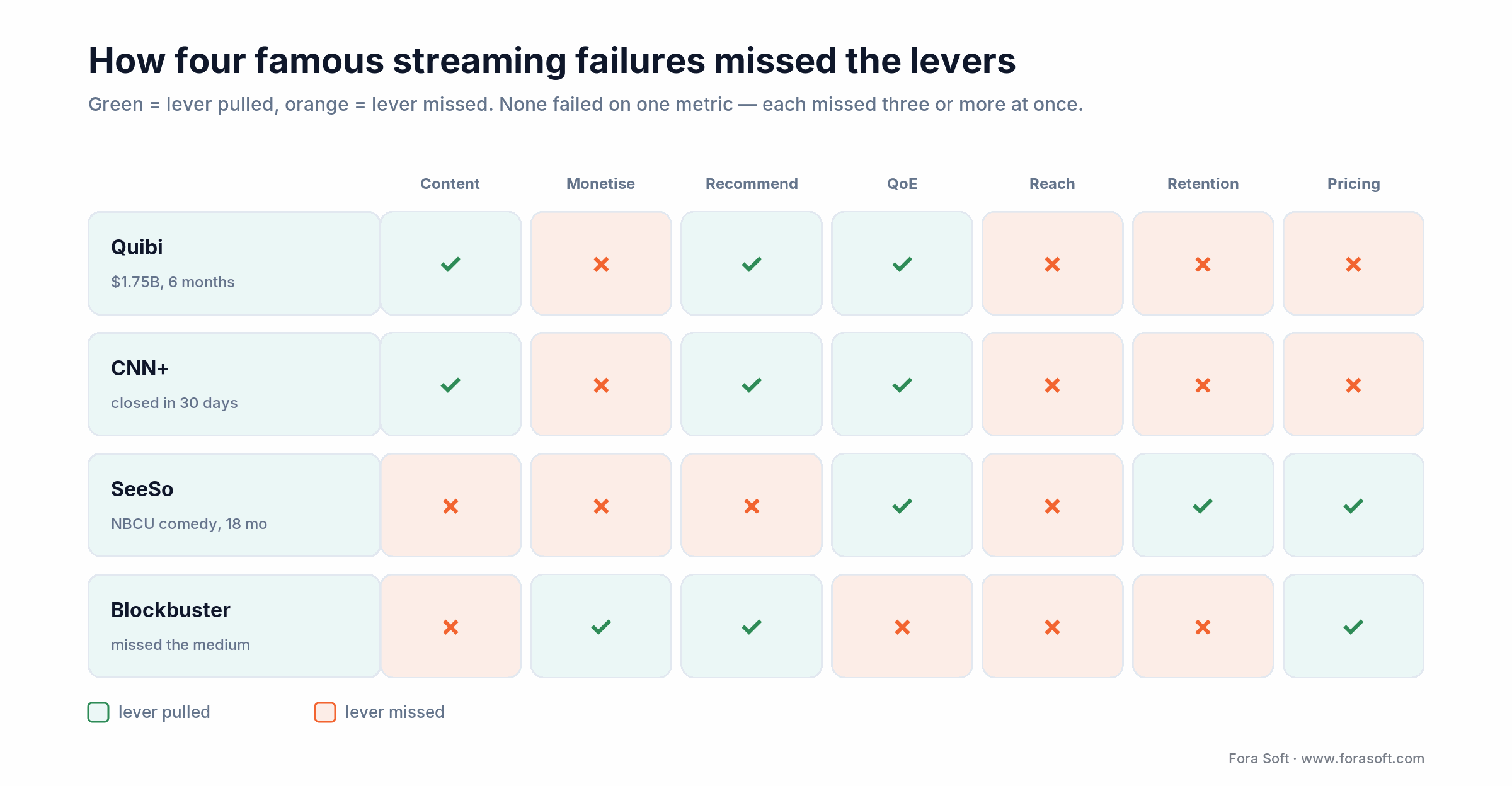
Figure 2. None of the four famous failures lost on a single metric — each missed three or more of the seven levers at once.
Quibi ($1.75 B raised, shut in 6 months). Mobile-only short-form launched at the height of COVID lockdowns. Misread the audience (millennials watch on TV, not phones), priced premium without premium scarcity, blocked sharing on social and starved organic growth. Three or four levers missed simultaneously.
CNN+ (closed in 30 days). News behind a paywall fighting free CNN.com and YouTube. Launched into a market that already discounted news content. Brand was strong; positioning was confused.
SeeSo (1.5 years). NBCUniversal’s comedy SVOD — thin catalogue, no exclusive marquee shows, no FAST tier. Lost the long tail to YouTube and the head to Netflix.
Blockbuster (the slow death). Built brand and physical distribution around an obsolete delivery model and refused to cannibalise it. The textbook case for why platform reach matters more than legacy assets.
By contrast, the recoveries are equally instructive. Netflix rebuilt growth in 2024 with a paid password-sharing crackdown plus a $6.99 ad tier — nine million net adds in Q1 2024 alone, operating margin to 28 %. Disney+ reset its trajectory with the Disney+/Hulu/Max bundle, trading subscriber growth for retention. Crunchyroll turned anime fandom into a 21 M-subscriber business (2026) with over $1 B in annual customer spending and a churn rate competitive with Netflix despite a 100× smaller catalogue.
The seven levers that decide everything
Every successful streaming service we have built or studied pulls all seven of the levers below. The diagram is the cheat sheet; the sections that follow unpack each lever with concrete metrics.
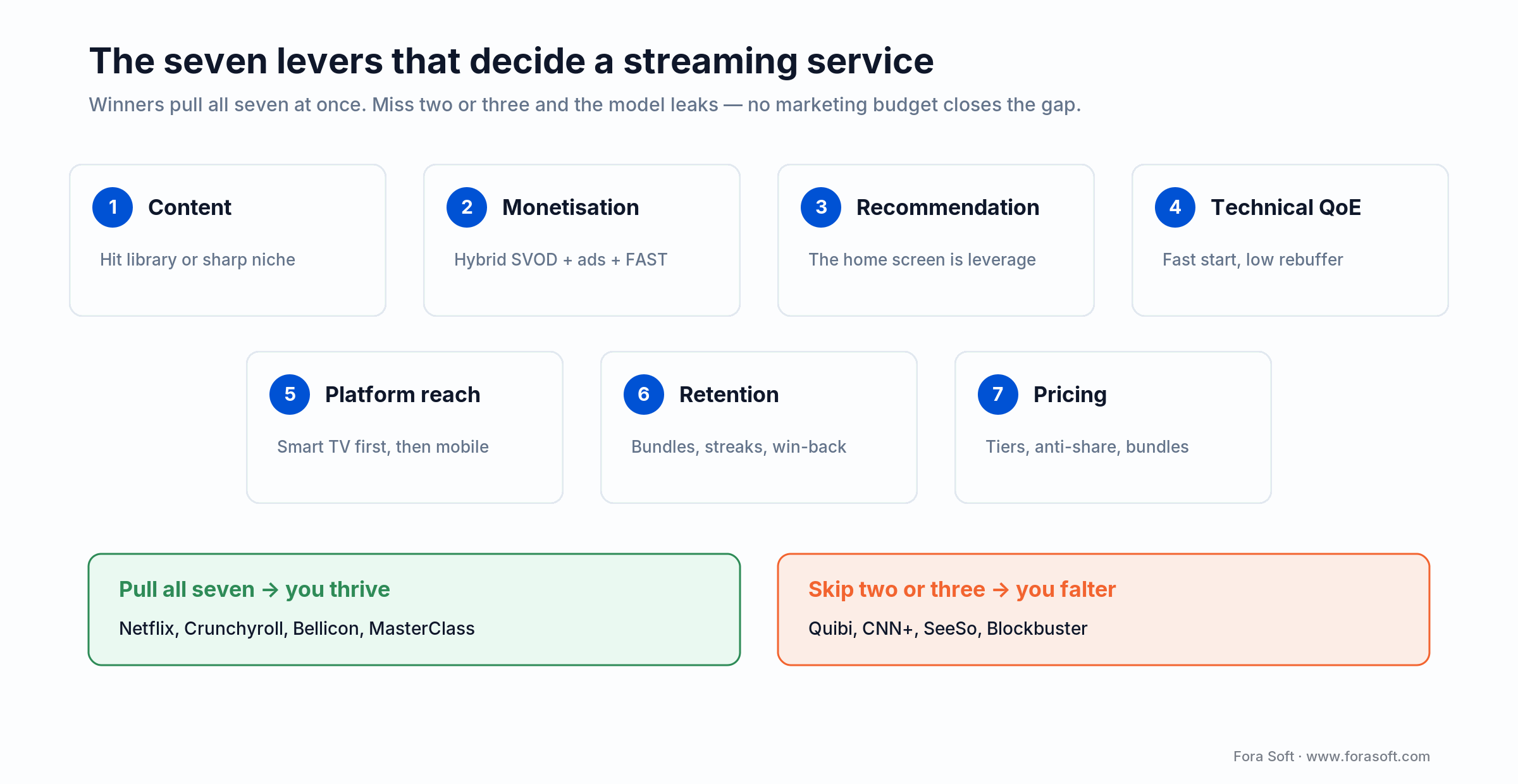
Figure 1. Pull all seven levers and you become Netflix or Crunchyroll. Skip two or three and you become Quibi or CNN+.
1. Content strategy
Either unbeatable hits plus a deep library (Netflix), or a curated niche so focused that nobody else can match it (Crunchyroll, Shudder, MasterClass). Generic mid-tier libraries die fastest.
2. Monetisation model
Hybrid SVOD + AVOD, with a FAST tier where it makes sense. Bundles outperform standalone on retention. Pricing wars erode ARPU; bundle lock-in protects it.
3. Recommendation engine
For scale players, collaborative filtering plus LLM-driven personalisation. For niche services, content-based recommendations on rich metadata work better. Either way, the home screen is the highest-impact surface in the product.
4. Technical quality of experience (QoE)
Cold-start under 2 seconds, rebuffer ratio under 0.5 %, 4K HDR available where the licence allows. Multi-CDN, AV1/HEVC encoding, LL-HLS / CMAF for live, real-time QoE monitoring (Conviva, Mux). Bad QoE drives churn more aggressively than most teams admit.
5. Platform reach
Smart TV first. ~85 % of ad-supported OTT revenue originates on connected TV; 54 % of CTV users by 2026 will watch FAST. Mobile-first streaming launches die in the living room. We covered the platform map in our recent Smart TV app dev companies playbook.
6. Retention and churn management
Bundle stickiness, watch streaks, intelligent pause/resume, win-back flows, and pricing experiments. Specialty SVOD churn averages 6.6 % per month; premium SVOD ~4.6 %; bundles cut both by ~20 %.
7. Pricing and bundling
Tiered pricing (ad / standard / premium / family), anti-share controls (Netflix’s paid sharing), partner bundles (Disney+/Hulu/Max, Apple One), regional pricing. Pricing is a product surface, not a back-office number.
Reach for a niche/specialty positioning when: you do not have $5 B/yr in content budget. The ultra-focused catalogues (anime, horror, fitness, education, sports, reality) routinely beat generic mid-tier services on retention and pricing power.
Benchmarks worth committing to in 2026
| Metric | Premium SVOD | Specialty SVOD | Notes |
|---|---|---|---|
| Monthly churn | ~4.6 % | ~6.6 % | Bundles cut both by 20 %. |
| ARPU (US) | $10–17 | $8–12 | Niche services punch above weight. |
| Cold-start to home | <2 s | <2.5 s | CTV minimum bar. |
| Time-to-first-frame (VOD) | <1.5 s | <2 s | Multi-CDN + ABR. |
| Live latency (LL-HLS / CMAF) | <4 s | <6 s | Sports demand <3 s. |
| Content as % of revenue | 40–60 % | 25–45 % | Tech 5–15 %, marketing 10–25 %. |
Build vs buy — the realistic options
Streaming platform development splits into two realistic paths for new entrants: a white-label OTT vendor (the fastest route) or a custom build (the most control). Both are valid; pick by ambition and time horizon. Our video streaming development team has shipped all three.
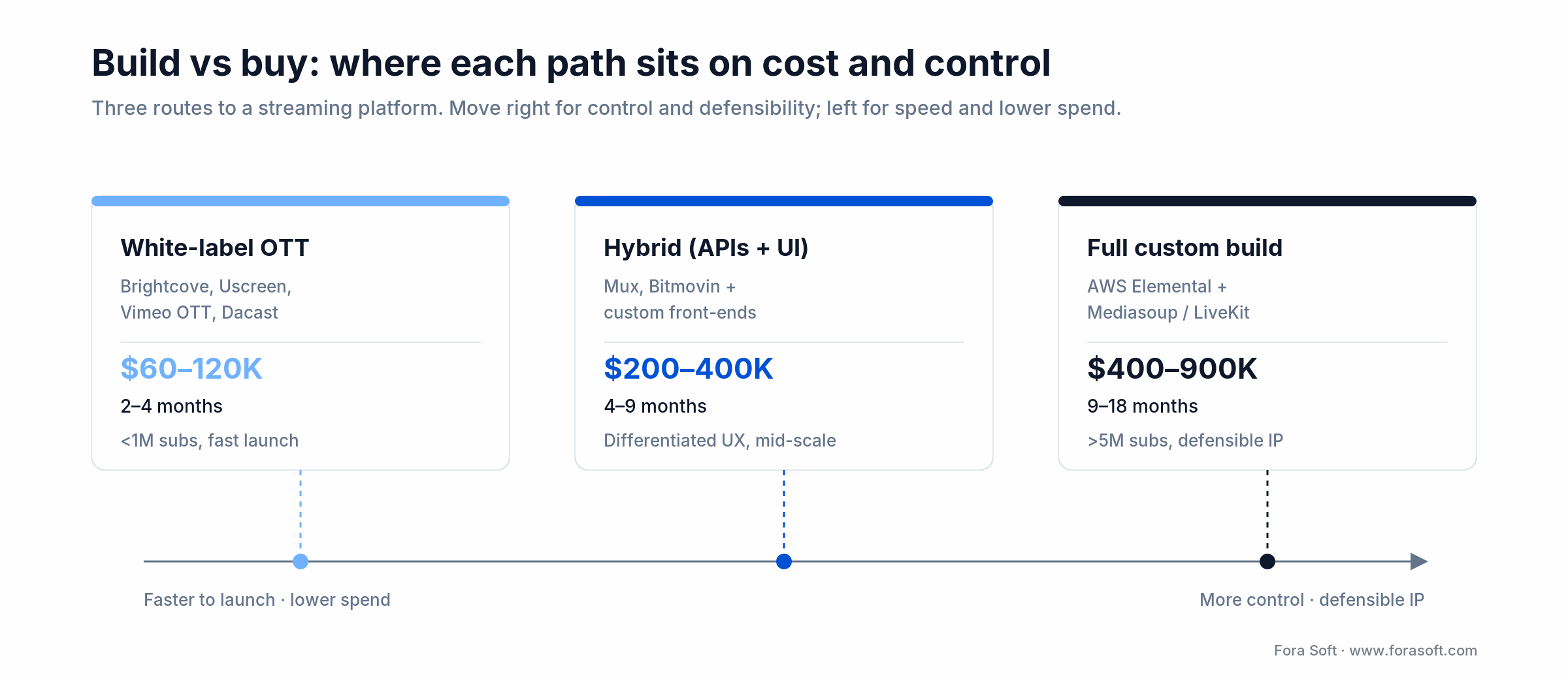
Figure 3. Where each streaming platform development path sits on the cost-versus-control spectrum.
| Path | Examples | Best for | Time to ship | Watch out for |
|---|---|---|---|---|
| White-label OTT | Brightcove, Vimeo OTT, Uscreen, Dacast, Kaltura, JW Player, Wowza Cloud | <1M subs, fast launch | 2–4 months | Limited UX control, vendor lock-in |
| Hybrid (managed APIs + custom UI) | Mux + Backstage UI, Bitmovin + custom front-ends | Differentiated UX, mid-scale | 4–6 months | Spread of vendor risk |
| Full custom build | AWS Elemental + Mediasoup/LiveKit + custom apps | >5M subs, IP-defensible | 9–18 months | Real engineering org needed |
Need a streaming partner who has shipped on every Smart TV and IPTV stack?
From Bellicon Smart TV fitness SVOD to Smart STB IPTV serving thousands of channels, we have built the apps and the infrastructure that streaming services live on. We will tell you whether to buy white-label, hybrid or custom.
A realistic cost model — what a streaming launch costs in 2026
The numbers below are starting points from real Fora Soft engagements; they assume our agent-engineering workflow, which has trimmed our typical timelines by roughly 25–35 % versus 2024 baselines. Treat them as a sanity check, not a quote.
| Scenario | Approach | Engineering | Time to ship |
|---|---|---|---|
| Niche SVOD MVP, 2 platforms | White-label + custom UI | ~$60–120 K | 3–5 months |
| Multi-platform SVOD with FAST tier | Hybrid managed APIs | ~$200–400 K | 5–9 months |
| Live sports / events platform | LL-HLS + multi-CDN | ~$220–450 K | 5–9 months |
| Full custom OTT (defensible IP) | AWS Elemental + custom apps | ~$400–900 K | 9–18 months |
Mini case: Bellicon, Smart STB IPTV and Smart IPTV
Three Fora Soft streaming projects illustrate three different lever combinations.
Bellicon Smart TV apps — niche SVOD on the right platforms. A premium fitness brand with 530+ workout videos, custom plans across weight/height/age/special needs, English and German. We shipped on Apple tvOS and Android TV first because that is where Bellicon’s premium audience lives. Levers: focused content (1), premium pricing (7), Smart TV reach (5), polished QoE (4). The product still grows by word of mouth in the trampoline community.
Smart STB IPTV — broad reach with operator-grade UX. A 10-foot client serving thousands of live channels through a single grid. Levers: monetisation flexibility (2), platform breadth (5), QoE on cheap hardware (4). The lesson is that scale-out streaming products live or die on disciplined engineering for low-end TVs, not flagship phones.
Smart IPTV — long-tail platform reach. One of the most widely installed third-party IPTV clients on Samsung and LG TVs. Levers: platform reach (5), monetisation flexibility (2), retention through habit (6). It is a useful counterpoint to the “you must build a brand-new app” instinct — sometimes a great client across millions of TVs beats yet another SVOD sign-up. Want a similar analysis of where your service stacks up across the seven levers? Book a 30-min discovery call →
A decision framework — pick the right path in five questions
Q1. Generic or niche? Without a $5 B+ content budget, niche wins. Pick the single audience you can serve better than anyone else.
Q2. SVOD, AVOD, FAST or hybrid? In 2026 the answer is almost always hybrid. SVOD-only launches without an ad tier are leaving 30 %+ of the addressable audience untouched.
Q3. Which platforms? Smart TV (Apple tvOS + Android TV + Tizen + webOS) plus mobile and web. Roku and Fire TV for US-heavy products. HbbTV for European broadcasters.
Q4. White-label, hybrid or full custom? <1 M sub ambition → white-label. Differentiated UX with mid-scale → hybrid (managed APIs + custom UI). Defensible IP, >5 M subs → full custom.
Q5. What is your retention strategy? Bundles (with a partner), engagement loops (streaks, recommendations), pause/resume, win-back flows. Plan day one, not at year two.
Five pitfalls we see every quarter
1. Thin catalogue, broad ambition. Trying to be Netflix without 10,000 hours of premium content. Either go niche or partner for library; never both half-heartedly.
2. Skipping Smart TV. Mobile-first launches consistently underperform on session length and retention. ~85 % of ad-OTT revenue lives in the living room.
3. Improvised ad insertion. Client-side VAST without SSAI yields IVT, low CPMs and fragile ad delivery. Premium FAST CPMs require server-side insertion.
4. No QoE monitoring. Without Conviva, Mux or equivalent you cannot tell why churn is rising; QoE issues compound.
5. Premature international expansion. Localisation, content licensing and CDN topology each add 10–20 % to cost. Earn the right to expand by saturating one market first.
Reach for SSAI when: ads are part of your monetisation, your audience is on Android TV and Smart TVs (where adblockers exist), or you cannot afford ad-fraud noise in your reporting. Client-side VAST is acceptable only for very small AVOD pilots.
Where streaming dollars actually go
Content amortisation: 40–60 % of revenue. Originals amortise over roughly four years (with 90 % of cost recognised by year 4); licensed content over the licence term. This is the single largest line and the lever that breaks most underfunded services.
Technology and infrastructure: 5–15 %. CDN, encoding, DRM, monitoring, application engineering. Multi-CDN strategies and AV1 encoding can reduce this 10–20 % within the first year.
Marketing: 10–25 %. Customer acquisition is brutal in saturated markets; bundles cut effective CAC by sharing it across two or three services.
Platform fees: 15–30 % of payment volume. Apple IAP on tvOS and iOS, Google Play, Smart TV manufacturer fees where applicable. The same product on web checkout is materially more profitable; route signup off-platform where you can.
KPIs — what to actually measure
Engagement KPIs. Daily active TVs, weekly retention by cohort, average watch time per active user (target +50 % on TV vs mobile), share of catalogue watched (target >15 % in 90 days for a healthy catalogue).
Monetisation KPIs. ARPU per tier, ad CPM by inventory class (target $5–8 for premium AVOD), trial-to-paid conversion (target +5 % YoY), lifetime value (target 3–5× CAC, 6–8× for bundled products).
Quality KPIs. Cold-start time per platform (target <2 s), rebuffer ratio (target <0.5 %), playback failure rate (target <1 %), DRM licence acquisition success (target >99.9 %), monthly churn (target <5 % premium, <7 % specialty).
When you should not launch a streaming service
Three situations where we have advised pausing. You do not own a community. The winners of the last five years (Crunchyroll, Peloton, MasterClass, Shudder) had a community before they had a streaming app. Without one, customer acquisition cost will eat the unit economics. Your catalogue is undifferentiated. If a Netflix subscriber would not switch, why would anyone buy your service? Sharpen the catalogue first. You cannot fund Smart TV. Mobile-only streaming services in 2026 are operationally precarious; if Smart TV is out of scope, reconsider whether to launch at all.
There is also a softer failure mode: going hybrid before you have proven SVOD. Adding ads, FAST and partner bundles to an already-leaky core does not fix the leak; it just spreads it.
Niche streaming patterns — how the small services keep winning
If you cannot outspend Netflix, you have to out-focus it. The pattern is consistent across the best-performing specialty services in 2026.
Crunchyroll turned anime fandom into 21 M subscribers (2026) and over $1 B in annual customer spending. Catalogue depth in one genre, not breadth across many. Shudder ranks #1 in 2026 customer-satisfaction surveys for streaming because horror fans get exactly what they want and nothing they do not. MasterClass built a premium-priced education franchise on talent exclusivity that no general SVOD can replicate. Peloton turned fitness video into a hardware-and-subscription compound, with completion-rate metrics no competitor matches.
The lesson for new entrants: pick the audience you can serve unfairly well, build the product around them, and expand only after you dominate the niche.
Reach for a hybrid live + VOD architecture when: your category mixes scheduled events with on-demand catalogue (sports, fitness classes, news, education). Pure VOD or pure live products are easier to ship; the hybrid combination is where engagement and ARPU lift.
Streaming tech, demystified
A serviceable streaming stack in 2026 looks like this. Encode in H.264 for legacy compatibility, H.265/HEVC for premium catalogues, AV1 where bandwidth savings of 30–50 % justify the encode cost (~13 % of developers in Bitmovin’s 2024–25 survey, growing fast). Package once with Bento4 or Shaka into HLS (near-universal, required on Apple) and DASH (Android, web, PlayReady devices); add LL-HLS / CMAF for live. Apply Widevine L1 DRM on Android, Tizen, webOS; FairPlay on tvOS; PlayReady where Microsoft-aligned.
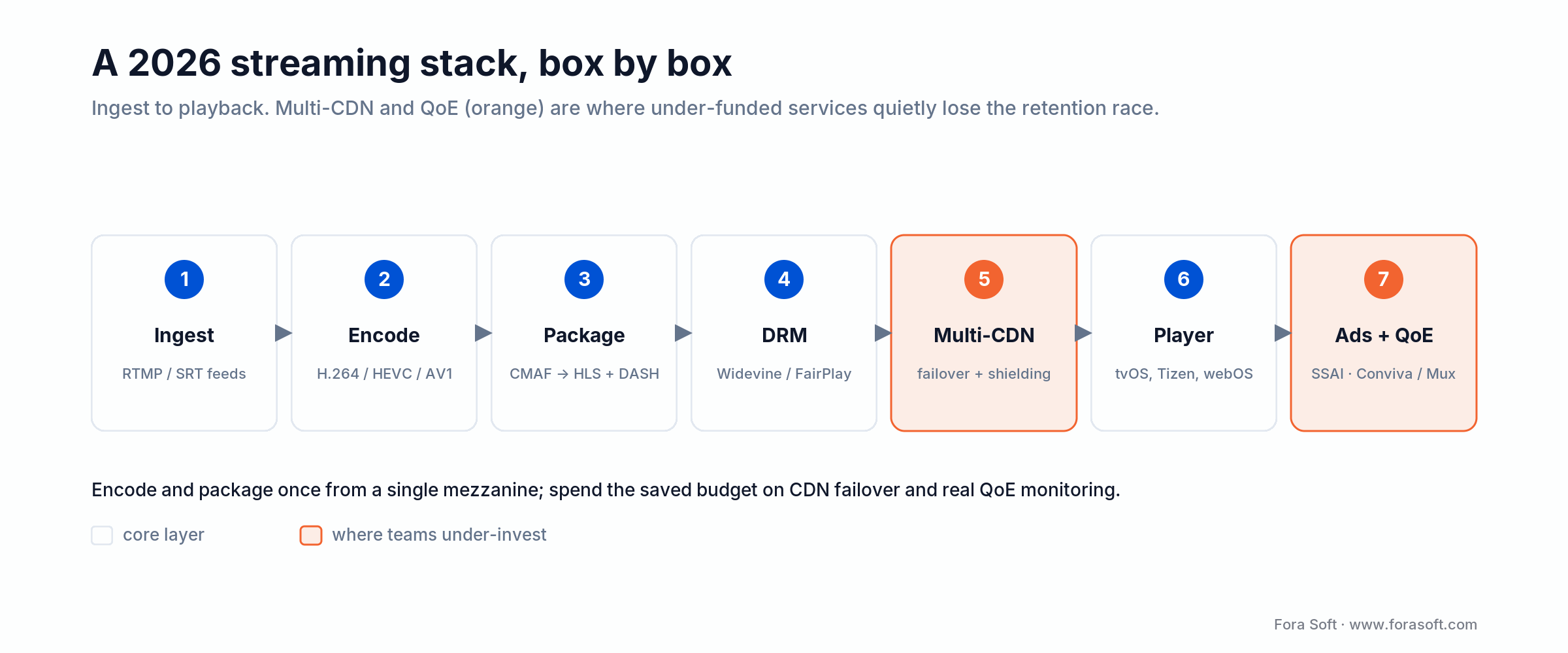
Figure 4. A 2026 streaming stack, box by box — multi-CDN and QoE are where under-funded services lose the retention race.
Deliver via a multi-CDN (CloudFront, Cloudflare Stream, Akamai, Fastly) with origin failover; this routinely cuts rebuffering 15–20 % versus a single CDN and adds origin and edge failover, and is mandatory for global launches. Insert ads server-side via VAST / VMAP for AVOD/FAST; instrument every session with Conviva or Mux for QoE monitoring. The same family of streaming concerns surfaces in our coverage of live streaming security.
For recommendation, scale players run collaborative filtering plus increasingly LLM-driven personalisation. Niche services often do better with content-based recommendations on rich metadata — cheaper, more explainable, and more aligned with how passionate audiences actually browse. For the full box-by-box breakdown of the platform layer, see our OTT video platform engineering hub.
2026–2027 trends to watch
AI-driven content commissioning. Predictive greenlighting based on audience-engagement modelling rather than gut. Expect studio rounds of layoffs as the workflow matures.
Generative thumbnails and trailers. Per-user creative assets, A/B tested in real time. Lift on click-through rate is in the 5–15 % range in early pilots.
FAST consolidation. Hundreds of FAST channels collapsing into a few mega-platforms (Tubi, Pluto, Roku Channel, Samsung TV Plus, LG Channels). Independent FAST plays become harder.
Sports rights inflation. NBA, NFL, EPL, Champions League rights pushing $10 B+ deals. Linear-TV decline accelerates the squeeze on sports-only services like DAZN.
NextGen TV (ATSC 3.0). Hybrid broadcast-IP delivery rolling out across the US through 2025–2027; the line between broadcaster and OTT continues to blur.
Vertical strategies — what good looks like by category
Live sports. LL-HLS / CMAF, multi-CDN with peering into ISPs, redundant origin, multi-cam with personalised camera selection, betting overlays where regulated. Rights inflation makes pure-sports SVOD increasingly fragile; hybrid live + VOD with FAST highlights tier is the safer model.
Fitness and wellness. Smart TV first, mobile companion second, optional hardware (Peloton, Bellicon trampoline) third. Class-based engagement loops outperform passive-watch loops on retention by a wide margin.
EdTech and certification. Long-form lecture, rich transcripts, search-driven discovery, completion certificates and progress dashboards. Premium pricing tolerates higher CAC if LTV is multi-year.
Live shopping and commerce video. Hybrid streaming + commerce stack. Latency, checkout integration and inventory sync matter more than catalogue size. We have shipped this end-to-end on Sprii.
FAQ
Why did Quibi fail despite raising $1.75 B?
Quibi missed several of the seven levers at once. Mobile-only launch during COVID lockdowns destroyed the commute use case; short-form premium pricing fought free YouTube/TikTok content; no social sharing throttled organic growth; no Smart TV reach kept the audience fragmented. Capital cannot fix product-market fit.
Is SVOD-only still viable in 2026?
For a premium niche service with a passionate community (Crunchyroll, MasterClass, Peloton), yes. For a generalist service launching after 2024, almost never — an ad tier or FAST adjunct is needed to reach the price-sensitive cohort and to monetise inventory the SVOD tier cannot.
What is a healthy churn rate for a streaming service?
Premium SVOD averaged ~4.6 % per month in 2025; specialty SVOD ~6.6 %; bundled products like Disney+/Hulu/Max cut both by roughly 20 %. New entrants should target premium-SVOD churn within 12 months and bundle-grade churn within 24.
What does it cost to launch a streaming platform in 2026?
A niche SVOD MVP on two platforms (white-label + custom UI) lands at $60–120 K, 3–5 months. A multi-platform SVOD with a FAST tier on hybrid managed APIs lands at $200–400 K, 5–9 months. A defensible custom OTT build runs $400–900 K, 9–18 months. These ranges assume our agent-engineering workflow and a competent specialist team.
Should I build on a white-label platform or custom?
Below ~1 M subscribers, white-label (Brightcove, Vimeo OTT, Uscreen, Dacast, Kaltura, JW Player, Wowza) is usually cheaper end-to-end. From 1–5 M, hybrid (managed APIs plus custom UI) gives you brand control without rebuilding video tech. Above ~5 M or where IP defensibility matters, full custom on AWS Elemental, Mediasoup or LiveKit is the right answer.
How important is FAST in 2026?
For ad-supported business models, very. FAST viewing surged 43 % YoY; close to half of US households watch FAST regularly; 54 % of CTV users by 2026 will use a FAST service. For premium-only SVOD niches with a tight community (anime, fitness), FAST is optional — for everyone else it is the default ad-monetisation surface.
Why does Smart TV matter so much?
Roughly 85 % of ad-supported OTT revenue originates on connected TV, and watch time per session is 1.5–3× mobile. Apps for Apple tvOS, Android TV / Google TV, Samsung Tizen and LG webOS are non-negotiable for any product whose monetisation depends on session length. We covered the platform decision in our Smart TV app dev companies playbook.
How long does a Fora Soft streaming build typically take?
An MVP on a white-label backend with custom UI on two platforms ships in 3–5 months. A full multi-platform SVOD with FAST tier runs 5–9 months. Live sports adds 1–2 months for low-latency and redundancy. A full custom OTT for a defensible IP product runs 9–18 months. Our agent-engineering workflow has trimmed all of those by roughly 25–35 % versus 2024 baselines.
What to read next
Platforms
Why Smart TV app dev companies are essential
The companion playbook: which Smart TV platforms to ship to, and why most teams fail.
Monetisation
Monetisation strategies for streaming platforms
SVOD, AVOD, FAST, hybrid — how to pick the model that matches your audience.
Security
Security considerations for live streaming
DRM, TLS, signal protection — what every streaming product owner must understand.
UX
Streaming app UX best practices
10-foot UI, focus management, recommendation surfaces and the patterns that drive watch time.
Case study
Bellicon Smart TV apps
A 530-video fitness SVOD on Apple tvOS and Android TV with custom plans and bilingual UX.
Ready to ship a streaming service that thrives?
The streaming services that thrive in 2026 pull all seven levers at once: focused content, hybrid monetisation, sharp recommendation, premium QoE, full Smart TV reach, disciplined retention and intelligent pricing. The ones that falter miss several at once — never one. Quibi misread mobile and timing; CNN+ misread positioning and reach; SeeSo misread catalogue and reach; Blockbuster misread the medium itself.
Pick the lever combination that matches your category. Niche SVOD plus Smart TV plus tight community (Crunchyroll, Bellicon, MasterClass). Hybrid SVOD + FAST plus deep library (Disney, Max, Paramount). Live sports plus low-latency tech plus a passionate audience (DAZN, ESPN+). White-label, hybrid or full custom — pick the path that matches your ambition. Either way, design the seven levers in from sprint one; do not retrofit them.
Let’s scope your streaming product
A 30-minute call covers your category, audience, monetisation, platform mix and ambition. You leave with an honest readout on the seven levers and a clear recommendation on what to build first.

