

Key takeaways
• Pick the model from the content shape, not the other way around. Evergreen scripted → SVOD. Disposable or UGC → AVOD. Unique live events → PPV. Licensed archive at 10M+ MAU → FAST.
• Hybrid wins on LTV. An SVOD with an ad tier plus sponsorship or affiliate revenue routinely lifts LTV 30–50% vs a single-stream service — if you price the ad tier to avoid cannibalising your flagship plan.
• The tech stack changes your unit economics. SSAI lifts ad CPM 2–3x vs client-side ads. DRM opens the door to premium licensing deals. Going web-first, with Stripe at 2.9% fees, beats Apple’s 15–30% for any subscription product you can market without store discovery.
• Watch churn more than growth. Under 2.5% monthly is healthy SVOD. Above 3.5% you need either much higher ARPU or a different model entirely — fitness, sports and niche verticals routinely sit at 4–6% and must plan for it.
• Realistic MVP cost for a monetised streaming platform with Fora Soft: 14–20 weeks and roughly 90–180k USD for web + mobile with a single monetisation path; double-stack hybrid with SSAI and DRM lands closer to 24–32 weeks and 180–320k USD.
Why Fora Soft wrote this monetisation playbook
We build streaming platforms for clients every year — live video, OTT, fitness streaming, edtech, niche VOD. That means we integrate Stripe, Recurly, RevenueCat, Apple and Google in-app purchase, Google Ad Manager, Magnite and FreeWheel, and we ship DRM stacks with Widevine, FairPlay and PlayReady on a routine basis. The numbers in this article come from real platforms we ship, cross-checked against analyst data from Deloitte, Ampere, eMarketer and Parks Associates.
Concrete examples you will see referenced below: Vodeo, a ticket-based TVOD cinema; Tradecaster, a subscription live-trading stream; Bellicon Home, a 530+-workout fitness SVOD; Alve Live and WorldCast Live, live-event platforms; and BrainCert, a B2B2C edtech streaming platform. We use Agent Engineering — engineers paired with AI copilots — so our estimates in this article intentionally sit below typical agency rates.
Planning a streaming platform and want the monetisation modelled first?
Send us your content mix, target ARPU and region. We will come back with a monetisation stack, realistic churn assumptions and a 12–16-week plan.
How to pick a monetisation model in five minutes
Every monetisation decision comes down to three questions about your content. First, is it evergreen or disposable? Second, is it consumed once per user (a movie, a lecture, a live match) or repeatedly (a fitness library, trading insights, a language course)? Third, do you have the scale — tens of thousands of paying users or tens of millions of ad impressions — to make the model work at unit economics that do not require a moonshot content budget?
The shortest possible heuristic: if content is evergreen and users return often, go SVOD. If it is disposable and you can reach tens of millions of viewers, go AVOD or FAST. If it is unique, time-sensitive and loved by a small group willing to pay high prices, go TVOD or PPV. If none of those cleanly fit, go hybrid — most real streaming platforms end there.
Reach for this frame when: you are about to pick an initial pricing model and you keep oscillating between SVOD and AVOD because investors want both growth and margins.
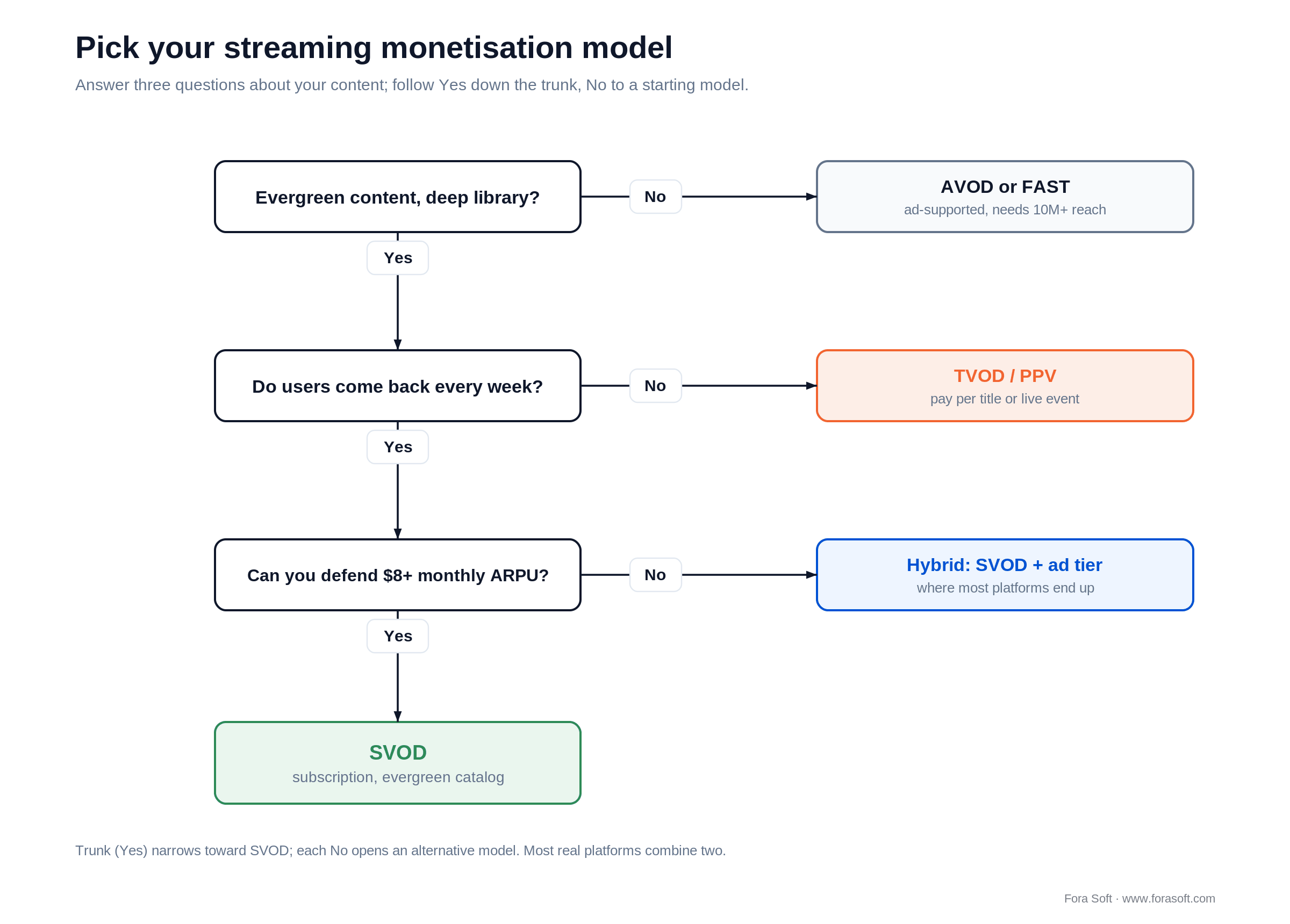
Figure 1. Start from the content, not the pricing page. Three questions route you to a first monetisation model.
Streaming monetisation in 2026 — the market snapshot
Global SVOD revenue lands between roughly $115bn on pure-play estimates (Statista, Ampere) and $181bn on Omdia’s broader 2025 definition that folds in bundled and telco subscriptions — a useful reminder to check what any “SVOD market” figure actually counts. The shape is not in dispute: SVOD is comfortably the largest segment and grows in the high single digits; ad-supported streaming (AVOD) is roughly $40–45bn in 2026 and grows fastest at 15–20% YoY on connected-TV inventory; TVOD is a mature $5–7bn segment; and FAST has climbed from about $6bn in 2025 (Omdia, US-dominated) toward a projected $10–12bn, powered by Pluto TV, Tubi, Roku Channel, Samsung TV Plus and LG Channels.
The strategic story is that every large SVOD has converged on a hybrid: Netflix, Disney+, Max and Prime Video all run an ad tier alongside the flagship plan, and that ad tier is now the volume-growth engine for most of them. Netflix’s ad tier passed 250M global monthly active viewers by May 2026, up from 94M a year earlier, and it now drives the majority of sign-ups in the countries where it runs; Netflix has stopped breaking out subscriber counts, and its blended ARPU sits near $12–13/month. The lesson for a new platform: do not plan as if the market is a one-stream decision. Plan for a two-stream P&L from day one.

Figure 2. SVOD still dwarfs the field in 2026, but AVOD and FAST are the fast-growing money.
SVOD — the baseline subscription model
SVOD — subscription video on demand — is still the default for any platform with evergreen, high-production-value content. You charge a fixed monthly or annual fee, users get unlimited access, you get predictable recurring revenue and good unit economics if you can keep monthly churn under 2.5%. If you’re choosing where to run that catalog, compare Dacast alternatives like Uscreen and Vimeo OTT against a custom build.
Pricing ARPU by region. North America sits around 12–16 USD/month for standalone SVOD; EU plans are commonly €8–12; APAC 5–10 USD; LATAM 7–11 USD. Price too low in a premium market and you leave money on the table; price too high in price-sensitive markets and churn spikes — Netflix’s India increase from ₹199 to ₹249 reportedly drove 2–3 pp extra monthly churn in the following quarters.
Why pick it. Predictable MRR, strong LTV on scripted/documentary/fitness content, and gross margins of 60–70% before content amortisation.
Who runs it. Netflix, Disney+, Max, Apple TV+, Paramount+, Peloton, Apple Fitness+, MasterClass. Our Tradecaster platform runs a tiered SVOD with a free trial; Bellicon Home runs a single-tier fitness subscription.
Limits. Needs a sizeable content library users return to. Needs strong retention mechanics (recommendations, downloads, new content cadence). Content amortisation eats 50–70% of ARPU on premium originals; breakeven per-sub ARPU sits around 8–12 USD/month after fees, so pricing below 7 USD is usually a losing proposition unless you are running on licensed content.
Reach for SVOD when: your content is evergreen, users consume multiple titles per month, and you can defend an ARPU of 8+ USD/month.
AVOD — ad-supported streaming done right
AVOD — ad-supported video on demand — trades subscription revenue for ad revenue. Users watch free, you sell their attention. Done well, AVOD scales to tens of millions of MAU with gross margins in the 50–60% range after ad-tech, delivery and content costs. Done badly, it stalls at sub-1m MAU with unfillable inventory, low CPMs and a rising CDN bill.
CPM math. Standard AVOD CPMs sit at 15–25 USD gross (10–15 USD net after ad-tech take) on premium content, 2–6 USD for generic UGC/long-tail inventory. FAST channel CPMs typically sit 2–5 USD standard, 8–15 USD for sports/live. Fill rate is where AVOD lives or dies: 85+% fill on premium inventory, 60–80% on long-tail, and below 60% the economics collapse.
SSAI vs CSAI is not an engineering detail — it is a P&L line. Server-side ad insertion stitches ads into the live video segment before it leaves your origin, bypassing ad-blockers and raising CPMs 2–3x on comparable inventory. Client-side ad insertion is easier to build but loses a meaningful slice of users to ad-blockers and delivers lower CPMs because advertisers discount for the unreliability. If AVOD is your primary revenue stream, SSAI is not optional.
Reach for AVOD when: you can reach 10M+ MAU within 12–18 months, your content is discoverable (good SEO, YouTube-style graphs) and you are willing to invest in SSAI and a proper ad server from day one.
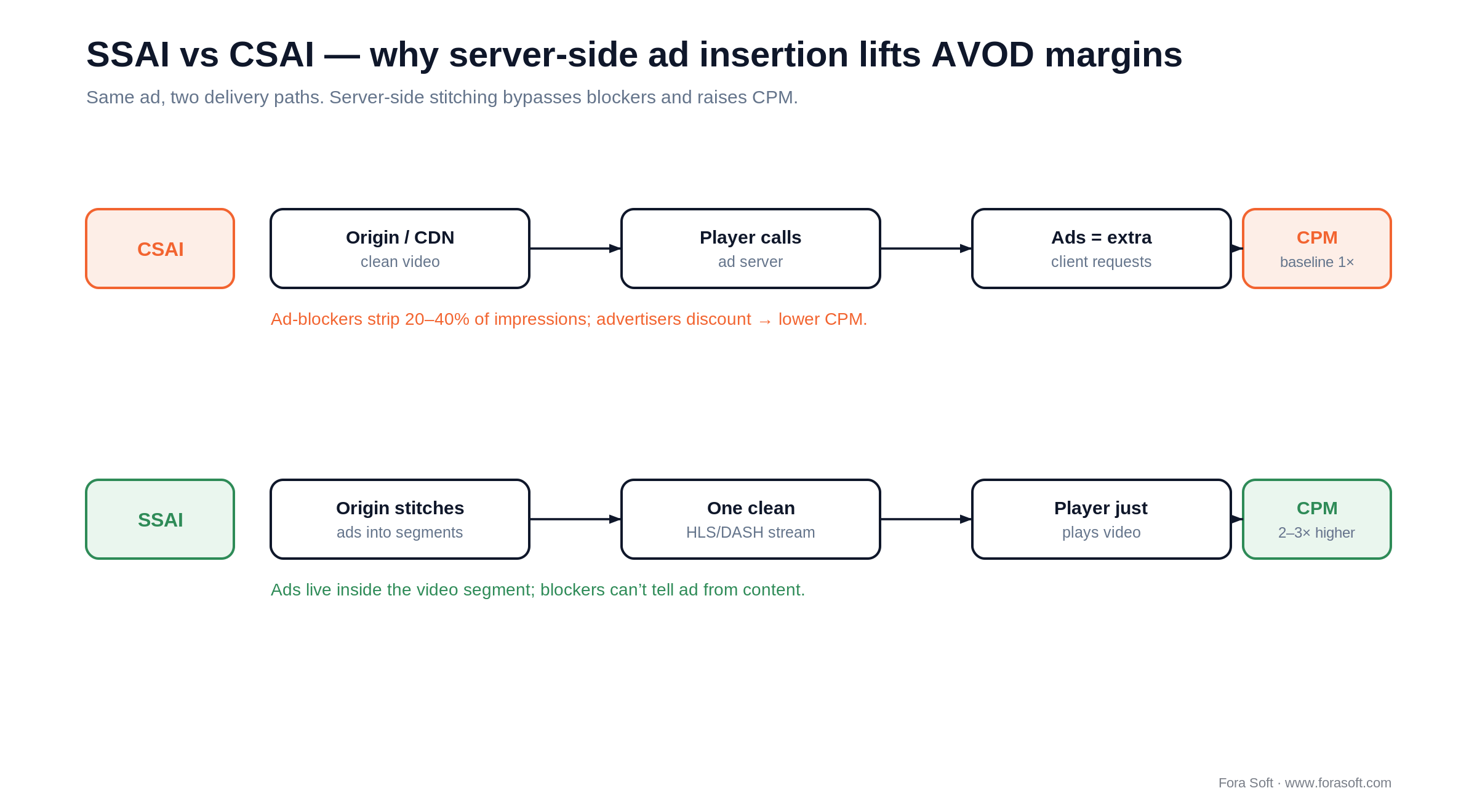
Figure 3. The same ad, two delivery paths. Server-side insertion is the single biggest lever on AVOD margins.
TVOD and PPV — pay per view, pay per event
Transactional video on demand splits into rent (24–48 hour window) and EST (electronic sell-through, permanent ownership). Rentals typically price 3–6 USD; purchases 10–20 USD for catalog and 20–25 USD for new releases. Pay-per-view (PPV) — the live-event cousin of TVOD — ranges from 15–25 USD for a typical concert or comedy special up to 80+ USD for a major boxing fight.
TVOD is the right model when your content is unique and users care about one title, not the library. Our Vodeo platform runs a variant of this: each title is sold as a ticket (0.10 USD) and the ticket grants 24 hours of playback — the cinema model rather than the video-store model. That design beat subscription for Vodeo because audiences were indie-film watchers with a “tonight” mindset, not a binge mindset.
Watch-outs. Payment friction compounds fast — if users have to type a card number for every rental, abandonment jumps. Use stored-payment providers (Stripe with Apple Pay/Google Pay, Adyen, Cleeng) and pre-authorise “one-click” checkouts. Chargebacks on live-event PPV can hit 1–2% if authentication is weak; enforce 3D Secure.
Reach for TVOD/PPV when: your content is unique and time-sensitive (a new release, a title fight, a one-night concert) and a passionate niche will pay 15–80 USD for that single event.
FAST — free ad-supported streaming TV
FAST channels simulate linear TV on connected-TV apps: you program a linear schedule, ads run at fixed breaks, users channel-surf. Pluto TV, Tubi, Roku Channel, Samsung TV Plus and LG Channels together reach hundreds of millions of monthly viewers; Pluto alone runs in the 80M MAU range. FAST is lucrative for operators who already own a large licensed catalog and punitive for anyone who has to license content specifically to fill channels.
For independent streaming platforms, FAST rarely makes sense as the first move. It makes sense as a distribution channel on top of an SVOD/AVOD product — publish a branded FAST channel on Pluto or Roku to acquire users on free-tier attention, then convert them into your on-platform ecosystem. The engineering lift is real: you need 24/7 encoding, solid SSAI, and proper CSAI fallback for older CTV devices.
Reach for FAST when: you already own a large licensed catalog and want free-tier CTV reach on Pluto, Roku or Samsung — not when you must license content just to fill a 24/7 schedule.
Hybrid models — where most platforms actually end up
The dominant model in 2026 is not any single one from the list above — it is a hybrid. Netflix runs SVOD plus an ad tier plus partner bundles. Disney+ runs SVOD plus an ad tier plus bundling with Hulu and ESPN+. Twitch runs subscriptions plus virtual gifts plus ads plus Prime Gaming sub-gifts. Peloton runs subscription plus hardware plus merchandise. Hybrid works because different user segments monetise differently and because you smooth seasonality across revenue streams.
How to avoid cannibalisation. The classic failure is an ad tier so cheap and so light on ads that premium-intent users drop down. Netflix mitigates this with a 4–6 minute/hour ad load on the ad tier, 1080p cap on lower plans and exclusive features (4K HDR, Atmos, four concurrent streams) locked to premium. Your ad tier should be a clearly inferior product at a clearly lower price, not a slightly cheaper clone.
Bundles as a hybrid lever. Bundling works when each bundled service has 30+% standalone willingness-to-pay and the bundle discount is ≤ 25%. Done right it lifts LTV 30–50% and drops churn 20–35% vs standalone. Done wrong (Apple One’s weaker bundles) it simply subsidises low-willingness-to-pay users.
Reach for hybrid when: you serve both premium-intent and price-sensitive viewers, and you can keep the ad tier a clearly inferior product so it adds users without cannibalising premium.
Creator, live and tipping models — virtual gifts, subs, affiliates
If your platform is creator-centric — live streaming, UGC video, podcasting, adult content — you almost certainly need a creator-payout layer on top of the monetisation model. Twitch, Kick, TikTok Live and OnlyFans demonstrate four main revenue streams: monthly creator subscriptions (5–15 USD/month, 50–70% creator share), virtual gifts/bits during live streams (thousands to hundreds of thousands per top creator per month), ad revenue share on replays, and affiliate or sponsor revenue (5–15% platform take).
Building a creator-payout stack is materially harder than a single-party checkout. You need compliant KYC and W-8/W-9 handling at the creator level, tax form issuance, currency conversion, fraud and chargeback handling, and a programmable settlement engine. Stripe Connect and Adyen For Platforms handle the infrastructure; the product decisions are yours.
Building a creator-payout or hybrid monetisation stack?
We ship Stripe Connect flows, SSAI ad pipelines, DRM-protected content and multi-currency billing. Tell us your content and we will sketch the plumbing.
Sponsorship, merchandise and in-app purchases — the secondary stack
Brand sponsorship. Viable once your user base is in the low millions and your content has brand-safe context. Niche streamers (fitness, finance, education, niche sports) typically see sponsor revenue at 5–15% of ARPU once the audience is established. Managing sponsors is editorial work more than engineering work — tag inventory, pacing, reporting dashboards.
Merchandise and in-app purchases. Netflix sells show merchandise; fitness platforms sell meal plans and supplements; edtech platforms sell course add-ons, certificates and 1:1 coaching. The common pattern is that IAPs contribute 5–15% of ARPU and help amortise content production by giving you something to push the audience toward at the moments they are most engaged.
Affiliate/partnership revenue. For niche streamers (travel, finance, fitness), affiliate revenue on third-party gear and services routinely adds 5–10% of ARPU with near-zero incremental engineering cost once the tracking layer is in place.
Monetisation models compared — the single table we keep on a wall
| Model | ARPU | Gross margin | Monthly churn | Scale needed | Best for |
|---|---|---|---|---|---|
| SVOD | $10–18 | 60–70% | 2.0–2.5% | 100k+ paid subs | Scripted, fitness, edtech, documentary |
| SVOD + ad tier | $8–14 avg | 50–65% | 2.3–2.8% | 500k+ total users | Growth-mode SVOD competing on price |
| AVOD | $2–6 (CPM-driven) | 50–60% | n/a (free) | 10M+ MAU | Disposable, UGC, news, catalog long-tail |
| FAST | $2–5 CPM | 50+% | n/a (free) | Existing licensed catalog | Retro catalog, branded channels, CTV reach |
| TVOD / PPV | $3.99–80/event | 50–70% | n/a (per purchase) | Passionate niche | Indie cinema, boxing, concerts, edtech courses |
| Creator subs + gifts | $2–8 avg | 30–50% (creator share) | varies by creator | Deep creator roster | Live UGC, gaming, music, classes |
| Bundle | +10–20% SVOD | 55–70% | –20–35% vs standalone | Anchor service + 2–3 partners | Ecosystem plays with cross-product value |
The tech stack that makes monetisation actually work
DRM opens premium licensing
If your platform carries content licensed from studios, networks or premium creators, DRM is non-negotiable. Widevine covers Android and Chrome; FairPlay covers Apple; PlayReady covers smart TVs and Edge. A multi-DRM key-management service (Axinom, VdoCipher, BuyDRM, EZDRM) typically runs 500–10,000 USD/year depending on traffic and features. Without DRM, you cannot license premium content at any meaningful price point, and your practical SVOD ceiling is capped around 7–8 USD/month.
SSAI and the ad server
Server-side ad insertion is the single largest lever on AVOD margins. Google Ad Manager, FreeWheel (Comcast), AWS Elemental MediaTailor and Mux Data all ship production-grade SSAI. Implementation typically adds 4–8 weeks to a streaming build — but a working SSAI path recovers that in under a quarter once the first decent CPMs come in.
Payments: web first, app second, app-store a distant third
On web, Stripe, Adyen and Recurly charge roughly 2.9% + 0.30 USD per transaction for card processing. On the App Store and Play Store you pay 15% (small-business or post-year-one subs) to 30% (first-year large-publisher subs) — roughly 10x the web fee. Netflix’s 2024 web-link change (letting users subscribe on netflix.com from an app) reportedly migrated a material chunk of users off app-store billing, saving tens of millions annually. The EU Digital Markets Act expanded this route in 2025, and you should design for it from day one: web-primary signup, apps as consumption surfaces.
Regional pricing and local payment methods
Card penetration in the US and EU is high; in India it is closer to 20%, with UPI dominating; in Brazil PIX and boleto matter more than card; in Southeast Asia wallets like GrabPay and GoPay carry significant share. Any serious global streaming platform supports at least: cards via Stripe or Adyen, Apple Pay and Google Pay, PayPal, and the two to three largest local methods per target market. Missing a local method routinely costs 10–25% of potential signups in emerging markets.
The 2026 cost model — building a monetised streaming platform
These numbers reflect Agent-Engineering teams working against a modern stack: React or Next.js web, native iOS and Android, HLS with low-latency live via LL-HLS or WebRTC, Stripe for billing (or Stripe Connect for creator payouts), a multi-DRM key service, Google Ad Manager or FreeWheel for SSAI, and a headless admin.
Simple SVOD MVP, web + mobile
14–18 weeks, 90–150k USD. Includes auth, catalog, playback with DRM, Stripe subscription flow with tiered plans, basic admin, analytics and search. For a practical scope reference see our live streaming platform cost breakdown.
AVOD / FAST MVP with SSAI
18–24 weeks, 140–220k USD. Adds a programmed linear engine, SSAI via MediaTailor or FreeWheel, VAST 4 ad pod management, pacing and ad-server integration (Google Ad Manager) and CTV app for at least one of Roku, Fire TV, Apple TV, Android TV.
Hybrid (SVOD + ad tier + PPV)
24–32 weeks, 180–320k USD. Full two-stream billing, entitlement engine per plan, ad tier with throttled ads, PPV live-event flow with 3DS and chargeback handling, multi-currency billing. See our AI video streaming guide for the deeper architecture.
Creator economy add-on (subs + gifts + payouts)
Add 10–14 weeks, 70–130k USD. Stripe Connect onboarding, KYC, tax forms, virtual currency wallets, payout scheduling, fraud rules, creator admin. Tapereal and Tradecaster both run variants of this stack.
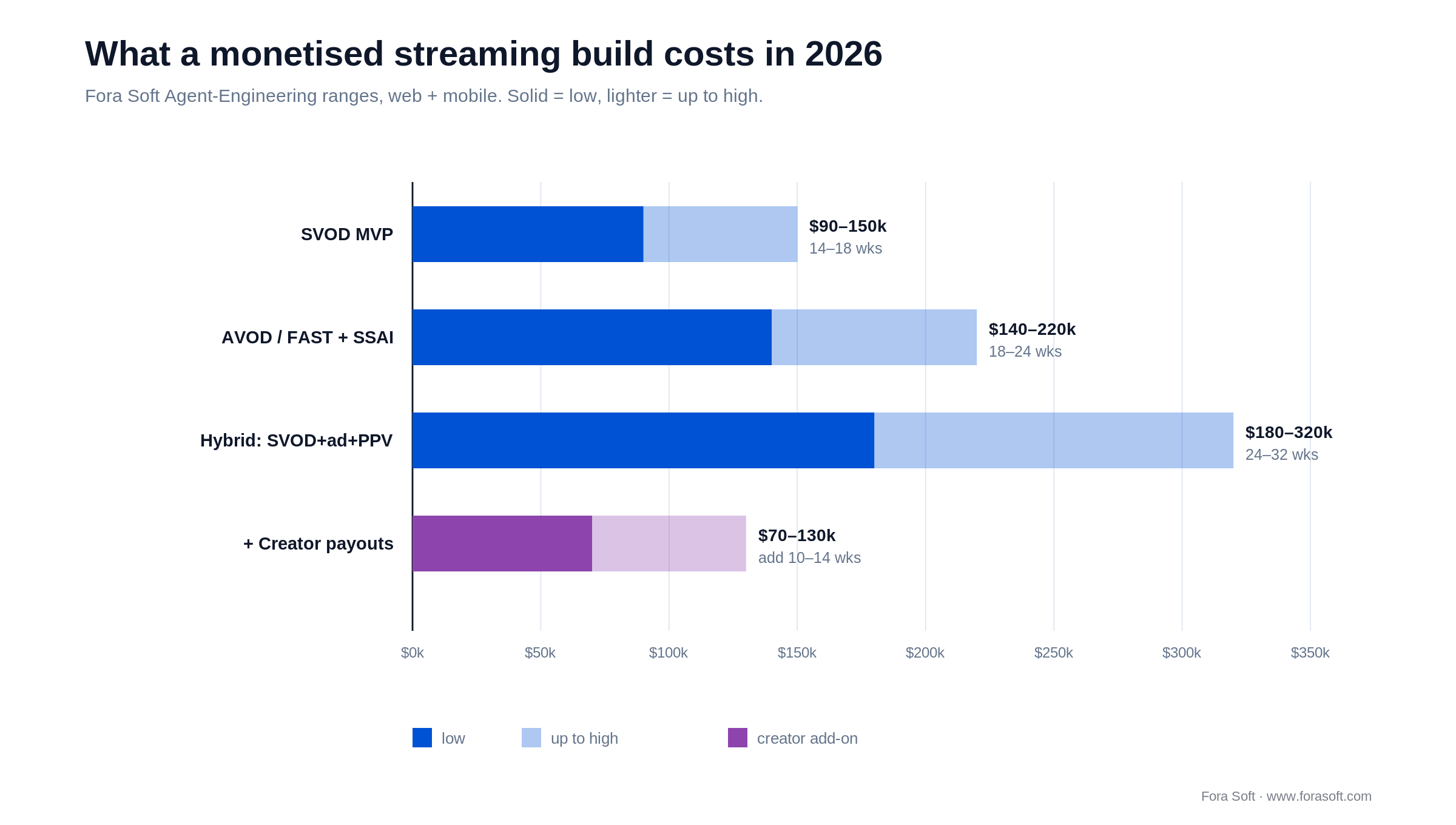
Figure 4. Realistic 2026 build ranges for each monetisation path, web plus mobile.
Mini case — the day Tradecaster added an ad tier
Situation. Tradecaster was a single-tier subscription platform for live trading streams. Growth was steady but capped at the free-trial conversion ceiling; paid users renewed well, but first-time visitors often bounced at the paywall without experiencing the product.
12-week plan. We introduced an entitlement engine, split the experience into three tiers (free trial, ad-supported “viewer” tier, premium subscription) and wired an SSAI pipeline to serve fintech-safe video ads on the viewer tier. Payment flow stayed on Stripe; the app-store build was capped to the paid tier because creator subscriptions bypass in-app-purchase requirements when billed off-device.
Outcome. Total active users expanded well past the paid-only baseline; ad-tier ARPU landed in the 4–6 USD/month range thanks to high-CPM fintech inventory; premium conversion from ad-tier viewers ran in double digits monthly, which more than paid back the extra engineering inside the first quarter. Critically, premium ARPU was not cannibalised because the ad tier was clearly an inferior product — limited live rooms, ad breaks at session start, no downloadable recaps.
Want a similar model for your streaming product?
Tell us the content, the audience and the region. We will come back with a monetisation stack, realistic ARPU and a 12–16-week plan to ship it.
A decision framework — pick your monetisation in five questions
Q1. What is the consumption pattern? Daily/weekly → SVOD. Monthly/occasional → AVOD or free-with-IAP. One-off event or new release → TVOD or PPV.
Q2. Who owns the content? You own originals → push for SVOD, defend with DRM, fund with bundles. You license → AVOD/FAST works best for catalog; TVOD works best for new releases.
Q3. What can you realistically charge? If target ARPU < 6 USD, SVOD rarely pencils out — go AVOD or hybrid. If target ARPU > 12 USD, plan content amortisation very carefully or pair with a bundle.
Q4. What is your acquisition channel? If you rely on App Store discovery, factor 15–30% platform take into unit economics. If you rely on content/social/YouTube, push users to web signup via Stripe.
Q5. What is your churn posture? Evergreen content keeps SVOD churn around 2%. Seasonal sports or fitness can sit at 4–6% — and needs churn-recovery mechanics (pausing, downgrade path to ad tier) baked in from day one.
Five monetisation pitfalls we keep seeing
1. Launching an ad tier that cannibalises premium. The cheap ad tier is supposed to capture price-sensitive users, not drop-down premium-intent users. Keep the feature gap wide (resolution cap, simultaneous streams, offline downloads) and the ad load high enough to sting.
2. Going app-store-first on a subscription product you could sell on the web. Apple and Google take 15–30%; Stripe takes < 3%. Over a million-user business, the difference is two or three engineers per year of runway.
3. Skipping SSAI on an AVOD launch. Client-side ads leak 20–40% of impressions to ad-blockers and command half the CPM. SSAI is work; shipping without it is worse.
4. Ignoring regional payment methods. Launching in India without UPI or in Brazil without PIX routinely costs 20+% of potential subscriptions. Stripe, Adyen and Cleeng all handle this; add them before launch.
5. Treating churn as an afterthought. Churn-recovery tooling (skip-a-month, pause, downgrade to ad tier, win-back offers) is the cheapest revenue you will ever earn. Build it into v1, not post-mortem.
KPIs — what to measure on a monetised streaming platform
Quality KPIs. Video startup time P95 < 1.5s; rebuffer ratio < 0.5%; ad-playback completion rate > 92%; checkout abandonment < 25%. These set the ceiling on all monetisation — a slow, stuttering product cannot charge premium prices.
Business KPIs. Monthly churn (< 2.5% SVOD; < 3.5% hybrid), LTV, CAC payback < 12 months, ad-tier to premium upgrade rate, merchandise/IAP attach rate, creator take-home (for creator platforms), trial-to-paid conversion.
Reliability KPIs. Billing success rate > 98%; involuntary churn from failed cards < 0.5% of active subs; ad-server fill > 85% on premium inventory; payout error rate on creator settlements < 0.1%.
When NOT to monetise with subscription
Some content simply does not deserve a subscription. If your library is shallow, your release cadence is irregular, your users are passive browsers rather than deep fans, or your content is genuinely disposable, forcing a subscription model produces low ARPU, high churn and a lot of support pain. In those cases, run AVOD or FAST until you have evidence of a repeat-use audience, then introduce a premium tier when habits show up in the data.
A second case: niche B2B education, corporate training and internal streaming rarely work on consumer SVOD economics. License the platform (B2B2C / white-label), charge per-seat and let the enterprise own engagement. Our BrainCert edtech platform is a textbook B2B2C streaming build.
FAQ
What is the difference between SVOD, AVOD, TVOD and FAST?
SVOD charges a recurring subscription (Netflix, Disney+). AVOD is free with ads (Tubi, Pluto TV on-demand). TVOD sells individual titles or rentals (iTunes, Prime Video purchase). FAST is free, ad-supported, linear-scheduled channels on connected-TV platforms (Pluto TV channels, Roku Channel, Samsung TV Plus).
Should I launch with a free trial or freemium?
For SVOD, a 7–14 day free trial typically converts better than indefinite freemium if your content is high-value. Freemium works when the free tier delivers genuine value by itself (Spotify-style), not when it is a crippled demo.
How much does DRM cost?
Multi-DRM licensing and key-service fees run 500–10,000 USD/year depending on traffic volume and feature set. Axinom, VdoCipher, BuyDRM and EZDRM all offer credible stacks; Widevine (Google) is free to license but still needs a key service. Without DRM you cannot offer premium licensed content at any meaningful price point.
Is SSAI worth the extra engineering?
If AVOD is your primary revenue stream, yes. Server-side ad insertion bypasses ad-blockers and lifts CPMs roughly 2–3x vs client-side ads. Implementation typically adds 4–8 weeks to a streaming build but recovers that inside a quarter once ad fill and CPM improve.
How do I avoid ad-tier cannibalisation of premium?
Keep feature differentiation wide (resolution cap, simultaneous streams, offline downloads, exclusive titles), set an ad load that rewards upgrading (4–6 minutes per hour is a common benchmark), and monitor cross-tier movement weekly. If premium-intent users downgrade, tighten the feature gap before cutting the ad-tier price.
Can I skip the app stores entirely?
For web-delivered subscription streaming, yes — you can run purely on web billing via Stripe. If you ship iOS or Android apps, Apple and Google usually require their in-app purchase APIs for consumable digital content; the EU Digital Markets Act and several local regulations now allow external payment links, which Netflix, Spotify and others exploit. Plan a web-first signup flow and treat the mobile app as a consumption surface with its own billing allowance.
How long does a monetised streaming MVP take to build?
Simple single-tier SVOD: 14–18 weeks. AVOD/FAST with SSAI and a CTV app: 18–24 weeks. Full hybrid (SVOD + ad tier + PPV) with multi-currency billing and DRM: 24–32 weeks. Creator payouts add 10–14 weeks on top.
Does Fora Soft build streaming platforms end-to-end?
Yes. Our video and audio streaming service covers live and VOD, web and mobile and CTV, with DRM, SSAI, billing and creator payouts. We have shipped OTT, live, fitness, edtech and niche VOD products across SVOD, AVOD, TVOD and hybrid models.
What to read next
Cost model
Live Streaming Platform Dev Cost
Scope-by-scope cost ranges so you can pressure-test any quote.
Mobile monetisation
Mobile Video Streaming Monetisation
The mobile-specific variants — IAP, store fees, DMA web links.
AI + streaming
AI Video Streaming App Guide
Architecture, costs and compliance for AI-enhanced streaming.
Playbook
Media Streaming Software Development
The full end-to-end playbook for building streaming products.
Mobile cost
2026 Mobile App Development Costs
Mobile-app budget benchmark for streaming on iOS and Android.
Ready to pick a monetisation model and ship it?
The honest summary of streaming monetisation in 2026 is that there is no single right model — there is a right model for your content, audience and scale. Evergreen and repeatable content wants subscriptions. Disposable content at scale wants ads. Unique live events want PPV. Anything in between wants a thoughtful hybrid. On top of whichever model you pick, SSAI, DRM, a proper billing stack and regional payment methods are the technical decisions that turn a reasonable model into a profitable product.
If you are turning any of that into a real streaming platform in the next two quarters, we are happy to pressure-test your plan. Bring content, audience and region; we will come back with a monetisation mix, a realistic ARPU range, an SSAI-or-not call and a week-by-week plan inside a 30-minute call.
Talk to a streaming team that has shipped SVOD, AVOD, TVOD and hybrid
Stripe, Adyen, RevenueCat, Google Ad Manager, FreeWheel, Widevine, FairPlay, PlayReady. Pick the call time, send us the spec, get back a realistic monetisation plan.

