


Ship the wrong protocol and your infrastructure bill grows a zero. Skip moderation and a regulator does the reminding. To build a video streaming app in 2026 is no longer to wire a media player onto a CDN — the codec, the protocol, the recommender, the moderation layer, and two EU regulations all pull on the same rope. Fora Soft has built video software since 2005 — 250+ projects shipped, streaming at the core of many — so this is the field guide we wish every founder had before the first architecture call: what to build, what to buy, and where the money leaks.
Key takeaways
• Pick the protocol by latency budget, not marketing. HLS (6–30 s), LL-HLS/LL-DASH (2–5 s), WebRTC (<500 ms). The wrong pick adds a zero to infra cost.
• AV1 is production-safe in 2026, H.264 is still mandatory. AV1 already carries ~30% of Netflix streaming (Dec 2025); VVC still has zero browser support, so ship a multi-codec ladder, not a single codec.
• AI is the moat, not the garnish. Recommender, auto-captions, moderation and scene search turn a pipe into a product a user comes back to.
• DSA is already law; the EU AI Act is landing. The DSA has applied to all platforms since Feb 2024; AI-transparency duties hit 2 Aug 2026 and high-risk rules 2 Dec 2027. Moderation and disclosure are architecture, not paperwork.
• Buy the pipeline, build the difference. Managed infra (Mux, Cloudflare Stream, AWS IVS) gets you live fast; go custom where margin, data residency or the AI layer is the product.
Why Fora Soft wrote this playbook
We have built video products since 2005 — 250+ projects shipped, a team of about 50, most of us on real-time and streaming media day in, day out. That is not a credential to wave around; it is why the numbers in this guide are the ones we have actually paid on invoices, not the ones a vendor deck rounds up.
Our own VALT platform runs recorded and live video for 770+ organizations and 50,000+ active users, so we feel the QoE and storage math from the operator side too, not just the agency side. When we say a recommender needs a logging spec on day one, it is because we have watched teams try to bolt one on in month nine and lose a quarter to it.
This playbook is written for product managers, CTOs and founders who already know what HLS is. If that is you, and you want the shortlist of decisions that decide whether your build ships on budget, read on. If you would rather just talk it through, our video streaming development team does this scoping every week — see the BrainCert build for a worked example.
What an AI video streaming app means in 2026
The phrase gets used three different ways, and they lead to three different budgets. Pin the definition down before discovery, or you will spend six weeks wondering why nothing fits.
1. AI as a feature inside the pipeline. Auto-captions, smart thumbnails, scene search, content-aware ABR, personalised recommendations. Netflix, YouTube, Hotstar. This is what most of our clients mean, and most of this guide.
2. AI as the thing being streamed. Live avatars, generative video, a presenter’s voice translated into five languages with lip-sync in near real time. The WebRTC and MoQ crowd. Growing fast in e-learning and live shopping.
3. AI sitting between the viewer and the content. Conversational search, “jump to the moment she explains X,” clip-and-summarise. Still emerging; it will be the norm by 2027. The protocol, codec and infra choices shift across all three, so write the flavour into the spec, not just the buzzword. Building a general custom platform without a heavy AI layer? Our custom video streaming app guide maps that architecture end to end; this playbook is the AI-native cut.
Not sure which flavour your app actually needs?
Bring the use case; leave with a protocol, a codec ladder, and a build-vs-buy call you can put in a budget.
The 2026 reference pipeline, stage by stage
Every AI streaming product we ship composes the same seven stages. The implementation of each stage changes per project; the shape does not.
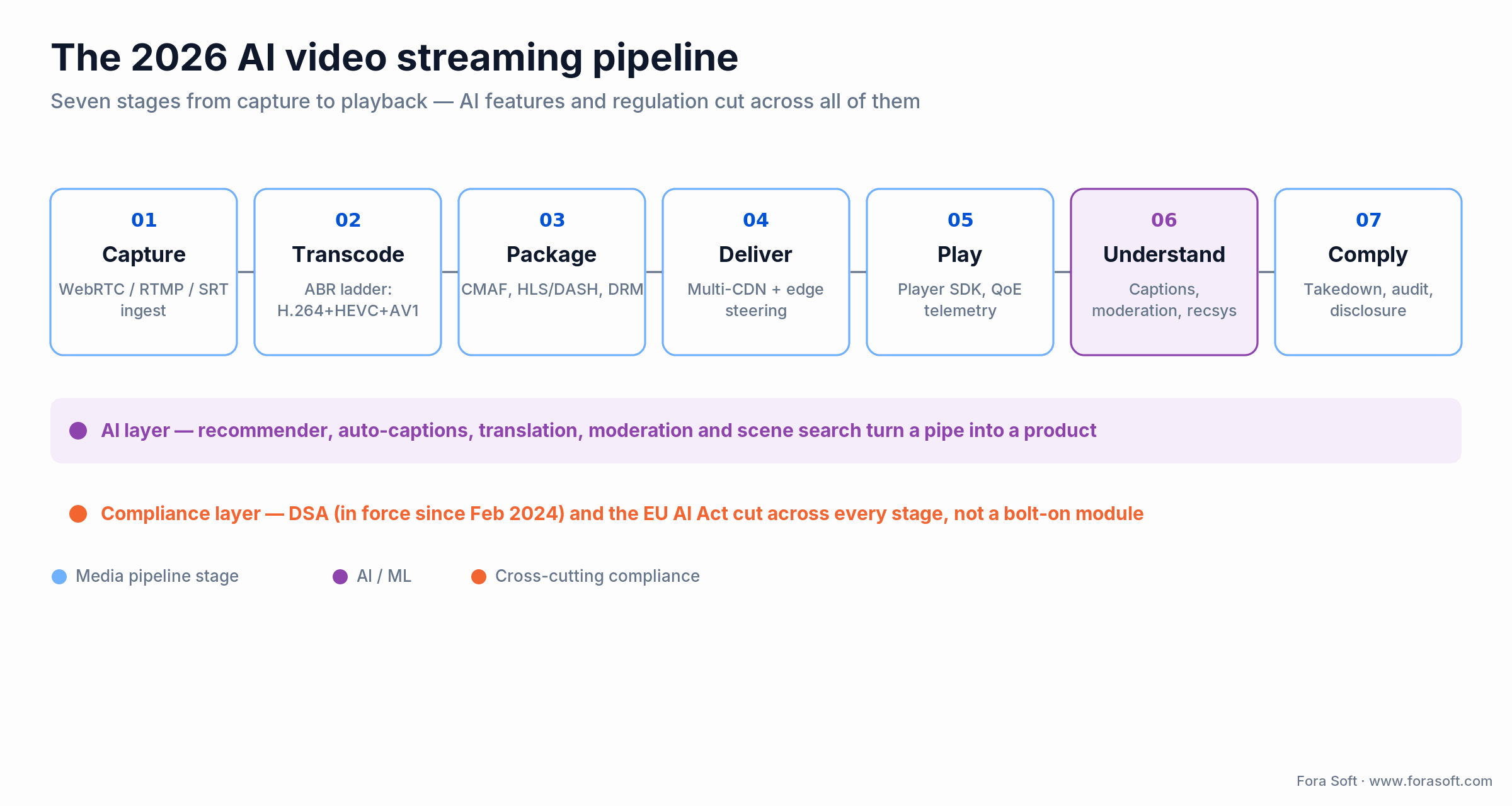
Figure 1. The seven-stage pipeline behind every AI streaming app — AI features and compliance are horizontal layers, not a final module.
1. Capture — camera, screen, SDI, RTMP, WebRTC ingest
User content and live events arrive over WebRTC (sub-second, browser-native) or RTMP (old but universal — every hardware encoder speaks it). Professional production still leans on SRT or SDI-to-RTMP bridges. Capture is where you enforce quality gates, frame-rate normalisation, and the first moderation pass.
2. Transcode — the adaptive bitrate ladder
One mezzanine file becomes 5–9 renditions across resolutions and codecs. The 2026 default ladder is H.264 for reach, HEVC for iOS and smart TVs, AV1 where bandwidth savings pay for the extra encode. Content-aware (per-title) encoding, now standard in Mux and Cloudflare Stream, trims bitrate 20–40% at equal quality.
3. Package — CMAF, HLS/DASH manifests, DRM
Renditions are wrapped as CMAF segments inside HLS or DASH manifests. Low-latency variants (LL-HLS, LL-DASH) shrink segments and use blocking playlist reloads. DRM is applied here if the content is licensed.
4. Deliver — CDN, edge, peer-assisted
Above ~100k MAU, a multi-CDN setup (Akamai, Fastly, Cloudflare, CloudFront) with a steering layer is the default. Edge hit ratio matters more than almost any other number: a one-point drop can add 10–20% to egress bills.
5. Play — the player SDK
Shaka, THEOplayer, Bitmovin, Video.js, or native AVPlayer and ExoPlayer. The player owns ABR, DRM licence acquisition, captions, analytics beacons, and the QoE telemetry loop that feeds encoding and steering decisions.
6. Understand — AI in-session
Real-time captions, speaker diarisation, scene detection, moderation, and a recommender that treats all of it as features. This is the layer where a build earns a moat instead of a demo.
7. Comply — DSA, AI Act, GDPR, DRM audit
The cross-cutting stage. Every asset carries metadata for takedown, risk class, rights, retention and audit. Compliance is a property of the architecture, not a module bolted on before launch.
Protocol decision matrix: HLS, LL-HLS, DASH, WebRTC, MoQ
The single most expensive line in a streaming spec is the delivery protocol. Each option trades latency against scale and cost, and the right answer is set by your latency budget and audience size, nothing else.
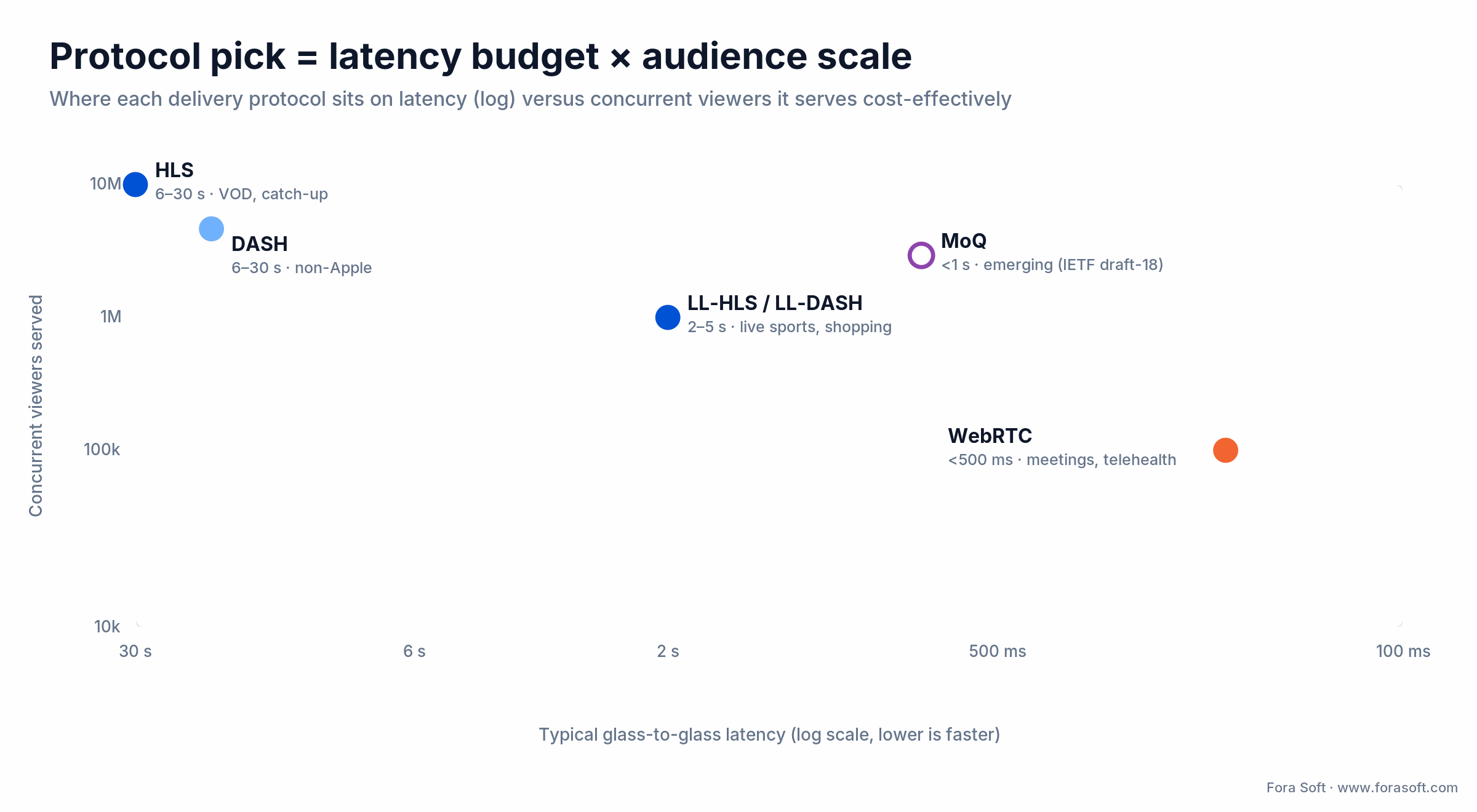
Figure 2. Where each protocol earns its keep — latency on a log scale against the concurrent audience it serves cost-effectively.
| Protocol | Typical latency | Scales to | Use when |
|---|---|---|---|
| HLS | 6–30 s | 10M+ concurrent | VOD, catch-up, non-interactive live |
| DASH | 6–30 s | 10M+ concurrent | Non-Apple ecosystems, broad codec support |
| LL-HLS / LL-DASH | 2–5 s | 1M+ concurrent | Live sports, auctions, live shopping |
| WebRTC | <500 ms | 100k–1M (with SFU) | Meetings, telehealth, 1:few interactive |
| Media over QUIC (MoQ) | <1 s | Millions (target) | Emerging: low latency at web scale |
The classic trap is picking WebRTC for a 500k broadcast because “it’s low latency,” then watching SFU fan-out costs explode. The inverse trap is shipping plain HLS for live shopping, where a 20-second lag means the product-of-the-minute already sold out. MoQ is the one to watch: it is an active IETF standard (draft-ietf-moq-transport-18, May 2026), demoed by multiple vendors at NAB 2026, but not yet a finished RFC — production-viable for pilots, not yet boring default infrastructure. Our MoQ deep dive tracks where it stands.
Reach for LL-HLS when: you need 2–5 s glass-to-glass at 100k+ concurrent (sports, auctions, live commerce) and full WebRTC interactivity is overkill. Pair it with a WebRTC side-channel for the interactive bits.
Codec choices for 2026: H.264, HEVC, AV1, VVC
Bandwidth savings from modern codecs are real. So are the compatibility and licensing tails. The practical 2026 answer is almost always a multi-codec ladder, not one codec.
H.264 (AVC). Still required. Plays everywhere, cheap licensing, universal hardware decode. Your compatibility rung.
HEVC (H.265). Roughly 25–35% smaller than H.264 at equal quality, the iOS and smart-TV default. The licensing tail (MPEG-LA, HEVC Advance, Velos) is the trap — budget for it in procurement, not after.
AV1. Royalty-free and about 30% smaller than HEVC. It now carries ~30% of all Netflix streaming (Dec 2025) and is on track to be their most-used codec; 88% of large-screen certification devices from 2021–2025 support it, and Apple added hardware decode with the A17 Pro and M3 (2023). Encoding still costs 5–20× H.264, so it pays off at scale, not at launch. Our state-of-AV1 explainer has the device tables.
VVC (H.266). Another 30–50% over HEVC on paper. In practice, as of 2026 no mainstream browser decodes VVC; adoption is stuck in broadcast and connected-TV hardware (Intel Lunar Lake, MediaTek, DVB mandates). Ship it when your partners do, not before.
Our default ladder for a mid-size VOD product: H.264 at 480p/720p/1080p, HEVC at 720p/1080p/4K, AV1 at 720p/1080p/4K. Nine renditions, encode cost ~1.6× an H.264-only ladder, bandwidth bill down 25–35%. The break-even sits near 1M monthly stream-hours — below that, run H.264 plus HEVC and skip AV1 until the egress line justifies the encode. That is the whole trade in one sentence: encode once, deliver millions of times, so you spend CPU to save egress only when egress is the bigger number.
Reach for AV1 when: you push more than ~1M stream-hours a month and your egress bill dwarfs your encode bill. Add it as a rung on top of H.264, never as a replacement for it.
The AI feature stack that moves the metric
“AI video streaming” sells. But not every AI feature shows up in a retention cohort. Here is what actually moves the needle, ranked by the lift we measure across builds.

Figure 3. What each AI feature buys you — observed spans across Fora Soft streaming builds, not guarantees.
1. Personalised recommendations. The largest lever on watch-time. A decent recommender adds 10–30% to session length versus a “newest first” list.
2. Auto-captions and translation. Accessibility, non-English reach, and SEO in one. A 20–40% bump in international retention is routine once captions and machine translation ship.
3. Scene search and chapters. “Jump to the moment the speaker covers X” turns 45-minute lectures into clippable gold. It lifts course completion 15–30% in e-learning.
4. Smart thumbnails. A CLIP model or visual LLM picks the most click-worthy frame; 5–15% CTR lifts over editorial thumbnails are typical.
5. Content-aware ABR. Encoding tuned to content type shaves 25–35% off bandwidth at equal quality. Silent, profitable, invisible to users.
6. Moderation. Not a retention feature — a legal one under the DSA and AI Act. Budget it into year-one engineering, not a later sprint.
Building the recommender, not “use a library”
The “add a recommendation system” line in a brief hides a quarter of the engineering cost. The real thing is a multi-stage funnel, and skipping a stage is how results plateau.
Candidate generation. Narrow millions of items to hundreds with two-tower models or approximate nearest-neighbour search over content and collaborative embeddings.
Ranking. Score candidates for this user, context and device with gradient-boosted trees (CatBoost, LightGBM) for v1, a sequence model (SASRec, BERT4Rec) once you have feedback data.
Re-ranking. Diversity, novelty, freshness penalties, business rules.
Cold-start. The under-designed stage, and the number-one reason “our recommender is bad.” A VLM that embeds each item from title, transcript and thumbnail closes most of the new-item gap cheaply.
Logging and A/B. Exposures, clicks, dwell, completion, dismissals — logged from day one, or your first six experiments are guesswork. Our AI integration team builds this end to end, A/B pipeline included. A sensible open-source starting stack: Sentence-Transformers and OpenCLIP for embeddings, Qdrant or pgvector for the index, CatBoost then a sequence transformer for ranking, Feast for the feature store, Ray Serve or BentoML for serving, GrowthBook for experiments.
Reach for a bought recommender when: you have fewer than ~10k daily active users and no ML team. A managed ranking API beats a half-built funnel. Build your own once personalisation is the product and the logs are worth mining.
Auto-captions, translation, and moderation
The three features that used to be “premium” are now mandatory — for accessibility, for international growth, and for legal defensibility. For the full set a modern build needs, see our video streaming app features checklist.
Captions. For live, Deepgram Nova-3 posts 6.84% streaming WER (5.26% batch), and Deepgram Flux adds turn detection built for voice agents; a self-hosted Whisper-large-v3 pipeline is the alternative above scale. Managed APIs run roughly $0.004–$0.008 per minute; self-hosting drops toward ~$0.001 per minute past ~100k hours a month. Our live speech-to-text guide has the vendor-by-vendor latency numbers.
Translation. ASR gives you the transcript; a small-model pass per segment translates it for cents per hour of audio. Real-time translation with lip-sync costs an order of magnitude more — usually only worth it for premium creator tools.
Moderation. Three layers minimum: visual (Hive, AWS Rekognition, or a custom VLM) for CSAM, nudity, violence and extremism; text classifiers for chat and comments; audio for hate and threats. Live adds a fourth: human-in-the-loop escalation with a panic control. Under the DSA this stack is a legal requirement for very large platforms and a standard ask in enterprise RFPs for everyone else.
Want a second opinion on your streaming cost model?
Send us your traffic assumptions and we’ll pressure-test the egress, encode and AI line items before you commit a budget.
CDN and infra cost math founders get wrong
Nearly every streaming startup we advise made one of two mistakes: they forgot egress, or they forgot encode scale. Here is the honest 2026 math, verified against current price sheets.
| Cost line | 2026 rate | Notes |
|---|---|---|
| Cloudflare Stream storage | $5 / 1,000 min stored | Encoding and ingress free |
| Cloudflare Stream delivery | $1 / 1,000 min delivered | Egress included |
| Mux Video (VOD) | ~$0.003 / min stored + ~$0.00096 / min delivered | Resolution-based; live encode $0.032/min |
| AWS IVS low-latency | Input + AWS-priced delivery | LL-HLS out of the box, sub-3 s |
| CloudFront egress (NA/EU) | ~$0.085 / GB list, to ~$0.02 negotiated | Private pricing at scale |
| Custom multi-CDN (Akamai / Fastly) | $0.003–$0.01 / GB | Worth it past ~500 TB / month |
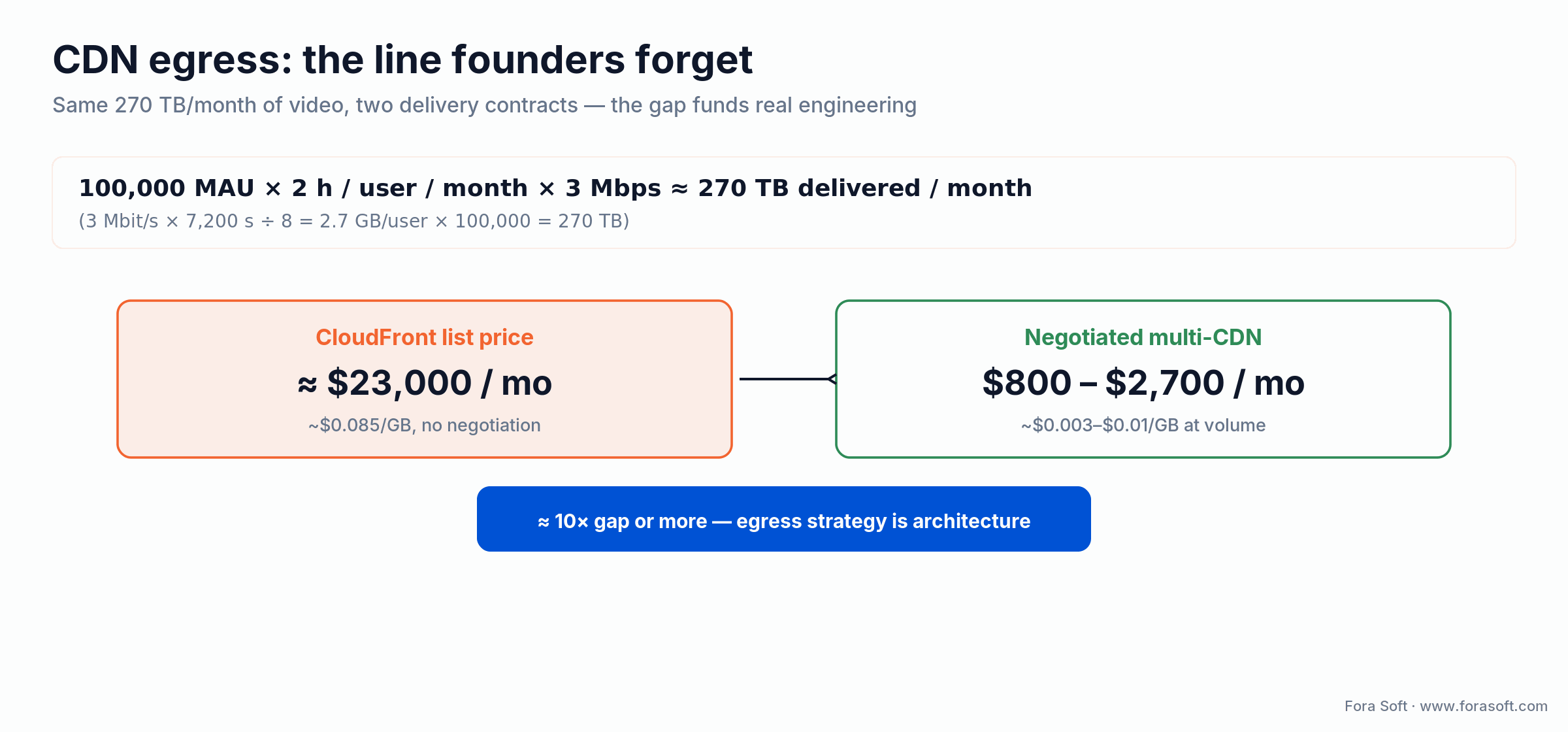
Figure 4. The egress line most cost models miss — the same 270 TB priced two ways, roughly a 10× gap or more.
Work it through. Take a 100k-MAU live product at 2 hours per user per month, 3 Mbps: that is 3 Mbit/s × 7,200 s ÷ 8 ≈ 2.7 GB per user, and 2.7 GB × 100,000 ≈ 270 TB of egress a month. On CloudFront list (~$0.085/GB) that is roughly $23,000; on a negotiated multi-CDN deal (~$0.003–$0.01/GB) it is $800–$2,700. The gap is not rounding — it funds a multi-quarter engineering investment that pays for itself many times over, which is exactly why egress strategy belongs in the architecture doc, not the finance spreadsheet.
DRM and rights: Widevine, FairPlay, PlayReady
If your content is licensed from a studio, network or label, DRM is a contract line, not an option. Three systems cover the world: Google Widevine (Chromium, Android, Firefox; L1/L2/L3 security levels), Apple FairPlay (Safari, iOS, tvOS, macOS), and Microsoft PlayReady (Edge, Xbox, Windows, smart TVs).
Multi-DRM as a service (Axinom, BuyDRM/KeyOS, EZDRM, Verimatrix) runs $0.001–$0.02 per licence plus a monthly floor. Studio content also needs forensic watermarking (Nagra, Friend MTS) at $0.01–$0.05 per session — a deal-breaker number to miss in pricing.
Running DRM in-house is possible and roughly 4× cheaper per licence at scale, but the audit burden (quarterly pen tests, hardware-backed key storage, Widevine L1 device certification) eats 6–12 engineering-months you probably do not have. Under ~10M protected sessions a month, buy.
Reach for multi-DRM-as-a-service when: you carry licensed content but ship fewer than ~10M protected sessions a month. The per-licence premium is far cheaper than the L1 certification and audit treadmill of a self-hosted key server.
Build vs buy: Mux, Cloudflare Stream, AWS IVS, or custom
Buy the pipeline to move fast; build where margin, control or compliance demands it. The honest matrix:
| Option | Strengths | Where it breaks | Sweet spot |
|---|---|---|---|
| Mux Video | Dev-first API, lean QoE data | Pricey past ~10M min/mo | B2B SaaS, dev tools |
| Cloudflare Stream | Flat pricing, egress included | Thin analytics, basic player | Education, mid-market VOD |
| AWS IVS | Sub-3 s live at scale | Egress is AWS-priced | Live shopping, interactive live |
| Ant Media / Wowza / self-host | Cost control, custom WebRTC | You own ops 24/7 | Telehealth, meetings, long-term scale |
| Custom build (our lane) | Margin, data, compliance, AI moat | Real upfront time and cost | Category leaders, VLOP-adjacent |
Our rule of thumb: buy until one of three things becomes true — unit economics (egress past ~$15–25k/month), compliance (on-prem or EU-only residency), or AI differentiation (the recommender or moderation is the product). Until then, every week not rebuilding the pipeline is a week shipping features.
Mini-case: BrainCert streaming for a global LMS
BrainCert is a global training platform — virtual classrooms, cohort courses, enterprise LMS. It came to us with a working product and a familiar problem: live classes ran fine, but recorded sessions were a flat wall of video no learner wanted to re-watch, and completion on self-paced content was stuck.
The call that mattered was hybrid, not one-size. Live classrooms stayed WebRTC for instructor interactivity; recordings were transcoded overnight into an HLS ladder with AI captions, auto-generated chapter marks, and searchable transcripts. Learners got a “jump to the moment your instructor explained X” experience instead of a scrubber and a prayer, and self-paced completion moved back up the way chapters and search reliably move it — a double-digit lift, not a rounding error. We wired QoE telemetry and recommender logging from the first sprint, so every later change was measured rather than argued.
The reusable lesson: a streaming product at this scale is half infrastructure (reliable live, solid transcoding, permissions) and half AI features (captions, chapters, recommender). Vendors who pitch only the AI or only the plumbing leave you with half a product. Want a similar assessment of your stack? Book a 30-minute review and we’ll walk your pipeline end to end.
Two more patterns: live shopping and telehealth
Live shopping — Sprii. A seller goes live, a buyer taps “mine” on a product on screen, and the order is reserved in under a second. We built the streaming and order-capture pipeline as dual-path: an LL-HLS path for broadcast scale, a WebRTC side-channel for product events and interactive controls. The lesson that transfers: a product that feels like one stream is often two systems under the hood, one for the video and one for the interactions that make the video a store. Treat it as a single pipe and you ship an app that technically works but does not convert.
Telehealth — ProVideoMeeting. A HIPAA-grade consultation platform: WebRTC media plane, end-to-end encryption, a recording vault with selective EHR sharing, and an auto-summariser that drafts a SOAP-style note the clinician reviews after the visit. The non-obvious requirement was that the summariser runs on-premise (self-hosted Whisper plus a self-hosted Llama model) because sending protected health information to a third-party API is a HIPAA failure you do not recover from. Streaming plus AI plus compliance is always a three-variable problem, never a feature list.
Metrics that matter: QoE, QoS, AI lift
Ignore “uptime.” It is the weakest metric in the streaming arsenal. The numbers that earn product-engineering investment:
Rebuffer ratio. Buffering time over play time. Industry floor is under 1%.
Start-up time. Tap Play to first frame. Under 2 s for VOD, under 500 ms for interactive live.
Exits before video start. Users who tapped Play and left before a frame rendered. Massively under-measured, and often the biggest silent leak.
Average bitrate delivered. The weighted average across real sessions, not the maximum you encoded.
Recommender and caption lift. Watch-time versus a chronological baseline in a ship-quality A/B framework, and median caption lag (word spoken to caption rendered; under 500 ms is the live bar). Moderation precision and recall, broken out by category, round out the set.
Compliance: DSA, EU AI Act, GDPR, COPPA
Four regulations reshape streaming requirements in 2026. Designing for them from sprint one costs 2–3× less than retrofitting.
Digital Services Act (DSA). Already law — it has applied to all platforms since 17 February 2024, with very large platforms (45M+ EU users) obligated since 2023. For everyone the notice-and-takedown regime, trusted-flagger channels and illegal-content reporting apply. Your architecture must support content tagging, removal audits and an appeals workflow, with fines up to 6% of global turnover for getting it wrong.
EU AI Act. The timeline moved. Prohibited-practice bans have applied since Feb 2025; transparency duties (Article 50 — label AI-generated media, disclose chatbots) apply from 2 August 2026; and under the Digital Omnibus agreed in May 2026, high-risk obligations were pushed from Aug 2026 to 2 December 2027 (Annex III), with embedded-product rules to Aug 2028. Recommenders that shape what millions watch, plus any emotion or biometric features, can fall in scope. Penalties reach €35M or 7% of turnover for prohibited uses, and €15M or 3% for most other breaches.
GDPR. Still the baseline. Streaming telemetry is often personal data, and captions from live calls can contain sensitive data. Data-minimisation and regional isolation are defaults, not opt-ins.
COPPA and youth protection. Under-13 access in the US triggers strict parental-consent and data-use limits; the UK Online Safety Act adds age assurance; the EU is tightening child-safety rules further. Age gating and youth-specific moderation are architecture decisions, not settings.
2026 AI line items in a streaming budget
Rough per-unit rates we use for first-pass budgets. Verify against current price sheets before you sign anything — these move quarterly.
| Feature | Vendor / stack | 2026 price |
|---|---|---|
| Real-time captions | Deepgram Nova-3 / Flux | ~$0.004–$0.008 / min |
| Batch captions (VOD) | Whisper-large-v3 self-hosted | ~$0.001 / min at scale |
| Visual moderation | Hive | ~$1.50 / 1,000 frames |
| Scene chapters | VLM pass (Qwen3-VL / Gemini) | ~$0.10–$0.40 / hour |
| Recommender inference | Ray Serve / BentoML | ~$30–$120 / 1M requests |
A decision framework: pick your stack in five questions
1. What is your latency budget? Sub-second and interactive points at WebRTC. 2–5 s at LL-HLS. Tens of seconds and huge scale, plain HLS or DASH. Answer this first; it constrains everything else.
2. Where does your audience watch? Heavy iOS and smart-TV means HEVC and FairPlay are non-negotiable. Broad web means H.264 plus AV1. That decides your codec ladder and DRM set.
3. Is content licensed? Licensed content forces multi-DRM and possibly forensic watermarking into the budget. UGC usually needs only signed URLs and token auth.
4. Which AI feature is the product? If the recommender, captions or moderation is your differentiator, build it and own the data. If it is table stakes, buy an API and move on.
5. What is your compliance surface? EU users, under-13 users or health data change the architecture, not just the paperwork. Answer this before sprint one, and pick a partner who quotes QoE numbers and names their codecs rather than one who answers in adjectives.
Eight red flags in a streaming-app proposal
1. One protocol to rule them all. WebRTC for broadcast or HLS for live shopping means the vendor missed the latency-scale trade-off.
2. Single-codec ladder. “We’ll just use H.264” in 2026 leaves 25–35% of the bandwidth budget on the table.
3. No QoE telemetry plan. No rebuffer ratio, start-up time or exits-before-start instrumentation means you ship blind.
4. AI as a “premium feature later.” Captions and moderation are compliance surfaces now. Later equals expensive retrofit.
5. No DRM strategy for licensed content. That is a contract-breaking omission, not an oversight.
6. No multi-CDN path. Single-CDN works until the one outage that becomes a PR incident.
7. No recommender logging spec. If exposures and dismissals are not logged from day one, your first six A/B tests are wishful thinking.
8. No DSA or AI Act section. A 2026 streaming proposal without a regulation plan is a liability dressed up as a saving.
A 90-day deployment playbook
For a mid-market product going from zero to ~100k users, our reference plan:
Days 1–15 — discovery and protocol choice. Latency budget, compliance surface, codec ladder, build-vs-buy. Output: a signed architecture doc with a budget carrying a ±15% confidence interval.
Days 16–45 — pipeline MVP. Capture, transcode, package, deliver, play. One codec, one CDN, a basic player, QoE telemetry wired up.
Days 46–75 — AI features. Captions, smart thumbnails, moderation, first recommender. Every feature A/B-testable from the start.
Days 76–90 — compliance, multi-codec, multi-CDN. DSA takedown pipeline, AI Act transparency surface, AV1 rung, secondary CDN, forensic watermark if content is licensed.
When NOT to build a custom AI streaming app
Honesty sells better than a pitch, so here is where custom is the wrong call. If you are validating an idea and just need video that plays, wire up Mux or Cloudflare Stream in a sprint and spend your runway on the product, not the pipeline. If your egress is under ~$15k a month, the savings from a self-hosted CDN will not cover the ops team it needs.
If none of your differentiation is in the streaming or AI layer — if the moat is your catalogue, your community or your brand — then a managed stack plus a thin custom layer is the right answer, and anyone telling you to build from scratch is selling hours. Custom earns its keep when margin at scale, data residency, or an AI feature that is genuinely your product tips the maths. Below that line, buy.
Reach for managed infrastructure when: you are pre-product-market-fit, egress is under ~$15k/month, and none of your moat lives in the streaming or AI layer. Revisit the build decision when any one of those flips.
Building an AI streaming app and want it audited first?
We’ll review your protocol, codec ladder, cost model and compliance surface, and tell you plainly what to build and what to buy.
FAQ
How do I build a video streaming app — buy the pipeline or build it?
Buy until one of three things is true: egress passes ~$15–25k/month, buyers need on-prem or EU-only residency, or your recommender, captions or moderation is the product. Until then, a managed stack (Mux, Cloudflare Stream, AWS IVS) plus a thin custom layer ships faster and cheaper than rebuilding the pipeline.
How much does it cost to build a video streaming app?
A mid-market MVP on managed infrastructure typically runs $120k–$300k over 4–6 months. A full platform with AI features and compliance lands higher and longer; VLOP-grade builds with multi-region, DRM and a transparency surface are higher still. Managed-infra products sit at the low end; self-hosted and compliance-heavy ones at the high end. We estimate with Agent Engineering, so our numbers usually come in below a traditional agency’s.
Is AV1 really production-ready for a small streamer?
Yes, as an addition to an H.264 ladder, not a replacement. AV1 already carries about 30% of Netflix streaming (Dec 2025) and hardware decode is on post-2022 iPhones, Pixels and smart TVs. It is worth the extra encode past roughly 1M monthly stream-hours; below that, stick with H.264 plus HEVC.
When is WebRTC the right pick over LL-HLS?
When sub-500 ms latency matters and the audience is under ~100k concurrent: tele-consults, auctions, interactive classrooms, one-to-few live shopping. Above ~1M concurrent, SFU costs punish you, and the right answer is LL-HLS or LL-DASH with a WebRTC side-channel for the interactions.
Do I need DRM for user-generated content?
Usually not. Signed URLs, HMAC tokens and CDN-level session encryption are enough for UGC. DRM is for licensed content — film, sports rights, music. Adding full multi-DRM to a UGC product means paying for a system you do not need.
What is the fastest way to add AI captions and moderation to an existing app?
Wire a managed captioning API (Deepgram, AssemblyAI, Speechmatics) plus a moderation API (Hive, AWS Rekognition) in a sprint. Budget 3–4 weeks to production quality with fallback, a latency SLO, a takedown workflow and a transparency surface. Move to self-hosted once volume justifies it.
Does the EU AI Act apply to my streaming recommender in 2026?
Transparency duties (label AI-generated media, disclose AI chat) apply from 2 August 2026. High-risk obligations that can catch large-scale recommenders were delayed to 2 December 2027 under the Digital Omnibus agreed in May 2026. The DSA, which governs takedown and content moderation, already applies today. Design for all three now; retrofitting later costs more.
Who owns the data and models we build together?
You do. Our standard contract grants Fora Soft only the access needed to operate and iterate the system, and prohibits training on your content without an explicit per-contract opt-in. Everything stays in your jurisdiction; we architect around your residency constraints from sprint one.
What to read next
Service
Video streaming development
Custom streaming platforms from MVP to multi-million MAU.
Deep dive
Speech-to-text in live streaming
Real-time ASR for live, with latency and WER numbers that hold up.
Codecs
AV1 in production (2026)
When the royalty-free codec actually saves money.
Strategy
Monetize video streaming with AI
Pricing, ads and recommender-driven revenue patterns.
Ready to build your AI video streaming app?
A modern AI video streaming app is a seven-stage pipeline — capture, transcode, package, deliver, play, understand, comply — where AI features are the moat and regulation is the floor. Pick protocols by latency budget, codecs by reach, infrastructure by whether unit economics or differentiation dominates. Build the recommender, captions and moderation properly from day one, because retrofits cost 2–3×. Treat the DSA and EU AI Act as constraints in the architecture doc, not paperwork at the end.
If you want Fora Soft to review, build or scale your streaming product, we do this every week — from MVP pilots to multi-million-MAU platforms. Bring your audience, your latency budget and your compliance surface; leave with a stack, a timeline and a number.
Let’s scope your streaming build
A 30-minute call gets you a protocol, a codec ladder, a build-vs-buy call and a budget with a real confidence interval.

