

Key takeaways
• The AI user engagement tools that move streaming retention are three layers, not one product. A recommender, an ML quality/adaptive-bitrate layer, and a real-time interactivity layer — wired together, not bought as one “platform.”
• The ceiling is real but earned. Netflix credits roughly 80% of hours streamed to its recommender (Gomez-Uribe & Hunt, 2015); Globo more than doubled click-to-play with Google Cloud recommendations. Those are years of data, not a switch you flip.
• Buy the engine, build the judgement. AWS Personalize, Recombee, Algolia Recommend, and NVIDIA Merlin cover ~80% of the ML work; your edge is the features, ranking policy, and interactivity on top.
• Latency is the hidden killer. A recommendation that buffers is a recommendation the viewer never sees; personalization that adds >150 ms per request quietly cancels the uplift it promised.
• Compliance is a product decision. EU rules (the AI Act, GDPR, the AVMSD content quota) shape vendor choice and data residency — design for them on day one, not after launch.
Why Fora Soft wrote this playbook
We’ve spent 21 years shipping video and AI products — 250+ delivered since 2005, a 100% Job Success score on Upwork, and a specialization in real-time streaming, recommendation systems, and LLM-backed agents. When a product owner asks us to add “AI user engagement tools,” they almost never mean one thing. They mean recommendations that actually lift watch time, adaptive quality that stops viewers rage-quitting on 3G, and live interactivity that keeps a Thursday-night event from feeling like a dead webinar.
This is the condensed version of the conversation we have with founders every week. It covers the three AI layers that matter for streaming, the third-party tools we actually integrate, the numbers we can defend, and the pitfalls we’ve watched teams hit. On the case side we’ll reference Worldcast Live (0.4–0.5 s latency concert streaming at 10,000 concurrent viewers), Vodeo (a 100K+ user iOS VOD platform for Janson Media), and BrainCert (an LMS with virtual classrooms serving 100K+ customers). If you want the commercial version, it lives on our video streaming development page.
The goal here isn’t to sell you a feature list. It’s to help you decide which user engagement tools are worth the infrastructure they need, which you can safely buy off the shelf, and where to spend engineering hours to get a moat that lasts.
Planning an AI engagement upgrade on your streaming platform?
30 minutes with a senior engineer. We’ll map the three AI layers against your traffic, your stack, and your budget before you commit to a vendor.
What AI user engagement tools actually do
Stripped of marketing, AI engagement on a streaming platform is three jobs: decide what to show, decide how to show it, and react to what the viewer does next. Each job maps to a distinct stack, a distinct latency budget, and a distinct buy-or-build call. Treat them as one megaproject and you ship slowly; treat them as three tracks and the first wins land in weeks.
The first job is personalization: choosing the next title, clip, module, or ad. The second is quality: adaptive bitrate (ABR) choices, per-title encoding, and device-aware upscaling. The third is live interactivity: AI moderation, real-time polls, sentiment-aware highlights, and agents that join a room as a participant. The diagram below shows how the three stack up, what each decides, and how to source it.
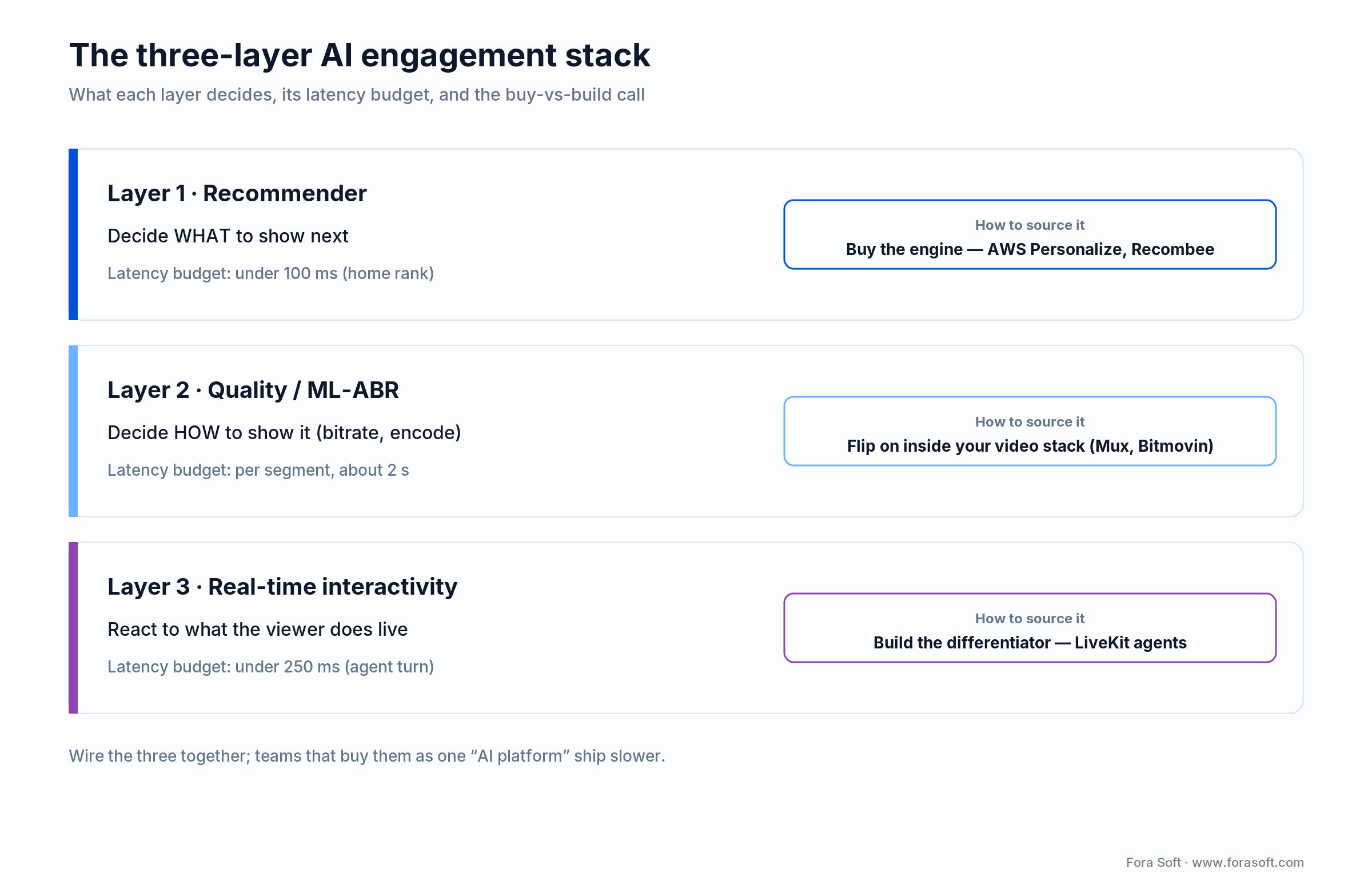
Figure 1. The three layers, what each decides, its latency budget, and whether to buy, flip on, or build.
Job 1: Decide what to show (recommender)
Candidate generation, filtering, ranking, and a reorder for diversity. Latency budget: under 100 ms end-to-end for home-screen ranking, under 300 ms for “up next.” This is where managed services (AWS Personalize, Vertex AI Search, Recombee, Algolia) are strongest and where most teams should start buying.
Job 2: Decide how to show it (quality & ABR)
ML-driven ABR, content-aware encoding (per-title and per-scene), and AI super-resolution at the edge. Budget: segment-level, so inference has to fit inside the ABR decision tick (roughly 2 s segments). This layer earns its keep silently — nobody praises a stream that just works, but everybody leaves one that stalls.
Job 3: React to viewer behavior (real-time interactivity)
Live moderation, polls with AI-summarized answers, sentiment-aware highlights, and voice agents that join a WebRTC room. Budget: under 250 ms for conversational agents, under 10 s for sentiment rollups. This is the newest, most differentiated layer — and the least well-served by off-the-shelf vendors, which is exactly why it’s where a moat gets built.
The engagement economics: why the category exists
Viewers spend roughly 7.5 hours a week in streaming apps, and week-one retention across the category hovers near 3% (Business of Apps / AppsFlyer benchmarks, 2025). The platforms that defend those numbers do it with AI, not with more content nobody finishes. Here’s what the public uplift reference points actually say — with the fabricated stats that float around SEO blogs stripped out.
- Netflix: about 80% of hours streamed are influenced by the recommender, ~20% by search (Gomez-Uribe & Hunt, The Netflix Recommender System, ACM TMIS 2015). It’s a ceiling built over a decade, not a target for year one.
- Globo (Brazil): more than doubled click-through-to-play on Globoplay after moving recommendations to Google Cloud (Vertex AI, not the retired “Recommendations AI” brand).
- Peacock: a personalized year-in-review campaign cut 30-day churn by 20% and nudged free-to-paid upgrades (Braze / Movable Ink case study). Treat the number as a campaign result, not a platform-wide promise.
- ML adaptive bitrate: reinforcement-learning ABR (MIT’s Pensieve, SIGCOMM 2017) reported 13–25% average QoE gains over the best prior heuristics — the strongest, most-cited number in the ABR literature.
- Live interactivity: viewers engage longer with streams that offer polls and Q&A; treat vendor “up to 35% retention” claims (BytePlus and others) as directional marketing, not measured fact.
The honest short version: a well-implemented recommender, plus a live-quality floor, plus some interactivity is worth a meaningful double-digit lift in watch time on most platforms, provided latency stays low and cold start is solved. Anyone quoting you a precise universal percentage is selling, not measuring.
Strategy 1 — AI recommendations and personalization
If you only build one engagement layer, build this one. Netflix’s 80% is a ceiling, not a promise — but a well-tuned recommender on a mid-sized VOD library routinely lifts home-screen click-to-play and average session duration inside a quarter. The trick is the cascade, not the model.
The cascade you actually need
Modern recommenders run a four-stage cascade: candidate generation → filter → ranking → reorder for diversity and business rules. The first stage is cheap vector retrieval (two-tower or approximate nearest-neighbour over embeddings — FAISS, pgvector, Qdrant). The ranker is a deep model (DLRM-class) scoring a few hundred candidates. The reorder step enforces diversity, freshness, and commercial constraints. Only the ranker is heavy; the whole path stays under 100 ms.
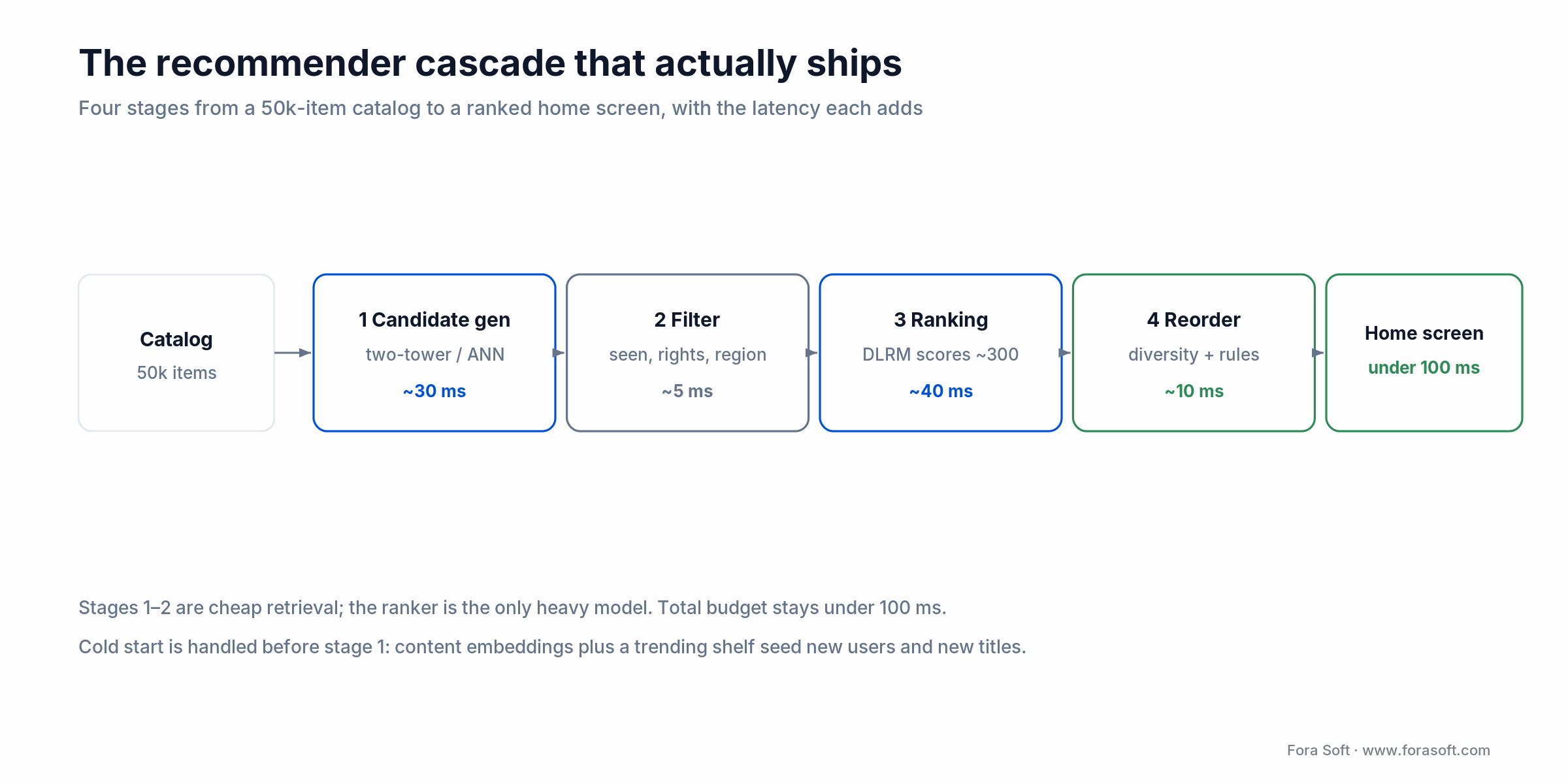
Figure 2. The four-stage cascade from a 50k-item catalog to a ranked home screen, with the latency each stage adds.
Build, buy, or Merlin the middle
For most streaming products under ~10 M monthly actives, a managed recommender (AWS Personalize, Recombee, Vertex AI) ships in 6–10 weeks. Above that, the economics start to favour NVIDIA Merlin or a custom two-tower on GPU — you stop paying per request and start paying per GPU-hour, which is usually cheaper at scale. We go deeper on the cascade and its trade-offs in our AI content recommendation systems guide.
Reach for a managed recommender (AWS Personalize / Recombee / Algolia) when: you’re under ~10M monthly actives, your catalog is under ~500k items, and you want a production-grade recommender live in a quarter.
Reach for NVIDIA Merlin or a custom stack when: you need sub-50 ms ranking, your per-request bill on a managed service has crossed ~$10k/month, or you need feature flexibility the vendor won’t ship.
Strategy 2 — Dynamic quality optimization
A great recommendation is useless if it buffers. The quality layer is where AI pays for itself quietly: ML-driven ABR, content-aware encoding, and AI super-resolution that lets you send 540p over the wire and upscale on the device.
ML ABR. Reinforcement-learning ABR (MIT’s Pensieve and its successors) beats hand-tuned heuristic ABR by 13–25% on QoE under variable networks. Mux, Bitmovin, Fastly, and several hyperscalers now expose ML ABR as a component. If you’re on HLS or DASH today, this is often the highest-ROI swap you can make: a three-second cut in startup time buys back more watch time than any homepage redesign.
Content-aware encoding. Per-title and per-scene bitrate ladders (Netflix’s Dynamic Optimizer and the equivalents from AWS Elemental, Bitmovin, and Harmonic) commonly save 20–50% bandwidth at the same VMAF. That saving lands straight on your CDN bill.
AI super-resolution at the edge. NVIDIA RTX Video Super Resolution on desktop, Apple’s on-device upscaling, and Real-ESRGAN-class models on newer mobile SoCs can make 540p read as 1080p-ish. It’s not a substitute for good encoding; it’s insurance against a bad network. For the full delivery picture, see our guide to scaling a streaming app.
Reach for ML ABR first when: your top-of-funnel loss is buffering churn, your p95 startup time is >3 s, or you’re already paying for a managed video stack (Mux, Bitmovin, CloudFront) that exposes it as a feature flag.
Strategy 3 — Real-time AI interactivity
This is the layer most teams skip and later regret. Live viewers stay longer when a stream offers polls, Q&A, and responsive hosts — and it’s the hardest layer for a competitor to copy, because it lives in your product, not in a vendor’s dashboard.
AI moderation. Off-the-shelf services (OpenAI moderation, Hive, Google’s Perspective API, Amazon Rekognition) flag the large majority of explicit content in low-millisecond time; vendors report catch rates in the mid-90s, which you should validate on your own traffic before trusting. Pair automated screening with a human review queue for the edge cases.
Live polls, Q&A, and summarization. The pattern we ship most often: a serverless function consumes the chat or voice stream, an LLM clusters questions and ranks them by upvote velocity, and the host sees a live “top questions” pane that refreshes every 5–10 seconds. Slido and Vevox package a hosted version of this with question clustering and sentiment; a custom build wins when you need white-label control.
Voice agents in the room. With LiveKit Agents, an AI participant can join a WebRTC room and take its turn in roughly 250 ms — useful for tutoring, support, co-watching, and language coaching. This is not a toy stack: LiveKit powers ChatGPT’s Advanced Voice mode, and LiveKit Agents reached 1.0 in 2025. The products that ship agent-mediated engagement now become the reference architecture cited two years from now.
Reach for real-time AI interactivity when: your product has live or social modes (classrooms, concerts, town halls, sports, shopping), you have a chat-volume moderation problem, or your next bet is agent-mediated learning or coaching.
AI engagement tools compared: the 2026 matrix
The tools below are ones we’ve integrated or evaluated for streaming clients. Pricing is public list as of 2026; your negotiated rate will differ. Every option has a place it wins and a place it breaks — the last column is the one that saves you a bad quarter.
| Tool | Layer | Pricing signal (2026) | Best for | Where it breaks |
|---|---|---|---|---|
| AWS Personalize (v2) | Recommender | $0.05/GB ingest, $0.002/1k interactions train, $0.15/1k inference; min 1 TPS/campaign | AWS-native shops wanting production quality in a quarter | Per-request billing scales ugly past ~5M DAU; limited ranker tuning |
| Vertex AI (Google) | Recommender | Custom; typically high 4- to low 5-figure monthly for mid-size | Teams with clean BigQuery telemetry and heavy catalogs | Locks you to GCP end-to-end |
| Recombee | Recommender | Free / Standard $99 / Pro $1,699 / Premium $4,499 per month | Video-native features (watch-next, infinite scroll) out of the box | Smaller ecosystem than hyperscalers; fewer local integrations |
| Algolia Recommend | Recommender (catalog) | 10k requests/mo free, then $0.60 per 1k | Search-first products already on Algolia | Less depth on sequential video behaviour |
| NVIDIA Merlin | Recommender (self-host) | Open source; cost = GPUs (A10 / L40 / H100) | Teams >10M MAU who’ve outgrown managed pricing | Needs an in-house ML engineer; 3–6 month ramp |
| Mux / Bitmovin ML-ABR | Quality | Bundled into video pipeline SKUs | Platforms already on a managed video stack | Limited control over the reward function |
| LiveKit Agents | Real-time interactivity | Open-source core; Cloud metered by participant-minute | Voice/video agents in rooms, sub-250 ms turn-taking | You still own the LLM/STT/TTS vendor choice and cost |
| Slido / Vevox | Live Q&A + sentiment | Per-event or per-seat | Webinars, town halls, enterprise classrooms | White-label is limited; API narrower than a Twilio-class stack |
Stuck between AWS Personalize, Recombee, and going in-house?
We’ve shipped all three paths for streaming clients and can sketch the 24-month total cost of ownership on a single call.
A reference architecture we actually ship
For a mid-size streaming platform (1–10M monthly actives) that wants all three AI layers, here’s the reference stack we propose at the start of most engagements. It’s opinionated on purpose: every box has one obvious default and one obvious upgrade path.
Data plane
- Event bus: Kafka (or Kinesis / Pub-Sub if you’re already in AWS/GCP) for user events.
- Warehouse: BigQuery, Snowflake, or ClickHouse for offline features and training.
- Feature store: Feast plus Redis for online features at under 10 ms read.
- Vector store: pgvector under ~5M items; FAISS, Vespa, or Qdrant above that.
Model plane
- Retrieval: two-tower model, trained nightly, served from the vector store.
- Ranker: DLRM-class model, refreshed daily or hourly; Triton, TorchServe, or Vertex.
- ABR agent: an RL policy rolled out through the player SDK with a server-side override path.
- Agent runtime: LiveKit Agents plus your LLM/STT/TTS of choice for voice and chat agents.
Serving plane
- Edge API: Cloudflare Workers or Fastly Compute for the ranker call; keeps home-screen TTFB under 80 ms globally.
- Video edge: CloudFront or Cloudflare in front of an HLS/DASH origin, with a Media over QUIC path on the roadmap.
- Observability: p50/p95/p99 on every AI call, VMAF on every encode, QoE telemetry from the player.
The full discussion of the underlying video architecture (codecs, origins, CDN splits, delivery) sits in our AI-based video streaming development guide, and the AI side in our AI for video engineering track.
The cost model: what an AI engagement layer actually costs
Numbers below assume a VOD platform with 1M monthly actives and a 50k-item catalog, on a mix of Hetzner AX-series (offline training), AWS (managed recommender plus warehouse), and Cloudflare (edge). These are the providers we use on real client engagements.
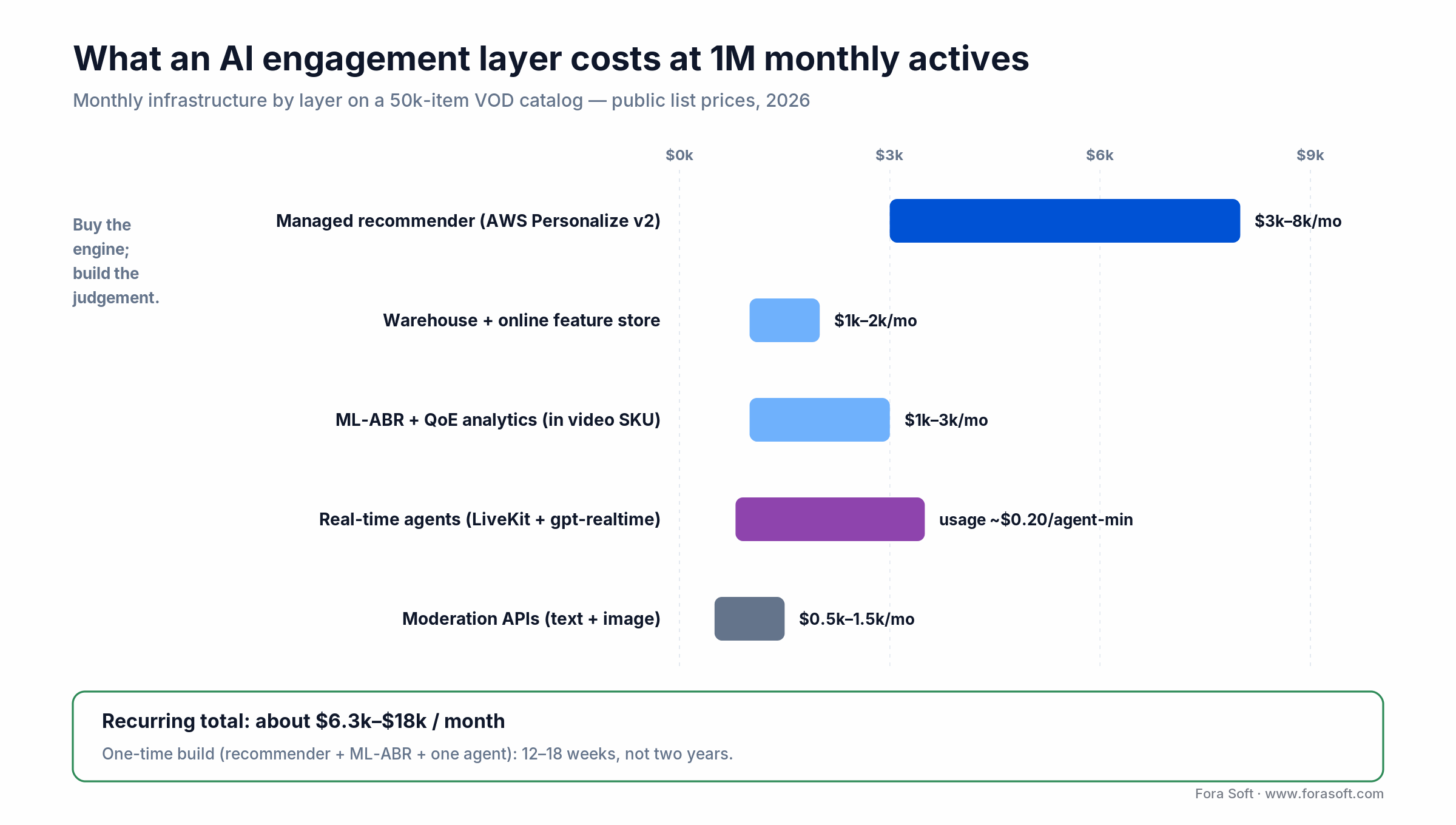
Figure 3. Monthly infrastructure by layer at 1M actives — a worked example, not a quote.
Recurring infrastructure (per month)
- Managed recommender (AWS Personalize v2): ~$3k–$8k at this scale, heavy on inference requests at $0.15 per 1k.
- Warehouse + feature store: ~$1k–$2k (BigQuery plus managed Redis).
- ML ABR + QoE analytics: usually bundled into a Mux or Bitmovin SKU; allocate ~$1k–$3k incremental.
- Agent runtime (LiveKit Cloud + gpt-realtime / Deepgram / ElevenLabs): usage-based; budget ~$0.20 per agent-minute (gpt-realtime audio runs $32/$64 per 1M input/output tokens; Deepgram Nova-3 streaming ~$0.0077/min).
- Moderation APIs: ~$0.50–$1.50 per 1k text or image calls.
That lands the recurring bill around $6.3k–$18k a month at 1M actives — a rounding error against the CDN and content spend it protects.
One-time build
An Agent-Engineering team using modern AI-assisted workflows delivers a first-production engagement stack (recommender live, ML ABR wired in, one agent use case) in roughly 12–18 weeks for a typical mid-size platform. If the team you’re talking to quotes two years for this scope, they’re pricing a rewrite you don’t need. For a fuller breakdown across scopes, see video streaming app development cost.
Mini case: Worldcast Live — latency as the engagement feature
Situation. Worldcast Live needed to stream HD concerts with true interactivity (chat, tipping, multi-camera switching, pay-per-view) at concert scale. Competing platforms ran RTMP-over-HLS with 30–60 second delays, which killed any chat-to-stage interaction. When the crowd reacts a minute late, the “live” feeling is gone and so is the engagement.
Plan. We built a WebRTC pipeline on Kurento media servers with adaptive bitrate, 1.5 Gb/s HD audio-video, picture-in-picture and multi-camera, an embeddable player (including a WordPress plugin), and a Multiple Venue Streaming feature that broadcasts to 20+ external sites at once. On top of the stream we layered moderation and a chat experience tuned for sub-second turn time.
Outcome. End-to-end latency of 0.4–0.5 s at up to 10,000 concurrent viewers. Tips, chat, and multi-camera switching became usable during a live event, not after it. The platform now runs Miami Carnival-scale festivals alongside church services and independent concerts. Want a similar assessment for your stack? Book a 30-min live-streaming review.
5 pitfalls that kill AI engagement projects
1. Shipping personalization before telemetry. A recommender is only as good as the events it trains on. If play, pause, seek, rate, and completion signals aren’t instrumented cleanly, you’ll spend six months tuning a model on noise. Ship the event schema and a four-week backfill before the model.
2. Ignoring cold start. New users have no history; new titles have no co-views. The fix is hybrid: content-based retrieval plus a “trending / new / critics’ picks” shelf, and a social-login or three-question onboarding signal to seed taste in one step. Pure collaborative filtering fails on launch day and keeps failing on every new release.
3. Letting the filter bubble harden. Rankers that chase only short-term click-through collapse catalog diversity. Reserve 10–20% of every list for diversity, serendipity, and business-rule injection, and track “unique items in a user’s top-10 per week” as a diversity KPI.
4. Treating compliance as an afterthought. EU rules touch every layer — GDPR consent, the AI Act’s transparency duties, and the AVMSD European-content quota. Design for granular consent and EU data residency on day one; retrofitting it after launch is the expensive path.
5. Confusing AI features with AI content. Use AI to personalize, surface, and moderate the best human-made content — recommendations, chapters, thumbnails, highlights. Replacing the content itself with generated video is a different, riskier bet, and the audience usually notices.
KPIs: how to tell the engagement layer is working
Quality KPIs. p95 video startup under 3 s; rebuffer ratio under 0.5%; VMAF above 90 on premium SKUs. On our client telemetry, every extra 1% of rebuffer time costs roughly 2% of session duration — quality is the engagement KPI with the highest payoff, not a backend footnote.
Business KPIs. Home-screen click-to-play; average session duration; 7/30/90-day retention; recommendation acceptance (share of plays that start from a recommender slot); revenue per session. A well-tuned recommender should drive more than half of plays within 90 days, with a 30-day retention delta of at least a few points versus a non-personalized cohort.
Reliability KPIs. p99 recommender latency under 150 ms; feature freshness under 5 min; moderation action latency under 500 ms. If p99 crosses 250 ms, the uplift from personalization is being eaten by the time-to-first-frame penalty it adds.
Want a KPI audit on your live platform?
We’ll review your QoE and recommender telemetry for 30 minutes and flag where the engagement is leaking: latency, cold start, ranking, or ABR.
When NOT to build an AI engagement layer
If your catalog is small (under ~2,000 items) and editorial, a curated home page with a “recently added / for you” split out-performs a naive ML ranker for the first year. If your audience is under ~50k monthly actives, a recommender’s cold-start tax eats the uplift — spend on content and UX first. And if you’re pre-product-market-fit, every hour on a recommender is an hour not spent validating the content proposition; hold the AI layer until you have a retention baseline worth improving. Honest sequencing beats a shiny model that arrives too early.
A decision framework — pick your stack in five questions
Order the roadmap by return per engineering week. The tree below is the same one we walk through on a scoping call; the five questions under it are the tie-breakers.
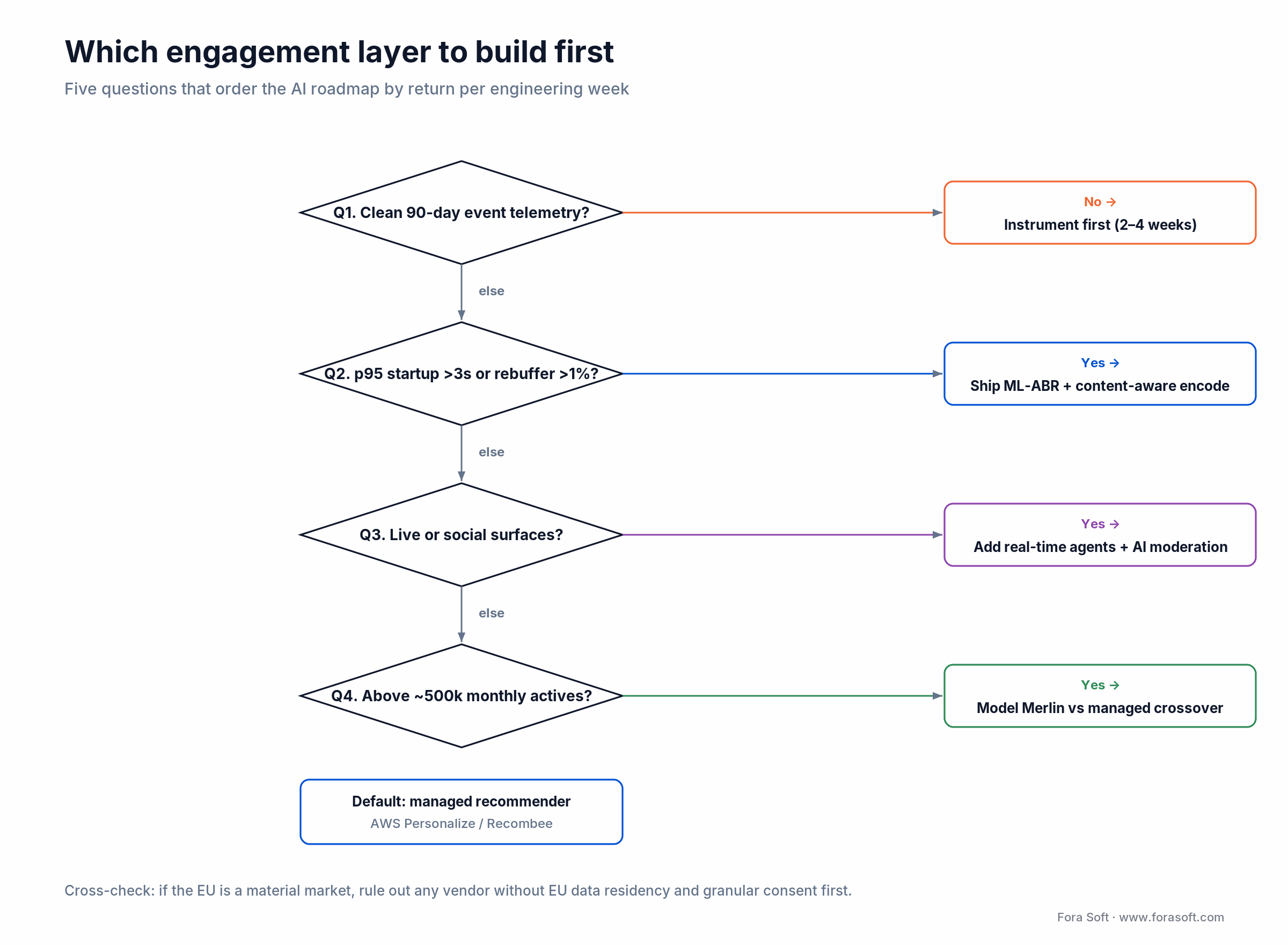
Figure 4. Which engagement layer to build first, ordered by return per engineering week.
Q1. Do you have clean event telemetry for the last 90 days? If not, any recommender underperforms — instrument first. That’s a 2–4 week fix, not a quarter-long project.
Q2. Is latency your current failure mode? If p95 startup is >3 s or rebuffer is >1%, ship ML ABR and content-aware encoding before a recommender — you’ll recover more watch time per week.
Q3. Do you have live or social surfaces? If yes, real-time interactivity (moderation, agents, live Q&A) is a higher-ceiling bet than recommendations alone.
Q4. Is your monthly active base above ~500k? Below that, favour managed recommenders. Above it, start modelling the NVIDIA Merlin versus managed-pricing crossover.
Q5. Is the EU a material market? If yes, rule out any vendor that can’t do EU data residency and granular consent, even if it’s cheaper. Compliance debt compounds faster than any engagement uplift.
Security, privacy, and model governance
GDPR and automated decisions. Ordinary content personalization usually falls outside GDPR Article 22, which only bites when a decision is solely automated and has legal or similarly significant effects — a recommender surfacing your next episode normally isn’t that (UK ICO guidance). You still owe transparency and a lawful basis, so offer granular consent and a “turn off personalization” toggle.
EU AI Act timeline. After the Digital Omnibus (Council’s final green light, 29 June 2026), the dates that matter are: prohibited-use rules since 2 February 2025; transparency duties (Article 50) from 2 August 2026, with machine-readable marking allowed a grace period to 2 December 2026; and high-risk obligations pushed to 2 December 2027 (Annex III) and 2 August 2028 (Annex I). Engagement recommenders aren’t high-risk today, but agent-mediated coaching or health content can be — scope it before you ship.
Data residency and on-device options. Keep EU user data in EU regions end-to-end — event bus, warehouse, feature store, inference. For children’s content, health, or other sensitive verticals, federated learning or on-device ranking (Core ML, LiteRT) is a legitimate privacy posture and speeds cold-start recovery on returning devices.
Model governance. Every production model needs a model card, an offline eval suite, a rollback plan, and a bias check against protected classes. Treat models as artifacts with a change-review process, not code paths you edit live. Our AI integration team ships this as standard.
Integration playbook: the 12-week path
Here’s the plan we ship most often when a streaming client wants AI engagement on a tight clock. It assumes an Agent-Engineering-enabled team of 3–4 engineers, one ML engineer, one QA, and a designer on demand.
| Phase | Weeks | Key deliverables |
|---|---|---|
| Telemetry & schema | 1–2 | Event schema, backfill, warehouse load, baseline dashboards |
| Recommender v1 | 3–6 | Managed recommender integration, home-screen A/B behind a flag |
| Quality layer | 5–8 | ML ABR flip, content-aware encoding on top 20% of catalog, QoE dashboard |
| Interactivity v1 | 7–10 | AI moderation, live polls/Q&A, one LiveKit agent use case in staging |
| Hardening & rollout | 10–12 | Full A/B readouts, runbook, rollback paths, model governance |
| Optimization | 13–18 | Ranker retraining cadence, second agent use case, cost tuning |
Where AI engagement is heading in 2026–2027
Agentic streaming. The voice-host pattern (an agent that narrates, picks what’s next, and converses) is migrating from audio into video. Tutoring apps, meditation platforms, and live-shopping products will ship it first. LiveKit Agents, Pipecat, and Vapi are converging on the reference stack.
Media over QUIC plus on-device ranking. MoQ collapses the live-versus-on-demand split and brings sub-second latency to the default delivery path; it’s an active IETF working group with no published RFC yet, so treat it as roadmap, not production. Paired with on-device ranking for privacy-first markets, “the edge is the experience” becomes table stakes.
Multimodal recommenders. Visual embeddings from the first seconds of a video, plus audio fingerprints, plus transcripts, plus interaction sequences — all in one embedding space. That’s where the public research lines point, and it’s reachable for mid-size teams as Merlin-class tooling matures. Our streaming monetization guide covers how these signals turn into revenue.
FAQ
What are AI user engagement tools for streaming?
They’re three cooperating layers: a recommender that decides what to show, an ML quality/adaptive-bitrate layer that decides how to show it, and a real-time interactivity layer (moderation, polls, voice agents) that reacts to what viewers do. Together they lift watch time and retention; separately, each solves a different failure mode.
How much engagement lift should we realistically expect from a recommender?
On a mid-size VOD platform moving from editorial to personalized home screens, a solid double-digit lift in session duration and click-to-play within a quarter is the usual band we see. The Netflix-style 80% of watched hours takes years of data and tuning — treat it as a ceiling, not a first-year target.
Is AWS Personalize the right first pick for a recommender?
For AWS-native shops under ~5M daily actives, yes: time-to-production beats every in-house alternative. Above that scale, the v2 per-request inference billing ($0.15 per 1k) becomes painful and NVIDIA Merlin or a Vertex-custom stack starts to win on total cost.
What’s the minimum telemetry a recommender needs?
Start, pause, seek, completion, rating or like, plus item metadata and a stable user ID. Device, geo, and time of day are strong secondary features. Ninety days of clean data is a solid starting point; thirty is the absolute floor.
How do we solve cold start for new users?
Use a hybrid strategy: content-based retrieval over item embeddings plus a “trending / popular / critics’ picks” shelf. Seed taste from social-login signals where possible, and ask two or three preference questions at onboarding — that’s enough to bootstrap collaborative filtering.
Do AI engagement tools conflict with GDPR?
Not inherently. Ordinary recommendation usually sits outside GDPR Article 22 (solely-automated decisions with significant effects), but you still need a lawful basis, granular consent, an opt-out of personalization, and EU data residency. A clean consent layer plus EU-region deployment solves most of it; federated learning helps in sensitive verticals.
What’s the difference between ML ABR and regular ABR?
Classic ABR uses hand-tuned rules (buffer thresholds, throughput estimates) to pick bitrates. ML ABR trains a reinforcement-learning policy on real QoE outcomes; MIT’s Pensieve reported 13–25% QoE gains over the best heuristics. If you’re already on a managed video stack, it’s often a feature flag away.
How long does it take to integrate an engagement layer end-to-end?
A three-layer first release (recommender live, ML ABR on, one agent or moderation use case) lands in 12–18 weeks with a modern Agent-Engineering team. Multimodal ranking, second agent use cases, and deeper personalization add another two or three quarters.
What to read next
Recommenders
AI Content Recommendation Systems
Cascade architecture, ranker choices, and compliance for video platforms.
Architecture
AI-Based Video Streaming Development
End-to-end architecture from capture to compliance for 2026.
Agents
Multimodal AI Agents on LiveKit
Ship voice and vision agents that join rooms with sub-250 ms latency.
Monetization
8 AI Monetization Methods for Streaming
SSAI, churn ML, shoppable video, and dynamic pricing for 2026.
Costs
Video Streaming App Development Cost
MVP to enterprise — what it really costs to ship a streaming product.
Ready to ship engagement that actually moves retention?
The user engagement tools that matter for streaming aren’t a product category — they’re a stack. Instrument telemetry. Ship a managed recommender. Flip on ML ABR. Layer in moderation and a first live-agent use case. Then, and only then, start optimizing.
Done well, this is a 12–18 week path to a measurably better platform. Done badly, it’s a two-year rewrite. Fora Soft has shipped this shape of project across concerts, VOD, LMS, and social video — and we’re glad to map the path for your product before you sign anyone’s contract, including ours.
Talk to a senior engineer about your AI engagement roadmap
30 minutes, real answers, no pitch deck. We’ll sketch the recommender, ABR, and agent plan that fits your stack and budget.

