


Key takeaways
• AI-powered multimedia solutions are software systems that generate, analyze, enhance, or personalize video, audio, image, and text content. They replace manual workflows that used to cost USD 1,000–5,000 per minute of video with pipelines that run at USD 0.50–30 per minute — a 90–99% cost collapse.
• The core stack is five layers. Computer vision, speech-to-text/text-to-speech, generative models (text-to-video, text-to-image, voice cloning), recommendation engines, and content moderation — wrapped in a streaming or CMS delivery layer around them.
• Start with managed APIs, not custom models. AWS Rekognition, Azure Video Indexer, Google Vertex AI, AssemblyAI, and OpenAI Realtime ship in weeks. Custom training is worth it only when volume, latency, or data residency force you off managed services.
• The highest-ROI use cases today are VoD personalization, e-learning content generation, live translation, content moderation at scale, and AI-assisted sales or debate platforms. Each has a working Fora Soft reference shipping in production.
• The real risk is mismatched training data, not model quality. A video model trained on YouTube news will fail on medical imaging. Pick vendors whose training domain matches your content, and keep a human-review loop in production.
Why Fora Soft wrote this playbook
Fora Soft has been building multimedia software since 2005, with 250+ projects across 21 years. We ship WebRTC video platforms, AI-assisted streaming products, e-learning systems, video surveillance solutions, and real-time translation platforms. This playbook is not theory; it is the map our engineers use when a prospect asks “can AI help us ship this faster or cheaper?”
The numbers behind our claims are real. BrainCert, a WebRTC-powered virtual classroom we built, delivers 500M+ minutes of live video per year for 100K+ customers across 10 datacentres. Sprii, a livestream-commerce platform, has generated €365M+ in sales and 72K+ live events. VOLO, our real-time AI translation engine, served 22K attendees at Black Hat Briefings 2025 with instant QR-code subtitles and voiceovers. Each of these systems uses AI at the core — not as a marketing label, but as the piece doing the work.
We use an Agent Engineering workflow internally, which means the same problem that took a 4-engineer team six weeks to scope in 2022 is now shipped in 2–3 weeks by the same team with AI pair programming and spec-driven agentic workflows. Your estimate should be faster and cheaper than a 2022 industry benchmark — ask any vendor why theirs isn’t.
Scoping an AI multimedia product?
Bring us the idea and the data you have. In 30 minutes we’ll tell you which pieces are already solved by managed APIs, which need custom work, and what a realistic Agent-Engineering budget looks like.
What an AI-powered multimedia solution actually is
The term is wide enough to hide almost anything, so let’s pin it down. An AI-powered multimedia solution is a software system that applies machine-learning models to one or more of: video, audio, still images, or text, to generate new content, extract structured signals from existing content, enhance quality, or personalise delivery.
Five technical layers usually sit inside the product:
1. Computer vision. Object detection, facial recognition, scene understanding, activity classification, semantic segmentation. This is what powers surveillance analytics, sports highlight reels, and automatic video tagging.
2. Speech and language. Automatic speech recognition (ASR), text-to-speech (TTS), voice cloning, speaker diarisation, sentiment analysis, captioning. This is what turns raw audio into searchable transcripts and live subtitles.
3. Generative models. Text-to-image (Midjourney, DALL-E, Stable Diffusion), text-to-video (Sora 2, Veo 3, Runway, Pika), voice synthesis (ElevenLabs, Cartesia), and multimodal LLMs (GPT-5, Gemini 3, Claude Opus 4). These turn prompts into net-new content.
4. Recommendation and personalisation. Collaborative filtering, content-based ranking, reinforcement-learning bandits that decide what each user sees. This is the Netflix-style algorithm powering VoD and e-learning catalogues.
5. Content moderation and safety. Automated classifiers that flag explicit imagery, hate speech, misinformation, deepfakes, or copyright infringement, usually at scale across user-generated content streams.
Around those five cores sits a delivery layer — streaming (HLS, DASH, WebRTC), CDN, storage, encoding/transcoding, and a product front-end. A real AI multimedia product is 20% model, 80% pipeline.
Market snapshot: where the money is moving in 2026
The generative-AI media market was worth about USD 63B in 2025 and is projected to reach USD 356B by 2030 (~41% CAGR), per Grand View Research and late-2025 industry trackers. The table below frames whether the category is small, growing, or saturated — useful when you brief a CFO.
| Segment | 2025 value | 2026–2030 trajectory | Where growth comes from |
|---|---|---|---|
| AI video generation | ~USD 790M | USD 3.4B by 2033 (~20% CAGR) | Social, marketing, short-form video, explainers |
| Generative AI media (all) | ~USD 63B | USD 356B by 2030 (~41% CAGR) | Text, image, audio, video combined |
| ASR / speech recognition | ~USD 27B | ~17% CAGR | Captioning, call analytics, voice UX |
| AI-driven streaming ops | Embedded | 20%+ opex savings for OTT | Encoding, bitrate, moderation, personalisation |
| Adoption rate | 71% of orgs use genAI for content | 40% productivity gains reported | Enterprise content, training, marketing |
The honest takeaway: the infrastructure category is growing double-digit but commoditising fast. Your defensibility as a product comes from workflow and integration, not from the raw model.
Core benefits that actually show up in P&L
The single biggest line item AI moves is production cost, dropping from USD 1,000–5,000 to USD 0.50–30 per finished minute. Four more savings land below; here is where each one shows up in a real operations budget, not a generic “AI improves efficiency” pitch.
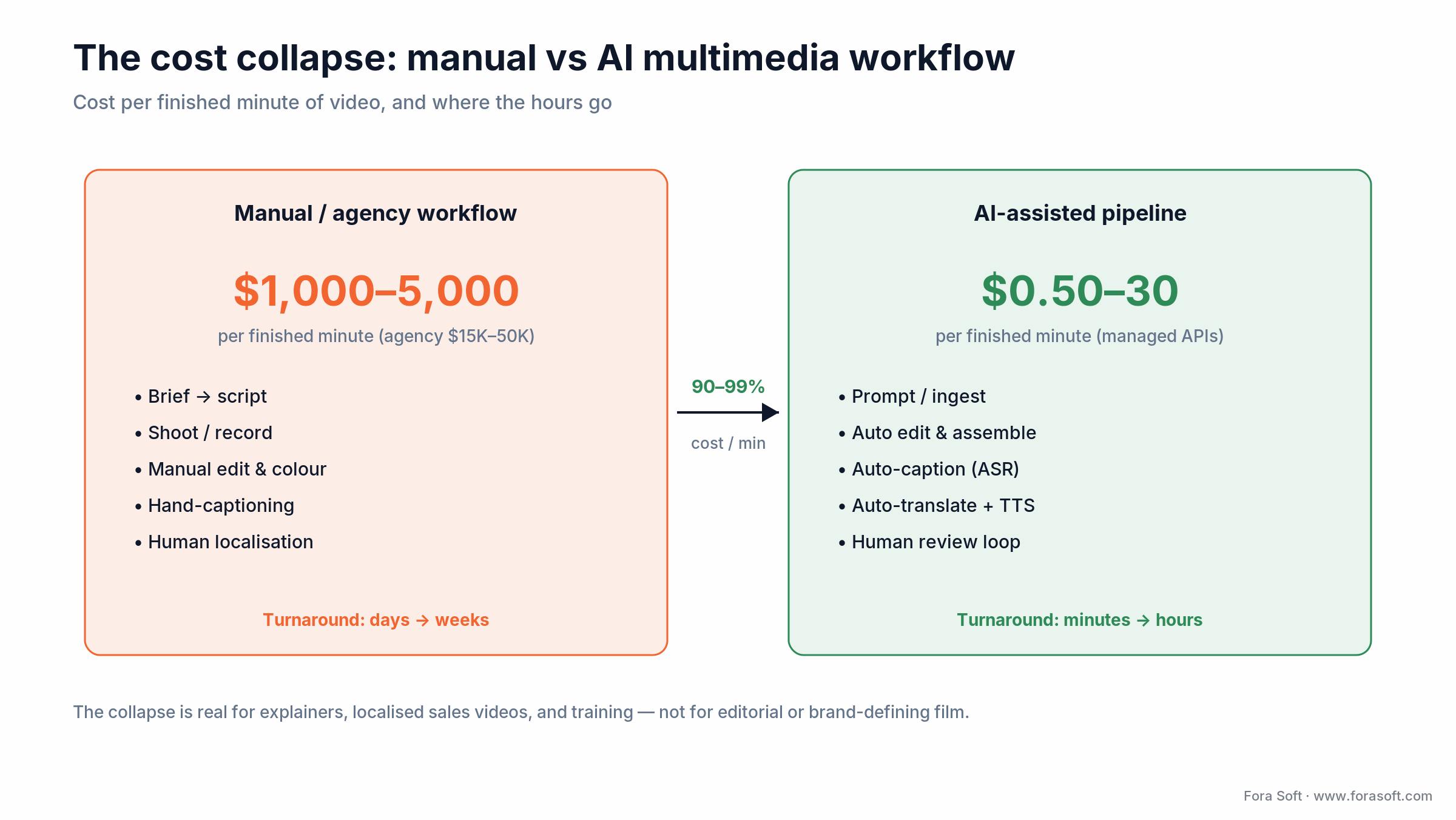
Figure 1. The cost collapse is real for explainers, localised sales videos, and training — not for editorial or brand-defining film.
1. Production cost collapse. A minute of brand video from an agency runs USD 15,000–50,000. A minute from a senior freelancer runs USD 1,000–5,000. A minute generated by a text-to-video platform like Runway or Synthesia runs USD 0.50–30. For explainers, localised sales videos, and internal training, the 90%+ cost cut is not marketing — it is documented in public case studies.
2. Automation of repetitive editing. AI systems can automate up to 70% of trimming, cutting, transition, colour-correction, and subtitle work. Our client ShortKlips pipes Amazon Transcribe into a collaborative editing front-end and eliminates manual captioning in 30+ languages — Nokia and The World Bank ship with it.
3. Encoding and bandwidth savings. AI-driven adaptive bitrate and perceptual-quality encoders cut 20–30% of CDN spend for OTT platforms at steady quality. For a platform streaming 100M minutes/month, that’s the difference between a five- and a six-figure bandwidth bill.
4. Personalisation lift. Netflix-style recommendation is worth 20–30% more watch time per user in a VoD catalogue. For commerce, livestream shopping platforms like Sprii report up to 20x conversion on stream-linked product overlays compared with flat catalogue pages.
5. Accessibility and reach at no marginal cost. Auto-transcription and live translation turn a single English livestream into a multilingual event. TransLinguist, the UK NHS-approved interpretation platform we built, supports 62 languages with real-time speech-to-speech in 16+ of them; clients report up to 1.5x revenue growth from global reach.
Applications by industry, with the operating pattern
Every vertical has one or two multimedia-AI patterns that move the numbers. Below are the ones we have shipped or seen ship — not the speculative ones.
Streaming and video-on-demand
Auto-tagging for scene-level search, perceptual-quality encoding, recommendation engines, and UGC moderation. Our Vodeo platform for Janson Media Group is a Netflix-style iOS app with 100K+ users; adaptive streaming at 480p–1080p, AirPlay/Chromecast, chunked S3 upload of full features, curated collections and recommendations across 24 genres, all built on the rental + in-app-currency model for independent filmmakers.
Reach for AI-driven VoD when: your catalogue is 200+ hours, your retention comes from discovery rather than a single tentpole title, and your encoding bill is visible in the P&L.
E-learning and corporate training
Text-to-video for explainers, auto-captioning, AI-generated knowledge checks, personalised learning paths, and live virtual classrooms. BrainCert delivers 500M+ minutes of virtual classroom per year to 100K+ customers across 10 datacentres, with interactive whiteboarding, LaTeX and Wolfram Alpha integration, SCORM/xAPI, and cloud DRM recording — four-time Brandon Hall Award winner. See also our blog on integrating AI into e-learning software.
Reach for AI e-learning when: content shelf life is short, learners are distributed across languages, or you need assessments graded at scale without 1:1 instructor time.
Video surveillance and industrial safety
Real-time anomaly detection, PPE compliance, intrusion alerts, and multi-camera scene synthesis. See our deeper pieces on industrial video surveillance AI and IoT + video surveillance integration for the operating stack.
Real-time translation and interpretation
ASR + MT + TTS chained in sub-second latency, with optional human fallback. VOLO uses Speechmatics and Google Cloud ASR over a WebSocket backend with a Next.js + NestJS front end; it shipped instant subtitles and voiceovers for 22K Black Hat 2025 attendees via a simple QR code. For the hybrid-quality playbook see hybrid human-AI translation.
AI sales, meeting, and conversation analytics
Speech diarisation, sentiment, talk-time balance, pitch scoring, CRM auto-fill. Meetric, the Swedish SEK 21M-funded platform we built, reports 25% higher close rates and 80–100% CRM data-entry automation. It integrates with Zoom, Google Meet, and MS Teams and does real-time attention/objection detection across multiple languages.
Livestream commerce
Real-time product overlays, adaptive bitrate, multi-channel syndication, AI-driven recommendations during the stream. Sprii handles 20x higher conversion than flat catalogues, has generated €365M+ in sales, sold 21M products, and hosted 72K+ live events — sellers see up to 200% revenue growth during active campaigns.
Voice AI and conversational experiences
Voice agents, IVR replacement, AI concierge, and hybrid SIP/WebRTC rigs for enterprise telephony. The playbook is in integrating OpenAI Realtime API with WebRTC, SIP and WebSockets.
Vendor map — what to reach for, by job
There is no single “AI multimedia vendor”. You compose the stack from specialists. This is the shortlist we return to in real scoping calls.
| Job | Managed API pick | Open / self-host pick | Rough public price |
|---|---|---|---|
| Video analysis / tagging | AWS Rekognition, Azure Video Indexer, Google Vertex AI | YOLO11, MMAction2, CLIP | ~USD 0.05 / min of video |
| Speech-to-text | AssemblyAI, Google Speech, AWS Transcribe, Deepgram | OpenAI Whisper, NVIDIA Riva | USD 0.004–0.015 / min |
| Text-to-speech / voice | ElevenLabs, OpenAI TTS, Google Cloud TTS | Piper, XTTS, Bark | USD 0.10–0.30 / 1K chars |
| Text-to-video generation | Runway, Synthesia, HeyGen, Pika, Luma | Open-Sora, Stable Video Diffusion | USD 10–400 / month plan |
| Real-time video AI (noise, relight, avatars) | NVIDIA Maxine, Daily.co effects, Agora AI | Mediapipe, ONNX Runtime models | Bundled with streaming SDK |
| Streaming + AI encoding | Mux, Bitmovin, Cloudinary | FFmpeg + custom ABR | Usage-based per minute / GB |
| Content moderation | AWS Rekognition Content Moderation, Hive, Sightengine | CLIP classifiers, NSFWJS | USD 0.001–0.01 / image or min |
Not sure which vendor fits your content?
Send us a 2-minute sample of your real footage, audio, or user data. We’ll benchmark it against three managed APIs and send back confidence scores, latency, and a cost projection at your volume.
Reference architecture: the five-layer pipeline
Every AI multimedia product we ship follows roughly the same shape. Swap components for your vertical; the layers and the data flow stay put.
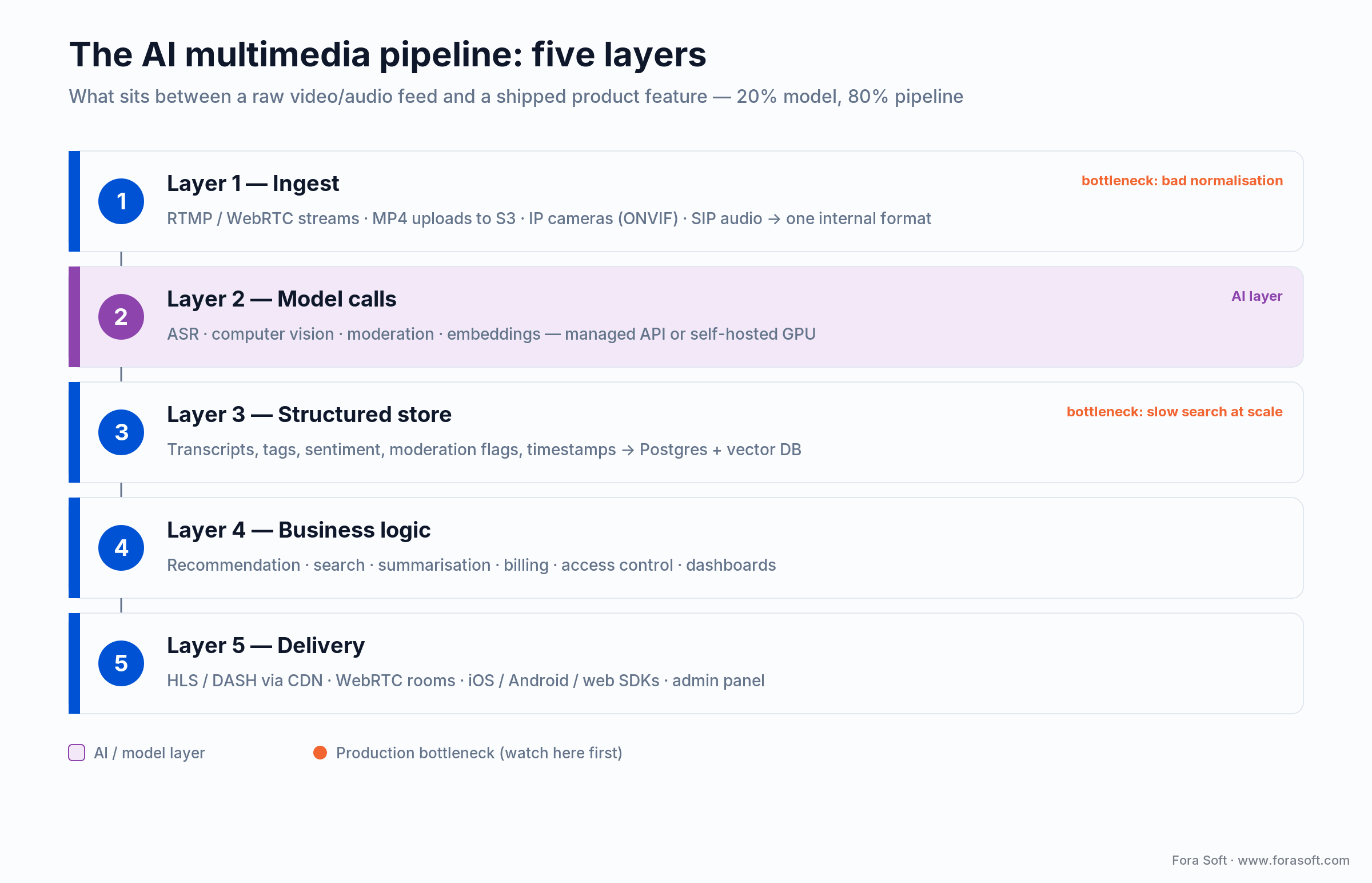
Figure 2. The five layers every AI multimedia product moves through. In production the bottleneck is almost always ingest normalisation (Layer 1) or search at scale (Layer 3), not the model.
Layer 1 — Ingest. Source feeds: RTMP/WebRTC streams, recorded MP4 uploads to S3/GCS, IP cameras via ONVIF, or SIP audio. Normalise to a single internal format.
Layer 2 — Model calls. Fan the stream out to the relevant AI services: ASR for audio, vision for video frames, moderation for both, embedding generators for later search. This is where you choose managed API vs. self-hosted GPU.
Layer 3 — Structured store. Transcripts, tags, sentiment, embeddings, moderation flags and timestamps go into Postgres + a vector DB (pgvector, Pinecone, Weaviate). This is the asset your product actually sells.
Layer 4 — Business logic. Recommendation rules, search, summarisation, billing, access control, live dashboards. Written in whatever your team already runs — Node, Python, Go.
Layer 5 — Delivery. HLS/DASH via a CDN, WebRTC for low-latency rooms, SDKs for iOS, Android, and web, plus an admin panel for moderation review.
The bottleneck in production is almost never the model. It is Layer 1 (bad ingest normalisation) or Layer 3 (slow search at scale).
Build vs. buy vs. integrate — how we actually decide
The default recommendation, for 9 out of 10 products, is: integrate managed APIs. Custom models are justified only under specific constraints. It is the same call we walk clients through in our AI software development engagements, and the mechanics of wiring a model into a live video product are in our guide to AI integration for video products.
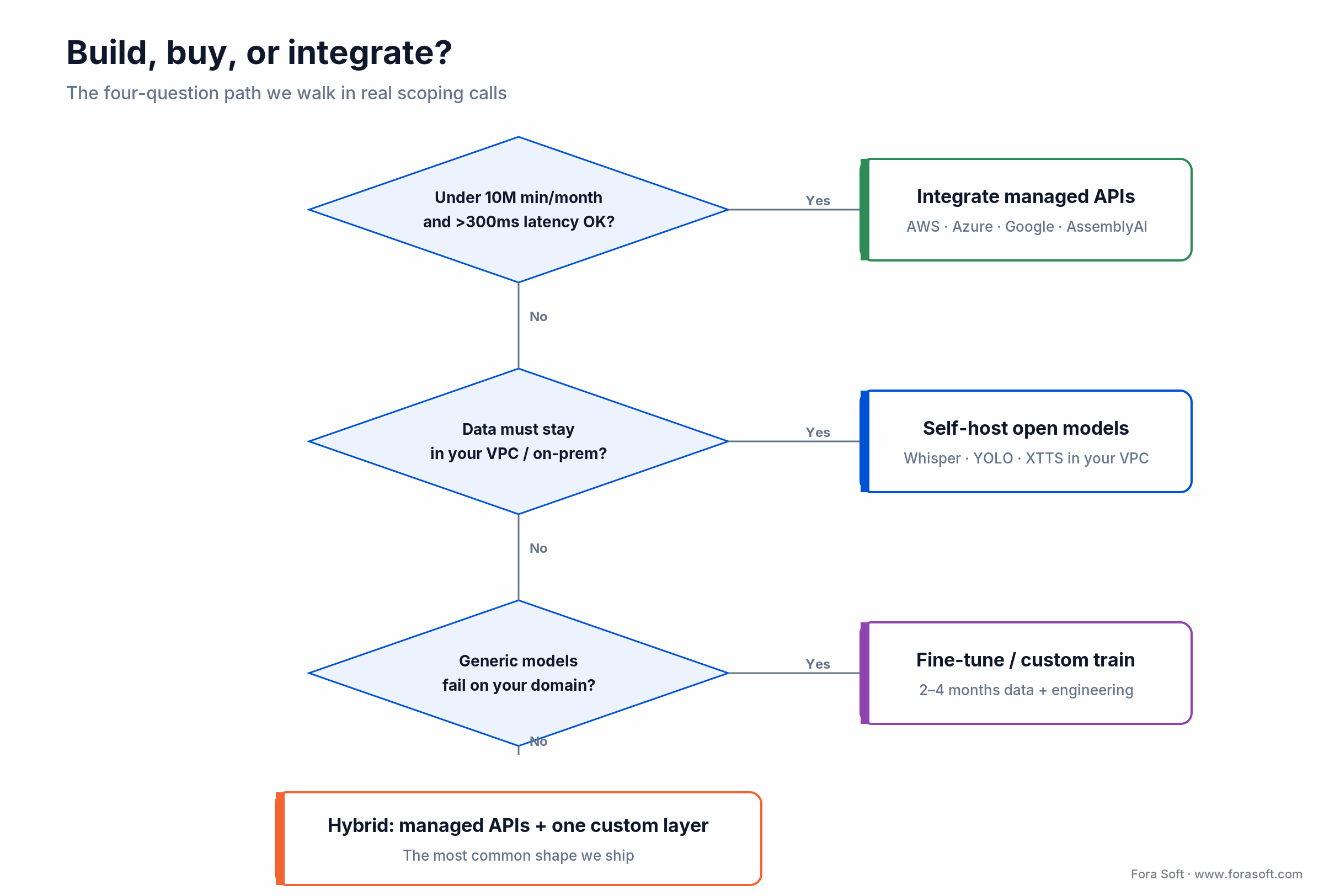
Figure 3. Four questions — volume, data residency, latency and domain fit — decide whether you integrate, self-host, fine-tune, or ship the hybrid we build most often.
Reach for managed APIs when: you are under 10M minutes/month, latency tolerance is >300ms, and your data is not under strict residency rules (HIPAA, GDPR health, defence).
Reach for self-hosted open-source models when: you are above 50M minutes/month, need sub-100ms latency, or must keep data inside your VPC. Whisper, YOLO, and XTTS all run well on mid-range GPUs.
Reach for custom training or fine-tuning when: generic models fail on your domain. Medical imaging, rare languages, niche industrial machinery, proprietary sports footage. Expect 2–4 months of data work plus engineering.
Reach for a hybrid (APIs + custom layer) when: your product is 80% commodity AI (ASR, moderation) and 20% differentiated (a proprietary classifier that is the product). This is the most common shape we ship.
Cost model — a worked example at three volumes
Below is a simplified monthly operating-cost model for a video platform doing ingest + transcription + moderation + recommendation. Infrastructure priced on Hetzner dedicated servers and Cloudflare, AI on managed APIs. Figures are directional, not quotes.
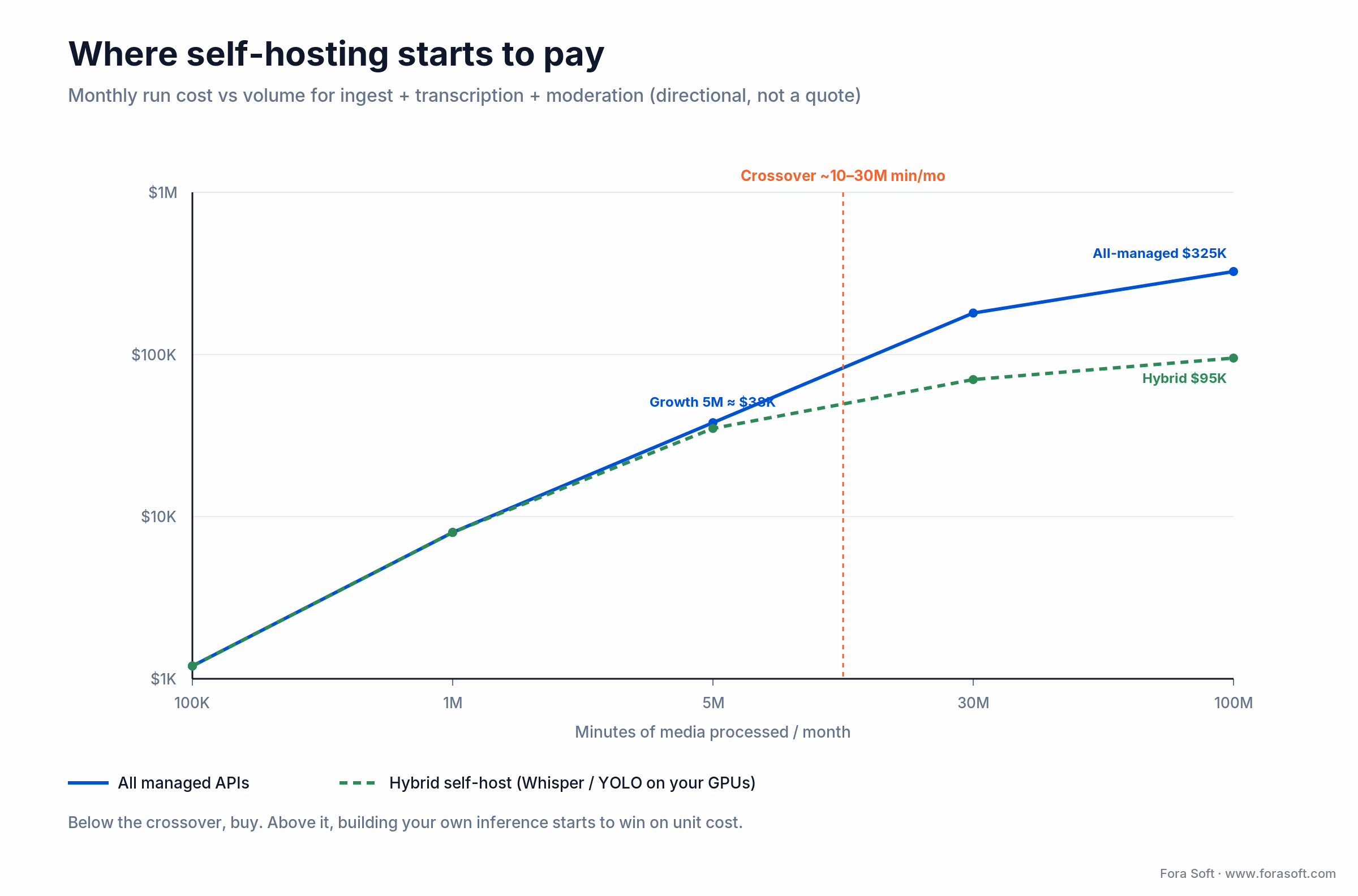
Figure 4. The two cost lines track together until roughly 10–30M minutes/month; past the crossover, moving ASR and vision onto your own GPUs is what keeps the bill flat.
| Volume tier | Minutes / month | Infra ~USD | AI APIs ~USD | Total ~USD |
|---|---|---|---|---|
| Pilot / MVP | 100K | ~300 | ~900 | ~1.2K |
| Growth | 5M | ~2.5K | ~35K | ~38K |
| Scale | 100M | ~25K (hybrid self-host) | ~300K if all managed, ~70K hybrid | ~95K hybrid |
At 5M minutes/month expect roughly USD 38K total per month; at 100M minutes/month, about USD 95K/month on a hybrid self-hosted setup versus ~USD 325K/month if everything stays on managed APIs. The cross-over between “all managed” and “hybrid self-hosted” usually lands between 10M and 30M minutes/month for ASR, and higher for vision. Below the line, buy. Above, build.
A decision framework — pick your stack in five questions
1. How much content, how fast? If you are under 10M minutes/month and tolerant to 300ms latency, managed APIs are always the right starting point. Skip the custom-model debate.
2. Where must the data stay? Health, defence, and finance often cannot send raw video or audio to third-party clouds. Self-hosting or on-prem is not a preference; it is a constraint.
3. What latency does the user notice? A 2-second delay is fine for batch transcription. It is catastrophic for live interpretation or AI avatars. Latency SLA dictates which vendors even qualify.
4. How distinctive is your data domain? If your content is mainstream English video, off-the-shelf models work. If it is Arabic medical imaging or Kazakh courtroom audio, expect a fine-tuning step.
5. Where is your team strong? If you have no ML engineers, do not buy a GPU cluster. Managed APIs + a senior Python dev will outperform a self-hosted stack without an MLOps lead.
Mini case — VOLO, real-time AI interpretation at Black Hat 2025
Situation. A conference operator needed live multilingual interpretation for 22K attendees at Black Hat Briefings 2025. Hiring 40+ human interpreters was off-budget; existing AI interpretation products were not browser-native and required per-attendee app installs.
Plan. We built VOLO: Speechmatics + Google Cloud ASR fanned into a WebSocket pipeline, MT via a cascading LLM chain, TTS via ElevenLabs for voiceover and live HTML subtitles for read-only. Attendees scanned a QR code; everything ran in their browser. Spec was agent-driven, shipped in weeks, not months.
Outcome. Instant language switch at the row level, zero app installs, graceful fallback when the ASR confidence dropped, plus an interpretation experience measurably faster to activate than the human-only baseline. Want a similar scoping? Book a 30-minute call and we’ll walk you through the architecture.
Five pitfalls that sink AI multimedia projects
1. Picking a model by brand, not by training domain. A text-to-video model trained on cinema will disappoint on surgical tutorials. A speech model trained on US English will disappoint on Gulf Arabic. Match training domain to content before you shortlist.
2. Treating confidence scores as binary. Every major API returns a probability (“92% likely a weapon”, “88% likely English”). Shipping without a review threshold and a human-in-the-loop path is how wrongful-takedown lawsuits happen.
3. Pricing pilots by the minute, production by the minute. Managed APIs scale linearly; at 100M minutes/month a USD 0.10/min service is a USD 10M/month line item, or USD 120M/year. Model the unit economics at production volume before you pick the vendor.
4. Ignoring rights and provenance. Who owns an AI-generated voice that sounds like a known actor? Who owns footage synthesised from your training data? If the answer is “we’ll figure it out later”, your enterprise buyer will refuse to sign.
5. Skipping the observability layer. Latency, failure rate, drift, per-tenant cost, and confidence distribution must be on a dashboard. Otherwise the day the vendor silently degrades — and they do — you find out from customers.
KPIs: what to measure after launch
Quality KPIs. Word error rate (WER) for ASR under 15% on your in-domain audio. Moderation precision/recall > 0.9 on flagged content. Recommendation click-through lift > 15% vs. a chronological baseline. Video encoding bitrate reduction at matched VMAF.
Business KPIs. Cost per minute of processed media. Watch time per user (VoD). Conversion lift from personalised recommendations. Revenue per live event (commerce). Support-ticket deflection (voice AI).
Reliability KPIs. P95 end-to-end latency under target. Per-region API error rate < 0.5%. Successful-transcription rate > 98%. Drift monitors on every model call — alert when confidence distribution shifts.
When NOT to deploy AI multimedia
AI is not a retrofit for broken product-market fit. Skip the AI layer when your content volume is under 50 hours/month, your audience is a single language, your differentiator is editorial voice, or your regulatory environment forbids automated classification of user content. In those cases a classic CMS + human editor will outperform any model pipeline on both cost and quality.
The other common “don’t”: a board-driven “we need AI in the product” mandate without a specific job to automate. AI is a tool, not a strategy. If you cannot describe the job in one sentence, delay.
Security, compliance, and rights management
AI multimedia products touch three classes of data that regulators care about: personal identifiable information inside video or audio, biometric signals (faces, voiceprints), and copyrighted content. The basics you must get right from day one:
1. HIPAA / GDPR / EU AI Act. If you process patient consultations, user profiles, or biometric identifiers, negotiate a BAA or DPA with every cloud vendor, or self-host. The EU AI Act’s high-risk obligations (including biometric categorisation) were deferred to December 2027 under the 2026 Digital Omnibus, while its ban on real-time public biometric identification has applied since February 2025 — scope compliance to the phase that actually hits you.
2. Data residency. Middle East, India, and Russia increasingly require data to stay in-country. Managed APIs that only serve from us-east-1 fail those audits.
3. Rights management and synthetic media labelling. If your platform generates voices or faces, you need consent records, watermarking, and a takedown workflow. Platforms without these are already seeing takedown litigation.
4. E2EE vs. AI processing. End-to-end encryption and cloud AI analysis are mutually exclusive on the same stream. Pick: either process in the clear at the edge/server, or move the AI inference onto the client device. For our Nucleus on-prem platform (SOC II, HIPAA, GDPR compliant) we shipped a hybrid where PII never leaves the client’s VPC.
How to start in 30 days — a pragmatic rollout plan
Week 1 — narrow the job. Pick one specific task: auto-captioning, moderation of UGC, personalised VoD rail, or live translation. Write the user story in a single sentence. Everything else is scope creep.
Week 2 — benchmark three vendors. For the job chosen, pick one cloud giant (AWS/Azure/Google), one specialist (AssemblyAI/ElevenLabs/Runway), and one open-source alternative (Whisper/YOLO/Coqui). Run them on a real 10-minute sample of your content. Record WER, confidence distribution, latency, cost at expected volume.
Week 3 — integrate the winner. Wire the chosen vendor into a feature flag inside your existing product. No public release yet. Add the five KPI dashboards (cost, latency, confidence, error rate, business metric).
Week 4 — canary to 10% and measure. Ship to a 10% cohort, compare KPIs to the control, and decide to promote, iterate, or kill. If you promote, write the runbook that covers vendor outages, confidence-score drops, and cost over-run alerts.
By day 30 you have one feature in production and three sets of benchmark numbers. That is the foundation for every next AI feature you ship on the same product.
Second-opinion on your current AI multimedia stack?
We’ll audit what you have, flag vendor lock-in, pricing cliffs, and latency traps, and give you a 90-day plan to cut cost or ship faster using Agent Engineering.
2026 trends worth pricing into your roadmap
Multimodal LLM agents. GPT-5, Gemini 3, and Claude Opus 4 now handle text + audio + video in one call. The interesting pattern is the agentic one: models plan, browse, generate, edit, and deliver, with a human approving at checkpoints. Our spec-driven agentic engineering piece goes into how we use this to ship video products faster.
Edge and on-device inference. Multimodal models at 4–12B parameters (Gemma 3, Qwen3-VL, Phi-4 Multimodal) now run on a single modern GPU or high-end mobile chip. Real-time moderation, live captioning, and privacy-sensitive workflows move out of the cloud.
Real-time AI avatars and voice cloning. ElevenLabs raised a USD 500M Series D at an USD 11B valuation in February 2026, with mid-2026 secondary talks near USD 22B; Synthesia and HeyGen have shifted corporate training and customer comms to generative avatars. Expect regulation around voice likeness in the EU and US — and the US NO FAKES Act — to bite in 2026.
Live translation becomes default. Sub-second speech-to-speech in 15+ languages is now production-viable. Conferences, webinars, support lines, and livestream commerce that do not offer it will lose audience share to the ones that do.
Compliance-grade AI. HIPAA, GDPR, and the EU AI Act push demand for self-hosted, auditable model pipelines. Managed-API-only stacks will be rejected by regulated buyers.
FAQ
What counts as an AI-powered multimedia solution?
Any software product that uses machine-learning models on video, audio, images, or text — to generate content, extract structure (tags, transcripts, sentiment), enhance quality, personalise delivery, or moderate at scale. The label covers everything from an auto-captioning button to a full Netflix-style recommendation engine.
How quickly can a small team ship a first AI multimedia feature?
With managed APIs and Agent Engineering we typically ship an auto-transcription, moderation, or recommendation feature inside a live product in 2–4 weeks. Full greenfield platforms with streaming + AI are 2–4 months to an MVP.
Do I need my own ML team?
For a managed-API-based product, no. A senior back-end engineer who has shipped against AWS/Azure/Google services is enough. You need ML specialists only for custom training, fine-tuning, or building novel model pipelines — which is where a partner like Fora Soft usually plugs in.
What about data privacy and compliance?
For healthcare (HIPAA), EU personal data (GDPR), or defence, either negotiate a BAA / DPA with the cloud vendor or self-host open-source models inside your VPC. Our Nucleus on-prem communication platform is a good reference for regulated-industry delivery.
How do I budget AI API cost for a growing product?
Estimate minutes of media processed per user per month, multiply by the blended per-minute cost (USD 0.01–0.10 for ASR + moderation + basic vision), and multiply by expected MAU. Add a 30% buffer for retries and over-runs. Above 10M minutes/month, revisit with a hybrid self-host scenario.
Should I pick AWS, Azure, or Google?
For broad video analysis and SDK coverage, AWS Rekognition. For out-of-the-box video insights and metadata for VOD, Azure Video Indexer. For multimodal custom models and YouTube-trained content, Google Vertex AI. In many products we mix: AWS for storage + vision, Google for speech, OpenAI/Anthropic for reasoning.
What KPIs should we track from day one?
Cost per processed minute, P95 latency, model confidence distribution, manual-review rate, and at least one business KPI (watch time, conversion, support deflection). Put them on the same dashboard so product and engineering see the same numbers.
Does Fora Soft build from scratch or integrate existing platforms?
Both, depending on the call. Most engagements start with us integrating managed AI APIs into the product, then progressively replacing commodity layers with self-hosted models as volume and compliance needs grow. Agent Engineering means our timelines and prices undercut 2022-era benchmarks.
What to Read Next
Streaming
AI Video Streaming Benefits for Enterprises
Six AI capabilities that actually move enterprise streaming economics — encoding, delivery, safety, engagement.
Voice AI
Integrating OpenAI Realtime API with WebRTC, SIP, and WebSockets
Practical patterns for voice AI in real-time products — from browser rooms to enterprise telephony.
Translation
Hybrid Human-AI Translation Services
When to combine machine MT with a human review step — the quality and cost crossover points.
Methodology
How We Use Spec-Driven Agents to Speed Up Video Development
The Agent Engineering workflow behind our faster-than-2022 estimates — with examples.
Surveillance
Industrial Video Surveillance AI: 5 Advanced Security Benefits
Anomaly detection, PPE compliance, and multi-camera synthesis inside manufacturing environments.
Ready to ship an AI multimedia product that actually pays off?
AI-powered multimedia solutions are past the hype curve and into the operating-budget line. The category is real, the cost collapse is real, and the highest-ROI use cases — VoD personalisation, e-learning content generation, live translation, content moderation, and AI-assisted meeting and commerce platforms — all have production references you can borrow from.
What decides success is not picking the fanciest model. It is matching the training domain to your content, starting with managed APIs, budgeting for unit economics at production volume, and putting a human review loop in front of every classifier that touches a user. That’s the playbook we use when we ship.
If you want a shortcut, bring us the shape of the product and we’ll tell you in 30 minutes which parts are off-the-shelf, which need custom work, and what a realistic Agent-Engineering timeline and budget look like for your volume.
Let’s scope your AI multimedia product together
30 minutes, no pitch deck. Bring a product idea, a sample of your content, or a current pain point. You walk away with a concrete architecture, a vendor shortlist, and a realistic timeline.

