

Key takeaways
• Delivery is the first problem, not AI. Enterprise video streaming lives or dies on getting one all-hands to 20,000 desks without melting the WAN. An eCDN with peer-assisted or multicast delivery cuts internal-event bandwidth by up to 99% (Hive Streaming, 2026).
• AI is six jobs, not one. Encoding, player-side adaptive bitrate, captioning and dubbing, moderation, recommendations, and frame-accurate video intelligence, each has its own return.
• Per-title AI encoding is the fastest payback. Bitmovin measured 22.7% bitrate savings at equal quality, and HEVC per-title reaches ~70% on some 1080p content (Bitmovin, 2025). For a $500k+ CDN bill, payback lands in 30–120 days.
• Compliance dates moved in 2026. EU AI Act transparency (Article 50) applies 2 Aug 2026; high-risk Annex III duties were deferred to 2 Dec 2027 by the Digital Omnibus. Plan to the real dates, not the old ones.
• Full year-one build lands near $1.1M for 2M viewers. Against $1.8–$4.2M in annualized value, the full AI layer pays back in 8–14 months. We show the arithmetic below.
Why Fora Soft wrote this guide
We've shipped video since 2005, WebRTC, HLS, DASH, CMAF, low-latency live, VOD catalogs, corporate video portals, telemedicine, e-learning, and surveillance. That's 21 years and 250+ delivered projects. Our VALT platform alone runs enterprise video for 770+ organizations and 50,000+ active users. So when we say enterprise video streaming is a delivery problem before it's an AI problem, it's because we've watched a badly-planned town hall saturate a corporate WAN in real time, live.
This guide is the buyer's map we wish existed: what enterprise video streaming actually is in 2026, how it reaches every desk, the six AI layers worth paying for, a real cost model, the compliance bar, and a 10-week rollout. Where we've shipped something, a 34% CDN cut for a sports OTT, live captioning for a global all-hands, we say so and show the numbers. Where a feature isn't worth it yet, we say that too.
If you'd rather talk through your own footprint than read 5,000 words, that's fair. Book a 30-minute scoping call with our CEO Vadim and we'll map your audience, content mix, and compliance bar to a concrete architecture.
Planning an enterprise video build?
We'll turn your audience size, content mix, and compliance bar into an honest architecture, cost, and timeline — no slideware.
What enterprise video streaming means in 2026
Enterprise video streaming is the practice of delivering video to a large, controlled audience — employees, customers, or students, with the security, scale, and analytics a business demands. It splits into two jobs. Internal streaming pushes town halls, training, and executive updates to thousands of people on a corporate network. External streaming powers customer-facing products: OTT services, e-learning platforms, product video, live events. The same platform often does both.
What changed by 2026 is that AI moved inline with the pipeline instead of running as a batch job after the fact: captions, moderation labels, and searchable embeddings are now produced at ingest, in well under a second per segment, rather than in a two-hour post-production pass. That single shift is why "video AI" is now a separate line item in Fortune 500 budgets.
Reach for a dedicated enterprise platform when: you stream to 500+ simultaneous internal viewers, carry regulated content, or need SSO, audit logs, and retention policies a consumer tool can't give you.
Below is the delivery model that makes internal enterprise video streaming possible at all. Skip it and your first company-wide broadcast becomes a helpdesk incident.
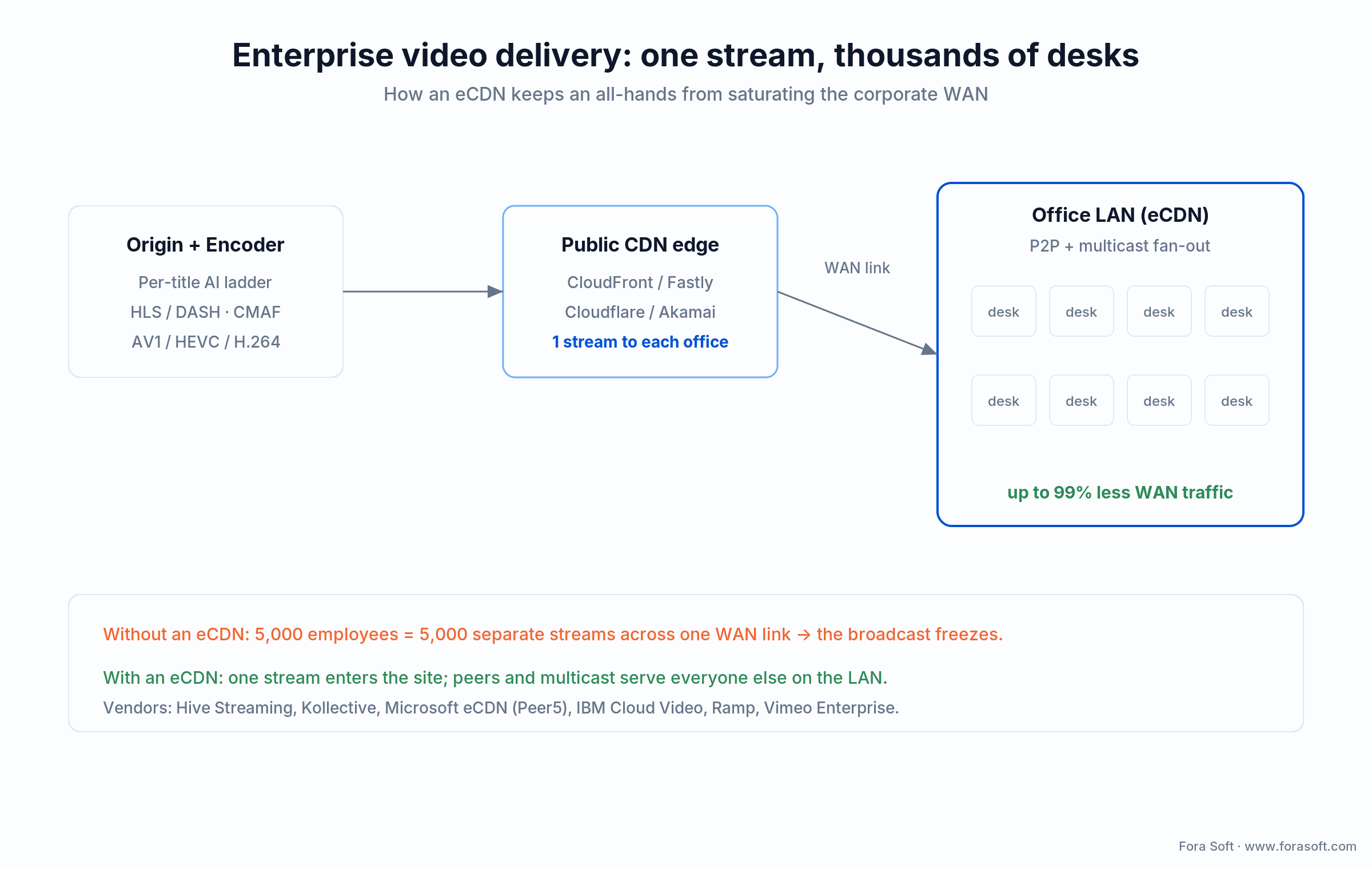
Figure 1. How one internal broadcast reaches thousands of desks without saturating the corporate WAN.
How enterprise video reaches every desk: eCDN, multicast, and P2P
The short version: a public CDN gets video to the edge of each office, and an enterprise CDN (eCDN) distributes it inside the building so 5,000 employees don't each pull a separate stream across a single WAN link. That's the difference between a smooth all-hands and a frozen one.
Three delivery methods do the internal work. Peer-assisted (P2P) lets browsers share segments with nearby colleagues on the same LAN; Hive Streaming reports up to 99% WAN bandwidth savings on large internal events (Hive, 2026). Multicast sends one packet stream that network switches replicate to many viewers, ideal where IT controls the network end to end. Edge caching parks content on an in-office appliance or software node. Most 2026 deployments blend P2P with a multicast fallback.
The eCDN vendors enterprises actually shortlist are Hive Streaming, Kollective, Microsoft eCDN (built on the Peer5 acquisition and native to Teams), IBM Cloud Video eCDN, Ramp, and Vimeo Enterprise's built-in eCDN. Microsoft Teams live events plug directly into Hive, Kollective, Ramp, or Riverbed, which is why so many corporate broadcasts run through Teams (Microsoft, 2026).
Reach for an eCDN when: a single site will have 200+ people watching the same live stream, or your WAN links to branch offices are already near capacity during business hours.
For external audiences, the delivery story is a standard public CDN (CloudFront, Fastly, Cloudflare, Akamai, Bunny) with adaptive bitrate over HLS or DASH. The AI layers below sit on top of both delivery models.
Market snapshot — spend, growth, adoption
The enterprise video platform market was worth roughly $25.1 billion in 2025 and is projected to reach $76.1 billion by 2032, a 17.2% CAGR (Fortune Business Insights, 2025). Estimates across research firms range from $21.5B to $27.2B for 2025 with CAGRs of 9–17%, so treat any single figure as a planning anchor, not gospel. The direction is not in doubt: budgets are growing, and AI-native features are taking a rising share of them.
Adoption clusters by feature. AI captioning is close to table stakes for internal video. AI-driven recommendations show up mostly in customer-facing products and larger internal portals. Content moderation is standard wherever user-generated video exists. Per-title or content-aware encoding is still under-adopted relative to its return, which is exactly why it's the first thing we recommend to any team with a serious CDN bill.
The buyer market splits three ways in 2026. Pure SaaS (Vimeo Enterprise, Brightcove, Kaltura, Panopto) covers internal comms and training. Build-kit (Mux, Bitmovin, JW Player, AWS Elemental) wraps public-facing products. Platform-as-code (Cloudflare Stream, self-hosted FFmpeg plus Whisper plus an open recommender) drives cost-sensitive, high-volume streaming. Most of our clients live in the middle lane.
The six AI layers worth paying for
Break the stack into six AI-augmented layers and shortlist two or three vendors per layer. You rarely need all six on day one; you almost always need layers one and two.
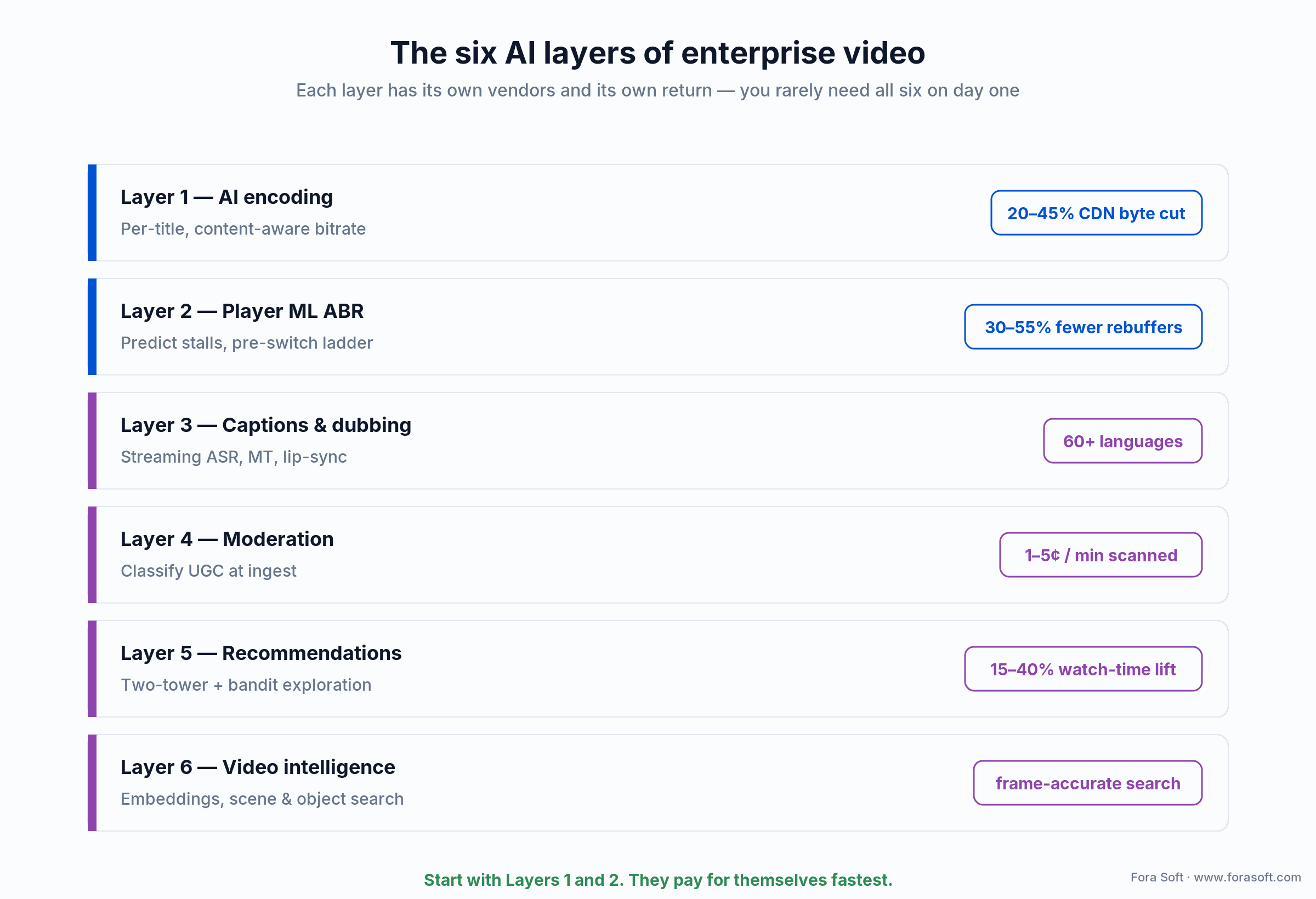
Figure 2. The six AI layers, each with its own vendor set and its own return.
Layer 1 — AI encoding and content-aware bitrate
Bitmovin Per-Title Encoding, Mux automatic encoding, AWS Elemental MediaConvert QVBR, and Brightcove Context-Aware Encoding all use content complexity to pick the optimal bitrate ladder per title. Bitmovin published 22.7% bitrate savings at equal or better quality against a static ladder, with HEVC per-title reaching about 70% on medium-complexity 1080p (Bitmovin, 2025). A safe planning band: 20–45% CDN byte reduction at equal VMAF. On a 2M-viewer platform that's $180k–$500k a year.
Layer 2 — Player-side ML for adaptive bitrate
THEOplayer, Mux Player, JW Player, and a Shaka Player fork with a custom bandwidth estimator can predict a stall roughly two seconds ahead and pre-switch the ladder. Against pure client-side heuristics, teams see rebuffer-ratio improvements in the 30–55% range. The catch is simple: keep a heuristic fallback, or one bad model deploy degrades every session at once.
Layer 3 — Captioning, translation, and dubbing
Deepgram Nova-3 streams at $0.0077/min pay-as-you-go (~$0.46/hr, billed per second); AssemblyAI runs a flat $0.15/hr base for both async and streaming, rising to about $0.45/hr with add-ons (vendor pricing, 2026). Rev AI, Google Cloud Speech-to-Text, and self-hosted Whisper round out the set; 3Play Media adds a human verification loop; HeyGen and Rask handle lip-sync dubbing. Our AI interpretation platform guide covers this layer at architecture depth.
Layer 4 — Content moderation and safety
Hive Moderation, AWS Rekognition Content Moderation, Azure Content Safety, Sightengine, and Clarifai classify NSFW, violence, hate, and child-safety signals at ingest, typically for one to five cents per minute scanned (industry band, 2026). AI classifies; it doesn't decide. Budget 2–5% of moderated minutes for a human review queue on low-confidence and high-severity cases.
Layer 5 — Recommendations and personalization
Amazon Personalize, Google Recommendations AI, NVIDIA Merlin, Algolia, and open-source RecBole drive the "next video" rail, personalized thumbnails, and homepage ordering. Managed services get you roughly 70% of what a dedicated data team delivers. Our AI content recommendation guide covers the two-tower and bandit patterns end to end.
Layer 6 — Video intelligence and frame-accurate search
Twelvelabs, Amazon Rekognition Video, Microsoft Video Indexer, Google Video Intelligence, and open-source VideoMAE embeddings enable scene detection, object tracking, brand-safety checks, ad-placement, and "find every mention of Project X" search across a portal. This is the newest and least-adopted layer, and the one that turns a video archive into a queryable asset.
Reach for video intelligence when: your archive is big enough that people give up searching it, or compliance needs you to find and prove what was said on which frame.
Comparison matrix — three enterprise video stacks
For a mid-market enterprise serving 2 million monthly viewers across internal and external video, here's how the three lanes compare on the dimensions that decide the bill.
| Dimension | Pure SaaS | Build-kit | Platform-as-code |
|---|---|---|---|
| Example stack | Vimeo Enterprise, Brightcove, Kaltura | Mux + Hive + Amazon Personalize | Cloudflare Stream + Whisper + RecBole |
| Time to live | 2–4 weeks | 8–14 weeks | 4–8 months |
| Cost per viewer-hour | $0.04–$0.12 | $0.018–$0.045 | $0.006–$0.018 (after CapEx) |
| Customization | Branding + glossary | Full player + rec models | Every layer |
| Compliance control | SOC 2, GDPR bundled | Customer-controlled | Full data sovereignty |
| Best for | Internal comms, training | Consumer & enterprise products | Telco, media, high volume |
Reference architecture — six AI-augmented stages
This is the shape most of our external-facing enterprise video builds take. Internal-only deployments drop the DRM and recommendation stages and add the eCDN layer from section three.
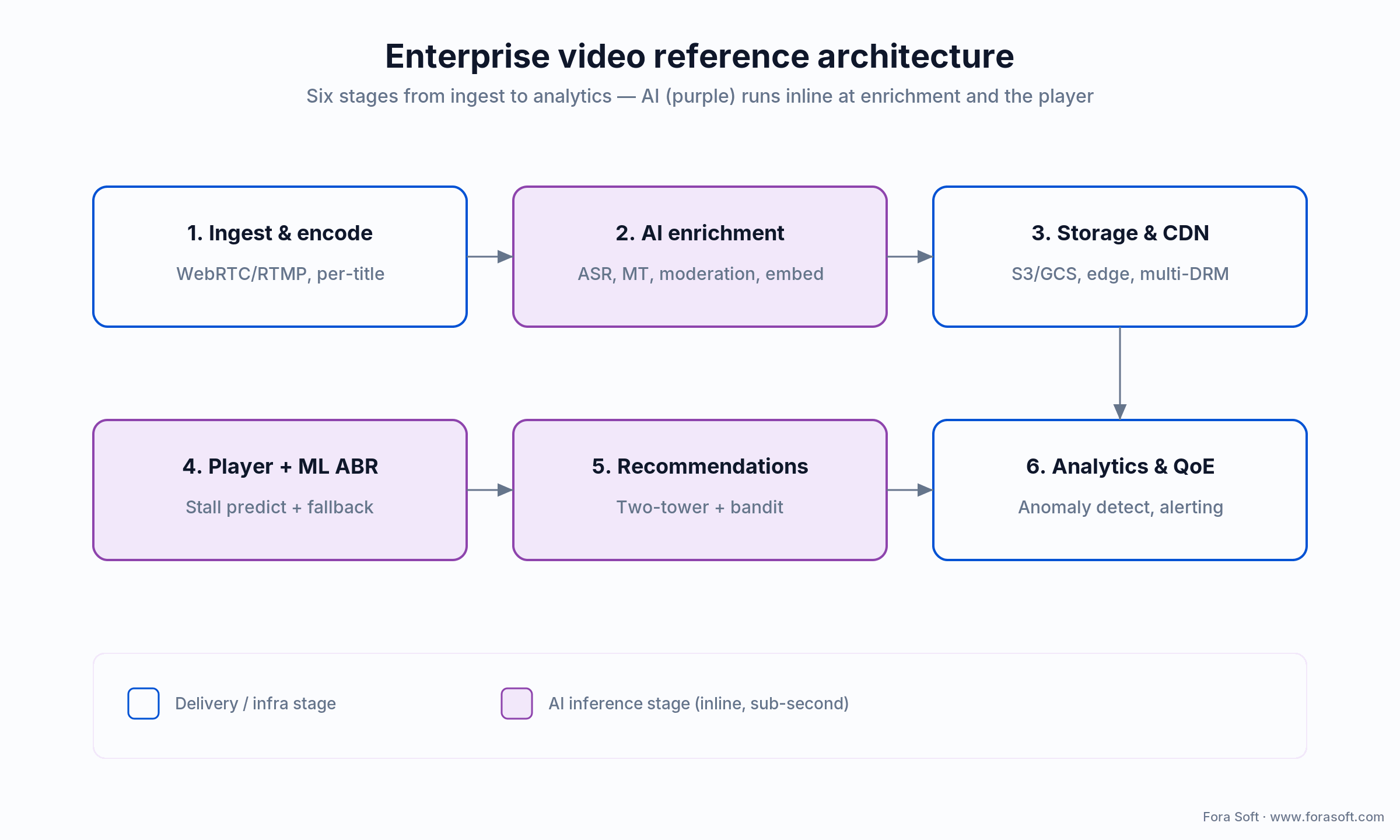
Figure 3. Six-stage pipeline from ingest to analytics, with AI running inline at enrichment and the player.
Stage 1 — Ingest and encoding. Live over WebRTC or RTMP; VOD via multipart upload. A per-title encoder selects the bitrate ladder from VMAF plus content-complexity features and outputs HLS/DASH in CMAF with AV1, HEVC, and H.264 renditions. Codec choice matters here; our AV1 in production guide covers when the royalty-free codec actually saves money.
Stage 2 — AI enrichment at ingest. Streaming ASR generates captions; neural MT translates them; a moderation model labels the content; an embedding model indexes every couple of seconds for search and recommendations. Output: WebVTT tracks, moderation labels, and vectors in a store like Pinecone or pgvector.
Stage 3 — Storage and CDN. S3 or GCS origin with lifecycle policies; a public CDN edge; per-viewer multi-DRM licenses (Widevine, FairPlay, PlayReady) issued at play-start. For internal audiences, the eCDN layer slots in here.
Stage 4 — Player and ML ABR. Shaka, THEOplayer, or Mux Player with a stall-predicting bandwidth estimator and a heuristic fallback. Telemetry flows to a QoE backend (Mux Data, Bitmovin Analytics, Conviva).
Stage 5 — Recommendations. Real-time user and content embeddings feed a two-tower recommender with bandit exploration. Output: homepage rail, next-video, thumbnail selection.
Stage 6 — Analytics, QoE, and operations. Real-time dashboards, anomaly detection on rebuffer ratio and startup time, and alerting that routes issues to on-call before viewers complain.
Want this built on your stack?
We'll map your video footprint to this architecture and hand you a concrete cost and timeline projection you can take to your board.
Security and compliance — EU AI Act, GDPR, SOC 2, DRM
EU AI Act (dates corrected for 2026). The Digital Omnibus reset the timeline. Article 50 transparency — disclosing when users interact with AI and labeling AI-generated content — applies from 2 August 2026, with the watermarking sub-rule pushed to 2 December 2026. High-risk obligations for stand-alone Annex III systems were deferred to 2 December 2027, and AI embedded in regulated products (Annex I) to 2 August 2028 (Council green light, 29 June 2026). For video, adult content recommendations are limited-risk (disclosure and user control); certain child-safety and biometric uses can fall into high-risk.
GDPR. Watch history, embeddings, and personalization profiles are personal data. Run a DPIA for any recommender built on behavioral data, honor Article 22 limits on fully automated decisions with legal effect, and expose a one-click opt-out for personalization.
SOC 2 Type II. The procurement floor for enterprise video. Mux, Bitmovin, Vimeo Enterprise, AWS Elemental, Cloudflare Stream, and Hive all ship reports; ask for the current one before you sign.
Multi-DRM. Enterprise content needs Widevine (Chrome, Android), FairPlay (Apple), and PlayReady (Edge, Xbox, smart TVs) together. Use a DRM-as-service (EZDRM, Axinom, Vdocipher, BuyDRM) unless you run a specialized media-ops team.
Forensic watermarking. For premium content (sports, film, paid SVOD), client-side forensic watermarking (NAGRA, Irdeto, Verimatrix) is the 2026 baseline. Segment-based watermarks trace a leak back to an individual viewer.
Reach for multi-DRM plus watermarking when: your library includes anything people would pirate — live sports, first-run film, or paid courses — not for internal training video.
Cost model — 2 million monthly viewers, shown as arithmetic
Assume a mid-market enterprise with 2M monthly active users, 3.5 hours each per month, so 7M viewer-hours. Mix: 70% VOD, 30% live. Build-kit tier pricing, with per-title encoding already applied to the CDN line.
| Line item | Monthly | Annual |
|---|---|---|
| CDN (after per-title savings) | $28,000 | $336,000 |
| Transcoding (per-title AI) | $6,500 | $78,000 |
| Captions (Deepgram, 40 percent of hours) | $7,200 | $86,400 |
| Moderation (UGC subset) | $3,600 | $43,200 |
| Recommendations (Amazon Personalize) | $4,800 | $57,600 |
| QoE analytics (Mux Data) | $3,500 | $42,000 |
| Video intelligence (Twelvelabs) | $5,500 | $66,000 |
| Subtotal, tools | $59,100 | $709,200 |
| Engineering (2 FTE amortized) | $33,000 | $396,000 |
| Year-one total | $92,100 | $1,105,200 |
Now the payback. The CDN line already reflects a per-title cut; without it, bytes would run closer to $40k/month, so encoding alone saves ~$144k/year. Add engagement uplift on recommendations, accessibility compliance, and reduced moderation labor, and annualized benefit lands at $1.8–$4.2M. Against a $1.1M year-one cost, net value is clearly positive, and the AI layer typically pays back in 8–14 months. We build this kind of scope with Agent Engineering, which pulls the engineering line below what a traditional team quotes. If a number ever looks too good, ask us to show the working.
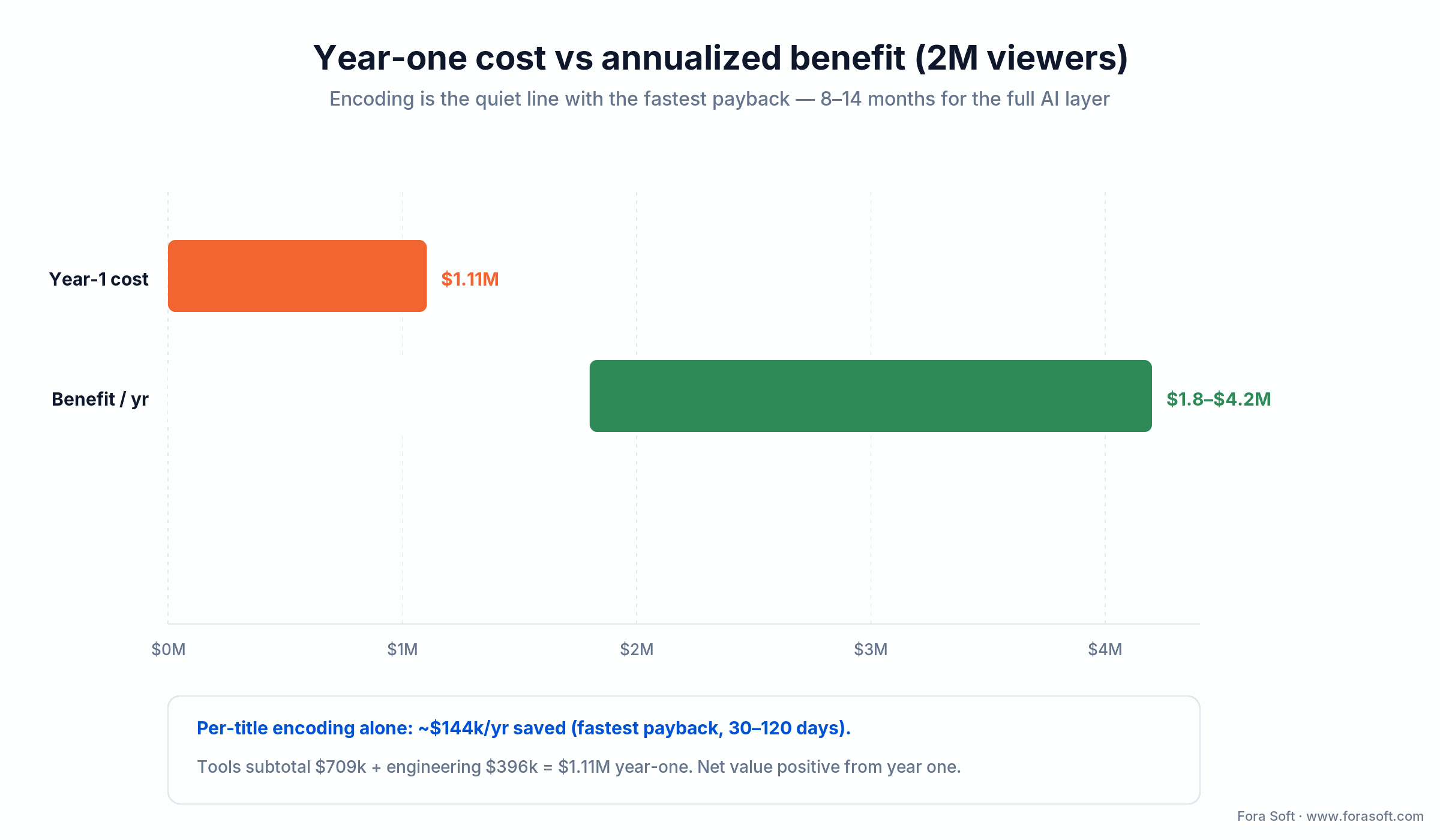
Figure 4. Year-one cost against annualized benefit — encoding is the quiet line with the fastest return.
Mini case — 34% CDN savings for a sports OTT
A European sports OTT client with 3.2M monthly users and a $4.8M annual CDN bill came to us in Q4 2025. Their bytes were growing faster than revenue, and a static bitrate ladder was pushing far more data than the picture quality justified.
We deployed Bitmovin Per-Title Encoding at a VMAF 93 target and a client-side ML bandwidth estimator in their Shaka Player fork, with a heuristic fallback. Rollout took six weeks, starting with the top 20% of the catalog by watch time and ABX-testing every batch before scaling.
Result: CDN bytes fell 34% at equal user-reported quality, and rebuffer ratio dropped from 1.9% to 0.8%. Annualized savings were about $1.63M against a $230k tool-plus-integration cost — payback in under two months. Then a Q1 2026 follow-on added Amazon Personalize to the "next match" carousel and lifted watch-time per session by 22%. Want a similar assessment of your own bytes? Book a 30-minute call and we'll estimate the savings before you commit.
A decision framework — pick the stack in five questions
Question 1 — Internal or external audience? Internal all-hands, training, and comms point to Vimeo Enterprise, Kaltura, or Panopto with an eCDN. Public products point to Mux, Bitmovin, or Cloudflare Stream with your own player.
Question 2 — How big is the CDN bill? Below $200k/year, per-title AI encoding is marginal — skip it. Above $500k/year, it's the single highest-return move we know, often paying back in 30–120 days.
Question 3 — Any user-generated content? No UGC, skip moderation. Regulated UGC (minors, live streaming, gaming) means mandatory moderation with an audit log, a human review queue, and an escalation playbook.
Question 4 — How many languages? One language, AI captions only. Multi-language, add neural MT; for flagship content, consider lip-sync dubbing.
Question 5 — Who owns recommendation quality? For internal libraries, managed auto-rec is fine. For products that monetize engagement, staff a small data team (one ML engineer, one analyst); it's worth 30–50% additional lift over managed services alone. When you want a second opinion on any of these, that's what our scoping call is for.
Five pitfalls that kill AI video rollouts
1. VMAF without verification. Per-title encoders optimize a VMAF target, and VMAF isn't a perfect stand-in for what eyes see. Teams that don't ABX-test the final renditions sometimes ship perceptually worse video. Run 500-clip ABX tests before scaling.
2. ML ABR without a fallback. If the model returns implausible values, the player must drop to a known-good heuristic estimator. Roll out behind a percentage flag so one bad deploy can't degrade every session.
3. Captions without punctuation or diarization. Raw ASR reads badly. Add punctuation and speaker labels for multi-speaker content, or accessibility reviewers will reject the output.
4. Moderation without a human in the loop. AI classifies; people decide. False positives alienate creators and false negatives expose viewers, so a review queue isn't optional.
5. Recommendations tuned only on clicks. Click-through-only models drift toward clickbait. Training on watch time, completion, and satisfaction together beats CTR-only by 15–25% on long-term retention.
KPIs — what to measure from day one
Quality KPIs. Rebuffer ratio (stall time / playback time) under 0.8% for VOD and 1.5% for live; startup time under 1.5s on broadband and 3s on LTE; caption accuracy at WER under 9% conversational, under 6% scripted.
Business KPIs. CDN bytes per viewer-hour before and after AI encoding (expect a 20–45% drop at equal quality); watch time per session and completion rate for recommendations (a 15% lift is good, 25–40% is top-quartile); caption coverage toward 100% of published minutes.
Reliability KPIs. Playback error rate, time-to-detect on QoE anomalies, and DRM license issuance success. If you can't chart these today, instrument them before you add any AI — adding models without QoE telemetry is flying blind.
Industries shipping real value in 2026
Media and OTT. Per-title encoding, AI dubbing for global launches, frame-accurate ad placement, and forensic watermarking against leaks.
Sports and live events. Real-time highlights, player tracking, dynamic ad insertion on breaks, and multi-language commentary tracks.
Education and training. Auto-chapters, quiz generation, native-language dubbing, and an accessibility-first player. On BrainCert-style e-learning work, completion rises when content plays in the viewer's own language; our BrainCert case study shows the platform we built for that scale.
Enterprise internal video. All-hands with live multi-language captions over an eCDN, a searchable portal, and compliance search across earnings calls and town halls.
Security and surveillance. Anomaly detection, privacy face-blurring, and object classification. Our AI video surveillance guide covers that vertical in depth.
Not sure which layer to build first?
Tell us your CDN bill, audience, and content mix. We'll rank the six layers by return for your specific case, free of charge.
Build vs buy vs adapt
Buy (SaaS). Vimeo Enterprise, Kaltura, Brightcove, or Panopto for internal video; Wowza, JW Player, or Dacast for mid-market OTT. Fast, feature-rich, and they carry the compliance bar for you.
Adapt (build-kit). Mux, Bitmovin, Cloudflare Stream, or AWS Elemental wrapped with your own player and ML layer. This is the middle lane for most product companies, and where we do the bulk of our video work. See our video streaming development services and our AI integration services.
Build. Self-hosted FFmpeg, Shaka Packager, Whisper, and a custom recommender. This only pays off at massive scale (hundreds of millions of viewer-hours a month) or under hard data-sovereignty requirements.
When not to adopt AI video (yet)
Low volume, static content. Under 100k hours a year of evergreen video, per-title encoding return is marginal. Use a SaaS bundle and skip the build.
Regulated content without a consent layer. AI moderation and recommendations need consent UX and audit logs first. Build the consent plumbing, then wire the AI.
No QoE telemetry today. If you can't measure startup time, rebuffer ratio, and error codes, adding AI just hides the problem. Instrument first, optimize second.
A 10-week deployment playbook
Weeks 1–2 — baseline and selection. QoE metrics, CDN bill, compliance bar, and a vendor shortlist per layer.
Weeks 3–4 — AI encoding. Start with the top 20% of the catalog, ABX-test, and measure the CDN cut.
Weeks 5–6 — captions, moderation, QoE analytics. Accessibility, safety, and operational visibility in one sprint.
Weeks 7–8 — recommendations and player ML ABR. Shadow-test in A/B before any production flip.
Weeks 9–10 — video intelligence and compliance review. Frame-accurate search, EU AI Act documentation, and a SOC 2 evidence pack. Our own delivery uses this cadence; you can read more on the engineering approach in our AI for video engineering track.
FAQ
What is enterprise video streaming?
Enterprise video streaming is the delivery of video to a large, controlled audience — employees, customers, or students, with the security, scalability, and analytics a business needs. It covers internal use (town halls, training) and external products (OTT, e-learning). Usually with an eCDN for internal scale and a public CDN for external reach.
What is the single highest-return AI feature for enterprise video?
Per-title AI encoding, almost always. It cuts 20–45% of CDN bytes at equal quality and typically pays back in 30–120 days for any enterprise with a $500k+ CDN bill.
Why do I need an eCDN if I already pay for a CDN?
A public CDN gets video to the edge of each office; an eCDN distributes it inside the building so thousands of employees don't each pull a separate stream across one WAN link. Peer-assisted eCDNs report up to 99% internal bandwidth savings on large live events.
Do AI captions meet accessibility compliance?
Yes for most internal and consumer video. For high-stakes public broadcasts (legal, government, some education), FCC and EN 301 549 rules may still require human-verified captions, so pair AI with a 3Play or Rev verification loop.
How does the EU AI Act affect enterprise video in 2026?
Article 50 transparency applies from 2 August 2026 (disclose AI interaction, label AI-generated content). High-risk Annex III duties were deferred to 2 December 2027 by the Digital Omnibus. Adult content recommendations are limited-risk; certain child-safety and biometric uses can be high-risk.
AV1 vs HEVC vs H.264 — which should we ship?
Ship all three as a ladder: AV1 (best compression, growing device support), HEVC (broad Apple and TV support), H.264 (universal fallback). Per-title encoding picks the right rungs per codec automatically.
Do I need my own data team for recommendations?
Not for internal video portals — managed services work well. For public products that monetize engagement, a small in-house team (one ML engineer plus one analyst) is worth 30–50% additional lift over managed services alone.
How does Fora Soft price an enterprise video AI build?
A typical first phase is a 10-week fixed scope, with vendor licenses and CDN passed through at cost. The exact figure depends on how many of the six layers you need and your compliance bar. Book a scoping call for a number tied to your footprint.
What to read next
AI Video Streaming
AI in Video Streaming: The Engineering Playbook
The broader 2026 view across encoding, personalization, and real-time analytics.
Recommendations
AI Content Recommendation for Video
Two-tower models, bandits, and the ROI of personalized video rails.
Interpretation
AI Interpretation Platform Development
Streaming ASR, MT, and TTS for multilingual live video audiences.
Services
Video Streaming Development by Fora Soft
WebRTC, HLS, DASH, and the full enterprise AI video stack since 2005.
Ready to scope your enterprise video roadmap?
Enterprise video streaming in 2026 is a delivery problem first, an AI problem second. Get the eCDN and adaptive delivery right, then layer AI where it moves your numbers, usually per-title encoding and recommendations before anything flashier.
Pick the two or three layers with the fastest payback, instrument your QoE before you optimize, and plan compliance to the real 2026 dates. The lever that pays back fastest is almost never the one with the loudest marketing. Quiet, technical per-title encoding beats splashy AI dubbing on ROI every time for enterprises over $500k in CDN spend.
Map your enterprise video stack with us
Bring your audience, content mix, and compliance bar. You'll leave with a concrete architecture, cost model, and timeline — and no obligation attached.

