

Key takeaways
• AV1 encoding is past the tipping point in 2026. Netflix runs ~30 % of streams on AV1. Roughly 88 % of large-screen devices certified 2021–2025 decode it. Apple Silicon, NVIDIA Ada Lovelace and Intel Arc all ship hardware encoders.
• ~30 % bandwidth saved, 5–10× more encode compute. AV1 cuts CDN bytes ~30 % over HEVC and ~50 % over H.264 at matched quality, but the encode is far heavier. Break-even is a function of viewers per encoded asset, not codec religion.
• Royalty-free, unlike the HEVC patent thicket. AOMedia members (Google, Netflix, Microsoft, Amazon, Cisco, Mozilla, Intel, AMD, NVIDIA, ARM, Apple) committed to royalty-free AV1. HEVC still carries per-device and content royalties across three patent pools.
• VOD is the easy win. Encode once, deliver many times. Live is tighter — SVT-AV1 preset 8–10 or hardware AV1 (NVENC/QuickSync) work, but you pay attention to the latency budget.
• The production answer is a multi-codec ladder. AV1 for capable devices, HEVC for the middle, H.264 as the safety net. The player picks the best it can decode; nobody gets left behind.
Why Fora Soft wrote this playbook
We're Fora Soft — we've built video and streaming platforms since 2005, 250+ projects across the last 20 years. A big share of that is OTT and broadcast: Worldcast Live (HD concert streaming), Mangomolo-scale OTT (30M+ viewers, Discovery MENA and Dubai Media among them), StreamLayer (NBC, CBS, Red Bull, Chelsea FC), Perspire TV, plus several IPTV/STB platforms.
Through 2024–2025 we ran AV1 production migrations for two OTT clients and AV1 evaluations for four more. The numbers here — encode cost, CDN savings, device coverage, break-even points — come from those migrations, not from vendor whitepapers. Where we haven't measured something ourselves, we say so.
If you're weighing AV1 for VOD or live, this guide tells you when it pays off, when it doesn't, what the encoder pipeline actually looks like, and how to ship a multi-codec ladder without breaking older viewers.
CDN bill eating your unit economics?
Send us your encoding ladder and viewership profile. We'll run the AV1 break-even math for your specific case in 48 hours, free.
TL;DR — when AV1 saves money in 2026
AV1 saves money when the same encoded asset is delivered to many viewers. The encode cost is paid once; the CDN savings scale with delivery. Break-even lands roughly when a single asset clears ~2,300 viewer-hours per month — past that, every extra viewer is margin.
VOD with real re-watch. Always wins. Encode once at SVT-AV1 preset 4–6, deliver thousands of times, save 30–50 % on CDN.
Live events with big concurrent audiences. Wins above ~50 k peak concurrent viewers per event with a hardware encoder. Below that, HEVC is usually cheaper because live encode cost dominates.
Long-tail VOD with low view counts. Loses. The encode cost is amortised across too few deliveries. Stay on HEVC or H.264.
Real-time interactive (sub-second). Loses, for now. AV1 encode latency at preset 10 is still tight, and browser AV1 encode in WebRTC isn't broadly there yet. Use HEVC or VP9 for low-latency real-time tiers.
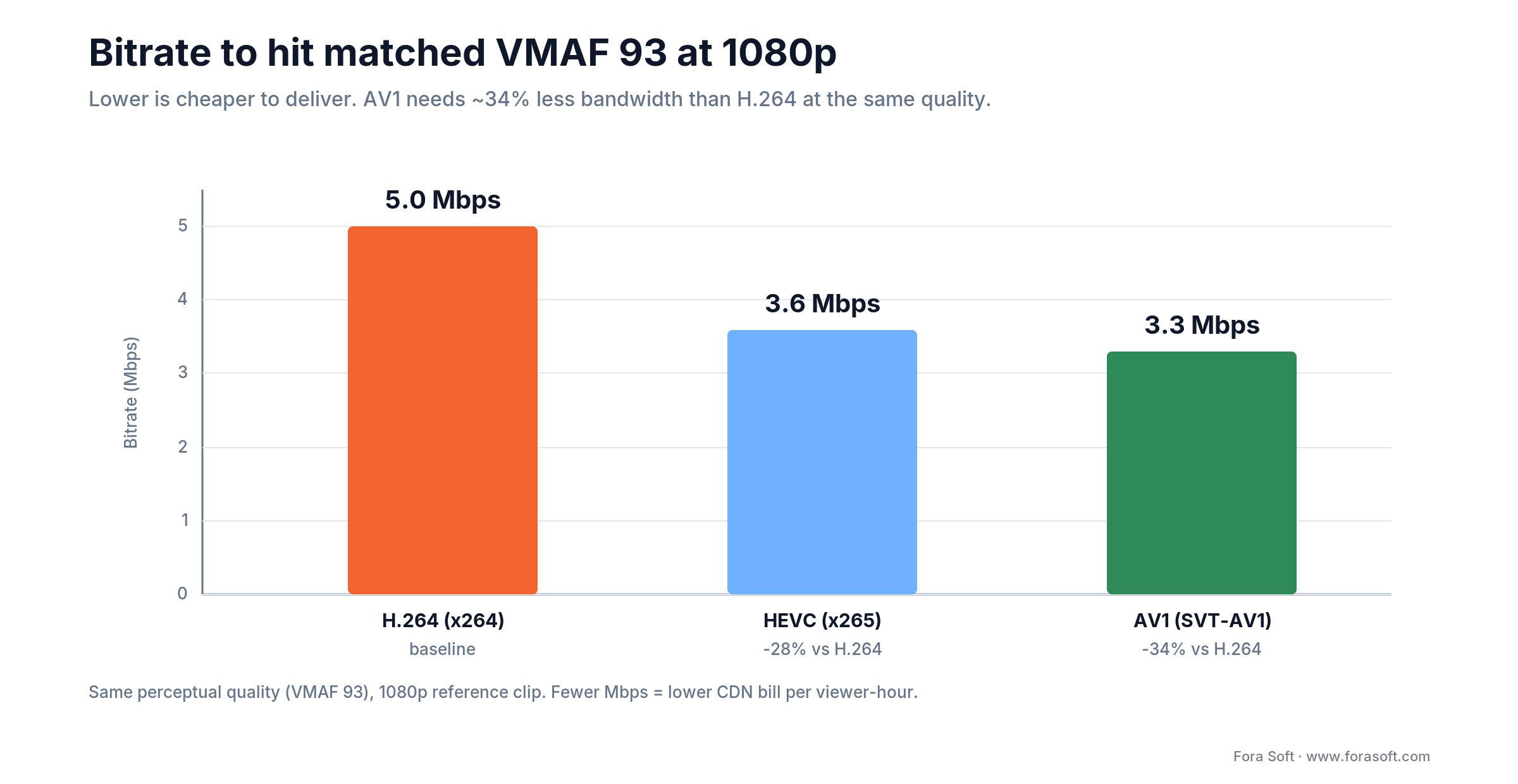
Figure 1. The whole case in one chart — AV1 hits the same perceptual quality as H.264 at about a third less bitrate, which is a third off every delivered byte.
What is AV1, and why is it royalty-free?
AV1 (AOMedia Video 1) is an open, royalty-free video codec finalised in 2018 by the Alliance for Open Media. At matched quality it needs roughly 30 % fewer bits than HEVC and 50 % fewer than H.264, which is why streamers adopt it: fewer bits per viewer means a smaller CDN bill.
“Royalty-free” is the part that changes the business case. HEVC royalties are fragmented across three patent pools (MPEG LA, Access Advance, Velos Media) plus per-device and, for some licensors, per-content fees — the reason many teams never shipped HEVC widely on the open web. AOMedia's members (Google, Netflix, Microsoft, Amazon, Cisco, Mozilla, Intel, AMD, NVIDIA, ARM, Apple) committed to royalty-free use of AV1 essential patents. A separate pool run by Sisvel exists, but the major AOMedia members dispute it and, as of 2026, have not paid.
Under the hood, AV1 leans on block sizes up to 128×128, motion prediction with up to 8 reference frames, switchable transforms, a directional enhancement filter (CDEF), and film-grain synthesis that strips grain before encode and re-adds it on playback. If you want the codec internals in depth, we cover them in our AV1 state-of-the-codec guide; this article stays on the money and the pipeline.
Why AV1 wins on bandwidth
The win is compression efficiency. Those bigger blocks, extra reference frames and the film-grain trick let AV1 hit the same VMAF as older codecs while spending fewer bits — and bits are what you pay a CDN for.
The numbers (Netflix benchmarks). AV1 sessions use roughly one-third less bandwidth than both AVC (H.264) and HEVC at matched VMAF. Netflix also reported ~45 % fewer rebuffering events on AV1-eligible sessions, and runs about 30 % of all streams on AV1 in 2026.
The trade-off. Encoding is expensive. SVT-AV1 at preset 4 (high-quality VOD) is roughly 5–10× slower than x265 medium. Hardware encoders close the wall-clock gap but give up a little quality at the same bitrate. So the math always comes back to one ratio: encode cost versus delivery savings.
Device support matrix — 2026 reality
Decode is what matters for delivery. Here's where AV1 decode actually lands across the fleet in 2026.
| Device class | Decode | Encode | Notes |
|---|---|---|---|
| Smart TVs (2023+) | ~88 % support | N/A | Native 4K @ 60 fps |
| Apple Silicon Macs | M3+ HW decode | M4 Pro/Max HW encode | M1/M2 software-only |
| iPhone | A17 Pro+ HW decode | Limited | Older iPhones via software |
| Android (Snapdragon 8 Gen 1+) | HW decode | HW encode (some) | Mid-range still software |
| PC (NVIDIA Ada Lovelace) | HW decode | NVENC AV1 | RTX 40-series and newer |
| Intel Arc / Xe | HW decode | QuickSync AV1 encode | Strong server-side option |
| Browsers (Chrome, Edge, FF) | Yes | N/A | Safari 17+ decodes too |
| Legacy STBs / older smart TVs | Limited | N/A | HEVC fallback required |
Reach for AV1-only delivery when: 90 %+ of your audience is on devices shipped since 2023 (modern smart TVs, recent phones, current browsers). Otherwise, go dual-codec.
Reach for HEVC + AV1 dual-codec when: your audience straddles 2020–2025 hardware. Most production stacks land right here.
Reach for a triple ladder (H.264 + HEVC + AV1) when: you serve legacy CTV STBs, older Android, or a compatibility tail you can't drop. Pay the storage, keep the reach.
Reach for H.264 only when: your audience is dominated by legacy hardware, your traffic is low, or the storage cost of multi-codec can't be justified yet.
Encoder strategy — SVT-AV1, hardware, presets
SVT-AV1 (software, Intel-led). The production-grade software encoder, Apache-2.0 licensed. Preset 0 is slowest and best; preset 13 is fastest. For VOD, preset 4–6 is the sweet spot. For live, preset 8–10 with bitrate caps. FFmpeg drives it directly — see the FFmpeg AV1 encode guide for flags.
A working VOD starting point with FFmpeg — preset 4, 10-bit, CRF 30, two-second GOP:
ffmpeg -i input.mov -c:v libsvtav1 -preset 4 -crf 30 \
       -svtav1-params tune=0 -g 240 -pix_fmt yuv420p10le \
       -c:a libopus -b:a 128k output_av1.mp4
libaom (Google reference). Higher quality than SVT-AV1 at a matched preset, but 3–5× slower. Reserve it for top-tier VOD where the encode cost amortises across millions of views.
NVIDIA NVENC AV1 (hardware). RTX 40-series and newer, real-time at 4K 60 fps. Quality sits a touch below SVT-AV1 preset 8 at the same bitrate, but the per-stream encode cost drops massively — see NVIDIA's own Ada Lovelace AV1 write-up. Best for live encoding clusters.
Intel QuickSync AV1 (hardware). Intel Arc and recent Xeon. Cheaper per stream than NVIDIA on commodity hardware; quality is competitive at high bitrates and slips below ~2 Mbps.
Apple Silicon AV1. M3 GPUs decode; M4 Pro/Max encode. Handy for studio workflows, less relevant for server-side clusters. Wiring these encoders into an ABR pipeline is the bulk of a migration — it's the core of our video processing engineering work.
The cost math — when AV1 break-evens
Here's the math worked out three ways. Plug your own CDN rate in; the shape doesn't change.
Worked example 1: VOD platform, 10k DAU, 1.5h average daily viewing. Bandwidth before AV1 is roughly 14 TB/day at 5 Mbps H.264. AV1 pulls that to ~8 TB/day. At $0.025/GB CDN that's about $11.5k/month saved. SVT-AV1 preset 4 encoding for the daily catalogue adds ~$1.5k/month compute. Net: ~$10k/month saved.
Worked example 2: live event, 100k peak concurrent, 1.5-hour event. ~57 TB delivered; AV1 saves ~32 TB. At $0.018/GB (volume tier) that's ~$575 per event. Encode via NVENC is real-time hardware, so cost is on par with HEVC. Net: ~$575/event — across 50 events/year, ~$28k. Real, but modest.
Worked example 3: long-tail VOD, 300 hours, 200 average views per asset. SVT-AV1 preset 4 encode at ~$1.50/h is ~$450 one-off. CDN saving ~$300/month. Break-even lands around month 1.5; after that it's pure profit — but only because these assets do get watched. Drop views to 20 per asset and AV1 never pays back.
The break-even formula. AV1 wins when (bytes saved per viewer) × (CDN price per byte) × (viewers per asset) > (encode cost premium). For VOD that product is almost always positive. For live under ~50 k concurrent per event it's often marginal.

Figure 2. The break-even line. Below ~2,300 viewer-hours per asset per month you're subsidising the encoder; above it, savings scale with every extra viewer.
Want a custom AV1 break-even calculation?
Send us your traffic profile, encoding ladder and CDN tier. We'll run the AV1 ROI math for your specific case in 48 hours, free.
The multi-codec ladder — the smart approach
Most production stacks don't pick “all AV1” or “all HEVC.” They run a multi-codec ladder: every variant in the manifest tagged with codec + resolution + bitrate, and the player picks the best its device can decode.
Manifest-level codec selection. HLS supports separate variant playlists per codec; CMAF DASH does the same. The player's capability negotiation reaches for AV1, falls back to HEVC, then H.264.
The storage trade-off. A triple-codec ladder roughly triples storage. For most origins that's small next to delivery: storage runs ~$0.02/GB/month, delivery $0.018–$0.05/GB every time. Storage triples once; a popular asset ships hundreds of times.
Per-title encoding. Netflix-style adaptive ABR gives each title its own ladder based on content complexity. Cartoons need fewer rungs; sports need more. AV1 amplifies this because its savings vary more with content.
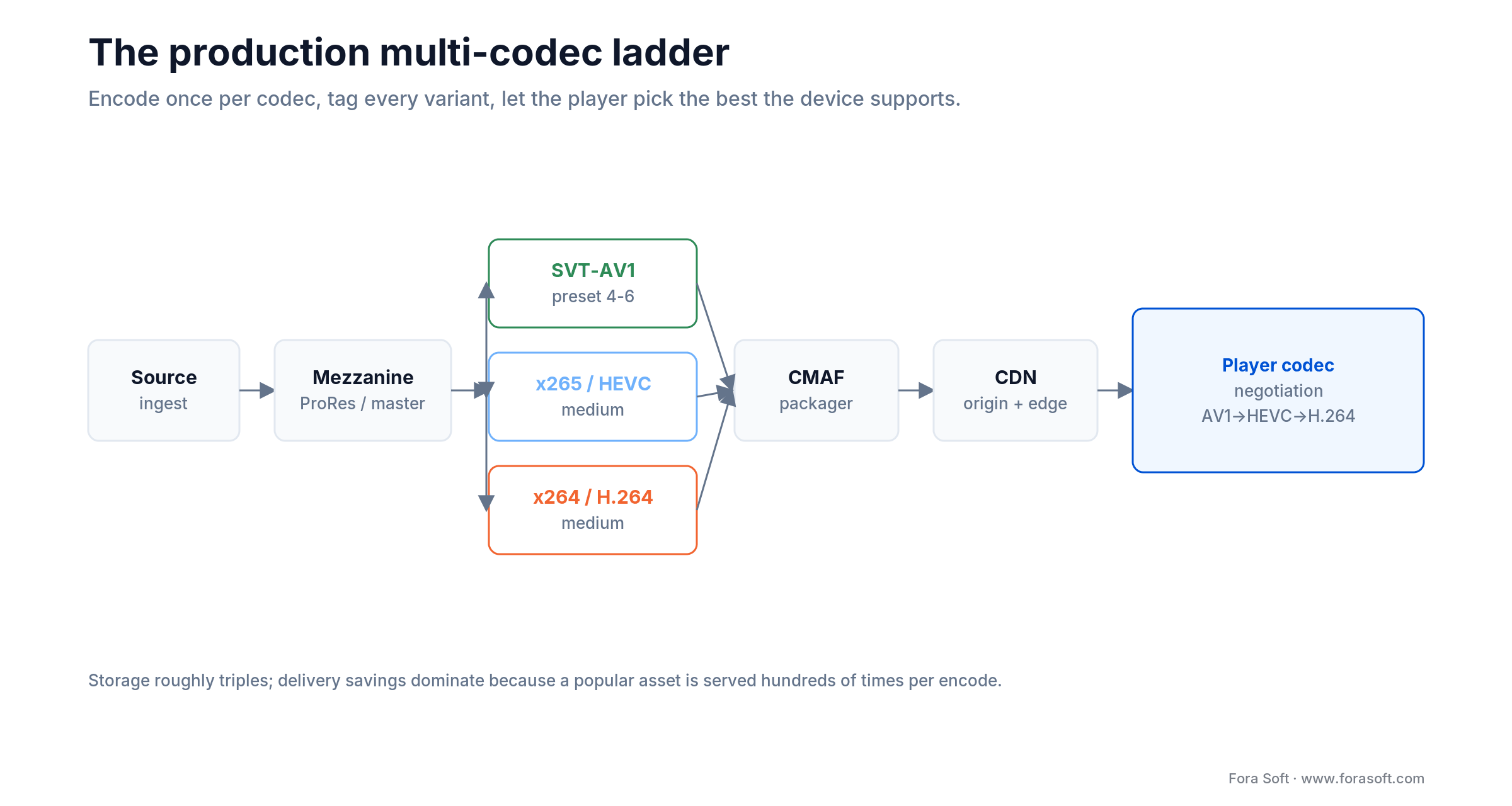
Figure 3. One mezzanine, three encoders, one packager. The player, not your origin, decides which codec each viewer receives.
Live AV1 challenges
Encode latency. SVT-AV1 preset 10 hits real-time at 1080p; preset 8 needs hardware to keep up. Budget a couple of GOPs, ~2 s added to glass-to-glass.
Multi-bitrate live ladder. Five AV1 rungs in parallel is serious compute. NVENC AV1 at ~$0.50/hour per stream is the cost-effective route; software live AV1 across five rungs runs $1.50–$3/hour per channel.
WebRTC AV1. Chrome, Edge and Firefox decode AV1 in WebRTC. Broad AV1 encode in WebRTC still isn't there in 2026. For real-time interactive flows, HEVC or VP9 remain the safer pick.
WHIP/WHEP + AV1. Both protocols are codec-agnostic; AV1 over WHIP/WHEP pipelines works in 2026 when encoder and player both support it. Test the specific path before you rely on it.
VOD pipeline — the easy win
A VOD AV1 pipeline is the highest-confidence migration. The workflow, end to end:
1. Source ingest → mezzanine. A visually lossless mezzanine (ProRes, JPEG XS, or a high-bitrate H.264 master).
2. Per-title analysis. A CRF-tuning pass that picks the bitrate ladder per asset complexity.
3. Multi-codec encode. SVT-AV1 preset 4 for AV1, x265 medium for HEVC, x264 medium for H.264 — five rungs each: 240p, 480p, 720p, 1080p, 4K.
4. Manifest packaging. CMAF with per-codec variant playlists. Subtitles and audio tracks fanned out separately.
5. CDN distribution. Origin shield, regional caches, signed URLs for paywalled content.
Vendor matrix — AWS, Bitmovin, Mux, Theta, Dolby
AWS Elemental MediaConvert + AV1. Live AV1 encode and on-demand AV1 with custom presets, priced per minute encoded. For live, roughly $0.60–$1.20/hour for 1080p output, less with hardware acceleration. Where it wins: you already live in AWS. Where it breaks: preset tuning is on you.
Bitmovin. Multi-codec encoding with strong AV1 and per-title optimisation. Higher per-minute cost than AWS, better quality control out of the box. Where it breaks: less appealing if you want to self-host the compute.
Mux. Developer-friendly video API with auto-generated codec ladders; AV1 on the premium tier. Where it wins: you want the API simple and the complexity hidden. Where it breaks: less low-level control over the ladder.
Theta. Decentralised CDN with AV1 support, aimed at cost-sensitive OTT. Cheaper per GB; fewer turnkey integrations than AWS or Mux.
Dolby OptiView (formerly Hybrik / Dolby.io). Enterprise transcoding with AV1 plus low-latency streaming and broadcaster-grade SLAs. Where it breaks: overkill for a small catalogue.
AV1 vs HEVC vs H.264 for production
For a production decision, four axes matter: bandwidth, encode cost, device reach and licensing. Here's the honest trade-off, side by side.
| Axis | H.264 | HEVC | AV1 |
|---|---|---|---|
| Bitrate at matched VMAF | Baseline | ~28 % less | ~34–50 % less |
| Encode cost | Lowest | Moderate | 5–10× H.264 (SW) |
| Device decode reach | Universal | Broad, uneven on web | ~88 % modern, growing |
| Licensing | Royalties (mature) | 3 patent pools + fees | Royalty-free (AOMedia) |
| Best for | Legacy tail, real-time | The compatibility middle | High-reach VOD, big live |
The takeaway isn't “AV1 wins.” It's that each codec owns a rung: H.264 for reach and real-time, HEVC for the middle, AV1 where delivery volume justifies the encode. That's exactly why the ladder exists.
Mini case — AV1 saved an OTT $42k/month
An OTT client (under NDA, similar profile to Mangomolo) ran a VOD library of ~8,000 hours for 45 k DAU, burning $145k/month on CDN delivery in late 2024. The split: 70 % H.264, 30 % HEVC, no AV1.
The 14-week project. Weeks 1–2: device-share audit — 88 % of delivered minutes hit AV1-capable devices. Weeks 3–5: an SVT-AV1 preset 5 cluster on Intel Arc QuickSync inside their AWS VPC. Weeks 6–9: re-encoded the top 1,500 most-watched assets (92 % of delivery), kept H.264 + HEVC for the tail. Weeks 10–12: manifest changes and player codec-preference logic. Weeks 13–14: staged rollout with A/B verification.
Outcome. CDN dropped from $145k to $103k/month — $42k saved. Encode added $4.5k/month, so net was $37.5k/month; the project paid for itself in about four months. Rebuffering fell 38 % on AV1-capable devices thanks to the lower bitrate. Want a similar audit? Book a 30-min call, or see our video streaming development work.
A decision framework — adopt AV1 in five questions
Q1. What is your CDN bill as a share of revenue? >15 %: chase AV1 now. 5–15 %: worth a 14-week project. <5 %: deprioritise.
Q2. Are your viewers on AV1-capable devices? Run a two-week audit on user-agent and reported codec capabilities. You want 60 %+ for the dual-codec path to make sense.
Q3. VOD or live? VOD: high confidence, ship now. Live above ~50 k concurrent: yes, with a hardware encoder. Smaller live: defer.
Q4. Encoder strategy? Cloud transcoding (AWS, Bitmovin, Mux): fastest. Self-hosted Intel Arc / NVIDIA cluster: cheapest at scale. Pure software CPU: only for top-tier VOD.
Q5. Storage budget? Triple-codec needs headroom. If origin storage is tight, dual-codec (HEVC + AV1) captures ~95 % of the savings at lower storage cost.

Figure 4. The same five questions as a decision path. Three “yes” gates and you're shipping the ladder; any “no” sends you to a cheaper hold.
Pitfalls to avoid
1. Encoding live AV1 on CPU. SVT-AV1 preset 10 is hungry — a single 1080p live stream eats 16+ cores, a multi-bitrate ladder 64+. Use NVENC AV1 or QuickSync.
2. Skipping per-title analysis. Generic ABR ladders waste bits on simple content and starve complex content. Per-title encoding is where AV1's advantage compounds.
3. Forgetting subtitle and audio tracks. A multi-codec ladder doubles the manifest plumbing. WebVTT subtitles are codec-agnostic, but the packaging step is where teams drop them in the first build.
4. Trusting browser codec strings. A browser can report AV1 “capable” while an old GPU falls back to software decode at high battery cost. Implement quality-aware fallback, not just a yes/no check.
5. Not testing CTV. Smart-TV support is uneven — some 2022 sets claim AV1 but stutter at 4K. Run a two-week QA pass on representative panels before you flip the manifest.
KPIs to measure
Quality. VMAF on AV1 vs HEVC at matched bitrate (target: matched or +1–2 points). Rebuffer rate on AV1-capable vs H.264 viewers (target: -20 % on AV1). Decode failure rate (target: < 0.1 %).
Business. CDN cost per delivered minute (target: -25 to -40 % post-AV1). Storage cost per asset (expect 2.5–3×). Net monthly savings. Time-to-payback on the encode investment.
Reliability. Encoder pipeline uptime (target: 99.95 %). Manifest generation success (target: 100 %). Player fallback rate from AV1 to HEVC (target: < 8 %; a high number means your AV1 manifests are broken).
When NOT to migrate
Low-traffic VOD. Below ~100k delivered minutes/month, encode cost dominates and AV1 loses. Stay on HEVC or H.264.
Real-time interactive (sub-second). AV1 encode latency is still tight for sub-1 s glass-to-glass. HEVC or VP9 is safer for live betting, watch parties and conferencing.
Audience dominated by legacy hardware. If 70 %+ of delivered minutes go to non-AV1 devices, the encode investment can't amortise.
Flat-rate CDN with no per-GB savings. Some contracts don't pass bandwidth savings back to you. Read the deal before you re-encode a thing.
FAQ
Is AV1 royalty-free?
Yes. The Alliance for Open Media (Google, Netflix, Microsoft, Amazon, Cisco, Mozilla, Intel, AMD, NVIDIA, ARM, Apple) committed to royalty-free use of AV1 essential patents within the alliance. Sisvel runs a separate AV1 patent pool that some implementers dispute; Netflix and Google have not paid it as of 2026.
How much does AV1 actually save vs HEVC?
About 30 % bandwidth at matched quality (Netflix benchmarks, echoed by AOMedia); vs H.264, roughly 50 %. Savings vary with content complexity — cartoons benefit more than sports.
Will Apple ever support AV1 fully?
Apple joined AOMedia in 2018 and added AV1 hardware decode in M3, A17 Pro and Safari 17; encode is in M4 Pro/Max. Older Apple devices remain software-only decode — workable, but less battery-efficient.
Should we use SVT-AV1 or libaom?
SVT-AV1 for ~95 % of cases. libaom only for top-tier premium VOD where you can amortise the 3–5× encode cost across millions of views. SVT-AV1 preset 4 hits roughly libaom cpu-used 6 quality in about half the time.
What about VP9? Is it still relevant?
VP9 was AOMedia's previous-generation codec. It's still useful in WebRTC, where AV1 encode lags. For new deployments, skip VP9 and go straight to AV1 + HEVC + H.264.
What about VVC (H.266)?
VVC is MPEG's next-gen codec, ~30 % better than HEVC. Licensing is unresolved and device support is sparse in 2026. AV1 wins on practical deployment now; VVC may matter in 2027–2028.
How do I test AV1 quality before migrating?
Run VMAF (or PSNR/SSIM) on a representative content sample at multiple bitrates. Compare SVT-AV1 preset 4 vs x265 medium at matched bitrates. Aim for AV1 to match HEVC at ~70 % of the bitrate; below that ratio, your encoder is mis-tuned.
Does YouTube use AV1?
Yes — since 2018 for premium 4K, expanded broadly through 2023–2025. By 2026, AV1 is the default for 4K+ on capable devices.
What to Read Next
Scale
Scale to 1M Viewers
Multi-region SFU mesh and origin-shield patterns.
Streaming
WHIP/WHEP Modern Stacks
Codec-agnostic transport for low latency.
Architecture
Scalable Streaming Challenges
Companion piece on encoder pipeline scale.
AI
AI Video Streaming Guide
Per-title encoding and ML-driven ABR pairing.
Sports
Interactive Sports Streaming
When sub-second latency drives codec choice.
Ready to chase 30% off your CDN bill?
AV1 encoding cleared the tipping point in 2026 — decode is at ~88 % of modern devices, hardware encoders are mature, and Netflix runs ~30 % of streams on it. For VOD with re-watch, the migration pays back in months. For live above ~50 k concurrent, hardware AV1 wins. For long-tail VOD or sub-second real-time, hold for now.
The smart pattern is the multi-codec ladder: AV1 for capable devices, HEVC for the middle, H.264 as the safety net. Storage triples but delivery savings dominate any reasonable traffic profile. Run a two-week device audit, build a per-title pipeline, and ship the manifest changes one cohort at a time.
Want a 14-week AV1 migration plan for your platform?
Send us your traffic profile and current encoder setup. We'll return a one-page architecture, ROI forecast and 14-week plan in 48 hours, free.