

Most AI video surveillance projects don't fail on model accuracy. They fail on the false-positive tax, a missed EU AI Act reclassification, or a camera fleet nobody can afford to rip out. Fora Soft has shipped surveillance software since 2005, and our V.A.L.T platform now serves 770+ organisations and 50,000+ users across U.S. police, hospitals, and child-advocacy centres — so this playbook is the build guide we wish vendors handed you: the reference pipeline, the models that actually earn their place in 2026, the edge-vs-cloud numbers, and the compliance clock that just moved. No hand-waving, and an honest section on when not to build at all.
Key takeaways
• The pipeline is settled. Ingest → detect (YOLO11/YOLO26) → track (ByteTrack/BotSORT) → reason (rules or a VLM) → deliver. The shape doesn't change; the implementation per stage does.
• Edge got cheap. The NVIDIA Jetson Orin Nano Super ($249, 67 TOPS, since Dec 2024) flipped the TCO math — on a 200-camera build, edge-first runs about $55k over five years vs roughly $300k on $300/camera/year SaaS.
• The compliance clock moved. The EU AI Act's Digital Omnibus (adopted June 2026) pushed high-risk obligations from Aug 2026 to 2 December 2027 — but the Article 5 prohibitions have applied since Feb 2025. Design for it either way.
• False positives are the product. Above ~5% false-alarm rate operators start ignoring alerts; the engineering that kills them (per-camera thresholds, temporal consistency, a VLM second opinion) matters more than the detector's mAP.
• Vision-language models are a new primitive. Open-weight VLMs (Qwen2.5-VL, Florence-2) turn "is anyone lying down in aisle 3?" into a prompt with an auditable answer — run on clips, never every frame.
Why Fora Soft wrote this playbook
We build and integrate video surveillance for a living. Fora Soft is a software development company founded in 2005, with 250+ shipped projects across video streaming, AI, and surveillance. Our flagship platform, V.A.L.T, streams and records HD video for 770+ organisations and 50,000+ active users — U.S. law-enforcement interview rooms, HIPAA-bound medical simulation labs, and child-advocacy centres where a mishandled recording is a legal problem, not a bug ticket. That work forces you to learn the parts vendors skip: reconnect logic at 500 cameras, per-case access control, evidence export, and a retention policy a court will accept.
This guide is vendor-neutral on purpose. We name the models, quote the benchmarks with their source, and show the arithmetic. Where we have a strong opinion (edge beats cloud on TCO for most fleets now, and a black-box alert won't survive an audit), we say so and show why. If you want the deeper model-engineering layer, we cross-link our AI for Video Engineering course and our ranked breakdown of anomaly-detection models for surveillance rather than re-deriving them here.
Evaluating an AI surveillance build?
Bring your camera count and use cases. In 30 minutes we'll stress-test the architecture — model choice, edge vs cloud, and AI Act readiness — and leave you with a number.
What changed in AI surveillance, 2022 to 2026
Three shifts, and one thing that stubbornly stayed the same. First, detectors got fast enough to run at the edge: YOLO11-Nano holds 39.5 mAP at 1.55 ms on a T4, numbers that needed a discrete GPU two years ago. Second, multi-object tracking matured: ByteTrack and BotSORT keep identities through crowds and partial occlusion instead of dropping them. Third, and this is the big one, vision-language models became a practical pipeline stage. Instead of training a bespoke classifier for "someone left a bag," you write a prompt and get a text justification back.
What didn't change: cameras still speak RTSP and ONVIF, customers still own a legacy fleet, and integrators still live or die on false-positive rates. The new constraint is legal. The EU AI Act put biometric surveillance on a compliance clock, and a 2026 system that can't explain why it fired an alert is a liability, not a feature.
The 2026 reference pipeline, stage by stage
Every AI surveillance system we build composes the same five stages. Swap the model inside a stage per project; the pipeline shape holds.
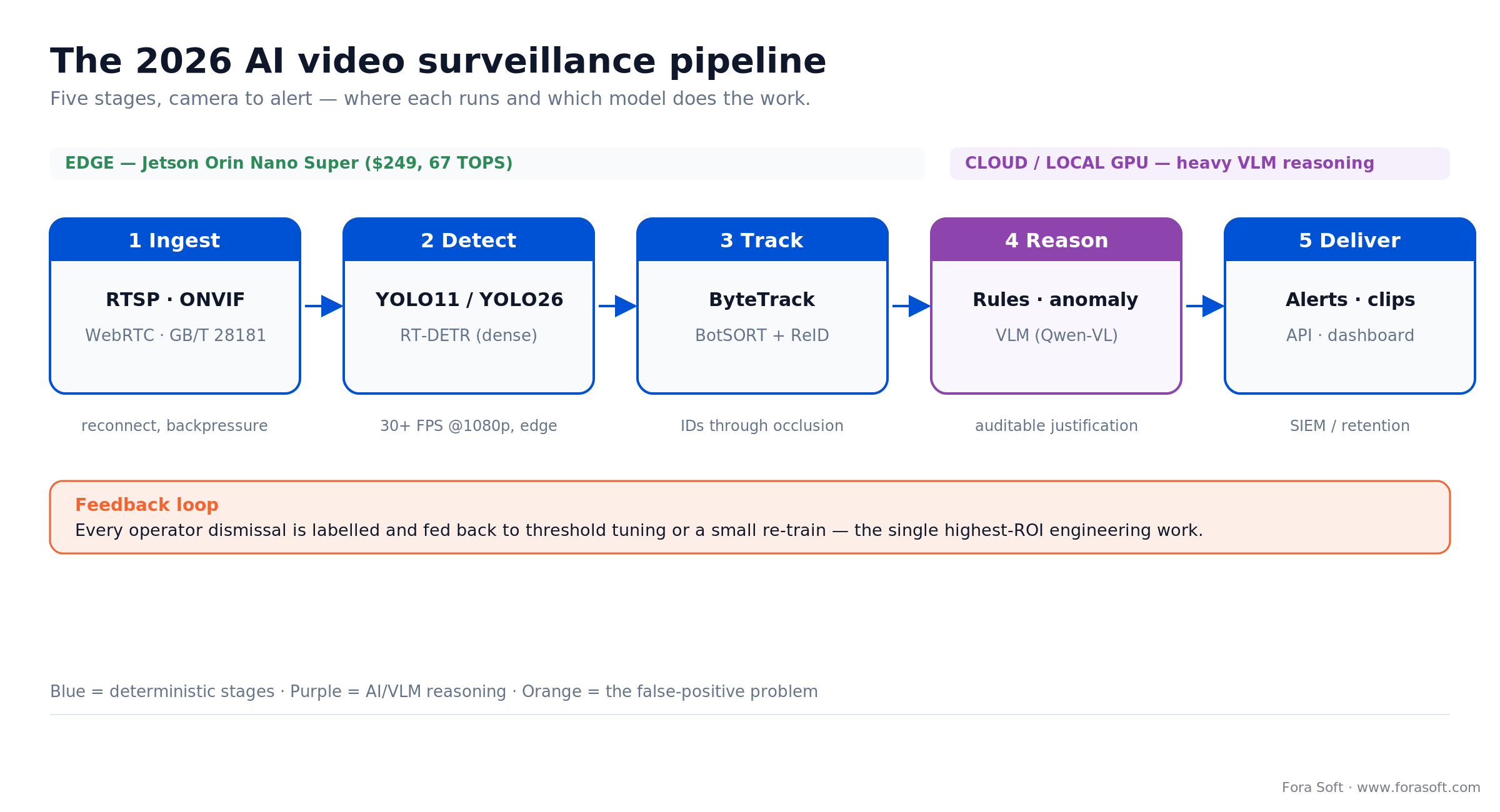
Figure 1. The five-stage reference pipeline — detect, track and rules run on a $249 edge box; heavy VLM reasoning stays on a GPU.
1. Ingest — RTSP, ONVIF, WebRTC
Most IP cameras speak RTSP (RFC 2326) for the stream and ONVIF Profile S/T for discovery and PTZ. Browser-based control rooms increasingly want WebRTC for sub-500 ms remote view; Asia-Pacific deployments need GB/T 28181. Ingest also owns reconnect logic, back-pressure, and stream-health metrics, boring until one malformed NAL unit crashes the decoder loop on a 500-camera site. If you want the standards depth, our position-1 guide to ONVIF profiles in security systems covers the Profile S/G/T/M decision.
2. Detect — YOLO11, YOLO26, or RT-DETR
YOLO11 is our default and Ultralytics' recommended production model. YOLO11-N reaches 39.5 mAP at 1.55 ms (TensorRT on a T4) and fits a Jetson Orin Nano Super; YOLO11-X hits 54.7 mAP on COCO (per Ultralytics) when accuracy outranks throughput. YOLO26 (early 2026) is the newer edge-tuned, end-to-end option Ultralytics also endorses for production. For dense small-object scenes (packed retail aisles), RT-DETR pulls ahead at 2–4× the compute. For flame, smoke, PPE, or firearm detection you re-train a detection head on 5–15k domain images.
3. Track — ByteTrack, BotSORT, StrongSORT
ByteTrack is the default: 80.3% MOTA (77.3 IDF1) on MOT17, real-time on one GPU, no separate re-identification model. When crowds and occlusion dominate, BotSORT adds a lightweight ReID head for ID stability; StrongSORT is worth the extra latency for forensic tracking across camera switches. Pick the wrong tracker and you double the false-positive rate without anyone noticing until an operator complains.
4. Reason — rules, anomaly model, or VLM
Detections and tracks are not alerts; the reasoning stage converts them. Low-risk deployments use a rules engine (zone + dwell time + class). Medium-risk ones train an anomaly model on UCF-Crime or ShanghaiTech-style data. High-risk ones call a VLM (Qwen2.5-VL, Florence-2, or hosted Gemini 2.5) on a short clip to answer a natural-language question and return a short, loggable justification. That justification is what an auditor reads — a black-box alert no longer ships.
5. Deliver — alerts, clips, dashboards, APIs
The operator UI is the product. Push notifications, side-by-side clip review, severity ranking, and a "mark as false positive" loop that retrains the model over time. Add an API for SIEM/SOC integration (Splunk, QRadar, Sentinel) and a storage strategy that satisfies retention rules in every jurisdiction you sell into.
Reach for a VLM stage when: the anomalies you care about change faster than you can label training data, and every alert needs a written reason an auditor can read. Skip it when a fixed rule (zone + dwell + class) already answers the question at a fraction of the cost.
A 2026 model shortlist, with numbers
Pick by job and hardware, not by brand. Every number below is a published benchmark, not a vendor claim.
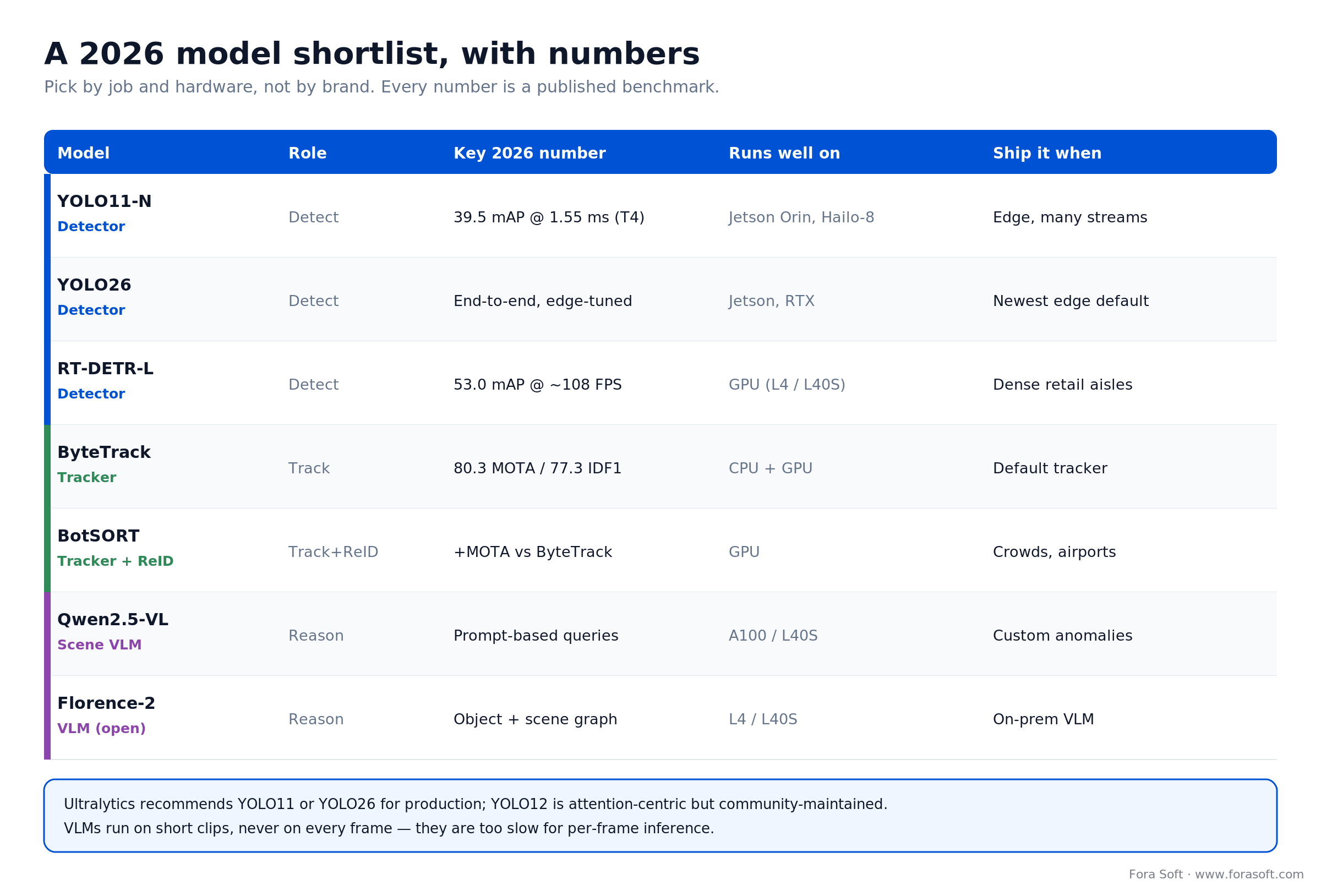
Figure 2. The shortlist by role, 2026 number, and where each model runs — detectors in blue, trackers in green, VLMs in purple.
| Model | Role | Key 2026 number | Runs well on | Ship it when |
|---|---|---|---|---|
| YOLO11-N | Detector | 39.5 mAP @ 1.55 ms (T4) | Jetson Orin, Hailo-8 | Edge, many streams |
| YOLO26 | Detector | End-to-end, edge-tuned | Jetson, RTX | Newest edge default |
| RT-DETR-L | Detector | 53.0 mAP @ ~108 FPS | GPU (L4 / L40S) | Dense retail aisles |
| ByteTrack | Tracker | 80.3 MOTA / 77.3 IDF1 | CPU + GPU | Default tracker |
| BotSORT | Tracker + ReID | +MOTA vs ByteTrack | GPU, crowded venues | Airports, stadiums |
| Qwen2.5-VL | Scene VLM | Prompt-based queries | A100 / L40S / API | Custom anomaly queries |
| Florence-2 | VLM (open-weight) | Object + scene graph | L4 / L40S | On-prem VLM |
One caveat on freshness: YOLO12 (early 2025) is attention-centric and benchmarks well (YOLO12-N, 40.6 mAP at 1.64 ms), but it's community-maintained and its original authors flagged the popular port as memory-heavy. For production we stay on YOLO11 or YOLO26. The Ultralytics YOLO11 docs track the current numbers.
Edge vs cloud: the TCO flipped in 2025
In December 2024 NVIDIA shipped the Jetson Orin Nano Super — $249, 67 TOPS (sparse), 1.7× the throughput of the previous generation that cost $499. One SKU changed the economics. For most commercial fleets the edge stack now wins on total cost of ownership inside 18 months.
| Deployment | Capex / camera | Opex / camera / year | Best for |
|---|---|---|---|
| Edge (Jetson / Hailo) | $150–300 | $10–30 (power + OTA) | Privacy, low latency, rural |
| Cloud (GPU API) | $0 | $80–200 (inference + egress) | Low volume, fast ship |
| Hybrid (edge detect + cloud VLM) | $150–300 | $20–60 | Regulated industries |
| On-prem GPU server | $60–150 (amortised) | $10–20 | Dense sites (64+ cams) |
Reach for cloud-only when: you have fewer than ~30 cameras, need to ship in days, and the per-camera SaaS bill is smaller than the engineering time to stand up edge hardware. Above that, the recurring line item usually loses to a one-time edge spend.
The cost model: 200 cameras over five years
Ranges are easy to wave away, so here's the arithmetic on a concrete 200-camera site. Edge-first: one Jetson Orin Nano Super per ~6 cameras is 34 units at $249, so 34 × $249 = $8,466 of inference hardware. Keep the existing cameras ($0), budget ~$26,000 for install and integration, and run power plus over-the-air updates at ~$20/camera/year, which is 200 × $20 = $4,000/year, or $20,000 over five years. Total: roughly $54,500.
Now the cloud-SaaS path at a typical $300/camera/year licence (Verkada-class pricing runs $200–400): 200 × $300 = $60,000/year, which is $300,000 over five years, before egress and storage add-ons. Break-even lands around month 11. Over the full term you're comparing ~$55k to ~$300k on the same workload.
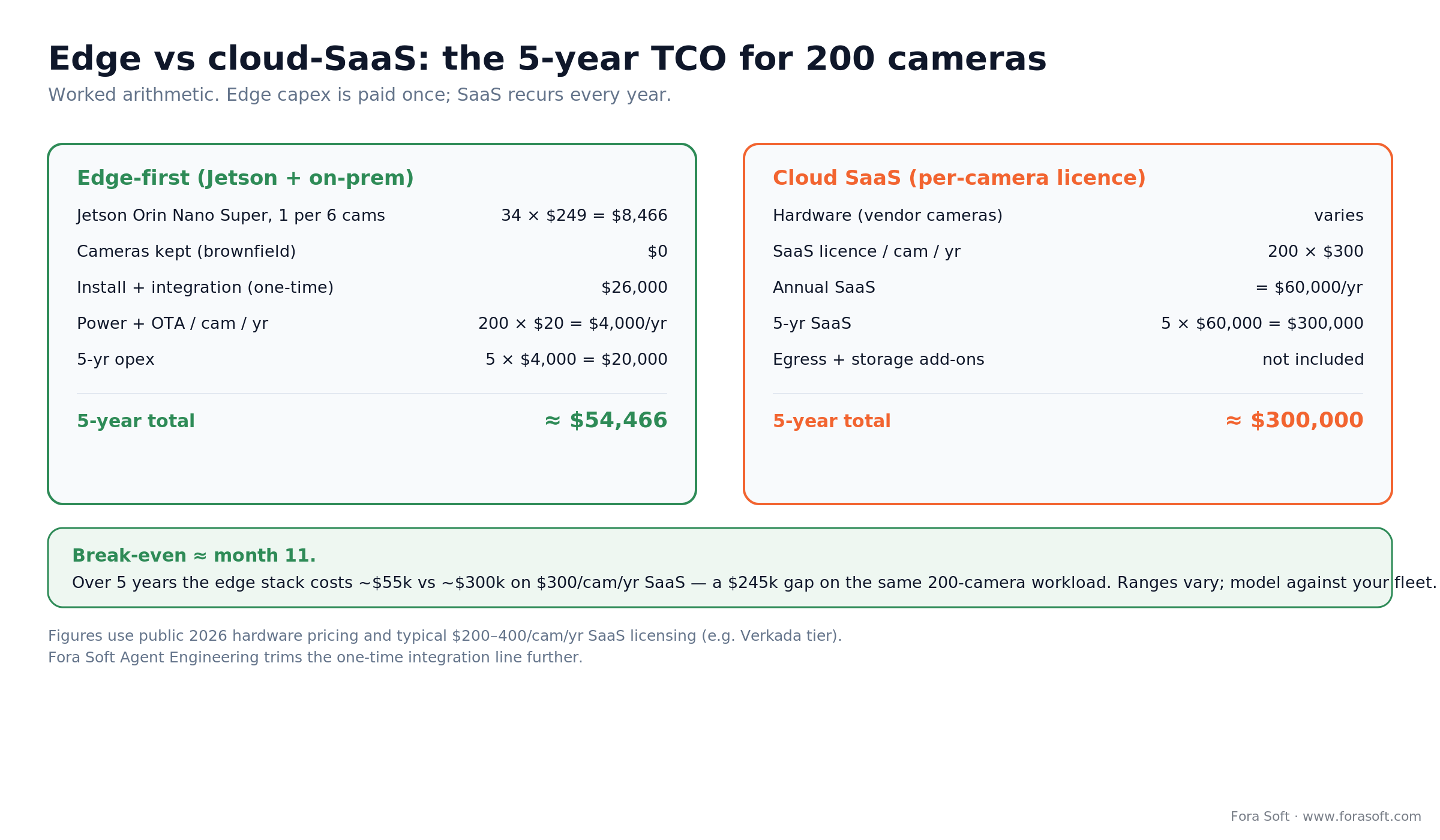
Figure 3. The worked five-year TCO. Edge capex is paid once; SaaS recurs every year — a ~$245k gap by year five.
Two honest caveats. Cloud wins below ~30 cameras where the edge integration cost dominates, and these are planning numbers: your egress, retention, and labour rates move them. We use Agent Engineering to trim the one-time integration line, which is where our estimates tend to come in under a typical shop's. Want the model run against your fleet? Our video surveillance team does this every week.
Paying cloud-only for 200 cameras?
That's a $60k/year line on a workload that could run on edge hardware amortised over five years. We'll model your exact numbers and show the break-even.
What anomaly detection actually means in 2026
"Anomaly" is doing a lot of work in most pitches. In a production system it decomposes into five concrete categories, each with its own model, data, and failure mode.
- Object anomalies. An unexpected class in a zone: a vehicle in a pedestrian area, a package left for 90+ seconds. Detector plus rules.
- Behavioural anomalies. Loitering, crowding, running, fighting, falling. Action-recognition models (SlowFast, MViT) or a VLM with a behavioural prompt.
- Trajectory anomalies. Wrong-way motion on an escalator, an unusual path through a warehouse. Tracker plus a learned trajectory model.
- Scene anomalies. Fire, smoke, flood, glass breakage. Specialised classifiers on re-trained backbones.
- Compliance anomalies. Missing PPE, tailgating, out-of-hours access. Detector plus identity and access-control context.
A vendor who says "we detect anomalies" without naming which of these five they solve is selling a demo, not a product.
Killing false positives: the highest-value work
Operator trust is a direct function of false-positive rate. Above ~5%, operators start second-guessing alerts; above 10%, they switch the module off. The five techniques below cut false alarms by an order of magnitude in our V.A.L.T rollouts, and they matter more than squeezing another point of mAP out of the detector.
1. Scene-aware confidence thresholds. Set the threshold per camera, not per model. A parking lot at 3 a.m. tolerates lower confidence than a retail floor at noon.
2. Temporal consistency. Fire only if the detection holds for N consecutive frames or re-identifies across a gap. That kills one-frame ghosts.
3. Zone geometry. Every alert zone is a polygon with entry and exit rules, not a rectangle. Eliminates "person detected" when the person is a poster.
4. VLM second opinion. For high-severity alerts, a VLM re-reads the clip and answers a structured question. Costs a few cents; cuts the top slice of false positives and leaves an audit trail.
5. Operator feedback loop. Every dismissal is labelled and fed back into threshold tuning or a small re-training run. This is where your data strategy lives: a seed set of 5–15k domain images, synthetic augmentation for weather and low light, and an active-learning queue that labels the model's own confusion. Median data beats a state-of-the-art model on thin data every time.
Reach for the feedback loop first when: your pilot's alerts are technically correct but operators still ignore them. The fix is almost never a bigger model. It's per-camera tuning plus a dismissal loop that compounds over three to six months.
EU AI Act and GDPR: design it in
The timeline moved in 2026, and getting it wrong in a pitch is an instant credibility hit. The EU AI Act's Digital Omnibus, adopted by the Council on 29 June 2026, deferred high-risk obligations for standalone (Annex III) systems from 2 August 2026 to 2 December 2027, and Annex I (AI embedded in regulated products) to 2 August 2028. But the Article 5 prohibitions have applied since 2 February 2025: untargeted facial-image scraping and most real-time remote biometric identification in public spaces are already banned, with narrow law-enforcement exceptions. Transparency duties under Article 50 apply from 2 August 2026.
Penalties are tiered: up to €35M or 7% of global turnover for prohibited practices, and €15M or 3% for other high-risk non-compliance. Even if you never sell into the EU, your enterprise customers will demand equivalent controls.
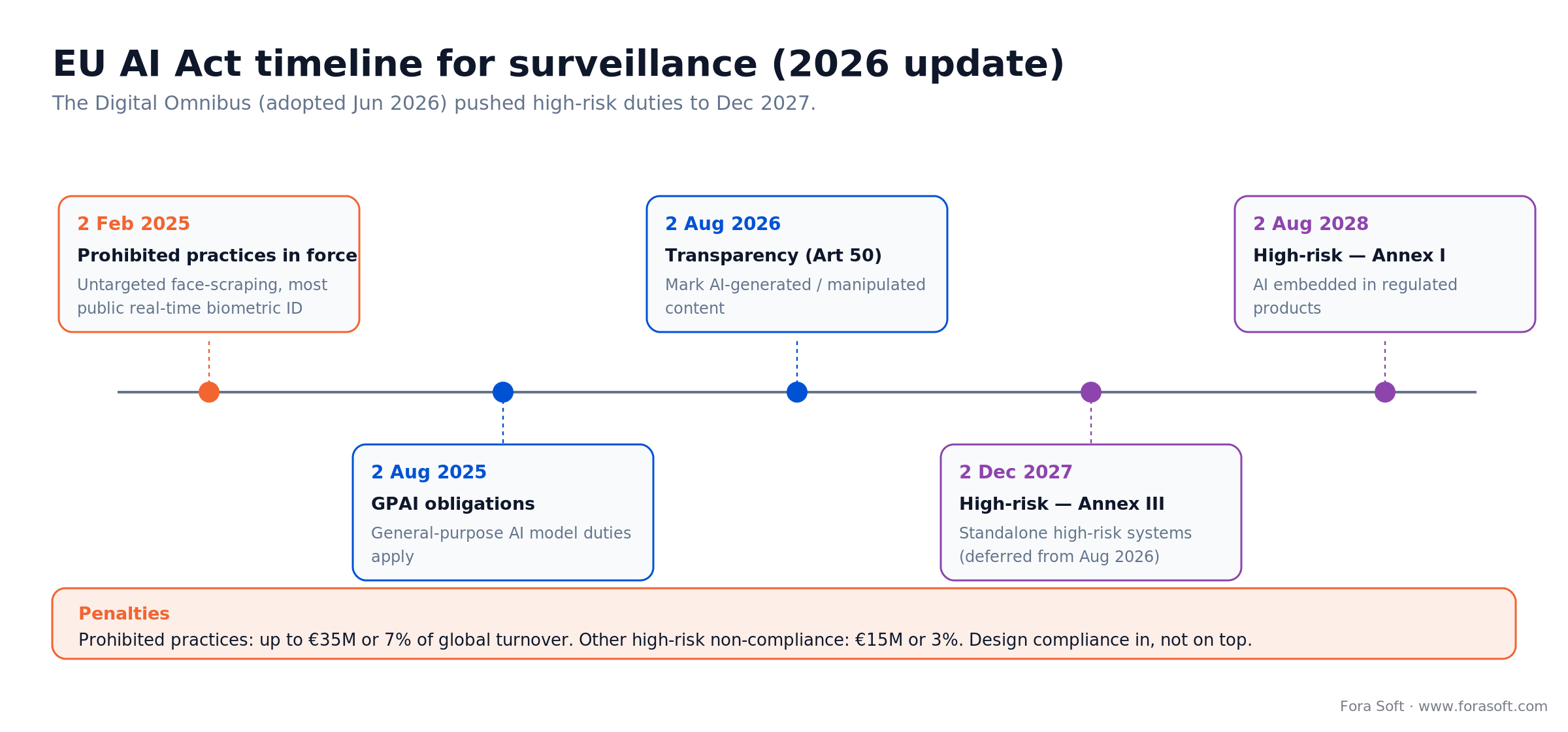
Figure 4. The 2026 EU AI Act clock for surveillance — prohibitions already in force, high-risk duties deferred to Dec 2027.
Six things to build in from day one: transparency (save the clip, detections, rule, model version, and any VLM prompt and response), human oversight (every high-severity action flows through an operator with a documented override), data minimisation (blur non-relevant faces by default), bias monitoring (track performance across demographic slices in an open register), jurisdictional routing (EU footage stays in the EU), and an immutable audit trail for every alert, dismissal, export, and model update.
Getting this right means the compliance people and the ML people share a room from sprint one. Our AI integration service ships with an AI Act readiness checklist baked into discovery. We translate the rules into product decisions. We're engineers, not lawyers, and we say so.
Integrating a legacy, pre-ONVIF fleet
A large share of enterprise camera fleets predate ONVIF or use vendor-extended RTSP. "Replace it all" is neither politically nor financially real. Our brownfield playbook:
1. Bridge gateway. A small Linux box per site (or per rack) re-exports the legacy stream as ONVIF/RTSP to the AI stack. Works for analogue-via-DVR, proprietary IP protocols, and vendor-locked NVRs.
2. Per-manufacturer probe library. A library of PTZ, presets, and events for common vintage cameras (Hikvision, Axis legacy, Pelco, Panasonic, Bosch). A one-time investment with lifetime payoff.
3. Frame-rate normalisation. Old analogue cameras run 6–12 FPS; tracking wants 10–15. Interpolate or drop gracefully and tune thresholds per camera.
4. Gradual replacement. Priority-queue by camera age and criticality. Replace ~20% per year, not 100% at once. For what to buy as you replace, our guide to AI-powered IP camera trends covers the camera-side ML shift.
The metrics that matter (and the ones that mislead)
Ignore "accuracy." A 99%-accurate model on a 1% anomaly base rate is a 99%-silent model. The numbers that matter:
- Recall at operational FPR. "We catch X% of real events at one false alarm per camera per week."
- Time-to-alert. Median latency from event onset to operator notification. Under 5 seconds is good; over 30 is useless.
- Operator time saved. Hours of review replaced by a ranked alert list, measured per operator per shift — not in buzzwords.
- Mean time to ID re-acquisition. How fast the tracker recovers an identity after occlusion. A forensic quality-of-life metric.
- Cost per actioned alert. Total stack cost divided by alerts that led to an operator action. The only number procurement cares about.
Mini-case: V.A.L.T, 770+ organisations
The situation. V.A.L.T is our video surveillance SaaS for regulated U.S. buyers: police departments recording interviews, medical schools running HIPAA-bound simulation labs, and child-advocacy centres capturing forensic interviews. Cameras are mostly Axis. The hard requirements were never "detect a person"; they were per-case access control, perfect audio-video sync, and evidence export a court will accept.
The plan. We built the platform as infrastructure first: HD multi-camera streaming (nine feeds per screen), PTZ with push-to-talk, SSL/RTMPS encryption, role-based access with LDAP, scheduled recording, searchable markers, and one-click PDF reports. The analytics layer is pluggable, so AI models attach on top of a backbone that already handles streams, permissions, and retention.
The outcome. V.A.L.T now serves 770+ organisations and 50,000+ active users, and clients say new operators are productive after a ten-minute browser walkthrough. The broader lesson holds for every AI build: a surveillance platform at scale is mostly plumbing — reliable streams, permissions, storage — and AI sits on top. Vendors who lead with the AI and skip the plumbing ship a demo that falls over at 200 cameras. Want a similar assessment of your stack? Book a walkthrough.
Build, buy, or hybrid: a decision matrix
| Option | Best when | Typical cost | Time to value |
|---|---|---|---|
| SaaS VMS + AI | 50 or fewer cams, standard use case | $80–200 /cam/yr | Days |
| On-prem NVR + AI SDK | Mid-market, data-sovereign | $15k–60k + $20–50 /cam/yr | 4–8 weeks |
| Custom build (our sweet spot) | 200+ cams, specific domain | $150k+ (one-time) | 3–9 months |
| Hybrid (VMS + custom AI) | Enterprise, regulated | $60k–400k | 6–12 weeks |
If you already run a fleet and want a commercial overview of the custom-vs-off-the-shelf tradeoff, see our computer vision for video surveillance page. The deep architecture layer is what you're reading now.
Pick your path in five questions
Answer these in order; the first "yes" that forces a custom or hybrid build usually settles it.
1. Fewer than 50 cameras and a standard use case? Buy SaaS. The per-camera bill is smaller than your engineering time.
2. Hard data-sovereignty or offline sites? Rule out cloud-only; you need on-prem or edge.
3. A domain model (PPE, firearm, forensic review) or 200+ cameras? Off-the-shelf accuracy and SaaS economics both break here — build or go hybrid.
4. Do you already run a proven VMS? If yes, a custom analytics layer on top (hybrid) beats rebuilding the backbone.
5. Can you pilot on 10 cameras first? Always yes. Calibrate thresholds and measure FPR before committing to any path.
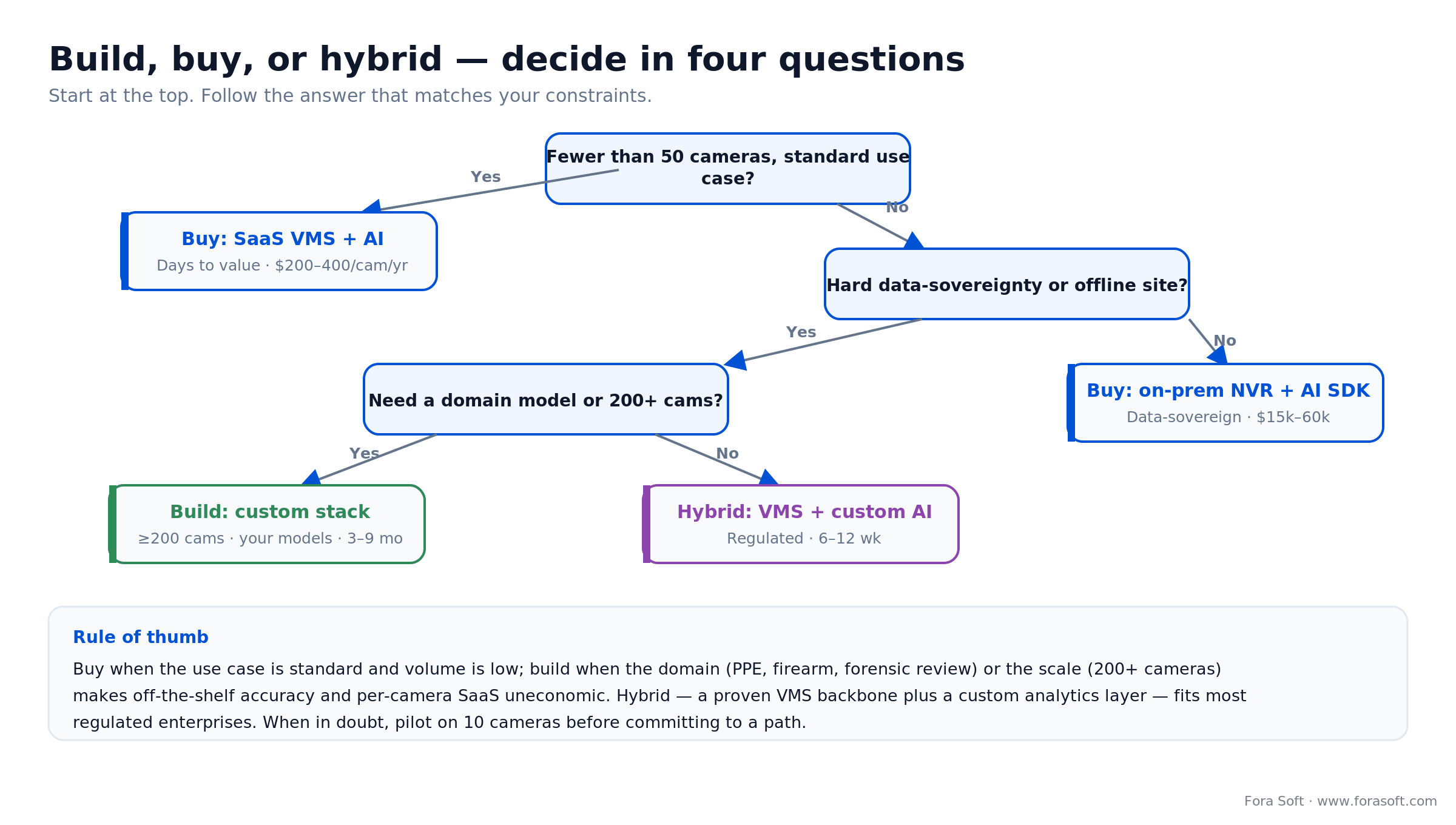
Figure 5. The build/buy/hybrid decision tree — start at the top and follow the answer that matches your constraints.
Eight red flags in a surveillance proposal
1. No false-positive rate stated. No FPR at a named recall means no product.
2. No model version. "Our proprietary AI" is a sales line; "YOLO11 with a re-trained head" is an engineering answer.
3. No edge option. In 2026, a vendor who can only do cloud is missing a key TCO lever.
4. No AI Act plan. If "EU AI Act" gets a shrug, your legal team will get one too.
5. No bias register. Demographic performance varies. Vendors who pretend otherwise are hiding something.
6. No ONVIF/RTSP support list. "We work with any camera" falls apart on a Panasonic unit from 2012.
7. No operator-feedback loop. A system without a dismissal UI gets worse with time, not better.
8. No SLA on time-to-alert. The product is the latency. No SLA, no product.
When NOT to build custom AI surveillance
Honesty sells better than a pitch, so here's when we tell people not to hire us. If you have fewer than 50 cameras and a standard use case (entry monitoring, basic intrusion), a SaaS VMS with built-in analytics will beat a custom build on time and cost, and we'll say so. If your anomalies are fully covered by fixed rules (zone plus dwell plus class), you don't need a VLM or a trained model at all; you need good zone geometry.
Two more. If nobody will own the operator-feedback loop after launch, don't build. An un-tuned system decays, and you'll blame the model. And if your real problem is a biometric-identification use case that Article 5 prohibits, the answer isn't a cleverer architecture; it's a different product. We'd rather flag that in the first call than in month six.
Reach for off-the-shelf when: your camera count is under 50, the use case is standard, and no regulation or domain model forces a custom path. Custom pays off at scale, in a specific domain, or under data-sovereignty constraints — not before.
Benchmarks and the open-source stack
Writing an RFP? Ground your accuracy requirements in published benchmarks, not vendor claims. COCO is the detection gold standard (YOLO mAP numbers refer to it). MOT17/MOT20 are the tracking benchmarks (ByteTrack posts 80.3% MOTA / 77.3 IDF1 on MOT17). UCF-Crime (1,900 real-world clips across 13 categories), ShanghaiTech Campus, and XD-Violence (4,754 videos) are the anomaly references.
Even if you're buying, knowing the open-source layer keeps vendors honest. Frigate is the best self-hosted NVR with local inference (pair it with a Coral TPU or Hailo-8). NVIDIA DeepStream is the right multi-stream framework on Jetson. Ultralytics is the accessible path to a production detector. OpenCV is still the preprocessing workhorse, and open-weight VLMs (Qwen2.5-VL, Florence-2, LLaVA-Video) cover on-prem scene reasoning when the cloud isn't an option. For the model internals behind all of these, our AI for Video Engineering course goes deeper than we do here.
Need a second opinion on a surveillance RFP?
Send us the proposal. We'll red-flag the false-positive claims, the missing AI Act plan, and the cloud-only TCO — and tell you what a fair build actually costs.
Frequently asked questions
How accurate is AI video surveillance in 2026?
For well-defined anomalies (abandoned object, fall, loitering) on a calibrated deployment, expect 85–95% recall at one or fewer false alarms per camera per week. Novel or subtle anomalies drop to 60–75%. Anyone quoting 99% on an open set is measuring the wrong thing.
What does "edge AI" mean in video surveillance?
It means the detection and tracking run on a small computer next to the cameras (typically an NVIDIA Jetson Orin Nano Super at $249/67 TOPS, or a Hailo-8 accelerator), instead of streaming every frame to the cloud. Edge AI cuts latency, keeps footage on-site for privacy, and removes the per-camera cloud inference bill.
Can I run AI surveillance entirely at the edge?
Yes for detect, track, and rules. A Jetson Orin Nano Super handles 4–8 streams at 10–15 FPS with YOLO11-N. VLM-based reasoning usually still lives on a local GPU server or the cloud, because 7B-class VLMs are too heavy for Nano-class edge hardware.
Does the EU AI Act stop us shipping in 2026?
No, for most commercial surveillance. The Digital Omnibus deferred high-risk obligations to 2 December 2027, and lawful designs (transparency, human oversight, proportionality) are fine. The hard limits are the Article 5 prohibitions in force since February 2025: public-space biometric identification and untargeted face-scraping. We classify your use case in discovery so you know your category on day one.
How do VLMs change the architecture?
They replace most custom-classifier code with prompts. You still need detectors and trackers (VLMs are too slow to run on every frame), but you call a VLM on a short clip to answer a specific question ("is anyone lying down?"). It ships new detections faster and returns a text justification you can log for compliance.
Do we need to replace our existing cameras?
Usually not. A bridge gateway re-exports legacy streams as ONVIF/RTSP and the AI stack doesn't care. Frame rate and resolution do matter (very old cameras at 4 FPS limit tracking), so plan a 3–5 year gradual replacement, not a day-one forklift.
What's a realistic timeline for a custom build?
Roughly 3–4 weeks discovery, 6–10 weeks piloting on 10 cameras, then 3–6 months to a scaled rollout for the first 200 cameras. Faster if you already have labelled data and a VMS; slower if you're building the VMS too.
Who owns the surveillance data?
You do. Our standard contract grants Fora Soft only the minimum access needed to operate the system and prohibits training on your footage without an explicit, per-contract opt-in. Footage stays in your jurisdiction.
What to read next
Models
Top anomaly-detection models for surveillance
The ranked model breakdown behind this pipeline's reasoning stage.
Standards
ONVIF profiles in security systems
The Profile S/G/T/M decision for multi-vendor camera fleets.
Architecture
Scalable video management systems
How modern VMS architectures scale beyond 1,000 cameras.
Service
Video surveillance development
Custom surveillance platforms from 10 to 10,000+ cameras.
The short version, 2026
AI video surveillance is a five-stage pipeline (ingest, detect, track, reason, deliver) on a settled stack of YOLO11 or YOLO26, ByteTrack or BotSORT, and a VLM for scene reasoning. The Jetson Orin Nano Super put edge inference under $250 a channel, so most fleets now win on TCO by going edge-first. The hard problems are false-positive rate, EU AI Act compliance (high-risk duties now Dec 2027, prohibitions live since Feb 2025), and brownfield camera integration — not detector accuracy.
Pick a partner who names their models, quotes FPR at a chosen recall, and ships an AI Act-ready audit trail by default. We do this every week, from single-building pilots to 50,000-user platforms — bring your camera count and your use cases, and leave with a stack, a timeline, and a number.
Ready to talk AI surveillance?
Bring your camera count and use cases. Leave with a stack, a timeline, and a realistic number — free, no obligation.

