


Key takeaways
• Buy the cameras, fight for the brain. AI-powered video analytics is worth building custom when your value is in the rules, ranking, and integrations — not the detector. YOLO-class models and ArcFace are commodity; your judgement layer is the moat.
• The ROI numbers are real. False-alarm reductions of up to 90%, response-time cuts from 4.2 min to 1.3 min (68%), and 12–18 month payback are standard in published deployments — but only when the pipeline is engineered end-to-end.
• Edge or cloud is the wrong question. The right answer is hybrid: Hailo-8 or Jetson at the camera for hot paths (intrusion, PPE, slip-and-fall), a Kafka + Triton cluster in the cloud for retention, search, and forensics.
• Compliance is the feature you can’t ship last. EU AI Act fines of up to €35M or 7% of global turnover and a surge of 100+ BIPA class actions in 2025 mean facial recognition, retention, and consent design belong on the first sprint, not the last.
• Storage math will mug you. A 4K camera in H.265 at 6 Mbps fills ~65 GB/day. A hundred cameras at 24/7 retention will cost more than the detectors — plan the codec, the retention tier, and the ONVIF profile before you pick a VMS.
Updated October 2026: refocused on choosing video analytics software, vendor pricing models re-checked, EU AI Act dates now final under Regulation (EU) 2026/1744.
Video analytics software is the layer that runs AI models on camera feeds and turns them into alerts, counts and searchable events. In 2026 you buy it in one of three shapes: a VMS with analytics plug-ins (Milestone, Genetec, Avigilon), a cloud platform that bundles cameras and analytics (Verkada, Rhombus, Eagle Eye), or a custom build on open models when the rules, data residency or scale are your edge. Pricing follows the shape: per-camera VMS licences, per-camera cloud subscriptions, or a one-time build plus hosting. This guide compares the platforms, shows what each costs per camera and tells you when a custom build pays off.
Why Fora Soft wrote this playbook
We’ve been building video and AI products for 21 years (250+ shipped, Upwork 99% Job Success), with a focused practice in video surveillance software, VMS, and AI video recognition. On the analytics side specifically we’ve delivered MindBox, an enterprise AI VMS running across 50+ deployments with 99.5% facial-recognition accuracy and 500K+ vehicles/day on ANPR; V.A.L.T, a SaaS serving 770+ organizations and 50,000+ daily users; and Netcam, one of the earliest widely adopted IP-camera management platforms.
This playbook is the shortened version of the architecture conversation we have every week with security directors, CTOs, and product owners who are evaluating whether to buy a VMS, extend one, or build a custom AI video analytics platform. It covers the detectors worth using in 2026, the vendors worth comparing against, the edge/cloud math, the compliance traps, and a 14-week integration path we’ve proven on client work.
The commercial point is blunt: if you’re investing seven figures into surveillance, you deserve a partner who will tell you which 60% of the AI pitch is marketing and which 40% actually moves operational KPIs. That’s the spirit of this guide.
Evaluating AI video analytics for your security program?
30 minutes with a senior engineer — we’ll sanity-check the vendor shortlist, the edge/cloud split, and the compliance exposure before you commit.
What AI-powered video analytics actually is in 2026
Strip the buzzwords and AI video analytics for security is a pipeline (our AI video analytics for security explainer walks through each stage and the use cases in detail): capture → decode → detect → track → classify → rule engine → notify → store → search. Each stage is a commodity or a differentiator depending on your use case; the platforms that win are the ones that get the rule engine and the search experience right.
The detection layer (YOLOv10, RT-DETR, Grounding DINO, ArcFace) is open-source and essentially free. The tracking layer (ByteTrack, StrongSORT, OSNet for re-identification) is equally open. Where the engineering goes is everywhere else: reliable RTSP ingest from mixed-vendor cameras, sub-second rule evaluation, a forensic search UX that lets an operator find “red backpack, north gate, between 14:00 and 14:10” in seconds, and an audit log that survives a legal discovery request.
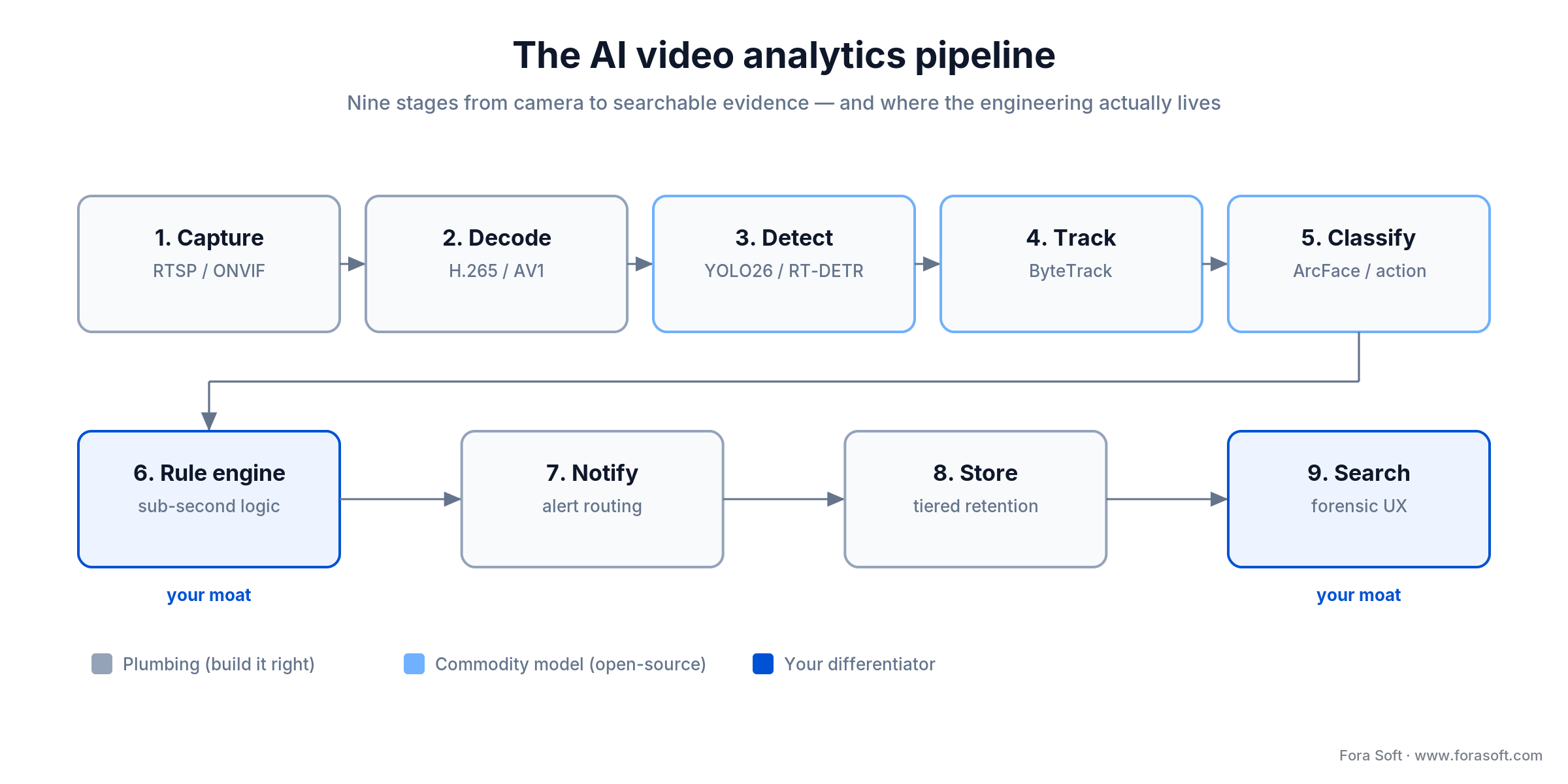
Figure 1. The nine-stage AI video analytics pipeline — detection and tracking are commodity; the rule engine and forensic search are where your product wins.
The eight analytics that actually get paid for
- Intrusion / zone breach. The baseline — line crossing, loitering, after-hours presence.
- PPE & safety. Helmet, vest, glove, and hair-net detection for construction, manufacturing, and food plants.
- License plate recognition (LPR/ANPR). Parking, logistics yards, gated campuses; modern systems hit 95%+ on open-air plates.
- Facial recognition + re-identification. Known-person alerts in enterprises; ArcFace embeddings, OSNet for multi-camera tracking at ~98% mAP on Market1501.
- Behavior / anomaly detection. Slip-and-fall, loitering, bag-drop, crowd surges, tailgating.
- Crowd counting & flow. Density heatmaps, queue length, throughput KPIs — Maha Kumbh Mela deployed 2,760+ AI cameras for a 450K-person real-time system.
- Vehicle & asset analytics. Logistics, airport ramps, retail delivery; overlaps with LPR and object tracking.
- Forensic search. Natural-language or attribute search over months of footage — the feature that beats every Ctrl+F timeline scrub.
The market: why this category is growing 22% a year
Mordor Intelligence pegs the AI video analytics market at USD 6.19B in 2026, scaling to USD 17.23B by 2031 at a 22.72% CAGR. Definitions vary a lot — firms that fold in non-AI tooling run higher (MarketsandMarkets puts broader video analytics near USD 14.7B in 2026), so treat any single headline number as a scope choice, not gospel. Cloud deployments already own ~58% share; hybrid/edge is the fastest-growing slice at 23%+ CAGR.
The growth isn’t driven by vision models getting smarter every year — they are, but slowly. It’s driven by three concrete shifts: ONVIF has finally standardized enough camera integration (30,000+ products conformance-tested) that mixed fleets are practical; edge AI accelerators (Hailo-8, Jetson, Ambarella CV5) have become affordable enough to put a detector on every camera; and insurers plus regulators have started pricing surveillance KPIs (false-alarm rate, time to dispatch) into premiums and compliance audits.
The detection stack: what to pick in 2026
Model choice is the smallest decision; integrating it well is the biggest. Here’s the opinionated default we ship.
Object detection
YOLO26 (Ultralytics, January 2026) is the current default: NMS-free end-to-end inference, edge-first, quantization-stable, and SOTA on COCO for its size class. If your toolchain isn’t on it yet, YOLOv10 and YOLO11 are proven fallbacks — YOLOv10s runs ~1.8× faster than RT-DETR-R18 at matching mAP. For open-vocabulary search (“find any red backpack”), Grounding DINO or YOLO-World give you natural-language detection at 52.5 AP zero-shot on COCO, no custom class training.
Identity and re-identification
ArcFace (InsightFace) is still the de facto face embedding; 512-D vectors, thousands of citations, reliable at scale. For person re-identification across cameras, OSNet_x1_0 reaches ~98.4% mAP on Market1501. Store embeddings in a vector index (FAISS for scale, pgvector for convenience) and search is cheap.
License plate recognition
Commercial ALPR APIs (Plate Recognizer, Rekor, OpenALPR Cloud) hit 95%+ in clean conditions. For self-hosted, a YOLO plate detector plus a fine-tuned CRNN/Parseq recognizer is the standard pattern — and the standard accuracy ceiling is 85–95% depending on angle, motion blur, and regional character sets.
Behavior and anomaly
Action recognition (SlowFast, MViT, X-CLIP) for structured events; unsupervised anomaly models (PaDiM, memory-bank methods, or simple temporal-difference heuristics) for “something weird here.” We cover this layer in detail in our 7 best ML algorithms for surveillance anomalies article, and the model internals sit in our AI-for-video-engineering learn track.
Reach for YOLO26 (or YOLO11) + ArcFace + OSNet when: you need production-grade detection/recognition on <1,000 cameras and your team can maintain PyTorch/TensorRT builds; it’s the cheapest path to 95% of the capability ceiling.
Edge vs. cloud: the real decision is “which work goes where”
Every vendor pitch is either “edge everywhere” or “cloud everywhere.” Real deployments are hybrid.

Figure 2. Which work goes where — latency-critical hot paths stay at the edge; forensic search, re-identification, and retraining live in the cloud.
Put on the edge: anything latency-critical (intrusion, PPE, slip-and-fall), anything that would cost you bandwidth if streamed raw (high-resolution 24/7 feeds), anything privacy-sensitive (on-device face-blurring, GDPR pseudonymization at the source).
Put in the cloud: long-tail analytics (forensic search, re-identification across sites), model training and retraining, cross-site correlation, the VMS UX, and audit logs.
Hardware shortlist for 2026: Hailo-8 at ~26 TOPS / 2.5 W for single/small-camera edge nodes (10 TOPS/W is class-leading); NVIDIA Jetson Orin for multi-stream edge aggregation; NVIDIA L40 with 3× NVENC / 3× NVDEC for cloud encode/decode + inference; H100 or L40S for model training and heavy multi-stream analytics; Google Coral / Axis ARTPEC chips for budget single-camera deployments. One live lesson in platform risk: AWS Panorama support ended May 31, 2026, and the appliances stopped functioning. Anyone who standardized on it is now migrating to Triton-on-Kubernetes or AWS IoT Greengrass. The takeaway: bet on portable, open runtimes, not a single vendor’s managed box.
Reach for pure edge (Hailo / Jetson) when: bandwidth is the constraint (remote sites, cellular backhaul), latency must be <100 ms, or you need to process video without ever sending it off-premise for privacy/regulatory reasons.
Reach for cloud aggregation when: you need cross-site forensic search, multi-camera re-identification, or centralized compliance/audit — the training and search workloads dwarf the inference cost.
Reach for hybrid edge + cloud when: you want sub-200 ms alert paths on hot rules (intrusion, PPE, slip-and-fall) while keeping retention, forensic search, and model retraining centralized — this is the default pattern we ship on MindBox-class deployments.
Video analytics software compared: 2026 platforms and pricing
The table below covers the video analytics software and VMS vendors we’ve integrated with or evaluated on client engagements, checked in October 2026. Most vendors no longer publish list prices, so the pricing column shows the model you will be quoted on; your negotiated rate will differ. If the platform has to plug into a VMS you already run, our VMS integration guide shows where analytics events land in Milestone, Genetec, Avigilon Unity and Nx Witness.
| Vendor | Model | Pricing signal | Best for | Watch out for |
|---|---|---|---|---|
| Milestone XProtect | On-prem VMS + plugin ecosystem | Perpetual license tiers; 500k+ installations, 1k+ integrations | Enterprises with mixed-vendor cameras and existing IT ops | Analytics are mostly 3rd-party add-ons; custom UX is limited |
| Genetec Omnicast / Security Center | Hybrid on-prem + cloud | Enterprise; per-camera perpetual + SaaS options | Regulated sectors (airports, cities) wanting unified PSIM | Large footprint; expensive to customize |
| Verkada | Fully cloud; bundled hardware | Per-device hardware plus per-device licence on 1–10-year terms; quote-based | SMB/mid-market buyers who want one SKU | Vendor-lock on cameras; limited custom rules |
| Rhombus | Cloud-native | Per-camera licence by tier (AI features in the upper tier); quote-based | Distributed retail/office networks | Same lock-in pattern as Verkada |
| Eagle Eye Networks | Cloud VMS, camera-agnostic | Per camera per month, priced by resolution and retention; not published | MSPs and multi-site operators | Analytics depth is narrower than BriefCam-class |
| BriefCam (by Milestone) | Analytics overlay on VMS | Enterprise; negotiated | Investigations, forensic video synopsis | Strong forensics, thinner live-alerting |
| Cisco Meraki MV | Cloud + on-camera ML | Enterprise Meraki licensing | Shops already standardized on Meraki networking | MV Sense is optional; custom CV needs engineering |
| Custom (Fora Soft-class build) | Hybrid edge + cloud | $150k–$600k first release depending on scope | Operators who need their own analytics IP, SLAs, or regulated data residency | Only worth it above ~500 cameras or with a differentiated use case |
For a deeper breakdown of what a modern VMS should include, see our 12 essential features of modern VMS software guide; for custom builds specifically, our custom VMS development guide walks through timelines and costs.
Shortlisting VMS vendors or weighing a custom build?
We’ll review your analytics requirements against Milestone, Genetec, Verkada, and a custom path — in 30 minutes, with honest numbers.
Reference architecture: what we ship
For a multi-site enterprise with 500–5,000 cameras, here is the opinionated stack we use as a starting point. Every component has one obvious default and one obvious upgrade path.
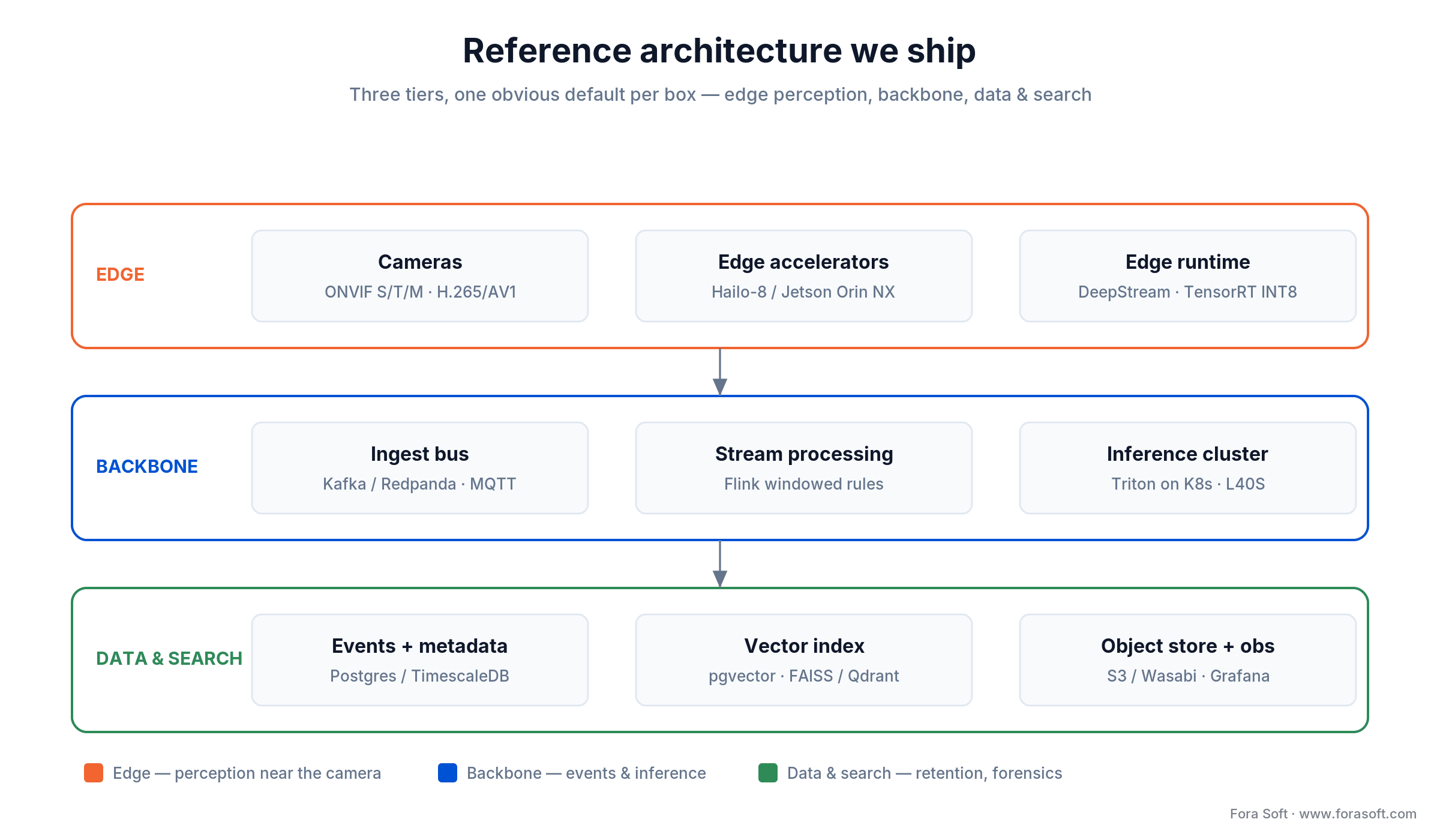
Figure 3. The three-tier reference stack — edge perception, an event-and-inference backbone, and the data-and-search tier that powers forensics.
Edge tier
- Cameras: ONVIF Profile S / T / M; H.265 as default, AV1 where supported (cuts storage another ~30% vs H.265).
- Edge accelerators: Hailo-8 for single-camera nodes, Jetson Orin NX for 4–8 stream aggregation, Axis/Ambarella for pre-classified devices.
- Edge runtime: DeepStream or Triton Edge, models quantized to FP16/INT8 via TensorRT.
Backbone
- Ingest bus: Kafka (or Redpanda) for events; MQTT for low-bandwidth edge telemetry.
- Stream processing: Flink / Spark Structured Streaming for windowed rules; simple Kafka Streams apps for basic joins.
- Inference cluster: Triton Inference Server on Kubernetes (Strimzi for Kafka), autoscaled on L40 or L40S GPUs.
Data & search
- Time-series + metadata: Postgres/TimescaleDB for events; Parquet in object store for cold tier.
- Vector index: pgvector up to a few million embeddings, FAISS/Qdrant/Vespa above that.
- Object storage: S3-compatible (AWS S3, Wasabi, Backblaze B2) with lifecycle rules to Glacier/Deep Archive.
- Observability: Prometheus + Grafana for infra; per-camera QoS (FPS, codec, bitrate, packet loss).
A full discussion of how we take object-recognition systems from prototype to production sits in our custom object-recognition cameras guide; the model-embedding work itself is what our AI integration services handle day to day.
Storage and bandwidth: the math that mugs you
The surprise line item on most AI video projects is storage, not GPUs. At 4K, a single camera at H.264 needs 8–12 Mbps; H.265 drops that to 4–6 Mbps; AV1 saves another ~30–40% on top of H.265. A 4K/H.265/6 Mbps camera running 24/7 generates ~65 GB/day — 100 cameras = ~195 TB/month before you touch snapshots and analytics metadata.

Figure 4. Storage per camera per day by codec — AV1 saves ~34% over H.265 at 4K, and the codec choice dwarfs the detector cost.
| Stream | Codec / bitrate | GB per camera / day | TB / 100 cams / month |
|---|---|---|---|
| 1080p H.264 | ~5 Mbps | ~54 GB | ~162 TB |
| 1080p H.265 | ~2.5 Mbps | ~27 GB | ~81 TB |
| 4K H.265 | ~6 Mbps | ~65 GB | ~195 TB |
| 4K AV1 | ~4 Mbps | ~43 GB | ~129 TB |
The tiering pattern we default to: hot tier (SSD or fast S3) for the last 7–30 days, warm tier for up to 90 days, cold archive (Glacier / Deep Archive / Backblaze B2) for retention-policy days beyond that. Done well, cold tier costs ~$0.002/GB-month and keeps the storage line under the AI inference line.
Cost model: what AI video analytics really costs
The numbers below assume 500 cameras, 4K H.265, hybrid edge + cloud, 30-day hot retention. Real clients, real providers (Hetzner AX-series for training boxes, AWS/GCP for the data plane, Cloudflare or Wasabi for cold storage).
Recurring (per month)
- Edge accelerators: ~$50–$150 per camera one-time (Hailo-8/M.2 module, Jetson Nano/Orin variants) amortized, plus modest power.
- Cloud inference (L40/L40S cluster): ~$2–$5k for 500-camera aggregation workloads depending on which analytics run cloud-side.
- Storage: ~$4–$9k for 1 PB hot + tiered archive at typical cloud list price; much less on Hetzner/Backblaze for cold.
- Monitoring + logs: ~$500–$1,500.
- Licenses: if you use a VMS (Milestone XProtect, Genetec), camera licenses typically $50–$200/camera perpetual or $15–$40/camera/month SaaS.
One-time custom build
A typical mid-size custom AI video analytics platform (8–12 analytics, mixed-vendor camera support, forensic search, role-based access, audit trail) lands in 14–22 weeks with a modern Agent-Engineering team of 4–6 engineers plus an ML specialist. If you’re being quoted 18–24 months for that scope, the quote is padded.
For a broader cost reference across adjacent video products, see video streaming app development cost.
ROI: what operators actually measure
Published case deployments of AI analytics keep landing on the same numbers:
- False-alarm reduction up to 90% (one documented deployment went from 85% false rate down to 16%).
- Incident response time from ~4.2 min to ~1.3 min (68% improvement) after AI alert routing.
- Forensic search collapses hours-long reviews to seconds (reported 20× speedups).
- 86% of end-users report ROI inside 12–18 months, driven by prevented incidents, fewer false dispatches, and labor offset.
- Enterprise-scale case: $1.8M+ annual savings attributed to reduced false-dispatch volume alone.
The catch: every one of those numbers assumes clean model retraining, solid camera coverage, and a rule engine tuned for the operator’s actual incidents — not vendor-default thresholds. Half the AI video projects that miss ROI do so because nobody owns the feedback loop from incident outcome back to model tuning.
Mini case: MindBox — an AI VMS at enterprise scale
Situation. MindBox needed an intelligent VMS that could handle face-recognition, license-plate recognition, and vehicle tracking across enterprise-scale deployments in transportation, pharmaceuticals, and security sectors — not a thousand small POCs, but one platform used the same way everywhere.
What we built. A multi-module AI VMS with facial recognition tuned to 99.5% accuracy, ANPR processing 500K+ vehicles per day, real-time alerting, role-based access control, and a forensic search UX that makes investigations tractable. We engineered the ONVIF and RTSP ingest to work with a mixed fleet, not a single brand, and wired the edge/cloud split so that most analytics happen near the camera and only the metadata flows upstream.
Outcome. 50+ deployments across transportation, pharma, and security. The same core platform reused; integrators configure rules and reports without touching code. Want a similar architecture review for your fleet? Book a 30-min MindBox-style assessment.
Running 500+ cameras and a vendor that can’t keep up?
We’ve delivered MindBox-class platforms with facial recognition at 99.5% and 500K+ ANPR/day — let’s sketch your architecture.
5 pitfalls that kill AI video analytics projects
1. Underestimating labeling. Bounding boxes cost $0.03–$1.00 per object, semantic masks $0.05–$3.00. Annotation can consume 80% of a custom-model project’s budget once you include multi-tier review. Budget accordingly or use synthetic data and active learning from the start.
2. Skipping camera hygiene. Adversarial lighting, lens dirt, IR cutoff, rolling-shutter artifacts, and codec noise destroy accuracy faster than any model choice. Every AI video deployment needs a site-survey checklist and a per-camera QoS dashboard.
3. Treating facial recognition like object detection. BIPA has produced 100+ class actions in 2025 alone — multi-million-dollar settlements (Aura Frames $1.857M; student-facial-modeling case $8.75M). Always require explicit written consent, retention limits, and a clear opt-out path in Illinois, Texas, Washington, and now the EU.
4. Ignoring model drift. Season changes, uniform refreshes, new camera firmware, and gradual traffic pattern changes all drift your precision/recall. Schedule a monthly drift review and quarterly retraining cadence from day one.
5. Neglecting the UX for operators. The best detector in the world is useless if the security operator can’t triage alerts fast or search footage intuitively. A mediocre model with great operator UX out-performs a state-of-the-art model with a generic VMS every time.
KPIs: how to measure if it’s working
Quality KPIs. Per-analytic precision (≥95% for intrusion, ≥97% for face-match in controlled conditions), recall (≥90% for critical alerts), and false-alarm-per-camera-per-week <1 after tuning. Track per-camera and per-site, not globally — averages hide the three bad cameras that generate 80% of the noise.
Business KPIs. Mean time to detect (MTTD), mean time to respond (MTTR), operator actions per hour, incidents prevented/documented, false-dispatch cost avoided, and insurance-premium impact. The durable wins are MTTR and false-dispatch.
Reliability KPIs. Camera uptime (target ≥99.5%), stream QoS (FPS, bitrate drift, packet loss), edge-node heartbeat, inference p99 latency (<250 ms for alerting analytics), and audit-log integrity tests per week. If p99 latency crosses 500 ms on live alerting, incident routing is broken in practice even if the dashboard looks fine.
Security, privacy, and compliance: the 2026 rulebook
EU AI Act. The Article 5 prohibitions bite hardest and have applied since 2 February 2025: no untargeted scraping of facial images from CCTV, and tight limits on real-time remote biometric ID by law enforcement, carrying fines up to €35M or 7% of global turnover. Transparency duties under Article 50 apply from 2 August 2026. The high-risk obligations a biometric surveillance system triggers were pushed back by the Digital Omnibus (Regulation (EU) 2026/1744, in force since 27 July 2026): Annex III stand-alone systems now land 2 December 2027, and Annex I embedded systems 2 August 2028. If Europe is a material market, treat the risk classification as a product requirement on sprint one, not a legal afterthought.
GDPR for CCTV. Requires lawful basis, signage, purpose limitation, retention limits, subject-access rights, and data-residency. A defensible position is: minimize retention to operational need, pseudonymize identity data by default, and put EU personal data in EU regions end-to-end.
BIPA and state laws. Illinois BIPA settlements in 2025 include $8.75M, $6M+, and $1.857M deals; Texas (CUBI) and Washington have similar statutes. If you’re deploying face/fingerprint/iris analytics, written consent and documented retention are non-negotiable.
Data governance. Encrypt in transit and at rest; tokenize identities; run quarterly bias audits on face and pedestrian detectors; keep an immutable audit log of every alert, search, and export.
When NOT to roll out AI video analytics
If you have fewer than ~20 cameras across a single site, a modern NVR with built-in analytics will usually out-perform a custom AI project on TCO. If your primary driver is liability documentation rather than active alerting, reliable capture and retention beats AI every time. And if you don’t have an operations process to act on alerts (dispatch, escalation, review), adding more alerts just manufactures alert fatigue. Fix the ops first.
A decision framework — pick your stack in five questions
Q1. How many cameras across how many sites? <50 single-site: cloud VMS (Verkada/Rhombus/Eagle Eye). 50–500 multi-site: Milestone/Genetec with selected analytics plugins. >500 or regulated: custom build on top of Milestone or from scratch.
Q2. Is facial recognition in scope? If yes, compliance work (BIPA, EU AI Act, GDPR) is mandatory on sprint one. Scope it explicitly or exclude it.
Q3. What’s your bandwidth constraint? Remote sites on cellular/LoRa need heavy edge inference. Fiber to every site lets you default to cloud.
Q4. Do you own an ops process? If there’s no on-call/dispatch process, start by building that — analytics without ops is alert fatigue in a suit.
Q5. Is your use case regulated (healthcare, critical infra, public space)? If yes, insist on on-prem or EU-region data residency, immutable audit, and a model-governance plan — before RFP.
Integration playbook: the 14-week path
| Phase | Weeks | Key deliverables |
|---|---|---|
| Site survey + camera audit | 1–2 | Camera inventory, codec/bitrate map, QoS baseline, blind-spot heatmap |
| Ingest + rule engine v1 | 3–5 | ONVIF/RTSP ingest, Kafka backbone, first 3 analytics (intrusion, PPE, LPR) |
| Operator UX + search | 5–8 | Live wall, alert triage, forensic search UI, role-based access |
| Compliance & audit | 7–10 | Consent model, retention policy, audit log, bias audit, data-residency routing |
| Scale + hardening | 9–12 | Multi-site rollout, chaos/failover drills, backup strategy, runbook |
| KPI tuning + handoff | 13–14 | Analytics tuning, operator training, retraining cadence, support plan |
Where AI video analytics is heading in 2026–2027
Open-vocabulary detection goes mainstream. Grounding DINO and YOLO-World-class models let an operator type “yellow forklift in lane 3” and get results without training a custom class. That collapses 60–80% of custom-model spend for the long tail of requests.
LLM-assisted forensic search. Multimodal LLMs will summarize hours of footage into a narrative timeline (“at 14:07 a truck entered lane 2, unloaded 8 pallets over 42 minutes, departed at 14:49”). Investigations collapse from hours to minutes; the new skill is writing retrieval-grounded prompts, not scrubbing timelines.
Edge accelerators in every camera. The Hailo-8 / Ambarella CV5 / Axis ARTPEC generation means the default in 2027 will be “AI inside the camera,” with cloud only for aggregation. Storage math, bandwidth, and privacy all improve simultaneously.
FAQ
How accurate is AI video analytics in real deployments?
In controlled conditions, modern detectors hit ≥95% for intrusion/PPE, ~95% for LPR on open-air plates, and 97%+ for face matching. Real-world accuracy depends heavily on camera placement, lighting, codec settings, and whether someone owns the retraining cadence — which is why the operator UX and ops process matter more than the model choice.
Should analytics run at the edge or in the cloud?
Both. Put latency-critical and bandwidth-heavy analytics at the edge (Hailo-8, Jetson). Put forensic search, training, and multi-site correlation in the cloud. The question isn’t “where,” it’s “which work where.”
Is Milestone XProtect enough, or do we need a custom build?
XProtect is excellent for mixed-vendor camera support and basic analytics via its plug-in ecosystem. You need a custom platform (or a custom overlay on XProtect) when your differentiation is in the rule engine, the operator UX, or a regulated data flow the plug-in ecosystem doesn’t cover.
What’s the storage cost for 100 4K cameras at 30-day retention?
At 4K/H.265/~6 Mbps, ~65 GB per camera per day × 100 × 30 = ~195 TB. Cloud list price for 195 TB of object storage is around $4–$5k/month; Wasabi/Backblaze/Hetzner cold pricing can drop that 3–5×. AV1 saves another 30–40% if your camera firmware supports it.
Is facial recognition legal for enterprise security?
Yes, with caveats. In the EU, the AI Act restricts real-time remote biometric ID in public spaces and bans untargeted CCTV scraping. In the U.S., Illinois BIPA, Texas CUBI, and Washington require written consent, retention limits, and clear opt-out. Enterprise internal use with consent and retention limits is defensible; public-space surveillance is not, outside narrow exceptions.
How long does it take to deploy AI video analytics?
Cloud VMS (Verkada/Rhombus): days to a few weeks. Enterprise on-prem with plug-in analytics (Milestone, Genetec): 6–12 weeks. Custom platform: 14–22 weeks for a first release; full productization 6–9 months.
Can we run YOLO26 on existing cameras, or do we need new hardware?
You usually don’t need to replace cameras — you add an edge box (Hailo-8 M.2 module, Jetson Orin NX, or even a decent mini-PC with a GPU) that pulls RTSP from existing cameras and runs YOLO there. The heavy cost is edge infra, not camera replacement.
What KPIs should we demand from a vendor?
Precision and recall per analytic on YOUR site’s footage (not vendor-sourced demos), false-alarm-per-camera-per-week after tuning, mean time to respond, camera-uptime SLA (≥99.5%), inference p99 latency on live alerts (<250 ms), and an audit-log integrity test.
What is the best video analytics software?
There is no single best product; the right one depends on your fleet. Milestone XProtect or Genetec Security Center fit mixed-vendor camera fleets with an IT team; Verkada, Rhombus or Eagle Eye fit multi-site buyers who want one cloud subscription; a custom build fits operators above roughly 500 cameras, or with regulated data, who need their own rules and search.
How much does video analytics software cost per camera?
On-prem VMS camera licences typically run $50–$200 per camera perpetual, or $15–$40 per camera per month as SaaS; cloud platforms quote per camera per year or month by tier and retention. Add $50–$150 per camera for an edge accelerator if analytics run on site. A custom platform is a one-time $150k–$600k first release plus hosting, which pays off mainly above about 500 cameras.
Which companies lead AI video analytics in 2026?
It splits by layer. For a full VMS with analytics plug-ins, the incumbents are Milestone (XProtect + BriefCam), Genetec, and Avigilon. For cloud-native bundled camera-plus-analytics, Verkada, Rhombus, Eagle Eye Networks, and newer AI-native names like Coram and Lumana. If your value is a custom rule engine, forensic search, or regulated data residency, none of the off-the-shelf platforms fit and a custom build wins — which is the work we do on MindBox-class systems.
Can AI video analytics improve workplace safety?
Yes, and it’s one of the highest-ROI use cases. PPE detection (helmet, vest, hi-vis) flags non-compliance in real time; slip-and-fall and restricted-zone models cut incident response from minutes to seconds; and forklift/pedestrian conflict detection prevents the collisions that drive most warehouse injuries. Because these run on the edge (Hailo-8 / Jetson), they alert on-site without streaming footage anywhere — which also keeps you clear of most privacy exposure. When footage does have to leave the building, video redaction software blurs the faces and plates before release.
What to read next
VMS
12 Essential Features of Modern VMS Software
The 2026 feature bar for enterprise VMS — and what most vendors still miss.
Custom Build
Custom VMS Development Guide
Timelines, costs, and architectural choices for a custom VMS build.
Algorithms
7 Best ML Algorithms for Surveillance Anomalies
Which anomaly detection families actually work on real CCTV footage.
Anomaly Detection
Anomaly Detection in Surveillance Footage
The 2026 playbook for catching the events your rules never anticipated.
Talent
When to Hire Computer Vision Developers
Deciding between in-house CV, a specialist partner, and managed vendors.
Ready to ship AI video analytics that actually cuts incidents?
AI-powered video analytics is no longer a science project — it’s a category with reliable detectors, real ROI numbers, mature vendors, and a published compliance rulebook. The decision isn’t whether to deploy it; it’s which analytics to run where, on which hardware, against what rules, inside which VMS.
Fora Soft has built the full spectrum — from V.A.L.T-scale SaaS serving 770+ organizations to MindBox-scale enterprise AI VMS with 99.5% face recognition and 500K+ daily plate reads. We’re happy to map the right path for your fleet before you sign anyone’s contract, including ours.

The book · Volume 7 of 7
AI for Video: A Complete Guide to Intelligence in Video Products: From Real-Time Pipelines and Agents to Serving, Cost, Compliance, and Verticals
Most AI security projects stall on the questions this playbook raises: which work runs at the edge, what it costs per camera, and what regulators will ask. Our seventh volume answers them in production depth: serving and inference infrastructure, cost per stream-hour, real-time pipelines, EU AI Act and biometric rules, and vertical playbooks for deployments like this one. Written by Nikolay Sapunov, CEO at Fora Soft.
Read it on Amazon →Kindle & paperback · Fora Soft Video Engineering Handbook
Talk to a senior engineer about your AI video analytics roadmap
30 minutes, real numbers, no pitch deck — we’ll sketch the analytics, vendor, edge/cloud, and compliance plan that fits your fleet.

