

Key takeaways
• Custom video streaming software development is a margin decision, not a tech decision. Build economics tilt your way once managed-service costs (Mux, Cloudflare Stream, AWS IVS, Wowza Cloud) cross roughly $8K–$15K / month or you need a workflow vendors won’t sell.
• Pick protocols by latency budget. WebRTC (300–500 ms) for two-way / interactive, LL-HLS or CMAF (2–5 s) for mass-scale live, standard HLS / DASH (8–12 s) for VOD. WHIP is now an RFC (RFC 9725, March 2025) and replaces RTMP for ingest in greenfield builds.
• Egress + transcoding eat 50–70% of TCO. Cloudflare R2 (zero egress) and Bunny CDN are 5–20× cheaper than CloudFront on volume. AV1 cuts bandwidth ~30% vs H.264 / H.265 — Netflix already serves 30% of streams in AV1.
• Realistic price tags (Agent Engineering pace). A working MVP lands in 8–14 weeks at $55–$120K. A production-grade multi-platform OTT or live system runs $180–$320K over 5–7 months; add $40–$70K for DRM (Widevine + FairPlay + PlayReady), captions and EAA / WCAG 2.2 AA compliance.
• What we’d build for you. A WHIP / RTMP → transcoder → LL-HLS / WebRTC pipeline on AWS MediaLive or self-hosted MediaMTX, R2 / S3 origin, multi-DRM, an AV1-ready ABR ladder, and a React / Next.js player + admin — benchmarked against our Vodeo OTT (Janson Media) and V.A.L.T. (770+ US organizations, 50,000+ users) production deployments.
Why we wrote this guide
Fora Soft is a software development company that has shipped video streaming products since 2005 (250+ projects, 50 in-house engineers) — OTT (Vodeo for Janson Media’s independent-film catalog, mobile + AirPlay + ChromeCast), real-time surveillance (V.A.L.T., 770+ US organizations and 50,000+ users, HIPAA) and audio platforms (Franchise Record Pool, professional DJ track library with Shazam-style fingerprinting).
In 2026 we use Agent Engineering, multi-agent code generation paired with senior architectural review, which compresses our boilerplate / IaC / CRUD layers by ~70%. Net result: we deliver custom streaming MVPs in 8–14 weeks where typical agencies still quote 16–20. The architecture and senior-engineer hours don’t change; the wiring does.
This is the playbook we hand to product owners and CTOs before a build starts, with us or with anyone else. It assumes you know what HLS, WebRTC and DRM are; what you want is a defensible architecture, an honest cost model, and the five questions that decide build vs buy.
Need a 30-min architecture review before you commit?
Bring your latency target, expected concurrent viewers and current vendor bill. We’ll come back with a build / buy verdict and a 12-week roadmap.
Market snapshot: scale, cost, time-to-market
The market context decides which architecture is worth your money. Five numbers do most of the work.
| Indicator | 2025 / 2026 reading | What it tells you |
|---|---|---|
| Global video streaming market | $100B+ in 2025 (Grand View est.); ~19% CAGR to 2030 | Funded enough to support a custom build with a real ROI window. |
| Global OTT users / revenue | 5.27B users; $351B revenue (Statista, 2025) | Manual ops break above ~1M concurrents — automation is non-negotiable. |
| Streaming share of downstream traffic | ~54% of downstream volume (Sandvine, 2024) | CDN / egress dominates TCO; storage is secondary. |
| AV1 adoption | ~30% of Netflix streams (Dec 2025); AV1-HDR since Mar 2025 | No AV1 roadmap by mid-2026 = leaving 25–30% bandwidth on the table. |
| EAA & WCAG 2.2 AA enforcement | Live in EU since 28 June 2025 | Closed captions are now mandatory for live + VOD; design accessibility in, not on. |
Read the table as: the problem is large, automation is mandatory, infrastructure cost is the actual lever, AV1 is the next codec generation, and accessibility is now a regulatory line not a marketing feature.
Reference architecture: ingest, transcode, deliver, play
Every production custom video streaming platform we’ve shipped converges on the same shape: a clean separation of ingest, transcoding / packaging, storage / origin, edge delivery and player. Skip any one of them and the system collapses at scale.
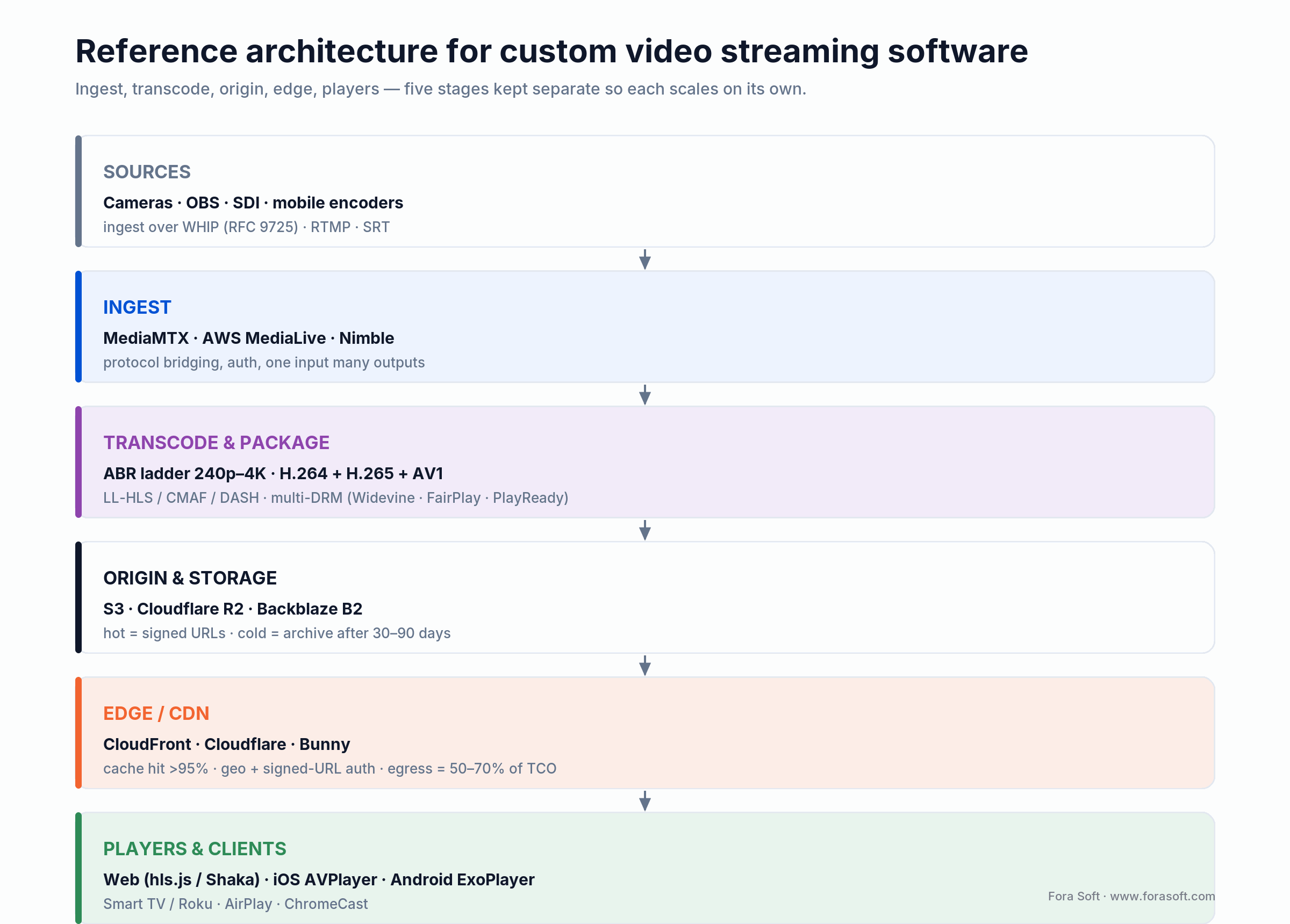
Figure 1. Reference architecture for custom video streaming software — five stages, each scaling on its own.
Three rules make or break this in production:
1. Decouple transcoding from delivery. Transcoding is bursty and expensive (4–6 vCPU per live stream for a 5-rung ABR ladder). Run it on autoscaling spot / preemptible nodes; serve from a stateless edge.
2. Make the origin replaceable. Push every segment to two stores (S3 + R2 / B2) so you can swap CDNs without re-encoding. We’ve seen four-figure monthly savings appear in the first month after this change alone.
3. Treat the player as a product. 70% of perceived quality comes from the player’s ABR logic, error recovery and DRM bootstrap. Spend on it.
Each of these five stages gets a full walk-through in our free end-to-end video streaming course.
Protocols 2026: WebRTC, LL-HLS, CMAF, HLS, DASH, SRT, WHIP
Pick protocols by latency budget and audience scale, not by what’s fashionable on Hacker News.
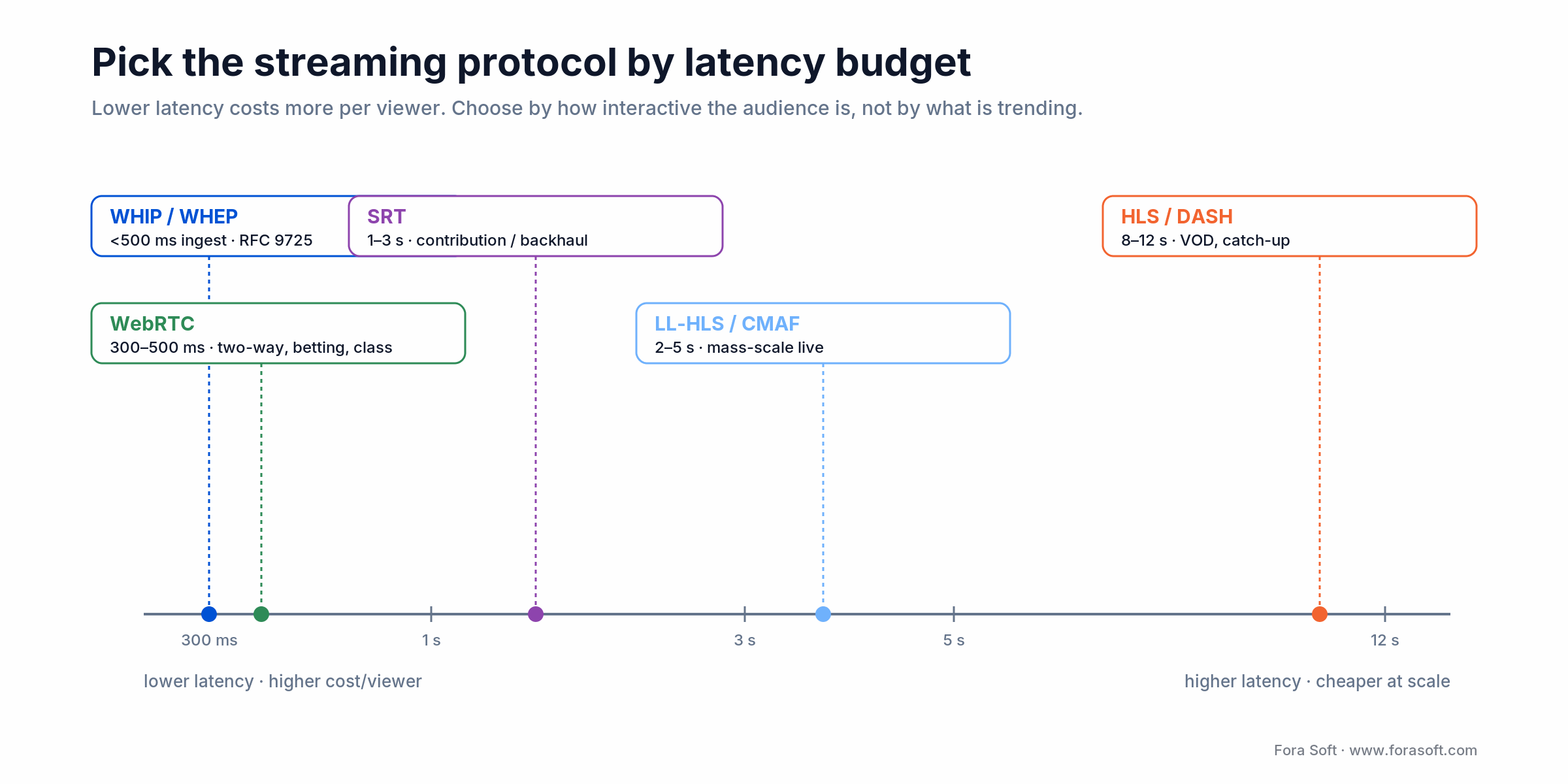
Figure 2. Pick the streaming protocol by latency budget — interactive, mass-scale live, or VOD.
| Protocol | Latency | Where it wins | Watch out for |
|---|---|---|---|
| WebRTC | 300–500 ms | Two-way calls, betting, auctions, classroom | Stateful SFU/MCU; per-viewer cost rises fast. |
| LL-HLS | 2–5 s | Mass-scale live (sports, news, talk-shows) | Player support uneven outside Safari / hls.js. |
| CMAF | ~3 s | Hybrid live where you need both HLS & DASH | Manifest tooling still maturing; pick mature SDKs. |
| HLS / DASH | 8–12 s | VOD, catch-up, archive | Don’t use for live where viewers can also chat. |
| SRT | 1–3 s | Contribution / backhaul over lossy WANs | Almost never used as last-mile to viewers. |
| WHIP / WHEP | <500 ms (ingest / playback) | Replacing RTMP for ingest from OBS / hardware | WHIP standardised (RFC 9725, March 2025); WHEP still draft. |
In practice we use WHIP / SRT for ingest, FFmpeg or AWS MediaLive for transcode, LL-HLS / CMAF for mass distribution, WebRTC for any real-time interactive layer. Open-source MediaMTX covers most of the protocol-bridging work and removes a layer of vendor lock-in.
Reach for WebRTC when: the audience interacts (chat, betting, classroom Q&A) within seconds of the action. Otherwise stick with LL-HLS or CMAF for cost — you’ll keep 70% of the latency benefit at 5–10× lower per-viewer cost.
Codecs and DRM: H.264, H.265, AV1, Widevine, FairPlay, PlayReady
Codecs. Ship H.264 as your universal baseline (every device on Earth plays it), H.265 / HEVC for premium 4K HDR (Apple ecosystem), and AV1 as your bandwidth-saver tier. Netflix streams ~30% of its catalog in AV1, now its #2 codec, and 85% of HDR view-hours as AV1-HDR10+ (Netflix Tech Blog, Dec 2025). AV1 cuts bandwidth roughly 30% vs H.264 / H.265, which is direct margin on your CDN bill.
DRM. If you carry premium third-party content, you ship multi-DRM — Widevine (Android, Chrome), FairPlay (Apple), PlayReady (Windows / smart TVs). Hosted DRM-as-a-service from EZDRM (from ~$199 / month; FairPlay sits in its ~$300 Universal Complete tier), Axinom (PAYG) or BuyDRM is almost always cheaper than running your own license server in year one.
ABR ladder. A reasonable default is 5 rungs: 240p (400 kbps), 480p (1 Mbps), 720p (3 Mbps), 1080p (5 Mbps), 4K (15 Mbps). Tune the lower end for the device fleet you actually serve — not the device fleet you wish you served.
Reach for AV1 when: bandwidth is a top-3 cost line — it cuts ~30% off your biggest bill for the price of a longer encode. Skip it only for a legacy device fleet that can’t hardware-decode it.
Buy first: realistic managed-service comparison
Before you build, pressure-test your numbers against the managed players. The shortlist below covers ~80% of the live + VOD market in 2026; pricing is per public benchmarks and partner quotes.
| Vendor | Model | Headline price* | Best fit |
|---|---|---|---|
| Mux Video | Per-minute encode + delivery | $0.0075–$0.048 / min | SaaS products that need a clean API and analytics. |
| Cloudflare Stream | Stored + delivered minutes; zero egress | $5 / 1K min stored + $1 / 1K min delivered | Bandwidth-heavy products; budget-conscious VOD. |
| AWS IVS / MediaLive | Per-broadcast hour + bandwidth | ~$2 / hour input + delivery fees | Existing AWS shops; deep IAM / VPC needs. |
| Wowza Streaming Cloud | Instance-based | $99–$499 / month base | Enterprise broadcast; SRT-heavy contribution. |
| Bitmovin | Per-minute output + egress | $0.021 / min + ~$0.18 / GB | Sophisticated codec / per-title encoding work. |
| api.video / Vimeo OTT | SaaS / per-viewer | $30–$1K+ / month tiers | Creator-led VOD where you don’t want to operate anything. |
*Headline pricing rounded; production quotes vary ±30% with codec mix, retention, region and viewer profile.
Custom build cost model: MVP → production
If you decide to build, here is the cost shape we’d quote for a typical multi-platform OTT or live-streaming product (web + iOS + Android, ABR + DRM + analytics + admin), 50K–500K monthly viewers, single region. The numbers below assume our Agent-Engineering pipeline and a senior squad of one tech lead, two backend engineers, one front-end engineer, one mobile engineer (50%), and a DevOps lead.
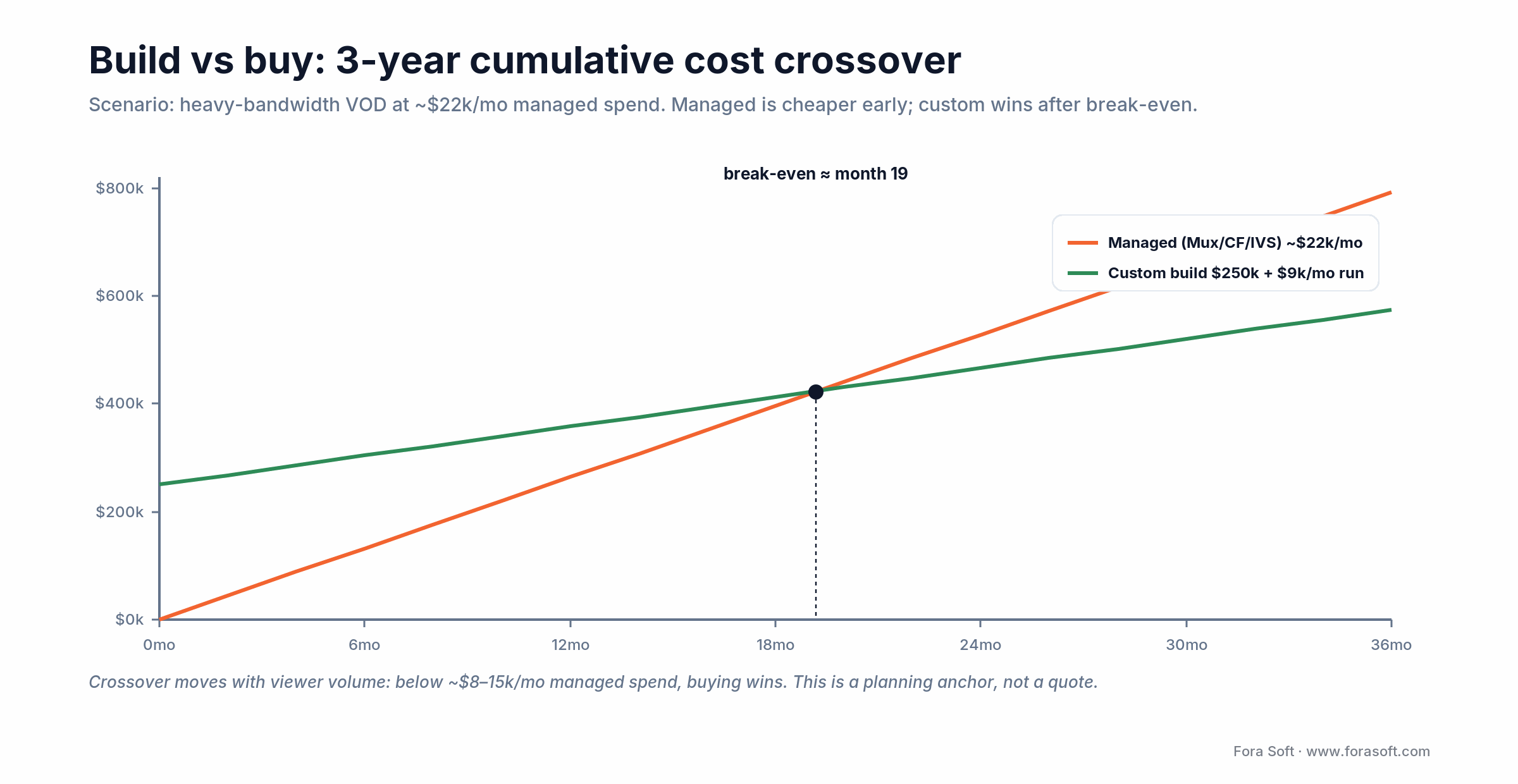
Figure 3. Build-vs-buy 3-year cost crossover — custom wins past break-even at heavy managed spend.
| Stage | Scope | Calendar | Typical price |
|---|---|---|---|
| Discovery + architecture | Latency budget, ABR ladder, DRM model, infra map | 2–3 weeks | $15–$25K |
| MVP (web only) | Ingest, transcode, LL-HLS, basic player, auth, admin | 8–14 weeks | $55–$120K |
| Multi-platform extension | iOS (AVPlayer), Android (ExoPlayer), AirPlay / ChromeCast / Roku | + 6–10 weeks | $60–$110K |
| Multi-DRM + captions / EAA | Widevine + FairPlay + PlayReady, WCAG 2.2 AA, auto-captions + review | + 4–6 weeks | $40–$70K |
| Analytics + recommendations | QoE dashboards, ABR experiments, AI recommender (matrix factorisation or two-tower) | + 4–8 weeks | $30–$60K |
| Production-grade total | Web + mobile + DRM + analytics | 5–7 months | $180–$320K |
Year-2 run cost (cloud + DevOps + maintenance) typically lands at $100–$160K depending on viewer volume, codec mix and DRM tier. For a deeper unit-economics breakdown see our video streaming app development cost guide.
Want a defensible cost model before procurement?
We’ll size build vs buy against your viewer count, codec mix and retention policy and send you a one-pager you can take to your CFO.
Storage, CDN, egress: where the money actually goes
Egress is 50–70% of total ownership cost on most streaming platforms. The single biggest-impact architectural decision after “HLS or WebRTC” is which origin and CDN you sit on.
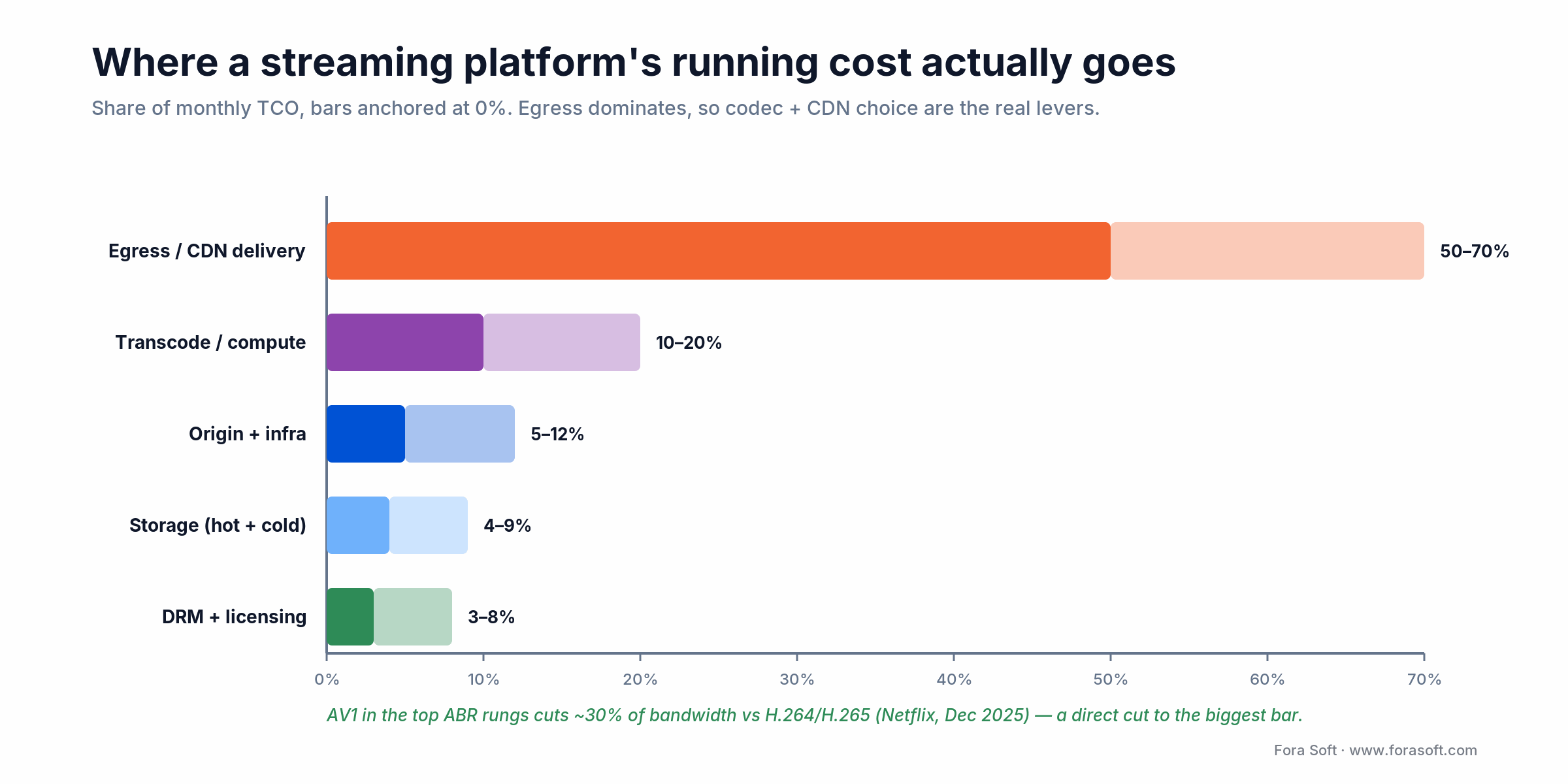
Figure 4. Where a streaming platform's running cost goes — egress dominates, so codec and CDN choice matter most.
| Provider | Egress price | Storage | When to choose |
|---|---|---|---|
| AWS S3 + CloudFront | $0.085–$0.11 / GB | $0.023 / GB / mo | Heavy AWS shop; need fine-grained edge logic. |
| Cloudflare R2 + Stream / CDN | Free | $0.015 / GB / mo | Default choice for VOD where bandwidth dominates. |
| Bunny CDN + Storage | ~$0.005–$0.04 / GB | $0.01 / GB / mo | High-volume EU / NA delivery; price-sensitive. |
| Backblaze B2 + Bunny / Cloudflare | Free to Cloudflare via Bandwidth Alliance | $0.006 / GB / mo | Cheapest cold storage for archive / catch-up. |
Three levers we apply on every project: (1) push to two stores so you can swap CDNs without re-encoding, (2) keep hot only the last 7–14 days, (3) move 30+ day content to a Backblaze / Glacier tier. On a single Vodeo-scale catalog this regularly cuts the storage bill 55–70%.
Reach for a zero-egress origin when: egress is your top cost line. Cloudflare R2 or a Backblaze B2 + CDN pairing turns your largest variable cost into a near-flat one, and you can swap CDNs later without re-encoding.
Security, DRM and abuse control
Custom video streaming software development — especially when you sell premium content — lives or dies on five controls:
1. Multi-DRM. Widevine + FairPlay + PlayReady, brokered by your player and a hosted license server. No single-DRM build survives serious content deals.
2. Signed, short-lived URLs. Tokens expire in 5–30 minutes, scoped to a viewer + IP + device. Stops leech bots from rehosting your manifests.
3. Forensic + visible watermarking. Per-session forensic watermark on the manifest plus an optional visible watermark for live VIP feeds. Lets you trace re-uploads back to the leaking account.
4. Concurrent-stream limits. Cap by account (Netflix-style 1 / 2 / 4 streams) at the manifest layer; revoke older sessions on cap exceedance.
5. Bot / scraper detection. Cloudflare Bot Management or AWS WAF + per-IP rate limits on manifest endpoints. Most piracy starts with a manifest scraper, not a screen recorder.
The player is your product surface
The single most important piece of code in any custom video streaming platform is the player. It is the difference between “Netflix-feel” and “why is this buffering again?”.
Web. Use hls.js or Shaka Player as the engine and skin them. Both ship modern ABR and DRM out of the box; do not write your own ABR algorithm in 2026.
Mobile. AVPlayer (iOS) and ExoPlayer / Media3 (Android) are the obvious choices. Wrap them in a small SDK so the rest of your team consumes one API.
TV. Smart TV (Tizen / webOS), Roku, Apple TV, FireTV. Treat each as its own engineering target with QA on real devices, not emulators.
For a deeper architectural look at building player tech specifically, see our custom video player development guide.
AI features that earn their place in the stack
AI-for-AI’s-sake will burn your runway. Five capabilities we ship because they consistently move retention, revenue or cost — the deep dives live in our AI for video engineering course:
1. Recommendations — matrix factorisation or two-tower retrieval re-ranked by a small LightGBM model. Lifts watch time 15–25%. See our AI content recommendation systems playbook.
2. Auto-captions + translation — Whisper-large-v3 for transcription, NLLB-200 or commercial MT for translation, with human review. Mandatory under EAA / WCAG 2.2 AA in EU since 28 June 2025.
3. Per-title encoding — per-content ABR ladders save 10–25% bandwidth vs a fixed ladder. Bitmovin and AWS Elemental ship this; you can also DIY with VMAF + FFmpeg.
4. AI super-resolution at the edge — ESPCN / EDSR on the client to upscale 720p → 1080p on weak networks. Pair with a lower-rung ladder to save delivery cost. Detail in our AI video enhancement tools piece.
5. Server-side ad insertion (SSAI) — manifest-level ad stitching with frame-accurate scte35 markers; ~20% higher completion rates vs client-side ads. We treat SSAI as a buy-first capability (Google Ad Manager, AWS MediaTailor) unless you have a unique ad workflow.
Monetization: SVOD, AVOD, TVOD, hybrid, internal currency
Pick the model that matches your content and audience, not the one that’s on Substack this month.
SVOD (Netflix-style). Best for catalogs that release continuously. Needs a recommendation engine and good churn instrumentation from day one.
AVOD (YouTube-style). SSAI-mandatory; otherwise viewers ad-block. CPMs in 2026 are healthy ($15–$30 in tier-1 markets) but only if your inventory is brand-safe.
TVOD (rent / buy). Lower-friction monetisation for sports / events / documentaries. Per-title pricing, TVOD is what powers our Vodeo model: an internal “ticket” currency for individual rentals on independent films.
Hybrid. The actual mainstream model in 2026: Netflix, Disney+ and Hulu all run SVOD + AVOD tiers. Build your billing layer to support multiple plans on day one; retrofitting it later is a six-figure pain.
Mini case: what we shipped on Vodeo
Vodeo is a Netflix-style iOS streaming app we built for Janson Media, a New York independent media company whose catalog also reaches Amazon, YouTube, Hulu and Twitch. It runs in production with 100K+ users.
Situation. Janson wanted a direct-to-consumer home for a deep film catalog without forcing viewers into a subscription. The app had to feel as polished as the majors, run on phone and TV, and let people pay only for what they actually watch.
Plan. We shipped an iOS app with AirPlay and ChromeCast casting, an internal-currency “ticket” model that rents individual films with no subscription, adaptive playback that switches between 480p, 720p and 1080p by connection, picture-in-picture and subtitles, and an admin panel for catalog, curated collections, ratings and analytics. Large films upload in chunks that Amazon S3 reassembles server-side — faster and cheaper than one big upload.
Outcome. Vodeo ships in production; the pay-per-title ticket model gives Janson margins a subscription catalog of niche titles couldn’t. “Great work! Attentive to details and excellent communication,” says Jesse Janson, EVP Acquisitions & Development at Janson Media. Want the same build-vs-buy read on your catalog? Book a 30-min call.
Five pitfalls we keep cleaning up after
1. Transcoding cost spirals. A 5-rung 1080p live ladder is 4–6 vCPU per stream. 100 concurrent live streams is 400–600 cores reserved, or $5–15K / month in compute alone. Use spot capacity, per-title encoding, AV1 in your higher rungs.
2. Manifest race conditions. If the origin can’t update the manifest for 10 s, every viewer freezes. Always run two encoder instances + a manifest health check + an automatic flip.
3. Over-aggressive ABR switching. Viewers report quality drops as failure even with zero rebuffer. Cap downward switches to 1 rung at a time.
4. DRM bolted on at the end. If your player can’t bootstrap a DRM session in <800 ms, viewers give up and bounce. Wire DRM into the player from day one.
5. Captions as an afterthought. EAA is now law in the EU; non-compliance means content delisting. Generate auto-captions, queue them for human review, and treat caption coverage as a first-class KPI.
KPIs that decide whether the platform is working
Quality KPIs. Start-up time <1.5 s, rebuffer ratio <0.5%, video start failures <0.3%, playback failure rate <0.5%, average bitrate within 10% of target ladder. Track per device-class.
Engagement KPIs. Watch time per session, completion rate, second-week retention, recommendation CTR. If a new model doesn’t move at least one of them in the first sprint, roll it back.
Reliability KPIs. CDN cache hit ratio >95%, origin uptime ≥99.95%, manifest 5xx rate <0.01%, DRM license latency <800 ms p95. Without these, your “product” KPIs are noise.
Decision framework: build or buy in five questions
1. What latency do you need? <1 s = WebRTC build or specialised vendor (Daily, Dolby.io). 2–5 s = Mux / Cloudflare Stream / your own LL-HLS. 8 s+ = anything works.
2. How many concurrent viewers at peak? <10K = a managed vendor wins on TCO. 50K–500K = math gets close. >500K = build economics tilt your way.
3. Is your monetisation standard or weird? SVOD / AVOD on a vendor is a click. Internal currency, per-event TVOD, B2B white-label, franchise sub-tenants — that’s a build.
4. Where will the data live? EU residency or strict enterprise data clauses tip toward custom + Cloudflare R2 / Hetzner / OVH.
5. Can you fund a 2–3-person engineering team for at least three years? If no, buy. A custom platform without a permanent owner rots inside 12 months.
Reach for build when: three or more answers above point custom, especially if monetisation is non-standard or you expect >100K concurrent viewers within 18 months. Otherwise stage a vendor pilot first and revisit in 12 months.
A realistic 14-week rollout plan
| Phase | Weeks | Outcome |
|---|---|---|
| Discovery + architecture | 1–2 | Latency budget, ABR ladder, infra map, DRM model. |
| Ingest + transcoding | 2–5 | WHIP / RTMP ingest, MediaLive / FFmpeg ladder, S3 + R2 origin. |
| Player + DRM | 4–8 | hls.js / Shaka skin, multi-DRM bootstrap, captions wiring. |
| Mobile + TV apps | 6–11 | iOS, Android, AirPlay, ChromeCast, basic Tizen / Roku. |
| Admin + analytics | 8–12 | Catalog admin, QoE dashboards, ABR experiments. |
| Hardening + EAA | 12–13 | Pen-test, captions human review, accessibility audit. |
| Soft launch | 14 | 5–10K viewers, runbook, incident drill. |
How Agent Engineering changes the build math
Three years ago, a multi-platform OTT MVP comfortably ran past $250K in year 1. Today, with multi-agent code generation paired with senior architectural review, we squeeze the same MVP scope into the $55–$120K band. The savings concentrate in three places:
Boilerplate. CRUD APIs, RBAC, IaC, ingest scaffolding, analytics events — agents emit ~70% of the first draft, senior engineers refactor and harden.
Test scaffolding. Generated unit + integration tests cover happy paths; humans add the failure modes that actually trip in production (network blips, manifest gaps, DRM 401s, codec fallbacks).
Docs that don’t rot. OpenAPI, runbooks and player SDK docs generated from the same source of truth, so the team gets accurate handover docs instead of a six-month-stale wiki.
When NOT to do custom video streaming software development
Five situations where we will tell a prospect not to build, even though we’d be happy to take the work:
1. Peak concurrent viewers below ~5K and growing slowly. Mux + a skinned hls.js handles you for <$2K / month.
2. You need to be live in <60 days. A vendor pilot can ship in 4–8 weeks; a custom MVP needs 8–14.
3. No internal owner for two years. Custom platforms die without a sponsor.
4. Standard SVOD / AVOD with mainstream content. Buying is just cheaper.
5. No multi-year operating budget. A platform that ships and then starves of maintenance is worse than no platform — the QoE numbers will tank in month 6.
FAQ
How long does custom video streaming software development actually take?
A defensible web MVP lands in 8–14 weeks with our Agent-Engineering pipeline. A multi-platform production-grade OTT or live system (web + mobile + TV + DRM + analytics) takes 5–7 months. Going to 4K + AV1 + multi-region adds another 2–3 months on top.
How much does a custom platform cost compared with Mux or Cloudflare Stream?
A 50K-viewer / month VOD product on Cloudflare Stream typically lands at $400–$1,200 / month. The same product custom-built sits at $180–$320K up-front and ~$100–$160K / year to run. Build pays back when (a) bandwidth or per-minute fees regularly exceed $8–$15K / month, or (b) the workflow can’t be expressed in vendor APIs.
Should we use HLS, DASH or WebRTC?
For VOD: HLS + DASH (CMAF makes them one set of segments). For live one-to-many: LL-HLS or CMAF (2–5 s latency, scales to millions). For two-way / interactive (auctions, classroom, betting, watch-party voice): WebRTC. Most products end up with two of the three running side by side. That’s expected, not over-engineering.
How important is AV1 in 2026?
Critical if bandwidth is a top-3 cost line. AV1 saves ~30% bandwidth vs H.264 / H.265 and is now hardware-decoded on most flagship phones (Apple from the A17 Pro), recent smart TVs and Xbox Series consoles, though the PlayStation 5 still lacks AV1 hardware decode. We ship H.264 as a universal fallback, then AV1 + H.265 on premium tiers. Netflix already serves ~30% of streams in AV1.
Do we need multi-DRM on day one?
If you carry licensed third-party content, yes. Rights holders will refuse to license without Widevine + FairPlay + PlayReady. For first-party content you can ship a token-protected, signed-URL build first and add DRM in phase 2 once revenue justifies the +$40–$70K and 4–6 weeks of integration work.
How do we keep the AWS bill from running away?
Three levers: (1) push to a zero-egress origin (Cloudflare R2 + a CDN front), (2) per-title encoding to cut bandwidth 10–25%, (3) move 30+ day content to Backblaze B2 / Glacier-class storage. We routinely cut existing AWS-only bills 40–55% with these three changes alone — full mechanics in our edge-computing live streaming guide.
What does compliance look like in 2026?
EAA / WCAG 2.2 AA is in force in the EU since 28 June 2025, so closed captions on live + VOD are mandatory. CCPA / CPRA covers data subject access in California. GDPR covers EU residency. PCI-DSS applies if you process card payments yourself (otherwise use Stripe / Adyen / Recurly). We treat captions, accessibility and EU residency as architectural constraints from day one, not phase 2.
How does Fora Soft typically engage on a project like this?
A 60-minute discovery, then a 2-week paid architecture sprint that produces a target architecture, cost model and 14-week roadmap. From there it’s a fixed-scope MVP (8–14 weeks), a soft launch, and a phased rollout. We can also slot in for a “second-opinion” review of an existing build or vendor evaluation. Book a 30-min call to scope it.
What to Read Next
Companion
Build a Custom Video Streaming App in 2026
The app-build tutorial — architecture, tech stack and timeline.
Cost
How Much Does a Video Streaming App Cost?
Unit economics, per-feature pricing, build vs buy.
OTT
How To Develop an OTT Platform Like Netflix
From catalog model to multi-DRM and recommendations.
Player
Custom Video Player Development: Complete Guide
ABR, DRM bootstrap, error recovery and TV apps.
Edge
Edge Computing in Live Streaming
Origin design, CDN strategy, egress cost control.
Ready to ship a streaming platform that earns its keep?
Custom video streaming software development is no longer about whether you can build it. The protocols, codecs and SDKs are mature. It’s about whether the math works for your viewer count, your monetisation model and your jurisdictions. The architecture has converged on WHIP / SRT ingest, CMAF / LL-HLS / WebRTC delivery, multi-DRM, AV1-ready ABR ladders and a player you treat as a product surface.
If you’re the person on the hook for streaming roadmap or media spend, you don’t need another generic explainer. You need a build-vs-buy line drawn against your viewers, your codec mix, and your budget. We’ll bring the architecture, the cost model, and two decades of receipts (250+ projects since 2005) from Vodeo, V.A.L.T., Franchise Record Pool and other production media systems. See the broader scope of our video streaming engineering work.
Get a build-vs-buy verdict in 30 minutes
Bring your viewer numbers, latency target and current vendor bill. We’ll come back with an architecture sketch, a cost model, and an honest recommendation.