


Key takeaways
• Mobile app development cost in 2026 spans $15K to $500K+. Most business apps land between $50K and $120K; a survey of 5,000+ projects puts the average custom build near $171,450.
• Engineering is under half the bill. Design, QA, project management and release work carry the rest. Estimates that only price “coding” are hiding money.
• Cross-platform cuts 30–50% versus two native apps. Flutter, React Native and Kotlin Multiplatform are all production-ready in 2026, each with a different sweet spot.
• Discount the AI-savings pitch. A 2025 controlled trial found experienced developers using AI tools were 19% slower while feeling 20% faster. AI trims boilerplate, not the hard 60%.
• Budget the run cost. Plan 15–20% of the build per year for maintenance, plus store fees that shift again in 2026 under the EU DMA.
Why trust these numbers
Ask five agencies what a mobile app costs and you get five numbers an order of magnitude apart. The reason is rarely dishonesty. It’s that “an app” can mean a weekend prototype or a real-time platform serving millions, and most pricing pages quietly assume whichever one flatters their rate card. Guess wrong and you either underfund a product that dies at launch or overpay for gold-plating no user asked for.
We’re Fora Soft. We’ve shipped 250+ products since 2005, hold a 100% job-success score on Upwork, and specialize in the media-heavy, real-time apps that sit at the expensive end of every estimate. We built the BrainCert virtual-classroom platform that grew to $3M annual revenue with branded iOS and Android apps, and the VALT evidence-recording system now used by 770+ organizations. So the figures below aren’t scraped from other blogs. They’re what we quote, and what we’ve watched land or blow up across two decades of invoices.
This guide gives you the real ranges, a cost breakdown that shows where money actually goes, a worked MVP budget you can copy, and the honest caveats most vendors skip. The goal is simple: by the end you should be able to read any estimate you’re handed and know which line items are real and which are padding.
Got an estimate that feels off?
Send us the scope. In a 30-minute call we’ll tell you which line items are fair, which are padded, and what your app should really cost in 2026.
What a mobile app actually costs in 2026
A custom mobile app in 2026 costs roughly $15,000 to $500,000+. A simple single-platform app runs $15K–$50K, a mid-level app with accounts, payments and a backend runs $50K–$120K, and an advanced or AI-heavy app climbs past $300K. GoodFirms, aggregating over 5,000 projects, pegs the average custom build near $171,450 in 2025–2026, though that average is dragged up by a few enterprise monsters. Most small-to-mid business apps land in the $50K–$120K band.
The jump between tiers isn’t linear. Going from a mid-level app to an advanced one typically multiplies cost 2× to 3×, because the expensive parts (real-time sync, multi-role permissions, third-party integrations, on-device machine learning) all arrive at once. The chart below is the mental model we hand every client on the first call.
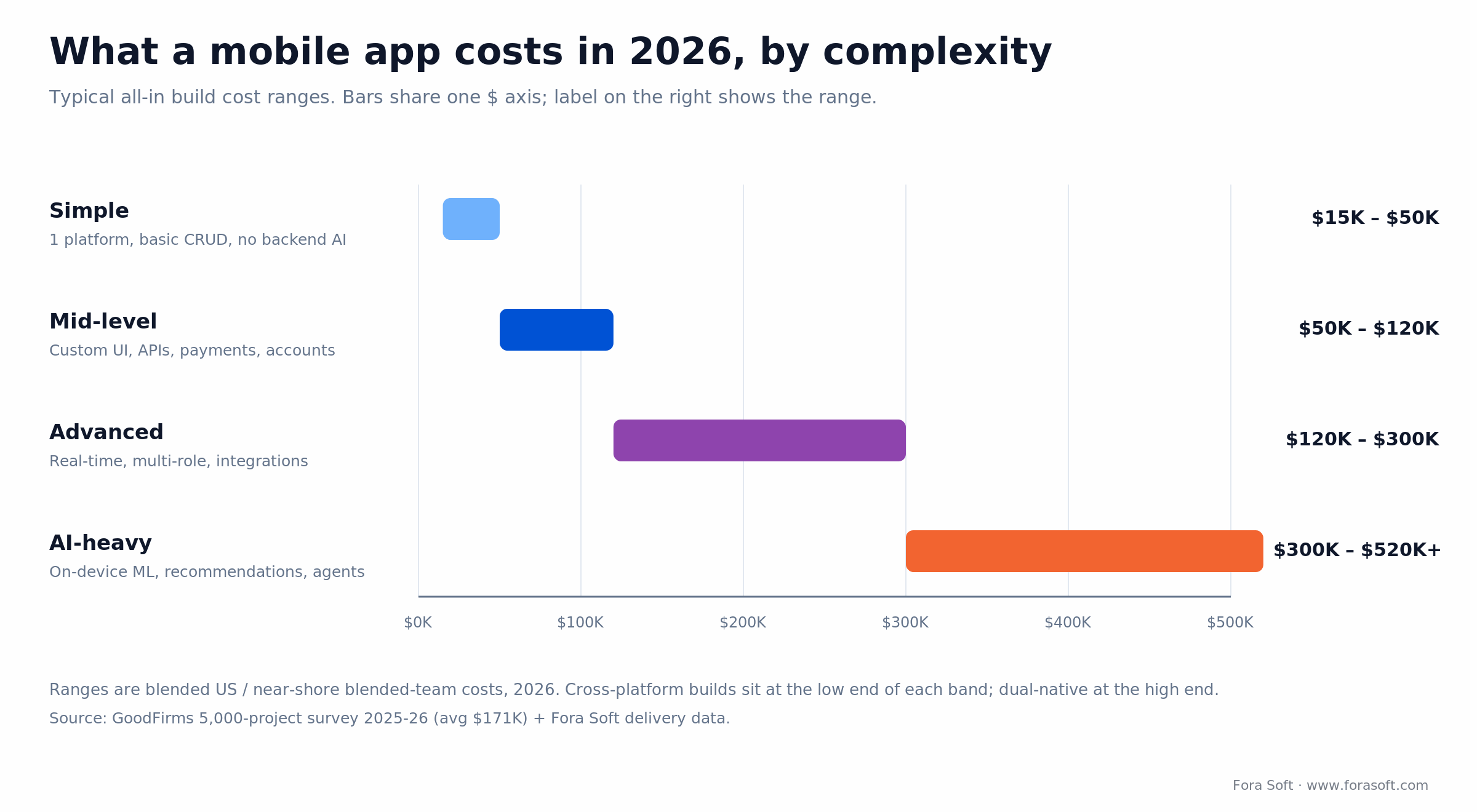
Figure 1. Cost ranges by app complexity tier. Cross-platform builds sit at the low end of each band; dual-native at the high end.
| Tier | Cost range (2026) | Timeline | Example |
|---|---|---|---|
| Simple | $15K–$50K | 1.5–3 months | Single-platform utility, static content, one login |
| Mid-level | $50K–$120K | 3–6 months | Accounts, payments, custom API, push, admin panel |
| Advanced | $120K–$300K | 6–12 months | Real-time video/chat, multi-role, integrations |
| AI-heavy | $300K–$500K+ | 9–18 months | On-device ML, recommendations, agentic features |
What it costs to build an app like Uber, Netflix, or a clinic
“How much to build an app like X” is the question we hear most, so here are honest 2026 ranges for the app types founders actually name. Each assumes a cross-platform build with a real backend; going dual-native or adding heavy AI pushes it toward the top of the range.
| App type | Example | Cost range (2026) | What drives the cost |
|---|---|---|---|
| On-demand / ride-hailing | Uber-like | $120K–$300K | Real-time GPS, matching, payments, two apps (rider + driver) |
| Video streaming / OTT | Netflix-like | $150K–$400K+ | Transcoding, CDN, DRM, recommendations |
| Telemedicine | Clinic / doctor-on-demand | $100K–$250K | HIPAA, video calls, scheduling, records integration |
| Fintech / banking | Neobank | $150K–$400K+ | Security, PCI DSS, KYC, core-banking integration |
| E-commerce / marketplace | Shop or multi-seller | $60K–$180K | Catalog, payments, search, seller tools |
| Social / community | Feed + chat app | $80K–$250K | Feeds, real-time chat, moderation, media handling |
| E-learning / LMS | Live-class platform | $80K–$250K | Live video, content tools, quizzes, progress tracking |
The video-heavy categories — streaming, telemedicine, e-learning — sit at the top because real-time media adds media servers, encoding and a whole testing discipline. That’s our home turf. We built BrainCert, a WebRTC virtual-classroom platform now past $3M annual revenue, and the Scholarly learning platform running live classes for up to 2,000 students at once. If your app is in one of these lanes, the estimate hinges on how much live media it really needs.
The five things that actually move your budget
Feature lists are a distraction. Five variables explain almost all of the spread between a $40K app and a $400K one.
1. Platforms. One platform or two? Building separate native apps for iOS and Android roughly doubles frontend cost. Cross-platform collapses that back down, which is why the platform decision belongs at the top of the estimate, not the bottom.
2. Backend complexity. A form that emails you is cheap. Real-time sync, role-based permissions, search, and analytics pipelines are not. The backend is where mid-level apps quietly become advanced ones.
3. Design depth. A template skin costs little. A custom design system with animation, accessibility and a design-to-code handoff is a real line item, and it’s the one that most affects whether users stay.
4. Integrations and compliance. Every third-party system (payments, mapping, a hospital’s records, a bank’s core) adds integration and testing work. Regulated data (health, finance, children) adds audits on top.
5. Team rate. The same senior engineer costs $130/hour in New York and $45/hour in Warsaw. Rate is a multiplier on everything above, and we’ll break it down by region in a moment.
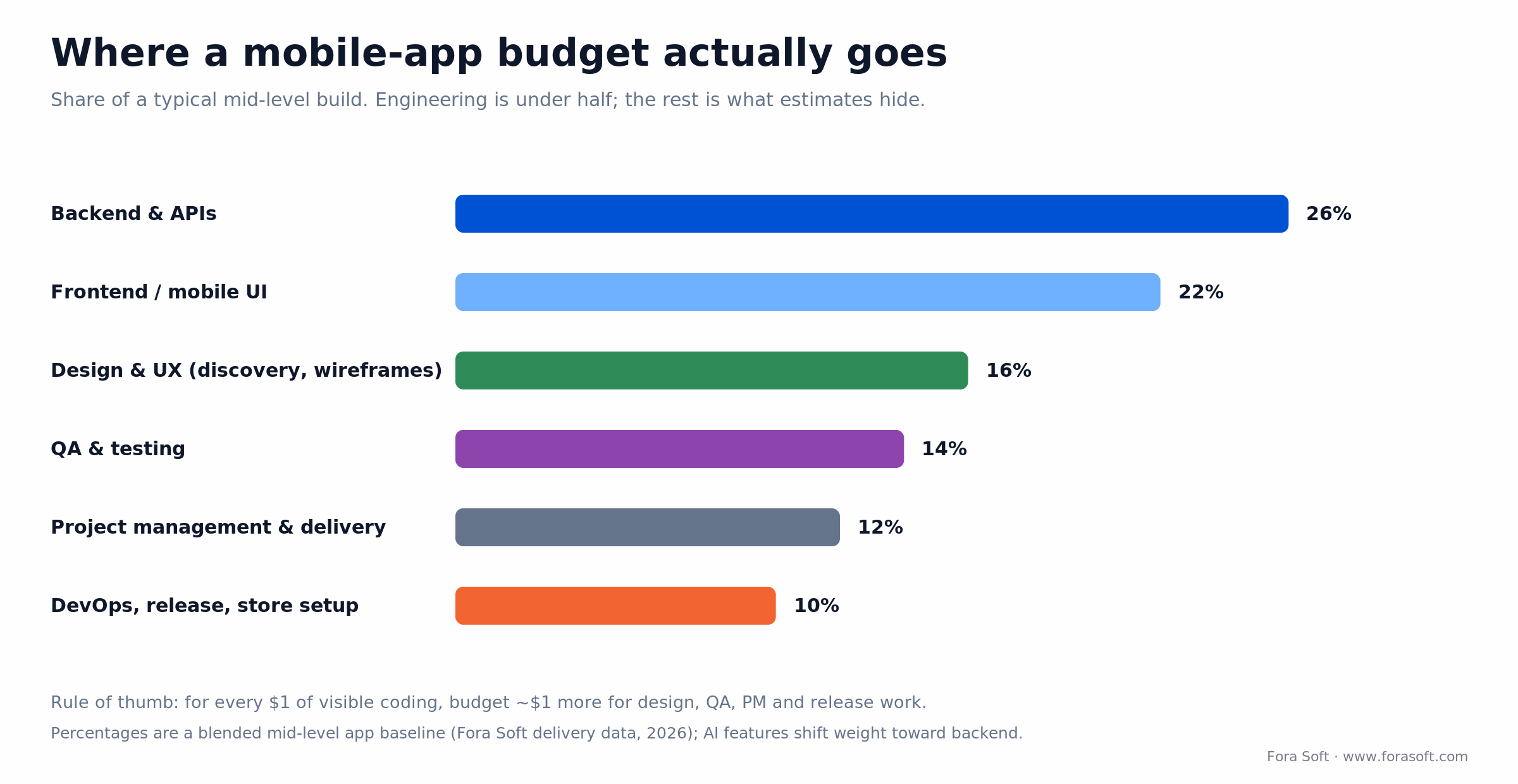
Figure 2. Where a typical mid-level budget goes. Pure coding is under half the total.
What each stage costs in dollars
Put real numbers on those percentages. Here’s how a $100K mid-level build typically splits across stages, so you can sanity-check any estimate line by line.
| Stage | Share | Cost of a $100K build | What you get |
|---|---|---|---|
| Backend & APIs | 26% | $26,000 | Data model, business logic, integrations |
| Frontend / mobile UI | 22% | $22,000 | Screens, navigation, state, device testing |
| Design & UX | 16% | $16,000 | Discovery, wireframes, design system |
| QA & testing | 14% | $14,000 | Manual + automated tests, bug fixing |
| Project management | 12% | $12,000 | Planning, coordination, reporting |
| DevOps & release | 10% | $10,000 | CI/CD, environments, store submission |
What developer rates look like by region
Location sets the price of an hour more than seniority does. A senior backend engineer in New York and one in Warsaw produce comparable architecture, but their rates differ 3× to 5× on local economics alone. Here’s the 2026 picture for mobile work.
| Region | Agency rate/hr | Freelance/hr | Trade-off |
|---|---|---|---|
| US & Canada | $100–$200 | $80–$130 | Timezone overlap, highest cost |
| Western Europe | $80–$150 | $60–$110 | Strong process, high cost |
| Eastern Europe | $35–$75 | $30–$70 | 40–55% below US, strong talent |
| India & South Asia | $25–$50 | $15–$45 | Lowest rate, widest quality spread |
The cheapest hour rarely wins. A $20/hour team that needs three rewrites costs more than a $55/hour team that ships once. What you’re buying at the higher rate is fewer rounds, better architecture, and someone who says “that feature will sink your timeline” before you’ve paid for it. Eastern Europe tends to be the value sweet spot for serious apps, which is where our own blended teams sit.
Reach for near-shore or offshore when: your budget is under $150K, your product isn’t bound to one timezone’s office hours, and you value shipping twice as much app for the money over sitting in the same room as the team.
Native vs cross-platform: the real cost gap
Cross-platform frameworks reduce build cost 30–50% versus writing two separate native apps, because one codebase serves both stores. In 2026 that saving comes with almost no quality penalty for most apps. The question is no longer “is cross-platform good enough” but “which one fits.”
React Native’s New Architecture and the Hermes engine closed most of the old performance gap, and it draws on the largest talent pool because 67% of developers already know JavaScript. Flutter, now on the Impeller renderer, wins design-heavy consumer apps — Nubank runs it for 70M+ users. Kotlin Multiplatform is the fast riser, jumping from 7% adoption in 2024 to 18% in 2025; Netflix and Cash App use it to share business logic while keeping fully native UI.
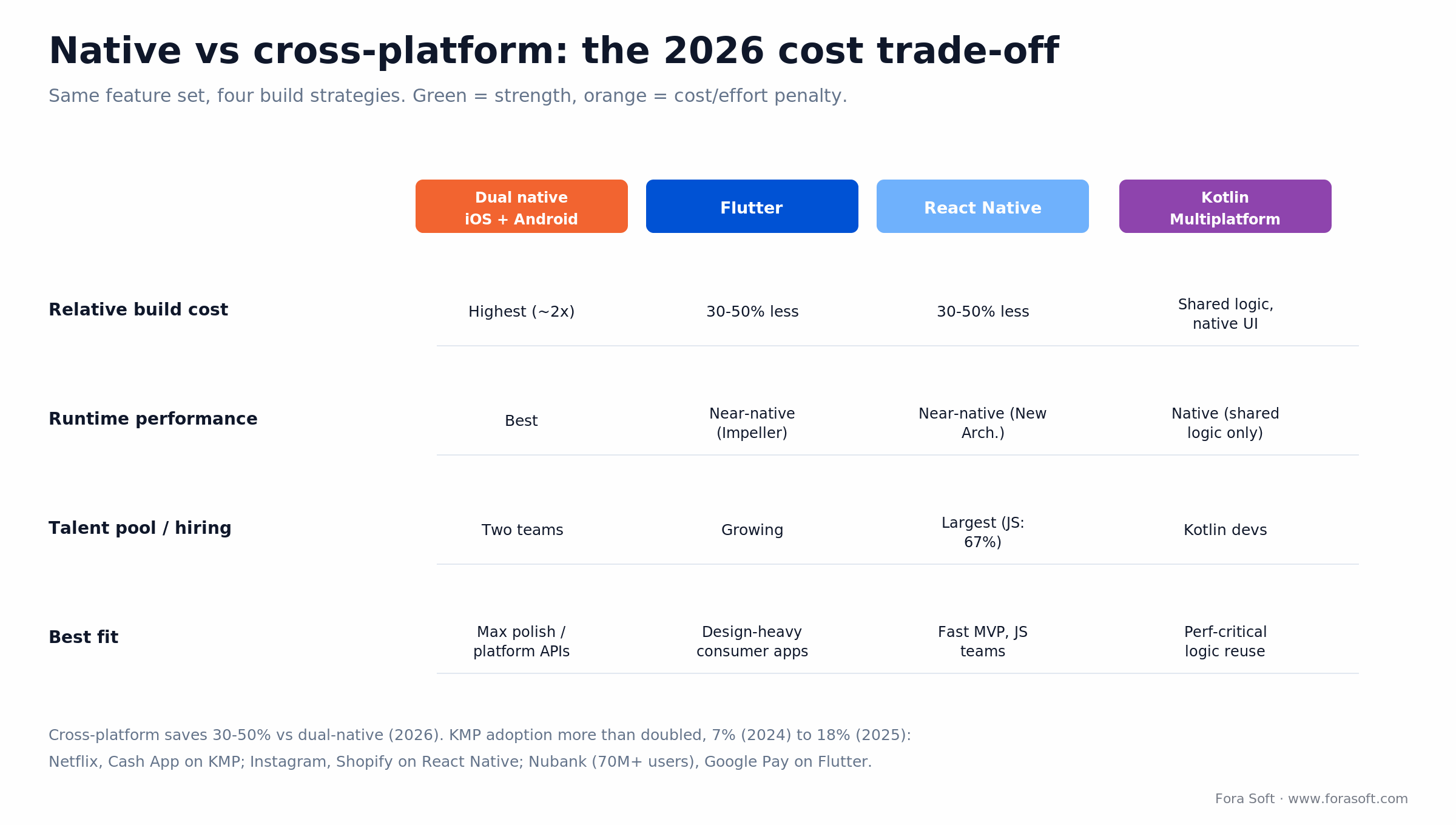
Figure 3. The four build strategies on the axes that decide cost.
Reach for dual-native when: your app lives or dies on platform-specific polish — heavy AR, complex gestures, deep OS integration — and you have the budget to pay for two teams. Everyone else should start cross-platform and only drop to native for the one screen that needs it.
Does AI-assisted development make apps cheaper?
A little, and less than the sales decks claim. In 2025 the research firm METR ran a randomized controlled trial on 16 experienced open-source developers. Those using AI coding tools were 19% slower on their own repositories — yet believed they were 20% faster. That 40-point gap between feeling and reality is exactly the gap a padded estimate hides in.
Zoom out and the picture is consistent. Six independent studies converge on roughly 10% organizational productivity gains, even though 84% of developers now use AI tools and about 27% of production code is AI-generated. GitHub reports Copilot writing 46% of active users’ code and teams merging pull requests 50% faster on the parts it helps with. Trust, meanwhile, fell: only 29% of developers trust AI output in 2026, down from 40% in 2024.
Here’s the honest read. AI is genuinely good at the first 40% of a task: scaffolding, boilerplate, test stubs, one-off scripts. It’s weak at the hard 60% that dominates a real budget — architecture, integration, edge cases, security review, and untangling the confidently-wrong code it sometimes produces. We use AI daily and it makes our engineers faster on the right tasks. But when a vendor tells you AI cuts your bill 70%, treat any claim above 15–20% as a number to interrogate. You can go deeper in our note on AI in the software development process.
Want a realistic estimate, not a hopeful one?
We scope with the AI savings already priced in honestly. Tell us your idea and we’ll come back with a range you can actually plan against.
What AI and ML features actually add
There are two very different price tags hiding under “add AI.” Calling a hosted model through an API, say a chatbot, summarization or basic image tagging, is a modest add-on, often $10K–$40K, dominated by prompt engineering, guardrails, and per-request costs you’ll pay forever. Building or fine-tuning custom models is a different world.
On-device machine learning, custom-trained recognition, and real-time inference push an app into the advanced or AI-heavy tier. We built an AI wardrobe app that recognizes garment type, fabric, color and cut entirely on-device using custom YOLOv8m and CLIP models through TensorFlow Lite. That kind of work — data collection, training, evaluation, on-device optimization — carries training and MLOps costs that a simple API integration never touches, plus the recurring GPU bill. If AI is core to your product rather than a garnish, our AI integration service page walks through where those costs sit.
Real-time media is the other classic multiplier. Video calls, live streaming and low-latency audio (our specialty) add media servers, encoding, and a whole category of testing. If your app needs them, budget for it early; the fundamentals are covered in our free video-engineering course on Learn.
Reach for an API model when: the AI feature is a helper, not the product, and off-the-shelf accuracy is good enough. Build custom only when the model is the moat and no API gives you the accuracy, privacy, or offline behavior you need.
Ongoing costs: hosting, maintenance, store fees
The build is a one-time number. The app is a subscription. Plan on 15–20% of the original build cost per year to keep it healthy: OS updates every autumn, dependency and security patches, bug fixes, and small improvements. Skip this and the app rots — it’ll break on the next iOS release whether or not you touched it.
Hosting scales with usage, not with the build. A modest app might run $50–$500/month; a media-heavy app with video can run into thousands. Picking the right provider matters, and it isn’t always the famous one — we lay out the trade-offs in AWS vs DigitalOcean vs Hetzner.
Then there are the stores, and 2026 is the year they stopped being simple. Apple charges a flat $99/year to keep a developer account; Google Play is a one-time $25. The commission on what you sell is where it gets interesting.
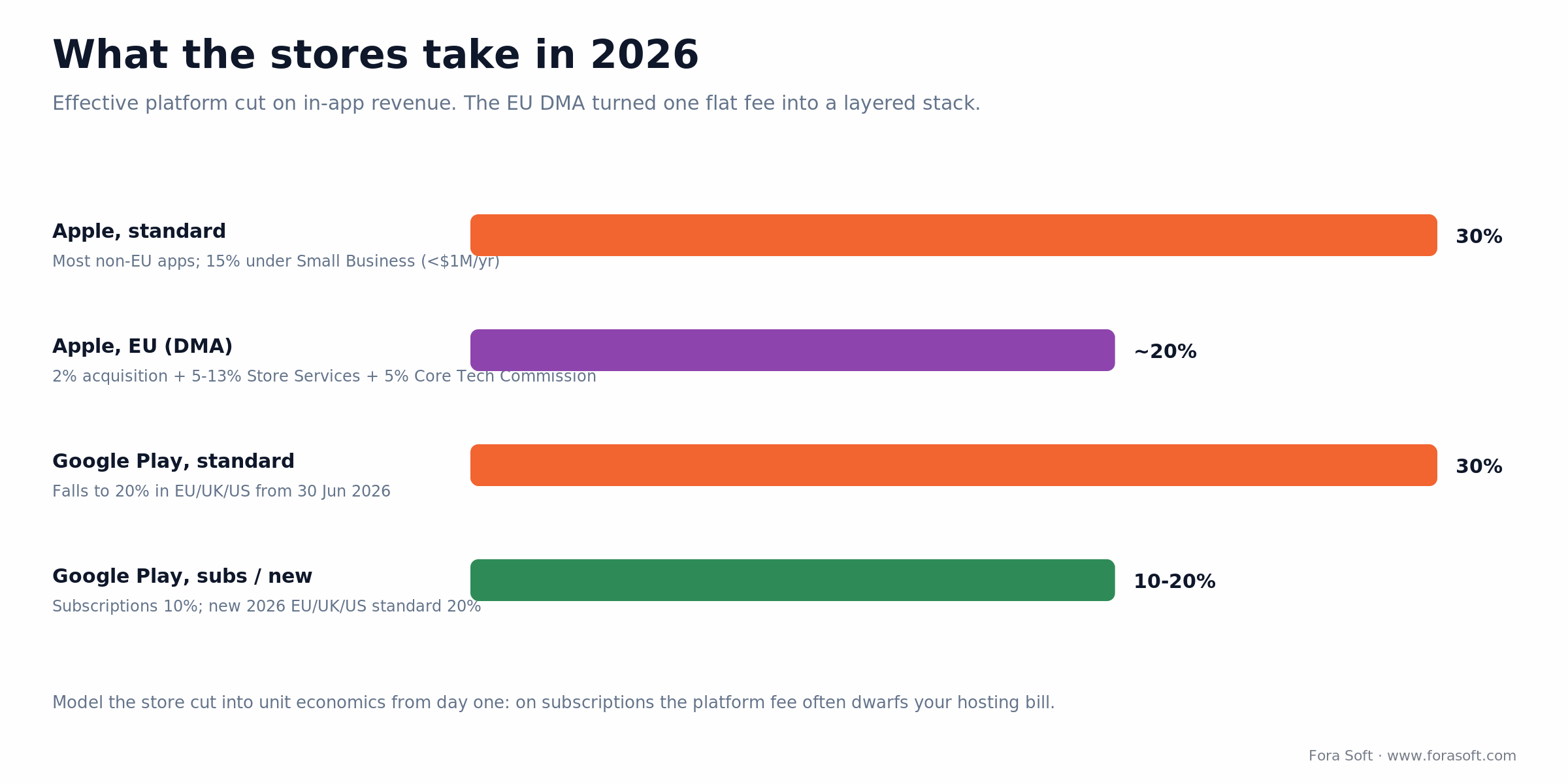
Figure 4. Effective platform cut on in-app revenue in 2026. The EU DMA turned one flat fee into a layered stack.
Outside the EU, Apple’s standard commission is still 30%, dropping to 15% under the Small Business Program if you earn under $1M a year. Inside the EU, the Digital Markets Act replaced the old per-install fee with a layered stack: a 2% initial-acquisition fee, 5–13% for Store Services, and a 5% Core Technology Commission. Google Play is moving the other way — from June 30, 2026 its standard commission drops from 30% to 20% in the EU, UK and US, with subscriptions at 10%. If you monetize in-app, model the store cut into your unit economics from day one; it often dwarfs the hosting bill.
What compliance costs in 2026
Compliance is the line item founders forget until legal counsel finds it. If your app touches personal data, health records, payments, or AI decisions, budget for it as engineering work, not paperwork.
GDPR applies to any app with EU users; fines reach €20M or 4% of global turnover, so consent flows, data-deletion, and audit logs are non-negotiable engineering tasks. A US health app needs HIPAA safeguards. Payments drag in PCI DSS. Each adds design, implementation and testing hours, and often an external audit.
The EU AI Act is the new one to watch. Its transparency rules apply from August 2026, and the AI Office gains full enforcement powers, including fines, the same month. The heavier high-risk obligations were pushed back by the May 2026 Digital Omnibus: stand-alone Annex III systems (recruitment, credit scoring, education) now comply by December 2027, and AI embedded in regulated products like medical devices by August 2028. If your app makes consequential automated decisions, that timeline is now part of your cost plan.
Hidden costs most estimates miss
1. Third-party subscriptions. Maps, SMS, email, analytics, push, error tracking, a chat SDK — each is $10–$500/month and they stack. A mid-level app easily carries $300–$1,500/month in services before a single user pays you.
2. App store review and rejections. Apple rejects for reasons a first-timer won’t predict. Budget a week of buffer and some engineering time for the back-and-forth; it’s routine, not a failure.
3. Content moderation. Any app with user-generated content needs moderation — automated, human, or both. It’s a running cost and, increasingly, a legal requirement.
4. Analytics and iteration. The build gets you to launch. Finding out what users actually do, then changing it, is where the product gets good — and it’s a budget line, not a favor.
5. Rework from skipped discovery. The most expensive line item is the one nobody quotes: building the wrong thing. An hour in wireframing saves ten in rework. Teams that skip discovery pay for the app twice.
Cost math: a worked MVP budget
Ranges are useful; arithmetic is convincing. Here’s how a real cross-platform MVP budget is built, with every number shown so you can swap in your own.
Take a four-month MVP: two mobile developers, one backend developer, and half-time QA, project manager and designer — 4.5 full-time equivalents. At a blended Eastern-European rate of $55/hour, and 160 working hours per month, the effort is 4.5 × 4 × 160 = 2,880 hours. That’s 2,880 × $55 = $158,400 to build. Add a 12% risk buffer plus store setup and CI/CD, about $19,000, and the all-in MVP lands near $177,400.
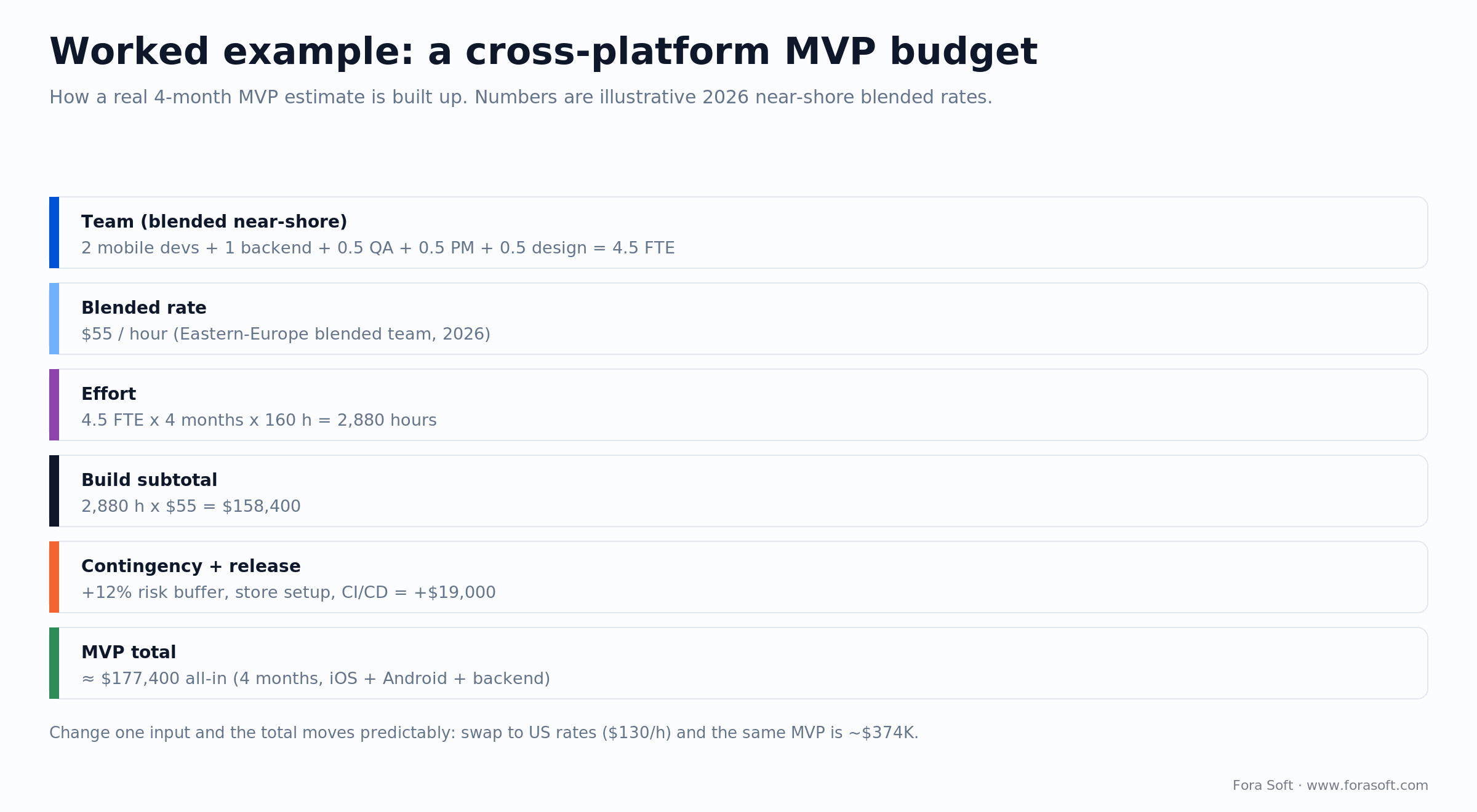
Figure 5. A worked cross-platform MVP budget. Change one input and the total moves predictably.
Now change one input. Move the same team to US rates at $130/hour and the identical MVP becomes 2,880 × $130 ≈ $374,000 before the buffer. Same scope, same hours, more than double the price — which is the whole argument for near-shore teams on a startup budget. Our own delivery, built around heavy automation, aims for the low end of these ranges; when we’re unsure a number holds, we’d rather not quote it than pad it. For a deeper method, see our guide to software estimation methods.
Fixed-price vs T&M vs dedicated team
How you contract changes both the price and the risk. There are three common models, and the right one depends on how well-defined your scope is.
Fixed price. You agree a scope and a number. Good for a well-defined MVP with clear requirements; bad the moment scope changes, because every change becomes a negotiation. The vendor prices in risk, so you often pay a premium for the certainty.
Time & materials. You pay for hours worked. Flexible, honest, and the right fit for evolving products — but it demands trust and an involved product owner. This is how most serious apps are actually built.
Dedicated team. You rent a stable squad monthly. Best for long-running products that need continuity. Predictable spend, maximum flexibility, and the model behind most of our multi-year partnerships.
Reach for fixed price when: your scope is genuinely locked and small. For anything you expect to learn from and change (which is most apps), time & materials or a dedicated team will cost less in the end, because you won’t pay a risk premium on requirements nobody can predict yet.
Mini-case: a cross-platform app for a fitness chain
Situation. A Dutch company wanted management software for gyms, martial-arts schools and boxing clubs: bookings, subscriptions, access control and payments, on web plus iOS and Android. Building three separate native front-ends was well outside their budget, and the market wouldn’t wait for a two-year build.
Plan. We built AppyBee on React Native so a single mobile codebase served both stores, with a shared backend handling subscriptions, QR-code access control, and integrations with Dutch payment systems (iDEAL, Bancontact and others). Cross-platform was the decision that made the numbers work: one team, two apps, roughly half the frontend cost of going dual-native.
Result. AppyBee now serves 800+ fitness centers, holds a 4.6-star rating, saves owners 10–15 hours a week on admin, and lifts member retention about 20%. The cross-platform choice is why a mid-market business could afford a genuinely good app on all three surfaces. Want a similar assessment for your idea? Book a 30-minute call and we’ll sketch the cheapest path to your MVP.
Not sure native or cross-platform is right for you?
That one decision can halve your frontend budget. We’ll help you pick based on your app, not our convenience.
Build, buy, or go hybrid
Custom development isn’t always the answer, and a good partner will tell you so. Here’s how the main routes to a mobile app compare, including where each one stops making sense.
| Approach | Typical cost | Speed | Best for | When it breaks |
|---|---|---|---|---|
| Full custom | $50K–$500K+ | Slow | Unique product, real moat | Idea is generic; budget under $30K |
| No-code / low-code | $5K–$40K | Fast | Validation, internal tools | Scale, custom logic, app-store limits |
| White-label / SaaS | $1K–$20K/yr | Instant | Standard needs, no differentiation | You need to own IP or stand out |
| Hybrid (custom + off-the-shelf) | $30K–$150K | Medium | Most real products | Integrations fight each other |
Most successful apps are hybrids: custom where you differentiate, off-the-shelf everywhere else. Paying to rebuild authentication or payments from scratch is how budgets die for no competitive gain.
A budgeting framework in five questions
Before you approve a single number, answer these five. They decide your budget more than any feature list.
Q1. One platform or two? If you can launch on one first, do it. Halving your surface area is the single biggest lever on an MVP budget.
Q2. What must be true at launch? List the features a user cannot live without. Everything else is version 2. Ruthless scoping is where the savings are — more on that in our piece on cutting features to launch early.
Q3. Where’s the real complexity? Real-time, AI, heavy integrations, regulated data — name yours honestly. This is the number that surprises people.
Q4. What’s your total runway, not just the build? Build plus a year of run cost plus store fees. If you can only afford the build, you can’t afford the app yet.
Q5. Buy, build, or borrow? For every major component, ask whether it’s your differentiation or plumbing. Build the moat; buy the plumbing. If a founder answers these five and still isn’t sure, that’s exactly the conversation we like to have on a call.
When NOT to build a custom app
The most honest thing a development shop can tell you is when not to hire one. Don’t build custom if your idea is genuinely generic — a booking form, a basic store, a simple directory. Off-the-shelf tools do those for a fraction of the price, and you won’t out-engineer a $10M SaaS on a $40K budget.
Don’t build if you haven’t validated demand. A no-code prototype or even a landing page can test the idea for a few thousand dollars before you commit six figures. Don’t build if you can only fund the build and nothing after; a launched app with no maintenance budget is a slow-motion refund request.
Build custom when you have a real product hypothesis, a differentiator worth owning, and the runway to run it. That’s when the six-figure number earns its keep — and if you’re not there yet, a good partner points you to the cheaper route first. If raising the money is the blocker, our funding playbook for founders is a useful next read.
The KPIs to track before and after shipping
Budget KPIs. Track burn against the estimate weekly, not at the end. A healthy project stays within about 10–15% of plan; a project that’s 40% over at month two won’t magically recover by month four. Watch scope creep as its own line.
Quality KPIs. Crash-free-session rate above 99.5%, app-store rating above 4.0, and cold-start time under two seconds. These predict retention, and retention predicts whether the whole investment paid off.
Business KPIs. Cost per install, day-30 retention, and lifetime value against acquisition cost. The build cost only matters relative to what the app returns; an $120K app that retains users beats a $40K one nobody opens twice.
FAQ
How much does mobile app development cost in 2026?
Between $15,000 and $500,000+. A simple single-platform app runs $15K–$50K, a mid-level app with a backend and payments runs $50K–$120K, and advanced or AI-heavy apps exceed $300K. The 5,000-project GoodFirms average is about $171,450, but most business apps land in the $50K–$120K band.
Why are mobile app development cost estimates so different?
Because “an app” is undefined. Team location changes the hourly rate 3–5×, platform count can double frontend cost, and complexity multiplies everything. Two honest vendors can quote very different numbers if they’re assuming different scope, teams, or regions.
Is cross-platform cheaper than native?
Yes. Cross-platform frameworks like Flutter and React Native cut build cost 30–50% versus writing two separate native apps, because one codebase serves both stores. In 2026 the performance penalty is minor for most apps; native only wins for deep platform-specific work.
Does AI make app development cheaper?
Modestly. A 2025 METR trial found experienced developers using AI were 19% slower while feeling faster, and six studies converge on roughly 10% organizational gains. AI speeds up boilerplate but not the architecture, integration and review that dominate a real budget. Treat savings claims above 15–20% with caution.
What are the ongoing costs after launch?
Plan on 15–20% of the build cost per year for maintenance, plus hosting ($50–$500/month for a modest app, more with video), third-party service subscriptions, and store fees. Apple takes up to 30% commission and Google Play up to 20% from mid-2026.
How much does it cost to develop an app with AI features?
Calling a hosted model through an API adds roughly $10K–$40K plus per-request running costs. Custom or on-device models — training, evaluation, MLOps, GPU bills — push an app into the $300K+ AI-heavy tier. The gap between “uses AI” and “is built on custom AI” is large.
How long does it take to build a mobile app?
A simple app takes 1.5–3 months, a mid-level app 3–6 months, and advanced or AI-heavy apps 9–18 months. Timeline and cost move together: the same team over more months is more money, so scoping a tight MVP is the fastest way to control both.
Can I reduce mobile app development cost without hurting quality?
Yes: launch on one platform first, cut to a true MVP, go cross-platform, buy commodity components instead of rebuilding them, and work with a strong near-shore team. The cut that hurts quality is skipping discovery and QA — that just moves the cost to expensive rework later.
What to read next
Estimation
5 Software Estimation Methods Compared
How the pros turn a scope into a number, with real spreadsheets.
MVP
Why Cut Features and Launch Early
The cheapest app is the one you scope ruthlessly before building.
Hosting
AWS vs DigitalOcean vs Hetzner
Where your monthly run cost actually comes from, provider by provider.
Funding
6 Investment Sources for Software Founders
A 2026 funding playbook for turning a budget into a build.
Ready to get a real estimate?
Mobile app development cost in 2026 comes down to a handful of decisions: one platform or two, native or cross-platform, how much real complexity you actually need at launch, and where your team sits. Get those right and a serious app fits inside $50K–$120K; get them wrong and the same app doubles.
The honest version costs less than the hopeful one, because it prices discovery, run cost and store fees up front instead of surprising you at month six. That’s the estimate we’d rather give you — even when it means telling you not to build yet.
Let’s cost your app properly
Bring your idea or your existing estimate. In 30 minutes we’ll give you a realistic 2026 range, the cheapest viable path, and the trade-offs behind every number.

