

Key takeaways
• Detection is commoditized; intent is the moat. YOLO-class detectors run at 15–60 FPS on the edge for pennies. The 2026 differentiator in AI video analytics is reasoning: what is the person doing, why, and what should the system do about it.
• Stack, don’t swap. Production systems run a three-tier pipeline: YOLO plus a tracker on the edge, a vision-language model (VLM) for scene captioning, and an LLM for intent reasoning, not one giant model on every frame.
• The cost math now works. A one-hour clip on Gemini 2.5 Flash costs about $0.11–0.33 to caption; a self-hosted Qwen3-VL on a rented H100 ($1–3/hr) wins once steady volume passes roughly 500 hours of video a month.
• The EU AI Act moved in 2026. Article 50 content-labelling went live on August 2, 2026, but the Digital Omnibus pushed most high-risk (Annex III) obligations to December 2, 2027. The compliance clock is different than last year’s guides say.
• Hallucination is the new failure mode. VLMs drop well below human reliability on safety-critical classes under motion blur. Detector + VLM + LLM ensemble with a human in the loop is the only sane architecture for high-stakes alerts.
Why context and intent matter in 2026
Traditional AI video analytics spots objects: a person, a car, a backpack. It draws a box. It counts. That’s detection, and in most stacks shipped before 2024, that’s where the intelligence ended. The operator was left reading boxes and inferring what was actually happening.
Three things changed. First, multimodal models went video-native: Gemini takes an hour-long clip straight through its API, Qwen3-VL handles roughly two-hour clips on commodity H100s, and MiniCPM-V 2.6 fits an 8-billion-parameter VLM into about 5.5 GB of edge memory. Second, the cost dropped: captioning an hour of video now costs cents, not dollars. Third, the regulators arrived: the EU AI Act’s transparency rules apply as of August 2, 2026, and enforcement now has teeth.
The result is a new product category. The system narrates what is happening, infers intent, lets operators search by natural language, and escalates only the events worth a human’s attention. This article is the playbook we use at Fora Soft when a client asks us to build one: the architecture, the models, the cost math, the regulation, and the failure modes we have actually hit. That work — LLM features, RAG pipelines, and custom generative models — is what our generative AI development services cover.
Why Fora Soft wrote this playbook
Fora Soft has built video and AI products since 2005: 250+ of them, with 50+ in-house specialists. Three streams of work feed this guide: real-time streaming infrastructure (WebRTC, mediasoup, LiveKit, MoQ), computer-vision pipelines (YOLO, ByteTrack, BoT-SORT, DeepSORT), and conversational and AI-integration work layered on top. Our delivery model is spec-driven agent engineering, which compresses a six-month build into eight-to-twelve weeks, and we price accordingly.
Three projects feed the architectural decisions below. VALT is a video-evidence platform we have been the sole development team for over 10+ years, serving 770+ US law-enforcement, child-advocacy, and medical organizations and 50,000+ users. Meetric is an AI sales-video platform (SEK 21M seed) running intent detection and call summarisation at scale. DSI Drones ships aerial surveillance with on-device threat detection. We have run every layer of the stack below in production.
Sketching a contextual video product?
Bring us the camera count, the use case, and the latency target. We’ll redline a hybrid YOLO + VLM + LLM architecture and hand you a delivery estimate on a 30-min call.
From detection to intent: the 60-second answer
Detection answers “what is in the frame?” Tracking answers “is it the same person across frames?” Captioning answers “what is happening in this scene?” Reasoning answers “why, and what should we do?” Contextual AI video analytics is all four, layered, not a single model running on every frame.
The cheap, fast layers (detection, tracking) run on the edge at 15–60 FPS and produce embeddings and short clips. The expensive layers (VLM captioning, LLM reasoning) run in the cloud at 0.5–8 FPS and produce narrative output, intent labels, and natural-language search. The thin pipe between them carries embeddings, alert clips, and operator feedback, never raw video. That’s the architecture in one paragraph.
The reference architecture: edge CV + cloud VLM + LLM reasoning
Production systems converge on the same shape, whether built by Ambient.ai, Coram AI, Avigilon, or by us for clients. Three tiers, one feedback loop. The edge does the cheap high-frequency work; the cloud does the expensive reasoning; the operator’s clicks become tomorrow’s training data.
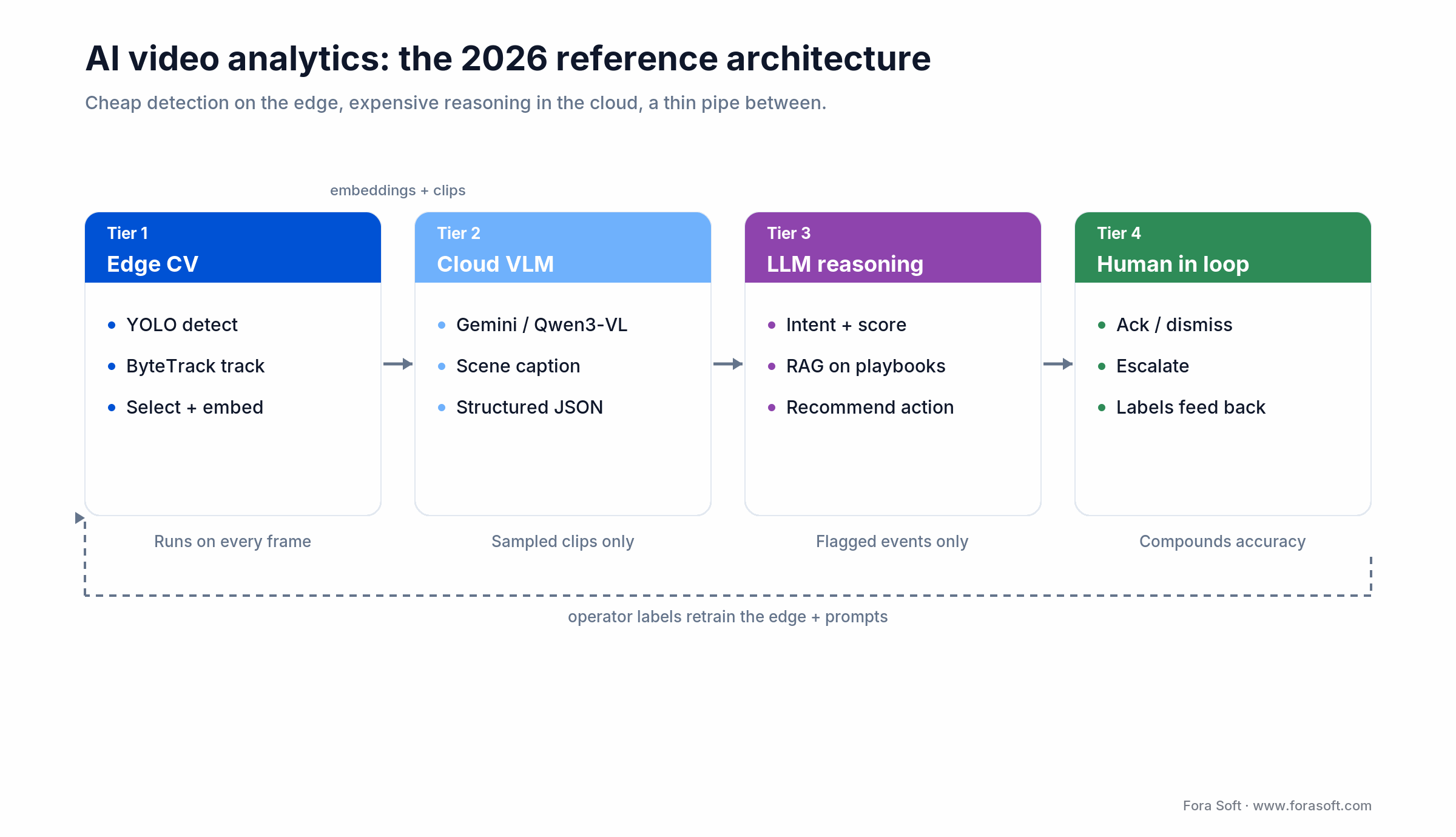
Figure 1. The 2026 hybrid reference architecture: cheap detection on the edge, expensive reasoning in the cloud, a thin pipe of embeddings and clips between.
Tier 1 — edge CV (every frame)
A YOLO detector (YOLO11 or YOLOv9, INT8) plus a multi-object tracker (ByteTrack, BoT-SORT, or DeepSORT) running on a Jetson Orin Nano, Hailo-8, or smart camera. Every detection produces a small embedding plus temporal context (track ID, dwell time, motion vector). More than 99% of frames never leave the edge. Our detailed take on this tier lives in the YOLO + ByteTrack + DeepSORT guide.
Tier 2 — cloud VLM (sampled frames)
A vision-language model (Gemini 2.5 Flash or Pro, Qwen3-VL, or edge-side MiniCPM-V 2.6) takes 1-FPS clips around interesting events and emits a structured caption: scene, actors, actions, attributes. Output is JSON, low temperature, schema-validated. Budget 1–2 seconds for a 30-second clip on Gemini, 5–10 seconds for a one-minute clip on a self-hosted Qwen3-VL.
Tier 3 — LLM reasoning + agent (intent)
An LLM ingests the structured caption plus a short context window (the last N captions for this entity, the venue’s rules, prior incidents) and emits an intent label, a confidence, and a recommended action. This is where you bolt on retrieval over operator playbooks, prior incidents, and a graph of entities and relationships. Anything below the confidence threshold goes to a human; everything above auto-routes.
Tier 4 — human-in-the-loop feedback
Every operator action (acknowledge, dismiss, escalate) becomes labelled training data. Hard cases queue back to the cloud for re-inference with a bigger model and into the retraining set for the edge. Without this loop the system drifts. With it, accuracy compounds.
The models that matter in 2026
Pick by tier, not by hype. The detection tier wants speed. The VLM tier wants context length and structured output. The LLM tier wants reasoning and tool use. Below is the shortlist we recommend to clients today; for a deeper open-vs-frontier comparison see our open-frontier VLM breakdown.
| Layer | Model (2026) | Where it runs | Why pick it |
|---|---|---|---|
| Detection | YOLO11 / YOLOv9 (INT8) | Edge (Jetson, Hailo, smart cam) | 15–60 FPS, mature ecosystem. |
| Tracking | ByteTrack / BoT-SORT | Edge | Stable IDs across occlusions; cheap. |
| Embedding | Twelve Labs Marengo / Florence-2 | Edge or cloud | Vectors enable visual RAG and language search. |
| VLM (cloud) | Gemini 2.5 Flash / Pro (3.x newest) | Cloud API | Native video, ~1-hr context, $0.11–1.37/hr. |
| VLM (cloud, US) | GPT-5.5 vision | Cloud API | Strong document and object reading; reliable JSON. |
| VLM (self-hosted) | Qwen3-VL / InternVL | H100 / H200 | Open weights, ~2-hr video, full data control. |
| VLM (edge) | MiniCPM-V 2.6 | Jetson AGX Orin | ~5.5 GB footprint; ~4 FPS on-device. |
| Reasoning LLM | Claude Sonnet 4.6 / Gemini / GPT-5 | Cloud API | Tool use, structured outputs, RAG-friendly. |
Reach for self-hosted Qwen3-VL when: data residency forbids sending video to a US cloud, monthly volume passes roughly 500 hours, or you need to fine-tune on your own domain (ATM lobbies, pharmacy aisles, oil-and-gas catwalks).
Real-time vs near-real-time vs forensic: latency budgets
Three operating modes cover almost every contextual video product. Pick the mode per use case, not per camera, and design the pipeline accordingly. The mode decides where the VLM runs, which is the single biggest cost and latency lever in the whole system.
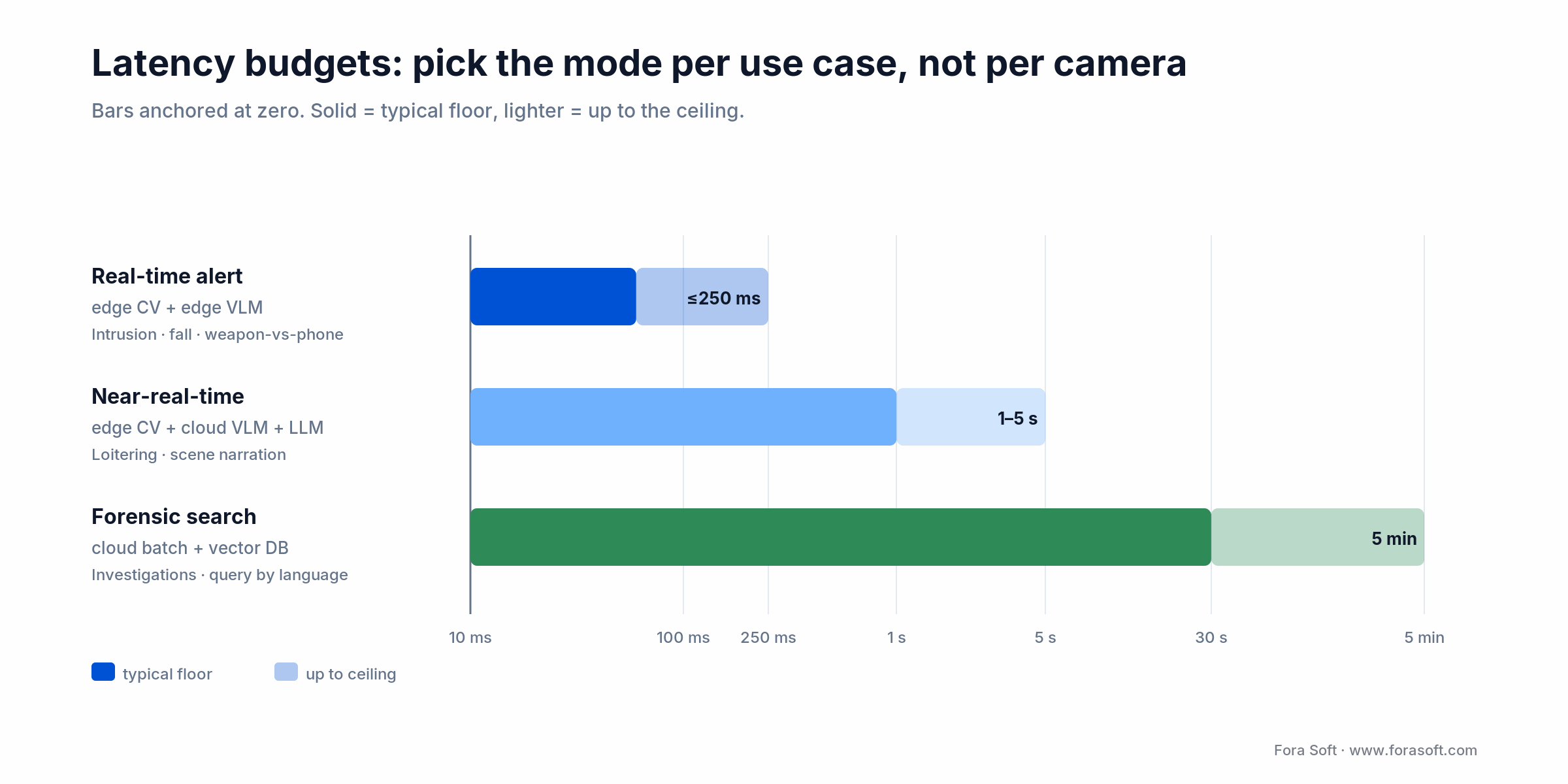
Figure 2. Latency budgets by mode. Bars are anchored at zero: the solid segment is the typical floor, the lighter segment runs up to the ceiling for each mode.
| Mode | Target latency | What runs where | Use cases |
|---|---|---|---|
| Real-time alert | <250 ms | Edge CV + edge VLM (MiniCPM-V) | Intrusion, fall, weapon-vs-phone, line-stop. |
| Near-real-time | 1–5 s | Edge CV + cloud VLM + cloud LLM | Behavioral anomaly, loitering, scene narration. |
| Forensic search | Seconds–minutes | Cloud batch, vector DB | Investigations, query-by-language, daily reports. |
Here’s the catch teams miss: you rarely need real-time everywhere. A 50-camera site might run three cameras in real-time-alert mode and the other 47 in near-real-time. Mixing modes is how the cost math stays sane, and it’s the decision that separates a demo from a deployable system.
Cost economics: cloud APIs vs self-hosted GPUs
Model your AI video analytics bill in dollars per hour of video processed. An hour of footage is about 1,080,000 tokens on Gemini at default resolution (roughly 300 tokens per second); drop to low resolution and it is a third of that, per Google’s video-understanding docs. That single fact drives everything below. Our full cost model for AI in video walks the whole spreadsheet.
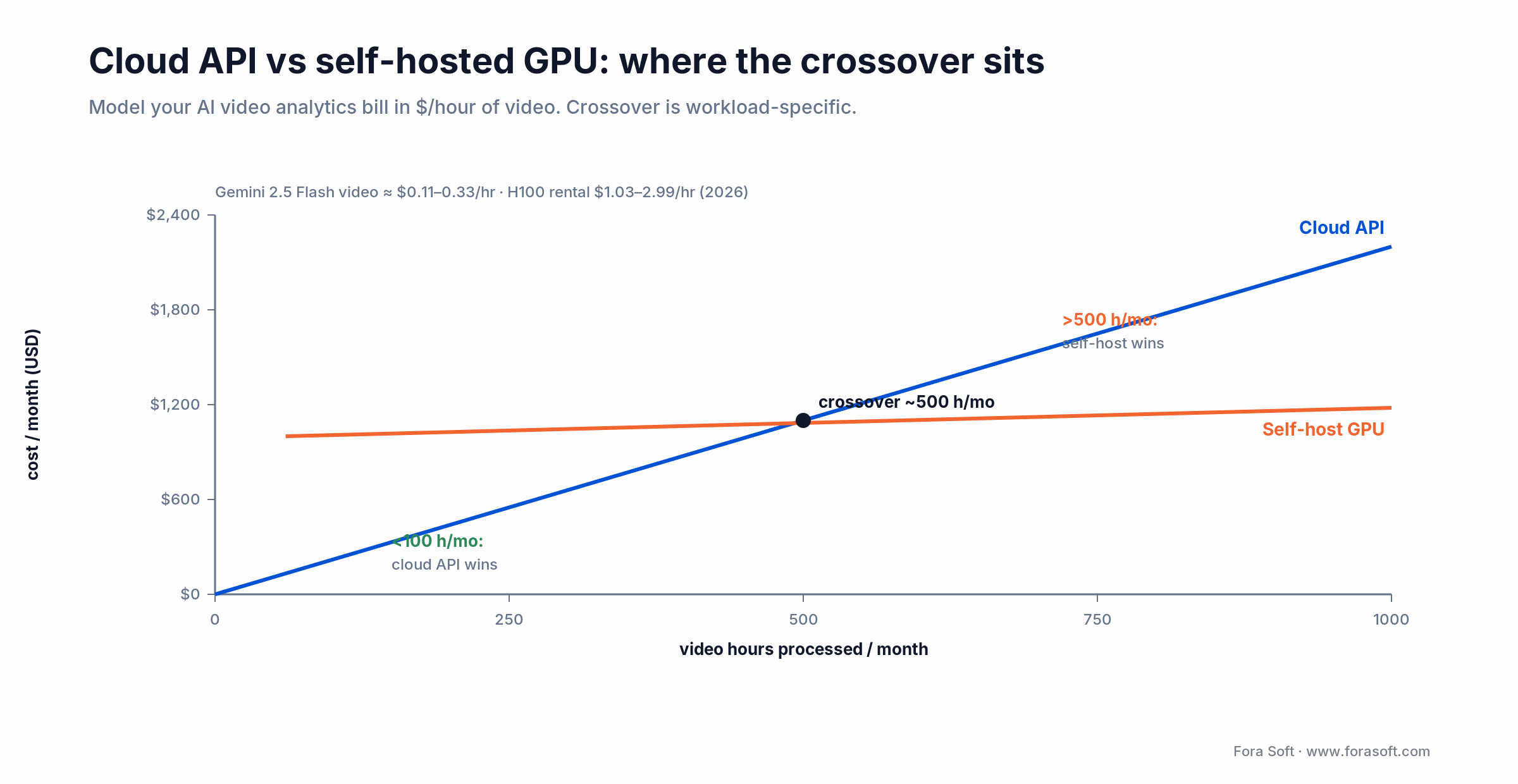
Figure 3. Cloud API cost rises linearly with volume; a committed self-hosted GPU is roughly flat. The crossover for steady VLM video work sits near 500 hours a month.
| Stack | Cost / hour video | Notes |
|---|---|---|
| Gemini 2.5 Flash (low-res) | ~$0.11 | 100 tokens/sec mode; halve again with batch. |
| Gemini 2.5 Flash (default) | ~$0.33 | Default resolution; best default for most work. |
| Gemini 2.5 Pro (default) | ~$1.37 | Higher recall on small objects and long context. |
| Self-hosted Qwen3-VL (H100 spot) | ~$1–3 (GPU rental) | Cheapest per hour once the GPU stays busy. |
| Self-hosted (AWS p5 on-demand) | $7–12 | Hyperscaler markup; only when compliance demands it. |
Two decision rules. Below 100 hours of video a month, cloud APIs win on total cost and are far simpler. Above ~500 hours of steady video, a committed GPU on a provider like Spheron, RunPod, or Lambda ($1.03–2.99/hr for an H100 in 2026) wins — the Lenovo TCO study puts self-host at 8× cheaper than cloud IaaS and up to 18× cheaper than frontier model-as-a-service. Between 100 and 500 hours, burstiness decides: bursty favors APIs, steady favors self-host. We have moved a video client from a $200,000-per-month closed-API bill to a $40,000-per-month hybrid stack with no loss in the features users actually see.
New use cases generative AI makes possible
1. Scene narration. Replace bounding boxes with a one-line description an operator reads at a glance: “Two people in hard hats operating a forklift near pallets at 03:42 AM” instead of “person, person, vehicle.”
2. Intent inference. Distinguish “loitering with a phone at the fence line” from “maintenance worker on rounds.” Research on reasoning-prompted VLMs (the VERA line of work) reports meaningful AUC lifts over generic prompts by asking the model to reason step by step before it labels.
3. Weapon-vs-phone disambiguation. Pure object detection misclassifies the same elongated dark object differently across frames. A VLM with surrounding context (posture, gesture, bystander reaction) resolves it more reliably — but only with the operator in the loop.
4. Query-by-language forensic search. “Show me clips of someone leaving with a backpack between 3 and 5 PM yesterday.” Visual RAG over embeddings replaces frame-by-frame scrubbing — the productivity story that video-recognition products sell hardest.
5. Multi-camera correlation. Track a person of interest across a 50-camera campus. Edge detection plus LLM reasoning over re-identification embeddings does this without sending every frame to the cloud.
6. Alert summarization. Roll up a shift’s alerts into a paragraph for the morning briefing. This is what makes VLM output usable to non-technical stakeholders.
7. Synthetic data for hard cases. Generate diffusion-model variants of rare events (PPE violations, slips, fights) to balance training sets without waiting to capture them in the wild. Tune the synthetic ratio carefully; too much and the model learns the generator, not the world.
Reach for natural-language search when: investigators or operators currently scrub recordings for hours per case — the productivity lift is the easiest ROI story to put in front of a CFO.
Implementation pattern: structured outputs & visual RAG
Two patterns do the heavy lifting in the products we ship. Both are simpler than they look once you see the wiring.
Structured-output VLM call
Always force the VLM to emit JSON against a schema. Temperature 0.1, validate, retry once on schema failure. The schema is the contract between vision and reasoning — get it right and the LLM tier becomes trivial.
{
  "scene": "warehouse loading dock, dusk",
  "actors": [
    {"id": "track-42", "role": "worker", "ppe": ["hard_hat", "vest"]},
    {"id": "track-43", "role": "visitor", "ppe": []}
  ],
  "actions": ["forklift_operation", "pedestrian_walking_in_zone"],
  "anomalies": ["unauthorized_pedestrian_in_forklift_zone"],
  "confidence": 0.82
}
Visual RAG
Embed every detection patch into a vector DB (Qdrant, Pinecone, or pgvector). At query time, embed the user’s natural-language query, retrieve top-K patches, send them plus the query to the VLM for re-ranking, then to the LLM for narrative output. That three-call pipeline is the engine behind “show me all clips of someone with a backpack” — we cover it end to end in the video RAG deep-dive.
Need a VLM-grade video product without the multi-quarter build?
Our spec-driven agent engineering ships a working pilot in 8–12 weeks. Bring the use case — we’ll bring the architecture and the budget on a 30-min call.
Privacy and the EU AI Act in 2026
Two things are true at once in 2026, and last year’s guides get them wrong. First, Article 50 transparency — you must label AI-generated or AI-modified video — went live on August 2, 2026 and was not deferred. So did enforcement: fines run up to 3% of global turnover or €15M. Second, the Digital Omnibus adopted in June 2026 pushed most high-risk obligations back: standalone Annex III systems (including permitted remote biometric identification) now fall under conformity assessment on December 2, 2027, and AI embedded in regulated products (Annex I) on August 2, 2028.
What is already prohibited outright, since February 2025: untargeted scraping of CCTV or internet imagery to build face databases, emotion inference in workplaces and schools, and most real-time remote biometric identification in public spaces by law enforcement (narrow exceptions aside). Our regulatory-engineering guide for the AI Act walks the specific articles and the engineering response. The shorthand for engineers: keep raw video on premise where you can, log every model decision with operator context, build the human-in-the-loop control plane on day one, and treat the audit trail as a first-class deliverable rather than a compliance afterthought.
Reach for on-premise or sovereign cloud when: the deployment touches EU residents in employment, schools, healthcare, or government — the obligations stack up fastest there, and the December 2027 clock is shorter than it looks.
Failure modes: hallucinations, adversarial inputs, drift
1. Temporal hallucination. VLMs drop well below human reliability on safety-critical classes (pedestrians, signs) when frames carry motion blur or sensor noise — a failure mode benchmarks such as VIDHALLUC were built to measure. Mitigate with fine-grained prompting, temporal-consistency scoring, and an ensemble where a detector and the VLM must agree before an alert escalates.
2. Adversarial inputs. A printed pattern on a T-shirt or sign can mislead a VLM across many frames. Defenses: detector-side anomaly scoring, prompt sandboxing on any text the VLM transcribes, and a hard rule never to act on text lifted from inside the camera frame.
3. Action–scene mismatch. A worker walks past a smouldering pallet and the VLM narrates only the worker. Multi-task learning and confidence calibration cut these omissions; in production we add hard rules (smoke, fire) that always escalate regardless of the VLM’s narrative.
4. Concept drift. Camera angles change, uniforms change, seasons change. Without a retraining loop, false-positive rates climb noticeably after 12–18 months. Build the hard-case collection pipeline before launch, not after.
5. Silent regressions on model upgrades. A new VLM release can change phrasing, JSON edge cases, or tail-class behavior. Keep a small held-out validation set per use case and rerun it on every model bump; gate the rollout on the metric, not the changelog.
Reach for ensemble + human-in-the-loop when: the alert can trigger a real-world action — a turnstile lock, a dispatch, an arrest. Single-model verdicts are not safe at that bar.
Mini case: VALT — video evidence search at 770+ organizations
Situation. VALT, by Intelligent Video Solutions, is a video recording and observation platform used across law-enforcement interviews, child-advocacy centers, medical simulation labs, and behavioral research. Investigators and instructors were scrubbing recordings by hand to find the moments that mattered inside long interview and training sessions.
What we built. We have been VALT’s sole development team for 10+ years, building it from scratch across web, iOS, and Android. The search feature that changed the workflow is word search: spoken words are transcribed with Amazon Transcribe and made searchable, so a reviewer types a phrase and jumps straight to the timestamp where it was said, then exports a PDF report. Encrypted streaming, permissioning, and audit trails keep it HIPAA- and GDPR-compliant — the compliance spine any contextual layer would extend.
Outcome. VALT now serves 770+ US organizations and 50,000+ users, with VALT 6.5 shipped in 2025. Transcription-based search is the honest precursor to the VLM stack in this playbook: the same “find the moment by describing it” workflow, extended from spoken words to visual events. Read the full VALT project page, or book a 30-min review if you’re building an evidence or compliance product.
A decision framework — pick your tier in five questions
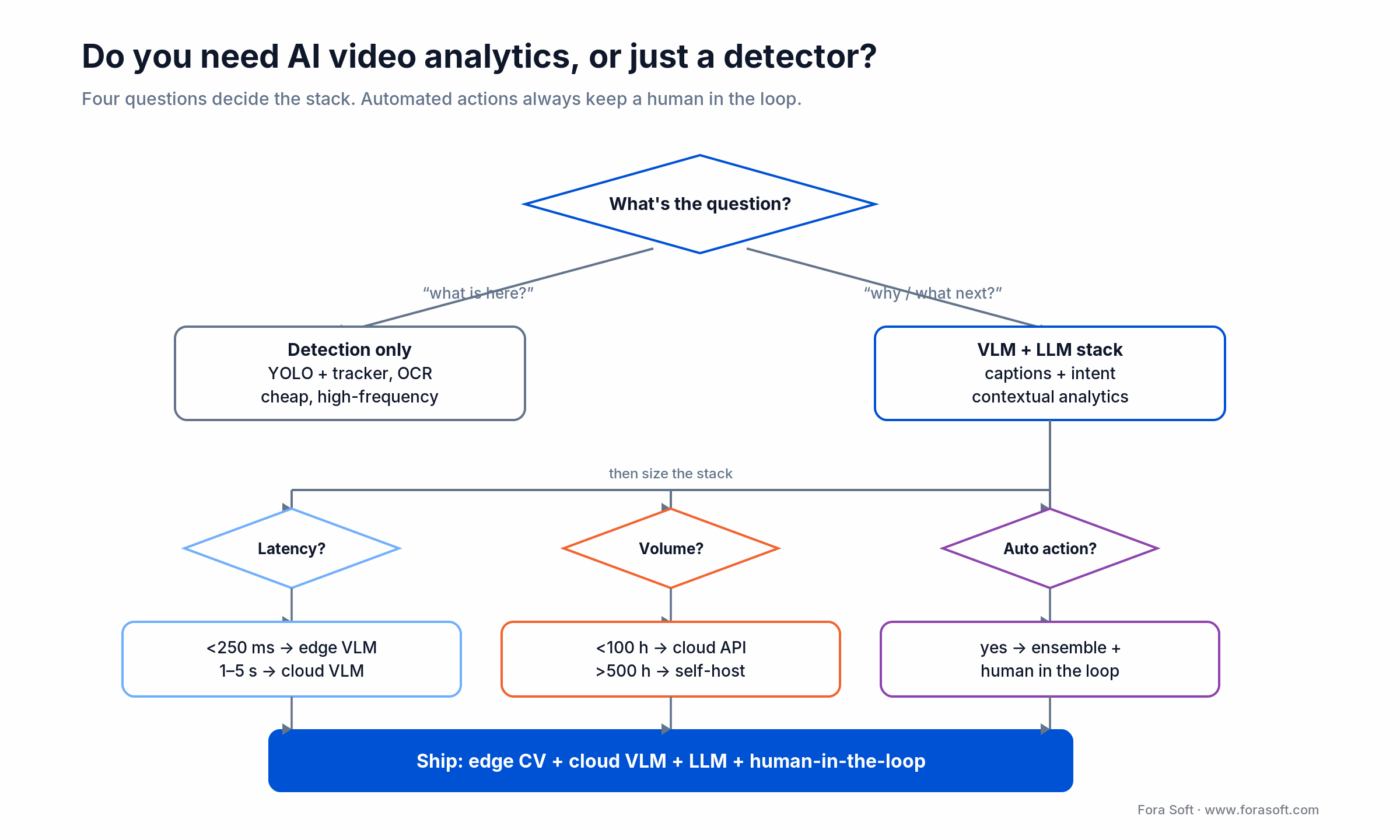
Figure 4. Four questions route you from “just a detector” to a full VLM + LLM stack — and automated actions always keep a human in the loop.
1. Is the question “what is here?” or “why is this happening?” Object detection alone solves the first. You need a VLM and an LLM for the second.
2. What’s the latency budget? Under 250 ms forces edge VLMs (MiniCPM-V). 1–5 s opens the door to cloud Gemini or Qwen3-VL. Forensic search has no real-time requirement at all.
3. How much video per month? Under 100 hours — cloud API. Over 500 hours — self-host on an H100. In between — depends on the burst pattern.
4. What regulators apply? EU residents, schools, hospitals, law enforcement, NDAA-controlled sites — on-premise or sovereign cloud, with a full audit trail and Article 50 labelling. Otherwise, commercial cloud is workable with a strong data-processing agreement.
5. Is the action automated or human-mediated? Automated alerts (turnstiles, line-stops) need ensemble certainty. Human-mediated alerts (operator triage, investigator search) tolerate VLM uncertainty as long as the rationale is shown.
Five pitfalls we see teams hit
1. Treating the VLM as the front door. Sending every frame to a VLM blows the budget and the latency. Detection at the edge funnels what reaches the VLM — aim for under 1% of frames.
2. Free-form natural-language outputs. A paragraph reply is unparseable. Force JSON with a strict schema; reject and retry on parse failure; log the schema violations and use them as training signal.
3. No held-out evaluation set. Without an internal benchmark, a model upgrade silently breaks behavior. We build a 200–500-clip eval per use case before anything ships, and rerun it on every change.
4. Skipping the operator feedback loop. If the operator’s dismiss and escalate clicks aren’t flowing back to retraining, you’re paying for an AI that can’t learn. The loop is cheap to build and pays for itself in the first quarter.
5. Ignoring Article 50 labelling and the impact assessment. “We’ll add the compliance UI later” is what teams say in week 2 and regret in week 18 when an EU pilot stalls. Build the labelling, the watermark, and the fundamental-rights impact assessment into the product spec from the first sprint.
KPIs to measure
Quality KPIs. mAP per class on your own validation set, not COCO. VLM JSON schema-violation rate — under 1% is healthy. Hallucination rate sampled by operator audit — under 3% on safety-critical labels.
Business KPIs. Cost per alert delivered (target under $0.10). Operator time-to-decision after an alert (median under 30 seconds). Customer-reported missed events, trending down quarter over quarter.
Reliability KPIs. P99 latency from frame to operator, within budget per mode. VLM API error rate under 0.5%. Mean time to recover after a model rollback, under 10 minutes on a healthy CI/CD.
When NOT to use generative AI on video
Generative AI is the wrong tool when the question is closed-form and high-frequency. Counting cars at an intersection? YOLO plus a tracker. Person-vs-no-person on a doorbell camera? YOLO plus a tracker. Reading license plates? OCR. You don’t need a VLM; you need a tight detector and a small operations bill. Plenty of solid video surveillance systems never touch a VLM at all.
It’s also wrong where you can’t tolerate hallucinations and can’t afford an operator. Fully automated weapon classification with no human in the loop is not a 2026 product; it’s a lawsuit waiting to happen. Use detection plus alert plus human triage, and let the VLM provide the rationale, not the verdict.
Ready to validate your VLM economics and architecture?
Send us your camera count, latency target, monthly hours, and compliance footprint. We’ll redline the stack and hand you a delivery estimate — agent-engineered, faster than you’d expect.
A 90-day path from pilot to production
| Weeks | Phase | Outcome |
|---|---|---|
| 1–2 | Spec & eval set | 200–500 clip eval per use case; latency budgets agreed. |
| 3–5 | Pipeline v1 | Edge YOLO + tracker; cloud Gemini/Qwen3-VL with JSON schema. |
| 5–7 | Visual RAG & search UI | Vector DB live; natural-language search ships behind a flag. |
| 7–9 | Hardening | Hallucination tests, ensemble checks, operator feedback loop, observability. |
| 9–11 | Compliance | Article 50 labelling, audit logs, impact-assessment template, RBAC, encryption. |
| 11–13 | Pilot & ROI report | Live customer data; before/after KPI report; rollout plan. |
This is the timeline we use with new clients on contextual video products. The compression versus traditional builds comes from agent-driven scaffolding and the fact that the model layer is now an API call, not a research project.
FAQ
What is AI video analytics, and how is it different from classical computer vision?
Classical computer vision answers “what is in the frame.” Contextual AI video analytics layers a VLM and an LLM on top to answer “what is happening, why, and what should we do.” In practice that means narrative output, intent labels, and natural-language search instead of bare bounding boxes.
Which VLM should I start with for an AI video analytics product in 2026?
For most clients we start with Gemini 2.5 Flash or Pro — native video, roughly one-hour context, $0.11–1.37 per hour of footage. For sovereign-data deployments we self-host Qwen3-VL on an H100. For real-time edge inference, MiniCPM-V 2.6 fits in about 5.5 GB and runs near 4 FPS on a Jetson AGX Orin.
How fast can a VLM realistically respond on live video?
Edge VLMs (MiniCPM-V) hit sub-250 ms at about 4 FPS today. Cloud VLMs land at 1–2 seconds for a 30-second clip on Gemini, 5–10 seconds for a one-minute clip on a self-hosted Qwen3-VL. Beyond that you’re in the forensic-search regime — fine for investigations, not for real-time alerts.
Does the EU AI Act apply to my video product if my company is outside the EU?
If your system processes the data of EU residents, yes — the regulation is extraterritorial. Most B2B video products touch EU data through one customer or another. Article 50 content-labelling and enforcement are live as of August 2, 2026; most high-risk obligations now apply from December 2, 2027 after the Digital Omnibus. Build for compliance from the first sprint either way.
How do I keep VLMs from hallucinating safety-critical events?
Don’t rely on a VLM alone. Use an ensemble: classical detection, VLM caption, and LLM reasoning, where two of the three must agree before the system escalates. Add hard rules on smoke, fire, and weapon detection, and keep a human in the loop for any high-stakes alert.
Cloud API or self-hosted VLM — which is cheaper at my scale?
Below ~100 hours of video a month, cloud APIs (Gemini 2.5 Flash) win on total cost and simplicity. Above ~500 hours a month of steady work, self-hosting Qwen3-VL on a rented H100 wins — independent TCO studies put self-host at 8× to 18× cheaper at scale. Between those numbers, burstiness and compliance decide.
How much does an AI video analytics build cost, and how long does it take?
A working pilot — 5–10 cameras, edge detection, cloud VLM with structured output, and a basic search UI — typically takes 8–12 weeks with our spec-driven agent engineering. Production rollout depends on certifications, integrations, and camera count. Bring us a scope and we’ll give you a number on a call.
What does the visual RAG architecture actually look like under the hood?
Edge devices push patch embeddings (Twelve Labs Marengo or Florence-2) into a vector DB (Qdrant, Pinecone, or pgvector). At query time we embed the user’s natural-language query, retrieve top-K patches, send them to the VLM for re-ranking, then to an LLM for narrative output. It’s a three-call pipeline that scales horizontally.
What to Read Next
Surveillance architecture
YOLO + ByteTrack + BoT-SORT + DeepSORT 2026 Guide
The detection and tracking stack that feeds every contextual video pipeline.
Edge vs cloud
Edge AI vs Cloud AI for Video Surveillance
Latency, cost, and the EU AI Act — where to put your inference.
Privacy & trust
2026 AI Surveillance Trends: Data Quality & Ethics
EU AI Act, GDPR, and the trust playbook for biometric video products.
Agentic video
Video AI Agents in 2026: Architecture & Economics
Latency budgets, per-minute economics, and the agent stack for live video.
Engineering practices
Real-Time Video Processing with AI: Best Practices
Architecture patterns and latency budgets from 250+ shipped video projects.
Ready to ship contextual AI video analytics?
The 2026 answer for serious video products is the layered stack: YOLO and a tracker on the edge, a vision-language model for scene captioning, an LLM for intent reasoning, and a human in the loop for the high-stakes calls. Detection is commoditized; the moat is everything that turns boxes into narrative, queries, and decisions.
If you’re scoping a custom product — surveillance, industrial monitoring, sports, sales intelligence, healthcare — the technology choices are well understood. The hard part is fitting them to your latency budget, monthly volume, and regulatory exposure. That’s the conversation we have with prospective clients on a 30-min scoping call: bring the constraints and we’ll bring the architecture and a delivery estimate.
The book · Volume 7 of 7
AI for Video: A Complete Guide to Intelligence in Video Products: From Real-Time Pipelines and Agents to Serving, Cost, Compliance, and Verticals
Moving from detection to intent puts every stage of your pipeline under a latency and cost budget. Our AI for Video volume on real-time pipelines covers exactly that: where models sit in a live video path, serving on vLLM, Triton and TensorRT, cost per stream-hour, and EU AI Act and biometrics rules, so a VLM tier holds up in production. Written by Nikolay Sapunov, CEO at Fora Soft.
Read it on Amazon →Kindle & paperback · Fora Soft Video Engineering Handbook
Talk to a team that has shipped 250+ video and AI products
Edge inference, VLM captioning, LLM intent reasoning, EU AI Act-ready data flows. We do this for a living — and faster than you expect, because of agent engineering.