

Key takeaways
• Live streaming platform development cost in 2026 typically lands between $35K and $180K for a production-grade MVP. A lean branded-stream app with chat, recording, and adaptive bitrate lives in the $35K–$70K band; a mid-tier platform with monetization, DRM, and moderation lands at $80K–$150K; a TradeCaster-scale enterprise system with sub-second latency, multi-CDN failover, and AI features starts near $180K. Agent Engineering knocks 25–40% off these versus traditional studios.
• Protocol choice sets the cost ceiling more than feature count. HLS/LL-HLS scales cheaply to hundreds of thousands of viewers at $0.02–$0.10 per GB of egress; pure WebRTC collapses financially past ~5,000 concurrent viewers because SFU compute scales linearly with participants.
• Egress, not development, is the real budget killer. One hour of 1080p at 4 Mbps for 10,000 concurrent viewers burns ~18 TB of bandwidth — $1,500 to $2,200 on AWS CloudFront, or ~$180 on Cloudflare Stream’s flat “minutes delivered” model. Pick the delivery tier before you pick the feature list.
• Managed services (Mux, Cloudflare Stream, AWS IVS, LiveKit Cloud) beat self-hosting until you clear ~50 TB/month egress or ~10M WebRTC participant-minutes. Below that threshold, paying a SaaS the “operational tax” is cheaper than hiring a DevOps team to run Janus, mediasoup, or SRS.
• Fora Soft has shipped 250+ multimedia projects since 2005, including BrainCert’s WebRTC LMS (500M+ classroom minutes, 99.995% uptime) and TradeCaster’s live trading stream (46,000+ users, WebRTC, auto-scaling for market-hour spikes). This guide distills that playbook into specific cost math, protocol trade-offs, and a build-vs-buy decision framework you can defend in front of a CFO.
Why Fora Soft wrote this playbook
Fora Soft has built streaming, video conferencing, and real-time multimedia products exclusively since 2005 — 20+ years, 250+ shipped projects, and a roster of clients that spans trading platforms, LMS leaders, fitness apps, and regulated-industry video systems. We do not write about live streaming cost theoretically. We run the budgets, negotiate the CDN contracts, and own the 3 a.m. pages when an encoder dies during a peak event.
The two cases that anchor most of this guide are BrainCert — the world’s first WebRTC + HTML5 virtual classroom LMS, now running 500M+ classroom minutes with 99.995% uptime and four Brandon Hall Awards — and TradeCaster, a live stock-trading stream now at 46,000+ users, where traders broadcast their desktops over WebRTC and the platform auto-scales through market-hour load spikes. Both shipped on budget; both are still running.
We also use Agent Engineering in every new engagement — spec review, architecture scaffolding, test generation, and UI glue are now partly AI-driven. That shaves 25–40% off the hours a traditional shop quotes, which is exactly why the dollar figures in this article are lower than what you will see on other “how much does a live streaming app cost” posts. If a number looks suspicious, it is because we are quoting our real 2026 rates, not someone else’s 2022 average.
Need a defensible cost range for your live streaming project?
We will benchmark your feature list against 20+ comparable builds, stress-test the protocol choice, and send back a two-page estimate with a fixed engineering ceiling — usually within 48 hours.
The 2026 live streaming market in four numbers
Before budgeting, calibrate expectations against the market you are entering. Live video keeps eating other media categories, and the infrastructure economics have shifted meaningfully in the last 18 months.
1. Global market size. The live streaming market is tracking toward $385B by 2028 from $88B in 2023, a mid-20s percent CAGR. Video-on-demand and OTT are driving most of the absolute growth, but live — fitness, education, trading, sports, shopping — is growing fastest on a percentage basis.
2. Latency expectations have collapsed. Two years ago, 10–30 seconds of HLS latency was the industry norm. In 2026, Apple LL-HLS, WHIP/WHEP ingest, and CMAF low-latency packaging have made 2–4 seconds the new baseline for broadcast-style delivery, and sub-500ms WebRTC is expected for anything interactive (live shopping, auctions, fitness classes, trading, betting). Building “just HLS” is now a competitive disadvantage.
3. Managed services got cheaper faster than bandwidth. Cloudflare Stream (flat $1 per 1,000 delivered minutes, no separate egress), Mux tiered pricing, and AWS IVS multitrack video all dropped per-unit cost 20–40% in 2024–2026. For most founders the math now tips toward managed services until you are comfortably past 50 TB/month in egress.
4. AI features are table stakes, not differentiators. Live captions, real-time translation, auto-highlights, toxicity moderation, and searchable transcripts are expected in any platform above a hobbyist tier. The question is no longer “should we include AI” but “buy (Mux AI, Cloudflare AI, AWS Transcribe) or build (LiveKit AI Agents + your own pipeline).”
Three realistic cost tiers for a 2026 live streaming platform
Most “live streaming app development cost” articles give a single $15K–$500K range, which is useless. Split the decision into three tiers by feature depth and audience scale, and the numbers resolve.
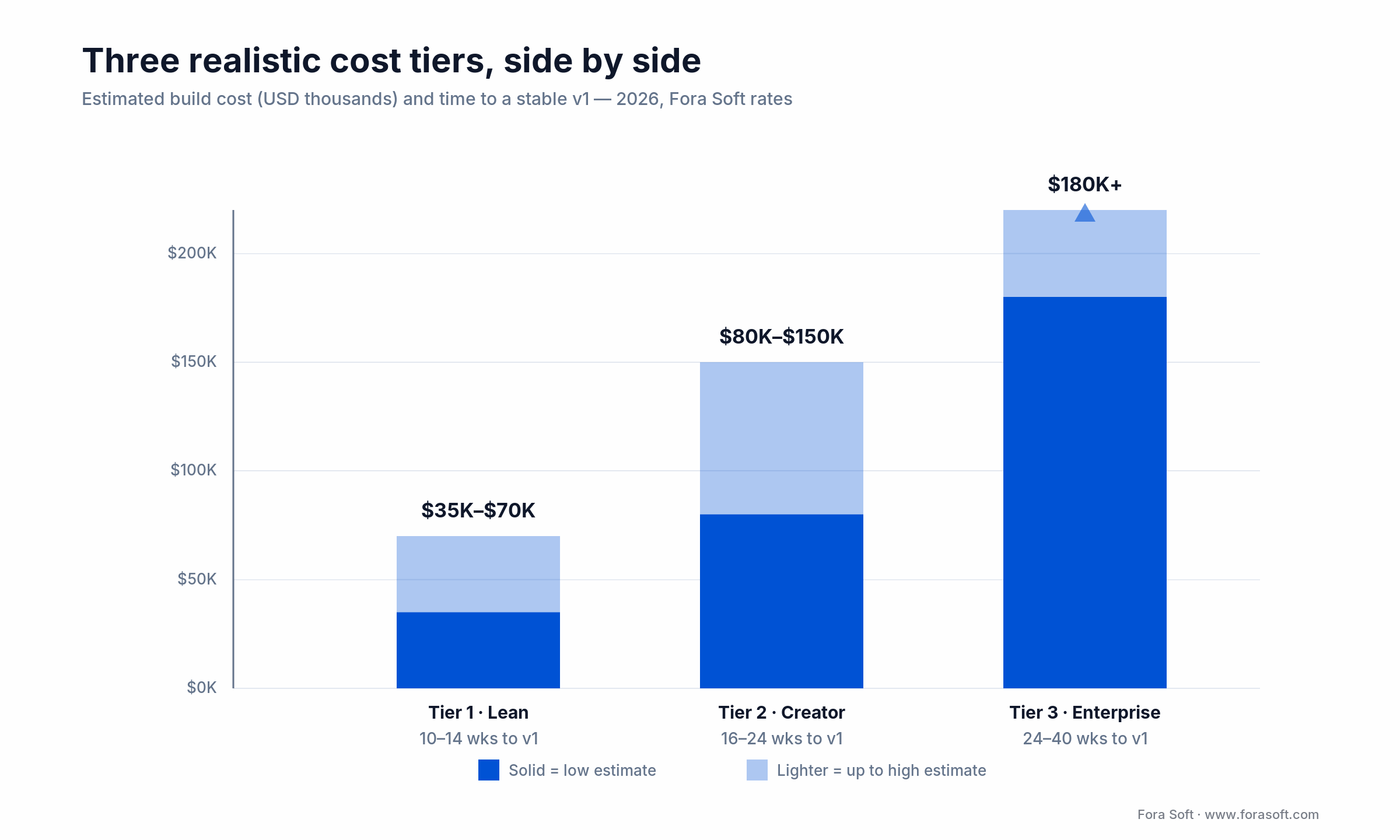
Figure 1. The three cost tiers and their time-to-v1 — solid bar is the low estimate, the lighter band runs up to the high estimate.
Tier 1 — Lean branded stream ($35K–$70K)
A single-brand live app: RTMP or WHIP ingest, HLS/LL-HLS playback, adaptive bitrate (3 profiles), live chat, moderation queue, VOD recording, and a web + mobile viewer. Built on managed services (Mux or Cloudflare Stream for delivery, Firebase for auth, Stream Chat or a self-coded WebSocket tier for chat). Ships in 10–14 weeks.
Reach for Tier 1 when: you expect < 10,000 concurrent viewers, own all the content, and want to launch within a quarter. Below this scale, managed-services tax is cheaper than hiring streaming ops.
Tier 2 — Multi-streamer platform with monetization ($80K–$150K)
Creator-style platform: multiple concurrent streams, subscriptions and tipping, reactions and gifts, DVR, a richer chat with bans and slow mode, email/push notifications, an analytics dashboard, and AI captions plus toxicity moderation. Mixed stack: managed delivery (Mux or AWS IVS), but a custom chat and engagement tier, plus custom billing. Ships in 16–24 weeks.
Reach for Tier 2 when: you run a two-sided marketplace (streamers + viewers), you need to rank creators and route revenue, and you expect 10K–50K concurrent viewers with interactive features.
Tier 3 — Enterprise broadcast / interactive ($180K+)
Broadcast-grade or trading/auction-grade: hybrid WebRTC SFU + HLS CDN, sub-second latency for active participants, DRM (Widevine + FairPlay + PlayReady), multi-CDN failover, geo-blocking, enterprise SSO, SOC 2 / HIPAA if applicable, redundant encoders, pre-warmed capacity for scheduled peaks, and full SRE observability. Usually self-hosted origin with managed edge. 6–10 months to stable v1, then ongoing.
Reach for Tier 3 when: you have 50K+ concurrent peaks, interactive sub-second features, premium content that demands DRM, or regulated industries (finance, healthcare, gov) that demand compliance and audit trails.
Tier comparison matrix — feature, cost, time, and protocol
Use this as the first page of your internal budgeting memo. The numbers assume a Fora Soft-style Agent-Engineering team at blended $55–$75 per hour; multiply by 1.4–2.2x for West-Coast US studios, by 0.7–0.9x for offshore boutiques without streaming specialization.
| Tier | Cost (Fora Soft) | Time to v1 | Protocol mix | Peak viewers | Infra model |
|---|---|---|---|---|---|
| Tier 1 — Lean | $35K–$70K | 10–14 wks | RTMP/WHIP in → LL-HLS out | < 10K | Fully managed (Mux / Cloudflare) |
| Tier 2 — Creator | $80K–$150K | 16–24 wks | RTMP/WHIP + LL-HLS + WebRTC chat | 10K–50K | Hybrid managed + custom services |
| Tier 3 — Enterprise | $180K+ | 24–40 wks | WebRTC SFU + LL-HLS + multi-CDN | 50K–1M+ | Self-hosted origin + managed edge |
| Add-on — AI suite | +$15K–$35K | +3–5 wks | Any | Any | Cloudflare AI / OpenAI / LiveKit Agents |
Feature-by-feature cost ladder
Every dollar in a live streaming build can be traced back to a specific feature. The table below is the expanded version of our internal estimating spreadsheet — hours and dollars assume a Fora Soft blended rate with Agent Engineering baked in. It is the ladder clients walk down with us when they want a defensible number inside of an hour.
| Feature | Hours | Cost | Tier | Notes |
|---|---|---|---|---|
| Auth + user profile | 40–70 | $2.4K–$4.5K | 1+ | OAuth, email, password reset, MFA optional |
| Core ingest → playback (LL-HLS) | 180–320 | $11K–$20K | 1+ | Includes RTMP/WHIP ingest, 3-rung ladder, player |
| Recording + VOD library | 50–90 | $3K–$6K | 1+ | S3/R2 archive, signed URLs, HLS catch-up |
| Live chat + moderation | 80–160 | $5K–$10K | 1+ | WebSocket, ban/mute, slow mode, profanity filter |
| Reactions, gifts, tipping | 40–70 | $2.4K–$4.5K | 2+ | Stripe/Paddle, payout splits |
| Subscriptions + paywall | 60–120 | $3.6K–$7.5K | 2+ | Trial, dunning, entitlement service |
| Ads / VAST + SSAI | 90–170 | $5.5K–$10.5K | 2+ | SpotX / Google IMA / AWS MediaTailor |
| DVR + scrubbing | 60–110 | $3.6K–$7K | 2+ | 30–60 min buffer, origin tuning |
| Analytics dashboard | 80–140 | $5K–$9K | 2+ | Concurrency, QoE, revenue; Mux Data or custom |
| AI captions + live translation | 60–110 | $3.6K–$7K | 2+ | Cloudflare Workers AI, AWS Transcribe, SyncWords |
| AI highlights + auto-thumbnails | 90–160 | $5.5K–$10K | 2+ | Scene detection, reaction-spike clip cuts |
| Multi-DRM (Widevine + FairPlay) | 80–140 | $5K–$9K | 3 | EZDRM/BuyDRM + key rotation |
| WebRTC SFU (interactive) | 200–360 | $12K–$22K | 3 | LiveKit / mediasoup / Janus, auto-scaling |
| Multi-CDN failover | 80–140 | $5K–$9K | 3 | Active-active token swap, health probes |
| SOC 2 / HIPAA readiness | 120–200 | $7.5K–$12.5K | 3 | Controls, logging, key management, audits |
Want a feature-by-feature estimate in your inbox?
Tell us which features on the ladder above matter and we will send a filled-in estimate, a protocol recommendation, and a 12-week staffing plan.
Protocol choice — the single decision that caps your cost
Pick the wrong streaming protocol and no cost-optimization later will save you. The choice is between four realistic options in 2026. Each has a very different cost curve as concurrent audience scales.
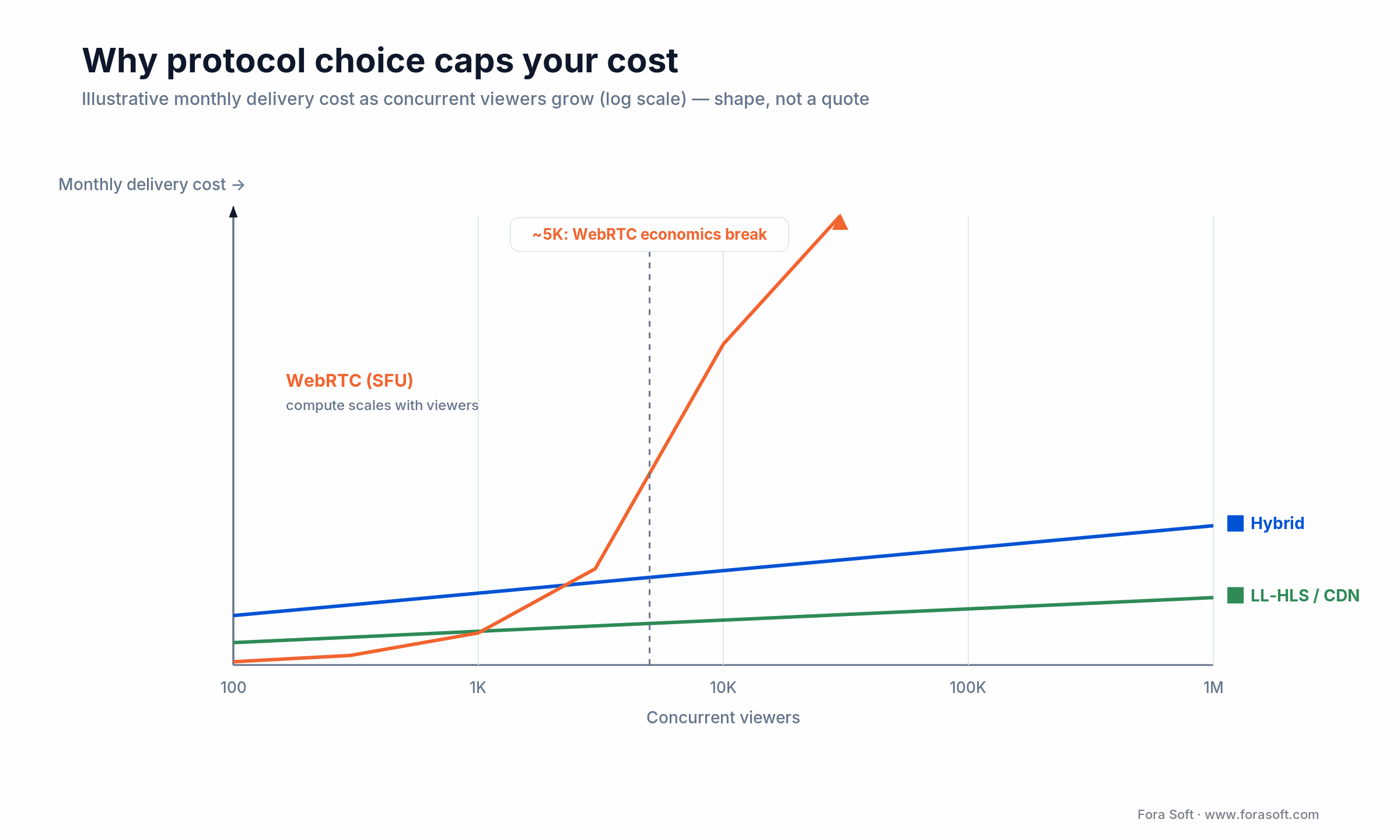
Figure 2. WebRTC compute rises with every viewer, so its cost curve turns sharply upward past roughly 5,000 concurrent; LL-HLS and hybrid stay nearly flat.
HLS and LL-HLS (Apple-blessed, CDN-friendly)
HLS scales essentially for free per viewer on a CDN because the edge caches segments. Apple LL-HLS brings latency down to 2–4 seconds glass-to-glass with part-cache and bumping playlist updates. This is the default choice for any broadcast style (sports, entertainment, news, shopping, education playback). The cost lever here is your adaptive-bitrate ladder — how many rungs you encode drives both compute and egress; our video encoding fundamentals hub breaks down how ABR profiles map to cost.
Reach for LL-HLS when: your use case is one-to-many, your audience is > 5,000 concurrent, and 2–4 seconds of latency is acceptable. This covers ~80% of live streaming projects.
WebRTC (sub-500ms, compute-bound)
WebRTC is the only way to hit sub-second latency. It runs on SFUs (LiveKit, mediasoup, Janus, Ant Media); each SFU instance handles 500–1,500 viewers depending on codec and server size. Server compute scales linearly with participants — past roughly 5,000 concurrent viewers the compute bill dominates and the protocol stops making economic sense as the delivery layer.
Reach for WebRTC when: you need true two-way interaction — live auctions, fitness classes with the coach reading chat, co-streaming podcasts, trading, live shopping, telehealth, betting. Or use it as a hybrid layer alongside HLS for active participants only.
RTMP / SRT / WHIP (ingest only)
None of these are delivery protocols in 2026; they are ingest protocols. RTMP is still the default for OBS and legacy hardware encoders. SRT is the quality champion for remote contribution over lossy internet. WHIP is the new WebRTC-over-HTTP standard now native in OBS 30+, and is how forward-looking platforms ingest sub-second content without RTMP’s latency penalty.
Reach for WHIP when: you control the encoder software and care about latency. Accept RTMP everywhere else for compatibility; keep SRT as the contribution path for remote broadcast scenarios.
Hybrid WebRTC + HLS (scale without breaking the bill)
The answer for most interactive-at-scale products is hybrid, and it’s the pattern we reach for on interactive builds. Active participants — the few hundred who actually act on the stream — get a sub-500ms WebRTC session; the “passive” ten-thousands watch the same content as a 2–3 second LL-HLS simulcast off the same origin. You pay WebRTC compute only for the people who need it, and let a CDN carry everyone else for near-zero marginal cost. Our TradeCaster trading stream (46,000+ users) is a good example of the interactive tier: real-time desktop broadcast over WebRTC, auto-scaled for market-hour spikes.
Managed streaming services compared (2026 prices)
Once you have decided on protocols, pick a vendor. The six services below dominate the 2026 market. Numbers reflect public list pricing as of August 2026; always negotiate volume discounts above 100K monthly minutes (Mux and LiveKit both quote 20–30% off on annual commits).
| Service | Model | Headline price | Egress | Best for |
|---|---|---|---|---|
| Cloudflare Stream | Minutes delivered | $1 per 1,000 min | Included | Predictable bills; hybrid live + VOD |
| Mux | Encoding + delivery per minute | ~$0.05–$0.07/min enc; ~$0.025/min deliv | First 100K min/mo free | Dev-first; great observability (Mux Data) |
| AWS IVS | Input hours + output viewer-hours | $2.00/hr HD input ($0.50/hr w/ Multitrack) | Per viewer-hour (tiered) | AWS-native; interactive features |
| LiveKit Cloud | Connection-minutes + bandwidth | $0.0004–$0.0005/min WebRTC | $0.10–$0.12/GB after free tier | Interactive, AI agents, sub-second |
| Agora | Minutes (per quality) | $0.99–$3.99 per 1K min HD | Included | China / APAC; legacy ILS clients |
| Dolby.io / 100ms | Participant-minutes | Custom / tiered | Included | Premium audio, event experiences |
We have a deeper LiveKit vs Agora cost breakdown that works through unit economics for a 10K-minute-per-day app if you want the math.
The hidden costs that ambush live streaming budgets
Most budget blowups come not from the build but from recurring infra costs nobody modeled. Here are the five we flag in every new-client kickoff.
1. Bandwidth egress. The quiet killer. 1080p at 4 Mbps = 1.8 GB per viewer-hour. Ten thousand viewers for one hour = 18 TB. At AWS CloudFront list rates that is ~$1,500–$2,200. At Cloudflare Stream’s flat model that is ~$180. Model this before you pick a delivery vendor.
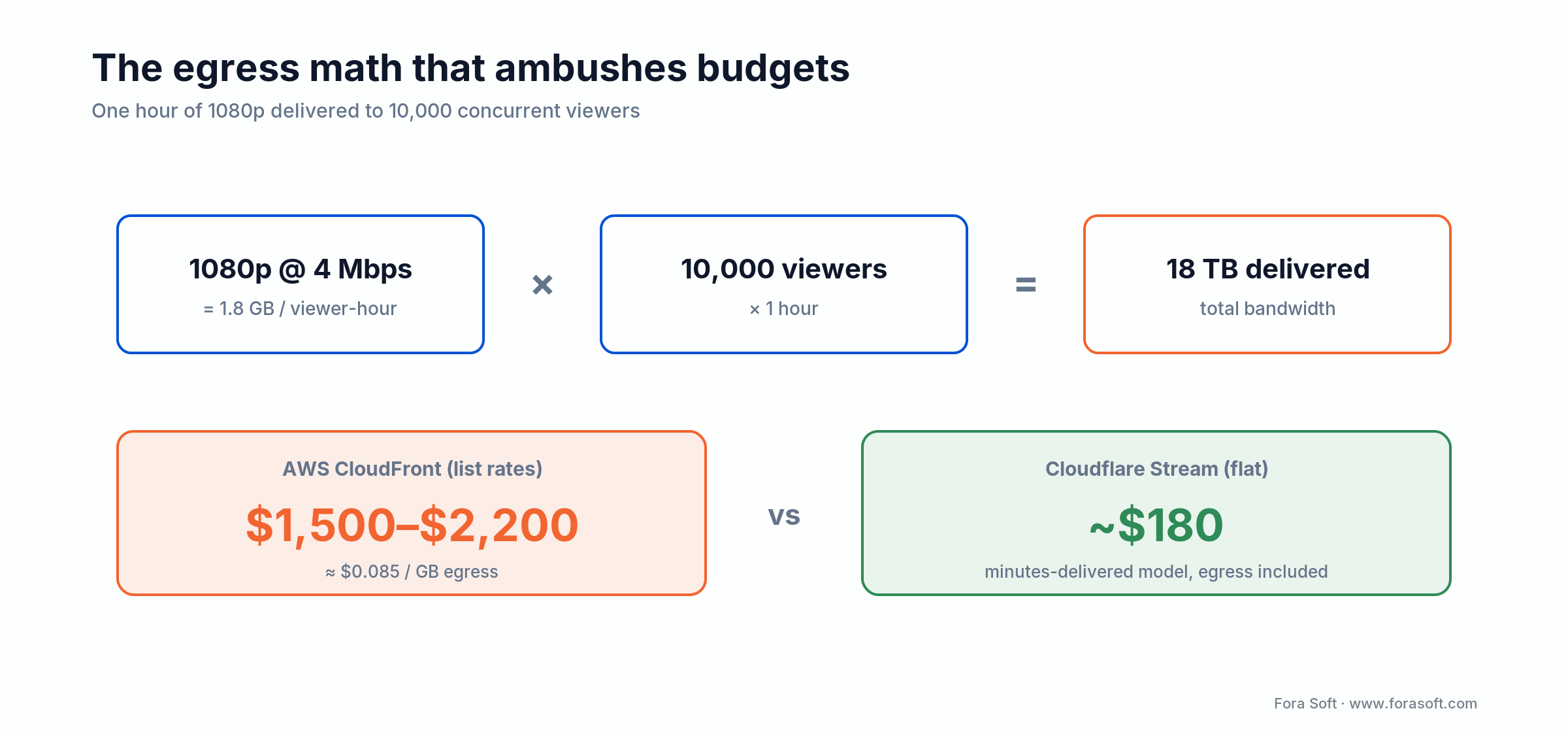
Figure 4. The same 18 TB of delivery costs an order of magnitude more on usage-priced CDN egress than on a flat minutes-delivered model.
2. Transcoding per minute. AWS MediaLive lists $0.7656/hr HD plus MediaPackage per GB. Mux (2026) bills roughly $0.05/min to encode plus $0.025/min delivered. A 4-hour daily event with a 3-rung ladder runs ~$40–$70/day on Mux depending on audience, or ~$3–$5/day on AWS MediaLive with self-packaging — but AWS comes with 3–4x the DevOps overhead.
3. Recording and storage. Easy to forget: VOD archive is ~5–7 GB per 1080p hour. 500 hours of archive on AWS S3 is ~$60/month; on Cloudflare R2 it is ~$40/month with zero egress fees. Model growth: archive size doubles every 8–10 months for a healthy platform.
4. Moderation. A single live stream over 50,000 concurrent chat users generates 2–5 messages per user per hour. Hybrid moderation (AI flags + human review) runs $1,500–$3,500/month at that scale. Under-budgeting moderation is the second most common reason platforms get bad press.
5. DRM licensing. Premium content without DRM is just piracy-bait. EZDRM and BuyDRM run $300–$800/month plus $0.001–$0.003 per viewer for Widevine + FairPlay + PlayReady. Break-even vs. piracy losses typically lands around 50K concurrent premium viewers.
Reference architecture for a Tier 2 platform
This is the stack we ship most often for creator-grade platforms in the $80K–$150K band. It balances cost, latency, and operational simplicity.
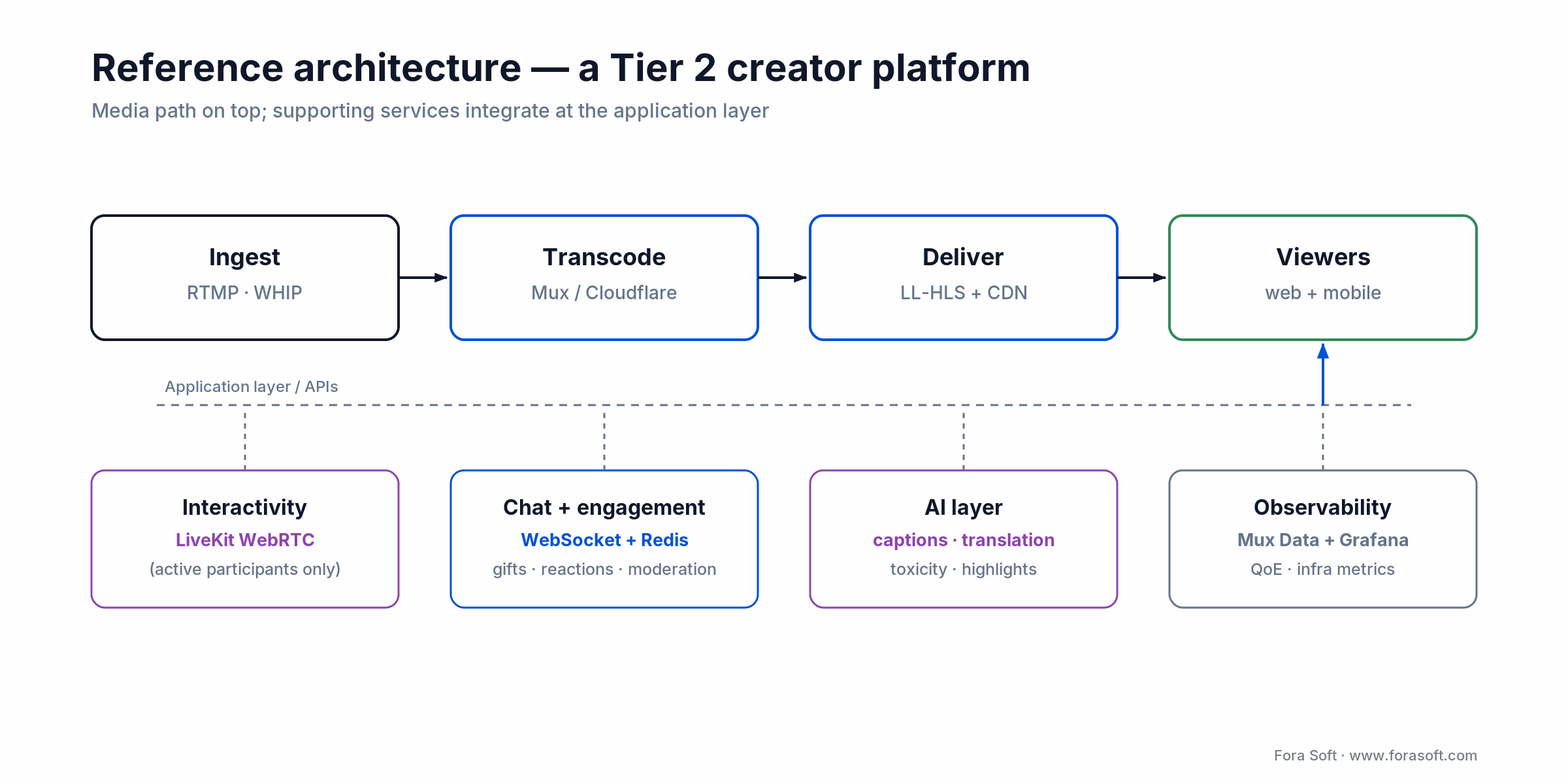
Figure 3. The media path runs across the top; interactivity, chat, AI, and observability integrate at the application layer and feed the viewer experience.
| Layer | Choice | Why |
|---|---|---|
| Ingest | RTMP + WHIP, fronted by Cloudflare or Mux | RTMP for compatibility with every encoder; WHIP for sub-second ingest from OBS 30+ |
| Transcoding | Mux / Cloudflare Stream | 3-rung ABR ladder, per-title where the content justifies the compute |
| Delivery | LL-HLS over Cloudflare / Mux CDN | 2–3s latency, scales to millions, CDN-cacheable |
| Interactivity | LiveKit Cloud for co-host / guest | Sub-500ms WebRTC only for active participants |
| Chat | Custom WebSocket + Redis Streams | Full control of moderation, gifts, UI; 10x cheaper than Stream Chat at scale |
| Recording / VOD | S3 or R2, signed URLs, HLS catch-up | Cheap long-tail storage, zero-egress via R2 when paired with Cloudflare delivery |
| AI layer | Cloudflare Workers AI / OpenAI Whisper | Captions, translation, highlight detection; pay-as-you-go |
| Observability | Mux Data + Grafana | QoE per viewer + infra metrics in one dashboard |
Build vs. buy — where self-hosting starts paying off
The single biggest lever on total cost of ownership is the managed-vs-self-hosted choice. Get this wrong and you either burn capital on DevOps you did not need or bleed margin to a SaaS for years. Use these thresholds. One caveat before you do: if the recorded master matters more than the live feed, cost moves off egress and onto storage and upload, which is the shape our custom remote video production platform case study walks through tier by tier.
1. WebRTC break-even: ~10M participant-minutes/month. Below that, LiveKit Cloud or Agora is cheaper than hiring an SRE to run mediasoup or Janus. Above, self-hosted wins on unit economics — but you need 2–3 ops-capable engineers.
2. HLS break-even: ~50 TB/month of egress. Below, Cloudflare Stream or Mux beats DIY by a mile because you avoid packaging, origin, and caching work. Above, a self-hosted SRS/nginx-rtmp origin plus direct CDN contracts starts cutting per-GB cost 40–60%.
3. Hybrid is almost always correct. Nearly every production platform ends up with managed ingest, self-hosted chat/engagement, managed delivery, and self-hosted observability. Pure “all managed” or “all DIY” is a smell.
4. DRM is the exception that proves the rule. Multi-DRM (Widevine + FairPlay + PlayReady) is almost never worth self-hosting. EZDRM, BuyDRM, and Castlabs compete on price and the engineering effort to maintain license servers is brutal.
5. Your team’s headcount is the tiebreaker. A 3-engineer team should never self-host. A 15-engineer team with a dedicated media SRE should probably own its origin.
Mini case — TradeCaster, a live trading stream at 46,000+ users
Situation. A financial-markets client came to us with a concept that had no off-the-shelf equivalent: let expert traders broadcast their live desktops — charts, positions, orders — so subscribers can watch real trades and copy the strategy. Two things made it hard. The broadcast has to feel real-time, because a delayed chart is a wrong trade. And audience load isn’t steady: it spikes hard at market open and on volatile sessions, then falls off. A generic webinar tool couldn’t express the trader workflow, and a naive setup would either lag or fall over during the open.
Plan. We built TradeCaster on a WebRTC real-time desktop-streaming core (React + Node.js, Redis, MongoDB on AWS) with TradingView-powered advanced charts, public and private chat rooms, a video lesson library, and real-time trade alerts. Streamer profiles surface each trader’s history and P&L so viewers pick proven performers. Billing runs on $99–$119/month subscriptions with a 7-day trial, plus a monetization path for streamers who clear 100+ daily viewers. The infra auto-scales to absorb market-hour load spikes instead of provisioning for peak 24/7.
Outcome. TradeCaster now serves 46,000+ users, got featured on MSN, and its founder has earned over $500K live on stream. The workflow-specific product — not “another Twitch” — is what made it defensible, exactly the test in the “when not to build” section below. Want a similar assessment of your streaming concept? Book a 30-minute scoping call.
Budgeting a 30K-to-100K concurrent-viewer product?
We will sketch a hybrid WebRTC + LL-HLS architecture, benchmark it against pure-SaaS options, and give you a 12-month TCO model.
AI features that actually move the needle in 2026
“AI everywhere” is a fast way to burn $30K on features nobody uses. The four below have the highest retention impact per dollar across the platforms we ship.
1. Live captions + translation. Sub-second captions (AWS Transcribe, Cloudflare Workers AI, SyncWords) plus real-time translation into 10–30 languages. Build cost $3.6K–$7K; runtime cost $0.02–$0.05 per hour of stream. Adoption in 2026: ~40% of live events ship with this by default.
2. AI toxicity moderation. Perspective API, OpenAI Moderation, or a custom classifier flags toxic chat in <200ms so a human reviewer can ban faster. Build cost $3K–$6K; runtime cost a few dollars per million messages. This is the single fastest ROI feature in any platform that hosts open chat.
3. Auto-highlights and thumbnails. Scene-detection + reaction-spike clip cuts + AI-generated thumbnails turn a 2-hour broadcast into 8–12 shareable moments ready within minutes of end-of-stream. Build cost $5.5K–$10K. Typically lifts social sharing 25–40%.
4. AI agents in the stream. LiveKit’s Agents framework (plus Claude/GPT/open-source models) lets you drop a voice-capable assistant directly into the live room — transcribing, summarizing, answering FAQs, or co-hosting. See our deep dive on LiveKit AI agent development. Build cost $8K–$20K. Still a differentiator in most verticals in 2026.
A worked cost model — 20K concurrent fitness platform
Abstract numbers do not help. Here is a concrete cost model for a realistic Tier 2 platform: a live fitness product (picture Perspire.tv) with 20,000 concurrent peak users, 3 live classes per day, Stripe subscriptions, and AI captions.
| Line item | Assumption | Monthly $ |
|---|---|---|
| Delivery (LL-HLS via Mux) | 3 classes × 45 min × 30 days × avg 12K viewers @ 2.8 Mbps | $3,800–$4,600 |
| Encoding | 4,050 live min @ ~$0.05/min | $200 |
| Chat + engagement | Custom WebSocket on AWS (c7i.xlarge × 3 + Redis) | $450 |
| Recording + VOD storage | R2, 400 hours archive retained 6 months | $45 |
| AI captions + moderation | 4,050 min captioning + toxicity API calls | $220 |
| Observability + monitoring | Mux Data + Grafana Cloud | $350 |
| Total infra | — | ~$5,100–$6,000 |
A $5K–$6K/month infra bill for a 20K-peak fitness platform is defensible. Against ~$20–$30/month per paying subscriber, you break even around 250–350 subscribers. Most Tier 2 platforms we ship clear that number within 90 days of launch.
A decision framework — pick your stack in five questions
Walk through these five questions with your team before writing the first line of code. The answers collapse the decision tree to one or two viable stacks.
Q1. What is the worst-case concurrent viewer count in year one? Under 5K → managed services across the stack. 5K–50K → hybrid managed + custom engagement. Over 50K → self-hosted origin + managed edge.
Q2. Do users interact with the stream in real time? No → LL-HLS only. Yes, under 1K simultaneous interactors → hybrid WebRTC + LL-HLS. Yes, many interactors → WebRTC SFU (and accept the scaling cost).
Q3. Is the content premium, licensed, or regulated? No → skip DRM; focus on signed URLs. Yes → multi-DRM via EZDRM or BuyDRM from day one.
Q4. How many engineers will run this after launch? 1–3 → managed everything; no self-hosted anything. 4–8 → managed core + self-hosted chat / engagement. 9+ → self-hosted origin becomes viable.
Q5. What is the latency SLA for the worst-case user flow? Over 6s → HLS. 2–6s → LL-HLS. Under 2s → WebRTC for that specific flow; HLS for everyone else.
Five pitfalls that blow up live streaming budgets
We have post-mortemed dozens of live streaming projects. The same five mistakes show up repeatedly. Avoid them and most cost overruns disappear.
1. Assuming HLS is free. HLS scales well — but egress is never free. A single 10K-viewer hour is $1.5K–$2.2K on AWS CloudFront list pricing. Model egress at target concurrency before you greenlight a feature list.
2. Picking WebRTC for an audience of 100K. WebRTC past ~5K concurrent requires dozens of SFU instances and a real SRE team. If your product is one-to-many, use LL-HLS and save $20K–$50K/month.
3. Single encoder, no failover. Live encoding failure equals a blackout. A redundant active-active encoder pair costs a few hundred dollars extra a month and prevents one lost revenue hour from wiping a quarter.
4. Shipping with manual moderation only. Humans cannot scan 500-message-per-second chat. Either ship AI-first moderation from day one or plan for a painful pivot at around 10K DAU.
5. Skipping load tests. Every production live streaming disaster we have reviewed started with an untested scale scenario. Budget two weeks of load testing and chaos engineering before any public event above 10K expected peak.
KPIs to measure post-launch
You cannot defend next quarter’s infra budget without the right telemetry. Instrument these three buckets on day one.
Quality KPIs. Rebuffer ratio (target <1%; alert at 3%); time-to-first-frame (target <2s p95); video start failure rate (target <0.5%); average delivered bitrate by device class. These map directly to churn on any subscription platform.
Business KPIs. Minutes watched per paying user, paid-tier conversion from free trial, gift/tip revenue per 1,000 minutes, ad fill rate, concurrent-per-account (shared-password proxy). These tell you whether engagement features are paying for themselves.
Reliability KPIs. Uptime against event schedule (target 99.9%+; our BrainCert holds 99.995%), CDN cache-hit ratio (target >85%), origin requests per 1K viewers, failover test cadence. These protect brand and SLA clauses.
When not to build a custom live streaming platform
Honest counter-position. A custom platform is the wrong answer for four real-world situations.
1. You are validating a concept at < 1,000 viewers. Use YouTube Live or Vimeo Livestream plus an embedded iframe. Custom platform spend before product-market fit is a writedown.
2. You just need a class/webinar tool. Zoom Events, StreamYard, Restream, or Livestorm already solve it and cost a few hundred a month. Don’t rebuild them.
3. Your runway is under 6 months. A Tier 2 build plus ramp takes longer than that. Either raise more or choose a white-label (Uscreen, Dacast Select, Brightcove) and invest the saved time in distribution.
4. You cannot defend a unique user experience. If your only differentiation is “we look nicer than Twitch,” you will lose. Custom is justified by a workflow that off-the-shelf tools cannot express — trading panels, medical protocols, classroom grading, live shopping cart flows.
A realistic 16-week Tier 2 timeline
The build phases below are what we run inside Fora Soft with Agent Engineering support. Dates are indicative of a typical 16-week Tier 2 engagement.
| Phase | Weeks | Deliverables |
|---|---|---|
| Discovery + spec | 1–2 | Product spec, architecture doc, protocol recommendation, infra bill-of-materials |
| Core streaming | 3–6 | RTMP/WHIP ingest, LL-HLS delivery, web player, mobile viewer SDKs |
| Engagement + chat | 5–9 | Chat, reactions, gifts, moderation queue, push notifications |
| Monetization | 8–12 | Subscriptions, pay-per-view, ads integration, revenue dashboard |
| AI + analytics | 10–13 | Live captions, toxicity filter, highlight generator, QoE dashboard |
| Hardening + load test | 13–15 | Load tests to 2x expected peak, chaos drills, security review |
| Launch + stabilize | 15–16 | Soft launch, observability tuning, runbooks, on-call handover |
Team structure that actually ships a Tier 2 platform
The team shape drives cost as much as the feature list. We have shipped both lean and heavy configurations; the lean one below covers most Tier 2 engagements.
1. 1 product lead / streaming architect. Owns the protocol choice, the infra bill, and the spec. In a Fora Soft engagement this is typically a senior architect with 5+ shipped live platforms.
2. 2 backend engineers. One on ingest/transcoding/chat pipeline, one on monetization/auth/entitlements. Both comfortable with media and distributed systems.
3. 2 frontend/mobile engineers. One web with HLS.js or Shaka, one React Native or native iOS/Android viewer. Player tuning is a real discipline.
4. 1 QA with streaming chops. Live streaming bugs are timing bugs; you need someone who can reproduce them.
5. 1 DevOps / SRE (part-time until launch). CI/CD, observability, load testing, handover runbooks. Goes full-time in weeks 12–16.
Ongoing cost after launch — model this before you ship
A live streaming platform is not a ship-and-forget product. The monthly running bill is what kills most platforms in year two when growth stalls.
Infra. Tier 1 lean apps run $400–$1,500/month on Mux or Cloudflare Stream. Tier 2 creator platforms run $3K–$10K/month at 20K–50K concurrent peaks. Tier 3 enterprise lands anywhere from $20K to $200K+/month depending on DRM, multi-CDN, and reserved capacity.
Content moderation. Hybrid AI + 1 human shift covers < 50K concurrent chat users at $1,500–$3,500/month. Above that, moderation cost grows roughly linearly; plan 24/7 coverage at 100K+ concurrent.
Maintenance engineering. Budget 10–20% of the initial build cost per year for ongoing engineering — codec upgrades, player regressions, dependency bumps, new device support, iOS/Android annual breakage.
Compliance. SOC 2 costs $20K–$50K/year in audit fees; HIPAA adds $30K–$80K/year in BAA management and penetration testing. These scale with audit vendor choice, not traffic.
FAQ
What is the minimum realistic live streaming platform development cost in 2026?
A stripped-down single-brand live app with RTMP ingest, LL-HLS playback, chat, and recording starts at about $35K with Fora Soft using Agent Engineering. Below that number you are either buying a template that you will outgrow in 60 days or paying for a hobbyist build that will not survive a 5K viewer peak.
How much does it cost to run a live streaming platform each month?
Tier 1 apps run $400–$1,500/month. Tier 2 platforms at 20K–50K concurrent peaks run $3K–$10K/month. Tier 3 enterprise systems run $20K/month and up, driven by egress and DRM. Always model egress against expected concurrent viewers before choosing a delivery vendor.
Is WebRTC or HLS cheaper for live streaming?
Neither across the board. WebRTC costs scale linearly with participants, so it is only economical under roughly 5,000 concurrent. HLS/LL-HLS scales for near-zero marginal cost per viewer on a CDN, so it wins for any one-to-many product. Most production platforms use both: WebRTC for interactive participants and LL-HLS for the rest.
Should I build my own SFU or use LiveKit Cloud / Agora?
Under about 10M WebRTC participant-minutes per month, managed services are cheaper than running LiveKit or mediasoup yourself because you save SRE headcount. Above that threshold self-hosting starts paying off — but you need 2–3 engineers who can own media infra. See our LiveKit vs Agora cost analysis for the unit economics.
How long does it take to build a live streaming platform?
Tier 1 lean apps ship in 10–14 weeks. Tier 2 creator platforms take 16–24 weeks. Tier 3 enterprise systems run 24–40 weeks to a stable v1 and then enter continuous iteration. Fora Soft’s Agent Engineering tooling compresses these by 25–40% versus a traditional studio.
Do I need DRM on a live streaming platform?
Only if your content is licensed, premium, or regulated. For user-generated content or free broadcasts, signed URLs plus token auth are usually enough. For premium sports, concerts, or financial content, multi-DRM (Widevine + FairPlay + PlayReady) via EZDRM or BuyDRM is table stakes.
What KPIs should I track after launch?
Three buckets: quality (rebuffer ratio under 1%, time-to-first-frame under 2s p95, VSF under 0.5%), business (paid conversion, minutes per paying user, gift revenue per 1K minutes), and reliability (uptime, CDN cache-hit ratio > 85%, failover test cadence). Mux Data plus a custom Grafana dashboard covers most teams.
Can Fora Soft help my in-house team instead of building end-to-end?
Yes. Roughly a third of our engagements are embedded pods — we drop a streaming architect and 1–2 engineers alongside your team for 8–16 weeks. This is usually how we help an in-house team cross into hybrid WebRTC or multi-CDN territory without a platform rebuild.
What to Read Next
Cost analysis
LiveKit vs Agora Pricing: Complete Cost Analysis
The unit economics of the two biggest interactive streaming platforms, compared at 10K-minute-per-day scale.
Development services
Live Streaming Platform Development Services
How Fora Soft scopes, staffs, and delivers live streaming platforms — including tech stack and process.
AI & streaming
LiveKit AI Agent Development: Complete Guide
Drop voice-capable AI agents directly into your live rooms — architecture, cost, and real-world patterns.
Infrastructure
Edge Computing in Live Streaming
How edge compute slashes latency and egress costs — with concrete TCO numbers by CDN.
OTT & VOD
OTT Platform Development Playbook
When OTT/VOD supersedes live-only. Architectures, monetization, and the build-vs-buy matrix.
Ready to scope your live streaming build?
Live streaming platform development cost in 2026 lands in three bands: $35K–$70K for a lean branded app, $80K–$150K for a creator platform with monetization and AI, $180K+ for enterprise-scale interactive or broadcast-grade systems. Protocol choice (LL-HLS vs hybrid WebRTC) caps the ceiling; egress and moderation dominate the ongoing bill. Managed services win until you clear 50 TB/month of egress or 10M WebRTC participant-minutes.
If you want the number for your specific product rather than a range, our video streaming development team will benchmark your feature list against 20+ comparable Fora Soft builds and send back a defensible estimate within 48 hours. No pitch deck, no funnel — just a two-page architecture memo and a fixed engineering ceiling you can take to your board.

The handbook · 7 volumes
Fora Soft Video Engineering Handbook
Protocol choice caps the cost and egress grows with every viewer, so a 20K-viewer budget is mostly a delivery decision. Our seven-volume Fora Soft Video Engineering Handbook covers the full streaming stack. Start with Volume 3 on CDN economics, ABR ladders and players, then Volume 2 for RTMP, SRT, HLS and latency budgets, and Volume 1 for encoder settings that keep bitrate down. Written by Nikolay Sapunov, CEO at Fora Soft.
Browse the handbook on Amazon →7 volumes · 9,000+ pages · Kindle & paperback
Want a two-page estimate, not a range?
Send us your feature list and expected concurrency; we will reply with a fixed engineering ceiling, a protocol recommendation, and a 12-month TCO model within 48 hours.