

Key takeaways
• Smart TV app development is no longer optional. 51% of global households will own a Smart TV in 2026 and streaming is already 47.5% of U.S. TV viewing, so an enterprise video platform now has to ship to the living-room screen.
• Pick your path before you pick a platform. Build, buy, or hybrid — each has a clean fit profile. Hybrid (commercial player SDK + custom CMS) hits the best time-to-market for most enterprises.
• A short OS list covers most homes. Android TV / Google TV is the largest OS ecosystem (300M+ active devices), with Samsung Tizen (~20%) and LG webOS the next two, though exact shares vary by tracker. Roku and Fire TV matter mostly in North America.
• DRM, certification, and focus UX are where projects die. Widevine L1 vs L3, FairPlay on tvOS only, PlayReady on Tizen/webOS/Roku — and 5–30 day store reviews are the invisible critical path.
• Realistic 2026 budget. A focused single-OS MVP ships from ~$20–35K in 3–4 months with Agent Engineering; a cross-platform enterprise rollout (3 OSes, DRM, analytics, CMS) lands in the $90–220K band over 5–8 months.
Why Fora Soft wrote this playbook
Fora Soft has spent 20+ years shipping video products — streaming, conferencing, IPTV, surveillance, telemedicine, e-learning. We have built Smart TV and set-top-box apps that move real traffic in production, not demo reels. Our Smart STB IPTV project delivers 3,000+ live channels with recording, time-shift, VOD and radio, pre-installed on set-top boxes for Swiss national-minority communities. Our Smart IPTV app runs on Android STBs and Smart TVs and is powered by the Stalker middleware API. Both came out of our OTT and IPTV platform development practice.
On the infrastructure side, we built BrainCert — the world’s first WebRTC + HTML5 virtual classroom LMS — from scratch. It now runs 500M+ classroom minutes, serves 100K+ customers, holds 99.995% uptime and is SOC 2 / ISO 27001 / HIPAA / GDPR compliant. That context matters because the hard part of an enterprise video platform is not the UI on the TV; it is the backbone behind it: CMS, DRM, origin/CDN, analytics, auth, and compliance.
This guide is written for the person who has to decide what to build, what to buy, who to hire, and how much to budget — without rewriting the plan three times after the first vendor call. Every number is sourced, every decision rule comes from a project we either shipped or audited.
Scoping a Smart TV video platform this quarter?
Tell us the content, audience, and platforms and we’ll return a build/buy/hybrid recommendation with a realistic budget and timeline.
What “good” looks like for an enterprise Smart TV video platform
An enterprise Smart TV video platform is not just a player on a TV — it is a full pipeline: ingest → transcode → package → protect → deliver → render on every living-room device your audience owns, plus a CMS and analytics backbone. “Good” in 2026 is not subjective. It is a set of measurable floors.
Startup speed. Sub-2-second time-to-first-frame on a warm session, sub-4 seconds on a cold one. Anything slower and remote-control users reach for a different app.
Playback quality. Adaptive bitrate across 1080p and 4K/HDR (HDR10, HDR10+, Dolby Vision where licensed), rebuffer ratio < 0.5%, exit-before-start < 2%.
Content protection. Multi-DRM (Widevine + PlayReady + FairPlay) via CMAF + CENC so you encrypt once and deliver to every OS. Studio-grade distribution requires Widevine L1 or PlayReady SL3000 for 4K.
Live + VOD parity. Same CMS, same entitlements, same analytics, same player. If your ops team has to log into two tools, the platform will bleed people.
Focus-engine UX. Every interactive element is reachable with a D-pad in ≤ 4 hops. No dead focus traps. Voice entry points (Google Assistant, Alexa, Siri) wired to search and playback intents.
Observability. QoE dashboards on startup time, rebuffer, bitrate ladder usage, DRM errors, player error codes — segmented by device model and OS version. Without this, every incident becomes a guessing game.
Market snapshot: why Smart TV is the next battleground
The numbers that matter in 2025–2026 are unambiguous: the Smart TV install base is huge, platform share is lumpy, and ad spend is migrating to CTV faster than publishers can absorb it. Streaming crossed 47.5% of U.S. TV time in December 2025 (Nielsen’s The Gauge), and U.S. CTV ad spend is tracking to roughly $38B in 2026 (eMarketer).
| Metric | Number | Why it matters |
|---|---|---|
| Global Smart TV households, 2026 | 51% (~1.1B) | A majority of the planet owns a TV you can ship to. |
| U.S. Smart TV households | 82% | The TV app often out-reaches the web/mobile apps combined. |
| Streaming share of U.S. TV viewing (Dec 2025) | 47.5% | Linear is collapsing; CTV is the mainstream channel. |
| U.S. CTV ad spend 2026 | ~$38B | Enterprise video platforms are now an ad-revenue pipe. |
| Android TV + Google TV active devices | 300M+ (2026) | Largest single OS — ship here first for max reach. |
| Roku / Samsung share (U.S.) | 28% / 23% | If you sell in North America, you cannot skip these two. |
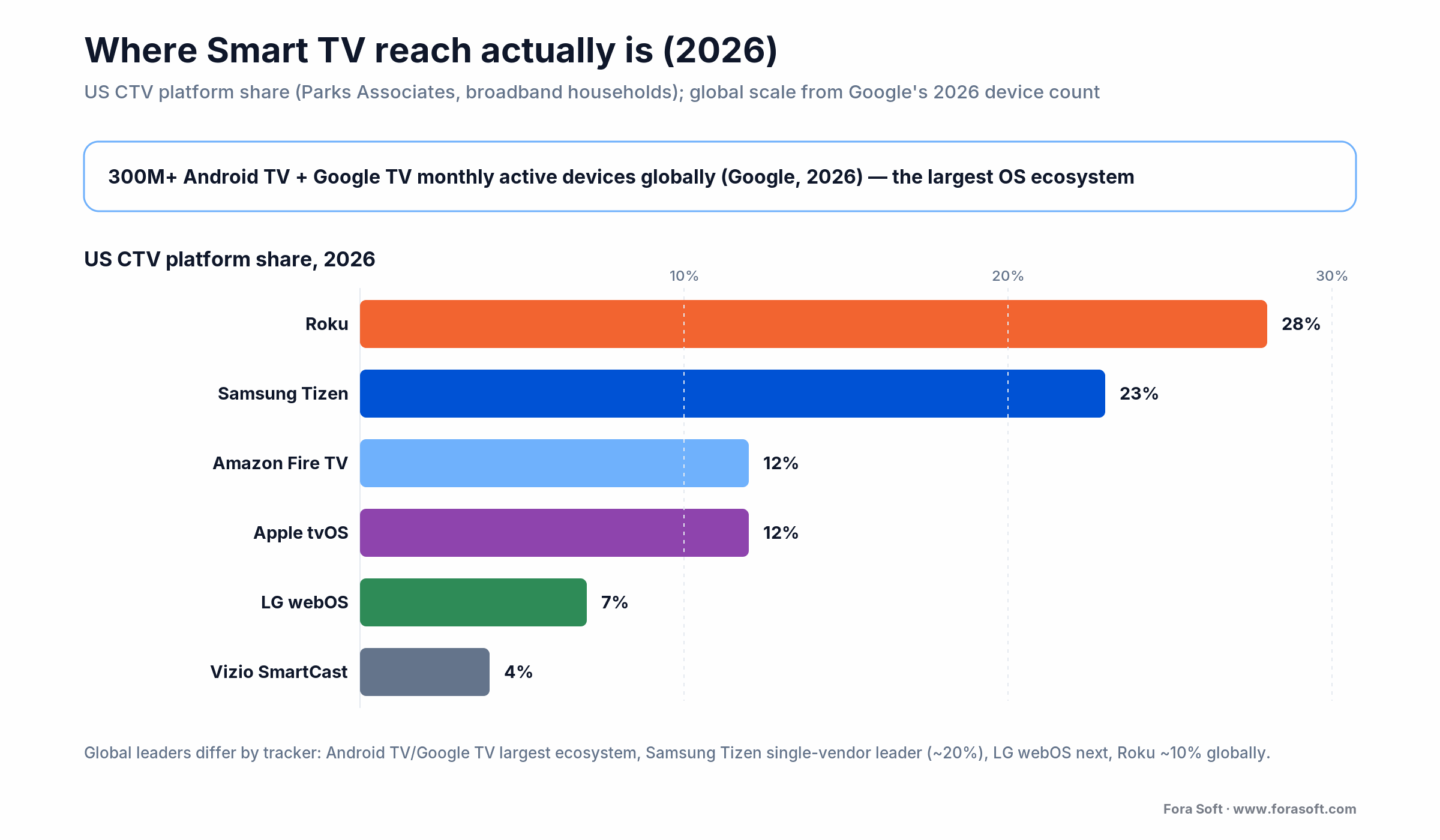
Figure 1. US CTV platform share in 2026 (Parks Associates) with global scale from Google I/O 2025. Reach concentrates in a handful of OSes.
Put differently: Android TV / Google TV, LG webOS and Samsung Tizen together cover roughly four in five homes globally. Roku and Fire TV close the gap in the U.S. That is the full short list. Chasing more than five OSes in year one almost never pays back.
Build vs buy vs hybrid: the three viable paths
Every enterprise video platform conversation collapses into one of three archetypes. Choose the wrong one and you rewrite the project mid-flight — which is exactly what the $100K+ overruns look like.

Figure 2. Three questions (UX moat, launch constraints, scale/compliance) route you to build, buy, or the hybrid default.
Build from scratch
You control the player, CMS, analytics, DRM workflow, and monetisation. You also own every codec upgrade, every certification cycle, every remote-control quirk across 12+ Tizen models. This pays off when UX is a moat (think Netflix, Disney+, Peloton-class fitness), or when compliance/sovereignty rules out SaaS.
Reach for Build when: you need a differentiated UX, proprietary analytics, ≥ 500K monthly users on TV, or a compliance regime (HIPAA, classified gov, studio-grade 4K) that SaaS won’t satisfy.
Buy a commercial platform
Pick a Brightcove / Kaltura / JWP / Vimeo OTT / Panopto-style suite, use their white-label TV apps, let them handle transcoding, DRM, and CDN. Fast, safe for content-first teams, weak when you need proprietary interactions (live commerce, fitness leaderboards, multi-camera sports).
Reach for Buy when: you need to ship in < 90 days, catalogue is < 5,000 hours, monetisation is subscription or ad-supported vanilla, and UX differentiation is not part of the moat.
Hybrid — custom shell, commercial core
Build your own CMS and TV UIs (where you differentiate), plug in a commercial player SDK (THEOplayer, Bitmovin, JWP), and use a managed DRM + CDN (Mux, EZDRM, Axinom + Cloudflare/Akamai). You keep product control; you hand off the most undifferentiated ~30% of the work. This is the default we recommend to most enterprise clients in 2026.
Reach for Hybrid when: UX matters but video infra isn’t your moat, you want to ship a multi-OS enterprise app in 4–6 months, and you can spend $90–220K for the first release.
Smart TV OS matrix: Android TV, Tizen, webOS, tvOS, Roku, Fire TV
Each OS has its own stack, its own certification flow, and its own footguns. The table below is the short version a CTO should memorise before the next vendor call.
| OS | Language / SDK | DRM | Cert time | Best for |
|---|---|---|---|---|
| Android TV / Google TV | Kotlin, Jetpack Media3, Compose for TV | Widevine L1/L3 | 3–7 days | Widest reach, richest dev tooling |
| Samsung Tizen | JS + HTML5, Tizen Studio, .wgt | PlayReady + Widevine | 2–4 weeks | Premium Samsung households, digital-signage reuse |
| LG webOS | JS + Enact (React-based), webOS SDK | PlayReady + Widevine | 2–4 weeks | Modern UI, shared code with Tizen |
| Apple tvOS | Swift, TVMLKit, AVPlayer | FairPlay Streaming | 1–3 days | Premium, paying audiences; strong HIG |
| Roku | BrightScript + SceneGraph XML | PlayReady | 5–10 business days | Cord-cutter U.S. reach, simple UIs |
| Amazon Fire TV | Android fork + Fire App Builder | Widevine L1/L3 | 1–2 weeks | Amazon billing, Alexa tie-ins |
Android TV / Google TV
The biggest single OS ecosystem, with 300M+ Android TV and Google TV monthly active devices in 2026 (up from 270M at Google I/O 2025). Kotlin + Jetpack Media3 is now the default player stack (it absorbed the old ExoPlayer); Compose for TV is the modern UI framework over the older Leanback library. Google’s low-RAM TV profiles target devices with as little as 1–1.5 GB, but 3–4 GB is the realistic floor for a smooth 4K app. Expect Gemini integrations to dominate the 2026 Google TV experience — voice and semantic search are suddenly table stakes.
Samsung Tizen
~20% global share (the single-vendor leader), strong in premium households. JS-based (HTML5 + Samsung APIs), packaged as `.wgt`, pushed through Samsung’s Tizen developer program (Seller Office). Older 2017–2019 Tizen boxes are the memory-constrained footgun that eats mid-project timelines. Samsung Knox adds device-level security for commercial displays, which is why Tizen still dominates digital-signage deployments.
LG webOS
Its global share varies by tracker (~12–25%). Built on the open-source Enact framework (React-flavoured). The stack plays nicely with Tizen — a clean React + Shaka Player codebase can share 70–80% of the code across webOS and Tizen, which is the single biggest reason the “JS TV” approach still makes sense.
Apple tvOS
Smaller base, highest ARPU. Native Swift + AVPlayer delivers the best QoE of any TV platform out of the box. FairPlay is the only DRM — you cannot ship Widevine or PlayReady. The shipping A15 Apple TV 4K has no AV1 hardware decode; Apple’s newer A17 Pro / A18 silicon does, so a future refresh will add it. Apple’s Human Interface Guidelines for tvOS are strict, so your designer needs to read them end-to-end before the first sprint or you will rewrite the navigation twice.
Roku and Fire TV
Mostly North-American. Roku uses its own BrightScript language and SceneGraph XML — cheap to hire for, impossible to share code with the rest of your stack. Fire TV is effectively Android TV with Amazon billing and an Alexa voice layer. If your monetisation depends on Amazon subscriptions, Fire TV deserves its own native app; otherwise your Android TV build will render on it.
Not sure which three OSes to ship to first?
We’ll map your audience analytics against the 2026 install base and hand you a ranked rollout order in one call.
Codec and DRM matrix across Smart TV OSes
Codec and DRM decisions drive 30–50% of your ongoing CDN bill. Get them wrong early and you pay forever.
| OS | H.264 | HEVC | VP9 | AV1 | DRM |
|---|---|---|---|---|---|
| Android TV | Yes | Yes | Yes | Yes (mandated on new devices) | Widevine L1/L3 |
| Tizen | Yes | Yes | Partial (newer models) | Model-dependent | PlayReady + Widevine |
| webOS | Yes | Yes | Yes (2019+) | Partial | PlayReady + Widevine |
| tvOS | Yes | Yes | Yes (tvOS 14+) | No (A15 hardware) | FairPlay Streaming |
| Roku | Yes | Yes | Yes | Ultra only | PlayReady |
| Fire TV | Yes | Yes | Yes | Yes (new devices) | Widevine L1/L3 |
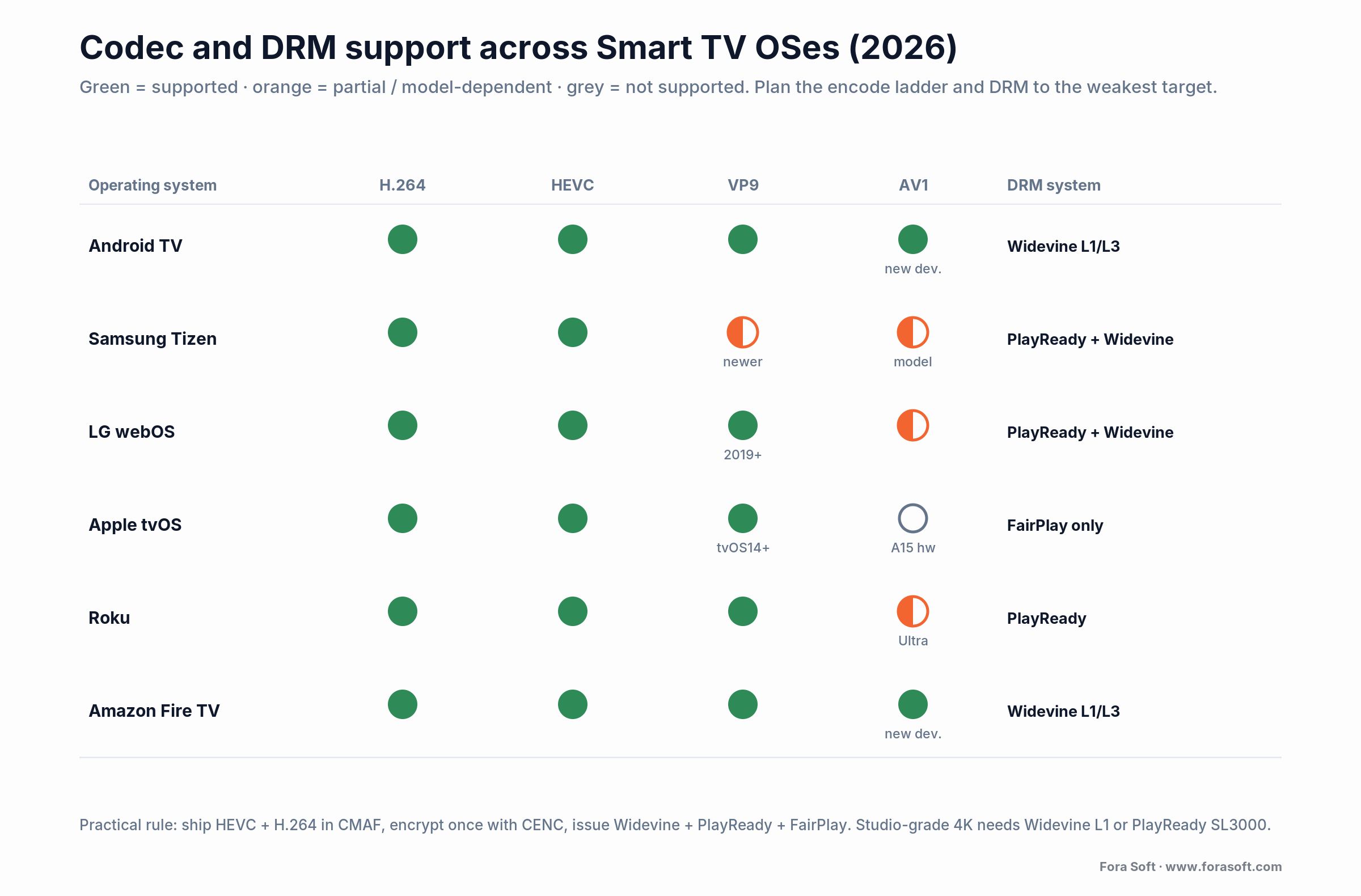
Figure 3. Codec and DRM support per OS. Plan the encode ladder and DRM stack to the weakest target you must reach.
Practical rule. Ship HEVC + H.264 in CMAF, encrypt once with CENC, and generate three DRM licences (Widevine, PlayReady, FairPlay) from the same asset. Add AV1 only if > 30% of your traffic sits on AV1-capable devices — the encode cost is still 3–5× HEVC and the CDN savings only pay off at scale.
4K gate. For studio-grade 4K distribution you need Widevine L1 or PlayReady SL3000 — both are hardware-backed. Software-only DRM (Widevine L3, PlayReady SL150) is limited to SD, which is why cheap STBs cannot play premium 4K.
Reference architecture for an enterprise Smart TV video platform
A defensible enterprise platform has six layers. Treat each one as a replaceable component with its own SLO — otherwise a single vendor failure takes the whole product down. For the streaming backbone in depth, from the encoding ladder to CDN cost engineering and DRM, see our OTT video platform engineering guide.
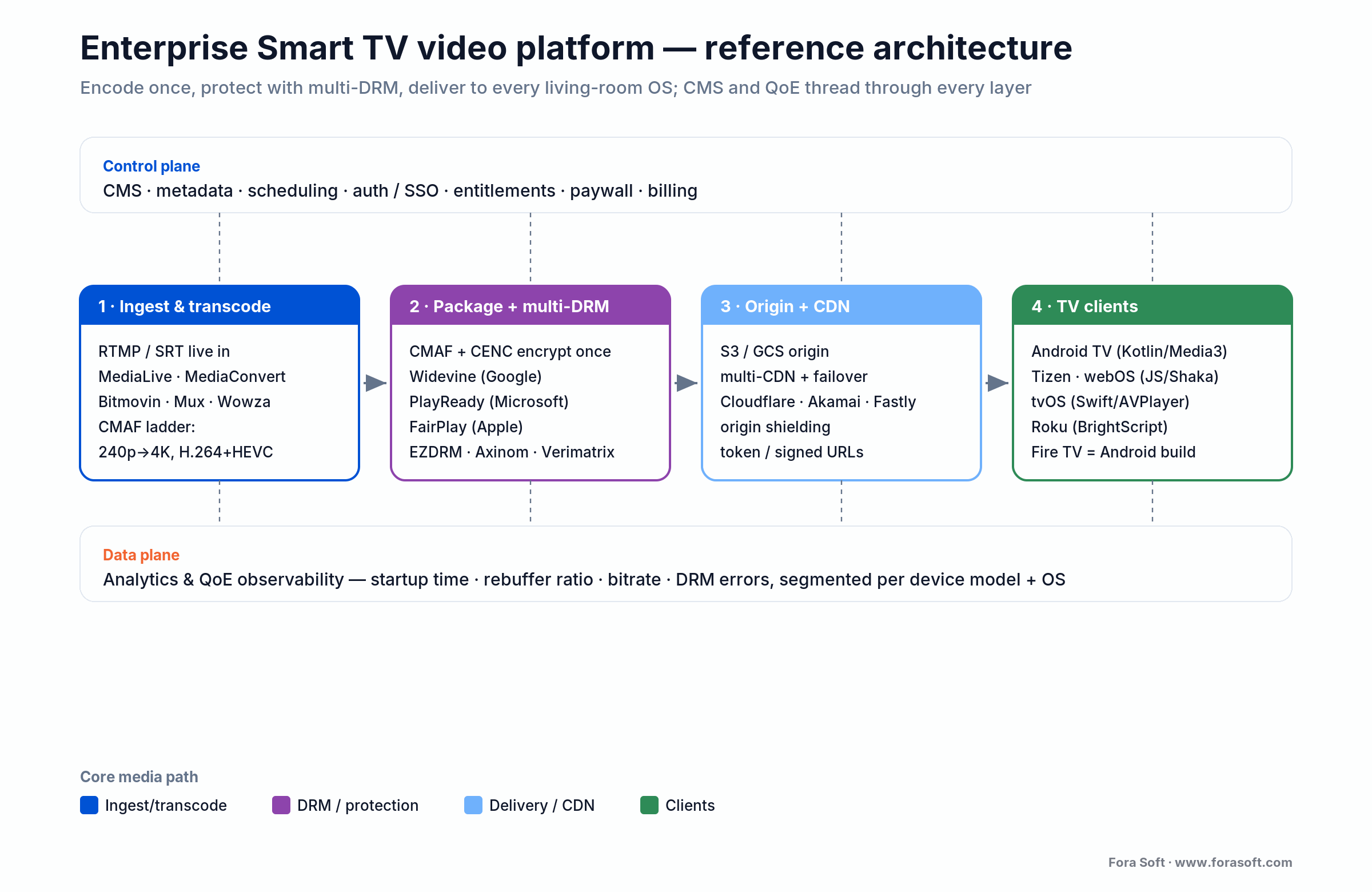
Figure 4. A production-grade pipeline: CMS and auth on top, ingest → transcode → CMAF+CENC multi-DRM → CDN → TV clients, QoE analytics underneath.
1. Ingest and transcode. For live: RTMP/SRT into an encoding origin (Wowza, AWS MediaLive, Bitmovin Encoder). For VOD: cloud transcoding (AWS MediaConvert, Bitmovin, Mux). Output a CMAF ladder of 240p/360p/480p/720p/1080p/4K rungs at H.264 + HEVC.
2. Packaging and DRM. Package into CMAF with CENC encryption. Generate licences through Widevine (Google), PlayReady (Microsoft), FairPlay (Apple). Managed services (EZDRM, Axinom, BuyDRM, Verimatrix) cut this to weeks.
3. Origin and CDN. Primary origin on S3/GCS, CDN on Cloudflare, Akamai, or Fastly, with at least one failover. Multi-CDN switching is critical at 100K+ concurrent users.
4. CMS and entitlements. Custom or commercial (Brightcove CMS, Kaltura MediaSpace). Handles metadata, scheduling, access control, paywalls. This is where Fora Soft most often adds value — custom CMS tightly coupled to the client’s existing ERP/CRM.
5. TV clients. Native Android TV (Kotlin + Media3), Tizen/webOS (shared JS codebase + Shaka/THEOplayer), tvOS (Swift + AVPlayer), Roku (BrightScript + SceneGraph). Fire TV reuses the Android build.
6. Analytics and observability. QoE from Mux Data, Bitmovin Analytics or Conviva; session logs into BigQuery/Snowflake; error budgets tied to on-call rotations.
Player SDK: ExoPlayer/Media3, AVPlayer, THEOplayer, Bitmovin, Shaka
Your player choice locks in startup speed, DRM behaviour, ad insertion flexibility, and 60% of your playback bug surface. Pick wisely.
| Player | License | Platforms | Strength | Catch |
|---|---|---|---|---|
| Jetpack Media3 (ex-ExoPlayer) | Open source | Android TV, Fire TV | Default Android stack, tight Widevine integration | You own the QoE pipeline |
| AVPlayer / AVFoundation | Apple SDK | tvOS only | Best-in-class QoE on Apple hardware | FairPlay only, zero flexibility |
| Shaka Player | Apache 2.0 | Tizen, webOS, Chromecast, web | Free, Google-maintained, multi-DRM | Ad-insertion and SSAI need custom work |
| THEOplayer | Commercial | All TV OSes + web + mobile | Unified API, HESP low-latency, strong ad stack | Per-device licensing, quote-only |
| Bitmovin Player | Commercial | All TV OSes + web + mobile | Bundled analytics, SGAI ad support | MAU-based pricing, not cheap at scale |
| JW Player | Freemium | Web-first, TV via JS | Fast to integrate, ads built-in | Weaker native TV SDKs |
Our usual pattern. Native Media3 on Android TV + AVPlayer on tvOS + Shaka Player on Tizen/webOS. For clients who want one API across everything — or who need fast time-to-market — THEOplayer or Bitmovin is the quickest off-ramp.
Commercial enterprise platforms compared
The buy path is crowded. Below are the platforms we actually see in RFPs and the shortest-useful characterisation of each.
| Vendor | Best for | Pricing signal | Weak spot |
|---|---|---|---|
| Brightcove | Media, large enterprise OTT | Enterprise quote-only | Lock-in on proprietary player and CMS |
| Kaltura | Education, gov, open-source fans | From ~$1K/mo; VPaaS pay-as-you-go | Heavy UI, long implementation cycles |
| JW Player | Publishers, web-first teams | Free tier to custom enterprise | Thin on native TV SDKs |
| Vimeo OTT | Creators, SMB subscription video | From ~$1K/mo | Limited enterprise features |
| Panopto | Corporate learning, lecture capture | Quote-only | Not built for ad-supported or live sport |
| Mux | Product teams shipping video as a feature | Usage-based, transparent | API only; no TV UI, no CMS |
| Wowza | Live streaming, RTMP/SRT pipelines | Per-instance + usage | Not a full OTT suite |
| Bitmovin | API-first video infra, live and VOD | MAU / minutes-based | Pricey at large scale, still needs you to build UX |
Cross-platform vs native: when each approach wins
Three codebase strategies cover 95% of real-world Smart TV projects. The one that wins depends on OS set, feature velocity, and how exotic your UX gets.
1. Native per OS. Kotlin on Android TV, Swift on tvOS, JS on Tizen/webOS, BrightScript on Roku. Best QoE, highest fidelity, most maintenance. Typical for top-tier streamers.
2. Shared JS core (webOS + Tizen + web). React/Enact codebase with Shaka or THEOplayer. 70–80% code reuse across the two biggest JS TV OSes, and you can port the same codebase to the web. Saves one full team.
3. React Native for TV. Callstack’s React Native for TV targets tvOS and Android TV natively from one codebase; Tizen and webOS are reached through a React Native Web build, and Roku (BrightScript only) is out of scope. Viable when you have a React team and can accept native escape hatches for complex playback.
Reach for shared JS core when: your content is VOD-heavy, you need Tizen + webOS parity, and your team is stronger on the web than on Kotlin/Swift.
App-store certification timelines you must plan for
Every Smart TV store reviews apps, and the gaps between them are the single most under-budgeted item in almost every plan. Budget for the slowest store on your list.
Apple tvOS. 1–3 business days is the norm in 2026; Apple has committed to a 24-hour review target for 90% of apps. Expect rejections for HIG violations, not for functionality.
Google Play (Android TV). 3–7 days for updates; up to 2 weeks for a first submission on a new developer account. Banner graphic, TV screenshots, and input-method metadata are the common reject loops.
Roku Channel Store. Officially up to 5 business days; in practice 5–10. Roku requires every new certification to pass against their semi-annual policy updates, which tighten accessibility and billing rules twice a year.
Samsung Seller Office (Tizen). Multi-stage pipeline (submission → pre-test → function test → content test). Plan 2–4 weeks for the first release; renewals are faster. Tizen apps need an author + distributor certificate, both managed through Tizen Studio.
LG Content Store (webOS). Three-stage process (submit → QA → approval). 2–4 weeks first time, often faster on updates. LG is stricter on memory footprint; a 1 GB-RAM 2018 webOS TV will kill you if you don’t profile.
Amazon Appstore (Fire TV). 1–2 weeks. Mostly painless if you already passed Google Play.
Need a certification-ready TV app before the next quarter?
We’ve shipped through all five stores and know what actually triggers rejections. We’ll scope your release path end-to-end.
Cost model: MVP, mid-tier, enterprise — with real 2026 numbers
Public estimates for Smart TV app development in 2025–2026 range from $8–12K for the simplest single-platform MVP to $250K+ for a multi-platform OTT build. Those ranges collapse fast once you factor in what “enterprise” really means. The table below is what we quote today, with Agent Engineering factored in — it is typically 25–40% faster and cheaper than a comparable traditional team.
| Tier | Scope | Timeline | Budget (FS, 2026) |
|---|---|---|---|
| MVP — 1 OS | Single OS (e.g. Android TV), VOD only, simple CMS, Widevine L3 | 3–4 months | $20–35K |
| Mid-tier — 2–3 OSes | Android TV + Tizen/webOS, VOD + simple live, Widevine + PlayReady, custom CMS, QoE analytics | 4–6 months | $60–120K |
| Enterprise — 3–4 OSes | Android TV + Tizen + webOS + tvOS, 4K HDR, multi-DRM, live + VOD, SSAI ads, entitlements, SSO | 5–8 months | $90–220K |
| OTT-grade — 5+ OSes | Add Roku + Fire TV, multi-CDN, FAST channels, studio-grade 4K (WV L1 / PR SL3000), compliance audits | 8–12 months | $200–400K+ |
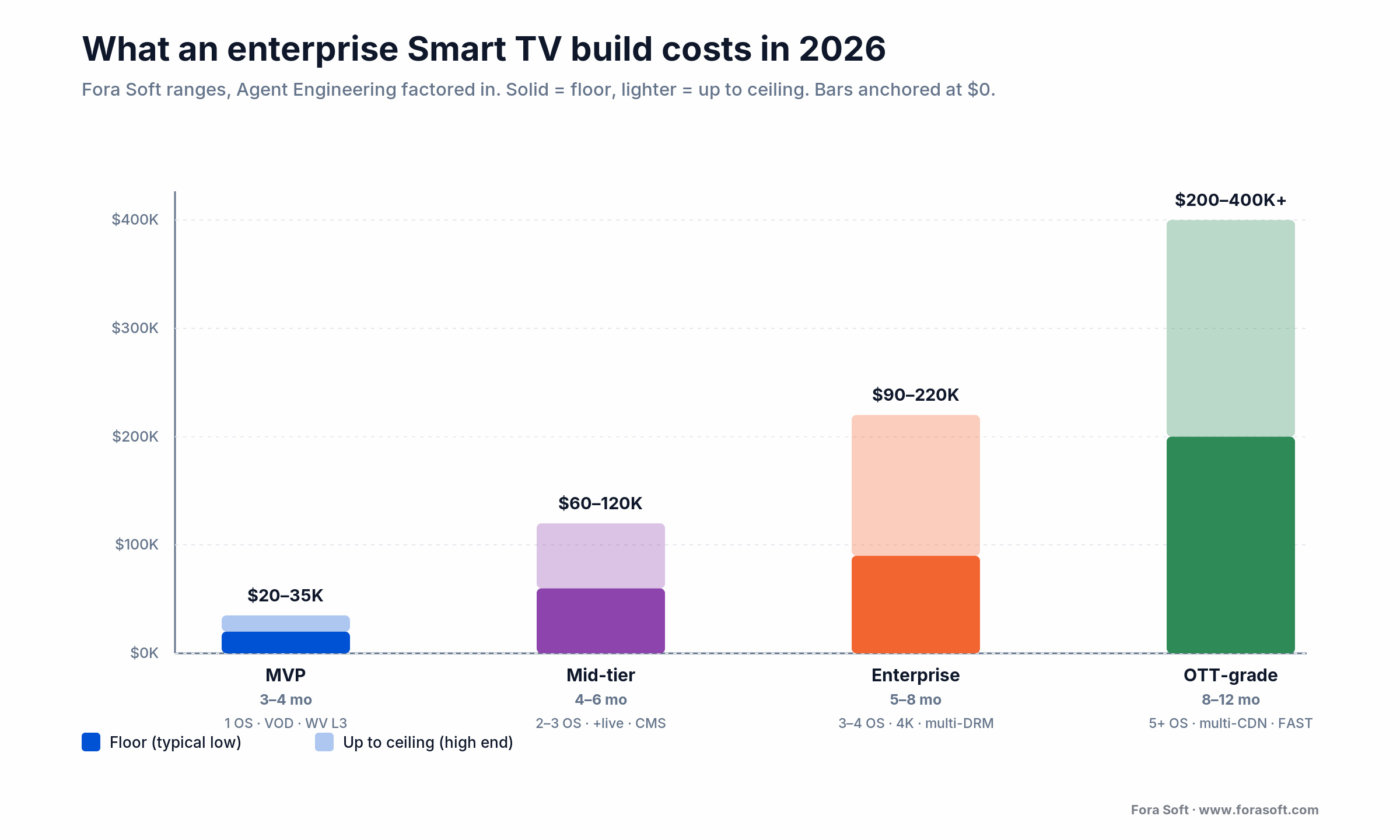
Figure 5. Fora Soft build ranges by tier for 2026, Agent Engineering factored in. Solid bar = floor, lighter = up to the high end.
What drives cost. Content protection (adds ~$8–15K plus managed DRM licensing), CMS complexity (another $15–40K if you integrate with legacy ERP/CRM), and live streaming with ad insertion (easily a separate $20–40K slice). Every extra OS is roughly +20% to the baseline build.
Running cost. Past launch you are paying CDN egress, origin compute, DRM licences, store memberships, and two platform updates per OS per year. A mid-tier multi-OS deployment runs ~$2–6K / month before content — do not forget this in the business case.
Mini case: Smart STB IPTV — 3,000+ live channels on set-top boxes
Situation. A Swiss operator wanted to serve four national-minority communities with an IPTV system delivered on pre-installed set-top boxes. The operator already had a channel catalogue but no software vendor and no TV client. The business model depended on adding channels and reselling the boxes at scale.
Plan. Fora Soft designed and shipped a web-based TV application that runs on Android STBs, with EPG, recording, time-shift, VOD, series and radio. The operator gets an admin panel for channel management, user entitlements, and reseller billing. Middleware is integrated via Stalker, channel origins are pulled from the operator’s head-end, and the player is a tuned HLS stack that gracefully degrades on cheap 1 GB-RAM boxes.
Outcome. 3,000+ live channels ship on-box on day one of each deployment, with the reseller able to compose channel bundles per community without touching code. The same codebase now powers the Smart IPTV app for Android STBs and Smart TVs, which is deployed in multiple markets. Want a similar assessment for your IPTV or OTT rollout? Grab a 30-minute slot and we’ll sketch your architecture and rollout order on the call.
What BrainCert teaches us about scaling a video platform
BrainCert is not a Smart TV product — it is a WebRTC + HTML5 virtual-classroom LMS we built from scratch. But the lessons translate directly to any enterprise video platform.
Operational scale. 500M+ classroom minutes, 100K+ customers, 99.995% uptime. If your Smart TV platform hopes to serve tens of thousands of concurrent users, you need the same operational discipline: observability, autoscaling, cross-region failover, and a DRM pipeline you can audit.
Compliance is a feature. BrainCert is SOC 2, ISO 27001, HIPAA and GDPR compliant. For any enterprise video platform that touches healthcare, finance, education, or government, the compliance posture decides whether the sale closes. Bake it in from day one — retrofitting SOC 2 on a live platform is 10× the cost.
AI is the new table-stakes layer. BrainCert ships AI course creation, automated proctoring, speech-to-text, and DRM-encrypted replays. On Smart TV the equivalent is AI-assisted content discovery, voice search, personalised rails, and smart ad insertion. With Google TV Gemini landing in 2026, voice and semantic search are no longer optional.
A decision framework — pick a path in five questions
1. How many OSes must you support in year one? If the answer is ≤ 2, a focused native build is usually cheaper. ≥ 3 OSes tilts decisively toward a shared JS core or React Native for TV.
2. Is UX a moat for you? Live commerce, interactive fitness, sports multi-cam, classroom whiteboarding — all require a custom client. Generic VOD rails do not. If UX is not differentiating, buy or hybrid.
3. What is your compliance envelope? HIPAA, SOC 2, ISO 27001, regional data residency, or studio-grade content protection push you toward custom builds or specific compliant vendors (Kaltura, Panopto), not generic OTT suites.
4. What is your expected peak concurrency? Below ~10K concurrent streams, an off-the-shelf SaaS handles it with no tuning. Above 100K, you need multi-CDN, custom origin tuning, and your own QoE pipeline.
5. How elastic is your budget and timeline? If you must launch in < 90 days with < $60K, buy. If you have 4–6 months and $100–200K, hybrid. If you have 8–12 months and can justify > $250K, a custom build becomes the cheapest option long-term.
Five pitfalls that kill Smart TV video platforms
1. Treating TV like mobile. D-pad navigation, over-scan safe zones, 10-foot UI — these are different worlds. Teams that port a mobile design to a TV screen discover in user testing that half the screen is unreachable and the other half is unreadable. Design for the remote and the couch from the first wireframe.
2. Under-budgeting certification. Five app stores, five review cycles, five sets of metadata rules. We have seen a $150K project slip by 6 weeks because nobody planned for Tizen’s content test or Roku’s semi-annual policy updates. Add a 4–6-week buffer to every Smart TV plan.
3. Running Widevine L3 in production. L3 is software-only, limited to SD, and easily extracted. Studios reject it. If you cannot prove Widevine L1 / PlayReady SL3000 coverage for your 4K catalogue, major content partners will not sign. Lock this down before the contract lawyers get involved.
4. Ignoring QoE observability. Every Smart TV platform ships with a long tail of old boxes — 1 GB-RAM 2018 Tizens, 2019 webOS models, Roku Express sticks. Without Conviva / Mux Data / Bitmovin Analytics segmented by device and OS, you debug blind. Ship analytics in the MVP, not the v2.
5. Outsourcing the CMS as an afterthought. The CMS is where your editors, ops team, and billing live. If it is awkward, your whole organisation pays the tax every day. Budget at least 25% of the build for CMS and admin tooling — this is the single most undervalued layer of the stack.
KPIs that prove your Smart TV platform is healthy
Quality KPIs. Video Start Failure < 0.5%, video start time < 2 s (warm) / < 4 s (cold), rebuffer ratio < 0.5%, average bitrate at or above the 720p rung on > 95% of sessions. Track per device model.
Business KPIs. Monthly active devices, average sessions/device/week, D7 and D30 retention, ARPU, ad fill rate for CTV, churn by acquisition channel. Tie every release to a primary business KPI or it will not earn its roadmap slot.
Reliability KPIs. 99.95%+ API uptime, 99.99%+ CDN availability, DRM error rate < 0.1%, mean time to detect regressions < 15 minutes. Define error budgets and cut releases against them.
When NOT to build your own Smart TV platform
Not every video product deserves a custom Smart TV app. Sometimes the honest answer is “don’t.” Skip the build when:
Audience is still on mobile. < 15% of watch time on TV? Put budget into mobile and the web until your own analytics prove TV demand.
Catalogue is tiny. < 500 hours of VOD, no live. YouTube or Vimeo OTT will out-serve you at one-tenth the cost.
Monetisation is weak. No clear subscription, ad, or B2B revenue path — custom TV apps will not create the demand; they amplify it. Prove monetisation elsewhere first.
Team has never shipped to TV. A first Smart TV project with a rookie team costs 2× and slips 6 weeks. If you cannot hire a specialist vendor or team lead, push the project out a quarter.
FAQ
How long does it take to build an enterprise Smart TV video platform in 2026?
A single-OS MVP ships in 3–4 months. A multi-OS enterprise rollout (3–4 operating systems, DRM, live + VOD, CMS, analytics) lands in 5–8 months. Anything claiming < 90 days for all five TV OSes either underscopes DRM or rents an off-the-shelf platform.
Which OSes should we ship to first?
Start with the OS that represents the largest share of your real audience. For most global products, that means Android TV / Google TV first (widest install base), then Tizen or webOS, then tvOS, then Roku/Fire TV in North America. Cover three OSes for your launch and add the rest in year two.
Do we need multi-DRM or can we ship with just Widevine?
Widevine alone covers Android TV, Chromecast, and Fire TV. For Samsung Tizen and LG webOS you need PlayReady (or a modern Widevine build where supported). For tvOS you need FairPlay. The standard solution is multi-DRM via CMAF + CENC: encrypt once, serve three licences. Managed vendors like EZDRM or Axinom make this weeks instead of months.
What is the cheapest way to ship an enterprise video platform to Smart TV?
Pair a commercial player (THEOplayer or Bitmovin) with a managed DRM service and a single shared JS codebase for Tizen + webOS, then ship a separate native app only for Android TV. That keeps your first release under $60–80K while still reaching roughly 60–70% of the global Smart TV installed base.
How do you handle 4K and HDR on Smart TVs?
Encode a CMAF ladder in HEVC with HDR10 (baseline), add HDR10+ and Dolby Vision only on platforms that support them (Samsung 2020+ for HDR10+, tvOS / Android TV / webOS for Dolby Vision, depending on device). Enforce Widevine L1 or PlayReady SL3000 for 4K delivery — otherwise studios will not license.
What skills do we need on the team?
Kotlin + Media3 engineer for Android TV, Swift + AVPlayer engineer for tvOS, JS/React engineer for Tizen and webOS (with Shaka or THEOplayer experience), a backend engineer for CMS and entitlements, a DevOps engineer for origin/CDN/DRM, and a QA engineer with a physical device lab. Plus a designer fluent in 10-foot UI.
Can we ship one React Native codebase to every TV OS?
React Native for TV is native on tvOS and Android TV today; Tizen and webOS are reached through a React Native Web build, and Roku (BrightScript) is out of scope. Most 2026 multi-OS projects pair React Native for tvOS + Android TV with a shared JS/web build for Tizen + webOS and a separate BrightScript app on Roku.
How much does ongoing maintenance cost?
Budget 15–25% of the build cost per year for maintenance: OS updates, certification renewals, bug fixes, security patches, and two planned feature releases per OS per year. Multi-OS enterprise builds typically run $2–6K per month in infrastructure plus team cost on top.
What to read next
Playbook
Smart TV App Development in 2026
The full frameworks & certification playbook for Tizen, webOS, Android TV, and tvOS.
Guide
OTT Platform Development: The Full Stack
How to design the streaming backbone behind your Smart TV app.
Use case
Smart IPTV: Corporate Training at Scale
How IPTV on Smart TVs replaces live training rooms.
Reference
Scalable Video Streaming & Conferencing
Architecture patterns that carry tens of thousands of concurrent streams.
Ready to ship a Smart TV video platform that scales?
An enterprise Smart TV video platform in 2026 is won on boring things done well: the right three OSes, CMAF + multi-DRM, a disciplined CMS, honest QoE analytics, and a release plan that respects each store’s certification calendar. The companies that ship on time have picked their path — build, buy, or hybrid — before they picked a vendor.
Fora Soft has been shipping video streaming platforms for 20+ years, from 3,000-channel Swiss IPTV set-top boxes to the compliance-heavy backbone of BrainCert. If you are weighing the build/buy/hybrid question right now, a 30-minute call is the cheapest way to sanity-check your plan before you write the first spec.
The handbook · 7 volumes
Fora Soft Video Engineering Handbook
A Smart TV rollout is decided by codecs, DRM and players long before the store review. We wrote a seven-volume handbook on the full video stack: encoding, delivery, audio and AI. Start with Volume 3 on players, DRM and ABR, then Volume 1 on codec choices per device and Volume 2 on HLS, DASH and CMAF packaging. Written by Nikolay Sapunov, CEO at Fora Soft.
Browse the handbook on Amazon →7 volumes · 9,000+ pages · Kindle & paperback
Want an enterprise Smart TV video platform costed and scoped this week?
Bring your content, audience, and target OSes — we’ll hand back a build/buy/hybrid recommendation, a realistic budget, and a rollout order.

