

Key takeaways
• Chat APIs collapse 6–9 months of in-house build into 2–4 weeks of integration. That alone is why, for most products under 500K MAU, the best chat API is a bought one — not a built one.
• The honest break-even with self-built chat is roughly 500K monthly active users. Below that, the math almost always favours Stream, Sendbird, or PubNub.
• The hidden costs are storage, push, and moderation — not the per-MAU sticker. Plan for $0.05/GB stored, push-payload limits, and moderation overhead from day one.
• Compliance is where vendors split. Sendbird and Stream sign HIPAA BAAs; Twilio Conversations covers SOC 2 + GDPR; PubNub leads on data-residency. Match the vendor to your regulatory bar.
• Choosing the best chat API is a use-case call, not a leaderboard. A custom dev partner wins in three lanes: healthcare/edtech compliance, deeply integrated video+chat, and the 500K–1M MAU band where vendor lock-in starts to bite.
Why Fora Soft wrote this playbook
Fora Soft is a software development company — 250+ products since 2005, 50 in-house engineers — and we have built real-time messaging into video, audio, and live products the whole time. We have integrated Stream, Sendbird, PubNub, Twilio Conversations, and CometChat in client products — and we have built fully custom chat backbones for cases where no vendor fit. Nucleus is a SOC II / HIPAA-compliant on-premise Slack alternative we built from scratch, now used by 5,000+ businesses. Speakk is a zero-data messenger that runs without consuming bandwidth. TradeCaster ships real-time chat to 46K+ traders alongside live streaming.
That mix — vendor integrations and ground-up builds — means we have made the buy-vs-build call dozens of times in concrete situations. This playbook is the framework we use, with the actual numbers, vendor edges, and decision rules behind it.
Picking a chat API or wondering if you need a custom build?
Tell us your MAU range, target compliance, and integration needs. We will return a vendor recommendation (or a custom-build estimate) on the call — not a sales pitch.
The real reason chat APIs save time and money
Strip away the marketing copy and the saving comes from one fact: shipping production-grade real-time messaging from scratch is genuinely hard. WebSocket fan-out, presence, message ordering, offline sync, push fallback, message storage, moderation, abuse handling, mobile reconnection, end-to-end encryption — each is its own subsystem with its own failure modes.
A chat API turns all of that into an SDK call. Typical engineering reality:
- Time-to-MVP. 2–4 weeks with Stream, Sendbird, or CometChat, vs. 6–9 months building from scratch.
- Year-1 total cost. $600K–$1.5M with a vendor (license + integration + light backend), vs. $2–6M to build a production-grade in-house equivalent.
- Engineering headcount. One full-stack engineer plus an SDK to integrate, vs. a dedicated 4–6 person real-time team for 9–12 months.
- Operational risk. Vendor SLA (up to 99.99–99.999% on enterprise tiers) vs. your own pager rotation at 3 a.m. when WebSocket connections leak.
The market reflects this. The messaging-application API market is valued at roughly $64.8B in 2026 and is forecast to reach $130.9B by 2030, a ~18.9% CAGR (MarketsandMarkets, 2026). The reason it keeps growing is simple: the math works for almost every product team that needs chat as a feature, not as a core product.
Reach for a chat API when: chat is a feature inside a larger product (marketplace, healthcare app, edtech, fintech, social), and you can hit your launch date by integrating — not by building.
The 2026 chat-API market in one snapshot
Three vendors lead the conversation: Stream (the developer-experience leader), Sendbird (the enterprise/compliance leader), and Twilio Conversations (the omnichannel/voice-adjacent option). Behind them, PubNub leads on data-residency and edge presence; CometChat dominates the “ready-made UI kit” segment; MirrorFly and ChatKitty compete on flexibility and price.
The pricing shape is almost entirely monthly active user (MAU)-based. Some vendors layer message storage, file transfer, and push notification surcharges on top. Where you are on the MAU curve, what your message-to-user ratio looks like, and how much media you store determines whether the all-in cost is closer to $500/month or $50,000/month.
Chat API vendors compared
Short version — the best chat API depends on what you optimise for. Our picks for 2026:
- Best developer experience — Stream. Cleanest SDKs (React, Swift, Kotlin), best docs. Pick it for social, community, and marketplace apps.
- Best for enterprise & compliance — Sendbird. HIPAA BAA (Enterprise), multi-region, mature moderation. Pick it if you scale past 100K MAU with a real security bar.
- Best omnichannel — Twilio Conversations. One inbox across chat, SMS, WhatsApp, and voice. Pick it when chat is one channel in a support stack.
- Best for global low-latency presence — PubNub / Ably. Edge networks for sub-50 ms presence. Pick them for live commerce and multiplayer.
- Best ready-made UI — CometChat. Drop-in UI kits. Pick it to ship a chat screen in days, not weeks.
- Best past 500K MAU or under HIPAA-by-design — a custom build. When per-MAU fees compound or chat is fused with video, owning the stack wins.
Directional comparison of the seven vendors most often shortlisted in 2026. Pricing is the publicly disclosed entry point per provider; final cost depends on MAU, storage, and add-ons.
| Vendor | Best for | Entry price | SLA | HIPAA BAA | Limit |
|---|---|---|---|---|---|
| Stream Chat | Best DX, social/community, marketplace | $499/mo (~10K MAU) | 99.999% (enterprise) | Optional (enterprise) | Overage (~$0.09/MAU at 10K) compounds fast |
| Sendbird | Enterprise, compliance, scale | $399/mo (Starter) | 99.9% (higher on Ent.) | Yes (Enterprise) | Steep overage curve |
| Twilio Conversations | Omnichannel, SMS+WhatsApp, support | Per-MAU + carrier fees | 99.95% | Yes | 1,000 participants per conversation |
| PubNub | Geo-distributed, edge presence, IoT | Free 200 MAU; $49/mo+ | 99.999% | Optional | Pricing complex (transactions + presence + storage) |
| CometChat | Pre-built UI kits, dating, social | $299/mo (Basic) | 99.9% | Add-on | Less customization at the protocol level |
| Ably | Pub/sub, live data, broadcast scale | Free 6M msgs; $59+/mo | 99.999% | No | Not chat-specific; thinner UX layer |
| Custom build (Fora Soft model) | Healthcare, edtech, video+chat, >500K MAU | Capex, no per-MAU fee | Whatever you spec | Whatever you spec | Higher upfront, longer time-to-pilot |
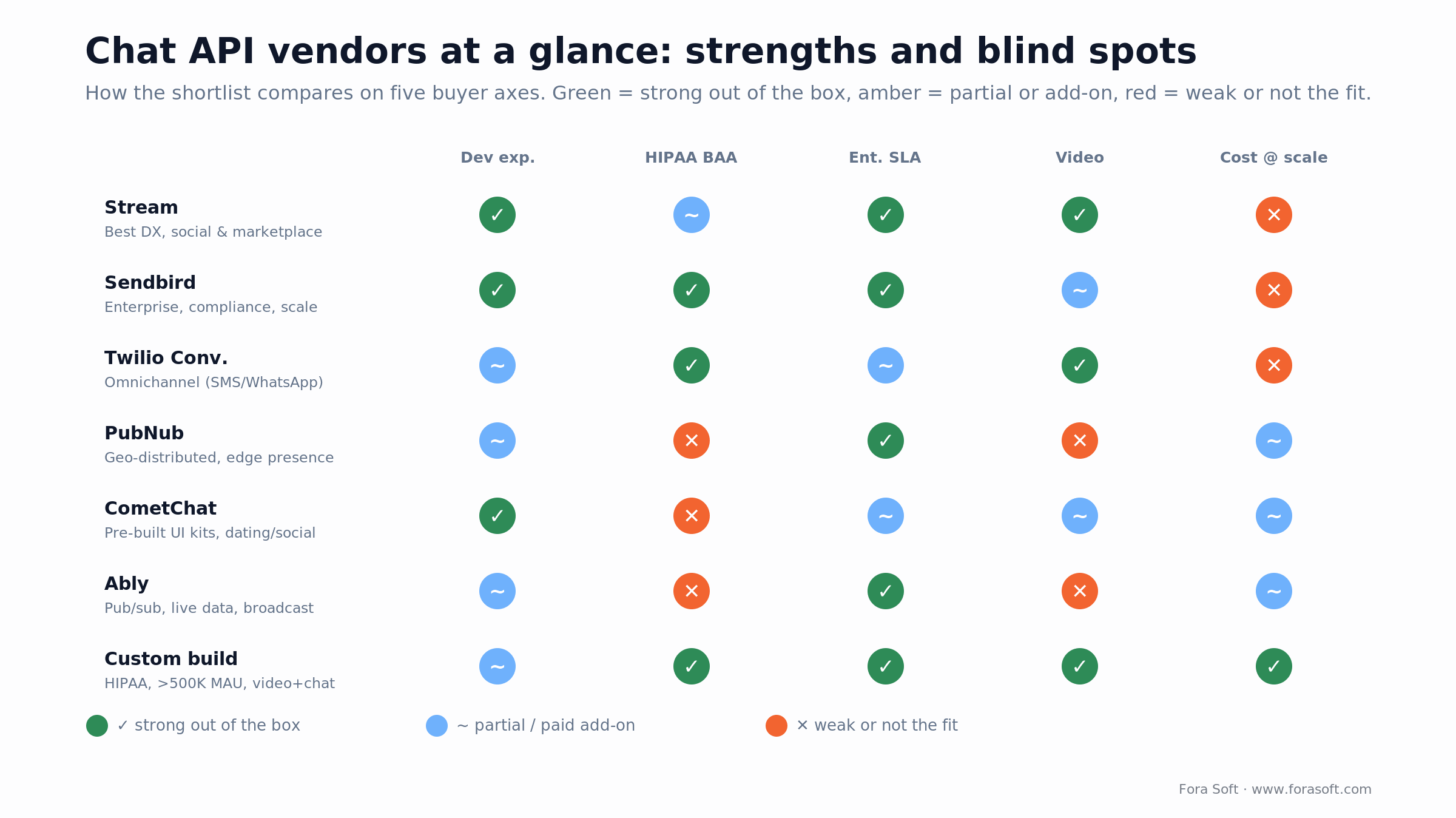
Figure 1. The shortlist on five buyer axes. Green = strong out of the box, amber = partial or a paid add-on, red = weak or not the fit.
Reach for Stream when: developer experience matters most, you ship a social feed, marketplace, or community product, and you want React/Swift/Kotlin SDKs that work on day one.
Reach for Sendbird when: you need enterprise-grade SLA, FERPA/HIPAA compliance posture, and your product will scale beyond 100K MAU within a year.
Reach for Twilio Conversations when: chat is one channel inside a multi-channel support stack — SMS, WhatsApp, voice, email all routed through one inbox.
Reach for a custom build when: you sit at >500K MAU, need custom compliance (HIPAA-by-design, FedRAMP, on-premise), or your chat is deeply integrated with video calls, telehealth flows, or live streaming.
Wondering which vendor fits — or if you should build?
A 30-min call is enough to map your MAU, compliance, and integration needs to the right path. We bring the spreadsheets so you don’t have to.
Must-have chat API features — what to insist on
Before you sign any vendor or plan a build, the feature list below is the non-negotiable floor. Anything less and you will be patching holes with engineering time that the whole “buy chat” decision was supposed to save.
Real-time delivery with offline resilience
WebSocket with automatic reconnect, exponential backoff, and message sync on reconnect. Your users should see their missed messages within 500 ms of coming back online — not after a pull-to-refresh they forgot about.
Rich message types
Text, image, video, file, reaction, reply-threading, edit, delete, read-receipts, typing indicators. Add custom message types so you can ship product-specific payloads (e.g. a shipment update in a marketplace chat) without shoe-horning them into free-text.
Push notifications with smart batching
APNs + FCM support is the floor. What separates vendors is how gracefully they handle quiet hours, group-chat batching, mute rules, and payload-size limits — APNs caps at 4 KB and over-stuffing silently drops notifications.
Moderation and safety tooling
AI moderation (profanity, spam, hate speech), human review queue, shadow-ban, rate-limit by user, and an audit log your trust-and-safety team can actually query. Vendors vary wildly here — Sendbird and Stream lead, most others require bolting on a third-party.
Presence, typing, and read state at scale
Sub-200 ms globally is the 2026 bar. Ably and PubNub push this to < 50 ms via edge networks. If you are building live commerce or multiplayer, the latency tier matters.
Analytics and search
Full-text message search, user activity analytics, top-active-channels reporting. Without it, operational questions (“how many DAU chat”, “which channels are hot”) require you to build a parallel data pipeline.
How chat-API pricing actually works (and where it stings)
Sticker price is rarely the all-in cost. The four buckets to model:
1. Per-MAU base
Most vendors charge in tiered MAU bands. Stream starts at ~$499/month for ~10K MAU (less on annual billing) and adds roughly $0.09 per MAU beyond the included quota. Sendbird starts at $399/month (Starter) and $599/month (Pro), with a steeper overage curve above the included MAU. PubNub combines a base fee with transaction-based pricing on messages and presence events. Always model 2×–3× your projected MAU for the budget — chat MAU usually outpaces product MAU because of inactive but counted accounts.
2. Storage
Message and media storage is typically $0.05–$0.10 per GB per month. A product with 100K active users sending 30 messages/day each generates ~90M messages/month. At ~1 KB per message, that’s 90 GB/month accumulating. Three years in, you have ~3 TB — $150–$300 of monthly storage cost before the message archive feature you didn’t plan for.
3. File and media transfer
File transfer is usually $0.10–$0.15 per GB. A consumer chat product where users share photos averages 5–15 GB transferred per 1,000 MAU per month. At 100K MAU, that is $50–$225 monthly — manageable, until users start sharing video. Then it doubles or triples.
4. Push notifications and moderation
Push notification fees are usually included up to a quota, then metered. Moderation is the silent budget killer. If you outsource human moderation, expect $0.10–$0.50 per moderated message; at 1% of traffic flagged on a 100K-MAU app, that is $4,500–$22,500/month. Vendor AI moderation (Sendbird, Stream, CometChat all offer it) drops this 70–90%, but you should still budget for it.
Build vs. buy — the honest economics
We have run this calculation on dozens of client estimates. The pattern that holds:
Buy a chat API when
- Chat is a feature, not a core differentiator.
- You need to be live in < 3 months.
- You will be under ~500K MAU within 12–18 months.
- Your compliance bar is generic SOC 2 / GDPR (most vendors clear this).
- Your product team is < 8 engineers and you cannot afford to dedicate 4 of them to a real-time backend.
Build (or augment heavily) when
- You will scale past ~500K MAU; per-MAU cost compounds beyond build cost.
- Your compliance bar is HIPAA, FedRAMP, on-premise, or specific data-residency.
- Chat is deeply fused with video, audio, telehealth, or live trading flows.
- Vendor lock-in is a strategic risk (you have already been burned, or your investors flag it).
- You need protocol-level customization (MQTT, custom message types, on-prem brokers).
The break-even line, in numbers
A useful rule of thumb on builds we have shipped, with our Agent Engineering practice in play:
- 0–100K MAU. Vendor wins by a wide margin. $5K–$15K/month all-in vs. $1.5M+ to build the equivalent.
- 100K–500K MAU. Vendor still wins, but the gap narrows. Audit annually.
- 500K–1M MAU. The break-even band. Vendor cost ($30K–$80K/mo) starts approaching the steady-state engineering payroll of an in-house team.
- >1M MAU. Custom build typically wins on a 24-month TCO — provided you have the engineering capacity to operate it.
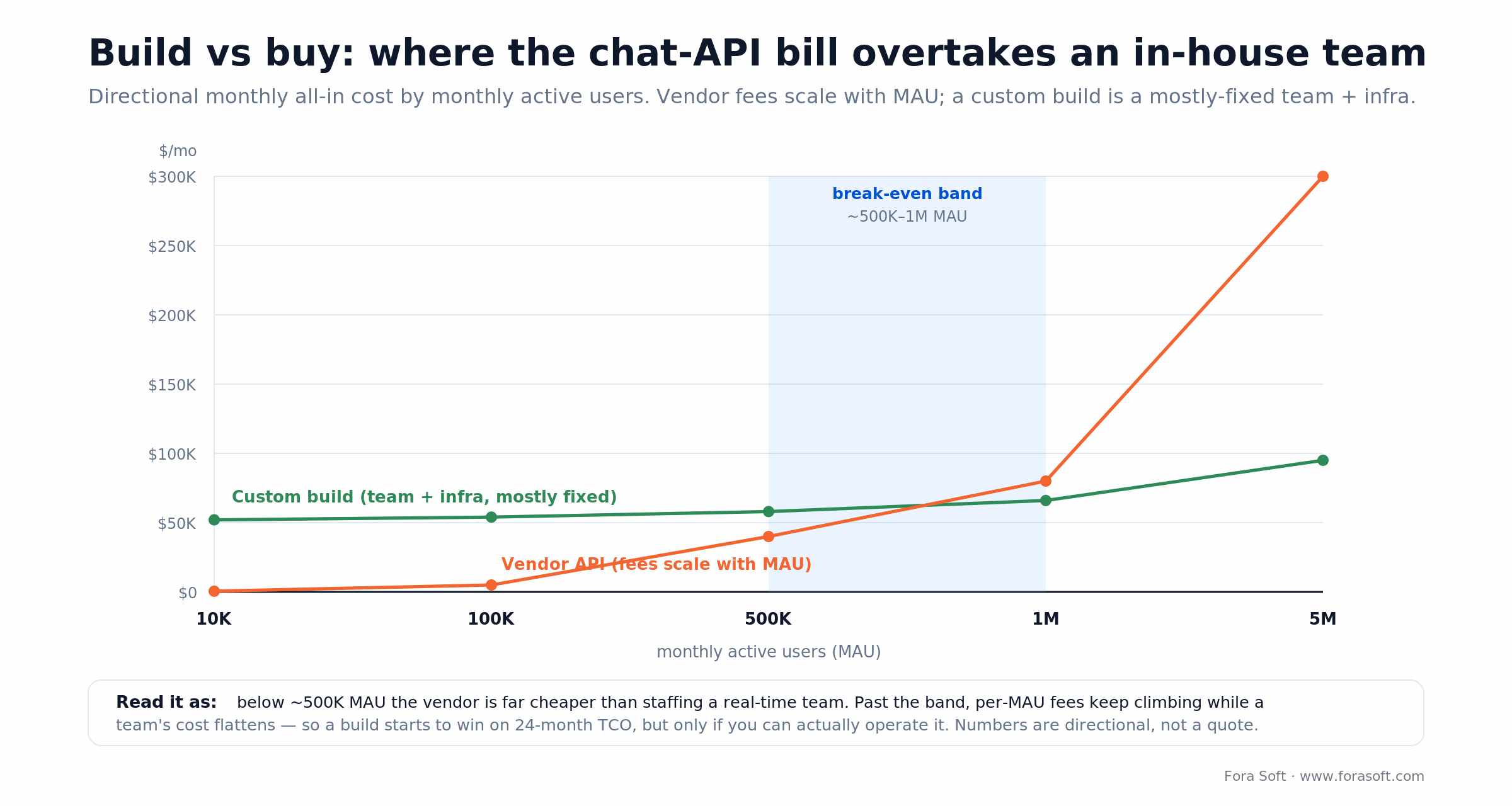
Figure 2. Directional monthly all-in cost by MAU. Below ~500K MAU the vendor is far cheaper; the break-even band sits at ~500K–1M MAU.
We deliberately don’t print absolute build budgets here — the spread between “chat for a marketplace” and “HIPAA-grade chat fused with telehealth video” is too wide. Send us a one-paragraph product profile and we’ll come back with a defensible range, not a prospect quote.
Reference architecture for a 2026 chat product
Whether you buy or build, the same architectural decisions matter. The five layers we touch on every project:
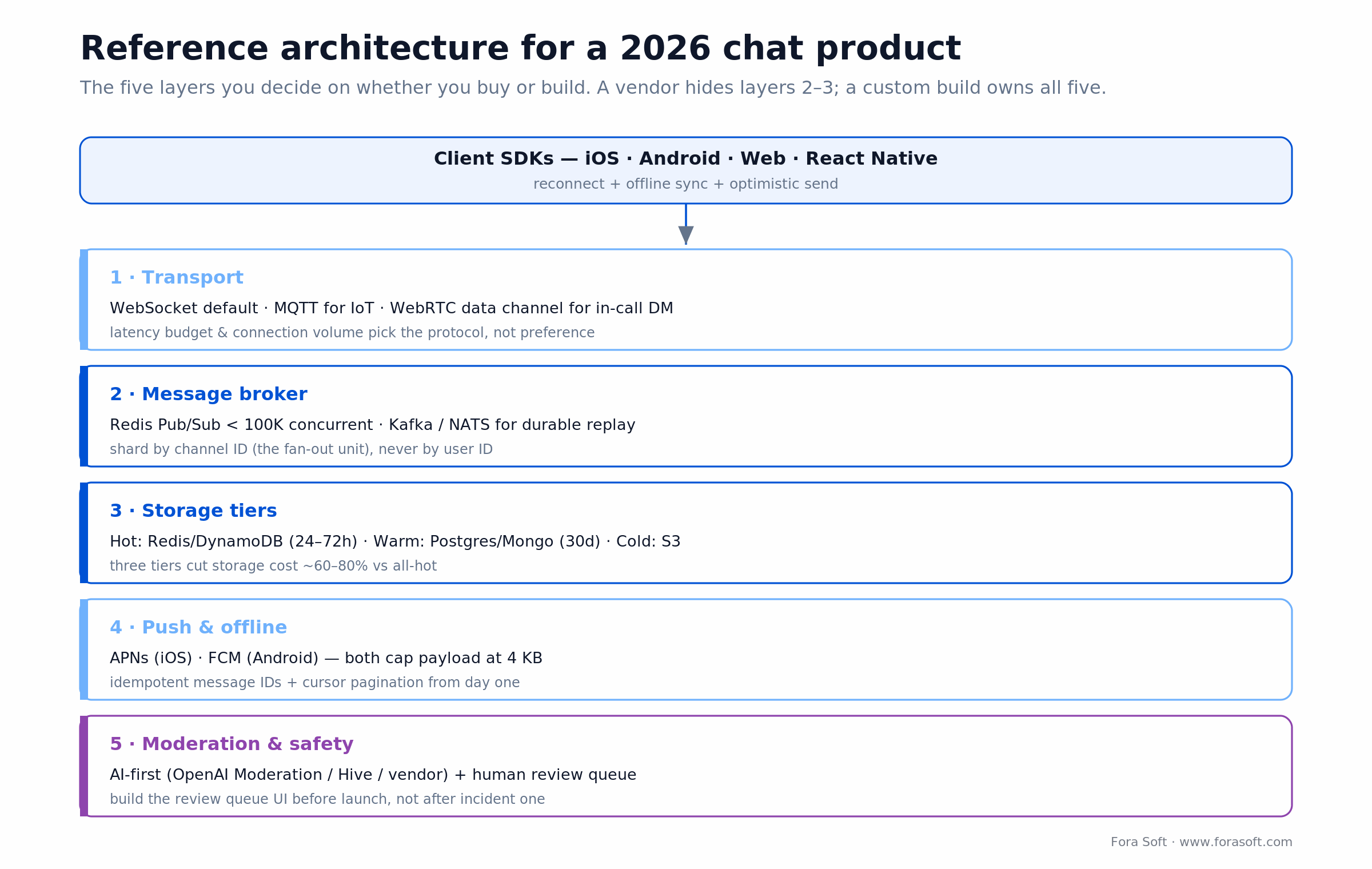
Figure 3. The five layers you decide on whether you buy or build. A vendor hides layers 2–3; a custom build owns all five.
1. Transport layer
WebSocket is the default. MQTT for IoT-adjacent products. WebRTC data channel for low-latency direct messaging inside live calls. The choice is dictated by latency budget and connection volume, not preference.
2. Message broker
Vendor-managed if you buy (Stream/Sendbird hide it). Custom: Redis Pub/Sub for < 100K concurrent, Kafka or NATS once you need durable replay and partitioning. Sharding by channel ID, not user ID — channels are the natural fan-out unit.
3. Storage
Hot store (recent messages, last 24–72 hours): Redis or DynamoDB. Warm store (last 30 days): Postgres or MongoDB with appropriate indexes on channel + timestamp. Cold archive (regulatory retention): S3 with lifecycle policies. Three tiers cut storage cost 60–80% vs. all-hot.
4. Push and offline
APNs for iOS, FCM for Android. Both cap payload at 4 KB — truncate or fetch-on-tap. Plan for offline message sync from day one (cursor-based pagination, server-side message versions, idempotent message IDs).
5. Moderation and safety
AI-first moderation (OpenAI Moderation API, Hive, or vendor-native), with a human review queue for flagged content. Build the queue UI before you launch — trying to add moderation tooling after the first abuse incident is the wrong order.
Code: a minimal Stream Chat integration in TypeScript
import { StreamChat } from 'stream-chat';

// Server-side (holds the API secret): mint a token for the user
const server = StreamChat.getInstance(apiKey, apiSecret);
const token = server.createToken(userId);

// Client-side (API key only): connect with that token
const client = StreamChat.getInstance(apiKey);
await client.connectUser({ id: userId, name: userName }, token);
const channel = client.channel('messaging', `support-${ticketId}`, {
  members: [userId, agentId],
  custom_priority: 'high',
});
await channel.watch();

// Send a message
await channel.sendMessage({ text: 'Hi, I need help with order #1234.' });
A dozen lines, working chat. The same pattern with Sendbird, CometChat, or PubNub looks similar — that ease of integration is the time-and-money story.
Need an architecture review — not a sales call?
Send us your stack, MAU projection, and compliance bar. We’ll respond with a one-page reference architecture and a vendor recommendation in 48 hours.
Compliance — where vendors actually split
Most vendors say they’re “compliant.” That’s a marketing word. The buyer questions are: do they sign a BAA, do they offer regional data residency, do they expose audit logs, and what is their breach response SLA?
GDPR
All major chat APIs are GDPR-aligned. The differentiator is data residency: Sendbird and Stream both offer EU-only deployments; PubNub offers single-region pinning. If your buyers in DACH or France require it, ask before you sign.
HIPAA / BAA
Sendbird and Twilio Conversations sign a Business Associate Agreement on enterprise plans. Stream offers it on enterprise on request. PubNub, CometChat, and most cheaper vendors do not. If your product touches PHI, BAA is non-negotiable — do not architect around “we’ll add it later.”
SOC 2
Stream, Sendbird, Twilio, PubNub, and Ably all hold SOC 2 Type II reports. Ask for the report under NDA before signing — not the badge on the marketing page.
FERPA, GLBA, FedRAMP
FERPA (edtech) and GLBA (financial) are usually customer obligations, not vendor obligations — you wrap the chat product in compliant access control. FedRAMP authorization is rare; if you sell to U.S. federal agencies, expect a custom or self-hosted deployment.
Reach for vendor compliance docs early when: your buyer asks for a SOC 2 report, BAA, or DPA. Procurement timelines die on this paperwork — have it in the data room before the security review starts.
Mini-case — a real chat backbone we ship
Nucleus is the cleanest example of a custom chat build we have shipped. It is an on-premise Slack alternative for high-security teams: SOC II/HIPAA-compliant chat, calls, and file sharing, deployed entirely inside the customer’s perimeter (no shared cloud).
The key engineering decisions were: end-to-end encryption on every message, a rotating-key model so individual user revocation does not require re-encrypting history, role-based access control with field-level audit logs, and an admin console that survives an external auditor’s review unmodified. None of that is available off-the-shelf from Stream or Sendbird — it is exactly the case where the vendor saving math breaks down.
On the opposite end, TradeCaster (46K+ users) ships chat alongside live trading streams. There we used a managed chat layer for messaging and built only the trade-context message types, plus moderation tuned to financial-content rules. Different product, different math, opposite call.
KPIs — what to instrument from day one
1. Engagement KPIs. Daily/Weekly active chatters as % of MAU, messages per active user per day, median session length, push-notification open rate. These tell you whether chat is contributing to product retention.
2. Reliability KPIs. Message delivery success rate (target > 99.9%), median message latency (target < 250 ms p50, < 1 s p99), reconnect-after-disconnect time (target < 3 s). These are your SLA backbone.
3. Cost KPIs. Total chat cost / MAU, storage growth rate, push notification spend / DAU, moderation flag rate. These are the levers you tune to keep the buy decision rational over time.
A 12-month chat migration roadmap
If you are already running chat and considering a vendor change or a build, the pattern we use for clients — adapted from migrations we’ve actually shipped:
Months 1–2: Audit + decision
Inventory message types, per-MAU costs, compliance gaps, storage footprint, and integration surface. Run the 5-question decision framework above. Output is a written recommendation (stay, migrate vendor, or build) and a target architecture.
Months 3–4: Shadow integration
Integrate the new vendor (or build the new backend) alongside the current system. No user traffic yet — replicate reads and writes in parallel, validate parity on delivery, ordering, and search.
Months 5–6: Dark-launch + user migration
Flip writes to the new system for a 5–10% cohort. Monitor delivery latency, push success, and moderation incidents for two weeks. Expand cohort weekly. By month 6, 100% of new messages land on the new stack.
Months 7–9: Historical backfill
Export and import historical messages in batches (prioritize the last 90 days, then the last year). Typical 100K-MAU product has 1–3 TB of archives; plan for it to take weeks, not days, and cost $500–$2K in egress fees.
Months 10–12: Decommission + operational tuning
Turn off the old system, redirect support docs, retrain ops on the new moderation queue, and run a cost review. Most migrations overshoot the original estimate by 20–30% — budget for it.
Where chat plugs into the rest of your stack
Chat never lives alone. The integration surface decides how painful ops will be:
Identity and auth
SSO via SAML or OIDC, and a user-sync pipe from your auth system (Auth0, Cognito, Keycloak) into the chat vendor’s user registry. Do not let chat grow a second source of truth for user profiles.
Analytics and data warehouse
Push message events into your warehouse (Snowflake, BigQuery, Redshift) via webhooks. Vendors all support event webhooks; the quality of schema documentation and retry logic varies — ask for the event-catalogue spec during evaluation.
Support and CRM
For B2C products, chat transcripts often need to flow into Zendesk, Intercom, or Salesforce for escalation. Budget 2–3 weeks for a clean webhook + transformation layer; most teams under-scope this.
Video, voice, and screen share
If chat is the thread and video is the call, single-vendor stacks (Stream, Sendbird, Twilio) save integration work. Multi-vendor buys you best-of-breed but adds session-linking logic. See our P2P vs MCU vs SFU and WebRTC primer pieces, plus our video streaming fundamentals guide, for the video-side tradeoffs.
Five pitfalls we see on almost every chat-API integration
1. Underestimating MAU growth. Vendor pricing scales sharply past included quotas. A B2C product hitting 4× growth in six months can blow through its budget without anyone noticing until the renewal call.
2. Ignoring storage growth. Messages compound. After 24 months a moderately active product is sitting on tens of TB. Tier your storage from day one (hot/warm/cold) or pay for the hottest tier on every byte you ever sent.
3. Building a moderation queue late. The first abuse incident, with no internal moderation tools, is how trust breaks. Wire up the AI moderation pipe and a basic review queue before launch — not after.
4. Trusting push notification quotas. APNs and FCM both rate-limit at the platform level. Sendbird/Stream batch and queue intelligently; a custom integration almost always under-handles backoff and ends up with silent push failures.
5. Vendor lock-in via message format. Custom message types make migration painful. Wrap them in your own schema layer so “swap Stream for Sendbird” is a connector swap, not a re-platform.
Reach for a contractual exit clause when: you sign a vendor for > 100K MAU. Negotiate data export in JSON/CSV, retention of historical messages on termination, and a 30-day overlap window for migration. Standard SaaS clauses do not cover chat.
When you should NOT use a chat API at all
Three honest cases where the API isn’t the right answer:
You operate in a tightly regulated environment with no BAA-signing vendor. Specific federal, defense, or critical-infrastructure work where on-premise or air-gapped is mandatory. Build, or buy a self-hosted enterprise SDK (Sendbird offers self-hosted on Enterprise).
You are at > 5M MAU with steady cost growth. Per-MAU pricing at that scale crosses well into “hire 8 engineers and own the stack” territory. Discord and Slack made this transition; you can too.
Your chat is the product. If you are building Discord, Slack, or Telegram, the API economics never work in your favour. Your differentiation is in the chat layer itself.
A decision framework — pick your path in five questions
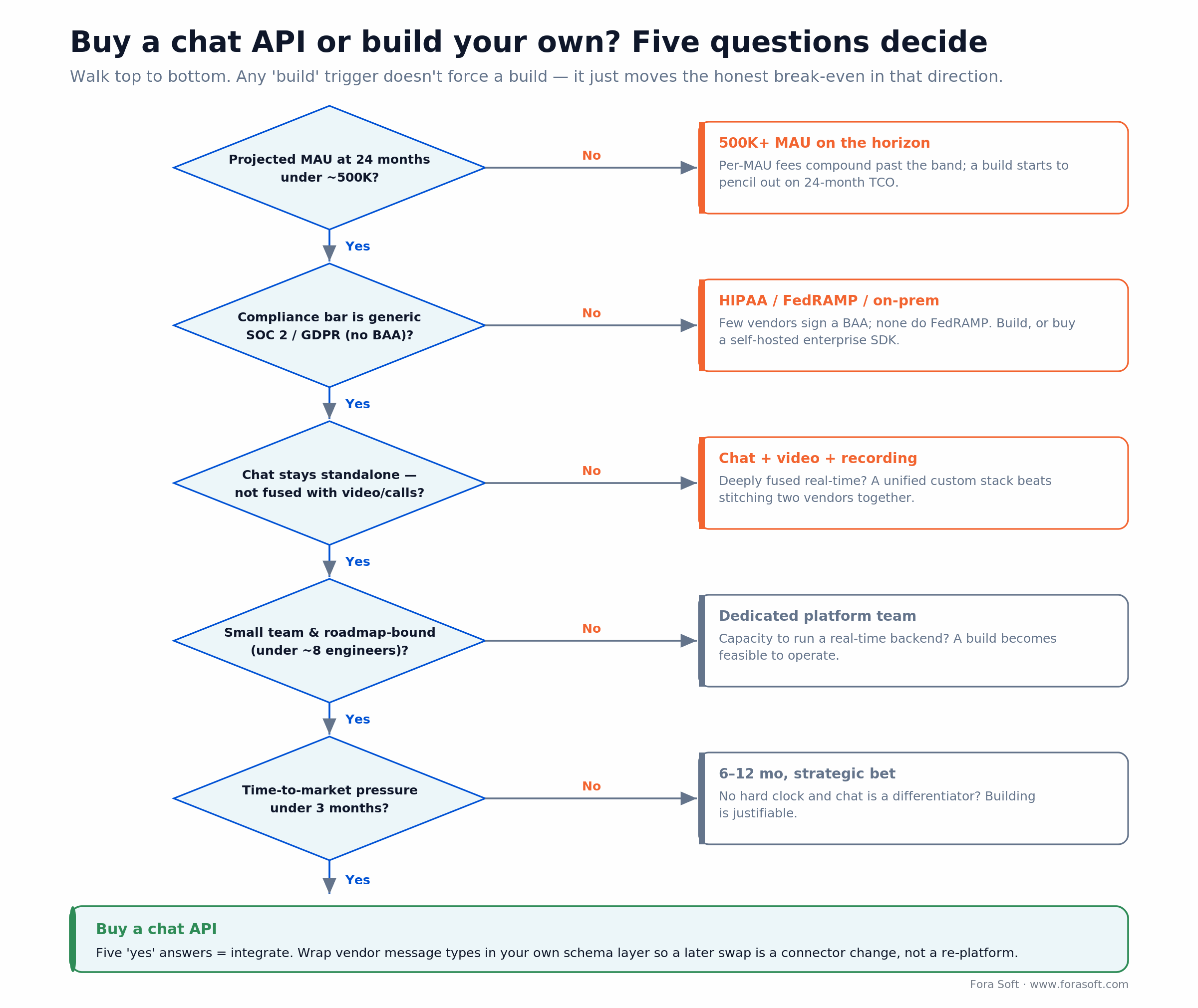
Figure 4. Five questions decide. Any ‘build’ trigger doesn’t force a build — it moves the honest break-even in that direction.
Q1. What is your projected MAU at 12 and 24 months? Under 100K → vendor. 100K–500K → vendor + audit annually. 500K+ → build is on the table.
Q2. What is your compliance bar? Generic SOC 2 / GDPR → any major vendor. HIPAA / BAA → Sendbird, Twilio, or Stream Enterprise. FedRAMP / on-premise → custom or Sendbird self-hosted.
Q3. How tightly is chat coupled to other real-time features? Standalone messaging → vendor. Chat + video + screen share + recording → consider building unified, especially if you’re already on a WebRTC stack.
Q4. What is your engineering capacity? < 8 engineers and roadmap-bound → vendor every time. Dedicated platform team → build is feasible.
Q5. What is your time-to-market pressure? < 3 months → vendor. 6–12 months and strategic differentiation → build is justifiable.
What is changing in chat in 2026
AI-native chat. Vendor SDKs now bundle LLM features — auto-summarization, smart reply, translation, sentiment-based escalation. Stream and Sendbird both ship this; differentiation has moved from “does it work” to “how cheap and how customizable.”
Translation as a default. Real-time translation across 50+ languages is now a $0.01-per-message line item. For global products, it is no longer a premium add-on — it is table stakes.
Edge presence. PubNub and Ably push presence and typing indicators to the edge for sub-50ms global latency. Worth it for live commerce, multiplayer games, and anything where “is the other person there” matters in milliseconds.
End-to-end encryption is becoming default. Signal Protocol-style E2EE is shipping in Stream and Sendbird; the “is your chat secure” question now has a vendor-supplied answer for most products.
Voice and video bundling. Pure-chat vendors are adding voice/video. Twilio has had it for years; Stream Video and Sendbird Calls are catching up. The buyer question is now “one vendor for all real-time, or best-of-breed?”
FAQ
What is a chat API and how is it different from a messaging SDK?
A chat API is the backend service that handles messages, presence, storage, and delivery. A messaging SDK is the client library you embed in your iOS, Android, or web app to talk to that backend. Stream, Sendbird, and the others ship both as a single product — you rarely deal with them separately.
How much does a chat API cost?
Entry tiers run $149–$499/month for ~10K MAU. Mid-tier production costs $1,500–$5,000/month for 50–100K MAU. At 500K MAU you are typically in the $20–$60K/month range plus storage, file transfer, and push notification surcharges.
Is Stream Chat better than Sendbird?
Different products. Stream wins on developer experience, pricing transparency, and modern SDKs (especially React, Swift, Kotlin). Sendbird wins on enterprise compliance posture, multi-region deployment, and SLA terms for HIPAA and FERPA workloads. Pick based on your compliance bar and team preference.
Can chat APIs handle video calls too?
Increasingly, yes. Stream Video, Sendbird Calls, Twilio Programmable Video, and others ship voice and video alongside chat. If your product needs both, a single-vendor stack saves integration overhead — but watch the per-minute pricing model on the video side.
Are chat APIs HIPAA-compliant?
Sendbird and Twilio Conversations sign HIPAA Business Associate Agreements on Enterprise plans. Stream offers it on Enterprise on request. PubNub, CometChat, and most consumer-grade vendors do not. If you handle PHI, the BAA is the gating question.
How long does it take to integrate a chat API?
A working MVP integration is 2–4 weeks for a small team using one of the established vendors. Production-hardening (push notifications, offline sync, moderation, custom UI, analytics) adds another 4–8 weeks. Compare with 6–9 months to build the equivalent from scratch.
Should we build our own chat instead of buying?
Build when you cross 500K MAU, have HIPAA/FedRAMP compliance bars no vendor meets, or chat is fused with proprietary real-time features. Buy when chat is a feature in a larger product and you need to be live in months, not quarters.
How does Fora Soft fit between chat-API vendors and custom builds?
We ship both. We integrate Stream/Sendbird/CometChat in client products where the vendor saving math wins, and we build fully custom chat backbones (like Nucleus) where compliance, scale, or product fit demands it. We are honest about which call to make.
What to Read Next
Architecture
P2P vs MCU vs SFU — pick the right video architecture
When chat lives next to video calls, the topology you pick matters as much as the chat vendor.
Real-time
What is WebRTC? Best explanation for non-developers
The protocol behind almost every modern voice/video stack — and how it interacts with chat.
Compliance
How to build a HIPAA-compliant video platform
When chat carries PHI, the same compliance playbook applies. Worth reading before signing a BAA.
AI
Enhancing video calls with AI language processing
Translation, sentiment, and summarization — the same AI features now showing up inside chat.
Scale
Edge computing in live streaming — how to cut latency
When chat needs sub-50ms presence at global scale, edge architecture is the lever.
Ready to ship chat without burning a year and $2M?
The headline answer hasn’t changed: for most products under 500K MAU, a chat API saves 5–9 engineering months and $1–4M in Year-1 cost compared to building from scratch. The detail that matters is which vendor — and where the line is when custom development starts to win.
Stream gives you the smoothest developer experience and best-in-class SDKs. Sendbird gives you enterprise compliance and the highest SLA. Twilio gives you omnichannel. PubNub gives you geo-distribution. CometChat gives you UI kits. Past 500K MAU, with a HIPAA bar or deeply integrated video, the math tips toward custom — and that is where a partner like us earns the engagement.
Either way, model storage and moderation costs from day one, build a kill-switch on the vendor lock-in (your own message-schema layer), and revisit the buy-vs-build math at every funding round. The right answer for a 50K-MAU seed-stage product is usually the wrong answer for the same product at Series C.
Want a defensible chat-build vs. chat-buy answer this week?
Send us your MAU projection, compliance bar, and integration scope. We’ll come back with a vendor pick, a build estimate, or both — whichever is honest.

