


Key takeaways
• Project scoping is the cheapest de-risking step in software. It turns a napkin idea into a priced, ranked, buildable plan before anyone writes code.
• Skipping it is expensive. Only 31% of software projects fully succeed (Standish CHAOS, 2020), 52% hit scope creep (PMI, 2018), and a scope error fixed after launch can cost up to 100x more than one caught during scoping (Boehm & Basili, 2001).
• Our version is Primary Analytics: a free, 4–7 day pass. One analyst, up to 20 hours, a priced plan the same week. You keep the document even if we never build for you.
• Primary vs Comprehensive. Primary is free, directional (a ±30% estimate). Comprehensive is paid, 2–4 weeks, with wireframes and a ±15% estimate. Primary is the scout; Comprehensive is the expedition.
• A $0 scoping pass routinely saves six figures. On one real build it cut roughly $114K of wrong-direction work. Scope first, build second.
Why Fora Soft wrote this project scoping playbook
Since 2005 we’ve shipped 250+ software products. That also means we’ve sat through 250+ kickoff meetings where a founder says “we already know what we want, can you just start building?” Every time we said yes without a proper project scoping pass, something broke: estimates drifted, priorities flipped after the UI was designed, a missed integration doubled the work. Every time we scoped first, the project shipped faster and cheaper.
So we turned that lesson into a fixed offer. Primary Analytics is our 4–7 day, up-to-20-hour, free scoping pass. It’s not a sales call with a PDF at the end; it’s analyst-led work that produces a priced, prioritised product plan the same week. If we turn out not to be the right partner, you still walk away with the plan. Several products in our portfolio of 250+ projects started exactly this way.
This playbook is the honest version for the person deciding whether to commit budget. It covers what project scoping is, why it matters, the questions we ask, what a good scoping document contains, the cost math, and when scoping is the wrong next step. Read it, steal the checklists, and scope your next build with or without us.
Want a free project scoping pass this week?
Tell us the product in one call. In 4–7 days you get a priced plan, a ranked feature list, and a go/no-go recommendation. No invoice attached.
What is project scoping?
Project scoping is the process of defining exactly what a project will and will not include — the goals, the features, the deliverables, a preliminary estimate, a schedule, and the risks — before the build starts. The output is a scope document: a short, shared reference that everyone (founder, engineers, investors) can point to when a new idea shows up mid-build and someone asks “is that in scope?”
For software specifically, scoping answers three questions in order: what are we building, what does it cost in time and money, and what is most likely to go wrong. Get those three on paper and the rest of the project has a spine. Skip them and you’re paying senior engineers to guess.
Scoping is not the same as a full requirements specification, and it’s not a fixed-price contract. It’s the decision layer that sits between “we have an idea” and “we’re committing real money.” Done right, it costs days, not weeks, and it pays for itself many times over.
Why project scoping matters: the failure data
Most software-failure statistics point at the same root cause: building the wrong thing, or the right thing in the wrong order, because nobody stopped to define scope. Here’s the data worth quoting, with sources you can check.
| What the data says | Number | Source (year) |
|---|---|---|
| Software projects that fully succeed | 31% (the other 69% are late, over budget, or cancelled) | Standish Group CHAOS (2020) |
| Cost to fix a scope error: requirements vs after launch | up to 100x more expensive | Boehm & Basili, IEEE Computer (2001) |
| Projects that experience scope creep | 52% (up from 43% five years earlier) | PMI Pulse of the Profession (2018) |
| Revenue-growth edge of design-led firms over 5 years | +32% (and +56% shareholder returns) | McKinsey Design Index (2018) |
| Top causes of failure | incomplete & changing requirements, weak user involvement | Standish CHAOS |
The single most useful curve here is Boehm’s. A mistake caught while you’re still deciding what to build costs almost nothing to fix. The same mistake caught in production — after design, code, and testing have all been paid for on top of it — can cost up to 100 times more (Boehm’s cost-of-change curve). Honest caveat: that 100x figure is for large systems; on a small app it’s closer to 5:1. The direction, though, never changes: earlier is cheaper.
Scoping is where you catch those mistakes for pennies. The chart below shows why.
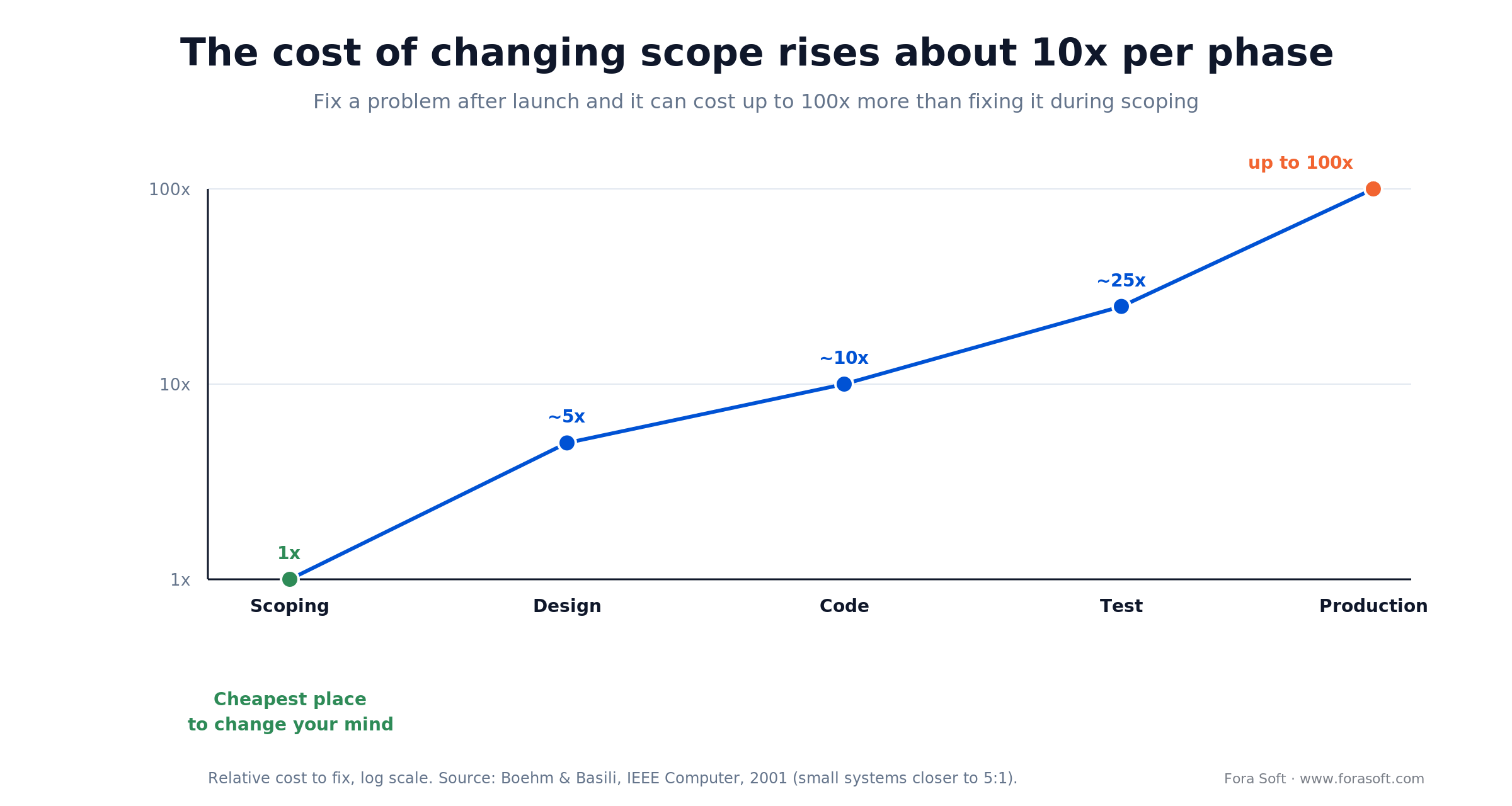
Figure 1. The later a scope error is caught, the more it costs — roughly an order of magnitude per phase (Boehm & Basili, 2001).
Reach for project scoping when: you’re about to spend real money on a build, you need a credible number for a budget or a board, or two people on the team would describe the product differently if asked right now.
What Primary Analytics actually is (and what it is not)
Primary Analytics is our name for a fast, free project scoping pass: one business analyst, up to 20 hours of work spread over 4–7 calendar days, ending in a structured document you can act on the same week. It’s real work delivered at no cost, not a discovery call dressed up as a deliverable.
What you get
A one-page product summary in plain language, a ranked feature list grouped as must-have / should-have / nice-to-have, an architecture sketch with a recommended stack, a directional time-and-cost estimate in a ±30% band, a named list of the top three to five risks, and a go/no-go recommendation on whether a paid Comprehensive pass is worth running next.
What it is not
Not a clickable prototype (that lives in Comprehensive Analytics). Not a 40-page requirements specification. Not a legally binding fixed-price statement of work. Not a design deliverable. The point is speed and direction, not polish.
Who runs it
A senior business analyst leads, with a solution architect checking the technical calls and one or two senior developers pricing the scope. Not a salesperson with a search engine. We only staff scoping with analysts who’ve shipped similar products, because the speed comes from pattern recognition, not from cutting corners.
Reach for Primary Analytics when: you need a directional estimate and a priced plan inside a week, you’re comparing two or three agencies, or you’re about to pitch investors and want a credible scope before the meeting.
Primary Analytics vs Comprehensive Analytics
Both are project scoping. They answer different questions and cost different amounts of time. Most founders run Primary first to decide whether Comprehensive is worth paying for.
| Dimension | Primary Analytics | Comprehensive Analytics |
|---|---|---|
| Duration | 4–7 days | 2–4 weeks (scope-dependent) |
| Effort | Up to 20 analyst hours | 80–200+ hours across BA, UX, architect |
| Cost | Free | Paid (typically 5–10% of the build) |
| Estimate accuracy | ±30% directional band | ±15% or better |
| Wireframes | No | Yes, clickable prototype |
| User stories | High-level only | Full story map with acceptance criteria |
| Architecture | Stack recommendation, sketch | Detailed diagrams, component map |
| Best input for | Go/no-go, agency comparison | Fixed-price contracts, funding rounds |
| Statement of work | Not yet — directional only | Ready to draft a priced SOW |
Reach for Comprehensive Analytics when: the build is regulated (HIPAA, PCI, GDPR with biometrics), the budget is above $100K, or you need clickable wireframes and a ±15% number to close a funding round.
Scoping vs POC vs prototype vs MVP vs pilot
These words get used as if they mean the same thing. They don’t. Each answers a different question and costs a different amount, and mixing them up is how budgets evaporate.
1. Scoping / discovery. Answers “what do we actually build?” Output: a plan, an estimate, a priority list. No code. Primary Analytics is the short version; Comprehensive is the long one.
2. Proof of concept (POC). Answers “is this technically possible?” Output: a tiny code experiment in a lab or notebook. No users. Usually a couple of weeks.
3. Prototype. Answers “does this feel right to a user?” Output: a low- or high-fidelity mockup, often clickable, tested with a handful of real users. Weeks, not months.
4. Minimum viable product (MVP). Answers “will the market pay for this?” Output: a real product with the smallest viable feature set, launched to real users. Months. Needs billing, auth, analytics.
5. Pilot. Answers “does this hold up in the field at a limited scale?” Output: the product running with a small set of real customers, usually one segment or geography, before full launch.
Reach for a POC first when: the whole business rests on one unproven technical bet — a model hitting an accuracy target, sub-second latency at scale — and there’s no point scoping a full build until you know it’s possible.
The project scoping process in 7 days
We run scoping in four short passes, each mapped to a day or two. It’s built around a founder’s calendar: we need about 3–4 hours of your time across the week, and we do the rest independently.
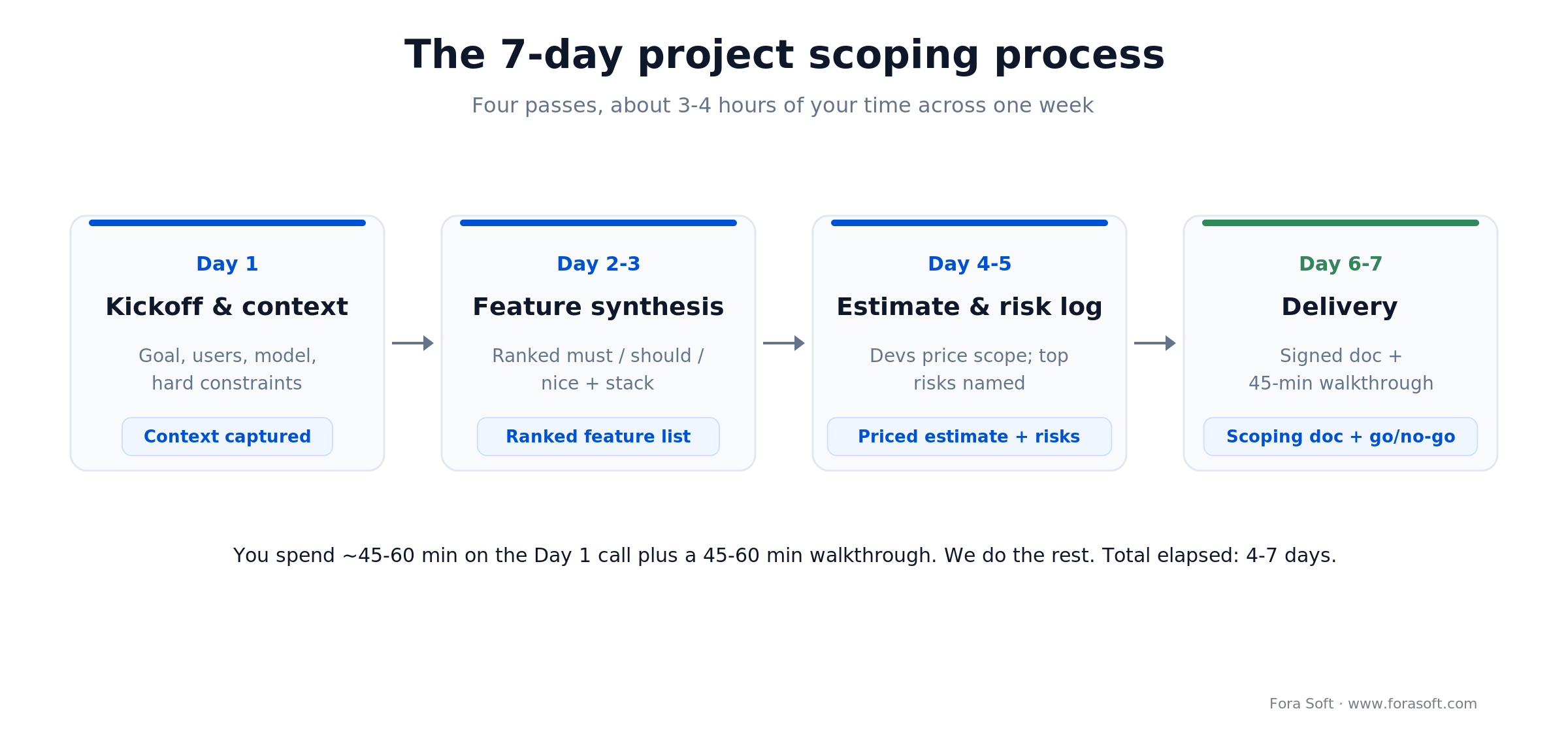
Figure 2. Four passes across one week, with two short calls on your side and a scoping document at the end.
Day 1 — kickoff and context
A 45–60 minute call with the product owner, plus one stakeholder if you have one. The analyst captures the business goal, the target user, the commercial model, the competition, and any hard constraints: a deadline, a budget cap, a compliance regime. We leave with enough to work solo for the rest of the week.
Day 2–3 — feature synthesis and prioritisation
The analyst writes a clean feature list, groups it into must / should / nice-to-have, maps items to high-level user stories, and flags cross-cutting concerns: auth, compliance, payments, offline support, real-time, internationalisation. The architect reviews the list and proposes a stack.
Day 4–5 — estimate and risk log
One or two senior developers sanity-check the scope and produce a directional estimate: one number for the must-haves, a separate one for the should-haves. The analyst drafts the risk log — the three to five things most likely to blow up the plan, named specifically.
Day 6–7 — delivery and walkthrough
We send the document, schedule a 45–60 minute walkthrough, and leave you with a shareable version for co-founders, investors, or other agencies. The document is yours regardless of whether you hire us for the build.
Ready to scope your product in 7 days?
Book a kickoff. You get a priced, ranked plan within a week — and the scoping document stays yours either way.
The project scoping questions we ask on day one
A good scoping call isn’t a wish-list session. It’s a set of questions designed to expose the real constraints fast. Steal these for your own kickoff, whoever runs it.
1. Who is the one user we can’t disappoint? Not “everyone.” The one persona whose problem, if solved, makes the product worth building. Everything else ranks against them.
2. What has to be true for this to be a success in 6 months? A number, a launch, a signed customer. This turns a vibe into a target the feature list can be measured against.
3. What’s the hard constraint? A demo date, a budget ceiling, a regulation, an existing system we must integrate with. Constraints shrink scope faster than any prioritisation exercise.
4. What already exists? An API, a data set, a design system, a half-built prototype. Reusing what’s there is the cheapest feature you’ll ever ship.
5. What happens if we don’t build feature X? Asked for every candidate feature. If the answer is “nothing much,” it’s a nice-to-have, and nice-to-haves don’t belong in a first build.
What a good project scoping document includes
A scoping document is only useful if someone on your team can pick it up on Monday and start making decisions. People often ask us for a project scoping template; the honest answer is that the structure matters more than the format. Here are the six sections we always include, and why.
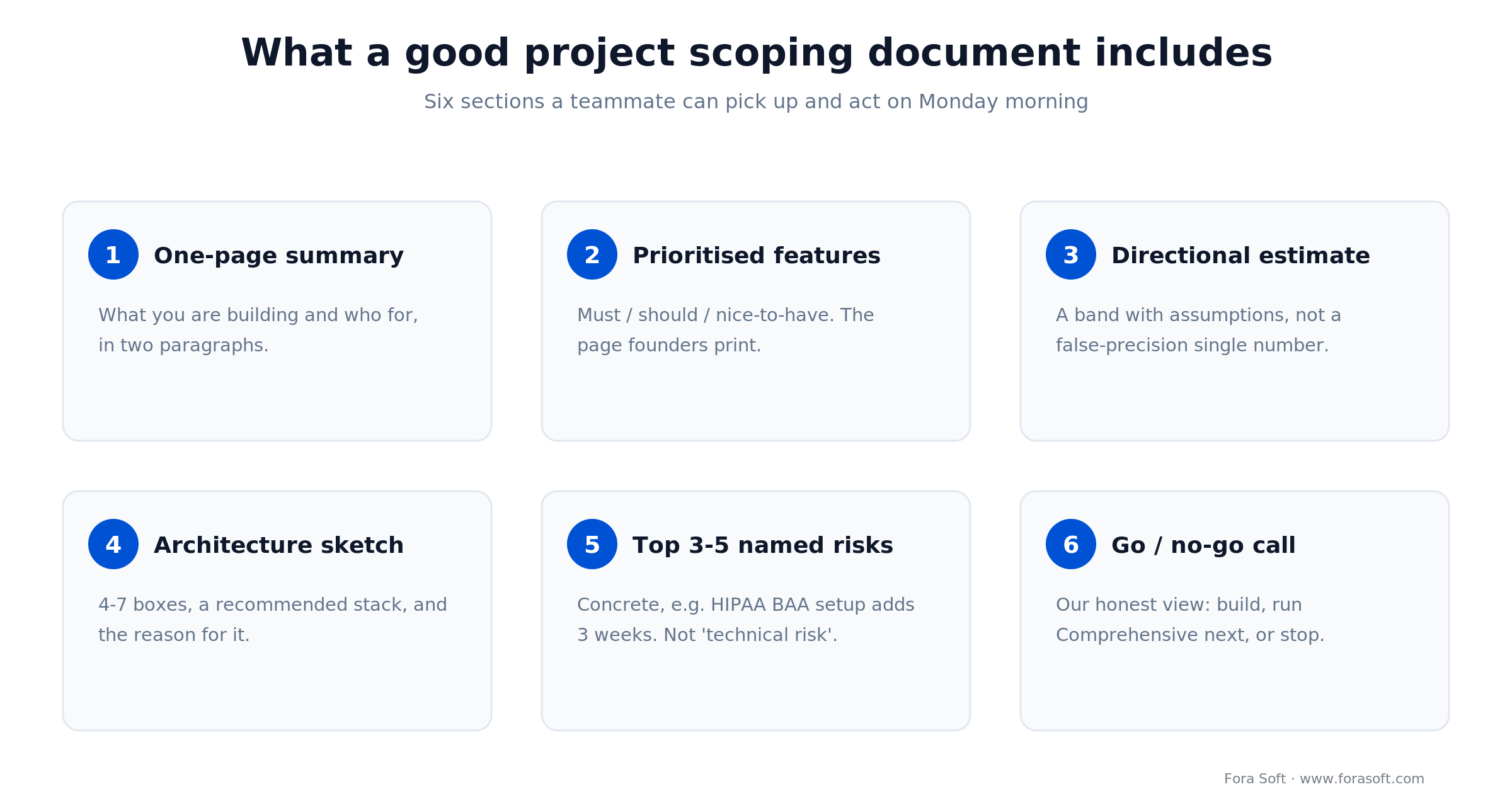
Figure 3. The six sections of a scoping document a teammate can act on without a meeting.
1. One-page product summary. If a non-technical reader gets through the first page, they should know what you’re building and who it’s for. Two paragraphs and three bullets. If we can’t hit that, the idea is still fuzzy.
2. Prioritised feature list. Must / should / nice, each item half a sentence, no epics yet. This is the most-used page in the document. Founders print it.
3. Directional estimate with a band. Real work takes a range. “Must-haves: 14–20 weeks at team rate X” beats a false-precision “17.3 weeks” every time. The band is a feature, not a hedge.
4. Architecture sketch. One diagram, four to seven boxes, a recommended stack, and the reason (for example, React Native for mobile because your team already writes React). No twenty-layer cake.
5. Top 3–5 named risks. Specific, not abstract. “App Store review can add two weeks if we use family sharing wrong” is a risk. “Technical risk” is not.
6. Go/no-go recommendation. Our honest read: build, run Comprehensive next, or stop. If we wouldn’t start, we say so. A well-argued “no” is worth more than a hopeful “yes.” From here, the scope becomes the backbone of a statement of work once numbers are locked.
Cost math: how a $0 scoping pass saves six figures
“Saves six figures” sounds like marketing, so here’s the arithmetic on a real build. Assume a blended engineering cost of about $3,000 per engineer-week (roughly $75/hour, which is conservative for senior work).
A scoping pass cut a founder’s candidate list from 40 features to 11 must-haves. Say only half of the 29 cut features would have been half-built before someone killed them: that’s roughly 15 features at about 2 engineer-weeks each, or 30 engineer-weeks of wrong-direction work. At $3,000 a week, that’s $90,000 avoided.
One architecture call did the rest. Swapping a custom WebRTC stack for a managed platform removed about 8 engineer-weeks of plumbing: 8 × $3,000 = $24,000. Add them up and a free, 20-hour pass steered roughly $114,000 away from waste, before a single feature shipped.
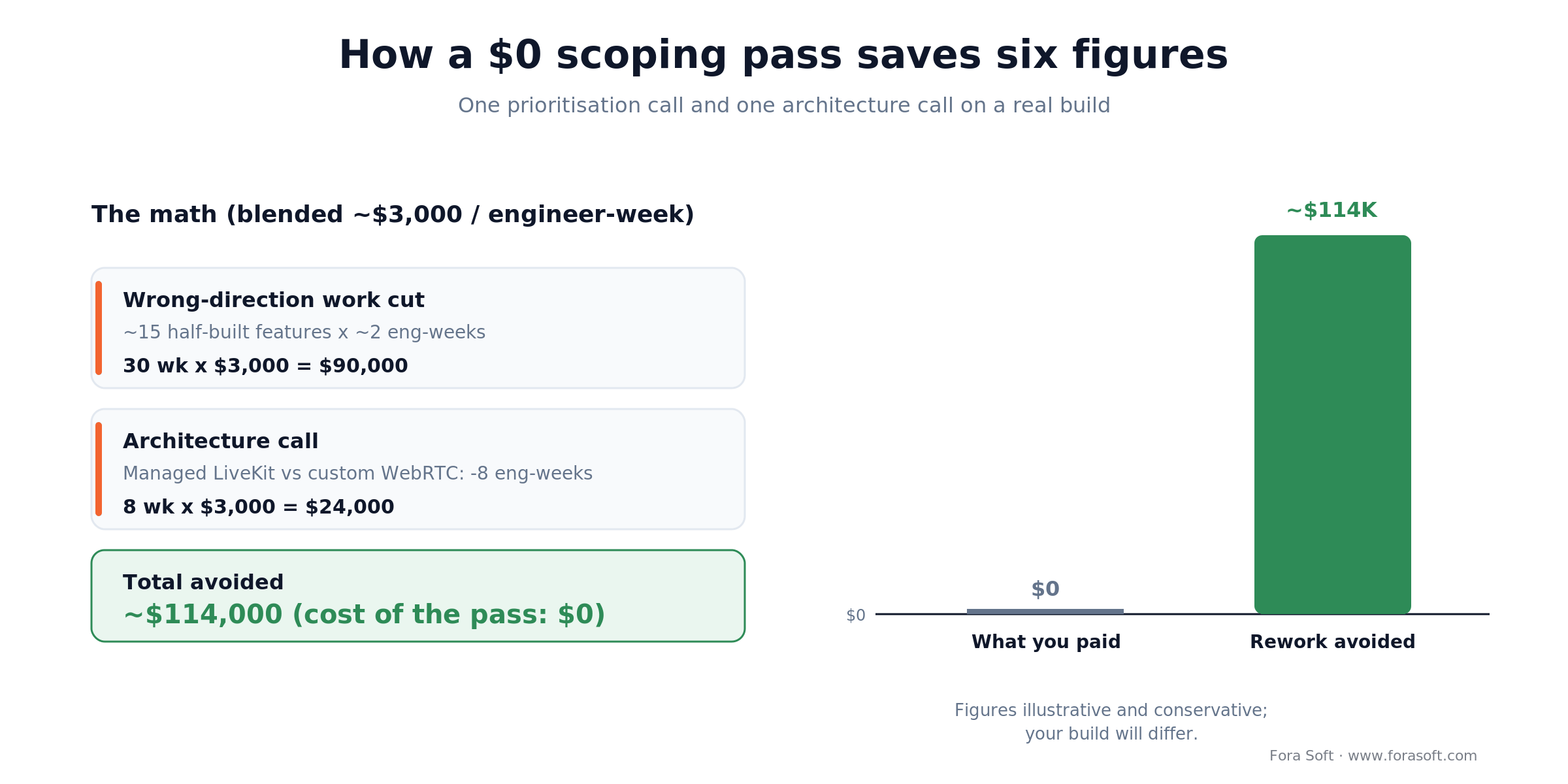
Figure 4. Two decisions in one scoping pass steered about $114K away from waste. Figures are illustrative and conservative.
The exact numbers vary by build. The shape doesn’t: a week of structured thinking is cheap, and the mistakes it prevents are not. For the techniques we apply once scope is locked, see our guide on how to cut software-project costs.
Mini case: scoping saved a founder from building the wrong thing
Situation. A founder came to us wanting a Zoom-style telemedicine platform built from scratch. Budget around $180K, timeline six months. He’d already interviewed three doctors and two clinic managers and was ready to start coding.
The 7-day pass. The feature list ran to 40 items; prioritisation cut it to 11 must-haves. The architect recommended a managed real-time video stack over custom WebRTC, saving roughly 8 engineer-weeks. The risk log flagged HIPAA BAA setup as a three-week prerequisite he hadn’t budgeted. The directional estimate landed at $95K–$135K for the must-haves over 16–22 weeks, against his $180K / six-month plan. If you want the background on why that stack call matters, our Learn library covers the fundamentals of digital video, and our video conferencing service page shows what we ship on it.
Outcome. He raised less capital than he’d planned to, locked the must-have scope, and dropped two features the doctor interviews had accidentally glorified. Compressions like this are normal when pattern recognition is applied early. Named products in our portfolio — BrainCert ($3M ARR, 100K+ customers) and TradeCaster (46K+ users) — began with the same kind of scoping pass. Want a similar read on your idea? Book a 30-minute scoping call.
Decision framework: Primary, Comprehensive, or skip
Q1. How concrete is the idea? If it fits on a napkin, Primary Analytics turns it into a plan. If it’s already a 200-item PRD, go straight to Comprehensive.
Q2. How soon do you need a number? This week: Primary. Two to four weeks: Comprehensive. Right now, this second: you’re pattern-matching, not deciding, and no scoping pass will help.
Q3. How large is the build? Under $100K and under four months: Primary is usually enough. $100K–$500K with real integrations: run both. Above $500K or regulated: always Comprehensive, often twice.
Q4. Are you raising? Showing investors: Comprehensive gives you a credible wireframe pack. Primary gives you the napkin-plus, which works at pre-seed but looks thin at seed and beyond.
Q5. How confident is your team on the stack? Confident on the stack, new to the category: Primary is enough. Confident on the category, new to the stack: go Comprehensive so the architect can de-risk the build.
Reach for a second opinion when: you already have an estimate from another vendor and it feels either suspiciously round or suspiciously cheap. A scoping pass is the fastest way to pressure-test someone else’s number.
Not sure whether Primary or Comprehensive fits?
A 30-minute call is the fastest way to pick the right scoping path. No deck, no pitch — just the plan.
Five pitfalls that wreck a scoping phase
1. Letting sales set the estimate. A salesperson will commit to a timeline before the team has seen the scope. Push back. Insist the number comes from engineers and the analyst, signed off by the architect. Sales-driven estimates are the top cause of fixed-price death marches.
2. Running scoping without a time box. With no deadline, analysis paralysis sets in. Four weeks becomes twelve, momentum dies, nobody commits. Box it: Primary is 7 days, Comprehensive is 4 weeks maximum.
3. Skipping the user. A session where the only voice is the founder misses half the signal. McKinsey found 40%+ of companies don’t talk to end users during development. Even a 7-day pass should include three to five user conversations, or the scope becomes an echo chamber.
4. Accepting single-point estimates. A number with no range is a promise the vendor can’t keep. Always ask for a band and the assumptions behind the low and high ends. Estimates that collapse to one number are hiding risk.
5. Treating the scope as a contract. A directional scope is not a fixed-price SOW. Treating it as one is how projects hit 200% overruns. The SOW comes after the numbers are locked, with the risks priced in.
The project scoping tools we actually use
You don’t need special software to scope a project well. You need a few artefacts and the discipline to keep them short. Here’s the toolkit behind a Primary Analytics pass.
A shared doc, not a slide deck. Google Docs or Notion, one page per section. Slides hide gaps behind big fonts; a doc forces you to write the sentence.
A must/should/nice priority grid. A three-column table is the whole tool. The value is the argument you have while filling it in, not the format.
A one-screen architecture sketch. Any diagram tool, four to seven boxes. If it needs scrolling, the scope is too big for a first build.
A three-point estimate. Optimistic, likely, pessimistic per feature bucket, rolled up into the ±30% band. It’s a spreadsheet, and that’s the point: the range is honest where a single cell isn’t. For where the money actually goes on a build, see our app development cost guide.
What project scoping returns on a zero invoice
1. A priced, ranked plan in days. Everything else follows from it: fundraising conversations, agency comparison, internal budget approvals.
2. Tighter cost control downstream. A scoped build works from a ranked list and a banded estimate, so the invoice tracks the plan instead of drifting. Our custom software development engagements start from exactly this scope.
3. Less scope creep. With a ranked feature list on the table, the “oh, and also” requests get graded against the priority grid instead of quietly slipping in. That’s how you stay off the wrong side of the 52% scope-creep statistic.
4. A credible artefact for investors. A ranked scope and a banded estimate are exactly what a diligent investor wants to see. It’s the difference between “we think it’ll cost about this” and a defensible plan. Our guide on getting investment for your app goes deeper.
5. A working relationship test. You see how our analysts think and how fast we turn things around before any money changes hands. Most clients who become long-term partners say the scoping week was the deciding signal.
When project scoping is not the right next step
Scoping is an early-stage decision tool. It’s the wrong move for a project already mid-flight, for a regulatory-heavy rewrite, or for a fixed-price contract that needs board sign-off next Monday.
Skip a free Primary pass and go straight to Comprehensive (or a paid discovery engagement) when the project is regulated (HIPAA, PCI, GDPR with biometrics), when it’s a multi-million-dollar rewrite, when you need clickable prototypes for a fundraise, or when investors have already committed on the premise of a detailed scope. In all of those, a ±30% band is too loose to be safe.
KPIs to track during and after scoping
Quality KPIs. Feature-list alignment (does the founder agree with the priority grid on the walkthrough call: target 90%+). Show-stopper risks identified (healthy range: 3–5). Estimate band tightness (Primary ±30%, Comprehensive ±15%).
Business KPIs. Time from kickoff to go/no-go (target: 7 days for Primary, 21 for Comprehensive). Reduction in must-have count after prioritisation (typical: 30–50% off the original list). Scoping spend as a share of final build (healthy: 5–15%).
Reliability KPIs. Post-build estimate accuracy (final invoice vs the Comprehensive estimate: target under 15% drift). Scope-change rate after sign-off (target: fewer than five material changes in the first quarter). Walkthrough satisfaction (target NPS 50+).
FAQ
What is project scoping?
Project scoping is the process of defining what a project will and won’t include — goals, features, deliverables, a preliminary estimate, a schedule, and the main risks — before the build starts. The output is a scope document the whole team can point to when new ideas appear mid-build.
How long does project scoping take?
Our free Primary Analytics pass takes 4–7 calendar days and up to 20 analyst hours. A full, paid Comprehensive pass with wireframes and a tighter estimate takes 2–4 weeks, depending on the size of the product.
Is there a project scoping template we can use?
The six sections in this article — summary, ranked features, banded estimate, architecture sketch, named risks, go/no-go — are the template. When we run Primary Analytics we deliver that document already filled in for your product; we’re happy to share the blank structure so your team can reuse it.
Is Primary Analytics really free, or is there a catch?
Free, no catch. We invest up to 20 analyst hours upfront because the document is useful to you even if we don’t build. It’s yours to share with other agencies, investors, or your own team.
Will you sign an NDA before any details are shared?
Yes, we sign NDAs routinely before any material is exchanged. Send your template or use ours — either works, and most founders get it done in under a day.
How accurate is the estimate really?
A Primary Analytics estimate aims for a ±30% directional band. After a Comprehensive pass, we tighten it to ±15% or better. Anyone promising tighter than ±30% off 20 hours of work is selling a number, not an estimate.
Can the scoping document be used to get competing estimates?
Yes, and we encourage it. The document is structured so another agency can scope against it quickly. Most clients say the ranked priority list shortens competitive estimate cycles from weeks to days.
How is this different from a free consultation?
A free consultation is 30–60 minutes of talking and a follow-up email. Project scoping with Primary Analytics is up to 20 hours of analyst, architect, and developer work that produces a structured, priced document. Different category.
What to read next
Process
Project Discovery: A Founder’s Guide
The deeper discovery phase that follows a scoping pass.
Analysis
The Analytical Stage of Software Development
What full business analysis produces, artefact by artefact.
Budget
How to Cut Software-Project Costs
Where the real savings hide once scope is locked.
Cost
App Development Cost Guide
What drives the numbers on a real software engagement.
Fundraising
How to Get Investment for Your App
What a scoping document does for investor conversations.
Ready to swap uncertainty for a scoped plan?
Project scoping is the cheapest de-risking step on any software build. A free Primary Analytics pass is 7 days, 20 analyst hours, and a $0 invoice. In return you get a priced, ranked plan, a named risk log, and a go/no-go call you can walk into a fundraising meeting with. For most founders it also steers six figures away from scope creep and wrong-direction engineering.
We’ve run this on 250+ projects since 2005. We’re not fast because we cut corners; we’re fast because we’ve seen the same patterns a few hundred times and know which ones reward pattern-matching and which need a deeper pass. If you want the scoping document on your desk by next Monday, the kickoff call is 30 minutes.
Start your free project scoping pass this week
Pick a kickoff slot. You get a priced, ranked, risk-flagged plan within 7 days — and the document is yours whether or not we build.

