

Key takeaways
• The single most expensive mobile app development mistake in 2026 is skipping idea validation. Talking to 12 real users before line one of code rewrites every other section of the build plan.
• Wireframes and a 2-week prototype phase save 20–30% of MVP budget. Founders who skip them burn that budget on rework. Period.
• Feature overload, ignored performance, weak ASO, missed compliance, and no post-launch ops are the other five recurring patterns that sink mobile apps in their first year.
• 2026 adds three new categories of mistakes: shipping iOS without Liquid Glass / Foundation Models awareness, skipping Apple ATT and EU DMA compliance, and treating AI features as a marketing line rather than a quality discipline.
• Use this article as a pre-build checklist. Each pitfall comes with a real client story, the cost of getting it wrong, and the practical fix we use on Fora Soft engagements.
In a competitive mobile app market where hundreds of new apps launch daily, getting the build right from the first sprint is the difference between a runaway success and a year of expensive rework. Most app failures we’ve audited boil down to a small set of recurring mistakes. Not exotic technical decisions, but predictable process and product missteps that show up across iOS, Android, Flutter, React Native, and Kotlin Multiplatform builds alike.
We’re Fora Soft. Since 2005 we’ve shipped 250+ projects with mobile surfaces — from BrainCert learning apps to CirrusMED telehealth to TradeCaster trader streaming. The mistakes below are the ones we’ve seen kill projects on our intake calls and the ones we’ve spent a sprint or three fixing on rescues. Each comes with the practical fix.
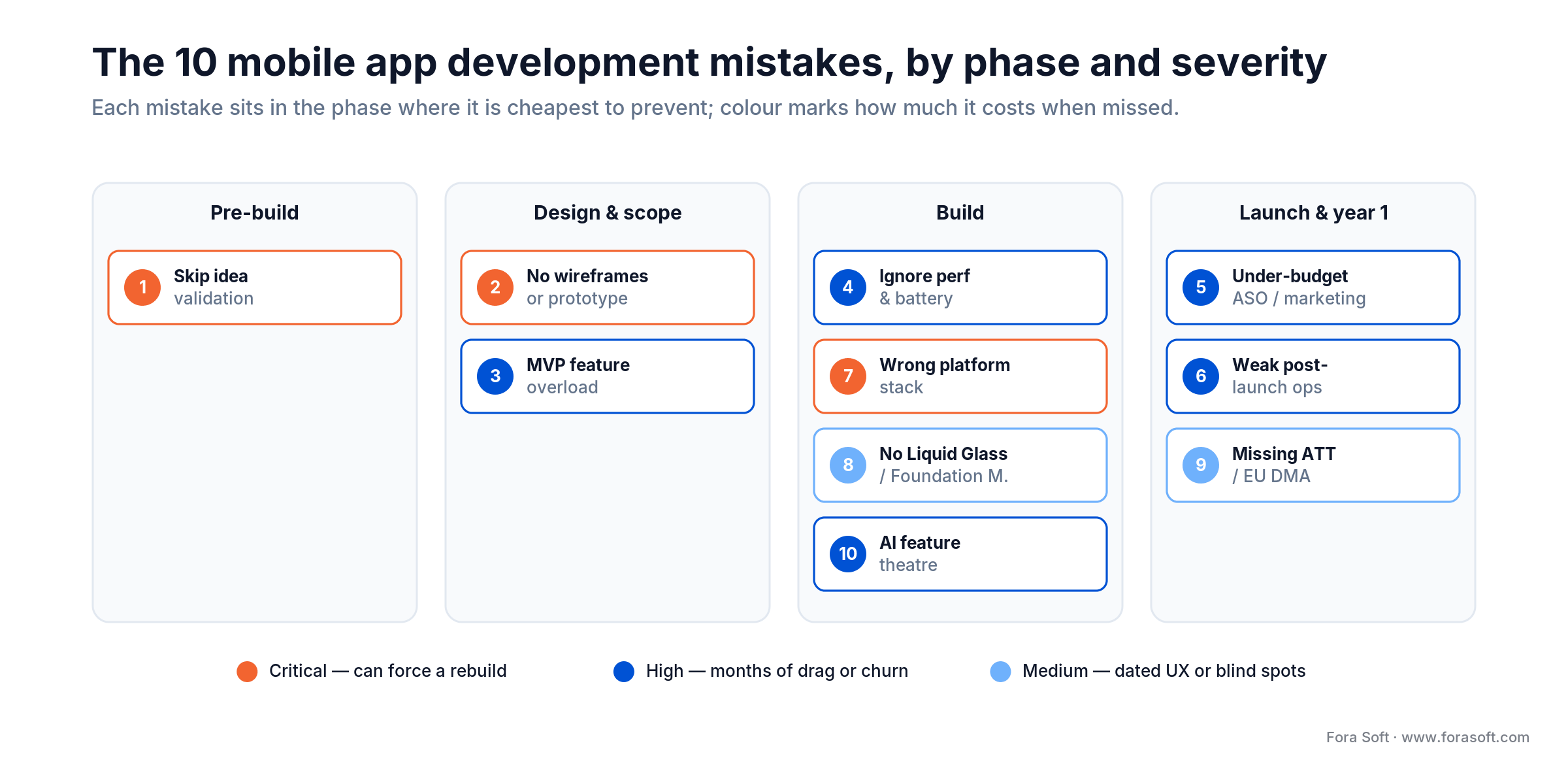
Figure 1. The ten mistakes, placed in the phase where each is cheapest to prevent — colour shows severity.
Why Fora Soft wrote this 2026 mistakes playbook
We see two patterns of mobile-app intake calls. Pattern A: a founder with a clear hypothesis, a wireframe, and a small target user pool. Those calls become projects that ship in 12 weeks. Pattern B: a founder with a long feature list, a vague audience, and a six-month timeline that’s already slipped twice. Those calls become rescues. The mistakes below are the diagnostic for which pattern you’re in.
Companion reads we maintain on this surface: the mobile app development services playbook, our native vs cross-platform decision, the Flutter buyer’s guide, and the software estimation playbook.
Want a 30-minute audit of your mobile app plan?
Send us your one-pager and we’ll flag which of the mistakes below are already in the plan — before you spend a dollar on code.
Mistake 1: skipping idea validation
Every great mobile app starts with an idea, but a startling number of founders ship before they’ve talked to a single real user. The cost: misaligned features, low engagement, and a product that lands flat. A teacher came to us pre-Zoom wanting an e-learning app with video chat, whiteboard, file sharing, and a formula editor — on a tiny budget. After interviews with his actual student cohort, we replaced the spec with something cheaper and better-fitting: broadcast of handwritten notes via a simple camera. Build cost dropped 4×; engagement went up.
Fix. Talk to 12 real users before scoping. Run a 1-week discovery sprint with surveys, personas, and a wireframe walkthrough. Validate that the problem you assume people have is the problem they actually have. Vendors who don’t do this well are usually vendors who can’t.
Reach for a 1-week validation sprint when: the budget is >$30k. Below that, just ship the cheapest possible MVP and learn in market. Above that, validation is the highest-ROI activity in the build.
Mistake 2: skipping wireframes and prototypes
Would you build a house without a blueprint? Same logic. A client asked us to embed a prebuilt virtual classroom — sounded like a one-day task. Two days in, requirements multiplied: teacher/student role differentiation, classroom naming conventions, recording control. What should have been a sprint stretched to two weeks of redesign because nobody had a wireframe.
Fix. Spend the first 1–2 weeks of any project on wireframes (Figma is the default tool) and an interactive prototype your target users can click through. Test usability on real users. The cost of catching a UX problem at wireframe stage is roughly 1/20th of catching it after the build.
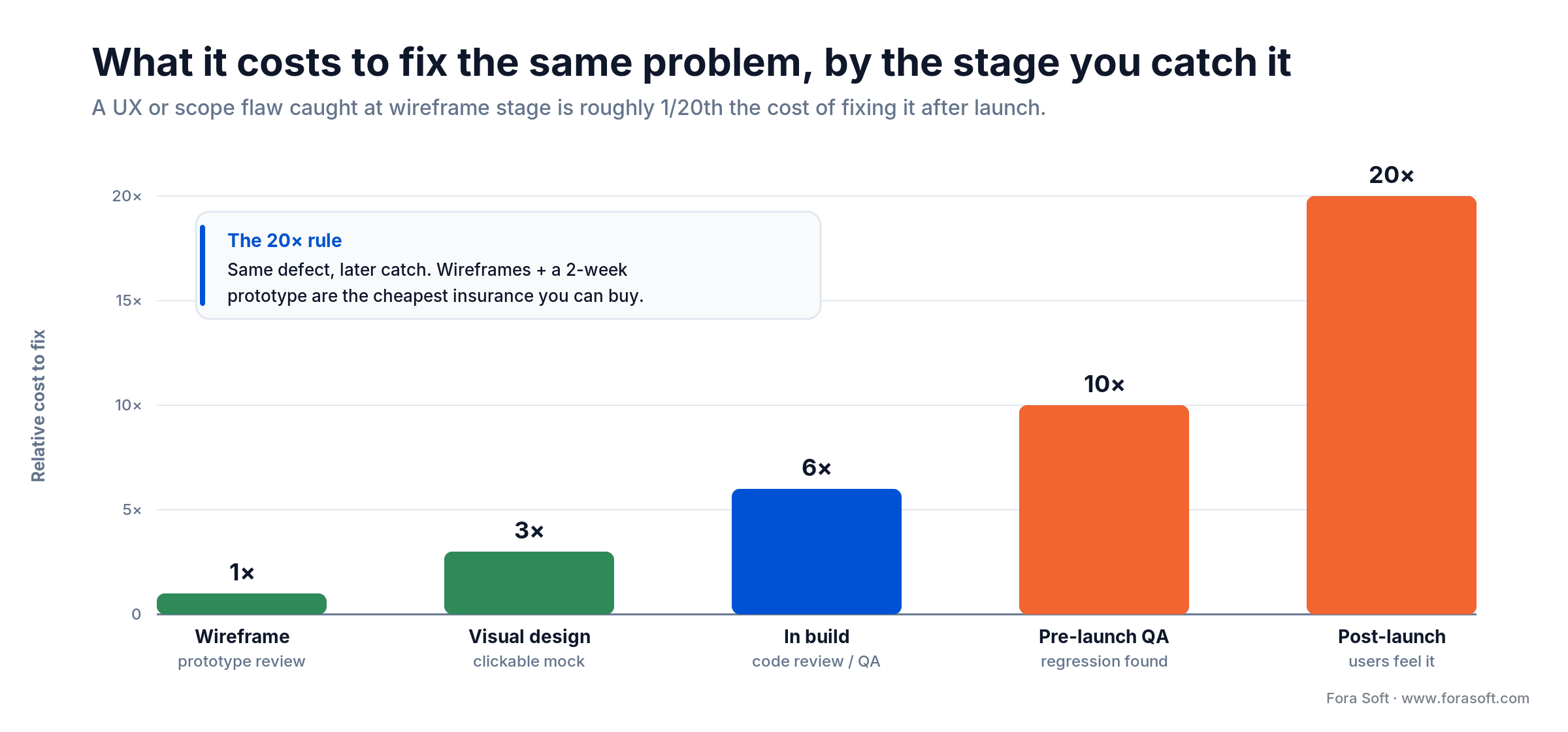
Figure 2. The same defect gets roughly 20× more expensive the later you catch it.
Mistake 3: overloading the MVP with features
More features sound like more value. They aren’t. They’re more bugs, longer timeline, higher burn, and a confused user. We worked with a remote-interpreter client who launched their MVP with one interpreter, one language, and no admin tools. It worked. They scaled to multiple interpreters, languages, admin reports, and analytics over the next year — phased, demand-led, profitable.
Fix. Define the “one thing this app does brilliantly”. Cut everything else. Ship in 8–12 weeks. Iterate based on real user behaviour, not roadmap inertia. The best apps in your category started narrower than you remember.
Mistake 4: ignoring performance and battery
If your app lags, crashes, or drains batteries faster than a charger can keep up, users uninstall in days. The 2026 mobile bar is unforgiving: cold start under 1.2 s, 60 fps animation, <5% battery drain per hour of moderate use. Apple’s MetricKit and Android Vitals expose this data in real time, and ASO algorithms factor crash rates into ranking.
Fix. Tune performance from day one, not as a launch-week panic. Profile with Xcode Instruments, Android Studio Profiler, Firebase Performance Monitoring, or Sentry from week one. Stress-test under expected and unexpected load. Plan for 10× growth in your architecture. We’ve seen apps overwhelmed by their own success because nobody load-tested above the launch traffic.
Mistake 5: under-budgeting marketing and ASO
A great app no one finds is a hobby project. App Store Optimisation, paid acquisition, and content marketing matter as much as the code. The 2026 norm: 30–50% of the launch budget goes to marketing, not engineering. Most failed founders we audit had <10%.
Fix. Allocate marketing in the original budget, not after launch. Test ASO keywords during the build, not after. Run paid acquisition in soft launch markets (Australia, Canada, Brazil) before the global push to learn the conversion funnel. Our iOS ASO guide walks through the levers.
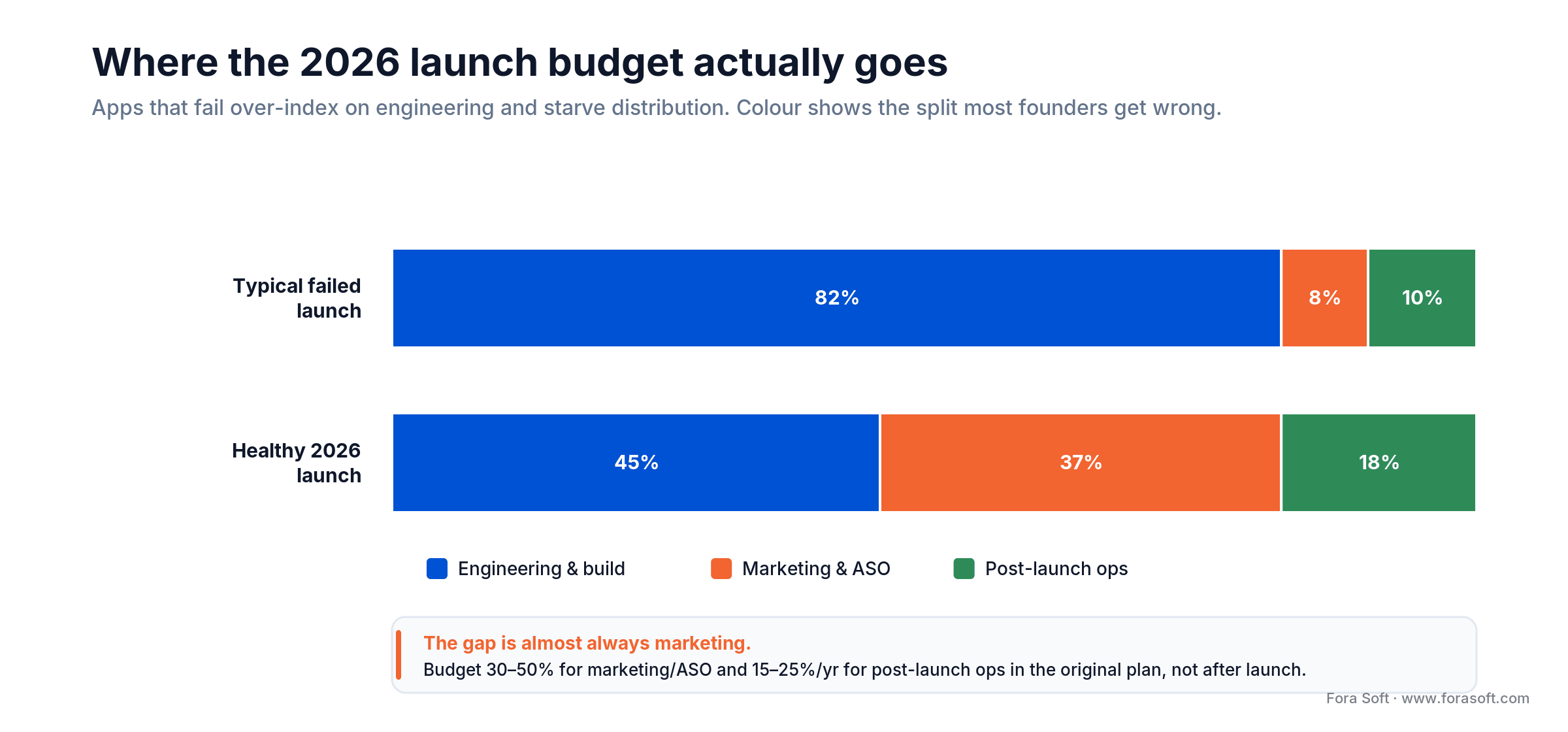
Figure 3. Failed launches over-index on engineering; healthy 2026 launches fund marketing/ASO and post-launch ops up front.
Recognise yourself in any of these mistakes?
We’ll spend 30 minutes on your plan and tell you which patterns to fix before code. No pitch, just an honest readout from a senior engineer.
Mistake 6: weak post-launch strategy
Launch isn’t the end. It’s the start of the product’s real life. Founders who treat launch as the finish line miss the next 12 months of compounding wins: monthly OS updates, weekly bug fixes, ASO iteration, retention experiments, monetisation tuning, and feature drops driven by user data.
Fix. Budget 15–25% of build cost per year for post-launch ops, or partner with the team that built it. Plan a 4-week, 8-week, and 12-week post-launch roadmap before launch day. Set up crash reporting (Sentry, Crashlytics), analytics (Mixpanel, Amplitude), and ASO dashboards (Sensor Tower, App Annie) on day one.
Mistake 7: picking the wrong platform stack
Native iOS / Android, Flutter, React Native, Kotlin Multiplatform, PWA — each is right somewhere. Founders who pick on vibes (“Flutter is hot”) without matching to the product end up with a code base that fights them. Examples: media-heavy products on React Native fight 60 fps animation; brand-critical products on Flutter ship sluggish on older Android; PWA-only products give up App Store distribution reach.
Fix. Match platform to product. Native for media, gaming, ARKit, real-time video. Flutter for B2B internal tools, lightweight consumer apps, design-system-driven UIs. React Native for teams already on React with simple animation needs. KMP for shared business logic between iOS/Android/web. Our native vs cross-platform decision guide covers the trade-offs.
Reach for native iOS/Android when: the product is media-heavy, AR-driven, or relies on platform-specific APIs (HealthKit, ARKit, Live Activities, App Clips). Cross-platform shines on B2B and content-driven apps; native still wins on the newest platform APIs.
Mistake 8: shipping iOS without Liquid Glass and Foundation Models awareness
iOS 26 (June 2025) introduced Liquid Glass, the translucent material design language, and the Foundation Models framework, which lets third-party apps run Apple Intelligence on-device. Apps that don’t adapt look dated; apps that don’t use Foundation Models for summarisation, classification, or rewriting send tokens to a third party unnecessarily — a real HIPAA / EU AI Act problem.
Fix. Run a 2–3 sprint Liquid Glass adaptation pass on existing iOS apps. For new apps, Liquid Glass-native by default. Wire Foundation Models for any feature where on-device AI is plausible — summarising chat threads, classifying user input, drafting writing. Save the cloud calls for the heavy lifting.
Mistake 9: missing Apple ATT and EU DMA compliance
App Tracking Transparency reshaped attribution since 2021; the EU Digital Markets Act in 2024–2026 reshaped distribution. By 2026 ATT-aware ad measurement is standard, and EU users can install via alternative app marketplaces. Founders who don’t adapt their attribution and distribution models lose visibility into their funnels and miss EU growth surfaces.
Fix. Use SKAdNetwork-aware attribution (AppsFlyer, Adjust, Branch) and design the ATT prompt copy carefully. For EU launches, evaluate alternative app marketplaces (AltStore PAL, Setapp Mobile) for niche reach. Don’t treat compliance as a checkbox; treat it as a marketing surface.
Mistake 10: bolting on AI features as marketing copy
By 2026 every consumer app needs an AI story. The temptation: bolt a generic chatbot on top, slap “AI-powered” on the App Store description. Users see through it instantly. The apps that succeed in the AI-native era have AI integrated into a specific user job-to-be-done, with eval suites and quality gates that catch regressions.
Fix. Pick one user job AI uniquely improves. Wire it deep, not wide. Set up an eval suite from day one to catch model swaps that regress quality. We’ve covered the discipline in our spec-driven agentic engineering playbook.
Top mistakes summary table: cost, timeline, fix
| Mistake | Typical cost when missed | Fix duration | Severity |
|---|---|---|---|
| Skipping idea validation | 25–50% of MVP rebuilt | 1 week pre-build | Critical |
| No wireframes | 15–25% rework | 1–2 weeks | Critical |
| Feature overload | 2–4 months delay | Cut scope, ship | High |
| Performance ignored | High uninstall rate | 2–3 sprints rescue | High |
| Under-budgeted ASO | Stagnant downloads | Ongoing | High |
| Weak post-launch | Churn spike year 1 | Year-long programme | High |
| Wrong platform stack | Full rewrite at scale | 3–6 months | Critical |
| No Liquid Glass / Foundation Models | Dated UX, ATT/HIPAA risk | 2–3 sprints | Medium |
| Missing ATT / DMA compliance | Attribution blind spot | 1–2 sprints | Medium |
| AI feature theatre | Trust erosion | Reset scope | High |
The combined pattern: how mistakes compound across a year-one launch
Each of the ten mistakes above is recoverable on its own. The trouble is that they cluster. The classic compound: a founder skips validation (1) and wireframes (2), so the team builds the wrong app. They overload it with features (3) to compensate for the missing user signal. Performance suffers (4) because nothing was profiled. Marketing (5) gets cut to fund engineering rework. Post-launch ops (6) becomes fire-fighting on bugs that wireframes would have caught. Twelve months later, the cost of the rebuild is more than the cost of just doing it right the first time.
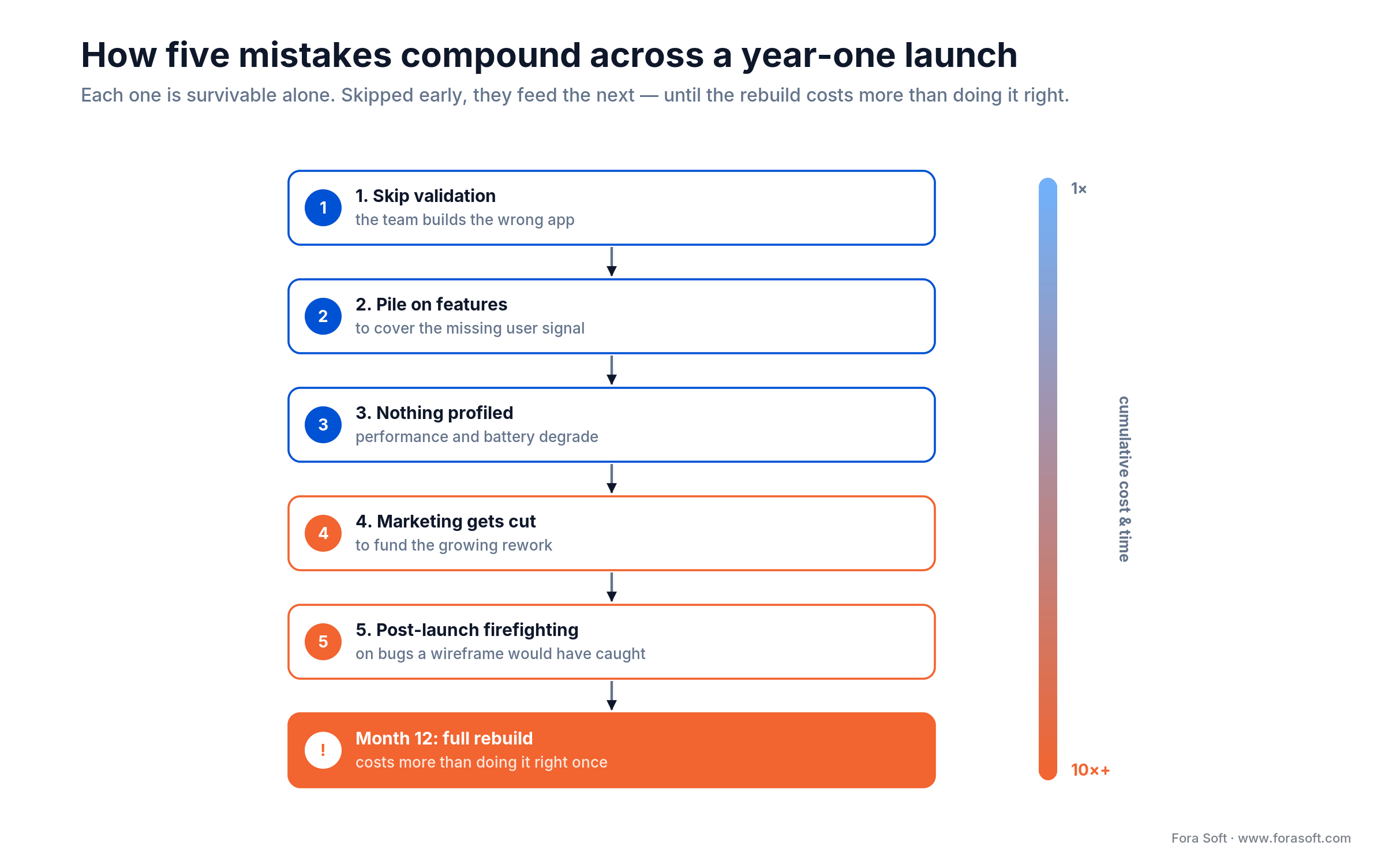
Figure 4. Skipped early, five mistakes feed each other until the rebuild costs more than doing it right once.
The fix is structural: insist on the validation sprint, the wireframe phase, and the focused MVP from the first day, even if the studio resists. Vendors who push back on these are saving themselves work, not your project.
Reach for an external second opinion when: your current studio refuses to build a wireframe before scoping or insists on T&M for greenfield work. Both are leading indicators of the compound mistake pattern.
Mini case: rescuing a mobile app that hit five of these mistakes
A mid-2025 client came to us six months and $180k in on a Flutter consumer app that wasn’t shipping. Diagnosis on intake: no validation (mistake 1), no wireframes (mistake 2), 47 features in scope (mistake 3), no profiling (mistake 4), no ASO (mistake 5). The previous studio had charged for surface area, not outcomes.
We ran a 2-week reset: 12 user interviews, a single Figma wireframe, a feature list cut to 5, a performance audit on the existing code, and an ASO keyword strategy. We then shipped the focused MVP in 9 weeks at an additional $58k. Three months post-launch: 4.4-star App Store rating, 38% week-4 retention, $14k MRR. The original spec would have produced a $260k app no one used. Want a similar reset for your project?
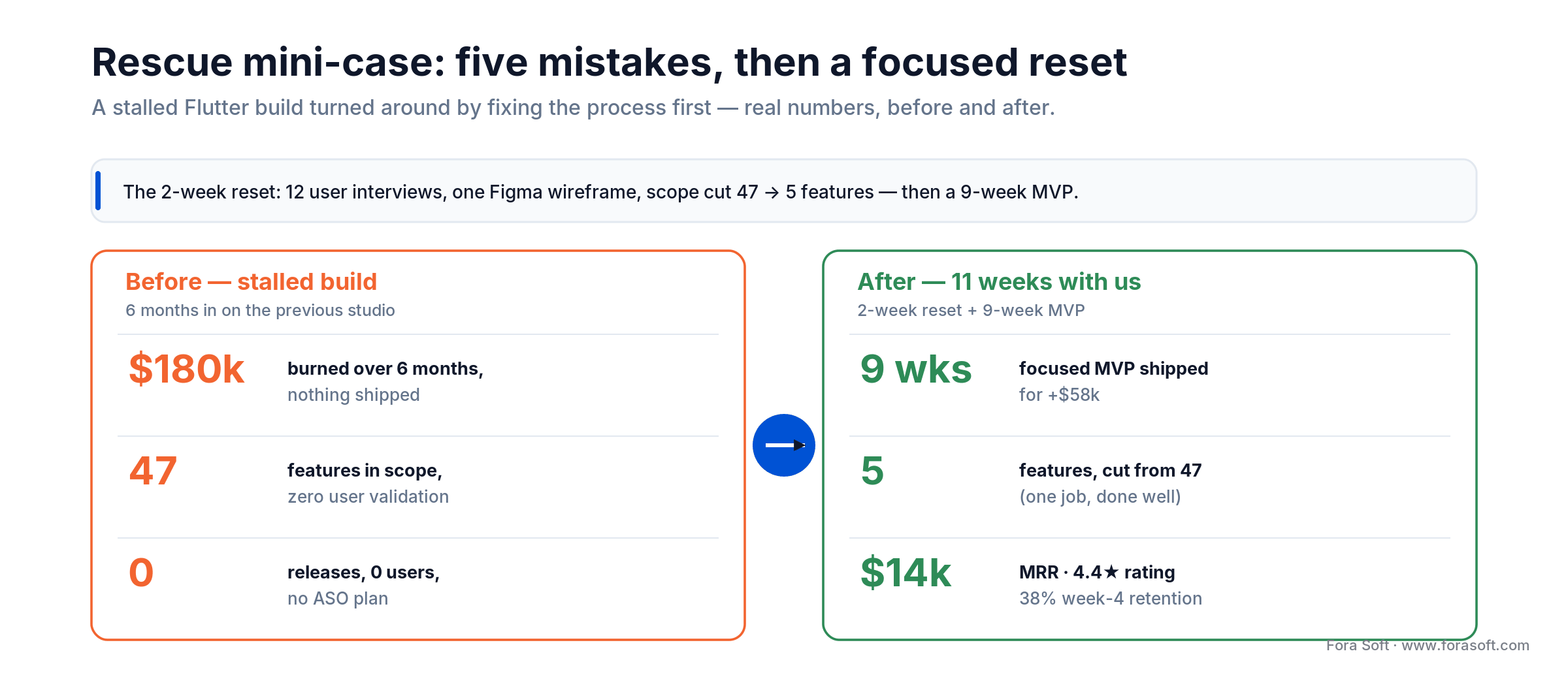
Figure 5. Fixing the process first: before-and-after numbers from a real rescue engagement.
A decision framework: pick a mobile app development partner in five questions
1. Do they insist on a 1-week validation sprint before scoping? If they accept your spec at face value, they’re booking revenue, not solving your problem.
2. Do they walk through a wireframe set before quoting? Vendors who quote off a vague brief always slip. Vendors who quote off a wireframe rarely do.
3. Are they comfortable cutting features? A studio that says yes to everything will ship a bloated app. The right partner pushes back.
4. Have they shipped on iOS 26 / Liquid Glass / Foundation Models in production? If they reference iOS 17 only, they’re a year behind.
5. Do they include performance, ASO, and post-launch in the original quote? Studios that bill for these as add-ons are signalling cash flow priorities, not your success.
Want our scoring against those five questions?
30 minutes, real engineering opinions, sample wireframes, performance audit checklist, fixed-range estimate at the end.
KPIs to watch in your first 90 days post-launch
Quality KPIs. Crash-free sessions (target ≥99.5%), ANR rate on Android (<0.05%), p95 cold start (<1.2 s), p99 frame drops (<1%), App Store rating (target ≥4.3 by week 8).
Business KPIs. Day-1 retention (target ≥55%), week-4 retention (target ≥25%), CPI in soft-launch markets, ARPU by month-3, conversion from free trial to paid (if applicable).
Reach for an instrumentation review when: any of those KPIs is missing from your dashboard. You can’t fix what you don’t measure.
Reliability KPIs. Bug burn-down rate, crash regression frequency, App Store / Play Store review velocity, response time to user reports (target <24 hours during launch month).
When NOT to build a mobile app at all
If your audience uses your product in 10-minute desktop sessions and never on the go, a responsive web app may serve you better. If you’re pre-product-market-fit and don’t have the budget for App Store optimisation and a year of ops, ship a PWA first and earn the right to a native build with revenue. If your distribution channel is enterprise procurement, web is almost always faster than App Store review.
Where mobile genuinely earns its budget is consumer products with daily-use frequency, on-the-go contexts, push-notification re-engagement, camera and sensor integration, or App Store discovery upside. Our custom software development services page maps the scope.
FAQ
What’s the single most expensive mobile app development mistake?
Skipping idea validation. We’ve audited dozens of failed projects, and 70% trace to assumptions about user needs that were wrong. A 1-week validation sprint at $5–15k saves $50–200k in rework downstream. Nothing else returns as much.
How much should I budget for marketing and ASO?
For a consumer mobile app at launch, 30–50% of total launch budget should go to user acquisition, ASO, and content marketing. For B2B mobile, the mix shifts toward sales enablement, but still don’t plan less than 20%. Apps with <10% marketing budget are usually the ones that fail to find an audience.
Is React Native still a credible choice in 2026?
Yes — especially after the New Architecture stabilised in 0.76 (late 2024). React Native works well for teams with React talent, business apps with simple animation, and teams who want shared code across platforms. It’s weaker on media-heavy products (video, audio, AR) where native still wins. Read our native vs cross-platform decision guide for the full breakdown.
How long does a mobile MVP take in 2026?
8–12 weeks for a focused single-platform MVP. 12–16 weeks for cross-platform iOS + Android. 16–22 weeks for media-heavy apps with custom audio/video pipelines. Agent Engineering compresses these by 2–4 weeks vs 2024 baselines, but a senior reviewer is non-negotiable on every PR.
Should I worry about Apple ATT and EU DMA?
Yes for any consumer app with paid acquisition or EU users. ATT changed attribution mathematics in 2021 and SKAdNetwork-aware tooling is now table stakes. EU DMA in 2024–2026 opened alternative app marketplaces, relevant for niche audiences. Treat both as marketing tools, not compliance overhead.
How does Liquid Glass change my existing iOS app?
Standard UIKit and SwiftUI apps inherit the new translucent style on system surfaces automatically. Custom UI that hard-codes blur radii, contrast values, or opacity stacks needs an audit — usually 2–3 sprints to tune legibility, accessibility, and motion settings. Apps that ignore Liquid Glass look 2024-vintage on iOS 26.
What does post-launch ops actually cost?
15–25% of build cost per year, distributed across bug fixes, OS updates, ASO iteration, retention experiments, and feature drops. For a $120k MVP, plan $18–30k/year for ongoing ops. Cheap-out and your launch traction will erode in months.
How does Fora Soft price a mobile MVP?
Most mobile MVPs land in the $40–130k range with a fixed-bid milestone structure depending on platform mix and feature scope. We use Agent Engineering to compress velocity, but every PR still goes through a senior human reviewer. Book a scoping call and we’ll quote a specific range against your spec.
What to read next
Buyer’s playbook
Mobile App Development Services
Native, Flutter, RN, KMP, PWA — how to choose.
Decision guide
Native vs Cross-Platform in 2025
When native wins, when cross-platform is cheaper.
Flutter
Is Flutter Worth It in 2026?
Performance, cost, hiring — the buyer’s lens.
ASO
iOS App Store Optimization Guide
Five levers, real numbers, agency vs in-house cost.
Estimation
Software Estimation in 2026
How to demand a defensible estimate from any vendor.
Ready to ship a mobile app that avoids these mistakes?
The mistakes above aren’t exotic. They’re predictable, recurring, and entirely avoidable with a partner who insists on validation, wireframes, focused MVPs, performance discipline, ASO budgeting, post-launch ops, and 2026-current platform awareness. The vendors who do this well charge no more than the vendors who don’t. The difference is in the conversations they have on day one.
If you’re scoping a mobile app in 2026 — consumer, B2B, telehealth, e-learning, marketplace, conferencing, surveillance — we can spend 30 minutes on your one-pager and tell you which of these ten mistakes are already in the plan. No pitch, just an honest readout from a senior engineer.
Get your mobile plan audited — before you spend a dollar on code
30 minutes, real engineering opinions, no slides, a fixed-range estimate at the end.

