

Key takeaways
• Most apps make almost nothing. About 81% of apps never reach $1,000 a month in revenue within two years, and only 4.6% reach $10K MRR (RevenueCat 2025). The top 1% of publishers take roughly 90% of store revenue. It is a power law, not a bell curve.
• The winners earn real money, and the money is moving. Global in-app spending hit $167B in 2025, and non-game apps out-earned games for the first time. TikTok led every app at about $6B, and ChatGPT reached about $3.4B (Sensor Tower).
• Subscriptions beat ads for almost everyone. 1,000 subscribers at $10/mo out-earn 100,000 ad-only users. Trial-start-to-paid runs 27–46% when onboarding is tight (RevenueCat 2025); ad revenue fell 15–25% after iOS ATT.
• Unit economics decide the outcome. 2026 cost-per-install averages ~$4.70 on iOS and ~$3.70 on Android (fintech $8–25). Payback of 4–9 months is normal; lifetime value has to beat acquisition cost by 3×.
• A real MVP is a low-to-mid five-figure build over 3–5 months with our AI-accelerated engineering. Budget 12–18 months of runway before break-even; anything cheaper is a prototype.
Why Fora Soft wrote this playbook
We have built software products since 2005 — 250+ projects across video streaming, SaaS, education, fintech, healthcare, and consumer apps. Some made their founders wealthy. Others made expensive lessons. Both kinds teach you what app revenue looks like on a real profit-and-loss statement, not on a pitch deck.
Take BrainCert, a virtual-classroom platform we build. It grew from an early MVP to $3M in annual revenue by 2024 (up 58% year over year, from $1.9M in 2023 and $1.5M in 2021) with 100K+ customers and 500M+ classroom minutes delivered — all bootstrapped, without a dollar of outside funding. TradeCaster, a livestream trading platform we shipped, passed 46,000 users on $99–$119/month subscriptions. When we talk about app earnings here, we are describing curves we have watched up close across our project portfolio.
This is not a "make $10K a month on your first app" article. It is the playbook we wish every founder read before they started: realistic revenue percentiles, monetization economics by category, the cost to build and the cost to market, and a framework for deciding whether to build at all. If you would rather talk it through than read, our custom software development team scopes ideas like yours every week.
Wondering if your app idea will actually earn?
We will stress-test your concept against real revenue percentiles and tell you, bluntly, whether it clears the bar. Free 30-minute call, no deck required.
How much can an app make? The short answer
How much can an app make? Anywhere from $0 to tens of millions of dollars a month — but the median app makes under $1,000. About 81% of apps never reach $1,000 a month in revenue within their first two years, and only 4.6% reach $10K MRR (RevenueCat 2025), while the top 1% of publishers capture most store spending (Developer Nation). The gap between those facts is the whole game.
The realistic version: a well-run subscription app that finds product-market fit usually reaches $10K–$50K in monthly recurring revenue (MRR) by month six, and $30K–$200K by month twelve. Category leaders in productivity or fitness can cross $100K MRR inside a year. Everyone else — the long tail — struggles to cover the build cost.
Your number depends on four things: the monetization model, the category, how well you keep users, and what it costs to acquire them. The rest of this playbook shows how to push each of those levers so you land in the top 17% that clears $1,000 a month instead of the ~81% that never does.
Aim for the top 10% when: your app charges real money for value people need weekly, and you have at least one proven way to reach buyers before launch. If you cannot name that channel, fix it before you write code.
The honest revenue distribution — where your app will land
App-store economics follow a power law. A handful of apps capture most of the money; everyone else fights for scraps. The tiers below use RevenueCat’s 2025 data on where apps actually land after two years.
| Tier | Share of apps | Typical monthly revenue | What it looks like |
|---|---|---|---|
| Top 0.1% | ~0.1% | $2.5M–$80M+ | Tinder, ChatGPT, the top mobile games |
| Top 1% | ~1% | $100K–$2.5M | Funded category leaders |
| Reach $10K MRR | ~4.6% | $10K–$100K | Strong niche or category winner |
| Reach $1K MRR | ~17% | $1,000–$10,000 | Established product, growing organically |
| Everyone else | ~81% | Under $1,000 | Most never recover their build cost |
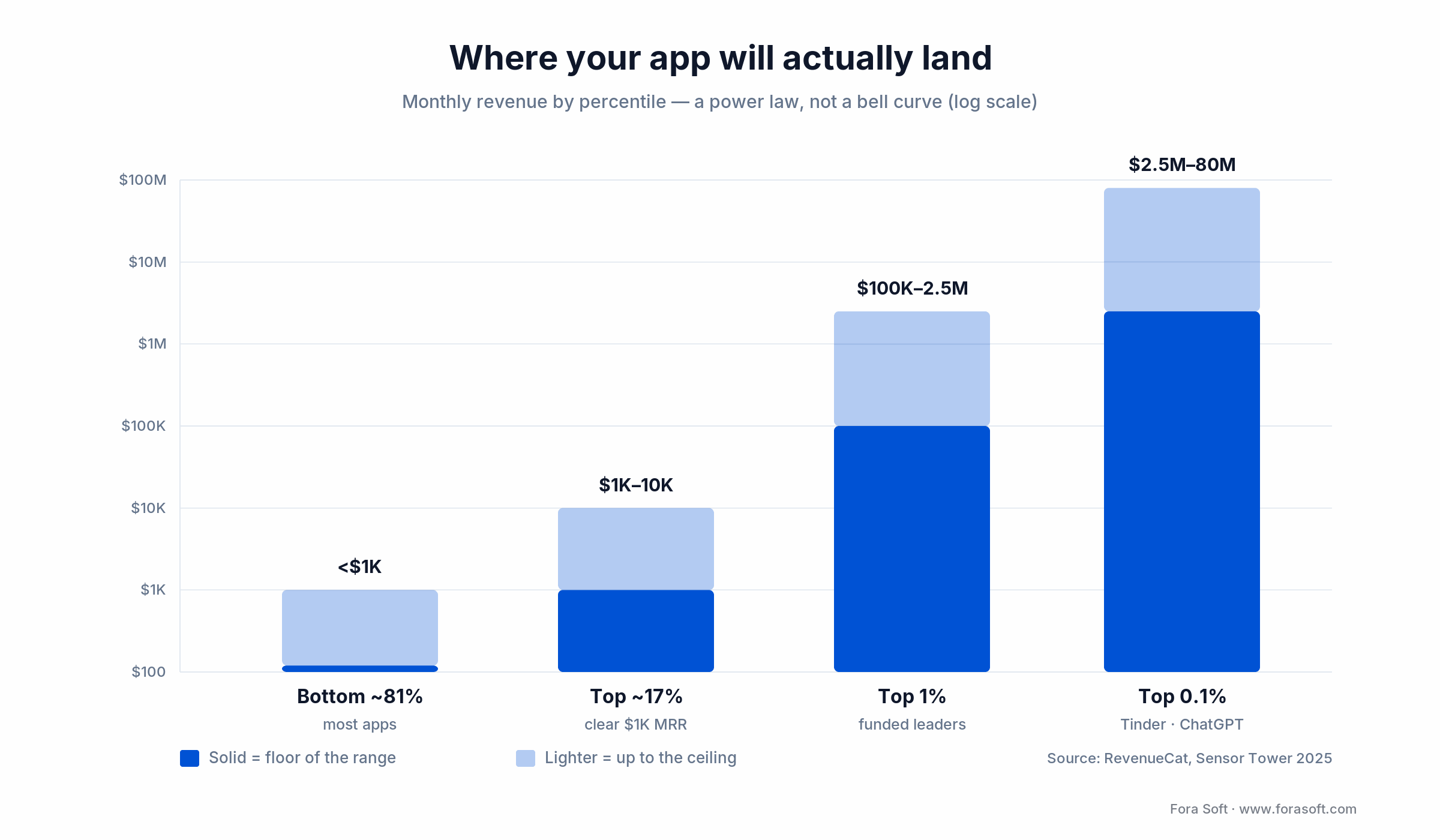
Figure 1. Monthly revenue by tier on a log scale. The solid bar is the floor of each range; the lighter extension reaches the ceiling.
The takeaway: the median app is economically invisible. If your plan is "build an app to replace my salary," the math only works if you reach the top 17% that clear $1,000 a month — and ideally the ~5% above $10K MRR. That takes product-market fit worth paying for, paid acquisition with sane unit economics, or (most often) both.
What the 2026 app market actually looks like
The pie is big and it is shifting. Global in-app purchase revenue reached $167B in 2025, up 10% year over year (Sensor Tower). For the first time ever, non-game apps out-earned games — consumers spent about $85B in non-game apps (+21%) versus about $82B in games (+1.3%). The engine behind that shift is subscriptions and AI.
AI is the loudest signal. In-app revenue from generative-AI apps more than tripled in 2025 and passed $5B for the first time, with ChatGPT alone generating about $3.4B. People spent 48 billion hours in GenAI apps last year, 3.6× the year before. If you are adding an AI layer, our AI integration team can tell you where it earns its keep and where it is just a demo.
For a founder, two things follow. First, the money is real and growing, so the opportunity is not imaginary. Second, concentration at the top is extreme, so "there is a lot of revenue in the market" is not the same as "you will get some." Plan for the distribution in the previous section, then use the freshest tailwind — recurring revenue and AI utility — to climb it.
The five monetization models and when each one works
Most apps mix two or three models. The right mix depends on category, audience, and how often people open the app — not on what feels comfortable to build.
1. Subscription (auto-renewable)
Best for. Productivity, fitness, dating, language learning, streaming, AI assistants — anywhere the user gets value again and again. Consumer subscription ARPU varies widely by category, with productivity and AI tools at the high end and fitness lower (2025 RevenueCat and Adapty data). When the trial-to-paid flow is tight, 27–46% of trial starts convert; weekly trials convert better than monthly.
2. In-app purchases (consumables and durables)
Best for. Mobile games (about half of all IAP revenue), dating apps (boosts, super-likes), creative tools (credit packs). Free-to-paid conversion is usually 1–5%; top games reach 4–8%. IAP rewards depth of engagement, so it lives or dies on session frequency.
3. Advertising (banner, interstitial, rewarded video, native)
Best for. Casual and hyper-casual games, news, and utilities with daily sessions. Rewarded video pays best (iOS US eCPM around $12–20); banners pay least (~$0.50–$2). After iOS App Tracking Transparency, ad revenue dropped 15–25% industry-wide. Ads only pay real money at millions of sessions a month.
4. Paid apps and one-time purchase
Best for. Pro and utility tools whose users hate subscription fatigue. Margins are high (70%+ after the store fee), but lifetime value caps at the purchase price. This works only if your app-store optimization pulls a steady stream of new buyers.
5. B2B SaaS / seat-based pricing
Best for. Vertical tools for teams, compliance-heavy workflows, data platforms. ARPU is an order of magnitude higher ($50–$500+ per seat per month), acquisition cost is higher (~$1,200 blended is common), and payback stretches to 8–9 months. The reward: annual retention often above 90%, which compounds into 4–5× LTV multiples.
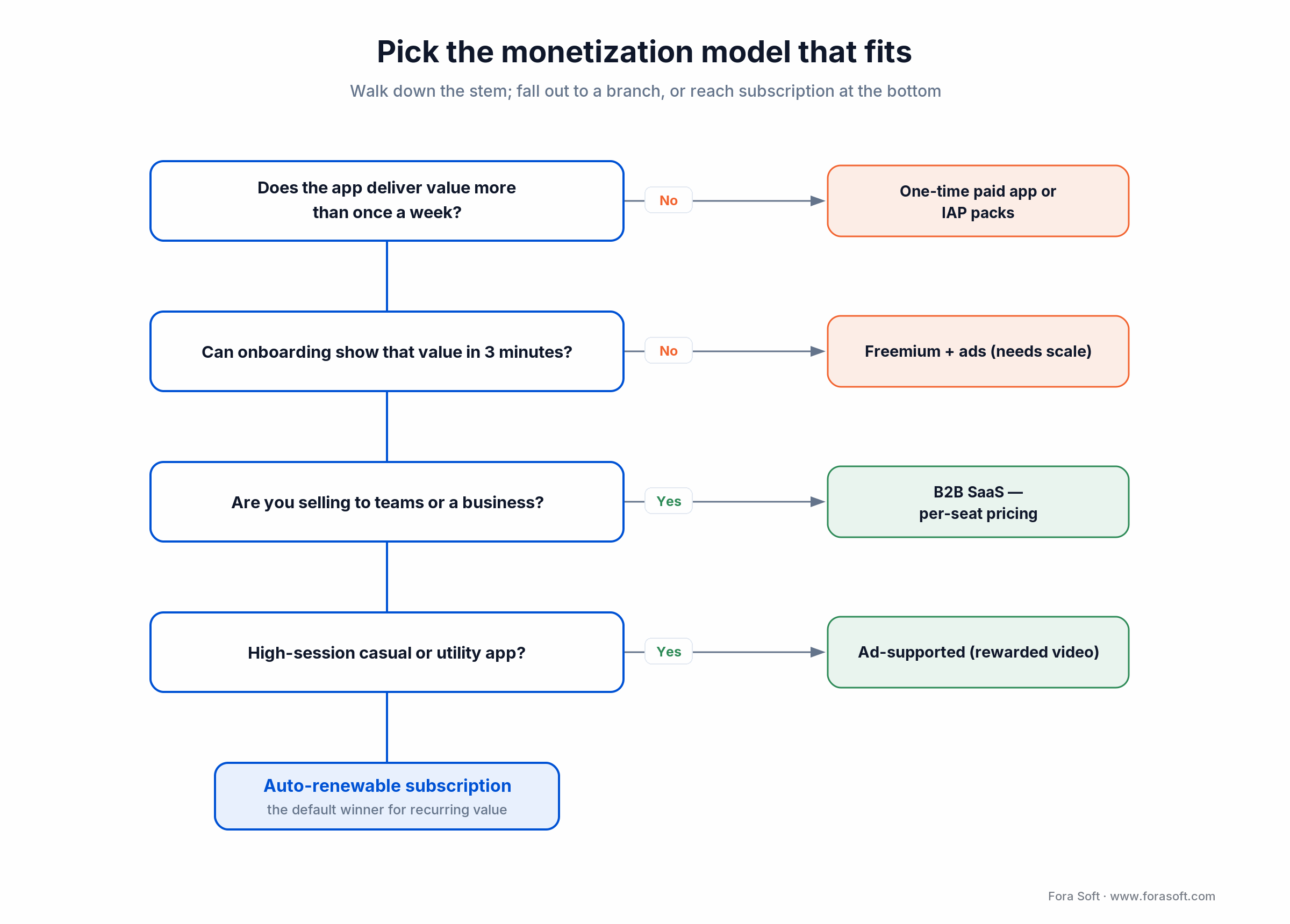
Figure 2. Walk down the stem. Fall out to a branch when the answer fits; reach subscription at the bottom if none do.
Reach for subscription first when: your app delivers value more than once a week and onboarding can prove that value inside the first three minutes. If either assumption breaks, pick a different model.
How much can an app make from advertising?
Ad revenue is real, but it is thin unless you have scale. A typical non-gaming app earns roughly $0.01–$0.05 per monthly active user from ads, so 100,000 monthly active users might clear $1,000–$5,000 a month. The format matters: rewarded video pays best (iOS US eCPM around $12–20), interstitials less, banners least (~$0.50–$2). After iOS ATT, blended ad revenue fell 15–25% across the industry.
Here is the comparison that reframes the question. Ads reward reach; subscriptions reward value. A modest subscriber base out-earns a large ad audience because paying users are worth far more than an impression.
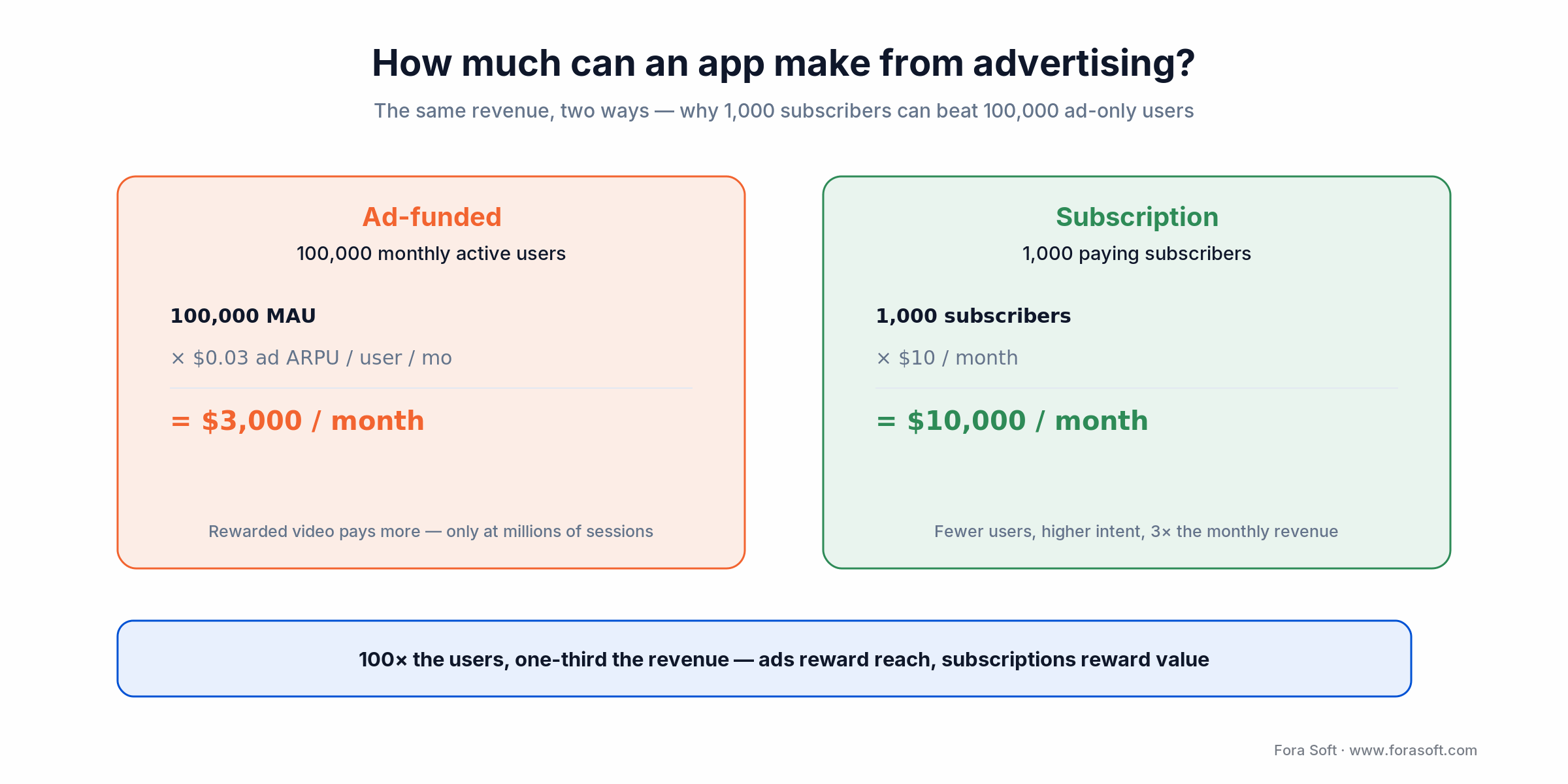
Figure 3. The same revenue two ways. 100,000 ad-supported users clear about $3,000/month; 1,000 subscribers at $10 clear $10,000.
So the honest answer to "how much can an app make from advertising" is: enough to matter only when you already have millions of sessions a month. For most apps, ads are a side dish, not the main course. If your app has huge, high-frequency usage — a casual game, a utility people open ten times a day — ads can carry the model. Otherwise, treat ad income as a supplement to a subscription or IAP core.
Reach for ads as your primary model when: you have a high-session casual or utility app with millions of monthly sessions and near-zero willingness to pay. Below that bar, ads will not replace a subscription line.
ARPU and trial-conversion benchmarks by category
These are planning floors from the 2025 RevenueCat and Adapty subscription reports, which cover well over 100,000 apps. One clarification that trips up most founders: "free-to-paid" (of everyone who installs) and "trial-to-paid" (of people who start a free trial) are different numbers. Install-to-paid is low single digits; trial-start-to-paid is much higher.
| Category | Blended ARPU / mo | Trial start → paid | Annual retention |
|---|---|---|---|
| Productivity | $15–$40 | 40–50% | 55–70% |
| Health & Fitness | $8–$15 | 30–42% | 40–60% |
| Dating | $20–$40 | 35–45% | 25–40% |
| AI / GenAI tools | $10–$30 | 25–40% | 30–50% |
| Streaming video | $8–$15 | n/a (no trials) | 60–80% |
| Ed-tech (B2C) | $10–$20 | 35–50% | 40–55% |
| B2B SaaS (per seat) | $50–$500 | 60–80% (trial or demo) | 85–95% |
Multiply expected monthly ARPU by realistic annual retention to get a rough lifetime value. If LTV is under 3× your acquisition cost, you do not have a business yet — you have a hobby with an occasional good month. The next section shows how to run that acquisition math.
Platform fees in 2026 — Apple, Google, the US ruling, and the EU DMA
Store fees are no longer a flat 30%. In 2026 they are a matrix, and your effective take-rate is a line item in your model, not a footnote. Two 2025–2026 changes moved real margin.
The US external-payment change. After the April 2025 Epic v. Apple contempt ruling and the December 2025 Ninth Circuit decision, US apps can link out to web payment with no Apple commission — you keep everything except the ~3% a payment processor charges. The fee question was remanded in April 2026, so the exact "reasonable" number may still move; check before you re-architect. Our guide on reducing Apple’s commission walks the web-payment and DMA routes.
The EU DMA change. From January 1, 2026, Apple replaced the old per-install Core Technology Fee with a 5% Core Technology Commission on digital-goods revenue, applied across the App Store, web distribution, and alternative marketplaces. It buys back margin but adds compliance and engineering work.
The baseline still applies. Standard commission is 30%, dropping to 15% after a subscriber’s first year. The Small Business Program is 15% if you earn under $1M a year. Google Play mirrors this and shaves a few points more with User Choice Billing. Build your model at 15% for a small-business app and 30% for a top performer.
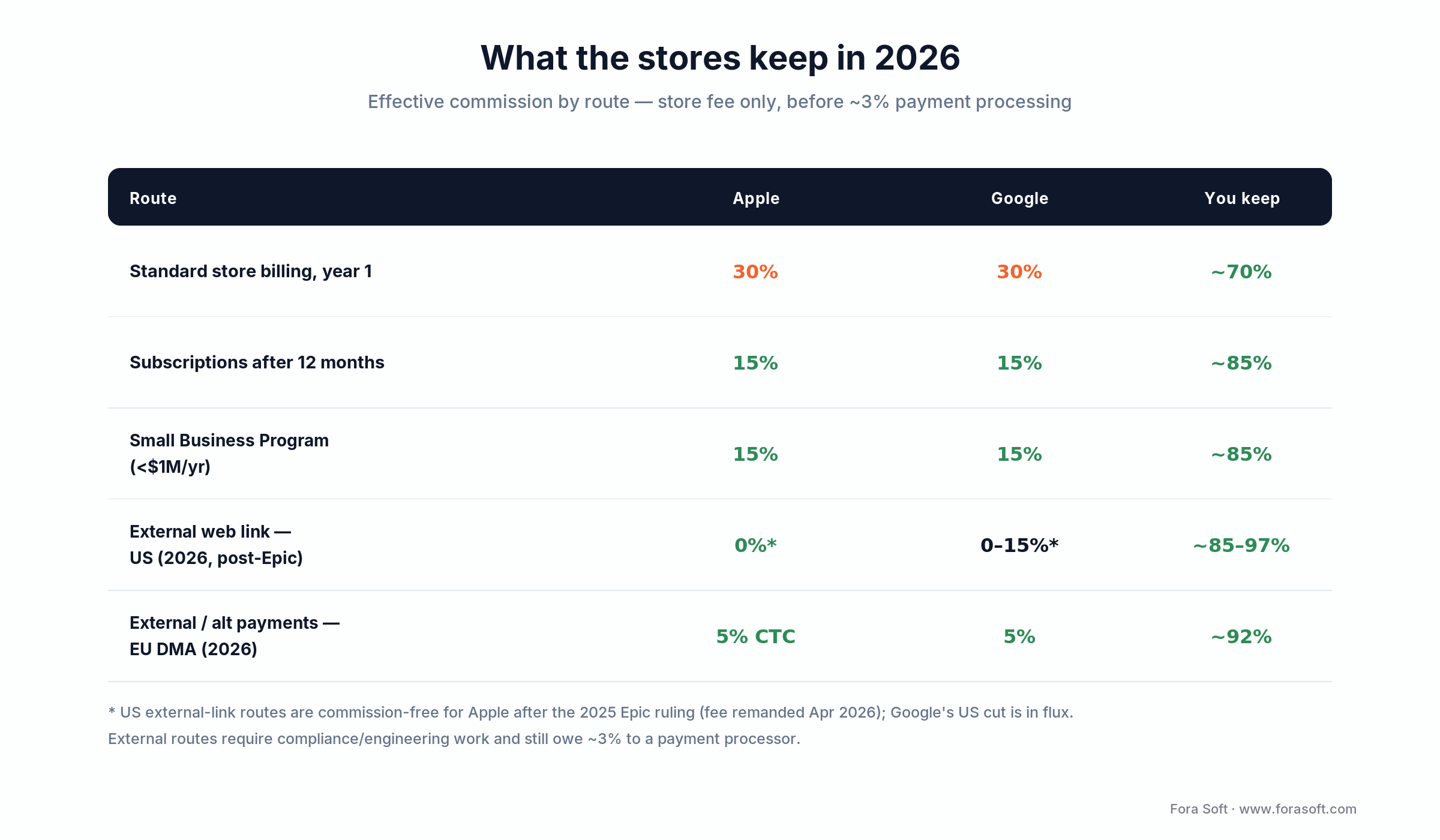
Figure 4. Effective store commission by route in 2026. US external-link routes are commission-free for Apple after the 2025 Epic ruling; the EU charges a 5% Core Technology Commission.
Reach for external payments when: you are large enough that saving 15–25 points beats the engineering and compliance cost of running your own billing — and you can absorb rule changes as the US case settles.
Need to model app revenue for investors?
We build financial models alongside the product, so your fundraising deck matches the engineering reality. Send us a napkin sketch and we will return a grown-up plan.
CAC, LTV, and the unit economics that separate apps from hobbies
You do not need a finance degree to run these numbers. You need three inputs: what it costs to acquire a user, how much they pay you over their lifetime, and how long it takes to earn that acquisition cost back.
Cost per install (CPI). In 2026, CPI averages about $4.70 on iOS and $3.70 on Android, up roughly 60% over five years. Fintech is among the most expensive ($8–25; finance apps around $8.23) because each user is worth so much. Gaming is cheapest on a blended basis (~$0.56), though mid-core games run $10–20. iOS costs 2–3.5× more than Android in top markets, but iOS lifetime value also runs 2–3× higher.
Cost per paying user (CPA). Multiply CPI by 1 divided by your conversion rate. If free-to-paid conversion is 3% and CPI is $4, your CPA is about $133. That is the number your lifetime value has to beat by 3× — so you need roughly $400 of LTV per paying user to have a healthy business.
Payback period. In 2026, well-monetized B2C apps see payback at 4–6 months; B2B SaaS at 8–9; hyper-casual games at 2–3. Anything over 12 months is a capital-efficiency problem — investors will flag it, and so should you.
The ATT reality check. Roughly three in four iOS users opt out of tracking, so attribution is murky and blended CPI is harder to read. If you plan to scale paid acquisition on iOS, budget 20–30% of engineering time for SKAdNetwork, the Conversions API, and server-side event tracking.
A realistic revenue ramp — month 1, 3, 6, 12, 24
Every founder wants the hockey stick; almost nobody gets it in month one. Here is how a well-executed subscription B2C app tends to ramp with a $20K–$50K monthly paid-acquisition budget.
Month 1 (launch). $0–$3,000 MRR, mostly founder-network installs and early organic. Expect no predictable revenue yet.
Month 3. $3K–$15K MRR if you iterated onboarding twice and started paid acquisition; $0–$1K if you "launched and waited." This is where most apps quietly die.
Month 6. $10K–$50K MRR if product-market fit landed. You should see positive contribution margin on paid acquisition; if not, fix the offer before you raise.
Month 12. $30K–$200K MRR. Category leaders in productivity or fitness often cross $100K MRR by month twelve; B2B tools take longer but retain better.
Month 24. Successful cases reach $150K–$1M+ MRR. The rest have closed or become side projects. Year-two churn is the silent leak: at 5% monthly churn you lose about half of any cohort within 14 months.
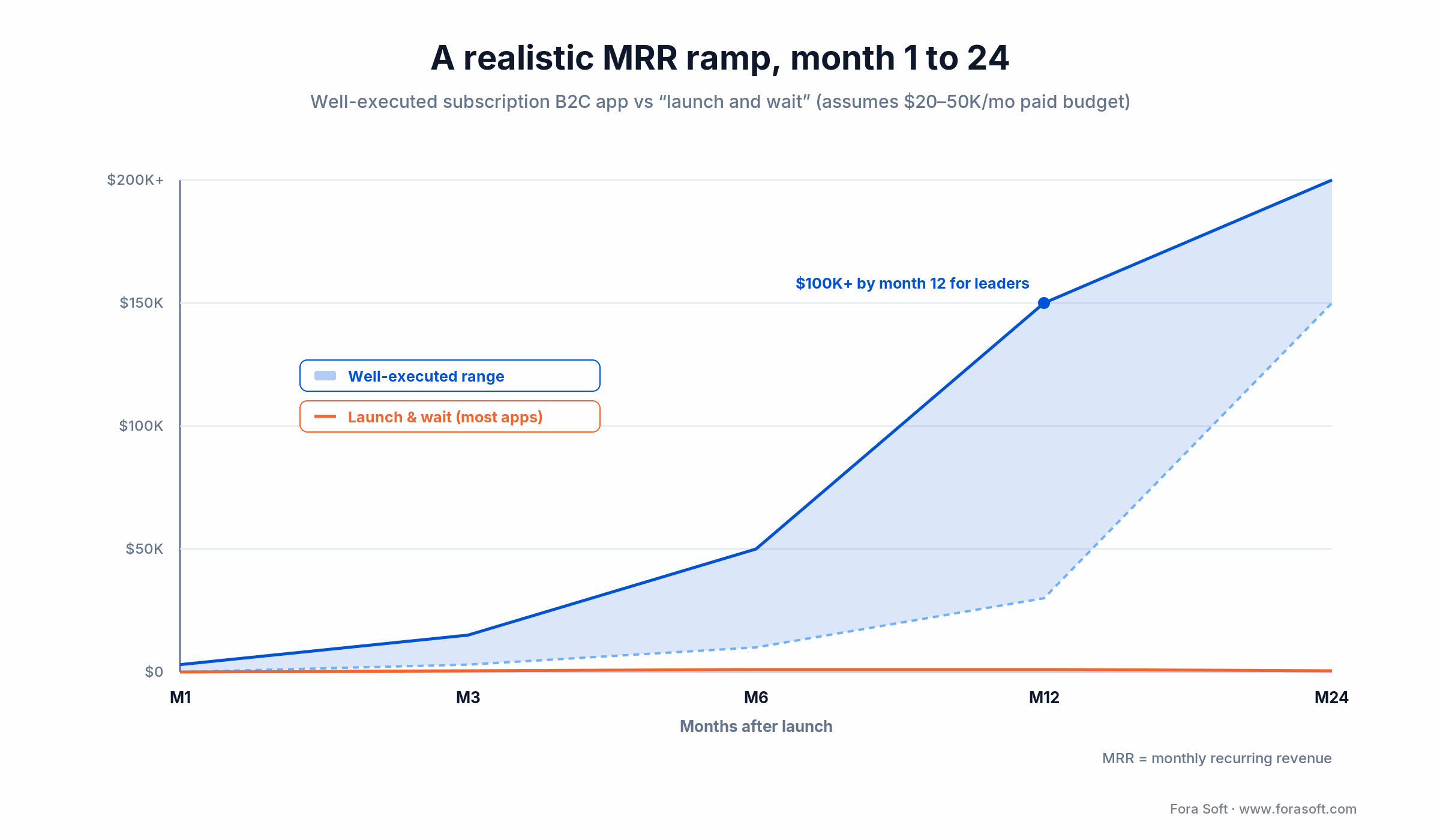
Figure 5. A well-executed subscription B2C ramp versus “launch and wait.” The gap is execution: onboarding, paid acquisition, and retention.
What does it actually cost to build an app in 2026?
With AI-accelerated engineering, timelines and budgets for well-scoped projects have compressed 20–35%. These are the ballpark ranges we see on our own deliveries.
| Scope | Typical duration | What it fits |
|---|---|---|
| Prototype / click-through | 2–3 weeks | Investor conversations, usability tests |
| Lean MVP (one platform) | 3–5 months | One core flow, no admin, minimal integrations |
| Cross-platform MVP (iOS+Android+web) | 5–8 months | Full subscription flow, admin, analytics, basic integrations |
| Scale-ready product | 9–14 months | Multi-tenant, compliance, analytics, content pipelines |
| Marketing spend (year 1) | Ongoing | Typically 1.5–3× build cost in paid + content + ASO |
We avoid hard dollar quotes on a public page because the same MVP scope swings 2–3× by hardware target, compliance class, and whether you need content production. For numbers against your spec, see our mobile app cost guide or book a scoping call. Lean teams should also read how to cut software-project costs without hurting velocity, and consider a dedicated development team once the roadmap is clear.
Reach for a full cross-platform build when: you already have paying users on one platform and the second platform’s audience is provably worth the added cost. Before product-market fit, ship one platform and go deep.
Mini case — BrainCert’s real revenue curve
Situation. BrainCert was a small ed-tech startup building a virtual-classroom product. The early MVP had video calls, quizzes, and a course builder — enough to sign the first paying schools, not enough to scale. Crucially, the team wanted to grow without raising outside money.
The plan. We invested in the revenue-shaping features: multi-tenant SaaS with per-seat billing, a WebRTC classroom that holds 100+ participants, adaptive-bitrate streaming for shaky networks, LTI integrations for universities, and a subscription-first onboarding funnel. Go-to-market shifted from "contact sales" to self-serve up to 50 seats, with an enterprise upgrade path above that.
Outcome. BrainCert grew from about $1.5M in revenue (2021) to $1.9M (2023) to $3M in 2024 — 58% year-over-year growth, 100K+ customers, and 500M+ classroom minutes, all bootstrapped. The pattern generalizes: ship the smallest viable product, land an anchor customer, then invest in billing and retention before feature breadth. Want the same diagnosis for your product? Book a 30-minute scoping call.
Which app categories actually pay in 2026
Not every category rewards effort equally. Here is the current picture, ranked by revenue per user and retention quality.
1. B2B vertical SaaS. Highest ARPU, best retention, hardest sales cycle. Niche tools for healthcare, legal, construction, and finance clear $50–$500 per seat per month at 85–95% annual retention. This is where patient founders win.
2. Productivity subscriptions. Notion-style and AI-assistant tools sit at the top of consumer subscription ARPU. If the AI wave fits your skill set, the ceiling here is the highest in consumer.
3. Dating and fitness. Huge installed bases and mature monetization, but brutal competition. The leaders dominate; viable niches remain (sport-specific, demographic-specific).
4. Streaming and content. Highest retention (60–80% annual) but lowest per-subscriber ARPU, and content costs are real. Our streaming monetization guide and the video streaming fundamentals in our Learn hub cover the hybrid pricing patterns we use.
5. AI / GenAI tools. The fastest-growing category (IAP more than tripled in 2025) but saturating fast — roughly a quarter of new apps now claim an AI angle. Pick a vertical and own it; the AI-for-video engineering track shows how narrow specialization beats a generic wrapper.
6. Mobile games and consumer utilities. Economics still favor the top 0.1%. Most indie devs here earn under $1K a month. Enter with caution and a proven genre-fit prototype.
A decision framework — should you build at all, in five questions
Q1. What is the smallest market you can win entirely? "Yoga instructors in Germany running paid classes" beats "people who exercise." A small market either pays you or proves the idea cannot work — both are useful.
Q2. What is the willing price? Ask five potential users their annual budget for the problem. If the median is under $50, you will need millions of users to matter; pick a different problem.
Q3. How will users find you? Paid, referral, content, partnership, or distribution. If the answer is "app-store optimization and hope," you have no growth engine. Apps with one proven channel before launch outperform apps without by about 3×.
Q4. Can you fund 18 months of operating runway? Build cost is one slice; you also need marketing, content, support, and iteration money. If runway is under 12 months, raise more or shrink the scope.
Q5. What is your kill switch? Decide in advance: if after six months you have not hit $X MRR, you change the plan. Without a kill switch, founders spend two years on an app the market already rejected.
Five pitfalls that quietly wreck your app’s revenue
1. Confusing downloads with revenue. Downloads are vanity; activation, trial starts, and paid conversion are the numbers your profit-and-loss hears. A 500K-download app at 0.5% conversion and $10 ARPU earns less than a 20K-download app at 5% conversion and $40 ARPU.
2. Underpricing because "users won’t pay more." Almost every founder underprices. Double your subscription price in the next A/B test; conversion usually drops less than revenue rises. RevenueCat data shows weekly trials at 3× the price convert nearly as well as monthly trials at 1×.
3. Ignoring churn until year two. 5% monthly churn sounds fine until you compound it — you lose about half of any cohort within 14 months. Measure churn by cohort from month one; anything over 6% on annual plans or 10% on monthly plans needs investigation before you scale paid acquisition.
4. Leaning on ads as the primary model. Post-ATT iOS economics broke ad-only apps that were borderline before. Without millions of monthly sessions, ads are a side dish, not the main course.
5. Building for 18 months before a single user interview. Every week you code without talking to a paying user compounds risk. Interview 20 real buyers before month two; their feedback beats any design review.
Need a second opinion on your monetization plan?
We review monetization funnels as part of every engagement. Send us your app and we will tell you where the revenue is leaking.
When an app is not the right business model
An app is not always the answer. A focused web app (PWA), a paid newsletter, a Shopify store, or a community on an existing platform often beats a native app on return — especially when your audience is small and your content is the product.
Skip building an app when the feature set is purely informational (a website will do), when the audience is under 10,000 and hard to grow, when you have no marketing budget, or when you are chasing a category owned by three giants with billion-dollar war chests. In those cases, pick a smaller vehicle and keep your cash. Honesty here is cheaper than a year of runway.
KPIs to track from day one
Quality KPIs. D1 retention above 40% for consumer apps, D7 above 20%, D30 above 10%. Trial-to-paid above 25% for subscription products. Net promoter score above 30 by month six.
Business KPIs. MRR growth month over month; CAC payback under 9 months; LTV-to-CAC above 3; gross margin net of store fee above 65%; organic-to-paid mix trending toward 60/40 by month twelve.
Reliability KPIs. Crash-free sessions above 99.5%; API p95 latency under 500ms; billing-error rate under 0.1%. Subscription apps live or die on the billing pipeline running clean.
Funding your app — bootstrapped, angel, seed, or revenue-based
The money model shapes the product. Bootstrapped founders aim for profitability fast; venture-backed founders aim for scale; revenue-based finance fits predictable SaaS with clear unit economics. BrainCert, above, is proof that bootstrapping to several million in revenue is possible when retention is strong.
If you are raising, our guide on how to get investment for your app covers the metrics investors actually check. A rule of thumb: you need a working product, a first cohort of paying users, and at least 4–8 weeks of MRR data before seed investors take the conversation seriously.
FAQ
How much can an app make realistically?
The median app earns under $1,000 a month: about 81% of apps never cross that line within two years, and only 4.6% reach $10K MRR (RevenueCat, 2025). A well-run subscription app that finds product-market fit typically reaches $10K–$50K MRR by month six and $30K–$200K by month twelve. The top 1% of publishers capture roughly 90% of all store revenue.
How much can an app make from advertising?
Roughly $0.01–$0.05 per monthly active user for a typical non-gaming app, so 100,000 users might clear $1,000–$5,000 a month. Rewarded video pays best (iOS US eCPM ~$12–20), banners least (~$0.50–$2). Ads only replace a subscription line at millions of sessions a month; below that, they are a supplement.
How much can a solo indie developer make from one app?
Honest median: under $1,000 a month. A realistic top-quartile solo result is $3,000–$15,000 a month after 12–18 months of work with tight niche positioning and subscription monetization. Six-figure solo outcomes happen, but they usually pair strong app-store optimization with one viral moment.
Subscriptions or ads — which makes more money?
For almost every app except hyper-casual games and very high-session utilities, subscriptions win. $10/mo from 1,000 subscribers beats ads from 100,000 monthly users in most categories, and ad revenue also fell 15–25% after iOS ATT.
How long before my app is profitable?
Assuming solid product and go-to-market: 12–18 months to cover the build cost, and 18–30 months to break even on total year-one investment including marketing. Plan for 24 months of runway; prepare mentally for 30.
Do I need to ship on both iOS and Android?
Not at launch. Pick the platform where your target audience spends most. iOS pays about 2× the ARPU; Android has bigger reach. Adding the second platform after product-market fit is cheaper than managing both during the zero-to-one phase.
Can I avoid Apple’s 30% cut?
Increasingly, yes. The rate drops to 15% after a subscriber’s first year and under the Small Business Program (below $1M/yr). After the 2025 US Epic ruling, US apps can link to external web payment with no Apple commission (you still pay ~3% to a processor); the EU allows alternative payments under a 5% Core Technology Commission. See our Apple commission guide for the routes.
What is a realistic MVP budget in 2026?
Ranges are wide because scope is. A lean single-platform MVP with our AI-accelerated engineering typically lands in the low-to-mid five figures; a cross-platform MVP with subscription billing, admin, and analytics lands in the low six figures. The mobile app cost guide has line-item breakdowns.
What to read next
Cost
Mobile App Development Costs Guide
Line-item budgets and the levers that move them up or down.
Funding
How to Get Investment for Your App
What investors actually want to see before signing the term sheet.
Monetization
Streaming Platform Monetization Strategies
Subscription vs ad-supported vs hybrid, with real unit economics.
Fees
How to Reduce the Apple App Store Commission
The DMA, small-business program, and web-side billing routes explained.
Engineering
Cutting Costs on a Software Project
Where to save without hurting velocity or quality.
Ready to build an app that actually earns?
The winning recipe is unglamorous: find the smallest market where you can charge real money, ship a lean MVP in 3–5 months, prove willingness to pay before scaling acquisition, price high enough that lifetime value beats acquisition cost by 3×, and keep working churn long after the product feels "done." Apps that follow this script reliably land in the top 10% of earners. Apps that skip a step mostly never earn back their build cost.
If you want a second opinion on the revenue plan behind your idea — or an engineering partner to actually ship it — that is our job. We have done it 250+ times since 2005.
Ready to pressure-test your app business case?
Bring us your idea, your market, and your numbers. We will come back with a scoping plan and an honest revenue forecast in 48 hours.

