

Key takeaways
• Video streaming app monetization is now a routing decision. In 2026 a $9.99 sub nets $6.99 at the 30% store rate, $8.49 at 15%, or $9.40 on the web. Since the 2025 US ruling you can link straight out to web billing from an iOS app at 0% Apple commission, so the fee is a choice you route around, not a fixed tax.
• Content shape picks the model, not the trend cycle. Evergreen and repeatable points to SVOD, disposable-at-scale points to AVOD with server-side ads, one-off events point to TVOD or pay-per-view. Almost every serious app lands on a hybrid of two or three.
• Billing is infrastructure you buy, not features you build. StoreKit 2, Play Billing, RevenueCat, Stripe, multi-DRM and server-side ad insertion cover trials, restores, chargebacks, price localization and the EU external-payment route. Rebuilding that later is a rewrite.
• Watch churn harder than ARPU. RevenueCat’s 2025 data puts the median subscription app near 13–14% monthly churn; mature video SVOD runs far lower, but only if you ship pausing, downgrades and win-back offers in v1.
• Realistic build with Fora Soft: a monetized mobile video app (iOS, Android, a light web mirror) lands at 16–20 weeks and $110–180k; a hybrid stack with server-side ads and DRM sits at 24–30 weeks and $190–300k, with creator payouts adding 10–14 weeks.
Why Fora Soft wrote this mobile monetization playbook
Pick the wrong billing model and you find out slowly, then all at once: the 30% store cut quietly eats the margin you needed for content, and by the time the board asks why unit economics are underwater, the fix is a billing rewrite. We’ve watched teams lose a year to that. This video streaming app monetization playbook is the version we wish those teams had read first: the models, the 2026 fee reality, the billing stack and the numbers, in the order you actually decide them.
Fora Soft is a software development company that has built video products since 2005, 250+ of them, with a 50-engineer in-house team. On mobile we ship Apple StoreKit 2 and Google Play Billing next to Stripe and Adyen, wire FairPlay and Widevine DRM, and run subscriptions through RevenueCat as routine work. The numbers below come from real app P&Ls, cross-checked against Apple and Google developer docs, RevenueCat’s 2025 benchmarks and public platform reporting.
Cases you’ll see referenced below are all shipped work: Vodeo, a ticket-based TVOD cinema on iOS; Tradecaster, a hybrid SVOD-plus-ad-tier live trading app; Bellicon Home, a 530-workout fitness SVOD on iOS and Android; and Tapereal, a creator streaming app with virtual-gift payouts. We work with Agent Engineering (engineers paired with AI copilots), so the estimates here sit below typical agency rates on purpose.
Planning a monetized mobile video app and want the P&L modelled first?
Send us your content mix, audience and target regions. You get back an iOS/Android billing stack, a realistic net-ARPU estimate and a week-by-week shipping plan.
What actually changes when you monetize on mobile
Most monetization guides treat mobile as a thin skin over the web. It isn’t. Mobile rewrites three things at once: how people find you, what a dollar of revenue actually costs you, and what they expect checkout to feel like. Every choice further down this page traces back to one of those three.
Distribution. For most new streaming apps, App Store and Play Store browse is the number-one discovery channel. That hands you install volume and, in the same breath, couples you to Apple and Google’s billing rails. Your acquisition stack becomes App Store Optimization, paid user acquisition, Apple Search Ads and Google UAC, not content SEO alone.
Unit economics. Apple takes 30% on standard in-app subscriptions and 15% under the Small Business Program or after a subscriber’s first year. Google Play charges 15% on subscription revenue from day one and 15–30% on other in-app purchases. Stripe on the web is roughly 2.9% plus $0.30 a transaction. On a $9.99 monthly sub that is the gap between $6.99 and $9.40 of net revenue per user, every month. The diagram below traces where each cent goes.
User expectations. Mobile users want a trial they can cancel in one tap, prices already in their currency, downloads for the flight, and restore-purchase that just works on their other device. Every mature streamer treats those as v1, not v2.
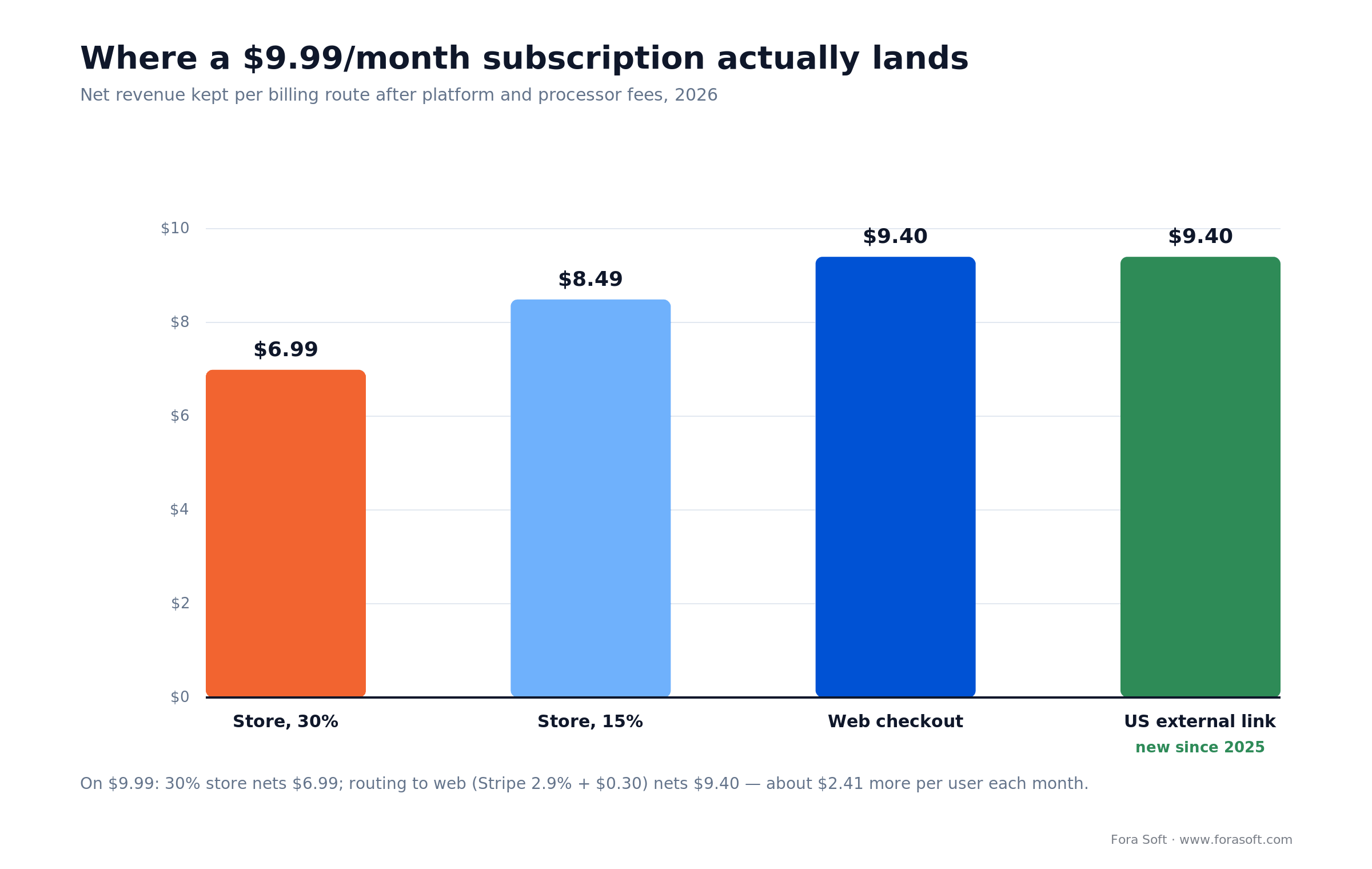
Figure 1. Net revenue on a $9.99/month subscription by billing route: 30% store, 15% store, Stripe web, and the US external-link path opened up in 2025.
The 2026 mobile streaming money map
Mobile carries roughly 60–70% of global SVOD watch-time and close to 85% of ad-supported time on YouTube and TikTok. Analyst consensus (Ampere, Omdia, Deloitte) puts subscription streaming near $95–105B in 2026, with ad-supported video adding $30–35B and growing 15–20% a year. The fastest movers are mobile-first niches: short-form, live tipping, fitness on the go, focused OTT.
The signal that matters for your roadmap: the giants have all converged on hybrid. YouTube stacks Premium, ads, shopping and Super Chat. TikTok runs ads, gifts and shop. Twitch layers subs, bits, ads and Prime Gaming. Netflix’s ad tier passed 250 million global monthly active viewers by May 2026 (Netflix upfront figures), up from 190 million in November 2025, and roughly 45% of new US Netflix sign-ups now choose it. Launch a single-model app in 2026 and you’re effectively scheduling a phase-two rewrite.
One number to keep you honest on churn: RevenueCat’s 2025 State of Subscription Apps, built on billions of dollars of tracked revenue, puts the median app at 13–14% monthly churn and median trial-to-paid at about 25.6%. Video done well beats both, but the median is where you land if you treat retention as a launch-week afterthought.
SVOD on mobile: subscriptions that survive churn
Subscription VOD stays the default for evergreen content. Users pay monthly or yearly for unlimited access, and you earn predictable recurring revenue at 60–70% gross margin before content costs. On mobile it splits into two decisions: bill through the store or through the web, and how many tiers to run.
Tiers that don’t overlap
Two tiers is usually the floor: an ad or basic plan at one price, premium at a clearly higher one. Three works when the top tier earns its keep with 4K HDR, spatial audio, four concurrent streams or offline downloads. Four almost never works: people satisfice and default to tier two, leaving your premium revenue on the shelf. Design the middle tier as the one you want most users to sit on.
Trials beat freemium for mobile SVOD
A 7–14 day free trial consistently outperforms open-ended freemium for SVOD. Apple’s introductory offers and Google’s free-trial pricing are mature, and RevenueCat handles the eligibility logic across both. RevenueCat’s 2025 data pegs the cross-category median trial conversion near 25.6%, with health and fitness closer to 35% and entertainment nearer 19%. Under 25% for a video app usually means onboarding isn’t showing the good stuff in session one. One catch worth knowing: trials shorter than four days convert worse, so don’t crush the window to chase a vanity number.
Reach for SVOD on mobile when: your library is deep enough that people come back weekly, the brand promise is legible (prestige drama, premium fitness, pro trading), and you can defend $7–10 net ARPU after store fees.
AVOD on mobile: ads that pay without wrecking retention
Ad-supported video pays on mobile once you hit scale: tens of millions of monthly actives for a broad AVOD, or low millions in a high-CPM vertical like finance or health. Below that line, the CDN bill outruns the ad revenue and you’re subsidizing strangers.
What ads actually earn. Effective CPMs swing hard by vertical. Muvi’s 2026 numbers put sports and live events at $28–32 and kids and family at $9–13; premium brand-safe inventory sits around $15–25 gross, generic long-tail UGC at $2–6. Fill rate matters as much as the headline CPM. Below 60% fill, the economics fold.
Use ad-server SDKs, not a homegrown parser. Google Ad Manager with the IMA SDK, FreeWheel, Magnite and Amazon Publisher Services are the production-grade options. Hand-rolling VAST and VMAP parsing means fighting ad-pod logic, skip windows, clickthroughs and deep-link measurement the SDKs already solved.
Server-side ad insertion is the mobile difference. SSAI stitches ads into the HLS or DASH manifest on the server, so ads play through device ad-blockers, there’s no black-flash between content and ad, and verified impressions lift CPMs. AWS Elemental MediaTailor, Google Ad Manager Dynamic Ad Insertion and FreeWheel are the common stacks.
Reach for AVOD on mobile when: you can put real scale or a high-CPM vertical behind the inventory, you’re committed to SSAI from launch, and free access is the acquisition engine for a paid tier later.
TVOD and PPV on mobile: a live niche, not a relic
Transactional VOD (rent or buy a single title) and pay-per-view live events are healthy on mobile. Indie cinema, boxing, MMA, concerts and cultural or faith events all sell tickets through the stores. Muvi’s 2026 pricing spans $4.99 for niche events to $49.99 for premium live sports, with the sports sweet spot at $14.99–24.99. Apple’s in-app purchase supports non-consumable (own forever), consumable (one-time) and subscription SKUs; pick the right type or eat a review rejection.
Our Vodeo iOS app runs a ticket-wallet variant: users buy tickets in bulk via consumable IAP, and each ticket opens 24 hours of playback. That moves the payment friction off the decision-to-watch moment, where mobile network latency otherwise kills the impulse. For live PPV, 3D Secure earns its friction: chargeback rates on live-event inventory routinely hit 1–2% without it.
Reach for TVOD or PPV when: the content is an event or a one-off people decide on tonight, willingness-to-pay per title is high, and a subscription would either feel like overkill or cannibalize your marquee moments.
The hybrid playbook: four revenue paths in one app
Hybrid is the 2026 default because segments monetize differently and content has different willingness-to-pay. A fitness app can charge $12.99 a month for on-demand plus live classes (SVOD), run an ad-supported short-form feed to pull in new users (AVOD), sell one-off masterclasses (TVOD), and add meal-plan purchases plus a gear affiliate program. That’s not four products. It’s one product with four monetization paths across a single user path, shown in Figure 2.
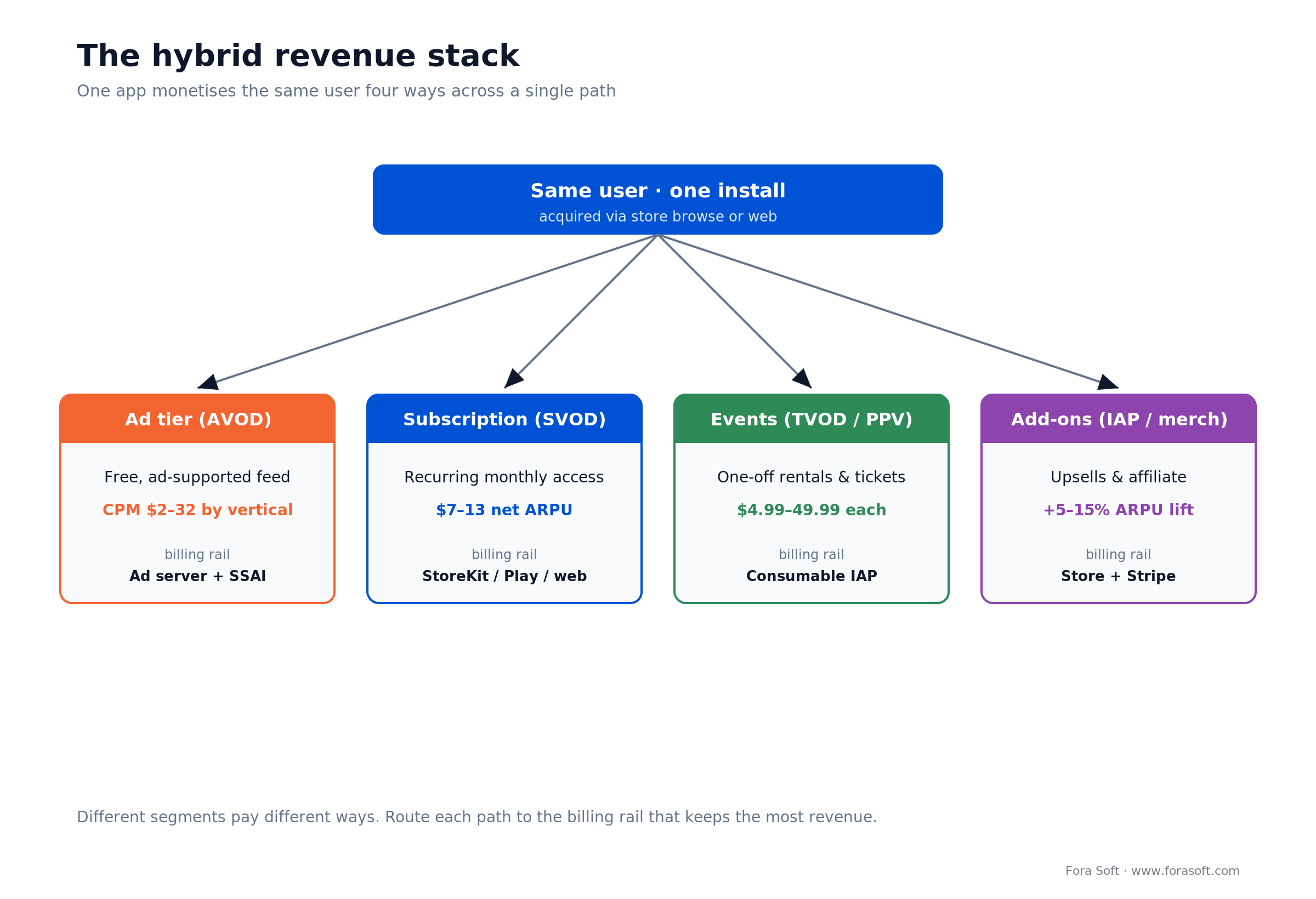
Figure 2. The hybrid revenue stack: a single app monetizes the same user through an ad-supported tier, subscription, transactional events and add-on purchases.
Don’t let the ad tier eat premium. The cheap tier should feel clearly worse: capped resolution, one stream, ads at session start, no offline downloads. Netflix’s ad tier, with its 1080p cap and no spatial audio, is the template. Copy the structure, set your own price.
Bundle where it fits. On mobile the strongest bundles are ecosystem plays (Apple One, the Disney bundle, YouTube Premium with Music). Solo-app bundling usually means annual-versus-monthly pricing or content-plus-merch kits, both of which lift lifetime value 20–30% on the right audience.
Reach for hybrid when: your audience splits into clear pay-now and pay-never segments, your content mixes evergreen and event, and you’d rather monetize the same install three ways than force one price on everyone.
Designing a hybrid app and worried the ad tier will cannibalize premium?
We ship entitlement engines that keep SVOD, ad tier, PPV and add-ons cleanly separated across StoreKit, Play Billing and Stripe. Tell us the product and we’ll sketch the plumbing.
Creator, live and tipping: subs, gifts and payouts
Creator-centric video (Twitch, Kick, TikTok Live, YouTube Live, OnlyFans, Rumble) stacks four streams on one another: creator subscriptions at $5–15 a month with a 50–70% creator share, virtual gifts and tips during live streams, ad-revenue share on replays, and brand or shop-the-stream affiliate money. Top creators pull tens of thousands a month from gifts alone.
On mobile you need a creator-payout engine sitting on top of a consumer-billing engine. Stripe Connect and Adyen for Platforms handle KYC, W-8 and W-9 collection, tax-form issuance, multi-currency payout and fraud tooling. The product calls stay yours: creator share, payout cadence, minimum threshold, virtual-currency tiers, refund policy on gifts. Our Tapereal app runs exactly this shape on Stripe Connect.
Reach for a creator model when: the value is people, not a library; you’re ready to run payouts, tax forms and a virtual-gift economy from day one; and you accept that retrofitting payouts onto a consumer app later is usually a rebuild.
IAP vs web billing after the 2025 fee shakeup
This is the single choice that moves your margin the most, and 2026 is the first year the honest answer is “it depends on where your user taps.” For digital content consumed inside the app, Apple and Google still require their in-app purchase APIs, at 15–30%. But the walls around that rule have real doors now.
United States: external links, 0% Apple commission. After the 2025 Epic v. Apple injunction, US iOS apps can put a link to web checkout right in the purchase flow, and Apple takes nothing on what the user pays on your site. That’s the biggest structural shift to app monetization in years. It is still under appeal, so track the status, but as of 2026 the external link is live and most competing guides still quote a flat 30%.
European Union: the DMA turned one fee into a stack. Under the Digital Markets Act, Apple replaced its flat commission with layered fees. Developers on the external-payment entitlement pay roughly 12–20% all-in, and a link-out can still carry an initial-acquisition fee (first six months after install) plus a store-services fee (first twelve months). There is no single number to drop in a spreadsheet anymore; model your actual path.
UK and most other markets: still 15–30%. The carve-outs are regional. Outside the US and EU, assume the classic store rate until proven otherwise.
The reader-app rule still applies everywhere. If your app delivers content purchased elsewhere (Netflix, Spotify, Kindle) you qualify as a “reader” and may show one link to your account page with no Apple commission on that web purchase. Netflix and Spotify ship as consumption surfaces with web-only signup for exactly this reason.
The worked number. Take a $9.99 sub. At the 30% store rate you net $6.99. Route that user to Stripe on the web (2.9% + $0.30) and you net $9.40. That’s $2.41 more per user per month. At 100,000 paying users: 2.41 × 100,000 × 12 = about $2.9M more net revenue a year, for the cost of a well-placed link and a web checkout. Our deep dive on legally avoiding the 30% Apple commission walks the implementation.
When to just pay the fee. If store discovery is your main acquisition channel (casual consumer apps, short-form, creator-first), you can’t pull users off-store without losing the volume that made the store worth it. Take the fee as distribution cost and win margin elsewhere. Apple’s own In-App Purchase documentation and Google Play Billing are the sources of truth for the current rules in each market.
Mobile monetization models compared
The table pins down the trade-offs; Figure 3 turns the net-revenue column into a picture you can scan in two seconds, and Figure 4 shows the decision path once you know your content shape.
| Model | Gross ARPU | Net (store) | Net (web) | Monthly churn | Where it breaks |
|---|---|---|---|---|---|
| SVOD | $9.99–15.99 | $7.00–13.60 | $9.40–15.00 | 2–3% (mature) | Thin library; shallow catalog churns fast |
| SVOD + ad tier | $5.99–9.99 | $4.20–8.49 | $5.70–9.40 | 2.5–3.5% | Ad tier cannibalizes premium if too generous |
| AVOD | $2–6 (CPM) | via ad network | via ad network | n/a (free) | Sub-scale audiences lose to the CDN bill |
| TVOD / PPV | $4.99–49.99/event | less 15–30% | less ~3% | n/a (per buy) | No recurring revenue; every month starts at zero |
| Creator subs + gifts | $2–8 (varies) | less fee, less creator share | less creator share | varies by creator | Payout, tax and fraud load is heavy |
| Merch / add-on IAP | 5–15% ARPU lift | 30% digital; 0% physical off-app | 2–3% card | n/a | Distracts the roadmap if it’s not core |
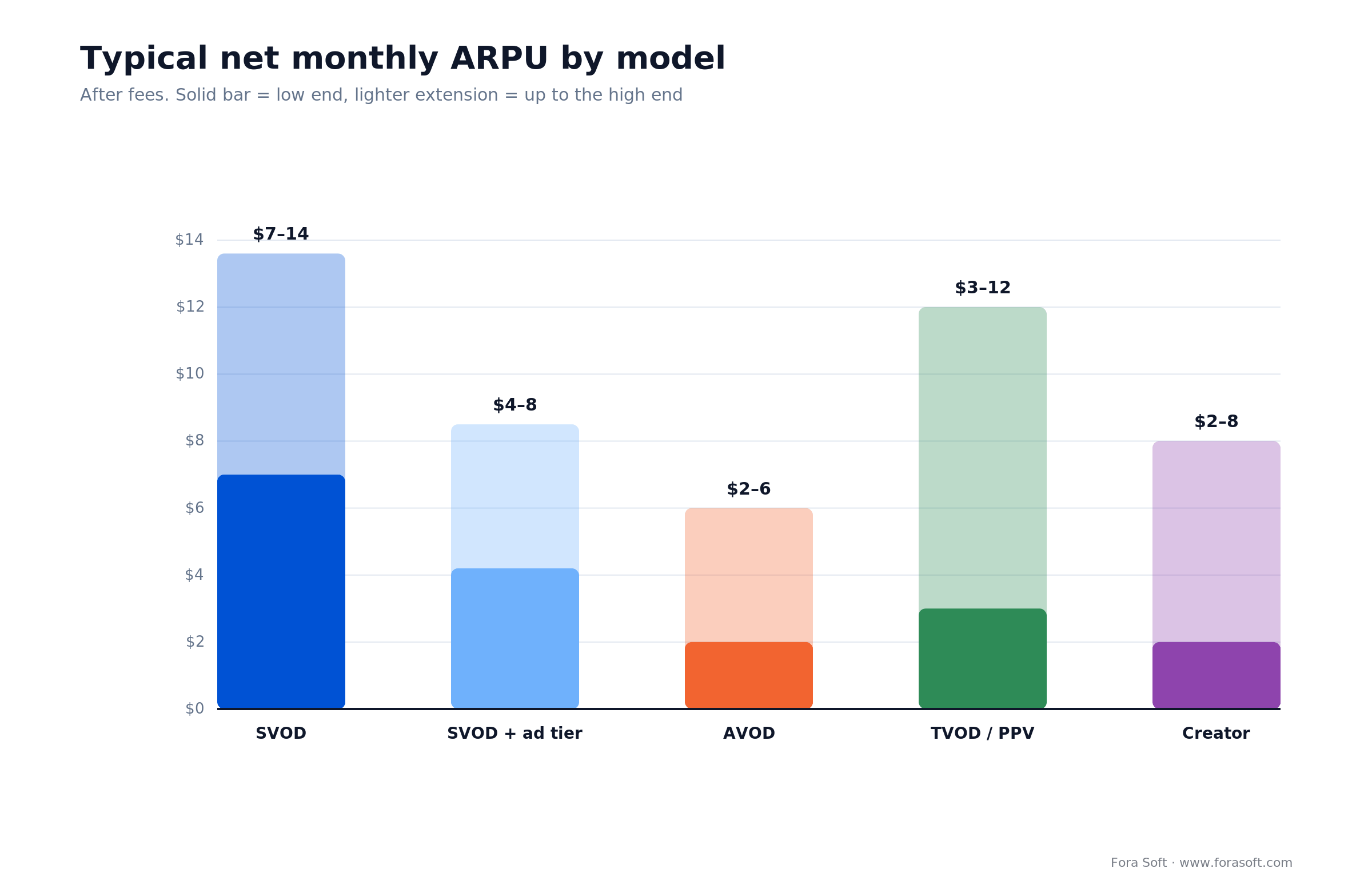
Figure 3. Net revenue kept per model, store billing versus web billing. The gap between the two bars is the store fee you can sometimes route around.
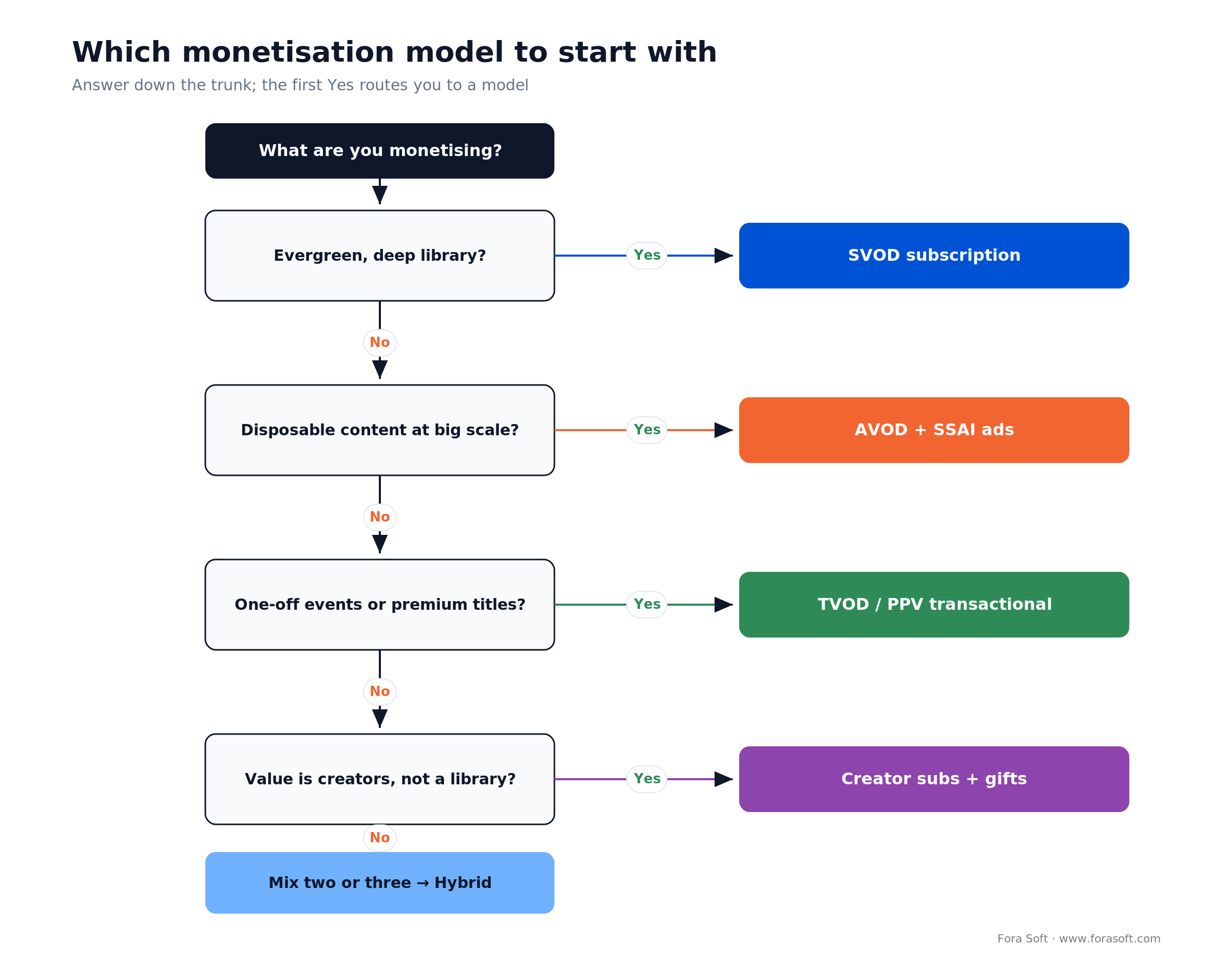
Figure 4. A decision tree from content shape and acquisition channel to a starting monetization model.
The billing stack that makes the money land
StoreKit 2 and Play Billing, done right
Apple StoreKit 2 and Google Play Billing v7+ are mandatory for in-app subscriptions and consumables. Validate receipts server-side, never in the client. Handle proration and crossgrades inside a subscription group correctly. Honour the server notifications (App Store Server Notifications v2, Play Developer RTDN) so billing state is authoritative on your side, not just on the device.
RevenueCat or Adapty for subscription middleware
RevenueCat and Adapty sit between your app and the store APIs, unifying iOS and Android receipts and giving you paywall A/B testing and subscription analytics. For most streaming apps they pay for themselves: you save weeks of engineering and get trial-conversion and lifetime-value reporting out of the box. Build your own only when compliance rules out a third-party SaaS, as in some healthcare and financial cases.
DRM: FairPlay, Widevine and HLS/DASH
Premium licensed content needs multi-DRM: FairPlay Streaming for iOS and tvOS, Widevine Modular for Android, plus a key service. Widevine is free to license; the key service (Axinom, VdoCipher, BuyDRM, EZDRM) runs roughly $500–10,000 a year by traffic, and integration adds 3–5 weeks. Skip it and most studios won’t license to you at all; your practical ceiling on licensed-only content is about $7–8 a month, and premium sports is off the table at any price.
SSAI: measurable CPM uplift on mobile
Server-side ad insertion matters more on mobile than web, because mobile users run aggressive DNS-level ad-blockers and many player SDKs trip over VAST redirects. SSAI sidesteps all of it: ads become part of the video stream. It adds 4–8 weeks and usually repays itself inside a quarter at real scale.
Regional pricing and local payment
Apple and Google auto-localize price tiers across 175+ storefronts; you set the base tier and they propagate. On the web side you handle purchasing-power pricing yourself and add local methods: UPI in India, PIX in Brazil, e-wallets across Southeast Asia. Missing local payment routinely costs 10–25% of potential signups in emerging markets.
What a monetized mobile video app costs in 2026
These ranges assume Agent-Engineering teams on a modern stack: SwiftUI on iOS, Jetpack Compose on Android, a Next.js or Remix web mirror for signup and account management, RevenueCat or Adapty for subscription orchestration, Stripe for web billing, StoreKit 2 and Play Billing for store purchases, multi-DRM for licensed content, and Google Ad Manager or FreeWheel for ads. Figure 5 lays the phases on a timeline.
Single-tier SVOD, iOS + Android + light web
16–20 weeks, $110–180k. Auth, catalog, playback with FairPlay and Widevine, one subscription tier via RevenueCat, admin, analytics and search. Our live streaming platform cost breakdown details the scope line by line.
Hybrid (SVOD + ad tier + PPV), iOS + Android + web
24–30 weeks, $190–300k. A full entitlement engine across two billing rails, an ad tier with SSAI and a third-party ad server, PPV with 3D Secure, multi-currency billing and paywall A/B testing.
Creator stack (subs + gifts + payouts)
Add 10–14 weeks, $70–130k. Stripe Connect onboarding, KYC, tax forms, virtual-currency wallets, payout scheduling, fraud rules and a creator admin. Our AI video streaming guide covers the companion architecture.
CTV companion (Roku, Fire TV, Apple TV, Android TV)
Add 8–12 weeks per platform, $50–90k each. The biggest CPM upside and effectively mandatory for a serious AVOD or FAST ambition. Apple TV and Android TV share most code with their mobile cousins; Roku and Fire TV are separate builds.
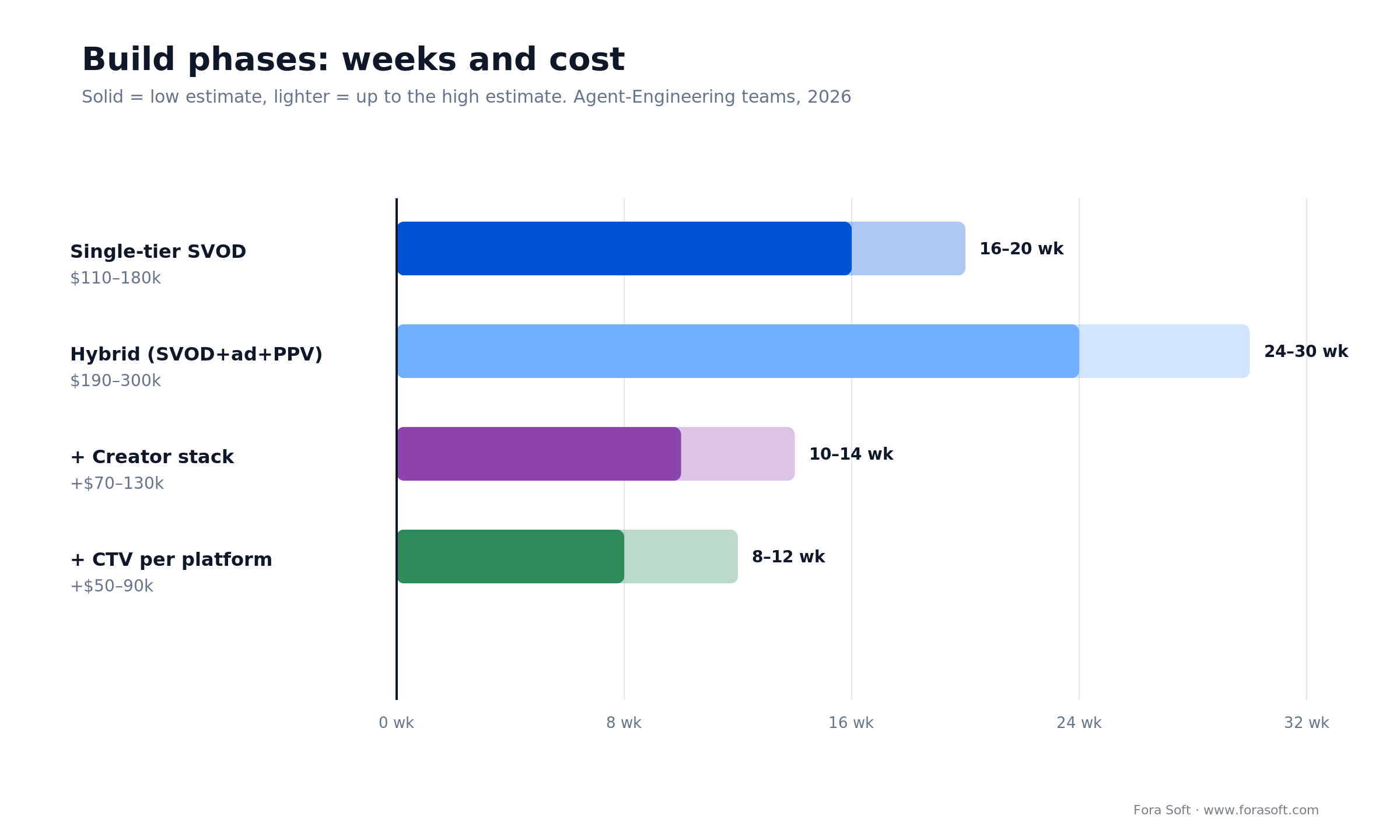
Figure 5. Build phases on a timeline: single-tier SVOD, the hybrid jump, the creator add-on and per-platform CTV, with weeks and cost.
Want a fixed-scope estimate for your build?
Tell us the content, the audience and the regions. You get the iOS, Android and web billing choices spelled out, plus a costed week-by-week plan to ship.
Mini case: how Vodeo shipped TVOD ticketing on iOS
Situation. Vodeo wanted an iOS-first online cinema for indie films. Its audience were “tonight” viewers, not bingers, so a subscription didn’t fit, and a full credit-card entry per movie was too much friction on a phone.
The 12-week plan. We built a ticket wallet. Users buy tickets in bulk through StoreKit consumable IAP (5, 20 or 50 at a time), and each ticket grants 24 hours of playback on any title. That compresses checkout to a single tap against a pre-purchased ticket, with Face ID handling the bulk purchase once. We wired FairPlay DRM for licensed titles, per-ticket redemption analytics, and a restore flow that carries across the user’s other Apple devices.
Outcome. Completion on “open app, watch a film” came out well above the per-title IAP alternatives the team had tested, because the payment friction moved off the decide-to-watch moment. The bulk mechanic keeps Apple’s fee structure intact but turns it into a single up-front purchase rather than a fee on every rental, which users accept more readily. Want a similar assessment? Book a 30-minute call and we’ll map it to your content.
A monetization decision framework in five questions
Q1. Where does acquisition come from? If it’s App Store browse, paid user acquisition and Apple Search Ads, take the store fee as distribution cost. If it’s content, podcast or email, route signup to the web and let the app be a consumption surface.
Q2. Is the content evergreen or disposable? Evergreen points to SVOD. Disposable points to AVOD. Disposable with a small audience means you’re either in a PPV niche or about to burn runway; be honest about which.
Q3. What net ARPU can you defend? Under $6 gross on the store with no route to web, SVOD rarely pencils out after fees, so go AVOD or hybrid. Above $12, plan content amortization carefully.
Q4. Are you creator-centric? If yes, plan Stripe Connect, KYC, tax forms and a virtual-gift economy from day one. Bolting payouts on later is usually a rebuild.
Q5. What’s your churn posture? Evergreen habits keep mobile SVOD near 2–3%; fitness, sports and niche sit at 4–6%, and the median app runs far higher. Build pausing, downgrade-to-ad-tier and win-back offers into v1, not after the first retention scare.
Five monetization pitfalls we keep fixing
1. Running store IAP for a reader app. If Apple classes you as a reader (streaming, cloud, magazines, books), you can and should route signup to the web. Not doing so hands over 15–30 points of net revenue for nothing.
2. An ad tier that undercuts premium. The cheap tier should catch price-sensitive users, not tempt premium users to drop down. Keep resolution, offline and concurrent streams clearly different.
3. Skipping SSAI on an AVOD launch. Client-side ads leak 20–40% of impressions to mobile ad-blockers and earn half the CPM. SSAI is work; going without it is worse.
4. Not instrumenting the paywall. RevenueCat or Adapty charts are the floor. Run at least monthly A/B tests on copy, price and default tier; the small wins compound.
5. Forgetting churn-recovery plumbing. Pause, downgrade-to-ad-tier and win-back offers are the cheapest lifetime value you’ll ever earn. Ship them in v1, not after the first retention crisis.
KPIs: what to measure on a monetized video app
Quality KPIs. Video start-up under 1.5s at the 95th percentile on 4G, rebuffer ratio under 0.5%, paywall load under 700ms, ad-completion above 92%, and trial-signup checkout conversion above 50%.
Business KPIs. Trial-to-paid above 35% for SVOD (the RevenueCat median is 25.6%, so 35% is genuinely good), monthly churn under 3%, CAC payback under 12 months, ad-tier-to-premium upgrades above 3% a month, add-on IAP attach above 10% on engaged users, and, for reader apps, a web-signup ratio above 50%.
Reliability KPIs. Billing success above 98% across StoreKit and Stripe, involuntary churn from failed cards under 0.5%, premium ad-fill above 85%, and restore-purchase success above 99% across iOS, Android and web.
When NOT to run in-app subscriptions
If the store fee strips 30% off a product whose unit economics were already thin, don’t charge a subscription in-app at all. Ship a free app with a web paywall for premium, the Netflix and Spotify pattern, or reposition to ads-first and monetize the traffic the store sends you.
If you’re pre-product-market-fit and the subscription thesis is still a guess, ship a free app that shows off the content, capture emails, and validate willingness-to-pay through a web pilot before you commit to an IAP-heavy architecture. Rebuilding billing is expensive; rebuilding it with a year of wrong price signals baked in is worse.
FAQ
Do I have to use Apple IAP for a video streaming subscription?
For users who subscribe inside the app, yes: Apple requires StoreKit IAP. For users who sign up on your website and log in on the app, no. The reader-app carve-out lets streaming apps show content purchased elsewhere, and since the 2025 US ruling you can also place an external payment link in-app at 0% Apple commission. Plan a web-first signup and let the app be a consumption surface.
How much of my revenue do Apple and Google take in 2026?
On Apple, standard is 30%, dropping to 15% under the Small Business Program or after a subscriber’s first year; Google Play charges 15% on subscriptions from day one. In the US you can route to web checkout with an external link at 0% Apple commission; in the EU the DMA replaced the flat fee with a layered stack around 12–20%; in the UK and most other markets it’s still 15–30%. Model your actual payment path rather than one number.
What is RevenueCat and do I need it?
RevenueCat is subscription middleware that wraps Apple StoreKit and Google Play Billing, unifies receipts, handles server notifications and provides paywall analytics. For most streaming apps it’s worth the fee: you save 4–6 weeks of engineering and get A/B testing and lifetime-value reporting out of the box. Adapty is a strong alternative.
How much does DRM add to a mobile streaming project?
Widevine is free to license; you pay for a key service such as Axinom, VdoCipher, BuyDRM or EZDRM, typically $500–10,000 a year by traffic. Integration adds roughly 3–5 weeks on top of the streaming build. Without multi-DRM you can’t license premium content at any meaningful price.
Can I run an ad tier and an SVOD tier from the same IAP?
Yes. Use a single subscription group with two products, ad-supported and premium. Apple and Google handle upgrade and downgrade proration automatically within a group. Don’t split the tiers across separate groups; cross-group transitions need manual refund handling that breaks the experience.
What churn and trial-conversion numbers are realistic?
RevenueCat’s 2025 report puts the cross-category median at about 25.6% trial-to-paid and 13–14% monthly churn. Mature video SVOD beats both, often 2–3% churn and 35%+ trial conversion, but only with strong onboarding and churn-recovery flows. Treat the medians as the gravity you’re fighting, not the target.
How long does a monetized mobile video MVP take to build?
Single-tier SVOD on iOS and Android with web signup: 16–20 weeks. Hybrid (SVOD plus ad tier plus PPV) with SSAI and DRM: 24–30 weeks. Add CTV (Roku, Fire TV, Apple TV, Android TV) at 8–12 weeks per platform, and creator payouts at 10–14 weeks on top.
Does Fora Soft build mobile-first streaming apps end to end?
Yes. Our video and audio streaming service covers live and VOD on iOS, Android, web and CTV, with DRM, SSAI, RevenueCat and creator payouts. We’ve shipped OTT, live, fitness, edtech and niche VOD on SVOD, AVOD, TVOD and hybrid models. For the platform-wide view, see our streaming platform monetization guide and the OTT monetization map in Fora Soft Learn.
What to read next
Platform-wide
Streaming Platform Monetization 2026
The cross-platform view: SVOD, AVOD, TVOD, FAST and hybrid.
Store fees
Avoiding the 30% Apple Commission
The legal routes to web billing, step by step.
Cost model
Live Streaming Platform Dev Cost
Scope-by-scope ranges to pressure-test any quote.
Stack pick
Cross-Platform Video App Framework
Native vs KMP vs Flutter vs React Native for streaming.
AI + streaming
AI Video Streaming App Guide
Architecture, costs and compliance for AI-enhanced streaming.
Ready to ship a video app that actually pays back?
The honest summary of video streaming app monetization for 2026: the model follows the content, not the trend. Store fees still move unit economics by 15–30 points, but the US external-link route and the EU DMA mean you can often keep more of the sub than the old flat-30% math assumed, so route signup to the web wherever distribution allows. An ad tier done right adds volume without eating premium, creator payouts are a real product line rather than an add-on, DRM and SSAI are infrastructure, and churn-recovery tooling is the cheapest revenue you’ll ever book.
If any of that is turning into a real app in the next two quarters, we’re happy to pressure-test the plan. Bring content, audience and regions; you get a billing stack, a net-ARPU estimate and a week-by-week plan in 30 minutes.
Talk to a team that ships StoreKit, Play Billing, Stripe, RevenueCat and SSAI every week
Mobile video monetization, from single-tier SVOD to hybrid creator apps. Pick a time, send the spec, get back a realistic plan.

