
Key takeaways
• A vulnerability caught in the IDE costs about $80 to fix; the same vulnerability found in production costs $7,600 and up. The shift-left business case is a 6–100× cost multiplier, not a slogan.
• AI code security upgrades every layer of the shift-left stack. AI-powered SAST, DAST, IAST, SCA, secrets scanning, IaC linting, and AI code review each compress one specific bottleneck — but they only pay off together.
• Pick tools by pipeline stage, not by vendor loyalty. IDE → pre-commit → PR → CI/CD → staging → runtime each deserve their own scanner, each with a different latency and false-positive budget.
• False-positive fatigue is the number-one program killer. Untuned SAST produces 30–90% noise; a well-tuned program runs under 15%. Budget tuning time or the alerts will be ignored.
• Regulation is catching up fast. NIS2, DORA (in force since January 2025), the EU AI Act, the SEC cyber-disclosure rule, and the EU Cyber Resilience Act all require documented shift-left controls. Audits ask for proof, not slides.
This guide explains how AI code security works in 2026: how AI changes the economics of finding vulnerabilities, and how to wire it into a real shift-left program. It is written for CTOs, engineering directors, heads of security, and founders who are evaluating AI-powered SAST/DAST/SCA/IAST tools, AI code-review assistants, or a full DevSecOps rollout. Every section answers a decision-grade question with numbers you can quote in a board deck.
The short version: the application-security tooling market crossed $14 billion in 2025 and grows at roughly 12% CAGR because the cost of a breach keeps climbing — $4.44M global average (the first drop in five years, down from $4.88M), $10.22M in the US (IBM 2025). AI shortens mean-time-to-remediate by 30–60%, cuts false positives in mature tools to under 5%, and turns pull-request review from a human bottleneck into a continuous gate. But AI does not replace human judgement on auth, crypto, and regulated data paths. It augments it.
Why Fora Soft wrote this playbook
Fora Soft has built secure, regulated software since 2005, with 250+ projects over 20 years, from HIPAA-compliant telemedicine platforms to an AI video-surveillance system that analyses 500K+ vehicles/day and a HIPAA-compliant interpretation network with 700+ certified interpreters in 169 languages. Our engineers live inside AI-augmented CI pipelines daily — we know which tools are ready for production, which are slideware, and where AI still breaks. Security is baked into how we do custom software development and AI integration, not bolted on at the end.
We work in Agent Engineering mode: senior engineers pair with AI coding agents for boilerplate, test generation, and refactors, which is why our secure-SDLC rollouts ship 30–40% faster than typical agency timelines. When we quote a number in this article, it is a number we have actually seen on a Fora Soft project, not a vendor brochure. See our spec-driven Agent Engineering write-up for the detail.
Need a shift-left assessment for your codebase?
Book a 30-minute scoping call and we will map your SDLC, identify the highest-ROI AI security controls, and give you a dollar-accurate rollout plan — no sales pitch.
Why shift security left — the 2026 numbers
“Shift left” is not a buzzword; it is a cost-curve argument. The earlier you catch a vulnerability, the cheaper it is to fix, and the cheaper the breach it prevents.
| Stage caught | Typical fix cost | Multiplier vs IDE | What AI shortens |
|---|---|---|---|
| IDE (coding) | ~$80 | 1× | Instant inline fix suggestions (Copilot, Cursor, Qodo) |
| PR / code review | ~$240 | 3× | Autofix + explain (CodeRabbit, Copilot Autofix) |
| CI/CD build | ~$960 | 12× | AI triage + deduplication of scanner output |
| QA / staging | ~$2,400 | 30× | Generated exploit payloads, fuzzing test cases |
| Production | ~$7,600 | ~100× | Runtime IAST / RASP with ML anomaly detection |
| Post-breach | $4.44M global avg, $10.22M US (IBM 2025) | > 50,000× | Forensic triage with LLM timeline reconstruction |
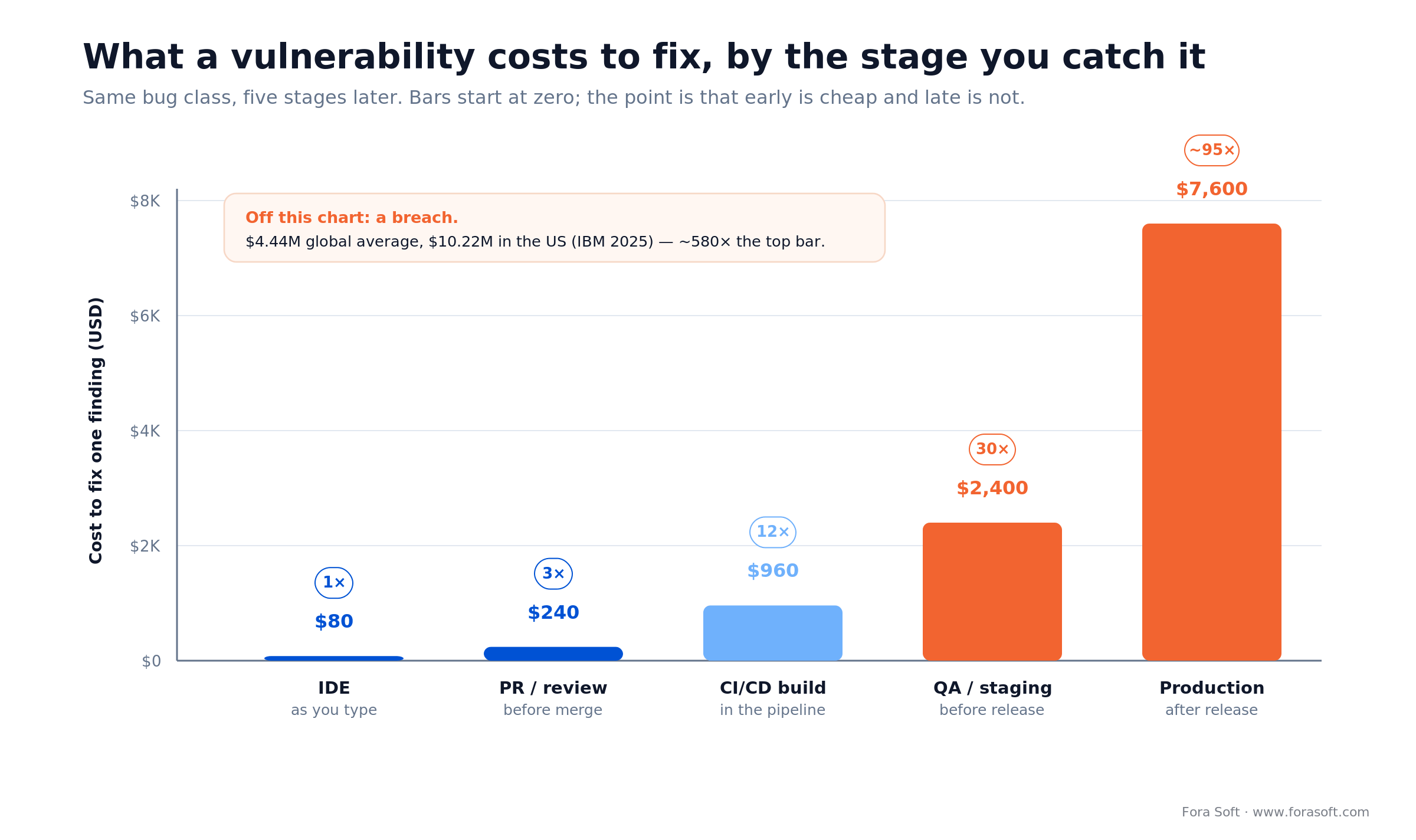
Figure 1. The shift-left cost curve: the same bug class is ~95× costlier to fix in production than in the IDE.
Organisations running mature DevSecOps programs report a 60–70% reduction in mean-time-to-remediate, 85% faster deployment frequency, and 95%+ of critical vulnerabilities blocked before production. That is the prize. AI just shortens the path to it.
Regulation in 2026 — why the audit is no longer optional
Four new rules are turning shift-left from a nice-to-have into a documented requirement.
1. EU NIS2 Directive. Expands cyber-security duties to roughly 160,000 EU entities. Board members are personally liable. Fines reach €10M or 2% of global revenue.
2. EU DORA (applies since 17 January 2025). Hard operational-resilience rules for financial services: mandatory ICT risk management and third-party supplier controls, SBOMs, vulnerability disclosure and incident reporting. It has been enforceable for over a year, so “we’re getting to it” is no longer an answer an auditor accepts. See the ESMA DORA overview.
3. EU AI Act. High-risk AI systems (finance, healthcare, recruitment, critical infrastructure) require documented risk management, human oversight, and bias / security assessments. Non-compliance fines up to 7% of global revenue.
4. EU Cyber Resilience Act (CRA). Requires a 24-hour early warning for actively exploited vulnerabilities, 5-year security-update support for products with digital elements, and SBOMs. Reporting obligations start 11 September 2026; full application lands 11 December 2027. Most vendors need to be audit-ready well before then.
In the US, the SEC cyber-disclosure rule (effective 2023) requires public companies to disclose material cyber incidents within four business days. Your shift-left dashboard now sits on your CFO’s desk, not just the CISO’s.
The six pillars of an AI-powered secure SDLC
Every mature shift-left program covers the same six pillars. AI makes each one faster and cheaper, but only if you wire them together.
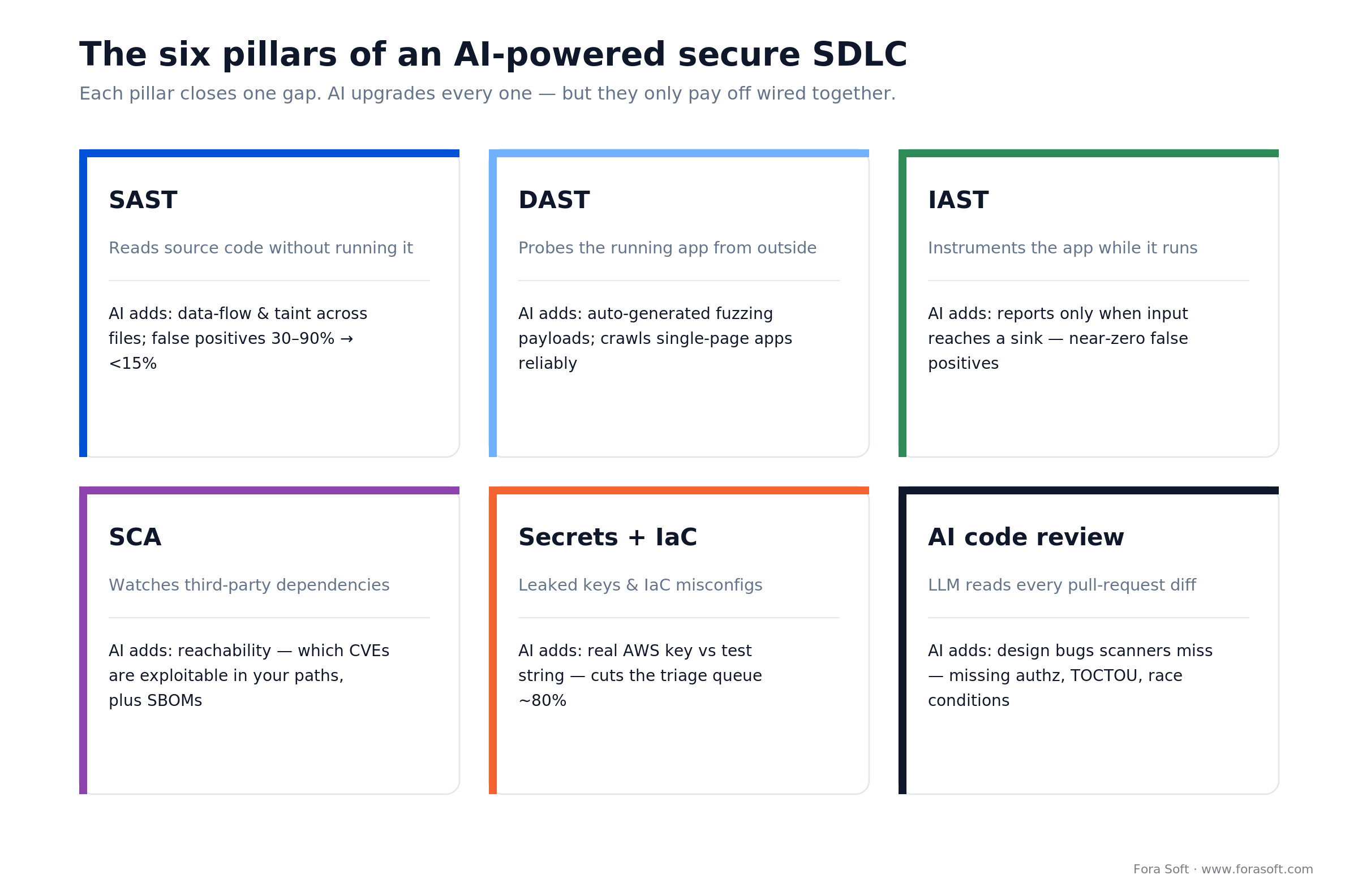
Figure 2. Each pillar closes one gap; AI upgrades all six, but they only pay off wired together.
SAST — static application security testing
Scans source code without running it. AI-enhanced SAST (Snyk Code, Semgrep Pro, Checkmarx, Veracode, CodeQL) traces data-flow and taint across files, catches injection, deserialisation, and crypto misuse, and produces machine-readable suggested fixes. False-positive rates drop from the 30–90% of rule-only tools to under 15% in tuned AI engines — Veracode claims < 1%.
Reach for AI SAST when: you want coverage across 10+ languages, need data-flow analysis, and can invest 2–4 weeks tuning rules before declaring the scanner production-ready.
DAST — dynamic application security testing
Probes a running app from the outside. AI DAST (Checkmarx, Invicti, Fortify WebInspect, HCL AppScan) auto-generates fuzzing payloads, crawls SPAs reliably, and reduces scan time from hours to minutes. Best for API and web-facing vulnerabilities: XSS, IDOR, auth bypasses, SSRF.
Reach for DAST when: the target is a web or API surface, you have a stageable deploy, and you need exploit-grade confirmation (DAST finds what SAST flags plus what SAST misses).
IAST — interactive application security testing
Instruments the running app, correlates SAST-style data-flow with real request traffic. Contrast Security is the mature option; Seeker and HCL AppScan IAST compete. Near-zero false positives because findings are only reported when an attacker-controlled input actually reaches a sink. Slightly heavier install; usually deployed in staging.
Reach for IAST when: SAST noise is already high, the app is server-side heavy, and you need confirmed-exploitable findings to rank by risk, not by severity heuristic.
SCA — software composition analysis
Watches third-party dependencies. Snyk, Dependabot, Black Duck, Mend, Endor Labs, and GitHub Advanced Security all fit here. AI narrows the reachability of each CVE. Out of a Log4Shell-style alert set, it tells you which paths are actually exploitable in your codebase. Without SCA, most organisations cannot pass a DORA or CRA audit.
Reach for AI SCA when: your stack is > 70% open-source dependencies (which is almost everyone), you need an SBOM, or regulatory reach-back is real.
Secrets and IaC scanning
Leaked API keys and misconfigured Terraform/K8s manifests are still the most common root cause of breaches. Tools: GitGuardian, Gitleaks, TruffleHog, Checkov, Trivy, KICS, Snyk IaC. AI adds context classification, distinguishing a real AWS key from a test string, cutting the “is this a secret or a constant” review queue by 80%.
AI code review and autofix
LLM-based PR reviewers (CodeRabbit, Qodo/Codium, GitHub Copilot Autofix, Cursor Bugbot) read the diff, ask for context from the repo, and comment inline. They catch the design-level issues classical scanners miss: missing authorisation checks, TOCTOU bugs, race conditions, bad error handling. Best used as an extra reviewer, never the only one. See our take on AI in testing and technical-debt management, our shift-left testing playbook, and how we apply AI across our AI engineering practice.
The AI security tool matrix — 2026 edition
Twelve serious tools, one decision table. Prices below are list prices as of mid-2026 and are typically discounted 10–40% in enterprise contracts. Note that GitHub unbundled Advanced Security in April 2025 into two metered products: Secret Protection ($19) and Code Security ($30) per active committer/mo, now also sold to GitHub Team orgs.
| Tool | Primary pillar | Strength | Price shape | Best fit |
|---|---|---|---|---|
| Snyk | SAST + SCA + IaC + Containers | DeepCode AI, reachability, Dev UX | $25–$98/dev/mo | Mid-market, dev-first |
| GitHub Advanced Security | SAST (CodeQL) + secrets + SCA | Zero integration, Copilot Autofix | $19 + $30/committer/mo | GitHub-native shops |
| Semgrep | SAST + custom rules | Fast, customisable, OSS base | Free / $40/dev/mo Pro | Policy-as-code teams |
| SonarQube / SonarCloud | SAST + quality + coverage | Quality gate culture | Free – $95K/yr Enterprise | Quality-first teams |
| Checkmarx One | SAST + DAST + SCA + IaC + API | Full-suite enterprise AppSec | $95K–$150K/yr | Regulated enterprise |
| Veracode | SAST + DAST + SCA + Fix | < 1% FP SAST, Veracode Fix | $100K–$200K/yr | FedRAMP, finance, health |
| Fortify (OpenText) | SAST + DAST + Audit AI | COBOL/legacy coverage | Enterprise, custom | Legacy-heavy enterprise |
| Contrast Security | IAST + RASP | Near-zero FP, runtime | Custom enterprise | Java / .NET heavy stacks |
| CodeRabbit | AI PR review | Contextual PR comments, SOC 2 | $24/dev/mo | Any team with PR workflow |
| Qodo (ex-Codium) | AI PR review + test gen | Test generation at scale | $30/dev/mo | Coverage-starved teams |
| Endor Labs | SCA with reachability | Lowest SCA noise | Custom enterprise | Dependency-heavy monorepos |
| GitGuardian | Secrets scanning | 450+ secret types, AI validation | Free – enterprise | Any team with > 10 repos |
Rule of thumb: consolidate on one suite (Snyk, GitHub Advanced Security, or Checkmarx) plus a best-of-breed PR reviewer (CodeRabbit or Qodo) and a dedicated secrets tool (GitGuardian). Adding more tools increases noise, not coverage.
Reference pipeline — where each AI scanner fits
Every secure SDLC walks the same six stations. Budget latency (developer patience) carefully: under five seconds in the IDE, under two minutes on PR, under fifteen minutes on CI. If a stage takes longer, developers route around it.
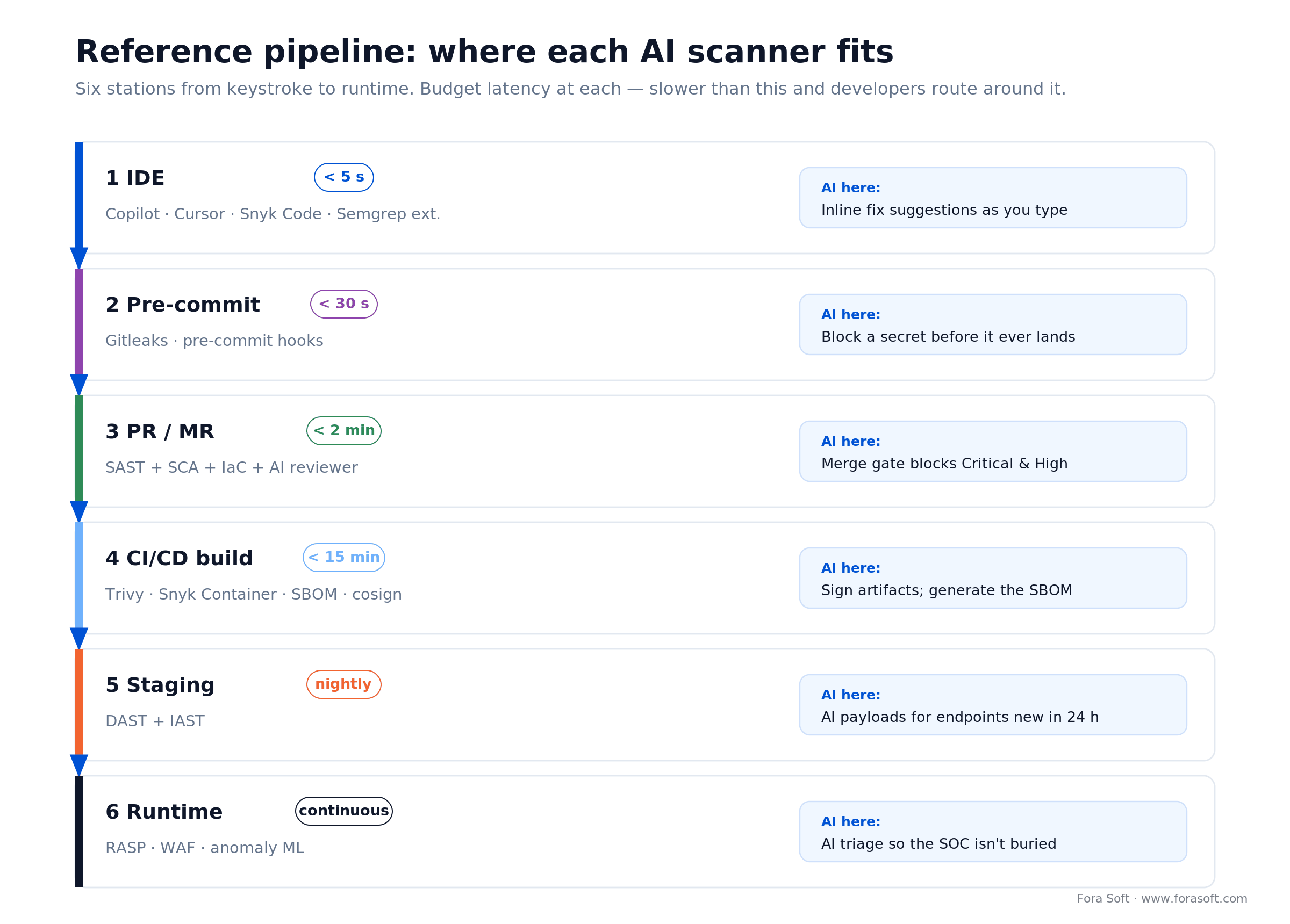
Figure 3. Where each AI scanner fits, with the latency budget developers will tolerate at each stage.
1. IDE. Copilot, Cursor, Windsurf, or Qodo inline. Snyk Code plugin, Semgrep extension, Gitleaks pre-save. Target: feedback < 5 s.
2. Pre-commit. Lightweight linters and secret scanners (pre-commit + Gitleaks). Block the commit if a secret leaks. Target: < 30 s.
3. PR / MR. Full SAST + SCA + IaC + AI reviewer. Enforce a quality gate that blocks the merge on any Critical or High severity. AI reviewer (CodeRabbit / Qodo) adds design-level feedback. Target: < 2 minutes.
4. CI/CD build. Container and IaC scanning (Trivy, Snyk Container). Generate SBOM with Syft or CycloneDX. Sign artifacts with cosign. Target: < 15 minutes total.
5. Staging. DAST + IAST. Nightly exploit-grade runs; AI-generated payloads for endpoints new in the last 24 hours. Target: daily.
6. Runtime / production. RASP, anomaly detection, WAF with ML behaviour baselines. AI-driven alert triage so your SOC is not buried in noise.
Drowning in false positives from your current SAST?
We will run a two-week tuning engagement against your existing tools and reduce alert volume by 60–80% without losing coverage. Fixed fee, documented outcome.
Rollout cost and timeline — SMB, mid-market, enterprise
Three realistic scenarios, with the build costs we quote clients on Agent Engineering rates. All figures include tool licences, integration effort, tuning, and training , not ongoing annual spend.
| Scope | Who it fits | Timeline | Annual cost |
|---|---|---|---|
| Starter shift-left | < 20 devs, SaaS product, no regulation | 2–6 weeks | $15K–$60K |
| Mid-market DevSecOps | 20–100 devs, SOC 2 / HIPAA | 8–16 weeks | $60K–$180K |
| Regulated enterprise | 100+ devs, NIS2 / DORA / CRA | 16–36 weeks | $180K–$450K+ |
| FedRAMP / finance | Government + top-tier finance | 6–18 months | $450K+ |
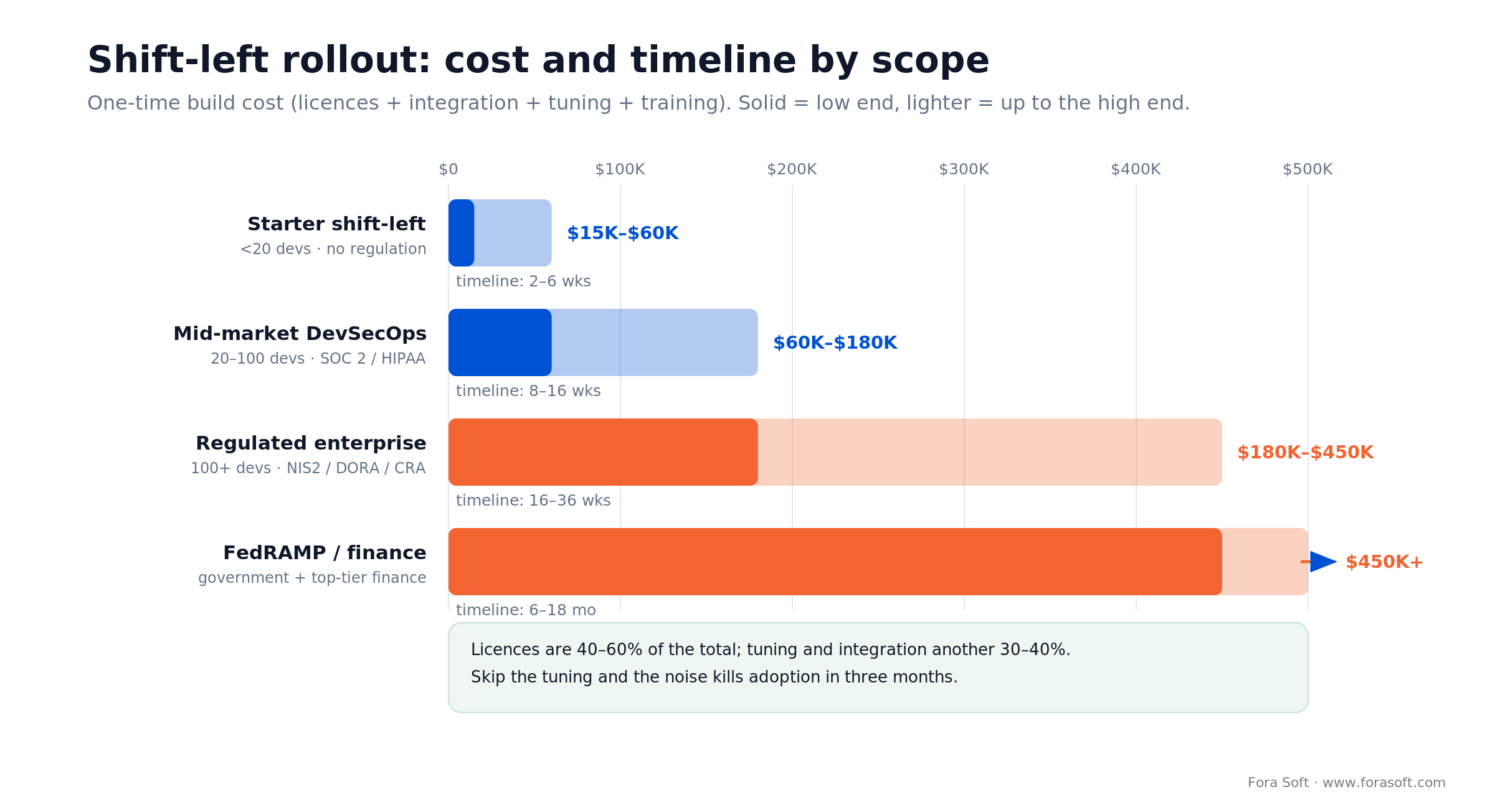
Figure 4. One-time build cost and timeline by scope, from a starter program to FedRAMP/finance.
Expect licence costs to account for 40–60% of the total; integration and tuning another 30–40%; training the rest. A classic mistake is buying the tool and skipping the tuning — at which point the noise kills adoption in three months.
Mini case — shipping HIPAA-grade AI code security for Video Interpretations
A US healthcare-adjacent client came to us with a WebRTC-based interpretation marketplace that needed HIPAA compliance, SOC 2 readiness, and a documented shift-left program to pass customer due-diligence questionnaires.
Our 10-week plan: stand up a CI pipeline with Snyk SAST + SCA on every PR, GitGuardian for secret scanning, Checkov for IaC, a CodeRabbit AI reviewer, and a manual threat-modelling review for anything touching PHI. We fixed 92 open vulnerabilities during the first four weeks (roughly 60% auto-fixed by the AI tooling, 40% manual), then tuned the rules to drop the ongoing FP rate under 12%.
Outcome: the platform now supports 700+ certified interpreters in 169 languages under HIPAA-compliant WebRTC. Mean-time-to-remediate for Critical issues dropped from 21 days to 4 days. The client passed two customer-requested security audits in a row on the first attempt. Full background on the Video Interpretations case study page. Want a similar assessment?
How to implement a shift-left program in four phases
Phase 1 — Baseline (week 1–2)
Run a free-tier SAST + SCA pass against the current codebase. Count open vulns by severity. Measure existing MTTR on the last 10 Critical bugs. Document the baseline before you buy anything. Without it, ROI is unprovable.
Phase 2 — Pilot (week 3–6)
Roll the chosen tool to one repo and one team. Tune rules against the baseline. Target a 60–80% reduction in false positives before exiting pilot. Require developers to close every genuine finding. No skipping.
Phase 3 — Enforce (week 7–12)
Flip the merge gate on for Critical and High. Extend scanning to all repos. Add IaC + secrets + container scanning. Roll out the AI PR reviewer. Stand up a security champions program.
Phase 4 — Mature (ongoing)
Add DAST + IAST in staging. Generate SBOMs on every release, sign artifacts with cosign, feed findings into Jira/Linear with SLAs. Review metrics monthly; retune quarterly. Audit-readiness becomes a byproduct, not a separate project.
Five pitfalls that sink shift-left programs
1. False-positive fatigue. Untuned SAST produces 30–90% noise and developers learn to ignore the banner. Mitigation: mandate a 60–80% FP reduction before rolling out; use IAST to confirm high-risk SAST findings; keep a "ignore with justification" workflow that demands a reason in code.
2. Ignoring the supply chain. Most 2021–2024 breaches touched a dependency, not your code. Log4Shell (CVE-2021-44228) would have been caught in minutes with SCA + reachability, yet most organisations detected it only after the public alert. Mitigation: mandate SCA, generate SBOMs on every release, upgrade dependencies quarterly, and sign artifacts.
3. LLM prompt-injection and hallucinated fixes. An AI reviewer that auto-merges “fixes” is a single prompt injection away from introducing a vulnerability. Mitigation: never auto-merge AI-suggested fixes without a human approver; red-team the AI reviewer with deliberately adversarial code samples; keep a human final gate on auth, crypto, and secrets paths.
4. Vendor lock-in. A single-suite strategy means a 10% price hike at renewal becomes a board-level issue. Mitigation: prefer tools that export SARIF (the standard static-analysis output); keep a best-of-breed PR reviewer separate from your main suite; negotiate multi-year caps.
5. Developer slowdown. Every second of IDE latency is a productivity tax; every minute of CI delay is a context-switch. Mitigation: measure latency at every stage, set hard budgets (5 s IDE / 2 min PR / 15 min CI), move slow scanners to nightly runs, cache incrementally.
KPIs for a secure SDLC — what auditors and CFOs look at
Quality KPIs. Vulnerability density (open vulns per 1,000 lines of code) — target < 1. Critical vulns escaped to production per quarter — target 0. False-positive rate after tuning — target < 15%. Percentage of vulns caught pre-merge — target ≥ 70%.
Business KPIs. Cost per vulnerability remediated at each stage (IDE, PR, CI, staging, prod). Deployment frequency (healthy DevSecOps runs 1–3 deploys/week minimum). Audit pass rate (target 100% first attempt). Hours of developer time per vuln triaged — target < 0.5h.
Reliability KPIs. MTTR for Critical severity — target < 7 days. Percentage of dependencies with patchable CVE in reachable path — target 0 for Critical. Mean age of oldest open Critical vuln — target < 14 days. Uptime of the scanning pipeline itself — target ≥ 99.5%.
The new hazard — AI-generated code and its security problems
Veracode’s 2025 GenAI Code Security Report tested code from 100+ large language models across 80 real-world tasks and found 45% of AI-generated code introduced a security vulnerability: injection, weak crypto, or missing validation. It gets worse by language and bug class: Java came out secure only 28.5% of the time, and for cross-site scripting the models wrote safe code in just 12–13% of cases. Veracode’s Spring 2026 update found little improvement. Copilot and Cursor are productivity rockets, but they confidently reproduce insecure patterns from their training data.
The tooling is starting to close the loop, not just flag problems. Google DeepMind’s CodeMender (October 2025) is an autonomous agent that both finds vulnerabilities and rewrites code to remove whole bug classes; it has already landed 72 fixes across open-source projects spanning 4.5M+ lines, and every patch is human-reviewed before it merges. Promising, but it proves the rule rather than breaking it: AI fixes still ship behind a human gate. Mitigation is boring but effective: treat AI-written code exactly like a junior developer’s first PR. Run the full scanner stack against every AI suggestion. Require explicit human approval for changes touching auth, crypto, secrets, IaC, or regulated data paths. And keep a human-owned threat model for every service that processes PHI, PCI data, or biometric signals — see our view on human-owned QA and security testing.
A decision framework — pick your AI security stack in five questions
1. Where does code live? GitHub-hosted teams should default to GitHub Advanced Security + Copilot Autofix. GitLab-hosted teams get similar coverage from GitLab Ultimate. Self-hosted or multi-cloud teams are usually better with Snyk or Checkmarx.
2. What regulations apply? NIS2, DORA, HIPAA, PCI-DSS, FedRAMP each change the tool shortlist. If the answer is “none yet,” pick the tool that will pass a SOC 2 audit cheaply, because someone will ask for one.
3. What is your biggest risk class? Supply-chain heavy stack → SCA-first (Snyk, Endor Labs). API-heavy → DAST-first (Checkmarx, Invicti). Serverless monorepo → SAST + IaC (Semgrep, Checkov).
4. What is the noise tolerance? If developers already complain about alerts, invest in IAST (Contrast) or a reachability-aware SCA (Endor Labs) before adding another SAST tool.
5. What is your budget cap? Under $60K/yr: Snyk Team + CodeRabbit + GitGuardian covers 80% of use cases. $60K–$200K: add Checkmarx or GitHub Advanced Security. $200K+: full suite with dedicated security engineer.
When not to trust AI for code security
Four situations where human expertise still wins.
Cryptography and authentication flows. LLMs confidently produce subtly wrong crypto code. Use a human cryptography reviewer plus automated property-based tests — AI can assist, not decide.
EU AI Act high-risk systems. Healthcare diagnostics, credit scoring, biometric ID, critical infrastructure. Human oversight is legally mandatory; an autofix that merges is a compliance violation.
Zero-day triage under active exploitation. When something burns in production, bring humans with experience. AI helps summarise logs and suggest rollbacks but should not own the call.
Supply-chain attack forensics. Malicious package detection needs a skilled investigator. AI triage tools can accelerate, but a senior engineer still reads the dependency tree.
Pre-launch checklist — the twelve items we never skip
Before a shift-left program goes organisation-wide, we walk every project through these twelve checks. Any red and the rollout is paused.
- Baseline vulnerability count and MTTR are measured and documented.
- SAST + SCA run on every PR, not only on main.
- Merge gate blocks Critical and High severity findings.
- False-positive rate is under 15% after tuning.
- Secrets scanning runs pre-commit and in CI.
- IaC scanner (Checkov / KICS / Terrascan) is in CI.
- SBOM is generated on every release and signed with cosign.
- AI PR reviewer never auto-merges; every fix needs a human approver.
- Scanner outputs export SARIF for auditability.
- Findings flow into Jira/Linear with SLA-based tickets.
- Developer latency budgets are measured (IDE < 5 s, PR < 2 min, CI < 15 min).
- Security champions exist in every team with > 10 engineers.
Metrics dashboard — the one-page view for the CFO and CISO
Executives rarely want the scanner console. They want a single-page dashboard with last-quarter deltas. Build it once; share it in every board meeting.
Top-left — Open Critical vulns. Total count, trend versus last quarter, age of the oldest open Critical. Target: 0 production Criticals open > 14 days.
Top-right — MTTR by severity. Mean-time-to-remediate for Critical, High, Medium. Target: Critical < 7 days, High < 30 days.
Bottom-left — Pre-merge catch rate. Percentage of vulnerabilities caught before merging to main. Target: ≥ 70%.
Bottom-right — Cost per vulnerability by stage. Simple bar chart: IDE / PR / CI / staging / prod. Used to prove ROI when the budget conversation starts.
Common mistakes we keep seeing in shift-left rollouts
Buying tools before defining metrics. Without a vulnerability-density baseline and an MTTR number, you cannot prove the tool paid for itself. Measure first, buy second.
Running scanners only on main. If SAST runs after merge, it is shift-right with extra steps. The value is at PR, before the merge button is clickable.
Stacking three overlapping SAST tools. One tuned tool beats three unturned ones. Every additional overlapping scanner adds noise, not coverage.
Treating secrets scanning as optional. Secrets are still the #1 root cause of breaches. Every repo, every branch, every commit — not just main.
Skipping IaC scanning. An S3 bucket misconfiguration is cheap to catch in Terraform and catastrophic to catch in AWS CloudTrail. Checkov or KICS in CI adds 10 seconds and saves six figures.
FAQ
Is GitHub Advanced Security enough on its own?
For GitHub-hosted teams of fewer than 50 developers without strong regulatory constraints, yes — CodeQL plus Copilot Autofix plus Dependabot plus secret scanning covers roughly 80% of the shift-left stack. Once you hit SOC 2, HIPAA, DORA, or multi-cloud code hosting, add a dedicated SCA with reachability (Snyk or Endor Labs) and an AI PR reviewer (CodeRabbit or Qodo).
How much does a shift-left program cost to stand up?
Our Agent-Engineering rollouts land at roughly $15K–$60K for a < 20-dev SaaS, $60K–$180K for a 20–100-dev mid-market, and $180K–$450K+ for a regulated enterprise. That includes licences, integration, tuning, and training , not ongoing annual spend. Expect tool licences to be 40–60% of the total.
What is the typical false-positive rate for AI SAST tools?
Untuned open-source SAST: 30–90%. Tuned commercial AI SAST (Snyk, Checkmarx, Semgrep Pro): 10–20%. Best-in-class tuned (Veracode Fix, CodeQL with custom queries): under 5%. Budget 2–4 weeks of tuning time before declaring any SAST production-ready.
Is it safe to use Copilot or Cursor for security-sensitive code?
Use them for drafting, not deciding. Veracode’s 2025 GenAI report shows roughly 45% of AI-generated code contains a recognisable vulnerability. Always run SAST + SCA + human review on AI-written code, and require an explicit human approver on any changes that touch auth, crypto, secrets, or regulated data paths.
How does NIS2 or DORA change my tool selection?
Both mandate documented ICT risk management including vulnerability management, third-party controls (SCA + SBOM), and incident reporting. Practically: SBOM generation on every release, SCA with reachability analysis, artifact signing with cosign or Sigstore, and auditable pipelines. Tools without SARIF export or SBOM generation are non-starters.
Is Snyk worth the price over free alternatives like Dependabot + Semgrep?
Free tooling works for small teams and OSS-heavy stacks. Snyk’s value kicks in with Snyk Code (AI SAST), reachability analysis that filters dependency alerts to the ones actually exploitable, and a unified dashboard across SAST + SCA + IaC + Containers. Past roughly 15 developers the productivity uplift usually clears the licence cost in six months.
How do we prove our shift-left program to auditors?
Auditors want evidence, not slides. Pipeline logs showing SAST/SCA on every PR, merge-gate configuration blocking Critical/High, Jira/Linear tickets tied to scanner IDs with SLAs, an SBOM per release signed with cosign, and monthly metrics (vuln density, MTTR, FP rate). SOC 2, ISO 27001, HIPAA, DORA auditors all accept the same artifact set.
What is the ROI timeline on shift-left?
For most mid-market teams the program pays for itself in 6–12 months through avoided rework, faster audits, and fewer production incidents. The big ROI comes from a single avoided breach — given the IBM 2025 average of $4.44M, avoiding one pays for a decade of tooling. Track cost-per-vulnerability-fixed by stage and MTTR as your leading indicators.
What to read next
QA & tech debt
AI in Software Testing & Technical Debt
Which QA tasks we hand to AI agents and which stay human-owned for security reasons.
Agent engineering
Spec-Driven Agentic Engineering
The methodology behind our 30–40% faster secure-SDLC rollouts.
Process
AI in the Software Development Process
How AI fits into SDLC stages without taking over security decisions.
Shift-left QA
Shift-Left Testing Playbook
Per-gate CI cost math and a versioned 2026 toolchain for testing left.
Architecture
AI in Software Architecture Design
Catching design-level security flaws before they ship, using AI assistance.
Ready to ship secure code without slowing your team down?
Shift left, then let AI compress every remaining bottleneck. Start with a baseline of open vulnerabilities and MTTR. Pick one tuned tool per pillar (SAST, DAST, IAST, SCA, secrets/IaC, AI PR review) rather than stacking overlapping scanners. Wire them into the pipeline with hard latency budgets so developers never route around them. Enforce a merge gate on Critical and High findings. Measure FP rate, MTTR, and vulnerability density monthly; retune quarterly. That is what AI code security looks like when it holds up in an audit rather than a demo.
Remember that AI augments but does not replace human judgement on auth, crypto, and regulated data paths. Treat AI-written code as a junior developer’s first PR. And recognise that regulators in 2026 expect documented evidence. A shift-left dashboard is now a C-suite artifact, not just an engineering one.
Fora Soft has rolled this playbook out across HIPAA telemedicine, SOC 2 SaaS, and AI-heavy video platforms. If you want a second pair of eyes on your shift-left plan or a team to run it with you, the fastest path is a 30-minute scoping call.
Let’s build your shift-left program
Tell us your stack, regulatory context, and current pain — we will come back with a tool shortlist, a phased rollout plan, and a dollar-accurate estimate within one business day.

