

Key takeaways
• The PM line on a proposal is insurance, not padding. Software project management is the discipline that catches scope creep, communication breakdown, and late risk before they eat the budget. Skip it on a multi-engineer build and you pay anyway, in change orders and missed dates.
• A good PM measurably moves the outcome. Projects led by high-business-acumen PMs hit 73% budget adherence vs 68% and cut the failure rate to 8% from 11% (PMI 2025 Pulse of the Profession). The gap between a good PM and an average one is large.
• You want a senior practitioner, not a status-report clerk. Bad PMs schedule meetings and write charts no one reads. Good PMs remove blockers, push back on scope, surface risk early, and translate between engineering and the business.
• Not every project needs a dedicated PM. Below three engineers with a hands-on buyer, the lead engineer can carry coordination. Above that, or with compliance, multiple stakeholders, or third-party integrations, a PM stops being optional.
• Fora Soft assigns a senior PM to every multi-engineer project. Same PM from kickoff to launch, weekly demos, a written risk register, formal change-control. 250+ projects since 2005 run on that discipline. If your vendor’s PM can’t name this week’s top three risks, that’s a signal.
Why Fora Soft wrote this software project management playbook
Buyers reading a software proposal keep asking us a version of the same question: “Do I really need to pay for a project manager? Can’t the developers just manage themselves?” On a tiny, well-scoped job with one or two engineers and a hands-on buyer, sometimes yes. On anything bigger, cutting the PM doesn’t save money. It moves the cost into change orders, blown deadlines, and rework you find out about in month four.
We’ve been shipping software since 2005: 250+ projects, 50 in-house engineers, a 100% job-success score on Upwork, with a senior project manager on every multi-engineer engagement. That’s not a billing decision. It’s the discipline that holds the schedule, surfaces risk, manages stakeholders, and lets engineers focus on shipping. The pattern is consistent across everything we deliver through our custom software development team: strong PM, the project lands; junior or absent PM, the project drifts.
This is the playbook we wish every buyer had before they questioned the PM line. It covers what software project management actually is in 2026, what a PM does week to week, how the role differs from a Product Manager or Scrum Master, the honest “when you don’t need one” case, the red flags of a project with no real PM, and the questions to ask before you sign. Proof of the discipline: on CirrusMED (HIPAA telehealth) the client’s own words were “user stories done in a fantastic way and timely fashion — all my requirements taken care of.” That’s what a PM buys you.
Not sure your project needs a dedicated PM?
Thirty minutes with a senior PM. Tell us your team size, stakeholders, and budget — we’ll tell you straight whether the PM line on your proposal is real value or padding.
Do you actually need a project manager?
Short answer: on any software project with more than two or three engineers, multiple stakeholders, third-party integrations, or a compliance load, yes — you need a dedicated project manager, and going without costs more than the PM does. On a small, single-developer job with a hands-on buyer who can prioritize, you can skip the dedicated role and let the lead engineer coordinate. The deciding factors are team size, stakeholder count, integration surface, and regulatory exposure, not the size of the invoice.
The reason is simple: software projects fail in patterned, repeatable ways, and a project manager is the person whose entire job is to catch those patterns early, when they’re cheap to fix. The rest of this guide walks the failure modes, the data on how much a PM moves the numbers, what the role does day to day, what it costs, and exactly where the line sits between “needs a PM” and “doesn’t.”
Seven failure modes a competent PM prevents
A good PM doesn’t eliminate risk. They catch it earlier, cheaper, and with less drama. Here are the seven ways software projects drift, and what the PM does about each.
1. Scope creep. Each new feature feels small; together they blow the budget. 52% of projects experience scope creep (PMI 2018 Pulse of the Profession), and every extra year on a large IT project adds about 15% to the overrun (McKinsey). The PM enforces written change-control: every casual request gets logged, sized, and approved or postponed.
2. Communication breakdown. Engineers can’t write status a CFO will read; CFOs can’t write tickets engineers can act on. The PM is the translator. Without one, tasks sit in “in progress” for days because nobody resolved which version of the requirement was final. That silence is where budgets quietly leak.
3. Late risk surprises. Vendor delays, skill gaps, third-party API limits, regulatory friction. The PM keeps a living risk register and escalates each item before it’s a crisis. Without one, leadership learns about the risk in week ten, when it’s already a problem.
4. Stakeholder misalignment. Marketing wants feature X, sales wants Y, the founder wants both by Tuesday. The PM forces the competing asks into one prioritized, written backlog with rationale. Engineers stop getting whipsawed.
5. Resource conflicts. Your senior engineer is on three other projects, and the urgent ticket elsewhere always wins. The PM negotiates capacity, escalates conflicts, and rebalances weekly so your project isn’t perpetually the lower priority.
6. Missed dependencies. Feature A needs API B, which needs infrastructure C, which needs procurement D. The PM tracks the chain so the gating item surfaces weeks ahead of the integration test, not during it.
7. Slipping deadlines that compound. One missed sprint becomes two becomes a quarter. The PM catches schedule risk early, compresses where possible, and surfaces the slip before anyone commits externally to a date that no longer holds.
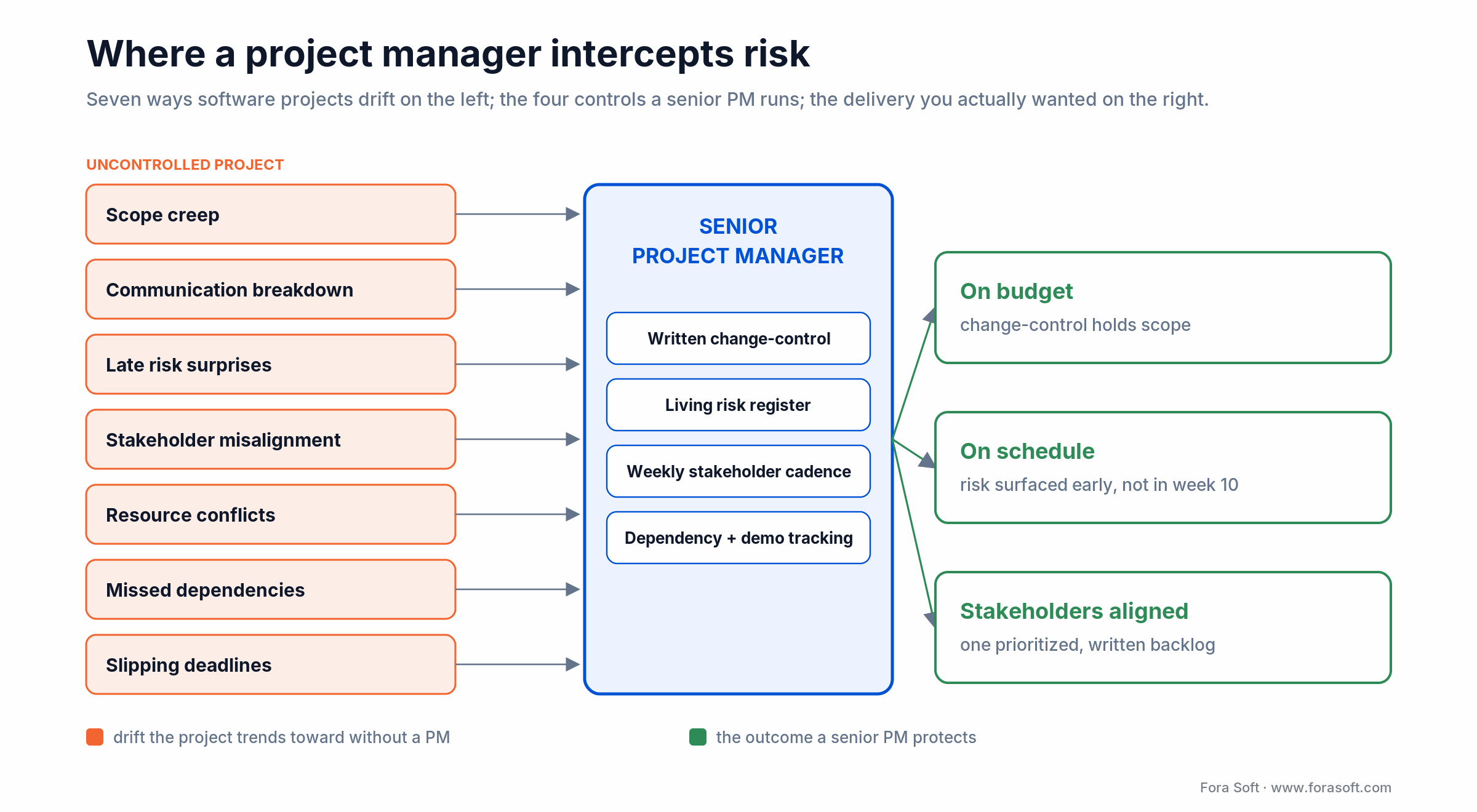
Figure 1. The seven ways a software project drifts, the four controls a senior PM runs, and the delivery those controls protect.
The data: how PM quality moves the numbers
How much does a project manager actually change the odds? The 2025 PMI Pulse of the Profession surveyed roughly 3,000 professionals and found that projects led by high-business-acumen PMs hit 73% budget adherence versus 68% for everyone else, 63% schedule adherence versus 59%, and a failure rate of 8% versus 11% (roughly a quarter fewer failures). Only 18% of project professionals qualify as highly proficient, which is exactly why the PM you get matters more than the PM line item.
Zoom out to big projects and the stakes get sharper. McKinsey’s study with Oxford, across 5,400+ IT projects over $15M, found the average large IT project runs 45% over budget, 7% over time, and delivers 56% less value than predicted; 17% go so badly they threaten the company’s existence. In the companion Harvard Business Review research (Flyvbjerg & Budzier, 2011), one in six IT projects was a “black swan” with a 200% average cost overrun. A senior PM owning change-control and the risk register from kickoff is the cheapest way to keep your project out of that tail.
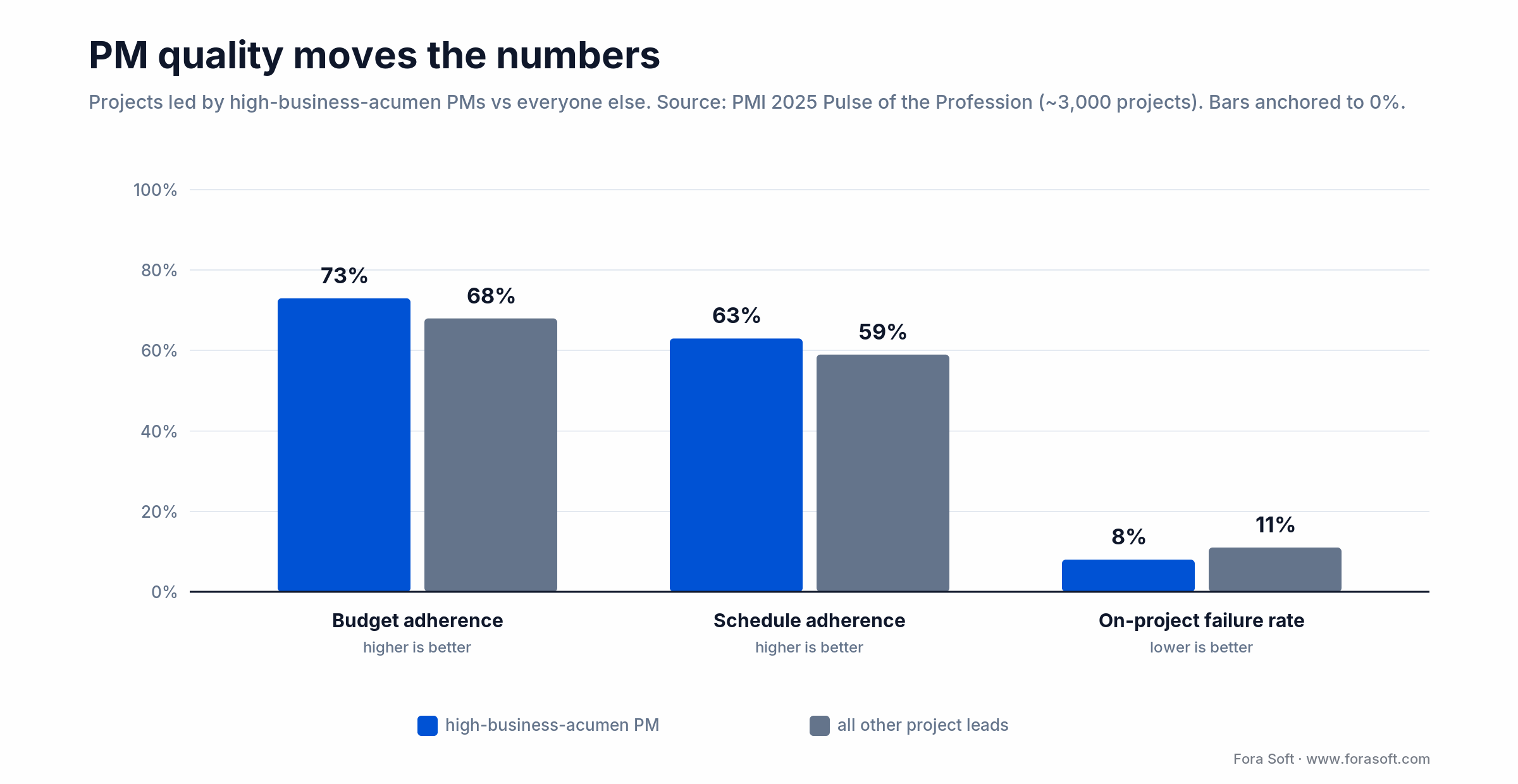
Figure 2. PMI 2025 Pulse of the Profession: high-business-acumen PMs beat everyone else on budget, schedule, and failure rate.
One nuance worth stating plainly: the discipline has to be the modern kind. Standish CHAOS data shows Agile projects succeed roughly three times as often as waterfall ones (39% vs 11%). A command-and-control PM who runs annual Gantt charts in an Agile shop slows the team down. The right PM in 2026 is Agile-literate, leads by removing blockers rather than dictating tasks, and works in weekly delivery, not quarterly plans. The role has evolved; not every PM has evolved with it.
What a software project manager actually does, week to week
A modern software PM isn’t a meeting-scheduler. On a healthy engagement the weekly cadence looks like this.
Planning and backlog
Sprint planning and backlog grooming. Working with the product owner to keep the next two sprints sharp — items sized, acceptance criteria written, commitment realistic. This is what prevents the “40 points of work for 20 points of capacity” antipattern.
Change management. Every scope change documented with cost and schedule impact, stakeholder approval before work starts, the plan re-baselined in the open. This is the control that stops the silent “we’ll just add it” that quietly ends a budget.
Risk, stakeholders, and delivery
Risk register and escalation. A living document: items added as they surface, closed as they resolve, escalated when they cross a defined threshold (say, cost impact over $20k or a slip over one week).
Stakeholder management. One weekly leadership call and a written status update with green/amber/red on schedule, scope, and risk. Every amber or red gets a named owner and a date.
Sprint ceremonies. A 15-minute daily standup, a sprint review with a working demo, a retro with action items — and the PM makes sure those actions actually happen instead of just getting noted.
Vendor coordination and a decision log. If you integrate Stripe, Twilio, or an AI API, the PM owns those relationships and escalates delays. And every material decision gets logged with date, decider, and rationale, so six months later “why did we build it this way?” has a written answer.
Project Manager vs Product Manager vs Scrum Master vs Engineering Manager
These four roles get conflated constantly. They’re different jobs, and a strong team usually needs at least two of them clearly named.
Product Manager. Owns the “what” and “why” — strategy, roadmap, market viability, business value. Interfaces with users, sales, and leadership to set priorities. Does not own delivery dates.
Project Manager. Owns the “how” — planning, execution, scope, timeline, budget, delivery. Coordinates across engineering, design, QA, vendors, and stakeholders. This is the role this guide is about.
Scrum Master. Coaches the team on Agile process and removes in-sprint blockers. Focused on team health and process adherence. Doesn’t face stakeholders or own scope.
Engineering Manager. Hires, grows, and evaluates engineers, and owns technical quality and team culture. Reports up the engineering line, not the project line.
PM responsibilities compared with adjacent roles
A condensed view of who owns what — useful when you’re reading a proposal that names several roles and wondering which one actually holds your deadline.
| Responsibility | Project Manager | Product Manager | Scrum Master | Engineering Manager |
|---|---|---|---|---|
| Roadmap & priorities | Supports | Owns | — | — |
| Schedule & budget | Owns | Influences | — | Influences |
| Sprint ceremonies | Drives | Attends | Facilitates | Attends |
| Risk register | Owns | Reviews | — | Contributes |
| Stakeholder updates | Owns | Co-owns | — | — |
| Vendor coordination | Owns | Influences | — | — |
| Hiring & team health | — | — | Influences | Owns |
Reach for both a PM and a Scrum Master when: the project is large and Agile — the PM faces outward (stakeholders, vendors, budget, schedule) while the Scrum Master faces inward (team, ceremonies, blockers). On smaller projects one senior PM covers both, and the buyer often plays Product Manager.
Which project management methodology fits your project
Waterfall
Linear progression: requirements, design, build, test, deploy. Right when scope is genuinely fixed and well understood — regulatory compliance, hardware-dependent systems, integrations with rigid third-party schedules. The risk is late-stage surprises, so the PM’s job is tight change-control that keeps scope creep from wrecking the schedule.
Agile (Scrum, Kanban, SAFe)
Iterative delivery in two-week sprints. Right for evolving requirements, feedback-driven products, and innovation work. The PM owns backlog prioritization, sprint commitment, cross-team coordination, and the ceremonies that keep the team accountable. Without a PM, Agile decays into chaos — no prioritization, no escalation path, no cross-team sync.
Hybrid / lean
Agile for development plus Waterfall rigor for governance. Common in regulated industries that need both rapid iteration and audit-grade documentation. The PM bridges the two cadences: engineering feels Agile while leadership gets the structured reporting they need.
Reach for Agile when: requirements will change as you learn, and you can ship and demo every two weeks. Reach for Waterfall when scope is fixed by contract or regulation and late change is genuinely off the table. Most real software projects land on a hybrid — and the PM is who makes the hybrid hold together.
PM tools we actually use in 2026
Jira (with Rovo AI). Still the default for large enterprise software and long ticket histories. Atlassian’s Rovo assistant got its biggest update at Team ’26 (May 2026): natural-language search across 50+ connected apps, automated retrospectives, and agents that surface institutional knowledge from years of tickets. Right for organizations with 50+ engineers.
Linear (with AI Triage and Linear Agent). Keyboard-first, sub-100ms, with AI Triage (GA mid-2025) auto-assigning priority, labels, and routing, and the Linear Agent in beta handling routine issue management. Beloved by fast-moving product teams under about 50 engineers.
Asana, Monday, ClickUp. General-purpose project management. Less developer-specific than Jira or Linear, but useful for cross-functional work spanning engineering, marketing, ops, and legal.
Notion (with Custom Agents). The “second brain” for decision logs, briefs, and runbooks. Notion’s Custom Agents (GA February 2026) run on schedules to post weekly project updates and pull context across Slack, Linear, and Figma. Used alongside Jira or Linear, not instead. The honest rule: the tool is downstream of the discipline — a senior PM with a clear cadence beats a junior PM with the fanciest stack. If you want the reference, Atlassian’s own Rovo docs are a good primer on where AI actually helps.
Reach for Jira when: you have 50+ engineers and years of tickets to mine. Reach for Linear when you’re a startup or product team that values speed and a clean keyboard-driven flow. Either way, insist your PM can show you this Friday’s status report — the tool is worthless without the person.
The cost — and the ROI you should expect
A senior software PM carries a fully-loaded cost of roughly $60–$80/hour at agency billing in our market segment, and typically runs 10–20% of total project hours — more on regulated or multi-vendor work. On a 2,000-hour project that’s 200–400 hours of PM time, or about $15–$30k. Because we run on Agent Engineering, our allocations tend to land at the lean end of that band, not the fat one.
The ROI math, shown out loud. Take a ten-person team on a $200k/month burn — roughly $5,000 in loaded cost per engineer-week. One uncontrolled scope-creep incident that slips the timeline by two weeks costs about 10 engineers × 2 weeks × $5,000 ≈ $100,000 in labour alone, before the launch-slip opportunity cost. A PM who prevents that single incident pays for their entire allocation (~$21k) roughly five times over, and a good PM prevents several across a project.
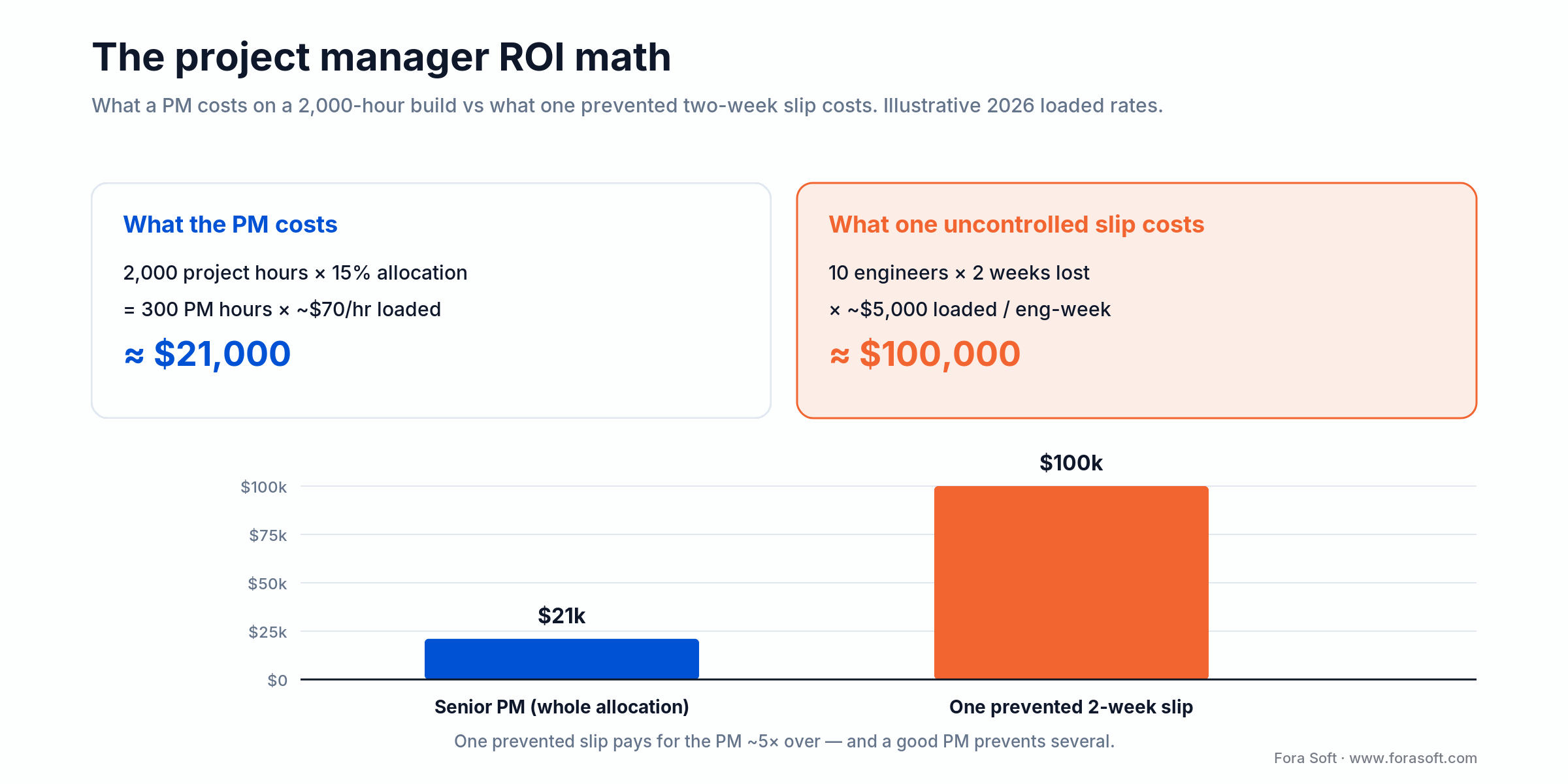
Figure 4. The PM allocation on a 2,000-hour build versus the cost of a single prevented two-week slip. One catch pays for the role several times over.
The corollary keeps you honest: a PM who doesn’t prevent those incidents is overpriced at any rate. The right test isn’t “is there a PM line item?” but “does the named PM have a track record of preventing scope creep, surfacing risk early, and pushing back on stakeholders?” If yes, it’s the cheapest insurance on the proposal. If no, it’s waste with a title.
Want to meet the PM before you sign?
Tell us your project shape and we’ll introduce the senior PM who’d own your engagement — with their real past projects and references. The PM you meet in scoping is the PM who delivers. No bait-and-switch.
Do you need a PM? A decision framework in five questions
Run your project through these five questions. The first “yes” means budget a dedicated senior PM.
Q1. How many engineers build at once? More than two or three in parallel and coordination stops being a side-of-desk task. Budget a PM.
Q2. How many stakeholders have a say? One decisive buyer is manageable; marketing plus sales plus a founder with competing priorities needs someone to force one written, prioritized backlog.
Q3. Is there a compliance or audit load? HIPAA, PCI, SOC 2, GDPR evidence trails. Regulated delivery needs a PM owning the evidence track alongside the schedule — get this wrong and the whole launch waits.
Q4. How many third-party integrations or vendors? Each external dependency is a delay waiting to happen. Several of them, and you need one person tracking the chain and escalating.
Q5. How is delivery driven? Fixed date with external commitments (a launch event, a contract deadline) raises the cost of a slip and the value of a PM catching it early. Loose internal timeline lowers it.
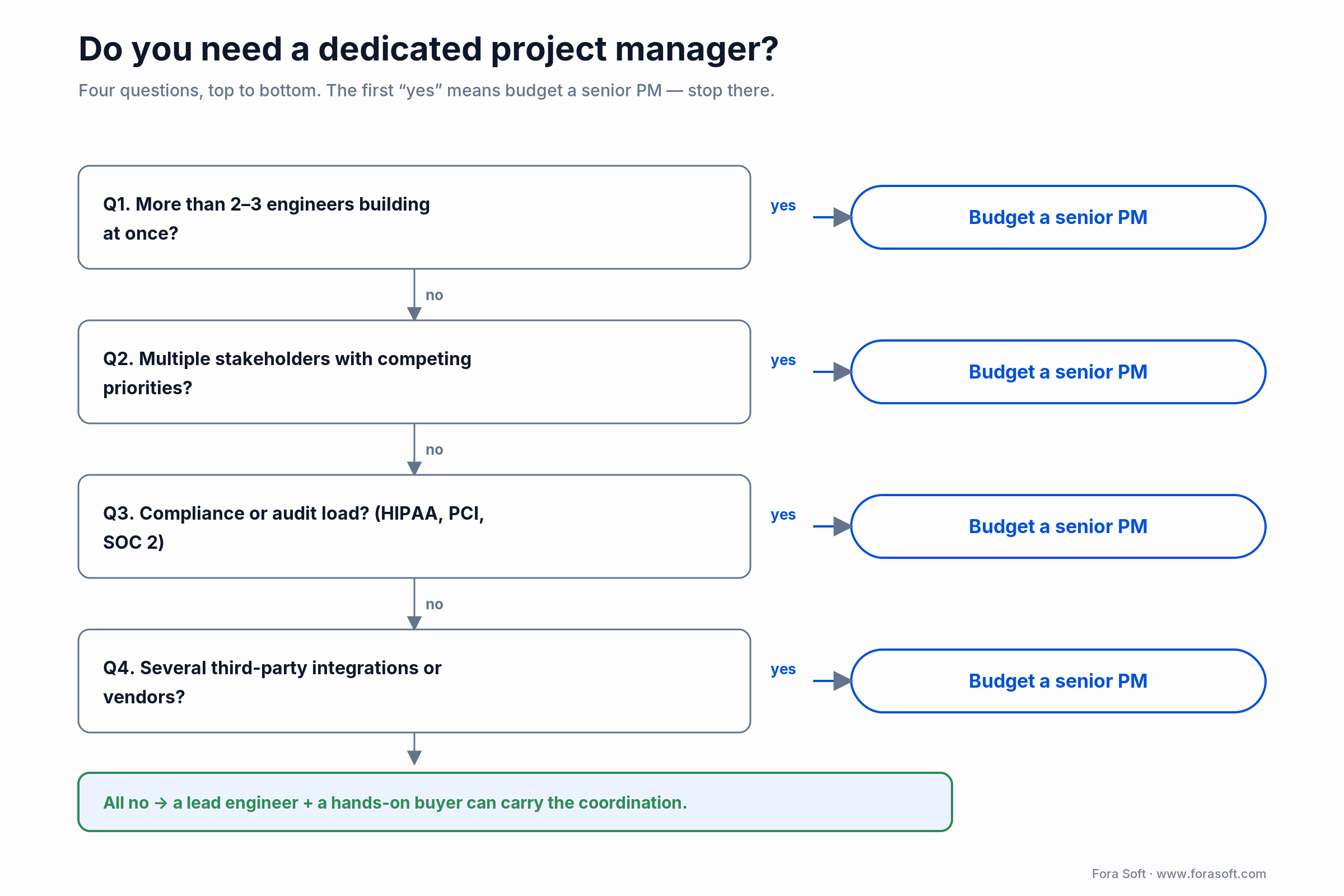
Figure 3. The four-question version of the same decision. The first “yes” means budget a senior PM; all “no” means a lead engineer can carry it.
When you don’t need a full-time PM
Honesty sells better than upselling, so here’s the counter-case. There are real projects where a dedicated PM is overhead, and a good vendor will tell you so.
Small, single-developer builds. One or two engineers, a hands-on buyer who can act as product owner and prioritize, and no compliance load. The lead engineer handles coordination; a part-time PM touchpoint is enough. Paying for a full-time PM here is waste.
Well-scoped, fixed-bid work. A tightly defined integration or a short, unambiguous feature with no moving stakeholders rarely needs a dedicated PM — the change-control surface is small enough for the lead to manage.
Internal experiments and throwaway prototypes. When the goal is to learn fast and the code may not survive, heavy PM process slows you down. Keep it light.
Reach for a lighter setup when: you have one or two engineers, a single decisive buyer, no compliance load, and no external launch date. Fund a fractional PM touchpoint for cadence and demos instead of a full allocation — and revisit the moment any of those conditions changes.
Red flags: signs your project has no real PM
1. Status reports are vague. “On track” with no detail on blockers, risks, or dependencies. A real PM gives you a one-page weekly with green/amber/red and named owners.
2. No sprint cadence. Work flows in ad hoc; no two-week planning, no committed scope. Symptoms: “we’ll see what we get done by Friday” and “the demo got pushed, I’ll let you know.”
3. Scope changes happen verbally. No change log, no impact analysis, no formal approval. Three months in, nobody can say which version of the requirement is final.
4. No risk register. Surprises arrive without warning — the vendor hears about a regulatory issue from your compliance officer instead of their own PM.
5. No decision log. Ask “why did we choose this architecture?” in month four and nobody can answer.
6. Demos slip without explanation, or there’s no demo cadence at all. You get no visibility into the working build until launch — the most expensive moment to find a problem.
7. Engineers context-switch constantly. No one protects focus time or routes requests through a backlog. Productivity collapses; morale follows.
PM antipatterns: the bad PMs you don’t want billing your project
1. The status-report bureaucrat. Generates dense charts no one reads, spends hours in tools no one else opens, adds zero risk-detection or stakeholder management.
2. The meeting-scheduler. Calls standups, reviews, and retros, then takes no action on the blockers raised. The team learns to ignore the meetings; the project drifts.
3. The technically illiterate PM. Can’t assess feasibility or risk, overpromises to stakeholders because they can’t evaluate engineering pushback, and loses the team’s trust inside a month.
4. The PM who can’t push back. Capitulates to every stakeholder demand. Scope grows weekly, the schedule doesn’t, and eventually the team revolts or the launch misses.
5. The PM who hides bad news. Delays escalation until a crisis forces transparency. Engineers learn this and stop reporting honestly; the risk register fills with green that should be amber.
6. The process-for-process’s-sake PM. Over-documents and over-governs until the team spends more time updating tickets than shipping. Documentation should serve decisions, not replace them.
The PM role in the AI age: what changes in 2026
Faster status, less busywork. Jira’s Rovo, Linear’s AI, and Notion’s Custom Agents auto-compile standups, dependency charts, and burndown. The PM no longer spends hours aggregating updates — they spend the hours interpreting and deciding.
Autonomous triage. Linear Agent and Atlassian Rovo handle routine triage and knowledge surfacing across the project history. The PM focuses on the 10% of decisions that matter, not the 90% of tickets that route themselves.
New AI-integration risks to manage. Hallucinations in AI-generated code, prompt injection in agent chains, cascading failures across multi-step LLM workflows. A modern PM understands these risk classes and enforces oversight — logging, human-in-the-loop approval gates, and kill-switches on autonomous workflows.
Orchestration over execution. The PM of 2026 spends less time updating tickets and more time validating outputs and keeping AI agents inside their guardrails. The grunt work is automated; the judgment work is now most of the role.
KPIs: how to tell your PM is actually working
Whatever the title on the invoice, instrument the engagement so the PM’s value is falsifiable within a quarter. Track three buckets.
Delivery KPIs. Sprint commitment reliability (committed vs delivered points), schedule variance against the last re-baseline, and demo cadence actually met. A PM who keeps commitment reliability above ~80% is holding the schedule; wild swings mean planning is broken.
Risk and change KPIs. Number of risks logged and closed per month, average age of an open amber/red item, and the count of scope changes that went through written change-control versus slipped in verbally. Zero logged risks isn’t a healthy project — it’s a blind one.
Stakeholder KPIs. On-time weekly status, escalation lead time (how many days before a slip you heard about it), and buyer-reported confidence. If you find out about problems the week they hit instead of weeks ahead, your PM isn’t doing the core job.
Mini case: how Fora Soft staffs a PM on a real project
Take CirrusMED, a “Netflix for medicine” telehealth platform we built for a Nevada private practice. It’s HIPAA-regulated and now licensed in 48+ US states, so a senior PM owned the compliance evidence track alongside the engineering schedule — HIPAA workflow gates, audit-log requirements, appointment reminders. The client’s own review names the discipline directly: “a detailed wireframing and user stories are done in a fantastic way and timely fashion. All my requirements are taken care of.” That’s a buyer describing what good project management feels like from the outside.
The pattern repeats across regulated, multi-stakeholder work. On BrainCert, a virtual-classroom LMS bootstrapped to $3M ARR and 100K+ customers, we’ve been the long-term delivery team for years, shipping continuous feature work against SOC 2 and HIPAA constraints. On TransLinguist, an interpreter platform that won the NHS UK national language-services framework, the PM coordinated a delivery spanning 75+ languages and a marketplace of 30,000+ interpreters, where a dropped dependency would have meant a missed public-sector deadline.
Common thread: a senior practitioner with real software-PM experience, the technical literacy to read the architecture (the kind of depth our engineers document in the video streaming engineering library), and the authority to push back on stakeholder requests. That’s what turns “PM line item” into actual risk reduction. Want the same discipline on your project?
Frequently asked questions
Do small software projects really need a project manager?
Below about three engineers, with a hands-on buyer who can act as product owner, you can usually skip a dedicated PM — the lead engineer handles coordination and the buyer handles prioritization. Above that team size, or with multiple stakeholders, integrations, or any compliance load, a PM stops being optional. The cost of going without shows up in change orders and missed deadlines.
What is the difference between a Project Manager and a Product Manager?
A Product Manager owns the “what” and “why” — strategy, roadmap, market viability, business value. A Project Manager owns the “how” — planning, execution, scope, timeline, budget, delivery. On a healthy team both roles exist; on a small project the buyer often plays Product Manager while the agency PM plays Project Manager.
How much project management time should I budget?
10–20% of total project hours is the typical range, more on regulated, multi-vendor, or cross-functional work. Below 10% on a multi-engineer project the PM is too thin to be effective; above 25% suggests either an unusually complex project or a PM who’s over-billing. Ask the vendor to break PM hours down per week so you can see what’s billed.
Can a Scrum Master replace a Project Manager?
No. A Scrum Master focuses on team-level Agile process and in-sprint blockers. A Project Manager owns the broader scope — cross-team coordination, stakeholder management, vendor relationships, schedule, budget, risk register. On larger Agile projects you often need both, with the PM facing outward and the Scrum Master facing inward.
How do I evaluate a PM during scoping?
Ask three questions. (1) “Walk me through a project where the schedule slipped and how you handled it” — listen for risk detection and escalation, reject vague answers. (2) “What are the three biggest risks in our project today?” — a real PM names three specific items with mitigations in five minutes. (3) “Can I see the status report you sent your last client Friday?” — a real PM has one ready.
Will the PM I meet during scoping be the PM on my project?
Ask explicitly. Some agencies bait-and-switch — the senior PM you meet in sales hands off to a junior after signing. The right answer is “yes, the same person, named in the contract.” If a vendor can’t commit to a named PM, you’re signing for an unknown.
How does AI tooling change the PM role in 2026?
AI compresses the routine artifacts — status updates, dependency charts, standup notes — so the PM spends less time aggregating and more time deciding. It also introduces new risks (hallucinations, prompt injection, agent kill-switch design) that PMs now have to govern. The job has shifted from execution to orchestration; the role is more strategic, not less important.
What project management tool should my software PM use?
It depends on team shape. Jira with Rovo is the default for large enterprises and long ticket histories; Linear for fast-moving startups and product teams under about 50 engineers; Asana, Monday, and ClickUp for cross-functional work; Notion as the decision-and-runbook layer alongside whichever ticket system you pick. The tool is downstream of the discipline — a senior PM with a clear cadence beats a junior PM with the fanciest tool.
What to Read Next
Recovery
Deadlines Slipping — What to Do
When the PM should have caught it earlier — a recovery framework once the schedule has already slipped.
Stakeholders
When Expectations Clash With Reality
Stakeholder misalignment is the second-biggest project killer — the PM’s playbook for closing the gap.
Scoping
Why Cut Features and Launch Early — the MVP Playbook
Smaller scope needs less PM, larger scope needs more — how to cut before you sign.
Estimation
Why Developers’ Time Estimates Don’t Always Work
How to read three competing quotes — the PM line is one of the most misunderstood.
Cost
How to Cut Costs on a Software Project
Which corners are safe to cut and which ones cost you more later — the PM is rarely the right cut.
Ready to staff your project with a senior PM?
A project manager isn’t billable filler. On any multi-engineer engagement they’re the discipline that prevents scope creep, surfaces risk early, aligns stakeholders, and translates between engineering and the business. The data across PMI, McKinsey, and the Standish CHAOS Report is consistent: PM presence and quality are among the strongest predictors of whether software project management actually lands a project on schedule and on budget.
And if your project is small, single-developer, and unregulated, we’ll tell you to skip the full allocation. That honesty is the point. But if your vendor can’t name the three biggest risks on your project this week, that’s a signal: either there’s no PM, or there’s a junior posing as one. The useful next step is a 30-minute call with a senior PM who’ll ask the right questions and tell you honestly whether the PM line on your proposal is value or padding. Bring the proposals; we’ll read them with you.
Get a senior PM on your software project
A 30-minute call with a senior PM from a team that’s shipped 250+ projects since 2005 across video, AI, telehealth, and EdTech. Bring your scope — we’ll come back with a PM allocation, a risk view, and a delivery plan you can defend to your board.

