

Key takeaways
• QA testing is the cheapest insurance you will ever buy. Poor software quality cost the US economy $2.41 trillion in 2022 (CISQ), and a bug caught in design is roughly 100× cheaper to fix than the same bug in production.
• Every recent “headline” outage is a QA story. Knight Capital lost $440M in 45 minutes (2012), Boeing 737 MAX killed 346 people, CrowdStrike took down 8.5M machines in July 2024, all traced back to testing gaps that would have been caught by basic pre-release QA.
• The 70/20/10 test pyramid still wins. 70% unit, 20% integration/API, 10% end-to-end, and mature teams automate 70–80% of regression and keep manual effort for exploratory, UX and accessibility work.
• Budget math is simple. Plan for 15–25% of project cost on QA for standard SaaS, 30–40% for regulated or safety-critical systems (healthcare, fintech, video surveillance). Skimping here moves the spend into incident response, refunds and churn.
• AI-augmented QA is here, but partial. ~90% of orgs are pursuing Gen AI in QA, but only 15% run it at enterprise scale (Capgemini WQR 2025–26). The right play in 2026 is a hybrid: AI for test generation, flakiness detection, log triage; humans for strategy, exploratory and regulated paths.
Why QA is still the cheapest insurance in software
QA testing is the discipline of catching defects before your users do, across requirements, code, integration and production. At Fora Soft, we have spent 20+ years shipping video conferencing, telemedicine, OTT streaming and video surveillance products, categories where a single bug can burn a launch, leak PHI, or freeze a live stream for 10,000 viewers. That is why our QA process runs at every stage of delivery, not just before release.
The numbers we operate at keep QA honest. BrainCert, our WebRTC-based virtual classroom, serves 100,000+ customers and has taken home four Brandon Hall awards, which you do not earn with flaky video. Worldcast Live streams HD concerts to 10,000+ concurrent viewers. VALT, the video surveillance platform we have built and run as sole development team for 10+ years, serves 770+ US organizations and 50,000+ users under HIPAA. For MyOnCallDoc and CirrusMED we own the full HIPAA testing paper-trail, not the marketing-deck version.
This playbook is what we hand to founders, product owners and CTOs who ask “how much QA do we actually need?” The short answer: probably more than you think, but almost certainly less than your competitor is spending badly. The long answer is below, grounded in CISQ, NIST, Capgemini World Quality Report 2025–26, and the projects we have shipped.
Unsure whether your QA budget is protecting you or just burning cash?
30 minutes with a senior Fora Soft QA lead — we will audit your current test strategy and show you where the leaks are.
What actually goes wrong when teams under-invest in QA
QA debt does not show up on the balance sheet. It shows up as a 2 a.m. incident, a Trust & Safety headline, a regulator letter, or a cohort of silently churned users. The economic ceiling is enormous: the Consortium for Information & Software Quality puts the 2022 cost of poor software quality in the US at $2.41 trillion, with $1.52 trillion of that sitting as accumulated technical debt that blocks future change.
Zoom in on a single product and the failure modes are predictable:
- Functional bugs in core flows: wrong totals, broken checkout, stream disconnects. These directly reduce conversion and retention.
- Security defects: unpatched libraries, leaking tokens, SQL injection paths. Equifax’s 2017 Apache Struts miss cost $1.38B in breach costs and settlements.
- Performance regressions: a 200ms median TTFB growing to 1.2s under real traffic, silently halving sign-ups.
- Integration and deployment bugs: config drift, missing feature flags, half-deployed services. Knight Capital’s 2012 dormant-code reactivation cost $440M in 45 minutes.
- Compliance and accessibility gaps: missing HIPAA audit trails, WCAG 2.2 failures, unresolved cookie consent paths.
- Data-quality bugs: an accumulating off-by-one in a trading app or a mis-rounded currency in a payout pipeline. These are the ones that still ship in 2026.
Notice what is missing from this list: “cosmetic issues in a staging build.” Every item above is a P0/P1 that reaches production when QA is treated as a checkbox instead of a discipline.
The 1:10:100 rule — when bugs get caught matters more than how many
The single most important QA number is not “how many bugs we found.” It is the ratio between where the bug was introduced and where it was caught. The classic 1:10:100 curve, drawn from Barry Boehm’s cost-of-change research and the NIST 2002 study on inadequate testing infrastructure, is still the cleanest way to explain QA ROI to a non-technical board. Treat the exact multipliers as directional, not gospel; the shape is what matters.
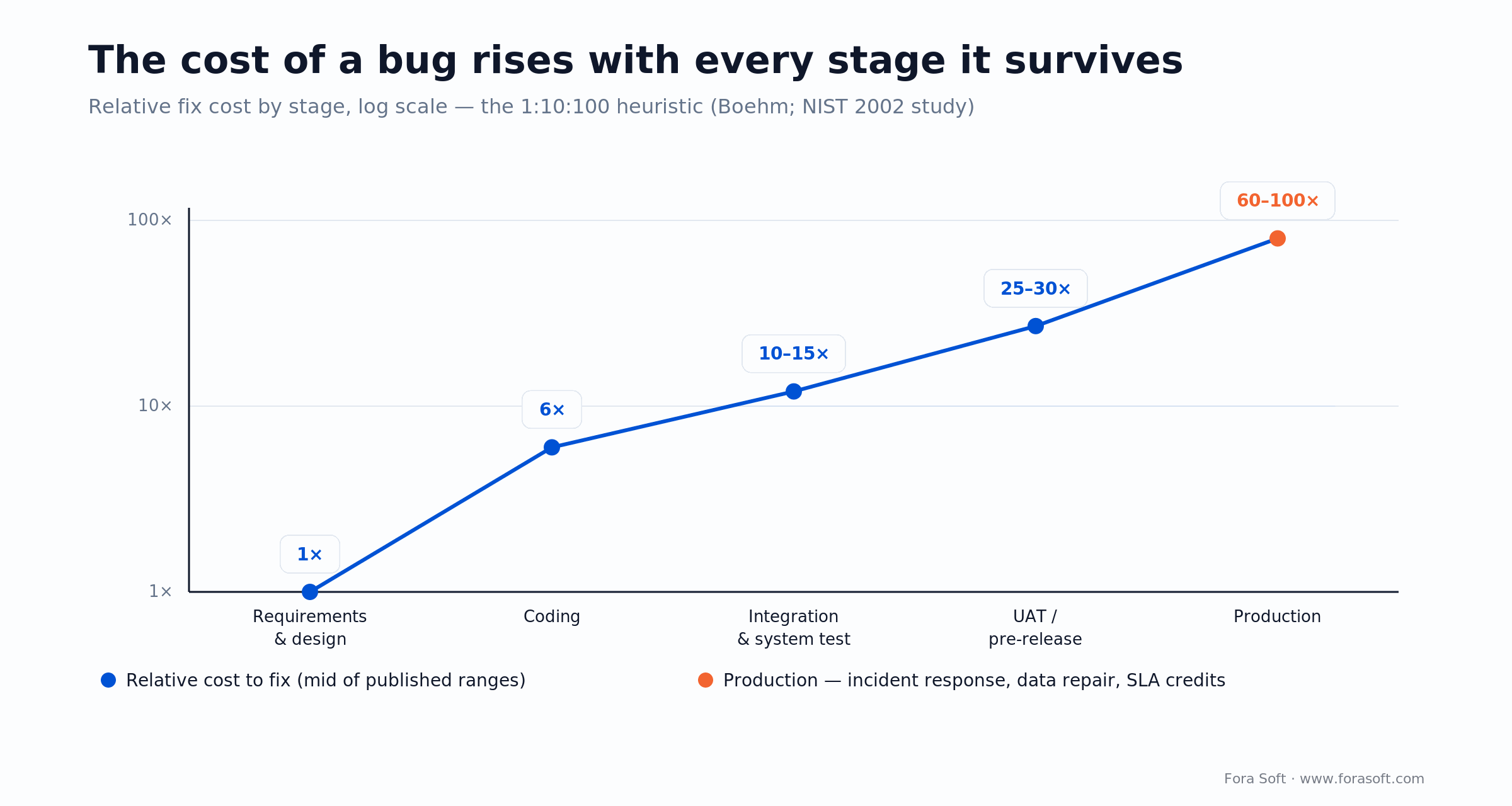
Figure 1. The 1:10:100 cost curve: the same defect gets 60–100× more expensive between design and production.
| Stage bug is caught | Relative cost to fix | Why the multiplier | Who catches it |
|---|---|---|---|
| Requirements / design | 1× | Fix is a diff in a spec doc. Zero code, zero rollback. | BA, PM, QA lead reviewing stories |
| Coding | ~6× | Developer pairing, static analysis, unit tests fail before merge. | Developer, linter, unit tests |
| Integration / system test | ~10–15× | Requires rollback of a feature branch, re-run of pipelines. | QA engineer, CI pipeline |
| UAT / pre-release | ~25–30× | Business users blocked, release slip, re-testing required. | Business users, QA |
| Production | 60–100× (more for regulated) | Incident response, data repair, customer comms, SLA credits, possible regulator action. | Customers, support, on-call |
Table 1. Relative cost-to-fix by stage. Source: cost-of-change research (Boehm; NIST 2002 study on testing infrastructure); multipliers are directional industry estimates.
Rule of thumb: if your team is catching more than 5% of defects in production, the QA investment is in the wrong place. Move money and hours left — into requirements review, automated unit and API tests, and pre-merge static analysis.
Five recent failures that QA would have caught
The best argument for QA is not a statistic — it is a timeline. Each of the failures below had an extant QA practice that should have blocked the defect. Each slipped because the practice was optional, under-resourced or ignored.
Knight Capital — $440M in 45 minutes (2012)
A deployment reached only seven of Knight’s eight trading servers, leaving dormant ‘Power Peg’ code live on the eighth. When the market opened, it fired roughly 4 million erroneous executions across 154 stocks in 45 minutes. QA gap: no automated post-deployment canary check that verified every server was running the intended build. A 50-line smoke script would have caught this before the first trade.
Boeing 737 MAX — 346 lives, two crashes (2018–2019)
MCAS relied on a single angle-of-attack sensor with no redundancy. QA gap: failure-mode and effects analysis (FMEA) was signed off without testing the single-sensor failure case end-to-end with realistic pilot workload. Safety-critical software needs adversarial testing, not happy-path validation.
Equifax — 147M records, $1.38B in costs (2017)
A public Apache Struts CVE was disclosed in March; breach started in May. QA gap: vulnerability scans ran but missed unpatched hosts, and an expired SSL certificate blinded the intrusion-detection system. Modern security testing in CI plus basic cert-expiry monitoring would have closed both holes.
CrowdStrike Falcon Sensor — 8.5M machines, July 2024
A malformed Channel File 291 passed content validation and bricked Windows kernels on boot. Delta alone reported ~$500M in losses. QA gap: no staged canary rollout for “content” updates, and the validator itself was not tested against malformed input. The fix, progressive rollout plus property-based tests on the validator, is not exotic.
Therac-25 — six radiation overdoses, 1985–1987
A race condition between operator input and radiation dose selection delivered lethal overdoses. Previous models had hardware interlocks; Therac-25 moved safety into software and trusted it. QA gap: no concurrent-behaviour testing, no formal verification, no defense-in-depth. It is the enduring argument for hardware backstops in life-critical systems.
Pattern: every “QA failure” at this scale is actually a process failure. The testing technique that would have caught it existed, was cheap, and was not applied because nobody owned “we do not ship without this gate.”
The QA testing pyramid that keeps releases sane
Mike Cohn’s test pyramid, re-documented by Martin Fowler, still describes what good test portfolios look like — even after SPA frameworks made UI testing more tractable. The three layers in descending volume:
- ~70% unit tests: isolate a function or class, run in milliseconds, live next to the code. This is where you catch 80% of defects at 1× cost.
- ~20% integration / API / service tests: exercise real HTTP, real database, real queues. Catch contract drift between teams and third-party SDK regressions.
- ~10% end-to-end / UI tests: a small, curated set of critical-path journeys. Slow, brittle, expensive to maintain — so keep the set tight.
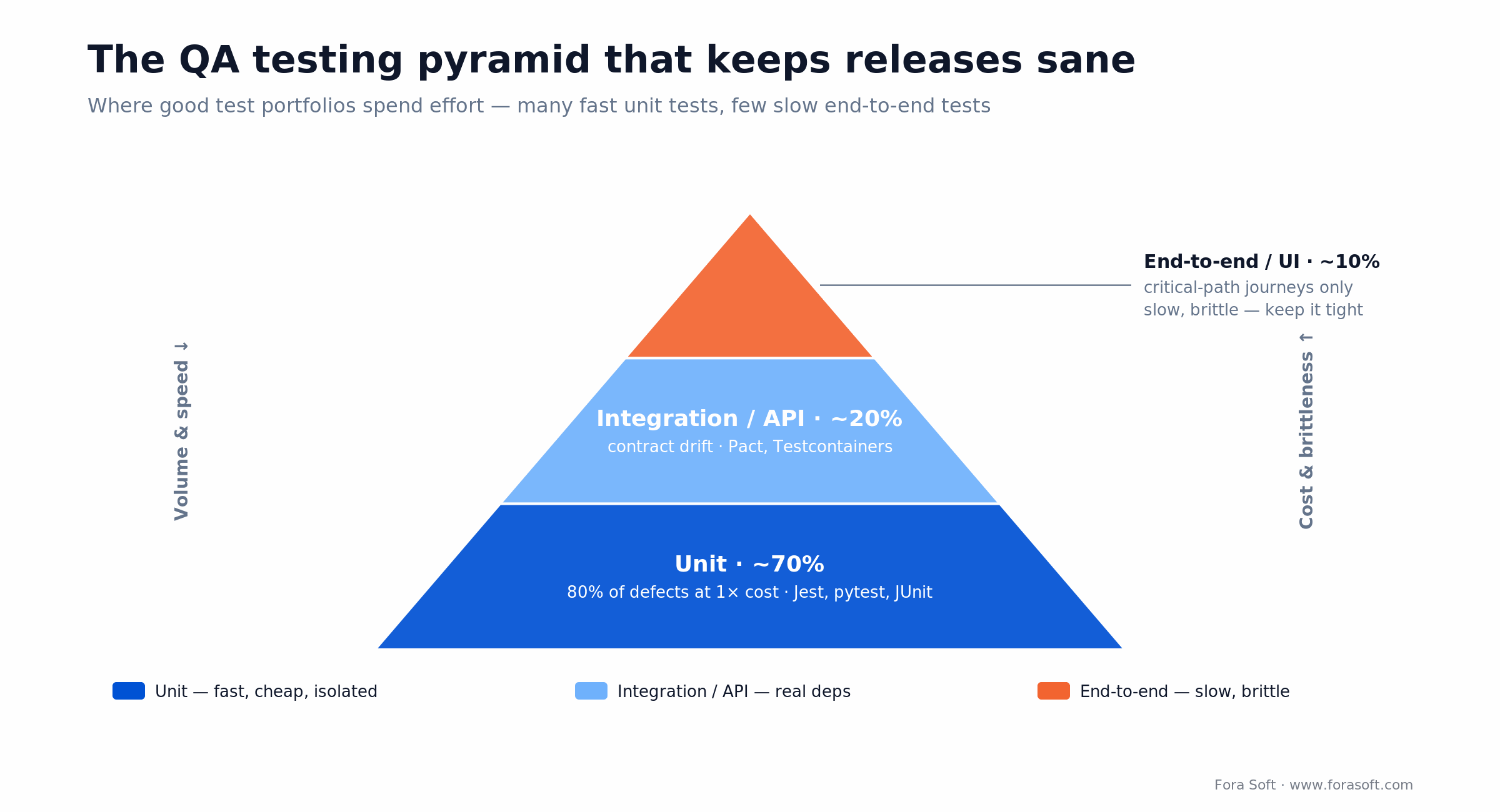
Figure 2. The test pyramid: many fast unit tests at the base, a few slow end-to-end tests at the top.
When teams invert the pyramid (hundreds of Cypress/Playwright tests and a handful of unit tests), the symptoms are predictable: flaky CI, 40-minute pipelines, night-before-release triage, and a QA team that feels like a bottleneck. Fixing this is mechanical: add unit tests at the point where bugs actually appear in your bug tracker, delete E2E tests that duplicate unit-level assertions, and set a CI budget (e.g. “unit suite runs in <3 min”).
Reach for a heavier E2E layer only when: you have multi-service user journeys with no strong contract tests, or regulated flows (payments, HIPAA) where a full browser assertion is the audit evidence.
The 12 types of QA testing, and when each earns its keep
You do not need all 12 on every project. The skill is knowing which to switch on at each maturity stage. We use this matrix when scoping custom software development engagements.
| Type | What it answers | When to switch on | Typical tooling |
|---|---|---|---|
| Unit | Does this function do the thing it claims? | Day 1, every repo. | Jest, Vitest, pytest, JUnit, XCTest |
| Integration | Do these modules still talk after a refactor? | When you have >1 service or DB. | Testcontainers, WireMock |
| API | Does the contract still hold for every consumer? | The moment you expose an external API. | Postman, REST Assured, Pact |
| End-to-end (UI) | Does a real user get through the critical path? | Pre-release gate on top N journeys only. | Playwright, Cypress, Selenium |
| Smoke | Is the build even alive? | After every deploy, before any deeper test. | Custom scripts, curl, Playwright |
| Regression | Did we break anything that used to work? | Every PR to main, every release. | CI runner + suite above |
| Performance / load | Does it still work at 10× traffic? | Before scale events, after architecture changes. | k6, JMeter, Gatling, Locust |
| Stress / chaos | What breaks first when we hurt it? | Once you have SLOs worth protecting. | Gremlin, Chaos Mesh, Toxiproxy |
| Security | Can an attacker break in or out? | From day 1, with annual pen-tests. | OWASP ZAP, Burp, Snyk, Trivy |
| Accessibility | Can everyone actually use it? | Any public or enterprise product. | axe-core, Pa11y, screen-reader passes |
| Usability / UX | Do real users understand the flow? | Before each major UX overhaul. | Maze, UserTesting, moderated sessions |
| UAT | Does it match the deal the business signed for? | Last gate before go-live in enterprise. | TestRail, Zephyr, signed acceptance |
Table 2. Twelve QA testing types, sorted by scope from narrow (unit) to broad (UAT). The tooling column is representative, not prescriptive.
Need a QA stack mapped to your product, not a textbook?
We will sketch a pragmatic test-type matrix and tooling plan for your exact domain — video, healthcare, fintech, surveillance — in a single working session.
Shift-left vs shift-right — and why you now need both
Shift-left is the classic move: pull testing earlier in the SDLC. Review non-functional requirements before design, lint before merge, unit-test before PR, API contract-test before integration. The payoff is the defect-cost curve: every bug caught a stage earlier saves the 5–10× multiplier in the next stage.
Shift-right is the newer discipline: deliberately test in production with real users and real data. That sounds reckless until you realise most SaaS already does a worst-case version of it — push and pray. A disciplined shift-right programme is the opposite: dark launches behind feature flags, canary rollouts to 1%→5%→25%→100%, synthetic probes against the live API, and observability dashboards that auto-rollback when error rate or latency crosses an SLO.
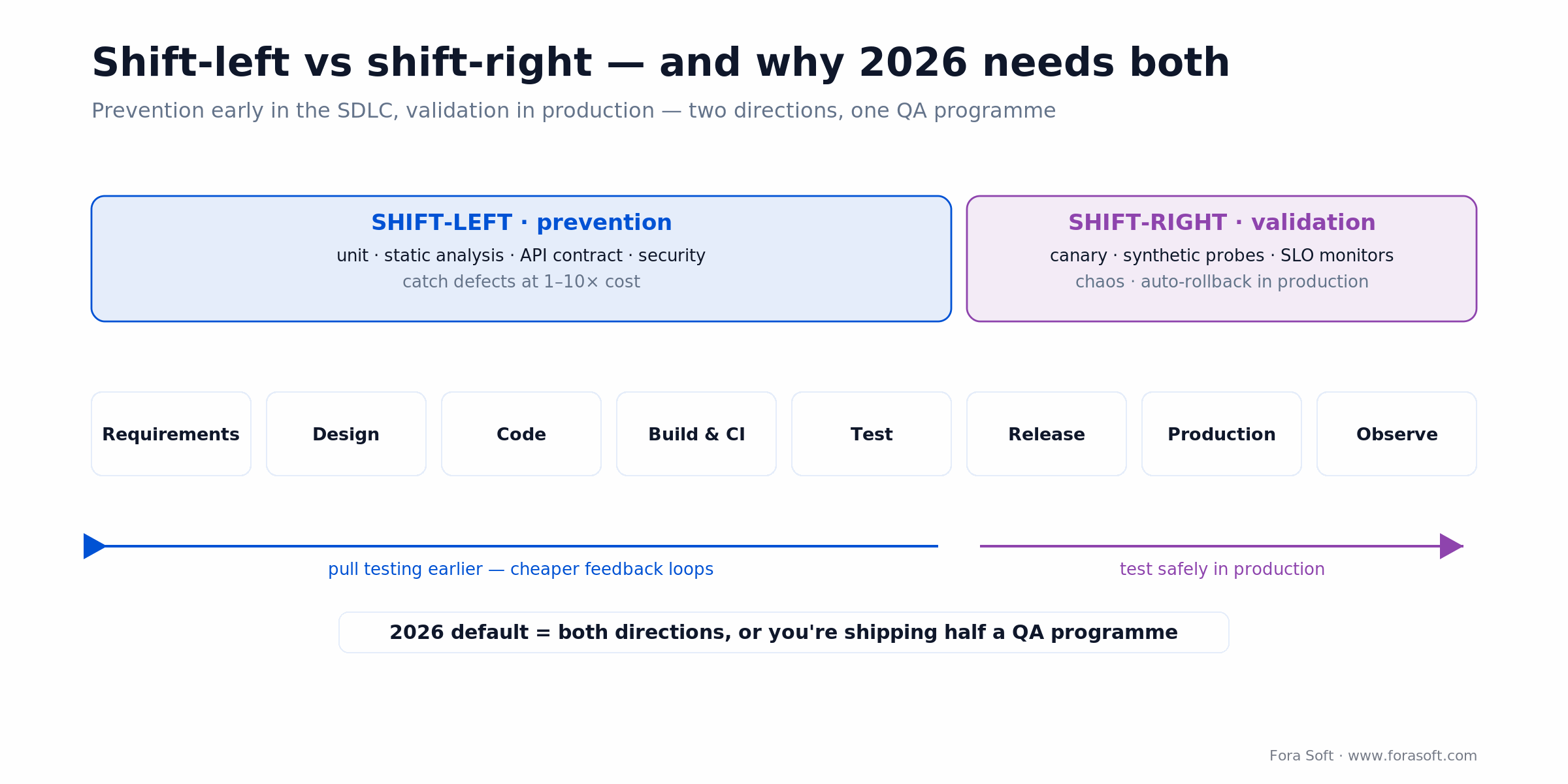
Figure 3. Shift-left catches defects cheaply before release; shift-right validates safely in production. 2026 needs both.
1. Shift-left wins. Cheap feedback loops. Developers fix their own bugs while context is fresh. Test data is easy to generate. Obvious when applied to unit, static-analysis and API contract testing.
2. Shift-left limits. Pre-production traffic is fake. Some classes of bug, like scaling, timing, specific device/network combos or third-party outages, only surface with real load.
3. Shift-right wins. The highest-fidelity test environment is production itself. Feature flags + canary + auto-rollback decouple deployment from release, so you can ship weekly without putting the whole user base at risk.
4. Shift-right limits. Requires real observability (APM, structured logs, SLO monitors) and a rollback culture. If your team cannot roll back cleanly in <5 minutes, shift-right is a loaded gun.
5. The 2026 default. Shift-left for prevention (unit, API, security), shift-right for validation (canary, chaos, synthetic monitors). Anyone selling you one without the other is selling you half a QA programme.
Reach for shift-right when: you already have a green CI, a rollback button that works, and at least one SLO you promise to customers. Otherwise, fix shift-left first.
Manual vs automated testing — the honest ratio
Every QA conference talk claims automation will replace manual testing. It will not, and pretending otherwise is how teams end up with a brittle 4-hour Cypress suite and no exploratory coverage. The honest split:
- Automate: regression, smoke, unit, API contract, load, visual regression, security scans. Anything that is run more than a dozen times and has a clear pass/fail.
- Keep manual: exploratory testing, UX and mobile app UX validation, accessibility with assistive tech, new-feature first-pass, localisation and RTL layouts, regulated sign-offs.
- Target ratios by maturity: MVP (0–6 months): 30–40% automated. Growth (6–18 months): 60–70%. Mature (18+ months): 70–80%, cap at 85% — above that you are automating tests nobody needs.
Katalon’s 2025 industry data lines up with what we see on enterprise engagements: roughly 82% of teams still rely on manual testing somewhere in the pipeline, and 45% have automated their core regression suite. The teams that claim 100% automation usually mean “100% of the tests we remembered to write.”
How QA budgets really break down
QA cost is not a line-item — it is a distribution across people, tools, environments and time. Here is how a realistic 12-month budget lays out for a mid-size product team (20–40 engineers). These are guide rails; your mileage varies by domain and regulatory load. When we scope work that includes fixing an already-buggy codebase, the QA share temporarily spikes 5–10 points.
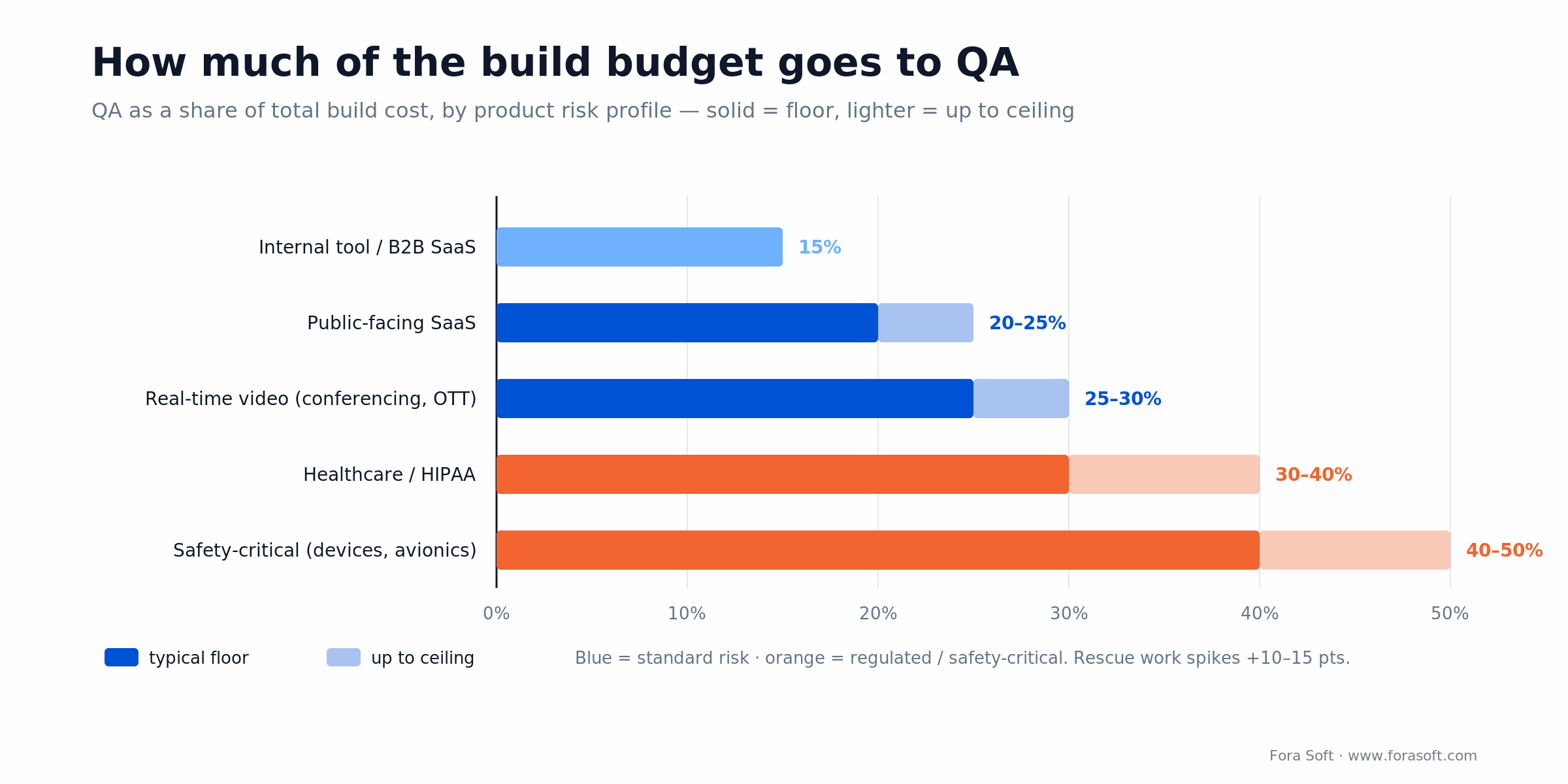
Figure 4. QA as a share of build budget climbs with product risk, from ~15% for internal tools to 40–50% safety-critical.
| Project type | QA share of total budget | Dominant cost | Why this range |
|---|---|---|---|
| Internal tool / B2B SaaS | ~15% | Manual + lightweight automation | Low blast radius; users tolerate short outages. |
| Public-facing SaaS (mass market) | 20–25% | Automation + performance + security | Brand risk, scale, 24×7 availability. |
| Real-time video (conferencing, OTT) | 25–30% | Load + network simulation + device lab | Codecs, NAT, jitter, devices explode the matrix. |
| Healthcare / HIPAA | 30–40% | Audit trails + security + UAT | Regulator-grade evidence needed. |
| Safety-critical (medical devices, avionics) | 40–50% | Formal verification + FMEA | Failure has legal and human cost. |
Table 3. QA budget share by project type. These are realistic ranges for teams with a functioning DevOps practice; rescue or legacy-modernisation engagements typically spike 10–15 points above these for the first 3–6 months.
Because Fora Soft leans on agent-assisted engineering across generation, review and test authoring, our current QA delivery tends to come in faster and leaner than a fully manual shop on the same scope — especially for regression suite bring-up and test-data generation. We still price cautiously; we do not promise numbers we cannot defend.
AI in QA testing in 2026 — what is real, what is hype
Capgemini’s World Quality Report 2025–26 is the cleanest snapshot: 89% of organisations are piloting or deploying Gen AI in QA (37% in production, 52% still in pilot), yet only 15% run it at enterprise scale. The average reported productivity lift is 19%, though a third of teams report minimal gains. Our read from the ground: AI in QA is genuinely useful in four places, and mostly noise in the rest.
1. Test generation from code and stories. LLMs draft unit tests from signatures and spec docs, flag missing branches, and generate realistic fuzz inputs. Expect a 2–4× speed-up on test authoring, with human review still mandatory.
2. Flakiness detection and triage. Models cluster failure logs, identify retry patterns, and quarantine unreliable tests automatically. The win is engineer time saved, not new bugs found.
3. Visual regression and self-healing selectors. Perceptual diffing and semantic locators reduce brittle-selector churn in E2E suites by 60–80% in our experience.
4. Log and incident triage at production. Auto-summarising stack traces, correlating alerts, recommending a first diagnostic hypothesis. This is shift-right territory and is where the biggest 2026 gains are landing.
5. Where it still fails. Autonomous end-to-end authoring of UAT-grade suites; anything regulated where you need signed test evidence; and critical-path safety testing. AI speeds the first mile; humans still have to sign the last mile. For a deeper read, see our full AI-in-QA stack breakdown and our note on using AI to prevent technical debt.
QA in Agile and CI/CD pipelines
In a modern pipeline, QA is not a column on the board or a gate at the end — it is a set of budgeted stages that every PR passes through. Here is a pipeline we would run for a typical product development engagement:
| Stage | Gate | Time budget | Action on red |
|---|---|---|---|
| Pre-commit | Lint, format, secrets scan, fast unit tests | < 30 s | Block commit |
| PR / CI | Full unit + integration + API contract + SAST | < 5 min | Block merge |
| Deploy to staging | Smoke + E2E critical-path + DAST | < 15 min | Block promotion |
| Pre-prod canary | Load test + synthetic probes | 20–60 min | Halt rollout |
| Production | SLO monitors, error-rate rollback, chaos drills | Continuous | Auto-rollback + incident |
Table 4. QA stages mapped to a CI/CD pipeline. The time budgets keep CI honest; any stage breaching its budget twice in a sprint triggers a test-health review.
Mini case: how QA saved an enterprise video surveillance launch
Situation. A large enterprise video surveillance vendor was about to push a major platform update across multi-camera deployments. The dev team had green CI, passing unit tests and a clean staging sign-off. The client wanted to skip the week of regression we had scheduled to shave launch date by five working days.
12-week plan. We pushed back. Instead of skipping, we re-ran a disciplined regression sweep across live camera feeds, event-rules engine, storage retention and alert pipelines — the classic load-handling risk surface on surveillance systems. Automated regression suite for stable flows; two exploratory QA engineers on edge-cases and real-camera matrices; load test simulating 2× peak.
Outcome. The sweep surfaced several defects, including two P0 blockers that were not reproducible in unit or integration tests — they only fired when real camera streams interacted with the updated alert pipeline. Fixes took four days. Launch shipped on time, with zero post-launch P0 or P1 incidents in the first 30 days. Client asked us to own the ongoing regression programme on that product. The comparable skipped-QA scenario, based on our internal benchmarks and the client’s own cost of downtime, would have pulled five to six figures of incident spend plus the reputational cost of a surveillance system misbehaving under production load.
See Netcam Studio for the surveillance-UI case study, or book a 30-minute session if you are about to cut QA from a launch plan and want a second pair of eyes.
Are you about to skip QA to hit a date?
Tell us the release plan. We will tell you in 30 minutes whether it is survivable — or where the P0 is about to come from.
The QA tooling stack we actually use
A QA stack is not a checklist, it is a budget. Every tool is a maintenance liability. We default to fewer, well-adopted options rather than a full bingo card.
- Test runners and unit frameworks: Jest / Vitest for JS/TS, pytest for Python, JUnit5 for JVM, XCTest and Espresso for mobile.
- E2E and visual: Playwright for web (dominant choice in 2026), Detox for React Native, Appium + BrowserStack / Sauce Labs for device matrices, Percy / Applitools for visual regression.
- API contract and integration: Postman / Newman for exploratory, Pact for consumer-driven contracts, Testcontainers for real-dependency integration.
- Performance and load: k6 for scriptable load, JMeter for legacy-stack teams, Locust where Python familiarity dominates, wrk2 for low-level latency work.
- Security: Snyk / Dependabot for SCA, Trivy for container images, OWASP ZAP / Burp for DAST, Semgrep for SAST, SOPS / Vault for secret management.
- Observability (shift-right): Grafana + Prometheus + Loki in cost-sensitive setups, Datadog / New Relic / Dynatrace when the ops team prefers SaaS.
- Test-case management: TestRail or Zephyr for regulated / UAT-heavy workloads; GitHub Actions + markdown test plans for lean teams. For the “what do we actually report on” layer, see our note on QA test reporting.
A decision framework — right-sizing QA in five questions
When a founder asks “how much QA do we need?” we answer with these five questions. The pattern of answers gives the budget and scope.
1. What is the blast radius of a bad release? Internal tool vs 10k paying customers vs a hospital ward. Blast radius sets the lower bound of QA spend.
2. Are you regulated? HIPAA, GDPR, SOC 2, PCI, MDR — each adds documented test evidence, access control and audit trail work. If yes, floor your QA share at 30%.
3. How often do you deploy? Quarterly releases tolerate heavy UAT. Daily deploys do not — you must automate or suffer.
4. Can you roll back cleanly in under 5 minutes? If no, shift-right is off the table and you need heavier shift-left.
5. Where do your customers find your bugs — support, Twitter, or the regulator? The answer tells you whether your QA gap is a pre-release or post-release problem, and that determines where to move money first.
Five pitfalls we see in most QA programmes
1. The inverted pyramid. Hundreds of slow E2E tests and a dozen unit tests. CI takes 40 minutes. Fix: add unit coverage where your bug tracker shows pain, delete duplicated E2E assertions.
2. QA as a gate, not a practice. All testing happens in “the QA column” at the end of the sprint, by two people. Fix: every PR carries its own tests; QA engineers pair with devs on risk assessment, not only execution. See our write-up on what to do when the bug count is already spiralling.
3. Flaky CI that nobody fixes. Tests are re-run until green; real failures get masked. Fix: quarantine policy with an SLA (e.g. “flaky tests must be fixed or deleted within 7 days”), flake-rate dashboard, ownership per test.
4. No production observability. You ship, you hope. Fix: at minimum, one golden-signal dashboard (latency, error rate, saturation, traffic) and SLO monitors that auto-page before customers do.
5. Outsourcing QA to junior manual testers only. Cheap until a P0 ships. Fix: a senior QA lead owns the strategy, manual testers handle exploratory and UX, senior SDETs own automation and tooling. Three-role structure, not one.
KPIs that prove QA is working
Pick five or six and report them monthly. More than ten and you are managing the dashboard, not the product.
1. Quality KPIs. Defect Removal Efficiency (DRE) ≥ 95%; defect escape rate (production defects / total) < 5%; defect density < 2 per KLOC for active code; critical-path test coverage ≥ 80%.
2. Business KPIs. Release-blocked rate (releases halted due to quality issues) trending down; customer-reported P0/P1 per month trending down; support-ticket quality share (% tickets that are real bugs) trending down; churn attributable to quality trending down.
3. Reliability KPIs. MTTR for production incidents < 60 min for P0, < 4 hours for P1; change-failure rate < 15%; automated regression suite runtime < 15 min; flake rate < 1%.
When NOT to invest more in QA
More QA is not always the answer. Here is where we tell clients to stop buying:
- Throwaway prototypes. If the code will be deleted in 8 weeks, a basic smoke suite is enough. Write-over-test is cheaper.
- Pre-PMF MVPs. When you are not sure what the product is, over-automating locks in the wrong shape. Ship, learn, then harden.
- When production observability is missing. More pre-release tests cannot substitute for not knowing what is happening after you ship. Fix observability first, then rebalance.
- When the team does not have time to fix what is found. More bugs in Jira you will never triage is worse than fewer bugs you will.
- When the real problem is missed deadlines or expectations out of sync with reality. QA will not fix a broken product plan.
FAQ
How much of my software development budget should go to QA testing?
For internal B2B tools around 15%. For public-facing SaaS 20–25%. Real-time video and streaming products land at 25–30%. Healthcare, fintech and other regulated work starts at 30% and scales to 40–50% for safety-critical systems. These are guide rails — your exact number depends on blast radius, release cadence and regulatory load.
Is automated testing always better than manual testing?
No. Automate anything you will run more than a dozen times with a clear pass/fail — regression, unit, API, load, smoke. Keep manual effort for exploratory testing, UX validation, accessibility with assistive tech, first-pass on new features and regulated sign-offs. Mature teams target 70–80% automation; pushing above 85% usually means you are automating tests nobody needs.
What is the 1:10:100 rule in QA testing?
It is the rule of thumb that a defect caught during design costs roughly 1× to fix, the same defect caught during coding around 6×, during integration and system test 10–15×, during UAT 25–30×, and in production 60–100× or more. The numbers trace to Barry Boehm’s cost-of-change research and the NIST 2002 study; treat the exact ratios as directional. The rule is the backbone of shift-left testing: the earlier you catch it, the cheaper the fix.
What is the difference between QA and QC?
Quality Assurance is the process — how we prevent defects across the SDLC (reviews, standards, CI gates, test design). Quality Control is a subset — the specific act of inspecting outputs (running test cases, validating a build). A healthy programme needs both: QA to keep defects from being introduced, QC to catch the ones that still slip through.
When should I start QA on a new software project?
Day one. QA begins with requirements review, not test execution. Having a senior QA lead read user stories, flag ambiguous acceptance criteria and sketch the test approach before coding starts typically saves 10–20% of total project time on mid-size engagements, because rework on misread stories is the most expensive rework there is.
Can AI replace QA engineers in 2026?
Not in any realistic sense. AI speeds up test generation, flakiness triage, visual regression and log correlation — real gains, typically 15–25% productivity. But it does not own release risk, talk to customers, design UAT evidence, or take regulatory accountability. Capgemini’s 2025–26 survey shows only 15% of orgs have enterprise-scale Gen AI in QA; humans still do the strategy, the last mile and the sign-off.
What KPIs should my QA team report on?
Five to seven, grouped: quality (defect removal efficiency, escape rate, defect density), business (customer-reported P0/P1, release-blocked rate, churn attributable to quality), reliability (MTTR, change-failure rate, automated regression runtime, flake rate). Report monthly. More than 10 KPIs turns QA into a dashboard-management exercise and stops driving behaviour.
How does shift-left testing reduce cost?
Moving tests left, into requirements review, unit, API contract and static analysis, catches defects where they cost 1–10× to fix instead of 60–100× in production. The savings come from that defect-cost curve, not a single magic percentage, so treat any headline figure as directional and specific to your defect profile. The caveat: shift-left only works paired with shift-right (canary rollouts, SLO monitors), because some bugs only exist under real traffic.
What to Read Next
Process
QA at every stage of product development
How Fora Soft bakes testing into every phase, not just before release.
AI in QA
AI in Quality Assurance in 2026: a 9-category stack
Every category of AI QA tools, and where to actually spend.
Technical debt
Using AI to prevent technical debt in QA
How we use AI in QA to stop tech debt from compounding.
Cost of bugs
Lovable app bugs: fix cost & when to hire devs (2026)
Realistic numbers for fixing the bug backlog in a shipped product.
QA reporting
How to report on testing
Turn raw QA activity into metrics your stakeholders can act on.
Ready to stop shipping bugs to your users?
QA testing is not a box to tick before a release. It is the shortest path between a plan and a product that actually works at scale — and, as CISQ’s $2.41T figure keeps reminding us, the most expensive line item you will ever skip. Every major outage of the last decade was a QA story waiting to be told.
The practical take is simple. Move money and attention left (requirements review, unit and API tests, CI gates) until you have a green pipeline. Add shift-right (feature flags, canary rollouts, SLO monitors) so production itself becomes a test environment with guardrails. Use AI where it already works (test authoring, flake triage, log correlation), stay sceptical where it does not (autonomous sign-off, regulated paths). Keep the pyramid right-side-up. Right-size the budget to your blast radius. Report five KPIs, not fifty.
If you are staring at a release calendar and a bug backlog, we can help — whether that is a one-off QA audit, a rescue engagement, or owning QA for the next product line.
Want a QA plan that ships without drama?
30 minutes with a senior Fora Soft engineer — we will map your real QA gaps and the cheapest way to close them before your next release.

