


Key takeaways
• Yes, you can build an app with AI in 2026, even with zero coding experience. Lovable, Bolt, Replit Agent, v0 and Claude Code take plain-English prompts to a deployed URL in a weekend — for simple CRUD, landing pages, and internal tools.
• There is a complexity cliff around 15–20 components. Once you add auth, payments, realtime, video or multi-tenant data, AI builders start losing context, overwriting work and creating tangled code.
• AI code comes with hidden debt. In 2025 Veracode found AI picked the insecure coding option 45% of the time, and duplicated code has climbed every year since 2020 (GitClear). Founders need guardrails, not blind trust.
• The winning pattern is hybrid — founder + AI + specialist engineers. Prototype with AI, hand off to a team that runs Agent Engineering, and the MVP ships 30–40% faster than the old way.
• Fora Soft runs this workflow every week. We take founder prototypes to production, rebuilding only what breaks and keeping everything that already works.
Why Fora Soft wrote this playbook
Fora Soft has shipped software since 2005: 250+ projects across video, e-learning, healthcare and B2B SaaS, built by 50 in-house engineers, with a 5.0 rating on Clutch. We run internal engineering the same way we tell founders to — Agent Engineering, where Claude Code, Cursor, Copilot and custom agents are paired with senior engineers who review, architect and test. We see a founder’s Lovable or Bolt prototype almost every week, so we know where they break, what to rescue and what to rewrite.
This article is the no-hype answer to one question: can you build an app with AI in 2026? Short version: yes for prototypes, no for production, and there is a clean hybrid path between the two. Cases like InstaClass, Talensy and BrainCert — SaaS products built for founders who could describe the outcome but not the code — show the pattern in practice.
Have a prompt-built prototype and wondering what is next?
30-minute scoping call: we look at your Lovable/Bolt/Replit build, tell you what to keep, what to refactor, and what a production-grade path would cost.
What vibe coding actually gets you in 2026
“Vibe coding” — describing software in plain English and letting an AI generate, deploy and iterate on the code — works for a specific slice of apps. In 2026 the honest capability list reads:
- Marketing sites, portfolios and landing pages — production quality in hours.
- Internal CRUD tools (to-do lists, lightweight CRM, simple dashboards) — 1–3 days to a usable build.
- Single-feature SaaS prototypes (quiz app, basic form-processor, calculator) — 1 week with some debugging.
- UI/UX exploration (v0, Magic Patterns) — turning a sketch into a clickable React prototype in minutes.
What it does not do reliably: multi-tenant authentication, subscription billing beyond Stripe Checkout, realtime communication (video calls, live chat at scale), AI features that need grounded retrieval, native mobile apps, anything HIPAA/GDPR/SOC 2. For a founder that is a feature — focus on the 80% an AI can handle and hand the other 20% to engineers.
When the no-code AI route works (and when it stalls)
Think of AI builders as three layers deep in the stack — they are fantastic in layer 1, decent in layer 2, and dangerous in layer 3.
Reach for pure AI building when: the app is a content site, internal tool, demo, proof-of-concept, or a prototype you will throw away in 4–8 weeks. Budget < $500/mo in tooling, no paying customers yet.
Reach for hybrid (AI + engineers) when: you have an MVP users will pay for, the product is a real business, and the feature roadmap includes auth, payments, or integrations. Plan for 12–20 weeks to V1.
Reach for a specialist team (no DIY) when: video, realtime, healthcare, finance, or anything regulated. Security, scalability and compliance are not areas where AI alone can bluff its way through.
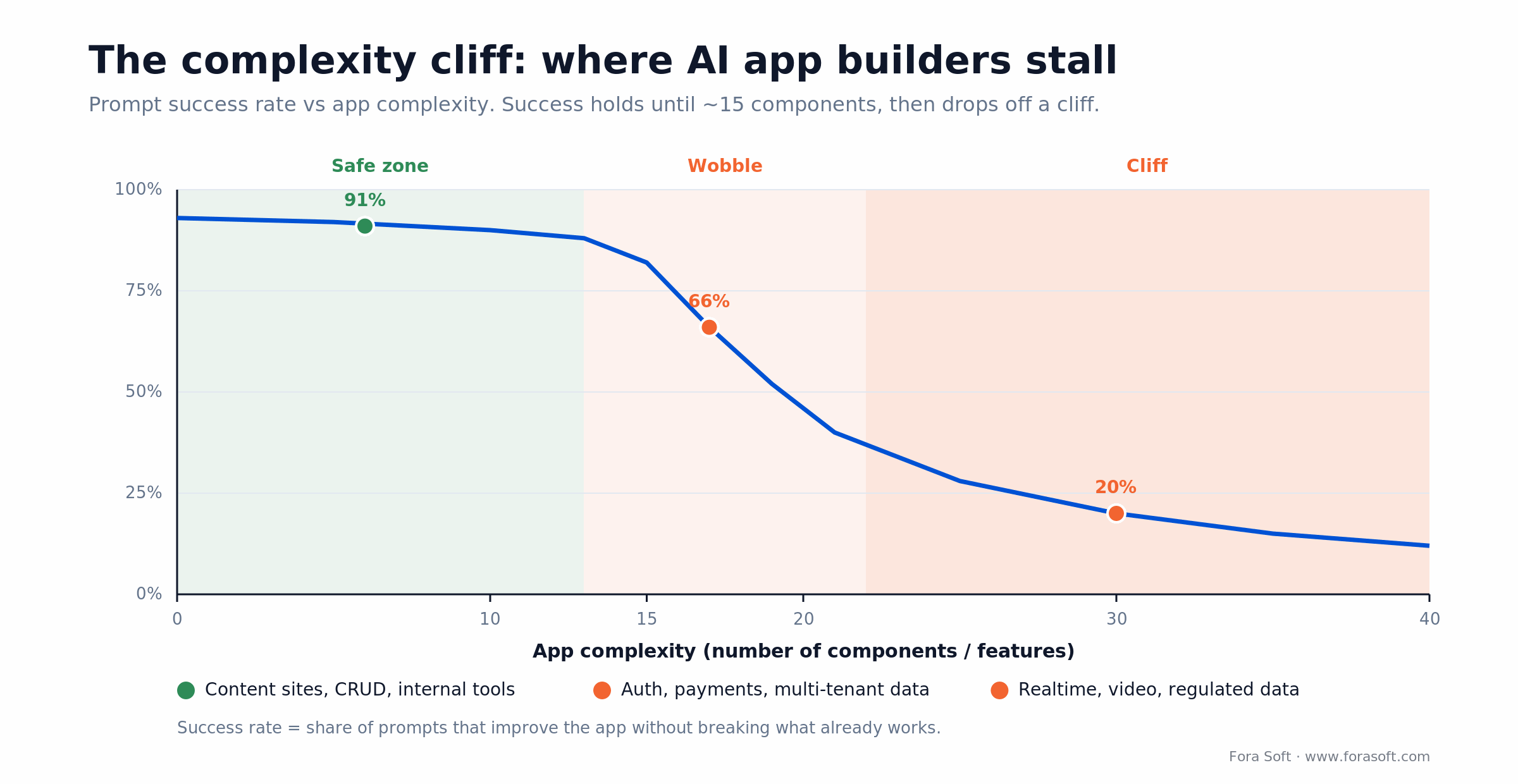
Figure 1. Prompt success holds high until roughly 15 components, then falls off a cliff as auth, payments and realtime pile up.
The 2026 AI app builder toolchain
Six categories dominate the 2026 toolchain. Founders should pick one or two, not all six.
1. Prompt-to-app platforms. Lovable, Bolt.new, Base44 — describe the app, get a deployed URL with database and auth wired up. Best for non-developers starting from zero.
2. Agentic dev environments. Replit Agent, Claude Code, Cursor’s Agent mode and Devin (which Cognition cut from $500 to $20/mo in 2026) — the AI plans, edits files, runs tests and iterates. Best for anyone comfortable seeing the code once in a while.
3. Component generators. v0 by Vercel, Magic Patterns — describe a UI screen, get production-quality React/Tailwind components to paste into your project. Best for designers and hybrid teams.
4. IDE copilots. Cursor, GitHub Copilot, Windsurf — the AI lives inside the editor, autocompletes, refactors and explains. Best for developers; not a useful starting point for non-technical founders.
5. Agent SDKs. Claude Agent SDK, OpenAI Agents SDK, LangGraph — build your own agentic workflows when prebuilt tools are not enough. Strictly for technical teams.
6. Managed backends with AI schema design. Supabase, Firebase, Convex — AI-assisted schema and RLS, still need a human to untangle auth policies when the prompt gets it wrong.
Tools compared: Lovable vs Bolt vs Replit vs v0 vs Cursor vs Claude Code
| Tool | Best for | Coding skill needed | Code quality | Price (2026) | Cliff at |
|---|---|---|---|---|---|
| Lovable | Full-stack prototypes for non-devs | None | Clean frontend, brittle backend | $25/mo (Pro) | ~20 components, Supabase RLS |
| Bolt.new | Fastest demo URL | None | Most bugs of the set | $25/mo (Pro) | ~15 components, auth flows |
| Replit Agent | Learners + small full-stack apps | Low | Coherent structure, credits costly | $25/mo Core, credit-based | ~25 files, debugging loops |
| v0 by Vercel | React/Tailwind UI components | Some — to integrate | Production-quality UI | $20/mo, token-based | Not a full-app builder |
| Cursor | Developers of all levels | Medium-high | Best of the set, you control | $20/mo Pro | Depends on your skill |
| Claude Code | Agentic coding in terminal or IDE | Medium | Very high on real codebases | From $20/mo (Pro) | Scales with good prompts |
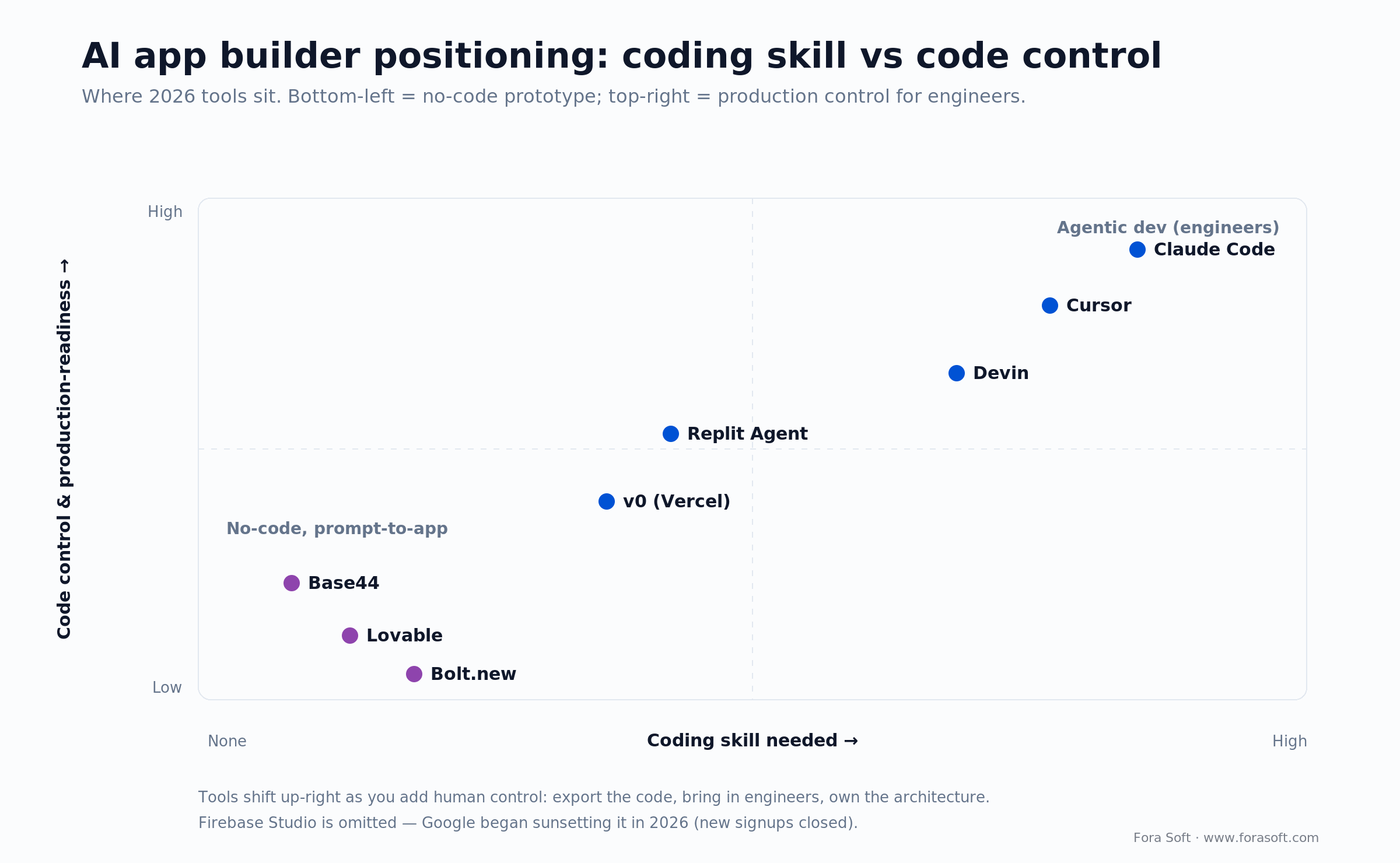
Figure 2. Where 2026 AI app builders sit on coding skill vs code control. You move up and right by bringing in engineers.
Reach for Cursor or Claude Code when: you (or an engineer) can read code and want the AI to edit a real repository, run tests and iterate — instead of handing you a black box you cannot open.
A realistic step-by-step: your first AI-built app in one weekend
Here is the boring, predictable path that actually works — copy it and you will ship a simple MVP in 2–3 days.
1. Write a one-page brief. Users, core job-to-be-done, the single screen that matters most, the data you’ll store. Keep it to 400 words. This is the best prompt you’ll write.
2. Sketch the happy path in v0 or Lovable. Just one flow. Log-in, create a record, see the list, edit one. Do not ask for payments yet.
3. Deploy to a staging URL. Lovable publishes to its own subdomain; Bolt and Replit deploy to theirs. Share with 3–5 prospective users.
4. Iterate in 60-minute cycles. One prompt, test, fix. When a prompt breaks more than it fixes — stop. That is the complexity cliff signalling.
5. Add auth through the platform’s managed path. Lovable/Bolt → Supabase, Replit → built-in auth. Do not try to hand-roll password flows.
6. Ship to 5 real users, collect feedback, decide. If users want to pay, you have a real product — the next step is a specialist team to harden it. If users shrug, you saved 6 months of engineering.
The complexity cliff: why prototypes stop scaling
Every AI builder hits a wall. The wall has a name: comprehension debt. The AI generates code faster than any human can read it, and eventually there is more logic in the repository than any single person understands. When that happens, every new prompt has a 30–50% chance of breaking something else — and the more code exists, the worse it gets.
Specific failure modes we see in founder prototypes:
- Auth regressions. One prompt tweaks the login form; RLS policies silently break; new sign-ups lose access to their own rows.
- Data drift. Schema changes made by the AI do not get a migration script — the staging DB diverges from production.
- Duplicate code. The AI re-implements the same utility in three places because it lost the earlier file from context.
- Silent failures. API routes that 200 but return empty bodies. No error, no telemetry, user leaves.
- Dependency chaos. Seventeen packages installed that none of the active code references. Security scans light up.
Industry data backs the anecdote. GitClear’s 2025 analysis found copy-pasted code rose from 8.3% in 2020 to 12.3% in 2024, the first year duplicated blocks outnumbered refactored ones, while refactored (“moved”) lines fell from 24.1% to 9.5%. A 2025 METR trial adds a twist: experienced developers were 19% slower using AI tools on codebases they knew well, even though they had predicted a 24% speed-up. The fix is not “prompt better”: it is bringing in people who can architect.
The hidden costs of AI-generated code
The monthly tool bill is the obvious cost. The invisible costs add up fast:
- Credit escalation. Credit-based tools (Replit, parts of Cursor) can 3–5× monthly spend during debugging cycles.
- Rework. 30–60% of AI-generated code typically needs a human rewrite before production. Budget that time.
- Lost velocity. “Prompt paralysis” — rephrasing the same request 10 times — is a real tax on founder time.
- Security audit. If you plan to charge customers, expect a one-off $1–15K audit to find and fix the AI’s vulnerabilities.
- Migration cost. Moving off a proprietary platform (Bolt, Lovable) once you outgrow it is 2–6 weeks of engineering.
The productivity story is murkier than the hype, too: while 84% of developers use or plan to use AI tools, only 29% trust the output’s accuracy (Stack Overflow, 2025). Factor all of this in and the “just use AI” thesis becomes a cost-aware decision, not a silver bullet.
Security debt: nearly half of AI code fails a security check
Is AI-generated code safe to ship? Not by default. Veracode’s 2025 GenAI Code Security Report ran 80 tasks across 100+ models and found AI chose the insecure option 45% of the time. It gets worse by language and flaw type: Java tasks failed security checks 72% of the time, and cross-site scripting showed up in 86% of the relevant AI code. The usual suspects are SQL injection, over-permissive IAM roles, unvalidated inputs, exposed secrets and misconfigured RLS.
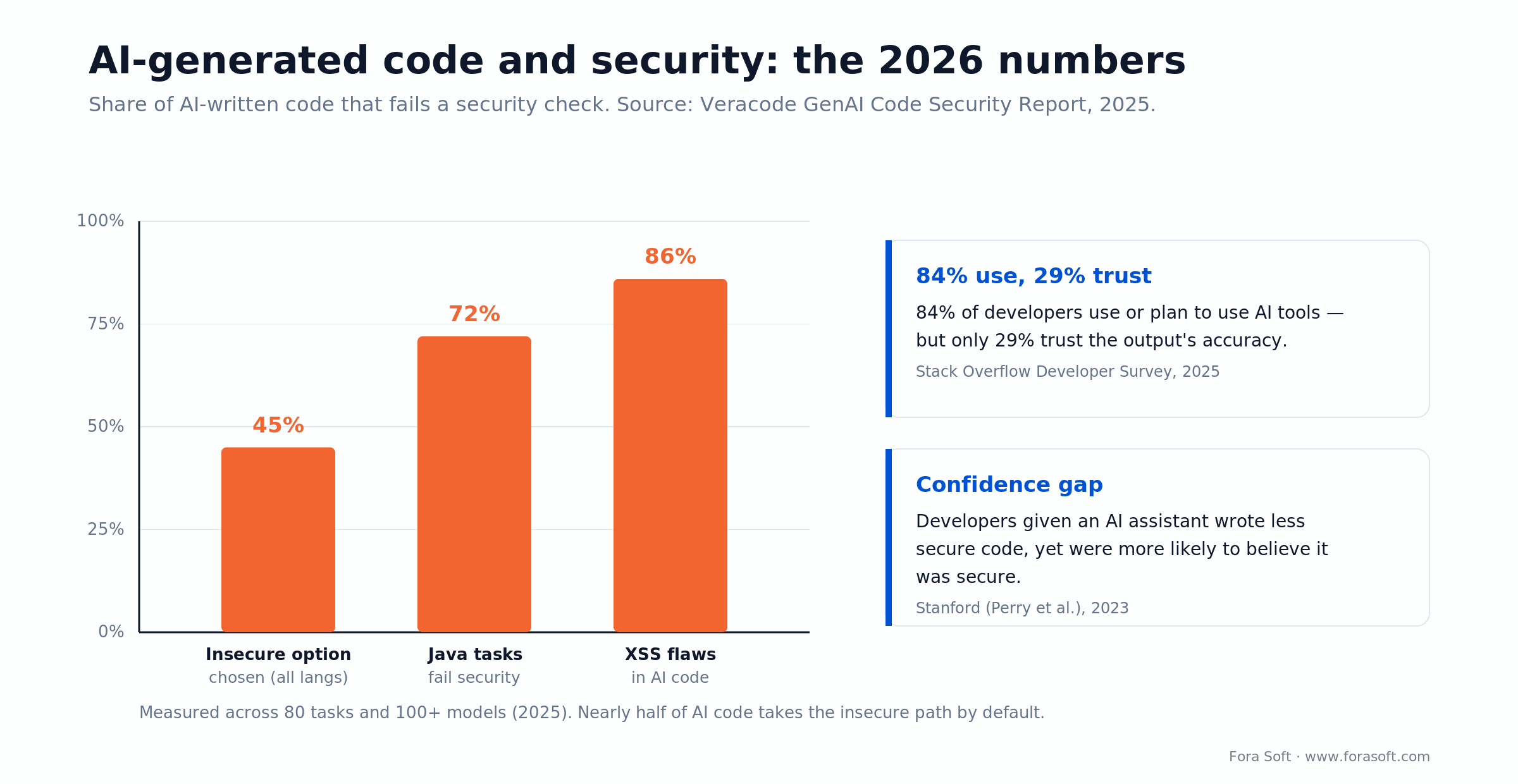
Figure 3. Veracode tested 80 tasks across 100+ models in 2025: AI takes the insecure path far more often than founders expect.
For a founder that means: never launch an AI-built product that handles payments, health data, financial data, or PII without a human security review. The cost of a single breach — notifications, fines, reputational damage — dwarfs any saving from skipping the audit. If you built on Lovable specifically, our guide to Lovable app bugs, fixes, and realistic 2026 costs breaks down the five failures we see most and when to hire developers.
See our piece on shifting security left in AI-assisted development for the playbook we run on every client hand-off.
Need a security review of your AI-built MVP?
We audit Lovable, Bolt and Cursor-built apps weekly. Fixed-fee review, clear findings, a written plan for production-grade hardening.
When to bring in engineers (and how to not lose momentum)
The right moment to hire engineers is after the prototype has proven demand and before the cliff breaks confidence. Classic signals:
- Users offer money. Even 5 paying users means you have a real product — get it production-grade.
- A prompt breaks something else three times in a row.
- You need a feature the platform does not support: video, realtime, multi-tenant data, mobile.
- Compliance enters the conversation (HIPAA, GDPR, SOC 2, PCI).
- Your monthly tool bill crosses ~$300 and output is dropping, not rising.
The handoff itself is simple when done right: share the prototype repo, record a 10-minute Loom of the happy path, hand over the backlog. A good team rebuilds what must be rebuilt, keeps what already works, and ships a production V1 in 8–14 weeks.
The hybrid model: founder + AI + specialist team
The mature pattern in 2026 is three roles, not two. Founder owns the product vision and user conversations. AI handles the rote work: scaffolding, UI components, boilerplate tests, first drafts of endpoints. Specialist engineers own architecture, security, scaling and the integrations where code has to actually work.
With this division a 2-person Fora Soft squad + a founder ships more in 8 weeks than a traditional 6-person team ships in 12 — because AI removes 40% of the typing, and senior engineers remove the 30% of bugs the AI would have introduced. It is the combination, not either piece alone, that compounds.
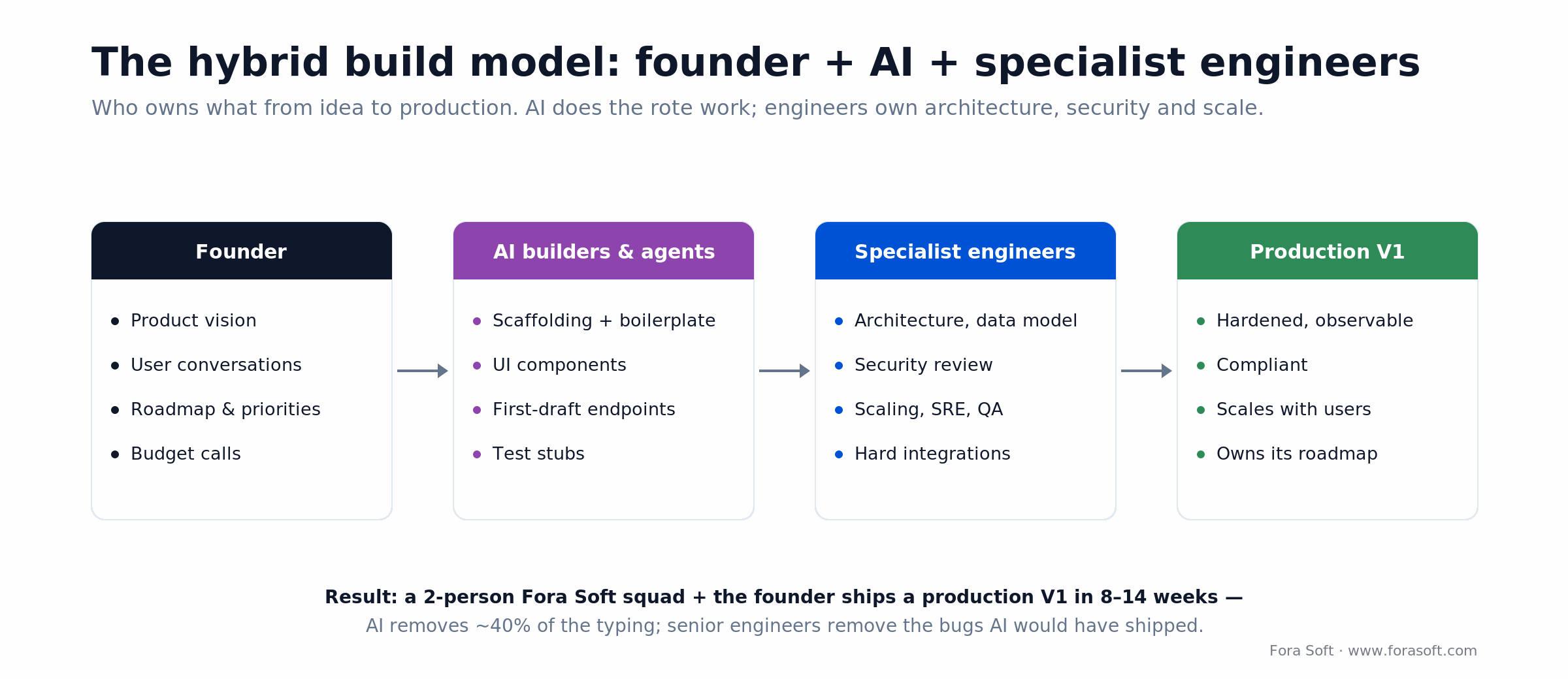
Figure 4. The hybrid model: the founder owns the vision, AI does the rote work, engineers own the parts that must not break.
How Fora Soft runs Agent Engineering
Agent Engineering is our internal name for senior engineers paired with AI agents across the whole lifecycle — the backbone of our AI development and integration work. In practice it looks like:
- Discovery: Claude Code drafts architecture diagrams and threat models against the brief; the solution architect reviews.
- Scaffolding: v0 + Cursor produce the component library and initial screens; engineers wire them to real services.
- Backend: Claude Code writes service + test skeletons; engineers pair-review every commit and own the data model.
- QA: AI generates test fixtures and regression scenarios; human QA owns exploratory and edge cases.
- SRE: AI writes Terraform and alert rules; SREs review and approve.
- Security: every AI-produced patch is scanned (Semgrep, GitHub Code Scanning) before merge; senior engineers sign off.
Net effect across 2025–2026 projects: ~30–40% faster delivery at equal or better defect rates. Read our notes on AI in the software development process, AI in software architecture design, and context engineering for AI agents.
Mini case: founder MVP → production handoff
Situation. A non-technical founder built an AI-coaching prototype in Lovable + Supabase. 40 early users, 8 of them paying. Then: auth regressions on every new feature, Stripe not reconciling, scheduled jobs firing twice.
12-week plan. Two Fora Soft engineers + founder, Agent Engineering model. Week 1–2: audit, untangle RLS, lock Stripe reconciliation, instrument the product. Week 3–8: rebuild critical flows (coaching sessions, calendar sync, payments) in a maintainable Next.js + Supabase architecture, keep the existing UI Lovable produced. Week 9–12: scale hardening, observability, compliance checks, app store launch prep.
Outcome. Similar to our Talensy and InstaClass trajectories: production-ready V1 in 12 weeks, paying users retained through the migration, founder still controls the roadmap, and the product now supports new features without breaking old ones. Want the same assessment for your prototype?
A realistic cost model for 2026
Three stages, three cost shapes. Plan the transitions deliberately.
| Stage | Team | Tools | Monthly cost | Typical output |
|---|---|---|---|---|
| Founder DIY | Solo + AI | Lovable or Bolt + Supabase | $60–$300 | Prototype, 10–50 users |
| Hybrid MVP | Founder + 1–2 engineers | Cursor, Claude Code, v0 | Fixed-fee engagement | Production V1 in 8–14 wks |
| Scale & compliance | 4–8 engineers + PM + QA | Full Agent Engineering stack | Monthly retainer | Multi-platform, regulated |
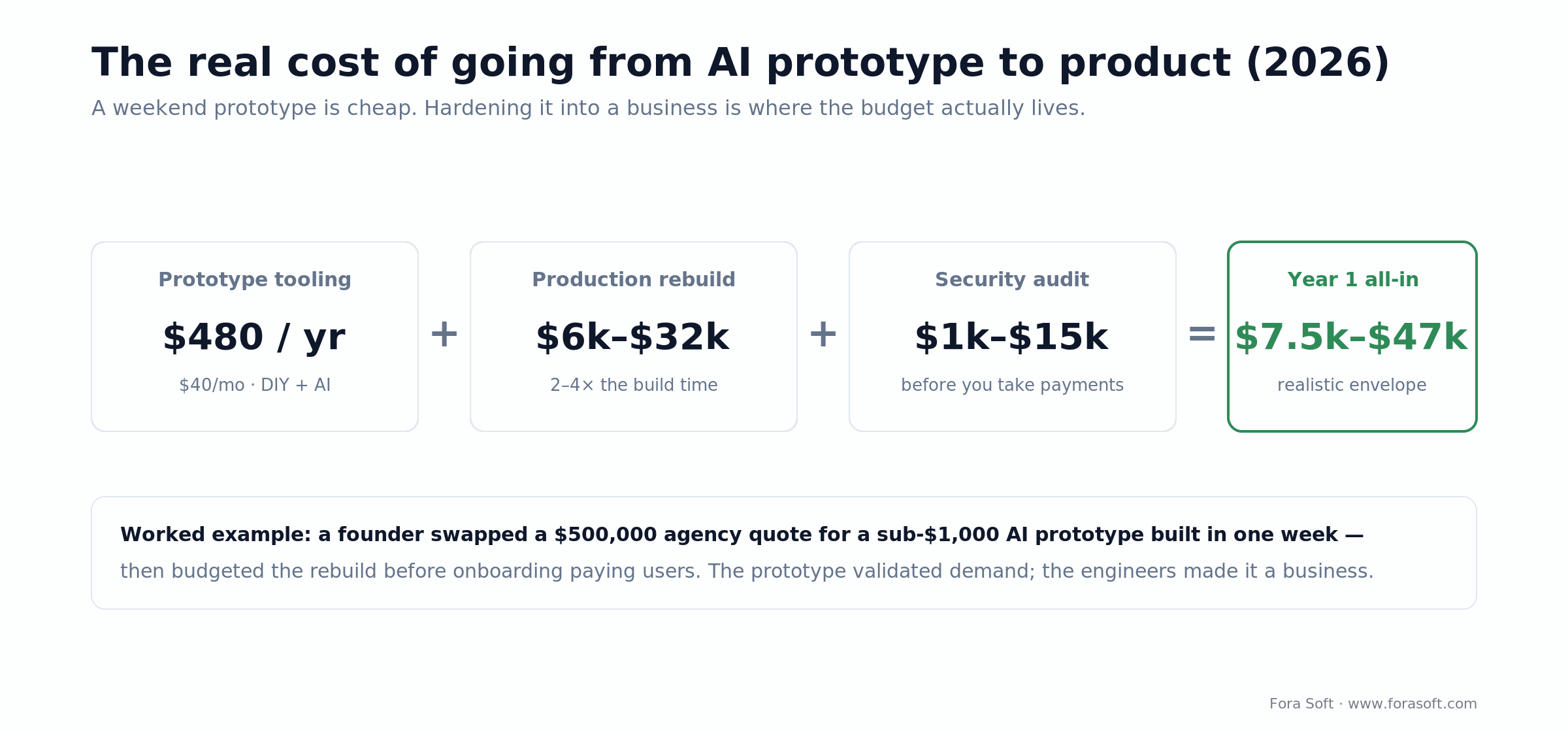
Figure 5. The prototype is a rounding error. Production hardening, not the first build, is where the real budget goes.
Fora Soft stays conservative on public numbers because every product is different. A 20-minute call with us or our project cost calculator gives a grounded envelope for your specific feature set. As a rule of thumb, taking a working AI prototype to a hardened, paying-customer V1 runs roughly $7,500–$47,000 in the first year once tooling, the rebuild and a security audit are counted.
A decision framework — five questions before you prompt
Q1. Who pays, and will they pay soon? If paying users are < 4 weeks away, plan for a specialist handoff now — not after the cliff.
Q2. What data leaves the app? Payments, PII, health, financial — all raise the security bar above what AI-only workflows can deliver.
Q3. Is there realtime, video or multimodal AI? If yes, AI builders alone will not carry the product to production.
Q4. How many components will the app have in 3 months? Past ~20 you need a codebase that humans comprehend. Plan for a rebuild moment.
Q5. Am I happy throwing this away if users don’t care? If yes, AI alone is a cheap bet. If no, budget for the engineer pair from week one.
Five pitfalls non-technical founders hit
1. Prompting for the whole app at once. The AI loses context past 2–3 features. Break into flows, ship one at a time.
2. Ignoring version control. Without Git the first broken prompt erases a week. Turn on Lovable’s GitHub integration (or equivalent) on day one.
3. Storing secrets in the client. API keys end up in your frontend bundle. Use the platform’s secrets manager — and rotate if you ever committed one.
4. Skipping Stripe Webhooks. Reconciliation without webhooks means missed payments on every checkout failure. Either accept Stripe Checkout with webhooks or don’t take money.
5. Treating the cliff as a failure. Hitting the wall is the signal that you validated demand — not that the project was wrong. Hire specialists, keep momentum.
What to measure from week one
Quality KPIs. Time to first useful action < 2 minutes, user-reported broken states < 1 per 10 sessions, login success rate > 98%, Stripe reconciliation 100%.
Business KPIs. Paying-users count (weekly), free-to-paid conversion > 3%, day-7 retention > 25%, weekly active users trend.
Reliability KPIs. Uptime > 99.5% on the prototype, > 99.9% on production; error rate < 1% per endpoint; AI-bill-per-active-user trending down, not up.
When NOT to DIY with AI
Some projects should never start in a vibe-coding tool. Video streaming, telemedicine, fintech, multi-tenant B2B SaaS and any product bound by HIPAA/SOC 2/PCI are in this bucket. The regulatory and technical risk outweighs the weekend-prototype benefit. If your product is a real-time AI video agent or anything latency- and compliance-bound, start with engineers, not prompts.
For those, go straight to a specialist partner. We take the idea to discovery in week one and ship a compliant V1 in 12–20 weeks using Agent Engineering — faster than a traditional team, safer than a pure-AI build.
FAQ
Can I really build an app with zero coding experience in 2026?
Yes, for simple apps: landing pages, internal CRUD tools, single-feature prototypes. Lovable, Bolt and Replit Agent will give you a deployed URL in hours. For anything production-grade — auth, payments, realtime, regulated data — you will need specialists before launch.
Which AI app builder should a non-developer choose first?
Lovable is the safest starting point in 2026: conversation-first, clean React output, Supabase integration, predictable $25/mo Pro pricing. Bolt if you want the fastest deployed URL for a demo. Replit Agent if you want to learn code along the way.
How much will it cost to go from AI prototype to production?
For a focused MVP — one monetization model, auth, payments, one mobile platform — plan for a 12–20 week engagement with a 2–4 person specialist squad, typically $7,500–$47,000 all-in for the first year. Exact numbers depend on feature set; our calculator gives a grounded envelope. Because we run Agent Engineering, that is typically 30–40% faster than a comparable traditional team.
Is AI-generated code safe to ship?
Not by default. Veracode’s 2025 report found AI chose the insecure option 45% of the time. Never ship AI-built code that handles payments, health or identity data without a human security review.
Can I move my Lovable or Bolt project to a custom codebase?
Yes. Lovable and Bolt expose the underlying code (typically Next.js + Supabase) so a team can fork, host and extend it. Expect 2–6 weeks of cleanup for a real product. We do this migration regularly — keeping the UI the founder validated and rebuilding the fragile parts.
Do you still need designers and engineers when you use AI?
You need fewer, not zero. A typical Fora Soft squad on an AI-accelerated project is 4–6 people versus 8–10 before 2024. The roles AI has not replaced: product design judgement, system architecture, security review, SRE, QA exploration. Those are the roles you actually want.
What is Claude Code and how does Fora Soft use it?
Claude Code is Anthropic’s agentic coding tool that runs in the terminal or IDE, powered by Claude’s Sonnet models. It is one of the most widely used agentic coding tools among professional engineers in 2026. At Fora Soft every engineer runs it daily for scaffolding, test generation and refactors, always under human review.
What happens to my data if my Lovable/Bolt subscription ends?
The code in your GitHub repo survives; the hosted preview does not. If you used the platform’s managed Supabase, export the data before you cancel. This is one of the biggest unplanned costs of staying too long on a vibe-coding platform — migrate as soon as you have paying users.
What to Read Next
Engineering
AI in the Software Development Process
How we embed AI into each lifecycle phase without losing engineering quality.
Agents
Context Engineering for AI Agents
The discipline that makes AI coding agents actually deliver useful code.
Security
Shifting Security Left for AI Code
What to scan, when to scan, and how to avoid AI’s most common vulnerabilities.
Architecture
AI in Software Architecture Design
Where AI is useful in early architecture work — and where it definitely is not.
Mobile
Choosing an AI Mobile App Development Company
What to look for in a partner who will take your prototype to production.
Ready to move from prompt to product?
In 2026 you can build an app with AI without writing code, but the builders break at the same wall every time, roughly 20 components in. The smart play is to use AI to validate demand, catch the cliff early, and bring in specialists before security debt and comprehension debt eat the product.
Fora Soft sits at that exact handoff. We run Agent Engineering, keep what your prototype got right, and rebuild the parts that need real engineering — faster than a traditional team, safer than a pure-AI build.
Let’s turn your AI prototype into a product
Bring your Lovable, Bolt, Replit or Cursor project. We’ll tell you what to keep, what to rebuild, and what a production-grade path costs.