


Key takeaways
• A competent Technical Project Manager is the cheapest insurance you can buy on a software budget. PMI 2025 data: 50% of projects still fail to hit their goals; tech-heavy projects without a TPM average 45% budget overruns vs. 15% with one.
• One well-managed $1M project pays for a TPM’s entire salary two to three times over. The business case is the math of scope creep (affects 52% of projects, ~27% average budget overrun) meeting disciplined change control.
• A TPM is not a traditional PM. They have an engineering background and earn 30–60% more — because they make technical tradeoff calls, not just calendar ones.
• Buy vs. hire vs. outsource: in-house (~$160K Year 1 fully loaded) wins at 3+ years of retention; outsourced agency ($130K–$135K/yr) wins on flexibility and mis-hire risk; the hybrid is often the pragmatic answer for growing product teams.
• The five KPIs that reveal a real TPM in 90 days: on-time delivery rate (>90%), budget variance (±5%), scope creep (<10%), velocity stability, stakeholder NPS (>50).
Why Fora Soft wrote this playbook
Fora Soft has shipped software since 2005 — 250+ projects with 50+ in-house specialists and a 99% Upwork job-success score. Every single project runs under a Technical Project Manager — not because it’s trendy, but because we’ve run the math on 250+ engagements and it’s always cheaper than the alternative. Nucleus (a SOC II + HIPAA on-premise Slack alternative) shipped three major releases in 18 months under a single TPM. TradeCaster scaled from MVP to 46K+ traders with live streaming + chat — a TPM held the line on scope while engineering sprinted. Speakk shipped zero-data messenger on time because the TPM killed 11 low-value features before they hit the backlog.
This playbook is the framework we actually use when a prospect asks “do we need a TPM or can our tech lead handle it?” It has real numbers, real role comparisons, and a decision rule you can run in 15 minutes. When a client hires our dedicated development team, the TPM comes with it as part of the team, not as a paid add-on.
Unsure if your project needs a dedicated TPM?
Send us a one-paragraph product brief — team size, timeline, budget. We’ll tell you honestly whether a TPM earns their keep for your specific case, or whether a senior tech lead can cover it.
Why this matters: the real cost of “no TPM”
Projects don’t fail because engineers can’t code. They fail because nobody is holding the line on scope, timing, risk, and stakeholder expectations at the same time. Five numbers you should sit with for a moment:
- 50% of projects succeed globally in 2025. 13% fail outright. (PMI 2025 Project Success Report.) The other 37% limp across the finish line over-budget and under-scope.
- 43% of projects finish over budget. And when large IT projects go wrong, they go badly wrong: 45% over budget, 7% over schedule, 56% less value than predicted — McKinsey’s 5,400-project study with Oxford (2012).
- Scope creep hits 52% of projects (PMI 2018 Pulse, up from 43% five years earlier) and drives an average 27% budget overrun — far more on the worst ones.
- Agile projects succeeded 64% of the time vs. Waterfall’s 49% (Ambysoft 2013; Standish CHAOS puts the gap even wider, roughly 3-to-1) — a swing that only matters if someone knows when to use which.
- A bad PM hire costs up to 30% of first-year salary in lost productivity, team churn, and rework.
A TPM doesn’t magically make engineering faster. They compress the loss side of the distribution. That’s where the money is.
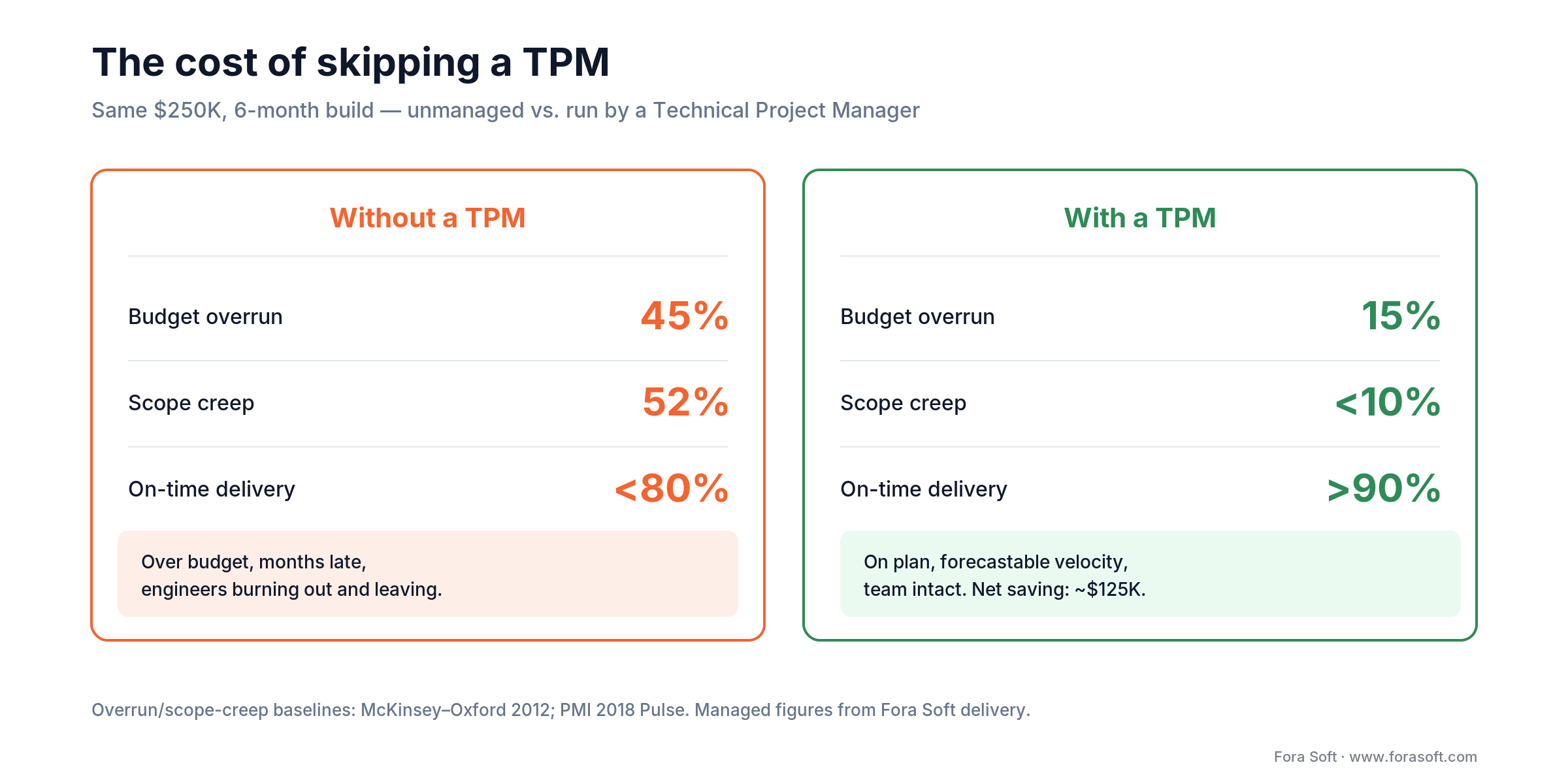
Figure 1. The same $250K build, run with and without a Technical Project Manager.
The one-line business case: If a TPM costs you $120K/year fully loaded and prevents a single 30-point budget overrun on a $1M project, they have earned back three years of salary in one engagement.
What a Technical Project Manager actually does
A technical project manager (TPM) is a delivery lead with an engineering background who owns the schedule, scope, risk, and stakeholder communication for a software project — technical enough to challenge an engineering estimate, disciplined enough to run a stakeholder steering committee. The day-to-day looks like this:
Plans, schedules, and tracks
Breaks work down into epics, sprints, and milestones. Keeps a single source of truth in Jira, Linear, or Asana. Runs a weekly status report that a CEO can read in 90 seconds.
Owns technical risk
Identifies architectural, integration, and dependency risks before they become issues. Maintains a risk register, assigns owners, and escalates when a risk looks like it’s about to land.
Translates between engineering and business
Non-technical stakeholders get clarity without being patronized. Engineers get clarity without being bureaucratized. The TPM is the transformer between the two dialects.
Holds the line on scope
Runs a change-control process. Every out-of-scope request gets a budget/timeline impact before it gets a “yes.” This one discipline, well applied, is how 52% industry scope-creep drops to <10% on a properly managed project.
Measures what matters
Tracks Earned Value Management metrics (Schedule Variance, Cost Variance, Cost Performance Index) alongside Agile metrics (velocity stability, burndown, cycle time) and quality metrics (defect escape rate < 5%).
Runs the retrospective that actually changes something
Post-sprint and post-project retros are where continuous improvement happens — or where it dies. A TPM writes down the lesson, assigns the action, and brings it back at the next kickoff.
TPM vs PM vs Scrum Master vs Engineering Manager vs Product Manager
The most common question we hear: “We already have a Scrum Master (or Engineering Manager, or Product Manager). Do we still need a TPM?” Short answer: usually yes, but the roles overlap in ways that are worth being precise about.
| Role | Primary question | Scope | Success metric | Typical salary (US) |
|---|---|---|---|---|
| Technical Project Manager | “When and how do we deliver this?” | Cross-team, program-level | On-time, on-budget, on-scope | $117K avg |
| Traditional PM | “Is the plan on track?” | Project, often non-technical | Schedule + budget | $89K avg |
| Scrum Master | “Is this team unblocked?” | One Scrum team | Sprint completion rate | $95K avg |
| Engineering Manager | “Is this team healthy and shipping quality code?” | One engineering team | Team health + code quality | $160K avg |
| Product Manager | “What should we build and why?” | Product surface area | Adoption, revenue, retention | $135K avg |
Rule of thumb. Product Manager decides what to build. Engineering Manager runs the team that builds it. Scrum Master keeps that team’s sprint ceremonies honest. Technical Project Manager stitches it all together across multiple teams, stakeholders, and months. On small projects (one team, < 10 devs) one person can often wear two hats. On anything cross-team or cross-stakeholder, they can’t.
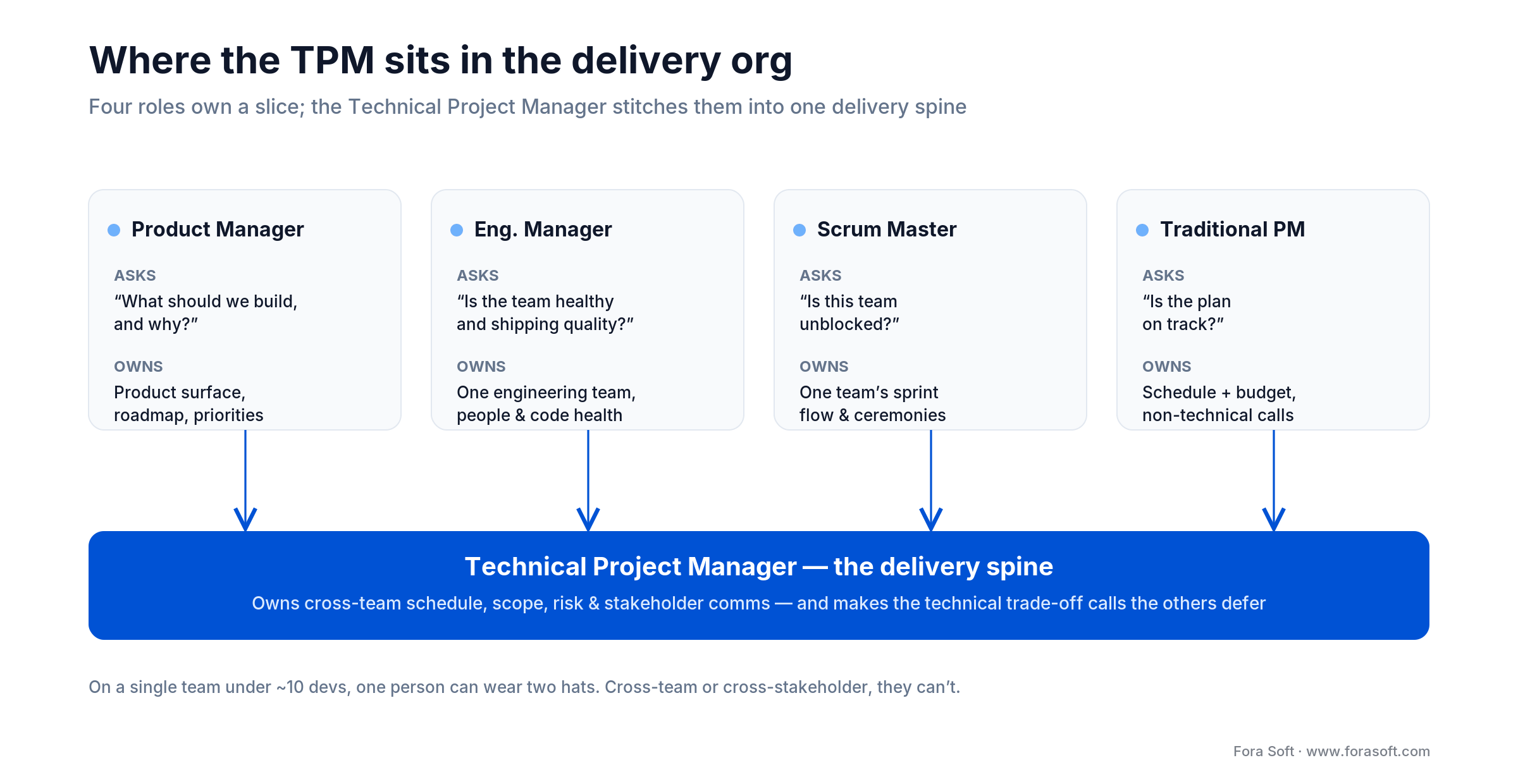
Figure 2. Four roles each own a slice of delivery; the TPM is the spine that connects them.
Five signs you need a TPM — and three signs you don’t (yet)
You need a TPM when
- Budget is above ~$250K and engineering will run for 4+ months. The math on overrun prevention starts working.
- You have two or more engineering teams working on interdependent features. Coordination overhead compounds fast.
- You have hit recurring scope creep, timeline slips, or stakeholder fire drills. These are symptoms of a missing coordinator, not a missing engineer.
- You need to translate technical tradeoffs to non-technical stakeholders. A senior engineer can do this — but usually at the cost of losing them as an engineer.
- Regulatory or compliance rigor is part of delivery. HIPAA, SOC 2, FedRAMP, GDPR: documentation burden needs an owner.
You probably don’t need a TPM yet when
- You have a solo founder-engineer or a team of three. Coordination overhead is a phone call. Add a TPM later.
- Your product is pre-PMF and changing weekly. You need a Product Manager first; the TPM comes once delivery cadence matters.
- You’re on a small fixed-scope build < 2 months. A senior engineer with project discipline can cover this, especially if they have delivered projects before.
Gut check: If your last three projects went 30%+ over budget or 8+ weeks late, you probably needed a TPM yesterday. The fact that you don’t have one is the cost.
Agile, Scrum, Waterfall, SAFe: which methodology, for which project
The TPM’s job is not to pick the fashionable methodology. It is to pick the one that fits the team, product, and risk profile — and then run it with discipline. The defensible defaults in 2026:
Agile + Scrum (the default)
~64% success rate (Ambysoft 2013); most software organizations use it. Fits iterative products with evolving requirements. 2-week sprints, daily standups, sprint review + retrospective. TPM runs the backlog, enforces scope discipline at sprint boundaries, and keeps velocity measurable.
Kanban (the ops / support default)
Continuous flow, WIP limits, cycle-time tracking. Fits support teams, DevOps, and anything where work arrives unpredictably. TPM’s focus is WIP discipline and cycle-time reduction, not sprint completion.
Waterfall (for the rare right case)
49% success rate but still defensible when scope is genuinely fixed (firm-fixed-price government contracts, regulated medical device cycles, construction-adjacent projects). TPM runs phase-gate reviews, detailed documentation, formal sign-offs.
SAFe (for multi-team programs)
When 5–15 teams need to ship coordinated. Program Increments (PIs), ARTs (Agile Release Trains), dependency maps. TPM typically holds the RTE (Release Train Engineer) role or partners closely with it.
Hybrid (the honest answer for many clients)
Waterfall shell for the contract and regulatory paperwork; Agile execution inside each phase. The TPM is responsible for making both halves legible to the other.
The tools a TPM actually uses in 2026
77% of high-performing teams use dedicated PM software. Almost any tool beats spreadsheets; adoption matters more than choice. What we see across our client base:
- Jira (Atlassian) — the standard for engineering teams. Deep customization, Agile + Waterfall support, integrates with everything. Steep learning curve; overkill for sub-10-engineer teams.
- Linear — the 2020s challenger. Fast, opinionated, delightful keyboard UX. Best for pure-engineering teams that want less admin overhead. Weaker for cross-functional work.
- Asana — the cross-functional default. Marketing + ops + eng in one board. Lighter on engineering ceremony; weaker Agile reporting than Jira.
- ClickUp — highly customizable, can model almost anything. Power comes with setup cost; adoption suffers if not championed.
- Monday.com — visually clean, easy onboarding. Best for small teams and business stakeholders who refuse to learn Jira.
- MS Project — still standard in enterprise / construction / regulated industries for Gantt-heavy planning. Rare in software outside of large enterprise.
- Notion / Confluence — not PM tools, but every mature TPM has a documentation spine for decisions, architecture, and post-mortems.
Tool-choice rule of thumb: Pick the tool your team will actually update daily. A mediocre tool used religiously beats an elegant tool used weekly.
The KPIs that tell you your TPM is actually working
We benchmark TPM effectiveness on 5 numbers. If a TPM moves these in the right direction over a quarter, they are worth their salary. If they don’t, something is off.
1. On-time delivery rate
% of milestones or sprints delivered on planned date. Target > 90%. Below 80% means something in planning or scope control is broken.
2. Budget variance
Actual spend vs. planned. Target ± 5%. Anything over 10% requires an escalation conversation, not a quiet note in the status report.
3. Scope creep %
Out-of-scope changes approved divided by original scope. Target < 10%. Industry average is 52%. If you’re near 52%, change control isn’t working.
4. Velocity stability
Variance in story points completed sprint-over-sprint. Not the absolute number — the consistency. A stable velocity means you can forecast; a volatile one means you can’t.
5. Stakeholder NPS
Quarterly survey to sponsors and key stakeholders: “How likely are you to recommend working with this project team?” Target > 50. Below 30 means trust is eroding even if the numbers look fine.
Supporting quality metric: defect escape rate
Defects found in production as % of total defects. Target < 5%. Escaped defects cost 10–100× more to fix than pre-production ones.
What a TPM costs in 2026 (USA, Europe, outsourced)
Sticker price is only a fraction of total cost. The honest numbers:
USA full-time
Base salary: $117K average for a Technical PM in 2026 (ZipRecruiter, Built In, and Indeed all cluster near $117K), vs. ~$89K for a generalist PM. Add ~30–40% for benefits, 401k, equipment = $160K–$180K fully loaded Year 1, including $5K–$10K recruiting/onboarding and $2K–$5K annual training. Premium regions (Bay Area, NYC, DC) add 15–30%.
Europe full-time
Germany: €76K national average, €70K–€100K in Munich. Portugal, Poland, Romania: 30–50% lower. A European TPM typically lands 30–40% below US cost while delivering equivalent PMP/CSM-certified work.
Freelance / staff augmentation
Freelance hourly median $81 in USA; $28–$155 range on Upwork and ContractRates.fyi. Staff augmentation: $50–$100/hour. A full-time-equivalent freelance TPM works out to ~$168K/year — typically higher than in-house, but with no benefits overhead, no mis-hire cost, and flexible scaling.
Outsourced (agency) — the sweet spot for many
Agency-backed TPM through a reputable software partner: $11,200/month or ~$134K/year full-time equivalent. No benefits, no mis-hire risk, plug-and-play with the rest of the dev team, proven methodologies. This is where our custom software development teams typically slot in for clients who don’t have an internal PMO.
Offshore (India, Vietnam, Philippines)
$15–$35/hour. 50–70% cheaper than US. Risks: communication lag, cultural context gap, less product fluency. Works well in a hybrid: onshore senior TPM for stakeholder management, offshore TPM for execution.
The Fora Soft edge: Agent Engineering — our AI-assisted delivery practice — lets a mid-senior TPM cover the status-report, planning, and documentation overhead of a full FTE while costing closer to a fractional engagement. Ask us for a concrete proposal.
Want a concrete TPM engagement rate for your specific project?
Tell us team size, timeline, current tooling, and compliance bar. We’ll come back with a fixed monthly rate and a proposed scope — no multi-round sales cycle.
Build, buy, or outsource — the honest TCO comparison
The decision tree on a 3-year horizon:
| Option | Year 1 cost | 3-yr cost | Best for | Risk |
|---|---|---|---|---|
| Hire in-house | ~$160K–180K | ~$450K–520K | Consistent $3M+ annual IT spend; stable team | Mis-hire costs up to 30% of salary; key-person risk |
| Outsource (agency) | ~$134K | ~$400K | Variable load; sub-$1M IT spend; short-term initiatives | Less institutional memory; vendor dependency |
| Freelance | ~$168K (FTE-equiv) | ~$500K | Specific expertise spikes; short gap coverage | Turnover; no vendor safety net |
| Hybrid (in-house + outsourced) | ~$130K | ~$390K | Growing teams; multiple projects | Coordination overhead between the two halves |
| DIY (tech lead wears PM hat) | “Free” on paper | Often costliest in hidden overruns | Pre-PMF startups; teams < 8 | Engineer burnout; 20–40% velocity loss; scope creep |
Break-even rule of thumb. Hiring in-house wins at 3+ years of retention and a stable pipeline of concurrent projects. Outsourced wins when load is bursty, the product is early, or you want to avoid hiring overhead. DIY wins in theory and loses in practice — every “free” tech-lead PM we’ve audited was costing 15–30% in hidden velocity loss.
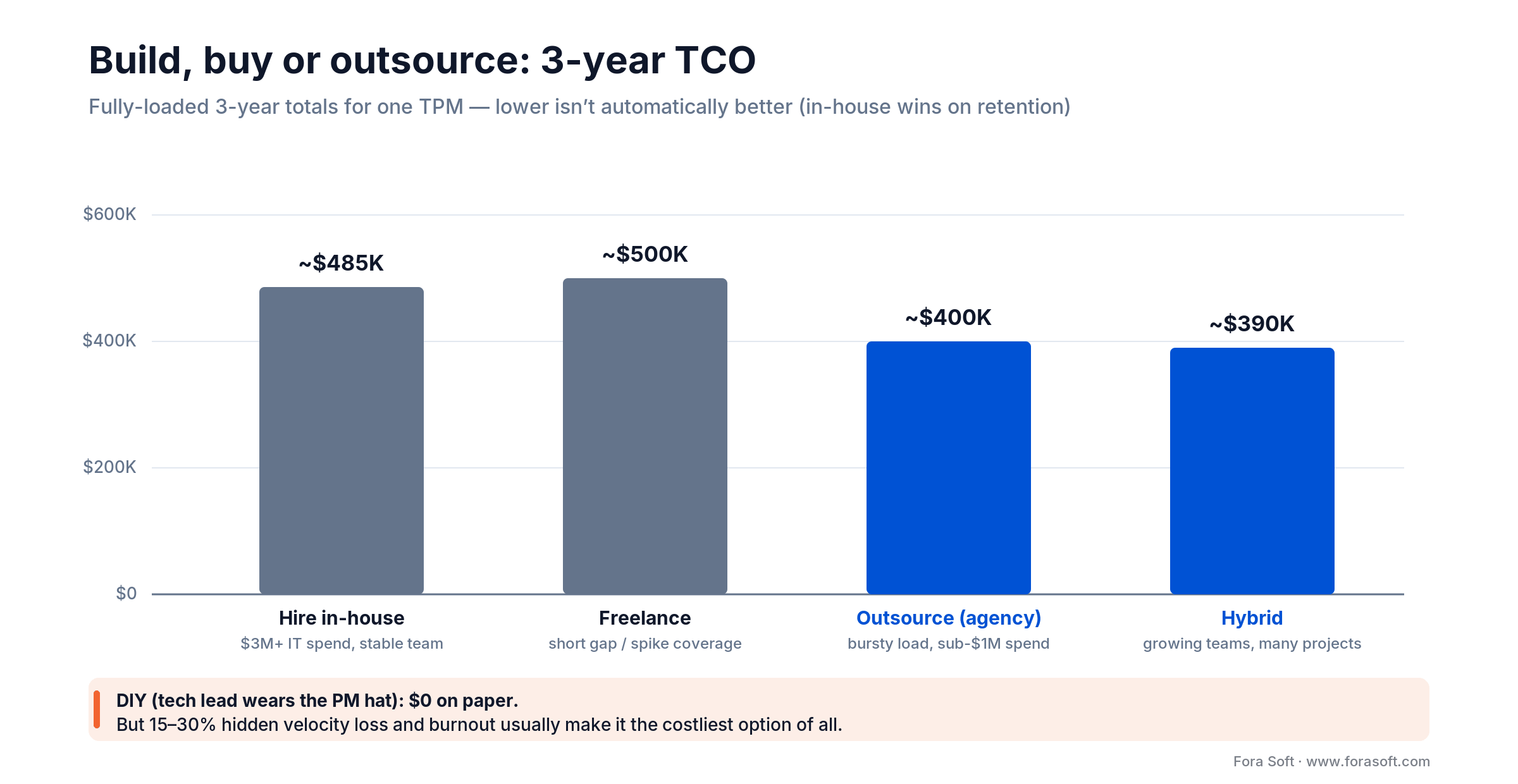
Figure 3. Fully-loaded three-year cost of one TPM across hiring models — and the hidden cost of DIY.
Two hard-number ROI scenarios
Scenario 1: a $250K SaaS project, 6 months, 5 engineers
Without TPM: a 45% overrun turns the $250K build into ~$362K, it ships 3 months late, and churn (two stressed engineers, partial-year replacement and ramp-up) adds ~$112K. Total damage ~$475K.
With TPM (fractional $60K engagement): Overrun cut to 15%, $287.5K actual cost. TPM cost $60K. Delivery +1 month. No departures. Total cost ~$350K.
Net savings with TPM: $125K+, plus faster market entry and zero team attrition.
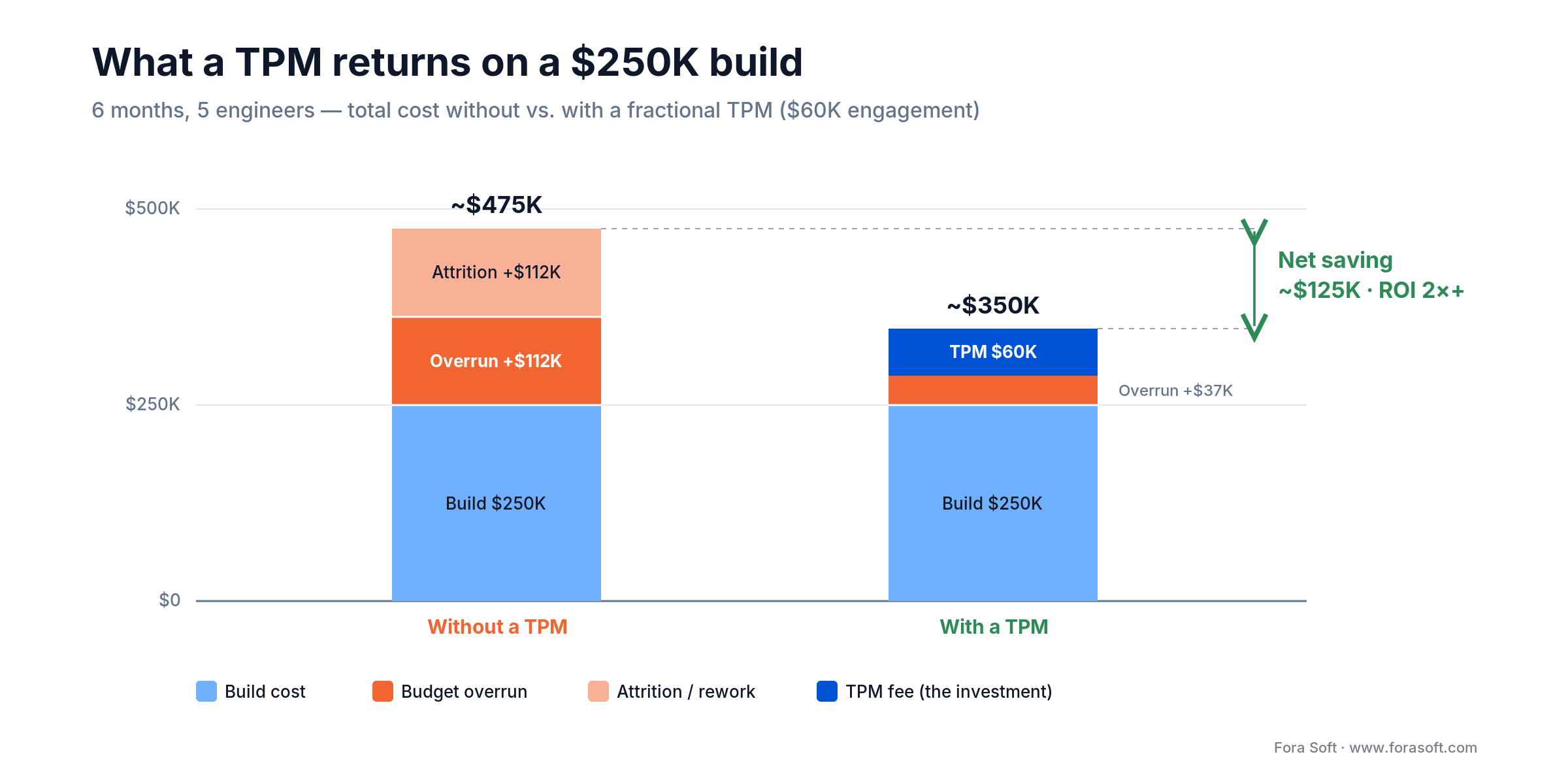
Figure 4. The ROI math on a $250K, six-month build: a $60K TPM saves roughly $125K.
Scenario 2: a $5M enterprise program, 18 months, 4 teams
Without dedicated program manager: 45% overrun = $7.25M, +6 months late, 3 production incidents year 1 costing $200K in customer-credits and reputation damage. Total damage ~$2.5M.
With full-time TPM ($200K fully loaded): Overrun 15% = $5.75M, +1 month, zero major incidents. Total cost ~$5.95M.
Net savings: $1.25M+. TPM ROI: 525%.
These aren’t hypothetical. They’re the pattern we’ve seen repeatedly on prospects who came to us after a project went sideways without a TPM in the seat.
Mini-case: how our TPM kept TradeCaster on track
TradeCaster is a live video + chat platform for 46K+ traders. The build combined low-latency streaming, real-time chat, moderation, and a compliance layer for financial content, classic scope-creep territory. Our TPM:
- Killed 11 out-of-scope feature requests in the first 90 days via a formal change-control rubric (each new ask got a cost/timeline delta). Sponsor approved 3 of 11; 8 went to a future phase.
- Held velocity stable at ±12% variance across the first 8 sprints. Forecasting became possible, and we ended up hitting the MVP ship date within 4 business days of the original.
- Ran a weekly 15-minute stakeholder sync that replaced the ad-hoc Slack firefighting that had plagued the previous engagement. NPS with the sponsor went from “frustrated” to 72.
- Escalated a WebRTC relay capacity risk 6 weeks before it would have hit; that pre-emptive infrastructure scaling saved a ~$40K emergency remediation.
None of this is exotic. It’s the compounding effect of a competent TPM running disciplined process on a high-complexity build. The same pattern shows up on Nucleus (on-premise enterprise chat), Speakk (zero-data messenger), and every other shipped engagement in the last five years.
Six pitfalls we see when teams try to skip or under-invest in a TPM
1. The tech lead wears the PM hat. Works up to ~8 engineers. Past that, either technical work suffers (bugs, tech debt), PM work suffers (schedule slips), or the lead burns out. 25–40% turnover follows.
2. Hiring a generalist PM for a technical product. They can’t call bullshit on estimates, can’t spot architectural risk, and lose engineer trust within the first quarter. Results in 15–45% project cost overruns vs. TPM-managed baseline.
3. Skipping formal change control. Every verbal “can you just add…” eats 1–3 days and nobody tracks it. At the end of the quarter, you’re 30% over and nobody remembers why.
4. Measuring velocity instead of velocity stability. Absolute velocity is a vanity number. Stability is what lets you forecast. A TPM who chases velocity numbers is actively harmful.
5. Running daily standups as status theater. 30-minute standups where each person reports to the TPM = dead productivity. A well-run standup is 10 minutes, engineer-to-engineer, with the TPM listening for blockers and risks.
6. Not documenting the decision. “Why did we pick React over Vue in month 2?” — six months later, nobody remembers, and the next team re-litigates it. A TPM who writes architecture decision records (ADRs) saves weeks downstream.
A 5-question decision framework — do you need a TPM?
Answer yes/no. Three or more yes = get a TPM.
Q1. Will your project budget exceed $250K or run longer than 4 months? If yes, the math on overrun prevention is already working.
Q2. Do you have two or more engineering teams (or > 8 engineers) working toward the same outcome? Coordination overhead is now a full-time job.
Q3. Have your last 3 projects gone > 20% over budget or > 4 weeks late? That is the cost of not having one.
Q4. Does your product have real regulatory or compliance overhead (HIPAA, SOC 2, PCI, GDPR, FedRAMP)? Documentation rigor needs an owner.
Q5. Is your senior engineer or tech lead spending > 30% of their time on planning, meetings, and status? You are paying $150K+/year for project management delivered by a part-time amateur.
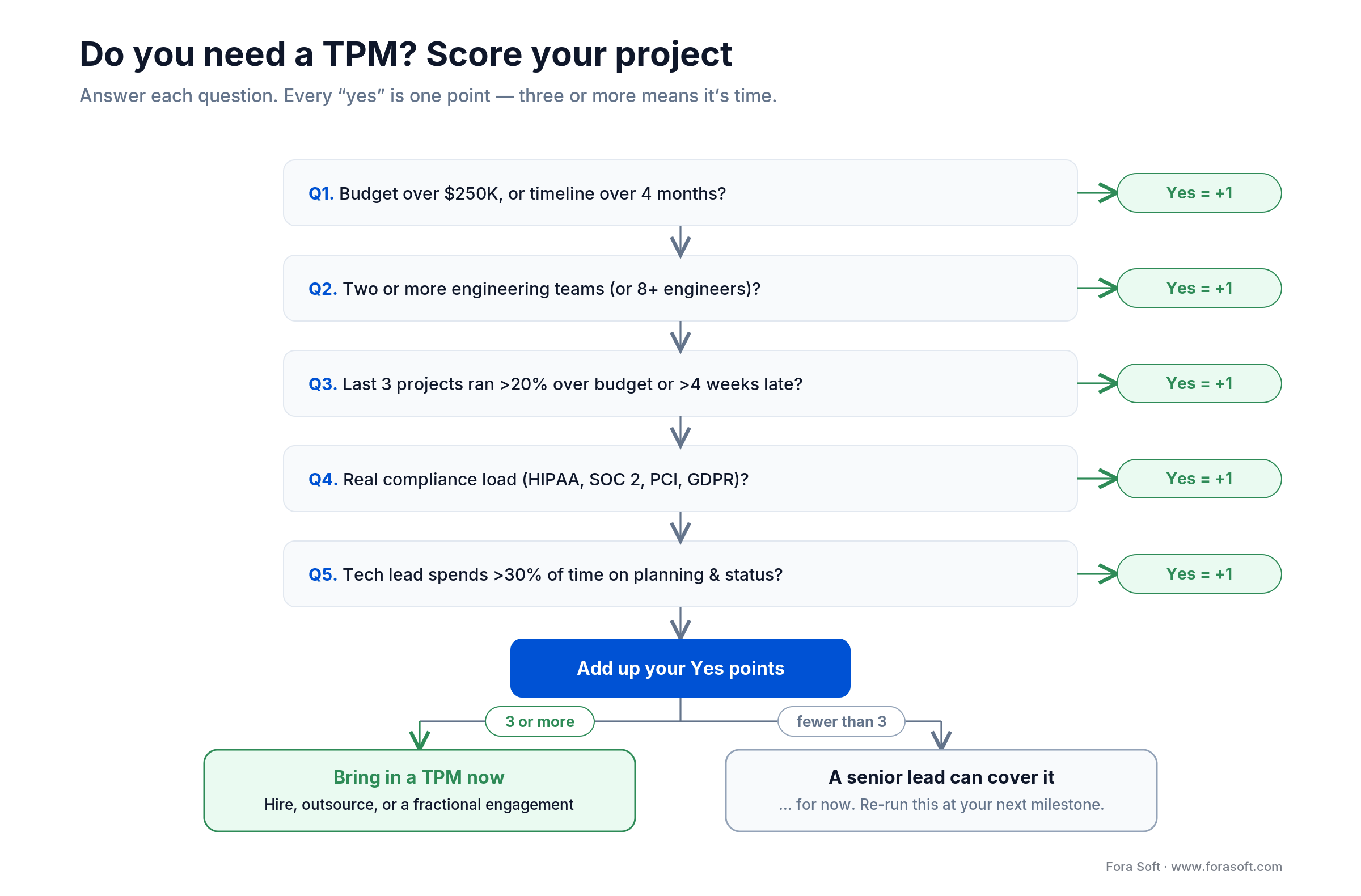
Figure 5. Score your project on five questions — three or more yeses means it’s time.
A realistic 90-day TPM onboarding plan
New TPM, whether hired or outsourced, won’t hit full stride for 90 days. What good looks like in each 30-day window:
Days 1–30: observe, document, stabilize
Shadow the team, read the last 3 months of standups and retrospectives, map the stakeholder list, document current state (scope, budget, risks). Only safe changes: fix one broken meeting cadence, stand up a single-source-of-truth status doc. Target: earn trust, not trust-loss.
Days 31–60: deliver something small and measurable
First real deliverable, usually a rewritten backlog, a clean risk register, or a working change-control process. Start moving the five KPIs. Stakeholders should notice “status is clearer” without explicit announcement.
Days 61–90: take full accountability
Own the delivery plan end-to-end. Run the first full sprint / milestone under the new process. Expect one escalation. Handle it cleanly. By day 90, budget variance should be tightening, velocity stabilizing, and stakeholder NPS trending up.
90-day warning sign: If by day 60 the TPM is generating meetings, docs, and status decks but the five KPIs haven’t moved, the problem is the TPM. Mis-hires cost 30% of annual salary. Catch it early.
Stuck with a project that has lost the plot?
We run 2-week emergency assessments — a TPM audits your current delivery, identifies the 3 biggest risks, and hands you a 90-day recovery plan. Flat fee, no lock-in.
What’s changing for TPMs in 2026
AI-assisted project management is real. By 2026 it’s concrete: Atlassian’s Rovo (its biggest update landed at Team ’26 in May 2026) drafts status and digs through Jira and Confluence context; Linear’s Agent (beta) triages and routes issues on its own; Notion’s Custom Agents (in public beta from February 2026, generally available later that year) post weekly project updates on a schedule. Good TPMs are now multiples more productive; the ones who were pure status-forwarders got exposed.
Outcome-based metrics are replacing output-based ones. “We shipped 48 story points” is out. “We reduced support-ticket volume by 18%” is in. A TPM who can connect sprint work to business outcomes is worth 2× one who can’t.
Distributed-by-default teams are the norm. Post-2020 remote work patterns stuck. A TPM who runs a coordinated delivery across 3 timezones and 6 time-shifted stakeholders is table stakes.
The “RTE” (Release Train Engineer) role is bleeding into TPM hiring criteria. SAFe-certified TPMs command a premium for enterprise programs.
Fractional / embedded TPM engagements are replacing full-time hires in the 50–200 employee band. Outsourced agencies and boutiques offer 0.5–1.0 FTE without the hire overhead.
When you should NOT hire a TPM (at least not yet)
Three honest cases:
You have no product-market fit yet. Hire a Product Manager first. Delivery discipline doesn’t help if you’re building the wrong thing.
You’re a team of three or four. Coordination overhead is negligible. A weekly 30-minute team sync covers it. Add a TPM at 7–8 engineers, not before.
You have a mature, shipped product with minimal new feature work. Ops-and-maintenance mode doesn’t need a TPM. A Scrum Master or Engineering Manager can cover.
FAQ
What does a Technical Project Manager actually do day-to-day?
Plans and tracks delivery, owns the risk register, runs change control, translates between engineering and business stakeholders, measures the five KPIs (on-time rate, budget variance, scope creep, velocity stability, stakeholder NPS), and runs retrospectives that produce real follow-through.
TPM vs. Project Manager — what’s the real difference?
A TPM has an engineering background and makes technical tradeoff calls; a traditional PM defers technical decisions to engineers. TPMs earn 30–60% more for exactly this reason. On software projects, the gap translates to 15–45% project cost overruns when managed by a non-technical PM.
Do I really need a TPM if I already have a Scrum Master and Engineering Manager?
On a single team < 10 engineers, often no. On anything cross-team, cross-stakeholder, or > $250K budget, yes — the Scrum Master works inside one team and the EM runs team health, neither owns cross-team delivery.
How much does a Technical Project Manager cost in 2026?
USA full-time: $117K base, $160K–180K fully loaded Year 1. Europe: €70K–100K. Outsourced agency: ~$134K/year FTE-equivalent. Freelance: $81/hr US median, $28–$155 range. Offshore: $15–$35/hour.
Is outsourcing a TPM better than hiring one?
Outsourcing wins on flexibility, mis-hire risk, and proven methodology. Hiring wins on institutional memory at 3+ years retention. The hybrid model — in-house tech lead + outsourced TPM — is the sweet spot for many 50–200-person product teams.
What KPIs prove the TPM is actually worth it?
On-time delivery rate > 90%, budget variance ± 5%, scope creep < 10% (vs. 52% industry average), velocity stability (variance ± 15% sprint-over-sprint), and stakeholder NPS > 50. If a new TPM moves these in one quarter, they’re earning their salary.
Should we use Agile, Waterfall, or something in between?
Agile (usually Scrum) is the default for software: 64% success rate, 71% adoption. Waterfall (49% success) still fits truly fixed-scope and regulated projects. Most enterprise programs end up hybrid — Waterfall for contracts, Agile for execution. A good TPM picks the fit, not the fashion.
How long before a new TPM is fully effective?
Days 1–30: observe and stabilize. Days 31–60: deliver a first real improvement and start moving KPIs. Days 61–90: take full ownership and run a complete cycle. By day 90, budget variance should be tightening and stakeholder NPS rising.
What skills and certifications does a technical project manager need?
A TPM needs enough software fluency to challenge estimates and read architecture — APIs, cloud, CI/CD, the SDLC — plus the core delivery skills: planning, risk management, stakeholder communication, and change control. The common certifications are PMP, CSM or PSM (Scrum), and SAFe for enterprise programs. In our experience, shipped delivery track record matters more than any single badge.
What to Read Next
Build vs buy
How chat APIs save you time and money
Stream, Sendbird, Twilio, PubNub compared on pricing, compliance, and architecture. Break-even math and a 12-month migration roadmap.
Related read
Why do I need a project manager for my software project?
The companion piece — when a PM earns their salary, what they actually protect against, and why skipping one costs more than hiring one.
Delivery discipline
What is done during the analytical stage of software development?
The discovery/analysis phase in plain language — what it produces, why skipping it costs you 30%+, and how a TPM runs it tight.
Estimation
The CTO’s guide to software project estimation
How to size a build before you commit — the cone of uncertainty, PERT math, and the hidden costs a TPM watches for.
MVP playbook
Why cut features and launch the product early?
How a TPM enforces MVP scope discipline, the feature cuts that pay for themselves, and what goes in vs. what waits for v2.
Ready to stop watching projects go sideways?
A Technical Project Manager is the cheapest insurance you can buy on a software budget. The math is not close. If your last three projects went over budget, over timeline, or out of scope, the problem is almost certainly not your engineers. It’s the missing person who was supposed to run defense.
We can embed a TPM (or a fractional one, or an Agent-Engineering-augmented one, depending on your scale) in two weeks. First 30 days we observe and document; by day 90 the five KPIs have moved and your sponsor can read the status report in 90 seconds. No mis-hire risk, no recruiting overhead. If the scope itself is still fuzzy, our software product planning and analytics work turns it into a prioritized roadmap and estimate before the first sprint.

The handbook · 7 volumes
Fora Soft Video Engineering Handbook
A TPM on a video product has to weigh latency against cost, or an SFU against a CDN, without waiting for engineers to translate. Our seven-volume handbook covers that stack from transport to AI in production; begin with Volume 3 on WebRTC, players, CDNs and delivery economics, then Volume 2 for latency budgets and ingest protocols and Volume 7 for AI serving and cost. Written by Nikolay Sapunov, CEO at Fora Soft.
Browse the handbook on Amazon →7 volumes · 9,000+ pages · Kindle & paperback
Need a TPM who has shipped real software, not one who has run real PowerPoints?
Book a 30-minute scoping call — we’ll look at your specific project profile, your pipeline, and your current delivery pain, and come back with a concrete engagement model and rate. No sales pitch.

