


Key takeaways
• SDK vs custom is a unit-economics question, not a religious one. Ship on the SDK when speed-to-market is the priority and per-user economics still work; build custom when scale, differentiation or compliance crosses the break-even line.
• The break-even line moves with your ops posture. For real-time video a lean single-node self-host can undercut the SDK from a few hundred thousand participant-minutes/month; a production-grade build with on-call needs several million. Payments rarely beat Stripe below ~$50 M GMV; auth rarely pays off before 10 M+ users.
• Most teams pick wrong in two directions. Pre-PMF startups overbuild custom infrastructure they cannot operate; post-PMF scale-ups stay on SDKs that quietly chew 20–40 % of gross margin.
• The right answer is usually a hybrid. Ship on SDKs to validate, hide the integration behind a thin in-house interface, then in-source the parts that cross the volume, margin or compliance threshold — one capability at a time.
• Fora Soft has shipped both sides since 2005. 250+ projects, 50+ in-house specialists, Twilio, Vonage, LiveKit, mediasoup, Janus, Stripe, Auth0, plus custom WebRTC, payments and video stacks. Book a 30-min call and we will scope the right path for your product.
Updated October 2026: re-checked SDK list prices (Twilio Video, LiveKit Cloud, Amazon Chime SDK, Stripe, Clerk’s February 2026 free-tier change), added a managed-vs-managed TCO line and the Amazon Chime shutdown to the vendor-risk audit.
Why Fora Soft wrote this SDK vs custom guide
Fora Soft has built and shipped both sides of this decision since 2005 — 250+ projects, 50+ in-house specialists, a 99% job-success record on Upwork. We integrate Twilio, Vonage, LiveKit, Stripe, Auth0, Sendbird and Hugging Face Inference Endpoints most weeks; we also build custom WebRTC, payments, auth, recommendation and AI infrastructure when the SDK math no longer works.
This playbook is the conversation we have with founders and CTOs in scoping calls, distilled. It is opinionated, vendor-neutral and grounded in actual unit economics from our delivery work across Sprii, BrainCert, CirrusMED, Mindwibe and Meetric.
We use Agent Engineering internally, which is why our build estimates and timelines run 30–50 % faster than agencies still doing this by hand. That changes the SDK-vs-custom math, especially on the “build” side — and it is the core of our custom software development work.
Stuck deciding whether to keep paying for an SDK or build custom?
Send us last quarter’s SDK invoice and your projected volume; we will model a 24-month build-vs-buy comparison in 5 working days.
SDK vs custom — what we actually mean
SDK vs custom development is the choice between renting a capability and owning it. With an SDK you plug a vendor’s ready-made video, payments or auth service into your app and pay per use; with custom development you build that capability to your own spec and run it yourself. The terms get sloppy, so for the purposes of this guide:
SDK / managed API. A third-party service exposed via SDK or REST API where the vendor runs the infrastructure. Twilio, Vonage, LiveKit Cloud, Stripe, Auth0, Algolia, Hugging Face Inference Providers, Sendbird, Mux, Cloudflare Stream. You pay per usage; you do not run servers.
What an SDK is and how it works. A software development kit is the libraries, APIs, docs and sample code a vendor ships so your app can call its service. Your code calls the SDK, the SDK talks to the vendor’s cloud, and the vendor meters every minute, user or transaction. An SDK differs from a framework in scope: a framework gives your whole app its structure, an SDK adds one capability to it.
Custom build. You implement the capability yourself, on infrastructure you operate. mediasoup / Janus on Hetzner for WebRTC, FastAPI + Stripe Connect on AWS for marketplace payments, Keycloak / Ory Hydra in Kubernetes for auth, vLLM on dedicated GPUs for AI inference. You own the code, the ops and the bill. In general terms, custom development is software designed and built for one organisation’s requirements instead of bought off the shelf; it is used when no product fits the workflow, the economics or the compliance rules.
Not to be confused with SDK development. Building an SDK means you are the vendor, shipping a kit other developers integrate (client libraries in several languages, versioning, docs). This guide is about the other side: whether to consume someone else’s SDK or build the capability into your own product.
Hybrid (the right answer most of the time). A custom-built abstraction layer over one or more SDKs, with the option to swap individual capabilities out for in-house implementations as scale or compliance demands.
The default in 2026: ship on SDKs to validate, hide them behind a thin internal API, then replace one capability at a time once volume crosses the break-even line. The curve below is why.
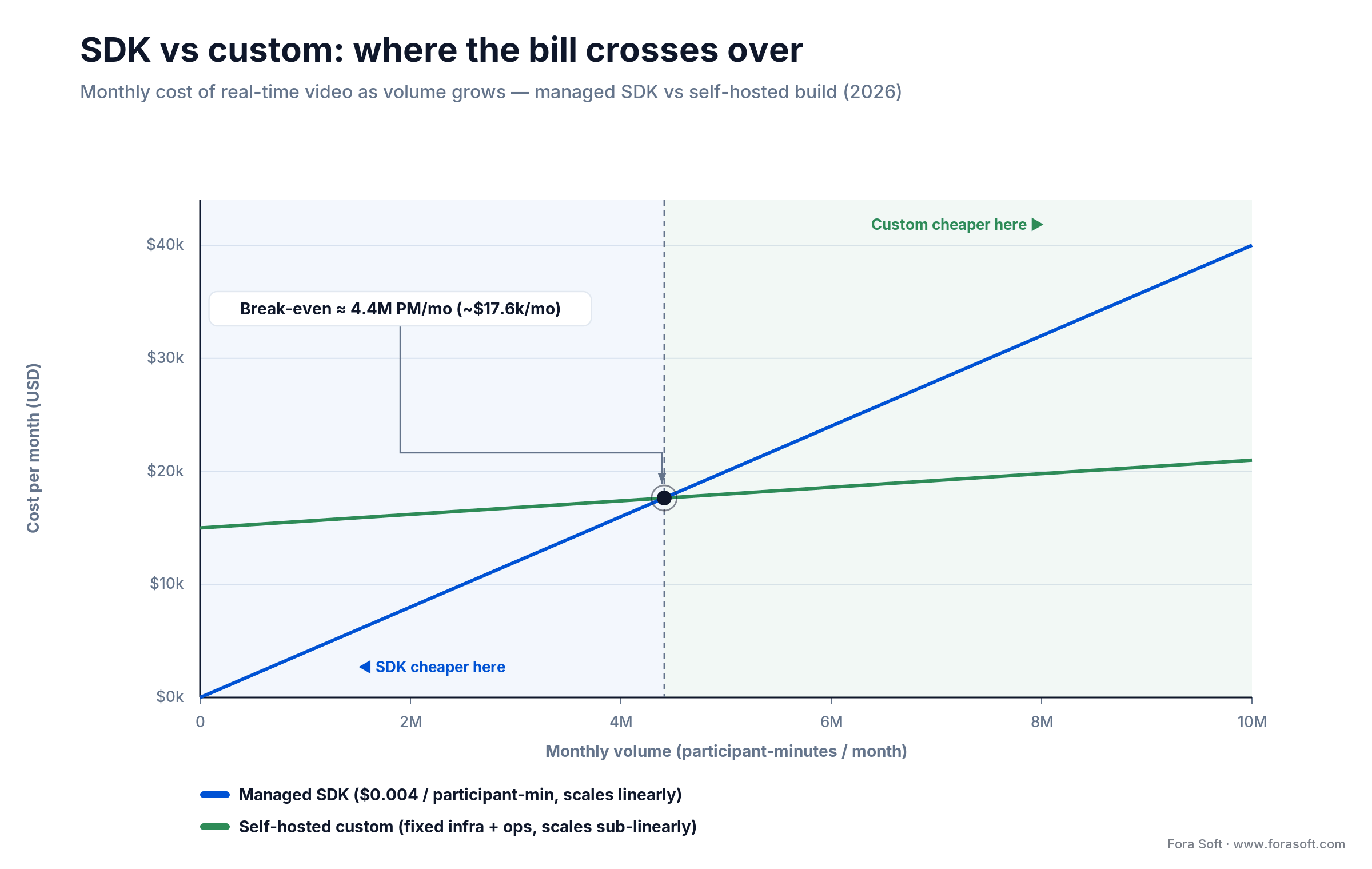
Figure 1. Where the managed-SDK bill overtakes a production-grade self-hosted build as monthly volume grows. The crossover shifts left if you run leaner infrastructure, right if you carry full HA and on-call.
Five reasons to ship on an SDK
1. Time-to-market is your real budget. A WebRTC stack on Twilio or LiveKit Cloud goes live in 1–2 weeks; a custom mediasoup deployment is 8–12 weeks plus an ops investment. If you are pre-product-market-fit, the cheapest currency is the four months you do not spend.
2. Your team is too small to operate the alternative. Custom infra means on-call, scaling, security patches, monitoring. If you are five engineers, every infrastructure capability you in-source costs another half-time engineer.
3. Compliance is bundled in the SDK. SOC 2, HIPAA BAAs, PCI DSS, GDPR, EAA. Stripe’s PCI scope, Auth0’s SOC 2, Twilio’s HIPAA — all of those are reused contracts you do not have to recreate.
4. The vendor’s team is bigger than yours. Stripe employs hundreds of engineers on payments alone; Twilio operates one of the largest session border controllers in the world. You almost certainly cannot match that on a small team.
5. Your differentiation is somewhere else. If video, payments or auth is plumbing rather than the product, paying a SaaS to make those work is the right trade. Save the engineering for the things customers actually buy.
Five reasons to build custom
1. Per-unit economics no longer work. A $0.004 / participant-minute Twilio bill that costs $400 / month at 100k PM hits $40k / month at 10M PM. Beyond a certain volume, the SDK becomes the largest line item on the COGS sheet.
2. Compliance or sovereignty forces it. Sovereign cloud, on-premise, regulated data residency, government contracts. Some SDKs simply do not have a region you need; some never will.
3. The capability is your product, not your plumbing. If video is what users pay you for, owning the protocol stack is a strategic moat. Twitch, Zoom and Spotify all built custom because the medium itself was the differentiator.
4. The SDK roadmap stops where you need to go. If you need Media over QUIC before your CDN ships it, AI agents before Twilio ships them, or a custom recording layout the vendor will not build, you have to build.
5. Vendor lock-in becomes existential. Twilio is the canonical warning: in March 2024 it announced a December 2026 end-of-life for Programmable Video, then reversed the decision on 21 October 2024 after customer pushback. Programmable Video is not reaching end of life: it remains a standalone product, and Twilio’s price page still listed it at $0.004 per participant-minute in August 2026 — but every team on it burned a quarter planning an exit. If one vendor moving sideways can break your business, reduce the dependency.
SDK vs custom — the comparison matrix
| Dimension | SDK / managed API | Custom build |
|---|---|---|
| Time to first prototype | Days to weeks | Weeks to months |
| Up-front cost | Low; $5k–$50k integration | High; $30–$300k+ build |
| Per-unit cost | Variable, scales linearly | Largely fixed, scales sub-linearly |
| Compliance posture | Inherited from vendor | Yours to design |
| Ops burden | Negligible | Real, ongoing |
| Roadmap control | Vendor’s | Yours |
| Vendor risk | Real (EOL, price changes, M&A) | None (you are the vendor) |
| Strategic moat | Limited | Possible if capability is core |
Where the break-even line sits in 2026
Different capabilities have different inflection points. The table gives the volume where custom starts to be worth evaluating; the real crossover then depends on how much ops you carry (see Figure 1). These are the ones we tune most often.
| Capability | Typical SDK | Where custom starts to pay off |
|---|---|---|
| Real-time video / WebRTC | Twilio, Vonage, Daily, LiveKit | ~300k PM/mo lean; several M with full HA |
| Live streaming | Mux, Cloudflare Stream | ~$5 k / month CDN bill |
| Payments | Stripe, Adyen | Rare. Direct acquiring beyond ~$50 M GMV |
| Auth / identity | Auth0, Clerk, WorkOS | 10 M+ users or hard SSO requirements |
| Search | Algolia, Elastic Cloud | ~$2 k–$5 k / month spend |
| Chat / messaging | Sendbird, Stream, PubNub | 100 k+ MAU on chat |
| AI inference (LLM) | OpenAI, Anthropic, HF Endpoints | ~50–100 M tokens / month |
| Analytics / events | Segment, Amplitude, Mixpanel | 10 M+ events / day |
These are starting points, not laws. The actual break-even depends on your team’s ops capacity, your compliance constraints and how much of the capability is differentiated. The TCO calculation in the next section is the only number that matters.
SDK pricing in 2026 — what the main meters cost
SDK pricing in 2026 runs on four meters: per minute (video and voice), per active or retained user (auth, chat), per transaction (payments) and per token (AI inference). The list prices below are what we model with; checked against each vendor’s price page in October 2026.
| SDK | Meter | List price | Source |
|---|---|---|---|
| Twilio Video | Per participant-minute | $0.004 / participant-minute; compositions $0.01 / composed minute; real-time transcription $0.027 / room-minute | Twilio, Aug 2026 |
| LiveKit Cloud | Plan + per minute + per GB | Ship $50 / month with 150k WebRTC minutes, then $0.0005 / min; Scale $500 / month with 1.5M minutes, then $0.0004 / min; data $0.10–$0.12 / GB; AI agent sessions $0.01 / min | LiveKit, Oct 2026 |
| Amazon Chime SDK | Per attendee-minute | $0.0017 / attendee-minute for WebRTC media sessions, metered in 6-second increments | AWS, Oct 2026 |
| Daily | Free tier + per minute | 10,000 free minutes / month, then usage pricing | Daily, Oct 2026 |
| Stripe | Per transaction | 2.9% + 30¢ per successful US domestic card charge | Stripe, Oct 2026 |
| Clerk | Per monthly retained user | Free to 50,000 MRU (raised from 10,000 on 5 Feb 2026); Pro $25 / month, then $0.02 / MRU | Clerk, 2026 |
Two things stand out. The same participant-minute costs anywhere from $0.0004 to $0.004 depending on the vendor, a 10× spread before any negotiation. And the cheaper per-minute vendors bill bandwidth separately, so compare whole invoices, not headline rates. For a per-vendor breakdown on video, see our Daily.co vs building your own cost comparison.
How to calculate TCO — the formula no one writes down
A real comparison includes everything, not just the SDK invoice. Use this:
SDK 24-month TCO = (24 × monthly usage cost) + integration build cost + integration maintenance cost + cost of expected vendor-risk events (price increases, EOL).
Custom 24-month TCO = build cost + (24 × infrastructure cost) + (24 × ops cost, including on-call) + (24 × security & compliance cost) + opportunity cost of engineering hours diverted from product.
A common 2026 example: 5M participant-minutes / month of video calling. Twilio at $0.004 / PM = $20k / month = $480k over 24 months, plus $50k integration — $530k all in. LiveKit self-hosted on Hetzner: ~$8k / month infra plus 0.5 FTE ops at ~$8k / month = $384k over 24 months, plus an $80k build — $464k. The custom path is ~$66k cheaper here, but only if your ops capacity is real.
Re-price the SDK before you build. The same 5M participant-minutes on LiveKit Cloud’s Scale plan at October 2026 list prices is $500 + 3.5M × $0.0004 = $1,900 / month in minutes. Bandwidth is the bigger line: assuming ~1.5 Mbps received per participant, that is ~56 TB a month, or ~$5.3k past the 3 TB included. Call it ~$7.2k / month, ~$223k over 24 months with the same $50k integration, well below both paths above. Switching managed vendors behind your own interface is often the cheapest first move. If Twilio is the SDK in question, our Twilio development and migration team models both options, staying and optimising or moving to a cheaper provider, from your real invoices.
Three numbers most teams forget: (1) the security and compliance “tax” on custom infrastructure, often 15–20 % of run cost; (2) the opportunity cost of senior engineers maintaining infra rather than shipping features; (3) the price-escalation clauses on the SDK contract you have not read in two years.
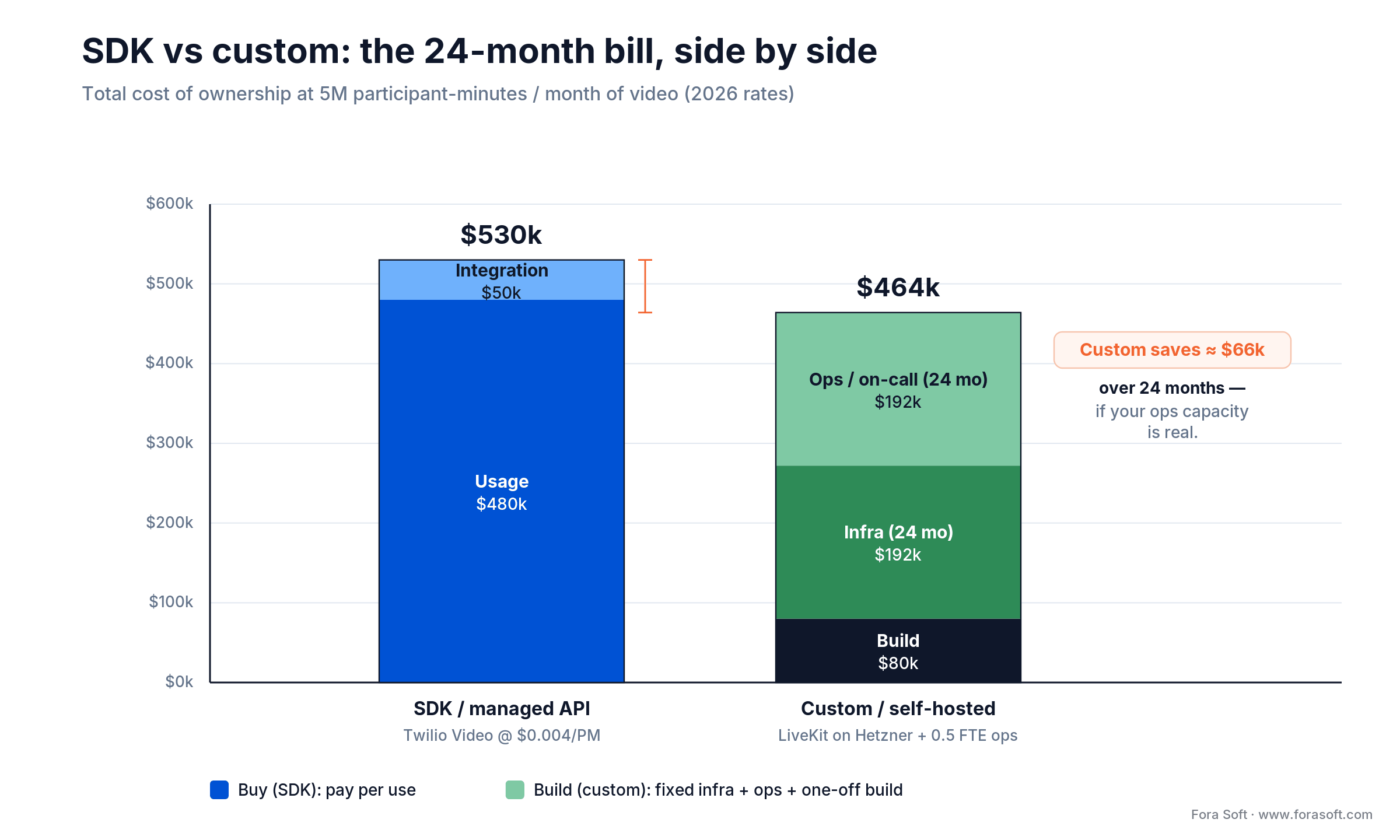
Figure 2. The same decision as a 24-month total-cost-of-ownership comparison at 5M participant-minutes/month. Custom wins by ~$66k — the whole margin is the ops line you have to staff.
Rule of thumb: if the custom build does not pay back inside 18 months on conservative assumptions, stay on the SDK and revisit when volume grows.
Need a 24-month TCO model side-by-side?
Send your traffic projection and current SDK contract; we will produce a build-vs-buy model with payback calculation in 5 working days.
The hybrid pattern — default to SDK, abstract, swap later
Most successful 2026 stacks are hybrids. The shape is the same across capabilities:
1. Ship on the SDK. Validate the feature, market and unit economics. Treat the SDK as the cheapest possible market test.
2. Hide it behind your own interface. A thin internal API or service that wraps the SDK. Your code never imports the vendor SDK directly. This is the difference between a 6-week and a 6-month migration later.
3. Instrument for the swap. Track per-call cost, latency and reliability. Know which calls dominate the bill and which features matter most.
4. In-source one capability at a time. When a single capability crosses the break-even threshold, replace it behind the same interface. The rest of the application does not know. For video, the encoding and delivery mechanics behind that swap are in our video encoding guide.
5. Keep a fallback. Even after migration, retain the ability to flip back to the SDK behind a feature flag. We have used this twice in 18 months on real client work to ride out unexpected ops issues.
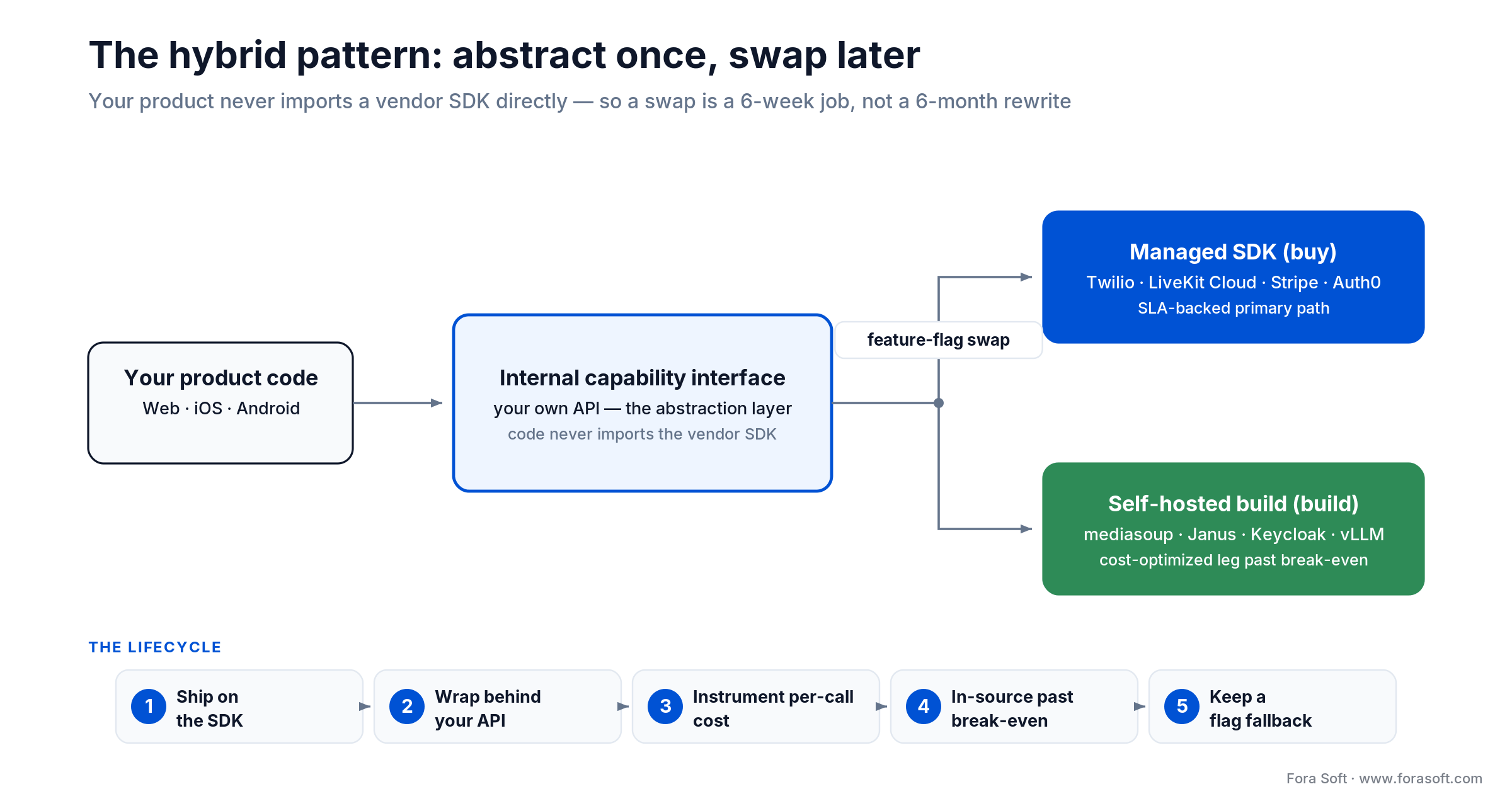
Figure 3. The hybrid pattern: your product calls your own interface, which routes to a managed SDK or a self-hosted build behind a feature flag.
A decision framework — pick SDK, custom or hybrid in five questions
Q1. Are you pre-product-market-fit? Yes → SDK every time. The cost of premature optimisation outweighs every other consideration.
Q2. Is the capability core to your differentiation? Yes → plan a hybrid that lets you in-source the differentiating part within 12 months.
Q3. Are your unit economics OK with the SDK at projected 24-month volume? Yes → SDK with a thin abstraction. No → build, in stages.
Q4. Do compliance, sovereignty or regulatory rules block the SDK? Yes → custom (or a self-hosted variant) is the only option. The SDK does not even enter the conversation.
Q5. Do you have the ops capacity to run the custom build? No → stay on the SDK or hire / partner before you build. A custom build you cannot operate is worse than the SDK you complain about.
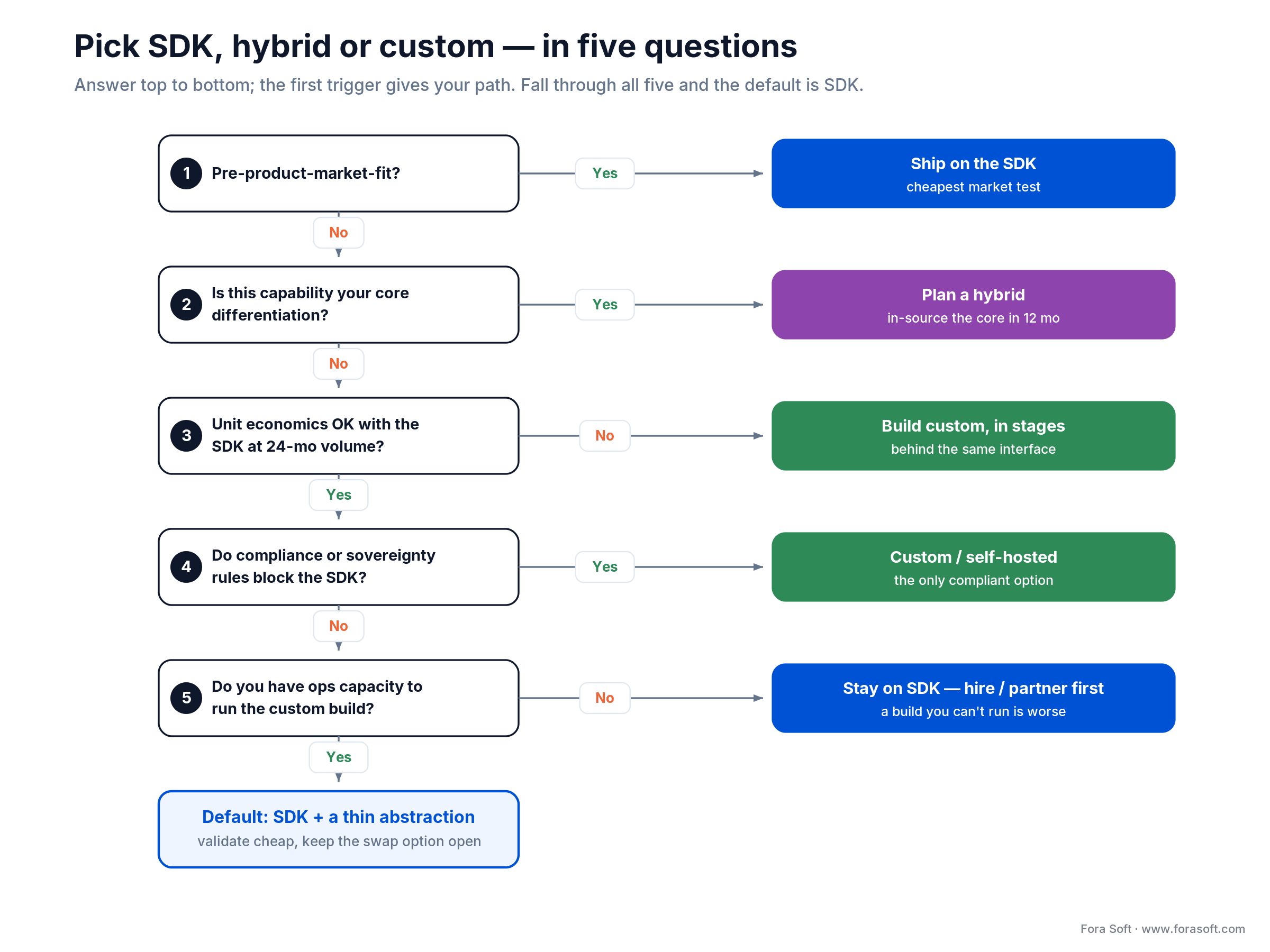
Figure 4. The same five questions as a decision tree — answer top to bottom, and the first trigger gives your path.
The SDK categories most app founders use
Different capabilities have different SDK landscapes and different break-even shapes. The seven categories below cover >90 % of the SDK spend in our client portfolio.
Real-time video and audio. Twilio, Vonage, Daily, LiveKit Cloud, Agora, Amazon Chime SDK. Per-minute billing ($0.0004–$0.004 per participant-minute at 2026 list prices), latency-sensitive, the canonical “volume tips into custom” category.
Live streaming and VOD. Mux, Cloudflare Stream, AWS IVS. Per-GB egress + per-minute encoding; the bills grow with audience and content library.
Payments. Stripe, Adyen, Checkout.com. Per-transaction pricing — Stripe’s standard 2.9% + $0.30 is the reference; the upper end of the market negotiates direct acquiring at $50 M+ GMV.
Auth and identity. Auth0, Clerk, WorkOS, Supabase Auth. Per-MAU or per retained user; the migration trigger is usually enterprise SSO requirements. Free tiers move too: Clerk raised its free plan from 10,000 to 50,000 monthly retained users on 5 February 2026, which pushed the auth break-even further out for most startups.
Search and discovery. Algolia, Elastic Cloud, Typesense. Per-search and per-record indexing; semantic-search demand pushes more teams to custom OpenSearch / pgvector.
Chat and messaging. Sendbird, Stream Chat, PubNub. Per-MAU; once chat becomes core to your product loop, custom XMPP / Matrix becomes attractive.
AI inference. OpenAI, Anthropic, Hugging Face Inference Endpoints, Together, Cerebras. The youngest category and the one whose break-even line is moving fastest. See our Hugging Face for business guide.
A vendor-risk audit you can run in one afternoon
Whether you stay on an SDK or migrate, the vendor risk on every SDK in your stack should be reviewed yearly. We use the same six-question audit on every client engagement.
1. EOL track record. Has this vendor or its parent ever sunset a product? How much warning did customers get? (Twilio’s Video reversal is the obvious 2024–26 case. The other is Amazon Chime: AWS ended support for the Chime meetings app on 20 February 2026 after a year’s notice, while the Chime SDK carried on. Read exactly which product a notice covers.)
2. Pricing escalation. What clauses allow price increases mid-contract? When did the last increase happen, and by how much?
3. M&A risk. Public or private? Recently acquired? Strategic ownership likely to change product direction?
4. Compliance trajectory. SOC 2 fresh? HIPAA BAA still on offer? GDPR sub-processors transparent?
5. Concentration risk. What share of your COGS is this single vendor? At what point does losing them become existential?
6. Replaceability. Is there at least one credible open-source equivalent? How many weeks of work is the migration with your current abstraction?
If a single SDK is >15 % of your COGS — or has shown a 25 %+ price increase in the last 24 months — treat the vendor-risk audit as a board-level concern, not an engineering one.
When SDK pricing turns into a surprise bill
The most common SDK regret is not the headline rate; it is the meter you did not know was running. Four patterns to plan for.
Multi-publisher / scale tiers. Some video SDKs price per-publisher; what looks like $0.004 / minute jumps the moment your room goes from 10 publishers to 30. Read the tier table, not the marketing rate.
Recordings, compositions and storage. The recording rate usually matches the streaming rate, composed MP4 is higher again ($0.01 / composed-minute on Twilio), and long-tail storage compounds month over month past the free 10 GB ($0.00167 per GB per day on Twilio in August 2026). Project recordings with the same rigour you project minutes.
Egress. CDN egress is the meter teams forget. A doubling of viewers can triple the bill once egress overage tiers kick in.
AI add-ons. AI features carry their own meters on top of the call: Twilio charges $0.027 per room-minute for real-time transcription and LiveKit Cloud $0.01 per AI agent session minute (both 2026 list prices). An always-on transcript or agent can cost more than the video itself.
Mini case — live shopping, SDK to hybrid in 12 months
Situation. Sprii shipped on a managed WebRTC SDK to validate live-shopping economics. By month 12 they were doing 8M PM / month and the SDK bill had become the largest line on their COGS sheet.
Plan. Wrap the SDK behind an internal “LiveRoom” service. Profile per-feature cost. Migrate the long-tail viewer leg first to a self-hosted SFU on Hetzner, keep the SDK for the host leg and chat-eligible front-row viewers. Twelve weeks of build, four weeks of A/B at 10 % then ramp. Splitting host and viewer legs across SDK and SFU is the kind of topology call our custom WebRTC architecture team makes before a line of migration code is written.
Outcome. SDK bill dropped 70 %; latency improved on the long-tail leg; the SDK stayed as the SLA-backed primary path during peak events. Want a similar staged migration? Book a scoping call.
Treat the SDK invoice as a budget line item, not a footnote. Plot the next 24 months on conservative growth assumptions; if the curve goes vertical, you are buying yourself an inevitable migration project at the worst possible time.
Five pitfalls that derail SDK-vs-custom decisions
1. Coupling product code to the SDK. Importing Twilio, Stripe or Auth0 SDKs directly in your application code makes the swap a multi-month rewrite instead of a six-week migration.
2. Building custom infra you cannot operate. An SFU cluster without an on-call rotation is worse than a Twilio bill. Plan ops capacity before you plan the build.
3. Forgetting compliance carry-over. Stripe’s PCI scope, Auth0’s SOC 2 and Twilio’s HIPAA all evaporate the moment you migrate. Plan the certification work as part of the custom build.
4. Ignoring the long tail of features. The SDK does 60 things; your custom build does 6. The other 54 are how the SDK earns its margin. Decide which ones you actually need before scoping the build.
5. Treating “it’s only $4k a month” as cheap. $4k a month is $48k a year (about $23 for every hour of a 2,080-hour work year), $144k over three years — and you will probably 10× the volume in that window. Always model 24–36 months out.
KPIs to track once you decide
Quality KPIs. Per-feature reliability against the SDK SLA, latency P50 / P95, error rates, support-ticket rate by capability.
Business KPIs. Per-unit cost (per call, per minute, per token, per transaction), gross margin, % COGS that is the SDK or custom infra, payback on the build over 24 months.
Reliability KPIs. Uptime, MTTR, on-call burden (in person-hours / week), security-review status, compliance-certification freshness.
When you should not migrate from SDK to custom
Migrations are expensive. Stay on the SDK if (a) the projected 24-month TCO of custom is within 20 % of the SDK’s, (b) the capability is plumbing rather than differentiation, (c) your team is at capacity on product features, or (d) you are inside a 6-month launch window.
Conversely, do migrate when projected unit economics fail by 24 months out, when compliance forces it, or when the SDK roadmap stops at the feature you need next. The cost of waiting is usually higher than the cost of the build.
How AI changes the SDK-vs-custom math in 2026
Three shifts make custom builds cheaper than they used to be.
1. Boilerplate is close to free. Agent Engineering and code-gen tools cut the boilerplate-heavy parts of a build (CRUD, auth, dashboards) by 30–50 %. The custom build is no longer 12 weeks of SDK-equivalent work.
2. Open source replaces closed APIs. Hugging Face Hub, vLLM, LiveKit self-hosted, mediasoup and Janus give you SDK-quality capabilities under permissive licences. Five years ago you would have paid for the API.
3. Observability is solved. LangSmith, Langfuse, Grafana and OpenTelemetry make a custom AI or video pipeline observable in days, not months. The ops gap that used to make custom prohibitive has narrowed.
Want a written SDK-vs-custom recommendation?
We deliver a 24-month TCO model with payback math, a vendor-risk assessment and a migration plan in 5 working days. Fixed price, no commitment.
Frequently asked questions
What is an SDK and how does it work?
An SDK (software development kit) is the set of libraries, APIs and docs a vendor ships so your app can use its service. Your code calls the SDK, the SDK talks to the vendor’s cloud, and you pay per minute, user, transaction or token.
How much does an SDK cost in 2026?
It depends on the meter. At October 2026 list prices, video runs $0.0004–$0.004 per participant-minute (LiveKit Cloud to Twilio), Stripe charges 2.9% + 30¢ per US card payment, and Clerk auth is free to 50,000 monthly retained users, then $0.02 each.
Is Twilio Programmable Video reaching end of life?
No. Twilio announced a 5 December 2026 end-of-life in March 2024, then reversed it on 21 October 2024; Programmable Video remains a standalone product, priced at $0.004 per participant-minute as of August 2026.
Should I always start with an SDK?
Almost always, yes — unless compliance, sovereignty or regulation forces a custom build from day one. An SDK is the cheapest market test you can buy, and it lets you validate demand before you spend a cent on infrastructure you would have to operate.
When does it make sense to build a custom WebRTC stack?
It depends on ops posture. A lean single-node self-host can undercut the SDK from a few hundred thousand participant-minutes / month; a production-grade build with HA and on-call usually needs several million PM / month to pay back (Figure 1 marks that crossover near 4.4M participant-minutes for a self-hosted stack at roughly $16k / month). HIPAA, sovereign-cloud or on-premise requirements move the line to day one. Below those, Twilio, Vonage, Daily or LiveKit Cloud usually win on TCO.
How do I avoid being trapped by a vendor SDK?
Wrap every SDK in a thin internal interface, instrument per-feature cost and reliability, and keep open-source equivalents on the technical roadmap. The hybrid pattern in this guide is built to make swap-out a six-week project, not a six-month one.
How do I model TCO over 24 months?
Sum: SDK monthly cost × 24 + integration build + integration maintenance + estimated vendor-risk events. Compare to: build cost + 24 × (infra + ops + security & compliance) + opportunity cost. Be honest about ops capacity and compliance work; that is where most build estimates miss.
Does open source automatically mean “custom”?
No. mediasoup, LiveKit, Keycloak and vLLM are open source, but if you self-host and operate them, that is a custom build with all the ops cost. If you run them on a managed service (LiveKit Cloud, Hugging Face Inference Endpoints), it is closer to an SDK.
What if my SDK announces an EOL?
If you wrapped it behind your own abstraction, you have a manageable migration. If you did not, plan a 3–6 month rewrite. Twilio’s Programmable Video saga — a December 2026 sunset announced in March 2024, then reversed in October 2024 — is a useful case study; we cover the migration paths in our Twilio Video migration guide.
How fast can Fora Soft move us off an SDK?
A standard custom WebRTC, payments or auth migration is 6–12 weeks of build, 2–4 weeks of A/B and ramp. We typically deliver 30–50 % faster than agencies still doing this by hand because we use Agent Engineering on the boilerplate-heavy parts of the build.
Does Fora Soft offer build-vs-buy audits?
Yes. We deliver a written 24-month TCO model with payback calculation in 5 working days, based on your actual SDK invoices and projected volume. Book a 30-min call.
What to read next
Migration
Twilio Video migration guide 2026: Vonage, Daily, LiveKit, Chime & self-hosted
The worked SDK-to-custom migration, with per-vendor trade-offs.
SDK alternatives
Agora.io alternative in 2026: custom WebRTC with LiveKit, mediasoup & Janus
When the SDK bill stops making sense, this is the path off it.
Cost analysis
LiveKit vs Agora: a 2026 cost analysis with real workload numbers
Granular per-minute math when WebRTC vendors are on the shortlist.
AI infrastructure
Hugging Face for business in 2026
The same SDK-vs-custom calculation, applied to LLMs and AI inference.
Ready to scope the right path?
SDK vs custom is a unit-economics question with a small number of right answers per capability. Pre-PMF, ship on the SDK and abstract it. Post-PMF, watch the per-unit cost and the strategic moat. When projected 24-month TCO crosses the line, migrate one capability at a time, behind the same internal interface, with a fallback you can flip back to.
Most teams do this badly in two directions: pre-PMF founders overbuild infrastructure they cannot operate, and post-PMF scale-ups stay on SDKs that quietly chew gross margin. Both are fixable in 5 working days of disciplined modelling. If the stack is already built, an independent architecture review tells you which SDKs to keep, which to wrap and which to replace, with the cost case for each.


The handbook · 7 volumes
Fora Soft Video Engineering Handbook
Video SDK bills are where the build-versus-buy math in this guide usually breaks first. Our seven-volume handbook explains what those per-minute fees pay for: Volume 3 covers WebRTC, CDNs and delivery economics, Volume 2 covers transport and ingest, and Volume 7 covers AI serving and cost per stream-hour. Written by Nikolay Sapunov, CEO at Fora Soft.
Browse the handbook on Amazon →7 volumes · 9,000+ pages · Kindle & paperback
Get a written SDK vs custom recommendation
A 30-minute call, a 24-month TCO model and a migration plan within 5 working days. No commitment.

