

Key takeaways
• Remote patient monitoring platform development is a reimbursement play first, a software play second. The code is the easy part. The money comes from hitting the 16-day data rule and logging 20-minute management time, so build the billing engine as a first-class feature, not an afterthought.
• Design to six layers. Devices, an aggregator, a FHIR data store, an alert engine, care-plan and EHR write-back, and reimbursement automation. Get the seams between them right and everything else follows.
• 2026 changed the CPT math. CMS added two new remote-monitoring codes (99445 and 99470) on January 1, 2026, so a platform that only knows 99453/99454/99457/99458 already leaves revenue on the table.
• Compliance is architecture, not paperwork. HIPAA’s five technical safeguards, a real BAA chain, and a clear read on when your software becomes an FDA medical device decide whether you can ship at all.
• Build vs buy is usually “hybrid.” Buy the commodity layers (managed FHIR store, device aggregator under ~5,000 patients), build the differentiators (alerting, per-patient thresholds, billing automation). Full custom pays off past scale.
Why Fora Soft wrote this playbook
Most remote patient monitoring platforms don’t fail on the demo. They fail three months in, when a nurse spends forty minutes reconciling a blood-pressure reading that never synced, a biller can’t prove 16 days of data, and a cardiologist stops trusting the alert feed because it cried wolf twice a shift. Every one of those is a design decision made too early and too casually. Fixing them after launch costs more than getting them right up front.
We’re Fora Soft. We’ve shipped 250+ projects since 2005 with 50 in-house engineers, and healthcare is a vertical we’ve lived in, not visited. We built CirrusMED, a HIPAA-compliant “Netflix for medicine” telehealth platform now licensed in 48+ US states, and VALT, a HIPAA video system running in 770+ US organizations across 50,000+ users. We’ve wired WebRTC, device data, and EHR integrations under real audit pressure, and it anchors our telemedicine development practice.
This is the guide we wish existed when a founder first asks “what does it take to build an RPM platform?” It covers the architecture, the 2026 reimbursement rules, the compliance lines you cannot cross, the real cost math, and the honest cases where you shouldn’t build at all. No filler, no hand-waving. Where the number is fuzzy, we say so.
Scoping a remote patient monitoring build?
Bring your patient population, target conditions, and EHR. We’ll map the architecture, the billable codes, and a realistic timeline in 30 minutes.
What a remote patient monitoring platform actually is
A remote patient monitoring platform collects physiologic data from a patient at home (blood pressure, weight, blood glucose, pulse oximetry, heart rhythm), moves it automatically to a secure clinical system, and turns it into something a care team can act on and bill for. That last clause is the whole game. A step counter is not RPM. RPM is FDA-defined device data, automatically transmitted, reviewed by a clinician, and documented against a reimbursable code.
People conflate it with telemedicine, and the two overlap, but they answer different questions. Telemedicine is the video visit: synchronous, episodic, doctor-and-patient on a call (we cover that side in our telemedicine engineering guide). RPM is the always-on data stream between visits: asynchronous, continuous, device-and-algorithm first, human second. A mature program runs both, which is why our telehealth work on telemedicine platform development and RPM tends to land in the same codebase.
Under the hood, an RPM platform is an integration problem wearing a healthcare app’s clothes. You’re joining consumer and medical devices you don’t control, a data model set by a standards body (HL7 FHIR), a billing rulebook set by CMS, a privacy rulebook set by HHS, and a device-regulation line drawn by the FDA. The engineering is real, but the hard part is respecting five external contracts at once without any of them silently breaking.
Why RPM is worth building in 2026
Because adoption crossed the line from pilot to standard of care, and the money is now durable. Grand View Research put the RPM systems market at roughly $30.9B in 2026, growing about 20% a year toward $110B by 2033. Device-only estimates run higher and system-only estimates lower, so treat any single headline number with suspicion. Scope matters more than the digits. What’s not fuzzy: 81% of clinicians reported using RPM in 2023, a 305% jump in two years (Vivalink, 2023), and Medicare RPM claims rose roughly 1,300% between 2019 and 2022 (mHealthIntelligence, 2023).
The clinical evidence caught up too, which matters because health systems buy outcomes, not dashboards. A 2024 systematic review in npj Digital Medicine found a clear downward trend in hospital admissions, readmissions, and length of stay when RPM supports care transitions. A 2024 heart-failure meta-analysis pinned down which program features actually work: daily monitoring, blood-pressure tracking, and video check-ins, with video-enabled programs showing markedly lower all-cause rehospitalization. UPMC reported cutting 30-day readmissions 76% for high-risk patients after adding RPM.
Read those studies closely before you promise anyone a number. The effect sizes swing with study design, and a few widely-copied stats (the “71 million Americans use RPM” figure, for one) don’t survive a source check. The safe claim: well-run RPM reliably bends readmissions and cost for chronic, high-risk populations. That’s the population your platform should be built to serve.
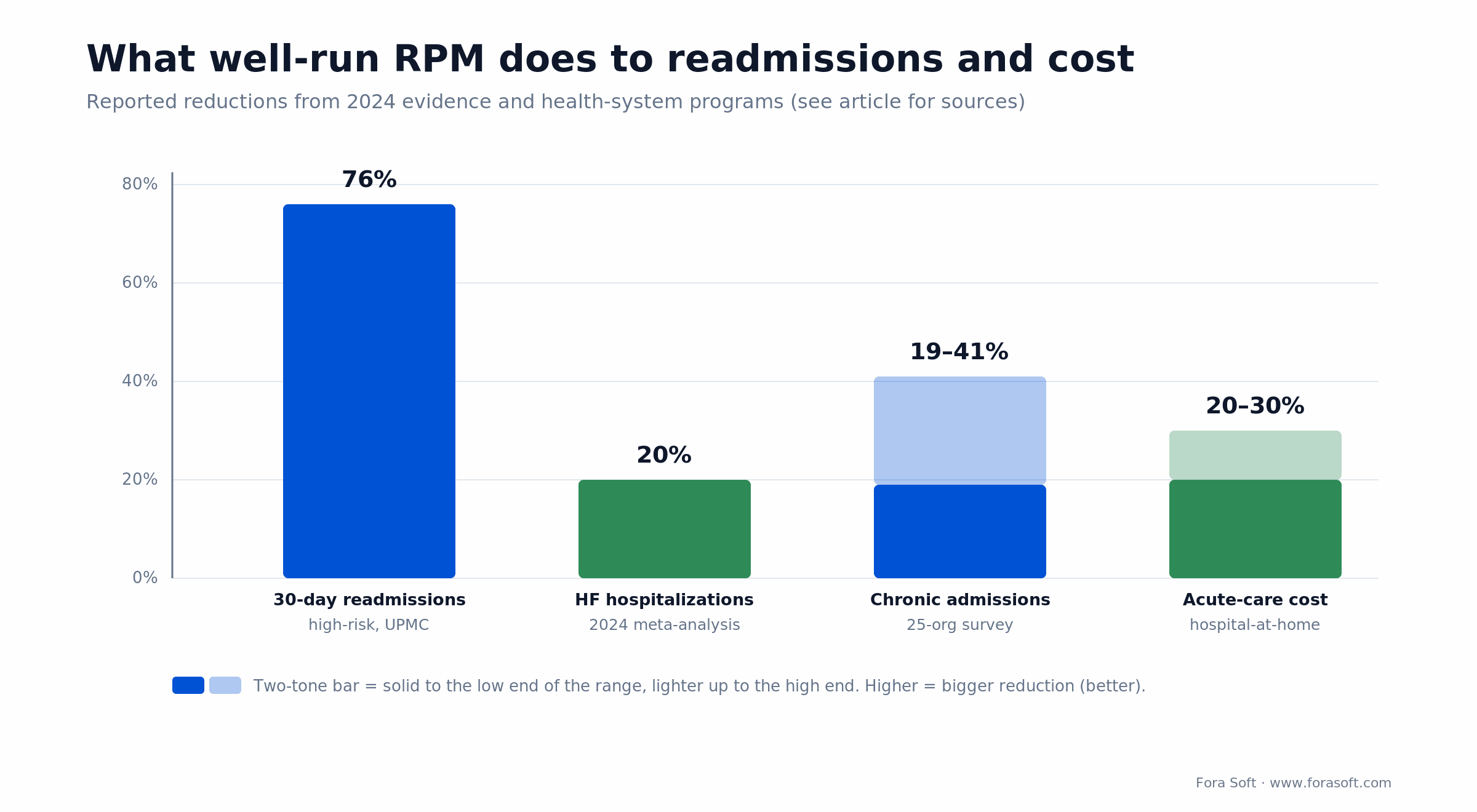
Figure 1. Reported reductions from 2024 clinical evidence and health-system RPM programs. Higher bars mean bigger cuts.
Build RPM when: you own (or partner tightly with) the chronic-care nursing relationship for a panel above ~500 patients with conditions that reward daily readings — hypertension, heart failure, diabetes, COPD. That’s where the reimbursement, the outcomes, and the software all line up.
Reference architecture: the six-layer RPM stack
Every RPM platform we’ve built or reviewed decomposes into the same six layers. Draw them as separate services with clean contracts and you can swap a device vendor or an EHR without a rewrite. Blur them (say, let alert logic read raw device payloads directly) and every new device type becomes a migration.
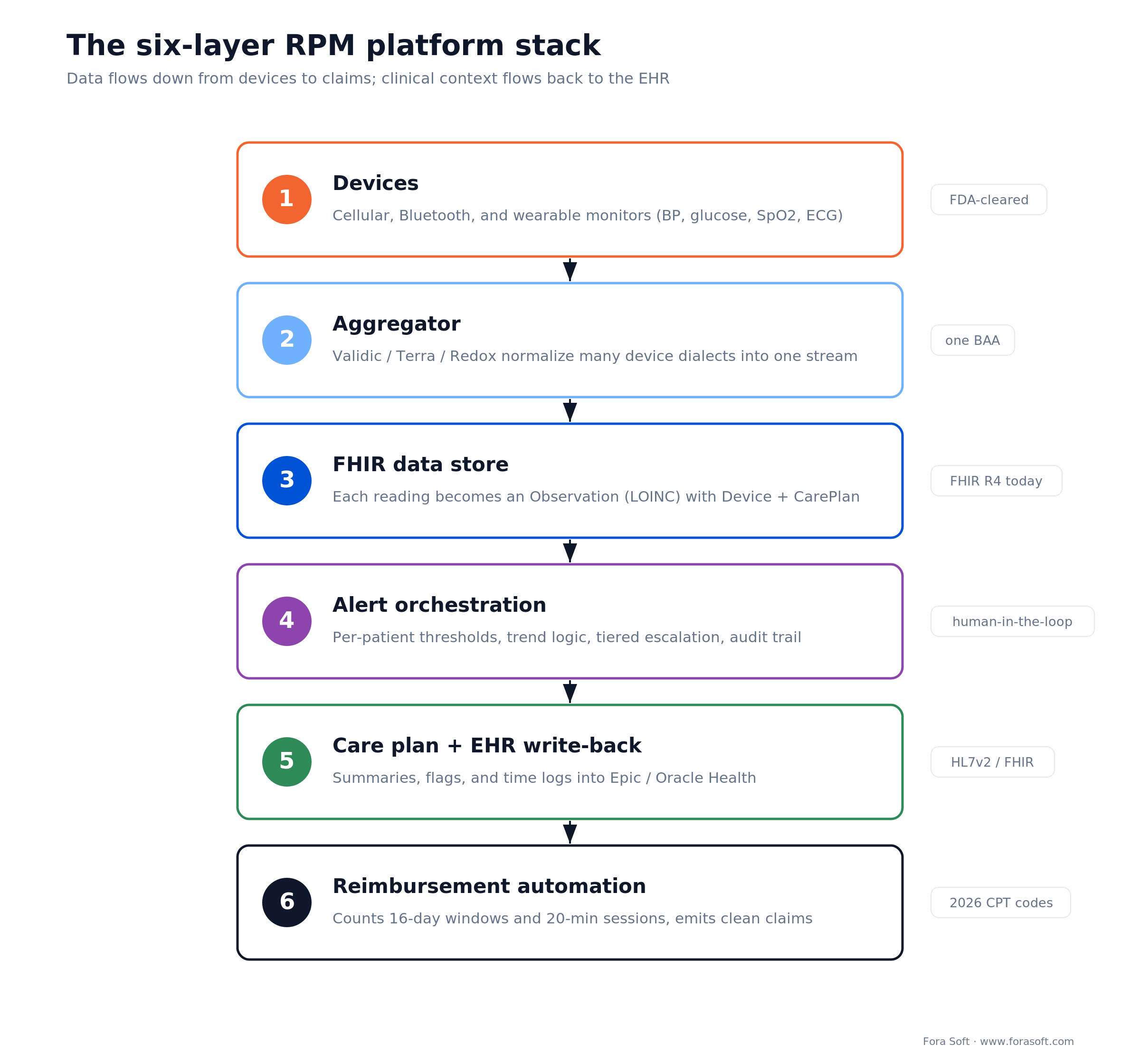
Figure 2. The six layers of an RPM platform. Data flows down from devices to claims; clinical context flows back to the EHR.
Layer 1 — Devices (cellular, Bluetooth, wearables)
The physical layer: FDA-cleared cuffs, scales, glucometers, pulse oximeters, and ECG patches, plus the occasional consumer wearable for context. Your first architectural fork lives here — cellular vs Bluetooth — and it drives adherence, cost, and support load more than any code decision downstream. We come back to it in the device-integration section.
Layer 2 — Aggregator (Validic, Terra, Redox, or direct)
A normalization layer that turns a hundred device dialects into one clean stream. Validic advertises 500+ device integrations behind a single BAA; Terra covers consumer wearables; Redox and Particle Health handle the EHR/FHIR plumbing. Under roughly 5,000 patients, buying this layer is almost always cheaper than building and maintaining direct integrations yourself.
Layer 3 — FHIR data store
The canonical record. Each reading becomes an HL7 FHIR Observation with a LOINC code, tied to Device and CarePlan resources. Use a managed FHIR store (Azure Health Data Services, Google Cloud Healthcare API, AWS HealthLake, or an engine like Medplum) so you inherit versioning and audit instead of hand-rolling them.
Layer 4 — Alert orchestration
The clinical brain: per-patient thresholds, trend detection, escalation tiers, and on-call routing. This is the layer that earns trust or destroys it, so it gets its own section below. Keep it stateless where you can and feed it from the FHIR store, never from raw device webhooks.
Layer 5 — Care plan and EHR write-back
RPM data is worthless if it lives in a silo the clinician never opens. Write summaries, flags, and time logs back to Epic, Oracle Health (Cerner), or athenahealth over FHIR or an HL7v2 ORU feed, so the care team works in one chart, not two.
Layer 6 — Reimbursement automation
The layer most teams bolt on last and regret. It counts qualifying days per patient per 30-day window, accumulates management minutes, checks consent and eligibility, and emits clean claims for the right codes. Build it early: it’s what turns a monitoring app into a business.
RPM CPT codes in 2026 — including the two new ones
Medicare pays RPM through a small family of CPT codes, and CMS changed the family on January 1, 2026 in the CY2026 Physician Fee Schedule Final Rule (CMS-1832-F). If your billing logic still assumes the four legacy codes, it’s already out of date. Here’s the current set, with approximate 2026 national amounts. Exact pay is RVU × the $33.40 conversion factor × your geographic index, so pull the fee schedule for your locality. The trackers disagree by a few dollars precisely because CMS publishes RVUs, not headline prices.
| CPT code | What it pays for | Key rule | ~2026 amount |
|---|---|---|---|
| 99453 | Setup & patient education, one-time | Now needs ≥2 days of data | ~$20 |
| 99454 | Device supply + data transmission | ≥16 days of readings in 30 | ~$47–$52 |
| 99457 | First 20 min/mo of management | Needs live interactive contact | ~$52 |
| 99458 | Each additional 20 min | Stacks on 99457 | ~$41 |
| 99445 (new 2026) | Device supply for 2–15 days | Same rate as 99454; can’t combine | ~$47–$52 |
| 99470 (new 2026) | First 10–19 min of management | Half of 99457’s work RVUs | ~$26 |
Sources: CMS CY2026 Final Rule (CMS-1832-F); Nixon Law Group (Nov 2025); Prevounce and Tenovi 2026 trackers. Amounts are national approximations — verify against your locality’s fee schedule.
Two 2026 additions matter for your build. 99445 lets you bill device supply when a patient logged only 2–15 days — below the old 16-day cliff — at the same rate as 99454, though you can’t bill both in the same period. 99470 captures 10–19 minutes of management, half the 99457 threshold. Together they rescue revenue from partially-adherent patients your old logic would have written off as $0. Your reimbursement layer needs to know all six codes and pick the best legal combination each cycle.
The 16-day rule still governs 99454, and it’s the number that quietly decides program economics. A patient who takes 15 readings earns nothing under 99454 — now something under 99445. That single threshold is why device choice and a nudge engine (covered next) aren’t nice-to-haves. One vendor claimed the 16-day requirement would be removed in January 2026; it wasn’t. CMS added 99445 for short spans instead. Don’t architect around rumors — architect around the Final Rule.
Treat the biller as a primary user. If your product team can’t answer “how many patients are on track to clear 16 days this month, and who’s at 12?” from the dashboard, you haven’t built RPM — you’ve built a data lake with a login.
Device integration: cellular, Bluetooth, or an aggregator
The device layer is where adherence is won or lost, and adherence is what clears the 16-day bar. Cellular devices ship with a SIM and transmit on their own — no phone, no pairing, no app. For a 72-year-old with heart failure, that’s the difference between 20 readings and 8. They cost more per unit and depend on carrier coverage, but they routinely lift adherence enough to pay for themselves in recovered 99454 claims.
Bluetooth devices are cheaper and come in far more varieties, but they lean on the patient’s phone, an app, and a pairing ritual that breaks. They shine with younger, tech-comfortable populations and tight hardware budgets. Consumer wearables (Apple Watch, and whatever syncs through Google Health Connect now that Google Fit is retired) are useful context, not a billing anchor. CMS contemplates an FDA-cleared monitoring device for 99454, not a smartwatch.
On the software side, the real question is aggregator vs direct. Under ~5,000 patients, an aggregator like Validic or Terra gets you live in weeks behind one BAA, and the per-patient fee is cheaper than the engineering to build and babysit direct integrations. Past that scale, or when you need sub-minute latency and full data ownership, direct integrations start to win on total cost. Most programs should start bought and earn the right to build.
Reach for cellular devices when: your population skews 65+ or low-tech and your ROI depends on clearing 16 days. Pay the hardware premium; you’ll earn it back in claims you’d otherwise never bill.
EHR and FHIR integration in 2026
HL7 FHIR is the data model, but “we support FHIR” hides a version trap. R5 (v5.0.0) is the current published release and R6 is in ballot as of mid-2026, yet US production EHRs — Epic, Oracle Health, and the US Core profiles — still run predominantly on R4. Build to R4 for real-world EHR write-back today, and keep your resource mapping version-tolerant so R5/R6 is a migration, not a rebuild. Each vital maps to an Observation with a LOINC code; devices and care plans get their own resources.
Below FHIR sits the device-interoperability stack most teams underestimate: Bluetooth LE Health Device Profiles, IEEE 11073 Personal Health Device standards, and the Continua Design Guidelines for plug-and-play devices, with IHE PCD-01 or the FHIR Personal Health Device Implementation Guide for the upload path. You don’t have to love these specs, but the aggregator you pick should implement them so you don’t reinvent them per device.
Write-back is where integrations earn their keep. A cardiologist will not open a second app to see a trend; the trend has to appear in Epic. That means summarized observations, flags, and, critically, the management-time log flowing back into the chart, so the same click that documents care also feeds the claim. If you’re weighing an off-the-shelf SDK against a custom integration here, our build-vs-buy decision framework applies almost verbatim.
Alert orchestration without alarm fatigue
The fastest way to kill an RPM program is a noisy alert feed. Clinicians who get paged for a reading that’s high because the patient just climbed the stairs stop reading the feed within a week, and then a real event slips through. The fix isn’t smarter thresholds bolted onto raw readings — it’s per-patient baselines, trend logic, and tiered escalation.
Concretely: set thresholds per patient, not per population, because a “normal” systolic for one heart-failure patient is an emergency for another. Alert on sustained trends, not single spikes — three rising morning weights matter more than one. Tier the response: a soft flag for the nurse queue, a hard page for the on-call clinician, and an auto-escalation if a critical alert goes unacknowledged. Log every alert and every acknowledgment, because that trail is both your clinical defense and your 99457 time evidence.
This is also where AI helps if you’re disciplined about it. Trend models can suppress benign spikes and surface the slow deteriorations humans miss, but a model that drives a clinical action changes your FDA posture (next section). Keep the model advisory, keep a human in the loop, and you get the noise reduction without the regulatory weight. We go deeper on that pattern in our work on clinical AI architecture.
Stuck on device strategy or EHR write-back?
We’ve wired cellular fleets, Bluetooth aggregators, and Epic/Oracle Health FHIR integrations under HIPAA. Tell us your stack and we’ll tell you the shortest safe path.
HIPAA compliance: five technical safeguards, built in
An RPM platform handles electronic protected health information from the first reading, so HIPAA’s Security Rule isn’t a compliance checkbox you add later. It’s the shape of the architecture. The rule names five technical safeguards under 45 CFR §164.312: access control, audit controls, integrity controls, person-or-entity authentication, and transmission security. In practice that means unique user IDs with role-based access, tamper-evident and exportable audit logs on every ePHI touch, integrity checks so data can’t be silently altered, real authentication (ideally with MFA), and encryption in transit and at rest.
One nuance engineers get wrong: in the current rule, encryption is an “addressable” specification, not a flat requirement — you may substitute a documented, reasonable alternative. Don’t. The 2025 HIPAA Security Rule NPRM from HHS OCR proposes to make encryption and MFA explicitly required and to strip much of that flexibility, so the compliance trajectory is clear. The industry baseline to build to today: TLS 1.2 or higher (prefer 1.3) in transit, AES-256 at rest, keys in a managed KMS or HSM.
Then there’s the paperwork that has teeth. Every business associate that touches ePHI — your dev shop, cloud host, FHIR vendor, device aggregator — needs a Business Associate Agreement, and those obligations flow down to their subcontractors. HIPAA documentation is retained six years. If you’re also carrying SOC 2 or building on prior video work, our guide to HIPAA and SOC 2 for telehealth platforms covers the overlap in depth.
Is your RPM software a medical device?
Sometimes yes, and the line is about what your software does, not what it’s called. The FDA regulates Software as a Medical Device (SaMD): software intended to diagnose, treat, or monitor a condition. Where an RPM app lands depends on how far it reaches toward clinical action.
The practical map: software that displays and trends readings and notifies a clinician typically sits in enforcement discretion or Class I — low regulatory weight. Software with a closed loop that drives a clinical action, say auto-titrating insulin or auto-adjusting a device, is usually Class II and needs a 510(k). Life-sustaining closed loops climb to Class III. The FDA’s 2022 Clinical Decision Support guidance narrowed the old exemption, so more CDS features now count as a device, and the agency revised its General Wellness policy on January 6, 2026 to clarify where low-risk wearables and wellness software stay outside device regulation.
The engineering takeaway is a design constraint, not a lawyer’s footnote. Keep your alert models advisory with a human in the loop and you stay on the light side of the line. The moment a model acts on the patient without a clinician, you’ve taken on a 510(k) and a very different timeline. Decide that on purpose, early, because it reshapes the whole roadmap.
Stay advisory when: your goal is faster clinician response, not autonomous action. Human-in-the-loop alerting captures most of RPM’s outcome benefit while keeping you out of Class II 510(k) territory and its clearance timeline.
Building the reimbursement engine
This is the feature that separates a monitoring app from a business, and it’s mostly a state machine. For each patient in each 30-day window it tracks: consent captured, patient established, qualifying reading days accumulating toward 16 (and 2 for the new 99445 path), management minutes ticking toward the 20-minute and 10-minute thresholds, and which codes are legally combinable this cycle. At period close it picks the highest-value legal combination and emits a clean claim.
Two rules keep it honest. Only one practitioner bills a given patient per 30 days, and RPM can stack with chronic-care management (CCM), transitional care (TCM), and similar programs only if the same minutes aren’t counted twice. The winning teams surface this live: a “days to 16” and “minutes to 20” readout the care team watches daily, so nudges and calls happen before the window closes, not after. That single dashboard is worth more than any AI feature on the roadmap.
Cost model: what an RPM build really costs
Remote patient monitoring software development costs scale with device mix, integrations, and EHR write-back scope, not headcount alone. Let’s do the arithmetic on a 300-patient hypertension program. A fully-managed, adherent patient bills roughly $140 a month: 99454 (~$47) plus 99457 (~$52) plus 99458 (~$41), with a one-time ~$20 setup at enrollment. No real panel is 100% adherent, so blend it: Prevounce estimates about $110,000 a year per 100 enrolled patients at 2026 rates, or roughly $92 per patient per month. That puts 300 patients near $27,600 a month, about $331,000 a year in billing.
Against that revenue, cloud infrastructure is noise, well under $2 per patient per month at this scale. The real recurring cost is clinical: the nursing time to log 20-minute management sessions. On the build side, a custom RPM platform lands around $150,000 to $350,000 production-ready, with a single-condition MVP closer to $80,000 to $130,000 over 4–5 months. At ~$331,000 a year of billing, a $200,000 build pays back inside a year, but only if you have the clinical staff to capture the management minutes. We tend to scope tighter than the market range by reusing our HIPAA telehealth foundations; if you want a defensible number for your exact device mix and EHR, our estimation guide shows how we get there.
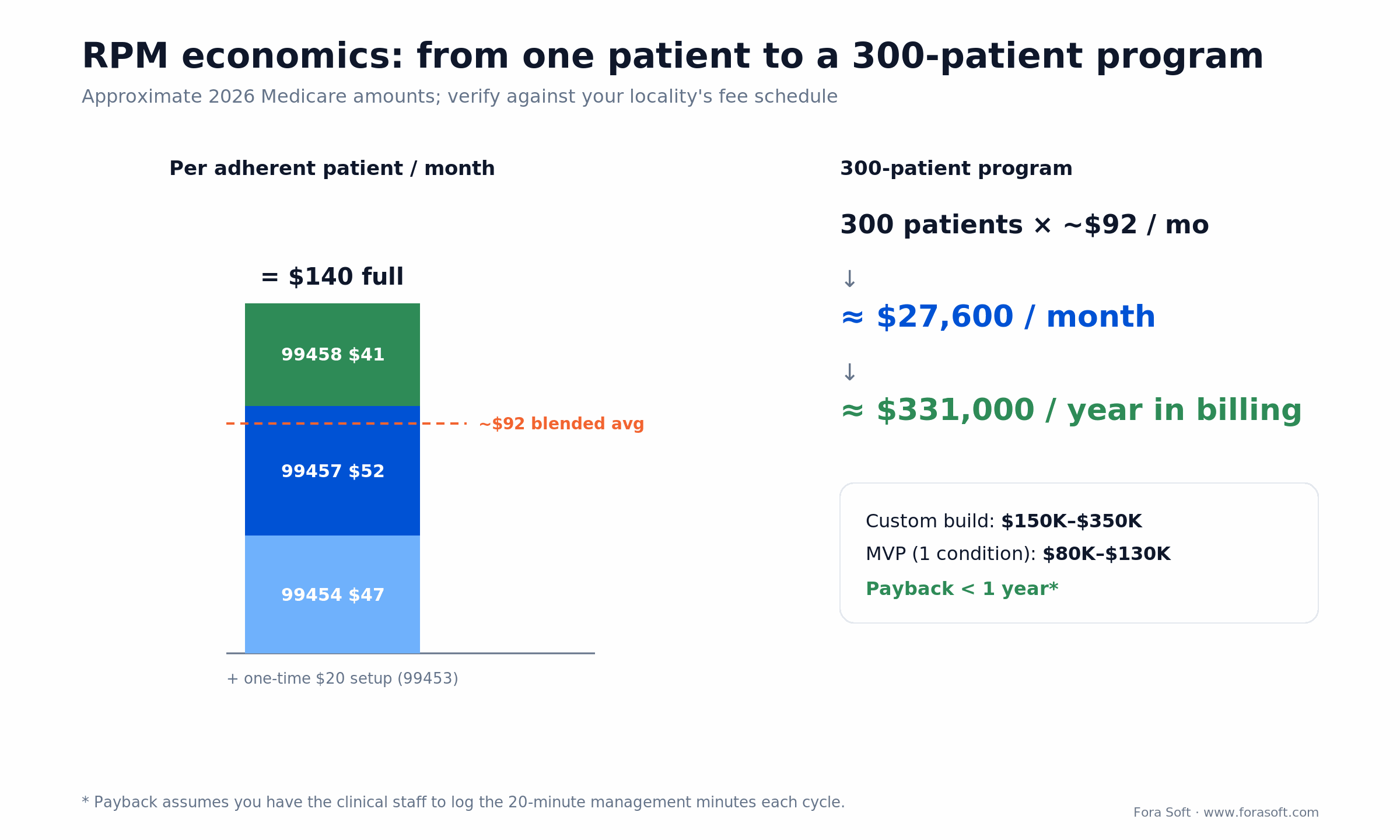
Figure 3. RPM economics: a per-patient monthly reimbursement stack, then a 300-patient program annualized against build cost.
Build, buy, or hybrid
The honest answer for most programs is hybrid: buy the commodity layers, build the differentiators. Buy a managed FHIR store and a device aggregator under ~5,000 patients; build your alerting, per-patient thresholds, reimbursement automation, and clinician UX, because that’s where your program actually competes. Full custom, including direct device integrations, earns its keep past scale, when aggregator fees and data-control needs tip the total cost the other way.
| Approach | Best for | Time to live | Where it breaks |
|---|---|---|---|
| Off-the-shelf | Pilots, <500 patients, commodity workflows | Weeks | No differentiation; per-patient fees scale badly |
| Hybrid (recommended) | 500–5,000 patients, custom alerting/billing | 2–4 months | Vendor lock-in on the bought layers |
| Full custom | >5,000 patients, data sovereignty, low latency | 4–8 months+ | Highest upfront cost; you own every integration |
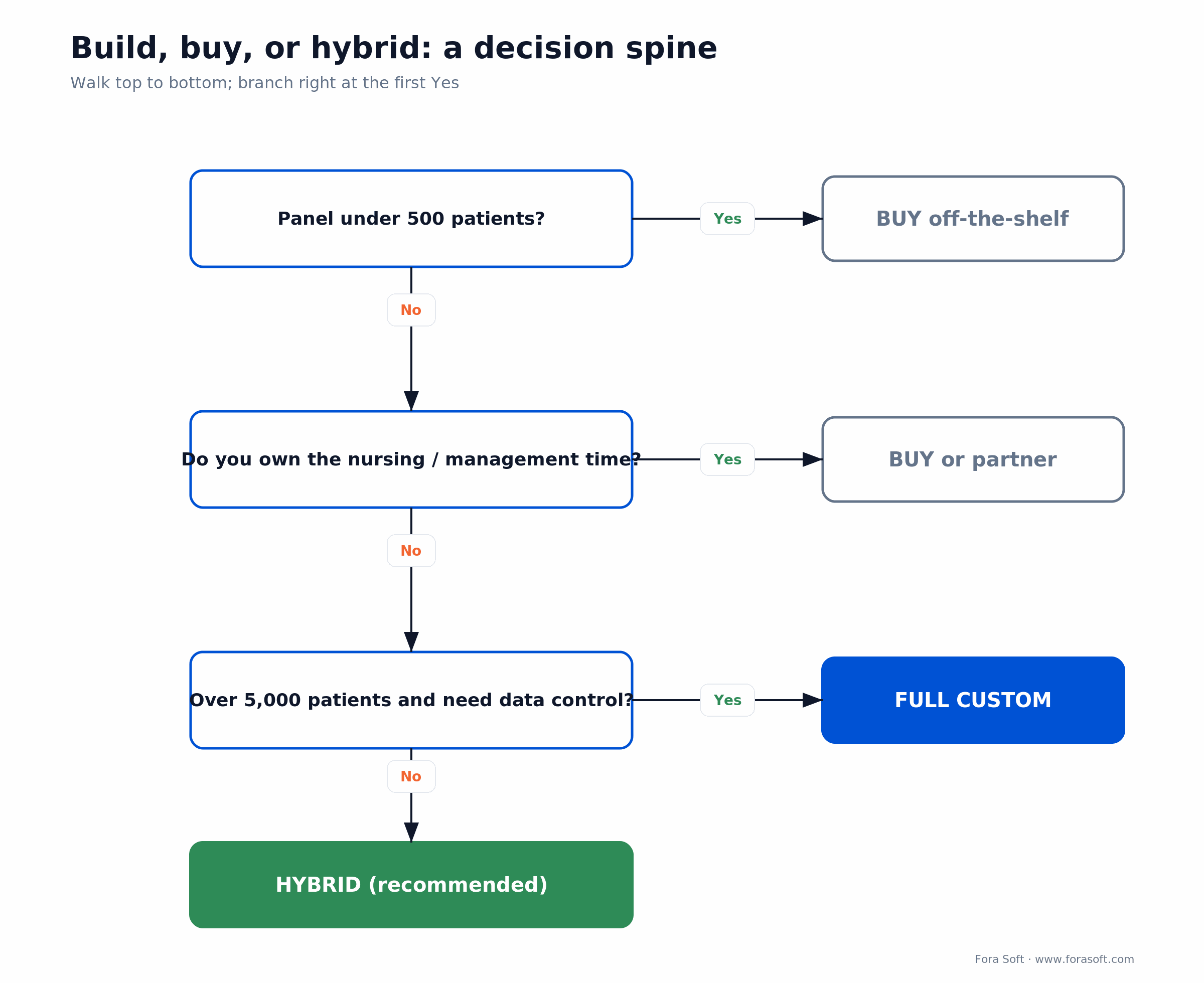
Figure 4. Build, buy, or hybrid, in three questions. Most programs land on hybrid: buy the commodity layers, build the differentiators.
Mini case: a HIPAA telehealth platform we shipped
Situation. A Nevada private practice wanted a “Netflix for medicine”: patients subscribe to their doctor for unlimited video visits and ongoing care, no per-visit fees, all inside one HIPAA-compliant browser app. They came through the InNEVator accelerator with a subscription model and a hard compliance bar, and no platform.
Plan. We built CirrusMED from scratch on WebRTC, React, Node.js, and AWS with a MongoDB record store: peer-to-peer video visits, 24/7 asynchronous messaging, an EMR tracking allergies, history, vitals, and prescriptions, plus lab and imaging orders and collaborative document sharing — the same integration and compliance spine an RPM platform needs.
Outcome. CirrusMED is licensed in 48+ US states with 20+ physicians on a Direct Primary Care subscription starting at $39 a month, serving patients nationwide from a single HIPAA-compliant system. The owner’s verdict: “All my requirements are taken care of. Highly recommended!” Want a similar assessment of your RPM or telehealth build? Book a 30-minute call and we’ll map it with you.
A decision framework in five questions
1. Do you own the nursing relationship? The margin comes from the 20-minute management codes. If a third party owns the chronic-care nursing time, those codes go unbilled and no software fixes it. Own it, or partner tightly, before you build.
2. How big is the panel? Under ~500 patients, buy. Between 500 and 5,000, go hybrid. Past 5,000, direct integrations and full custom start to pay.
3. Which conditions? RPM rewards conditions that benefit from daily readings — hypertension, heart failure, diabetes, COPD. If your population doesn’t need daily data, the reimbursement and the outcomes both thin out.
4. Cellular or Bluetooth population? Skew 65+ or low-tech, and cellular devices are the adherence strategy that clears 16 days. Younger and tech-comfortable, and Bluetooth saves money.
5. How custom are your workflows? Commodity workflows on a tight timeline: buy. Differentiated alerting, billing automation, or clinician UX: build those pieces and buy the rest.
Five pitfalls that sink RPM builds
1. Building the billing engine last. Teams ship monitoring, then discover the reimbursement logic is a rewrite because day-counting and minute-tracking weren’t in the data model. Build it first; it’s the revenue.
2. Population thresholds instead of per-patient baselines. One global alert rule pages clinicians for readings that are normal for that patient. Two weeks of that and nobody reads the feed. Baseline per patient.
3. No adherence engine for the 16-day cliff. Without cellular devices or nudges, half your panel misses 16 days and bills nothing under 99454. The new 99445 softens it, but adherence is still the whole ballgame.
4. FHIR version mismatch. Building to R5 because it’s newest, then hitting an EHR that speaks R4, is a painful surprise late in integration. Target R4 for production write-back, stay version-tolerant.
5. Treating wearables as billable devices. A smartwatch is context, not a 99454 device. Anchor billing to an FDA-cleared monitor, and know exactly when a smart feature pushes you across the FDA device line.
KPIs that matter
Clinical quality. Percentage of patients clearing 16 days each cycle, median alert-acknowledgment time, and 30-day readmission rate for the monitored cohort. These prove the program works and keep clinicians trusting the feed.
Business. Realized dollars per patient per month, enrollment and 90-day retention, and clean-claim rate. If realized revenue drifts far below the ~$92 blended benchmark, your adherence or your minute-capture is leaking.
Reliability. Device sync-success rate, data-transmission latency, and platform uptime. A reading that never arrives is a missed billing day and a clinical blind spot at once, so treat sync failures as incidents, not noise.
When NOT to build custom RPM
Honesty sells better than hype, so here are the cases where a custom build is the wrong call. If your panel is under a few hundred patients, the build cost and run-rate outweigh the reimbursement — an off-the-shelf platform or an aggregator plus a thin layer ships in weeks and de-risks the pilot. If you don’t own the nursing time, the management codes go unbilled and custom software won’t change that math.
If your workflows are commodity and your timeline is tight, buy and launch, then revisit custom once volume justifies it. And if you have no cellular or adherence plan for a low-tech population, fix that before writing code, because no amount of clean architecture clears the 16-day bar for a patient who never takes a reading. For almost everyone, the right first move is hybrid: buy the commodity layers, build only the differentiators.
Want a second opinion before you commit budget?
We’ll pressure-test your build-vs-buy call, the billable codes, and the compliance surface — and tell you honestly if you shouldn’t build.
FAQ
What is a remote patient monitoring platform, and how is it different from telemedicine?
An RPM platform collects physiologic device data (blood pressure, weight, glucose, pulse oximetry, heart rhythm) from a patient at home, transmits it automatically to a clinical system, and turns it into billable, actionable data. Telemedicine is the synchronous video visit; RPM is the always-on data stream between visits. Mature programs run both, often in one codebase.
How much does it cost to develop custom RPM software in 2026?
A production-ready custom RPM platform typically runs about $150,000 to $350,000, and a single-condition MVP around $80,000 to $130,000 over 4 to 5 months. The number swings with device mix, aggregator vs direct integration, and EHR write-back scope. We usually scope tighter by reusing HIPAA telehealth foundations.
What are the RPM CPT codes for 2026, including the new ones?
The core codes are 99453 (setup, ~$20), 99454 (device supply, 16+ days, ~$47–$52), 99457 (first 20 min, ~$52), and 99458 (each additional 20 min, ~$41). Effective January 1, 2026, CMS added 99445 (device supply for 2–15 days, same rate as 99454) and 99470 (10–19 minutes of management, ~$26). Exact pay is RVU times the $33.40 conversion factor times your geographic index.
What is the 16-day rule, and did it change in 2026?
To bill 99454, a patient’s device must collect data on at least 16 days within a 30-day period. That rule still stands in 2026. What changed is that CMS added 99445 for shorter 2–15 day spans, so partially-adherent patients are no longer a total loss. The 16-day minimum does not apply to the management codes (99457/99458).
When does the FDA regulate RPM software as a medical device?
When the software does more than display and trend data. Displaying readings and notifying a clinician usually sits in enforcement discretion or Class I. A closed loop that drives a clinical action (for example, auto-titrating a therapy) is generally Class II Software as a Medical Device and needs a 510(k). Keeping alerts advisory with a human in the loop keeps you on the light-regulation side.
What does an RPM platform need to be HIPAA compliant?
Implement the five technical safeguards under 45 CFR 164.312: access control, audit controls, integrity, authentication, and transmission security. In practice that means role-based access with unique IDs, exportable audit logs, MFA, and encryption (TLS 1.2+ in transit, AES-256 at rest). You also need signed Business Associate Agreements with every vendor touching ePHI, and six-year documentation retention.
How does RPM data integrate with Epic and Oracle Health via FHIR?
Each reading maps to an HL7 FHIR Observation with a LOINC code, tied to Device and CarePlan resources, then writes back to the EHR over FHIR or an HL7v2 ORU feed. Build to FHIR R4 for production, since Epic, Oracle Health, and US Core still run predominantly on R4 in 2026, even though R5 is published and R6 is in ballot.
Should we build custom RPM or buy an off-the-shelf platform?
Under ~500 patients or on a tight timeline with commodity workflows, buy. Above that, go hybrid: buy the managed FHIR store and device aggregator, build your alerting, per-patient thresholds, and reimbursement automation. Full custom, including direct device integrations, pays off past roughly 5,000 patients or when data sovereignty and latency demand it.
What to read next
Telemedicine
Telemedicine Platform Development 2026
The synchronous half of the stack: video visits, architecture, and compliance.
Compliance
HIPAA & SOC 2 for Telehealth Platforms
The compliance spine every RPM and telehealth build sits on.
Decision
Build vs Buy: A Decision Framework
The same logic that decides aggregator vs direct device integration.
Estimation
CTO’s Software Project Estimation Guide
How we turn a vague RPM scope into a defensible number.
Healthcare
Virtual Patient Observation & Telesitting
Another remote-care pattern where video and alerting meet compliance.
Ready to ship RPM that pays for itself?
Remote patient monitoring platform development rewards teams who treat it as a reimbursement product with a clinical brain, not a dashboard with a login. Design to six layers, build the billing engine first, know all six 2026 CPT codes, keep alerts advisory to stay on the light side of the FDA line, and bake HIPAA’s five safeguards into the architecture instead of bolting them on.
Then make the honest call: buy the commodity layers, build the differentiators, and go full custom only when scale earns it. We’ve done the HIPAA integrations, the EHR write-backs, and the compliance reviews on real healthcare platforms. If you want a partner who’ll tell you the truth about your build — including when not to — let’s talk.
Let’s build your RPM platform
Architecture, 2026 reimbursement, HIPAA, and a realistic timeline — mapped to your patients and your EHR in one call.