

Key takeaways
• Telemedicine platform development in 2026 is a known-architecture problem. Reimbursement is settled, the FHIR/SMART integration path is standard, and the video stack is a build-vs-buy decision. The risk moved from “can we build it” to “did we scope compliance and EHR depth correctly.”
• HIPAA and SOC 2 are contract table-stakes, not features. Hospital systems and payers won’t sign without them. Design encryption, MFA, audit logging and the BAA chain into the first commit; retrofitting costs far more. Our companion HIPAA + SOC 2 guide covers the controls.
• FHIR R4 is what you integrate against today. R5 shipped in 2023 and R6 is in ballot in 2026, but production EHRs still expose R4 through SMART on FHIR. Build for R4 first, keep R5 in view. Skipping FHIR makes you uncompetitive at enterprise sales.
• A HIPAA-grade MVP is roughly 71 person-weeks, about 5–7 months. Discovery, patient app, clinician portal with EHR, video, scheduling and billing, with compliance running in parallel. AI scribe is usually a v2 add-on of another ~10 person-weeks.
• AI scribe is the 2026 adoption driver. Ambient documentation drafts the SOAP note from the consult so clinicians stop typing after hours. Keep the whole pipeline inside the BAA boundary: the OpenAI Realtime audio modality still isn’t BAA-covered.
Why Fora Soft wrote this playbook
We build video and real-time healthcare products, and have since 2005 — 250+ projects, a 50-engineer in-house team, and HIPAA-grade builds like CirrusMED (a “Netflix for Medicine” direct-primary-care platform now licensed in 48+ US states), TransLinguist (medical video interpretation), and a Hospital Phone Interpreter used across clinical settings. That’s the vantage point this guide is written from.
This is the architecture-and-cost playbook, not a brochure. If you want the commercial version, our telemedicine development services page has the engagement model. Here we stay on the build: the reference architecture, the EHR integration reality, the video-stack trade-offs, the compliance floor, and a bottom-up MVP cost model you can defend to a board.
Who it’s for: a founder raising a round, a hospital COO building patient portals, or an insurance product lead adding video consults. Every section is meant to move a real decision forward, and we call out where each option breaks, not just where it wins.
What telemedicine platform development actually means in 2026
Telemedicine platform development is the work of building a system where patients and clinicians meet over secure video, and where the clinical data around that visit (identity, records, notes, prescriptions, billing) flows correctly between your app and the electronic health record (EHR). A telehealth “app” is the visit. A telemedicine platform is the visit plus scheduling, documentation, e-prescribing, reimbursement, audit, and the compliance envelope that lets a hospital put its name next to yours.
Concretely, a platform is seven layers: patient and clinician front-ends; an identity and access layer; application services; a real-time consult layer; an integration plane that speaks FHIR and HL7 to EHRs; encrypted storage; and an audit trail — all sitting under one Business Associate Agreement (BAA) umbrella that covers every vendor touching protected health information (PHI). Get those seven right and the product scales. Miss the compliance envelope and you can’t sell to the buyers who pay the most.
What changed for telehealth builders in 2026
Demand keeps outrunning supply. The telemedicine market was about $141 billion in 2024 and is projected to reach $380 billion by 2030, roughly a 17.5% compound annual rate (Grand View Research, 2024), while the US faces a projected shortfall of up to 86,000 physicians by 2036 (AAMC, 2024). Video care is now how the system absorbs demand it cannot staff, which is why platform quality, not novelty, decides who wins.
Medicare telehealth flexibilities run through the end of 2027. After a stopgap that lapsed at the end of January 2026, the FY2026 package extended the pandemic-era Medicare flexibilities through December 31, 2027. On the commercial side, most states hold payment parity for synchronous video, and behavioural health is treated favourably. See the CMS telehealth coverage page for the current policy.
The HIPAA Security Rule is being tightened — but it’s still a proposal. The Office for Civil Rights published a Notice of Proposed Rulemaking on January 6, 2025 that would move controls like encryption-at-rest, MFA and asset inventory from “addressable” to explicitly required. The comment period closed in March 2025 and the rule is not final as of mid-2026. Build to the proposed bar anyway: it’s where enforcement is heading, and it’s good hygiene regardless.
Interoperability rules have teeth. ONC’s HTI-1 final rule took effect in March 2024, and USCDI v3 is the certification-program data floor as of January 2026. That’s why every serious EHR now exposes patient data over FHIR — the regulation forces the door open for your platform.
AI scribe went mainstream. Abridge raised a $300M round in mid-2025 at a $5.3B valuation; Microsoft folded Nuance DAX into “Dragon Copilot” in March 2025; Suki and others are in production at hospital systems. Ambient documentation is now the feature clinicians ask for by name.
The video-SDK market reshuffled — and a myth needs killing. Twilio announced then reversed the end-of-life for Programmable Video (October 2024), so it remains a live option; don’t plan a panic migration off it. Meanwhile Amazon retired the Chime application in February 2026, but the Chime SDK is unaffected and remains a strong BAA-covered choice. Names matter here.
Need a telemedicine architecture review?
Send us your spec, target patient volume and EHR integration needs. We’ll return a one-page reference architecture and a scoped MVP plan — free.
A reference architecture for a telemedicine platform
Here’s the shape almost every serious build converges on. Read it top to bottom: requests and PHI flow down from the apps, through identity, into services and the video layer, out to the EHR via the integration plane, and into encrypted storage and the audit log. One BAA umbrella covers the lot.
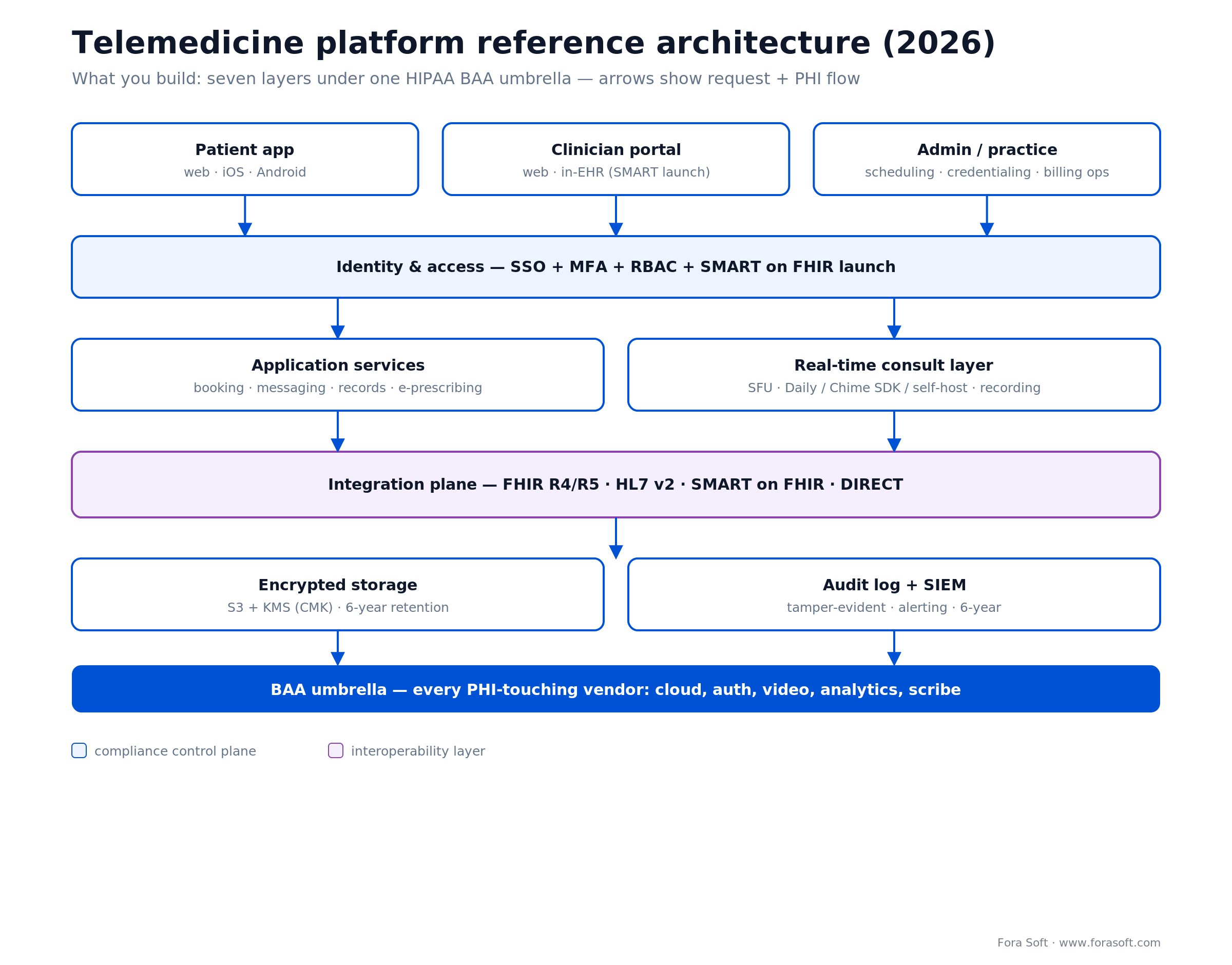
Figure 1. The seven layers of a telemedicine platform, with request and PHI flow, under one BAA umbrella.
The two layers teams under-scope are identity and audit. Identity is where SMART on FHIR launches live, where role-based access control decides who sees which PHI, and where MFA gets enforced. Audit is the boring layer that turns a breach into a footnote instead of a lawsuit: tamper-evident, append-only, retained for six years, with alerting on unusual access. Neither is glamorous. Both are the difference between passing an enterprise security review and losing the deal.
FHIR, HL7 and SMART on FHIR: EHR integration in practice
EHR integration is where telemedicine platform development gets real, so define terms before the acronyms pile up.
FHIR (Fast Healthcare Interoperability Resources) is the modern standard for exchanging health data as web resources — Patient, Encounter, Observation, Condition, MedicationRequest, DocumentReference. Your platform reads and writes these against the EHR. The version reality: R4 is what EHRs expose in production today; R5 is the current published release (2023); R6 is balloting in 2026. Build against R4, structure your code so R5 is a swap, not a rewrite. The HL7 FHIR specification is the source of truth, and ONC tracks adoption on HealthIT.gov.
HL7 v2 is the older pipe-delimited standard, and it’s not going anywhere. Admit/discharge/transfer, orders and results, scheduling — a lot of billing and lab traffic still moves as v2 messages. You’ll speak both, even when FHIR is available.
SMART on FHIR is the auth and launch pattern: an OAuth 2.0 / OpenID Connect flow that opens your app inside the EHR’s patient context with a token scoped to that patient’s data. Epic (through its developer program, now branded Showroom rather than App Orchard), Oracle Health/Cerner, and athenahealth all support it. DIRECT secure messaging handles cross-organisation referrals and care summaries.
The honest caveat: a single-site SMART integration is a few months of work; a full marketplace listing (Epic, Oracle Health) is a longer certification road. Most startups do single-site first and list later. If your first customer is one hospital, you don’t need the marketplace on day one.
The video stack: SFU, BAA-covered SDKs, recording
Two-party consults are technically easy; the hard parts are the BAA, recording as PHI, and cost at scale. Nearly every telehealth build routes media through a Selective Forwarding Unit (SFU) rather than mixing server-side. If you want the fundamentals, our primer on how digital video works explains the encoding layer underneath. The choice that matters is who runs the SFU and who signs the BAA.
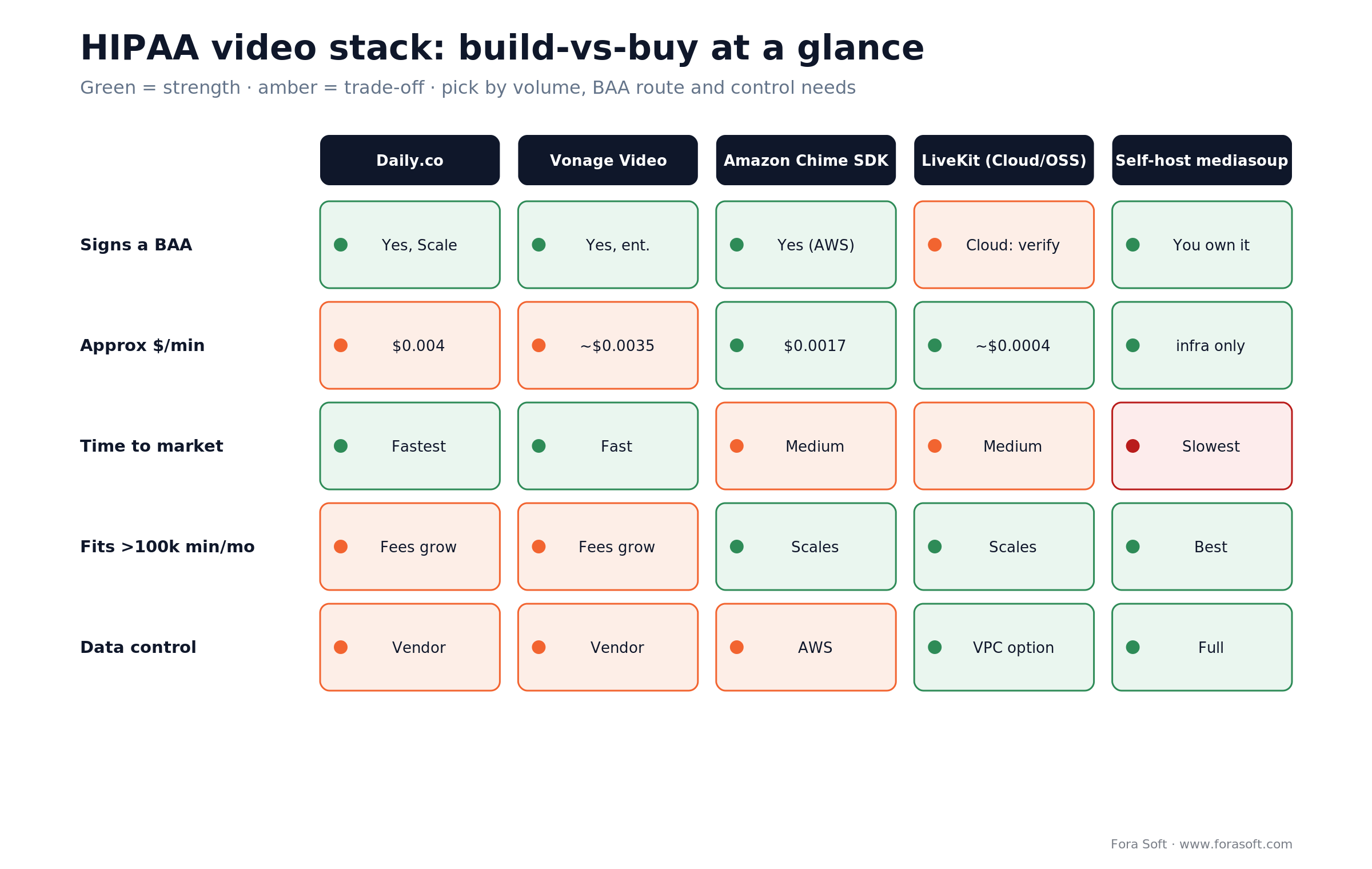
Figure 2. HIPAA video options at a glance — green is a strength, amber is a trade-off. Pick by volume, BAA route and control needs.
| Option | BAA route | Approx cost | Best fit | Where it breaks |
|---|---|---|---|---|
| Daily.co | Signs BAA (paid HIPAA add-on) | ~$0.004/participant-min | Fastest MVP, clean SDKs | Per-minute fees grow past ~100k min/mo |
| Vonage Video | Enterprise BAA | ~$0.0035/min | Teams with OpenTok history | Legacy OpenTok in maintenance mode |
| Amazon Chime SDK | BAA via AWS | ~$0.0017/attendee-min | Already on AWS, want scale | More wiring than a turnkey SDK |
| LiveKit (Cloud / OSS) | Cloud: verify tier; OSS: you own it | from ~$0.0004/min or infra | Scale with a migration path | Self-host adds ops burden |
| Self-host mediasoup | You own the deployment | Infrastructure only | >100k min/mo, strict residency | Slowest to build; you carry SRE |
Reach for a BAA-covered SDK when: you’re below ~100k video minutes a month, time-to-market is the priority, and you’d rather pay per minute than run media servers. Daily.co or Amazon Chime SDK get you consulting in weeks.
Reach for self-hosted media when: you’re past ~100k minutes a month where SDK fees dominate, an enterprise contract demands customer-managed keys or data residency, or you need bespoke transport behaviour. LiveKit OSS or mediasoup in your own VPC removes the third-party media BAA entirely.
Recording is where teams get surprised. Every recording is PHI: encrypted at rest with customer-managed keys, six-year retention minimum, an audit entry on every access. The recording and storage path is often more work than the live consult. Budget for it up front.
Patient, clinician and admin: three products in one platform
Patient app. High volume, infrequent sessions, mobile-first, on the public internet, zero patience for friction. Its non-functional requirements: sub-3-second load on 4G, one-tap join, MFA by SMS or authenticator, WCAG 2.2 AA accessibility, and graceful behaviour on poor coverage. For a worked treatment of NFRs, see our non-functional requirements checklist.
Clinician portal. Lower volume, longer sessions, desktop-first, frequently launched inside the EHR via SMART. It tolerates dense clinical UI and demands the opposite of the patient app: fast patient switching, sub-second EHR fetches, an integrated note editor, AI scribe, and prescription routing.
Admin / practice console. The one teams forget. Scheduling templates, provider credentialing, billing operations, reporting. Low volume, operationally critical — the practice can’t run without it. Scope it in the MVP or you’ll bolt it on painfully later.
AI scribe and ambient documentation
AI scribe is the feature that drives clinician adoption right now, because it attacks the after-hours “pyjama time” that burns physicians out. The pattern: capture consult audio, transcribe with a HIPAA-eligible speech service, have a text model draft the SOAP note and suggested billing codes, and put the clinician in the loop to review and sign. Nothing reaches the chart unsigned.

Figure 3. A HIPAA-safe ambient documentation pipeline — every stage stays inside the BAA boundary and the clinician signs before write-back.
Buy or build? Abridge, Suki and Microsoft’s Dragon Copilot (the former Nuance DAX) are mature and integrate with major EHRs. Building your own is viable on HIPAA-eligible parts: Azure OpenAI text endpoints under a BAA, plus Azure Speech, AWS Transcribe Medical or Google Cloud speech-to-text. Build when the scribe is your differentiator; buy when it’s a checkbox.
Reach for a chained scribe pipeline when: any PHI audio is involved — which is always. The OpenAI Realtime audio modality isn’t BAA-covered in 2026, so chain a HIPAA speech-to-text service, a text LLM and text-to-speech instead. Our OpenAI Realtime production guide explains the boundary in detail.
Security and HIPAA compliance in 2026
Compliance is an architecture decision, not a late audit. The controls that matter, and that enterprise reviewers actually check:
1. Encryption everywhere, with your keys. TLS in transit, AES-256 at rest, customer-managed KMS keys for anything storing PHI — recordings especially. Under the proposed Security Rule update, encryption stops being “addressable” and becomes expected; build it in now.
2. Identity, MFA and least privilege. MFA on every account touching PHI, role-based access so a scheduler can’t read clinical notes, and short-lived scoped tokens from the SMART flow. Access is the most-audited surface you have.
3. Audit logging that survives scrutiny. Append-only, tamper-evident, six-year retention, alerting on anomalous access. When something goes wrong, the audit log is what turns an incident into a contained event.
4. The BAA chain. Every vendor that can see PHI (cloud, auth, video, analytics, scribe) needs a signed BAA. One uncovered vendor breaks the chain. SOC 2 Type 2 usually rides alongside because payers and hospitals ask for both; the mechanics are in our HIPAA and SOC 2 platform guide.
Reimbursement and billing integration
Coding. Synchronous video visits bill on the standard evaluation-and-management codes (99202–99205 for new patients, 99211–99215 for established ones) with modifier 95 for real-time audio-video. Modifier 93 covers audio-only. Place of service 10 flags the patient at home. (The old 99201 code was deleted in 2021; if a vendor’s docs still show it, that tells you something.)
Between visits. Device-based monitoring bills on its own code family rather than the E/M ladder: 99453 (setup), 99454 (device supply), 99457 and 99458 (management time), plus 99445 and 99470, which CMS added on January 1, 2026. Those thresholds behave like a state machine — 16 qualifying reading days in 30, then 20-minute blocks of clinical time — so the logic belongs in the platform, not a spreadsheet. Our remote patient monitoring platform development guide works through all six codes and the device layer behind them.
Eligibility. Verify insurance in real time before the visit through a clearinghouse such as Change Healthcare or Availity. A failed check means self-pay or a reschedule — handle it in the flow, not after the fact.
Claims. Most MVPs hand claims to an existing practice-management system rather than submitting 837P themselves. Direct submission is possible but rarely first-release scope.
Self-pay. Stripe or Square at booking, with a refund path on cancellation. For cash-pay specialties like mental health and dermatology, this is often the primary flow, not the fallback.
Licensure and controlled substances. A clinician must hold a license in the state where the patient is physically located, so multi-state platforms map patient location to provider licensure at booking. The Interstate Medical Licensure Compact (44 states plus DC and Guam in 2026) speeds licensing but does not remove the rule, and it is exactly the state-by-state reality that CirrusMED’s 48-state footprint encodes. For controlled substances, the DEA and HHS extended tele-prescribing flexibilities through December 31, 2026, a bridge while permanent rules are written, so behavioural-health and e-prescribing flows can still begin a Schedule II–V prescription over video.
MVP cost and timeline
Ignore the round numbers you’ll see online — ranges from $75k to $300k tell you nothing without scope. Here’s the bottom-up version, in phases, with senior-engineering person-weeks you can challenge line by line.
| Phase | Weeks | Deliverables | Person-weeks |
|---|---|---|---|
| Discovery & architecture | 1–4 | Architecture, NFRs, EHR integration design, HIPAA gap assessment | 8 |
| Patient app | 5–14 | Web + iOS + Android: booking, consult, records | 22 |
| Clinician portal + EHR | 8–16 | Consult, SOAP notes, FHIR R4 read/write, SMART launch | 14 |
| Video + scheduling + billing | 10–20 | SFU integration, recording, reminders, PMS handoff | 21 |
| HIPAA controls (parallel) | All | Encryption, KMS, audit log, MFA, BAAs signed | 6 |
| Total | ~24 | ~71 person-weeks |

Figure 4. Bottom-up MVP effort: 8 + 22 + 14 + 21 + 6 = 71 person-weeks, roughly 5–7 months with a team of four.
Do the arithmetic out loud: 8 + 22 + 14 + 21 + 6 = 71 person-weeks. With a team of four that’s about 18 working weeks, so 5–7 calendar months once you allow for review cycles and EHR sandbox lead times. At typical blended senior rates that lands most HIPAA-grade MVPs in the low-to-mid six figures; the exact number is driven by EHR depth and video volume, not by a price list. We use Agent Engineering and pattern reuse from prior healthcare builds, which pulls the total toward the low end — and if a figure ever looks too clean, we’d rather scope it than quote it. For the estimation method behind numbers like these, see our CTO’s estimation guide.
Want a bottom-up estimate for your platform?
Tell us your target market, EHR list and volume. We’ll return a phased plan and person-week estimate you can defend to a board — free.
Build vs buy: four paths
BAA-covered SDKs (Daily, Chime SDK, Vonage). The fastest route: pre-built consent, recording and transcription, linear per-minute pricing. Right when scope is well-defined and volume is moderate.
Full-stack telehealth platforms (eVisit, Doxy.me, Mend). The cheapest way for a small practice to start consulting. White-label with little differentiation — the wrong choice if you’re building a product rather than running a clinic.
Custom on LiveKit OSS or mediasoup. Full control for vertical workflows, customer-managed keys, or volumes where SDK fees dominate. Some verticals rewrite the rules entirely; our veterinary telemedicine build is a good example, where the VCPR rather than HIPAA shapes the product.
Hybrid. Custom UI and EHR integration on top of a BAA-covered SDK — the common shape for a Series-A startup. Ship fast on a managed SDK, migrate the media layer to self-hosted at scale. Our build-vs-buy SDK framework goes deeper on the trade-off.
Reach for the hybrid path when: you need to be in-market this quarter but expect enterprise contracts within a year. Start on Daily.co or Chime SDK, keep the media layer abstracted, and migrate to self-hosted once volume or a customer-key requirement forces it.
When not to build a custom platform
Honesty sells better than a pitch, so here’s when custom is the wrong call. If you’re a single practice that just needs to see patients over video, buy Doxy.me or eVisit and be consulting tomorrow — a custom platform is a product decision, not a clinic decision.
If your differentiation is entirely clinical or operational and not in software, don’t sink a year into engineering; wrap an off-the-shelf platform and put your energy into the care model. And if you have no path to the compliance overhead — no security owner, no budget for pentests and a SOC 2 cycle — a half-built HIPAA platform is worse than a bought one, because it looks compliant without being it. Build custom when the software is the moat: a unique consult workflow, deep EHR integration, or volume where you own the media economics.
Mini-case: CirrusMED, a DPC telemedicine platform
The situation. CirrusMED came to us to build a “Netflix for Medicine” — a direct-primary-care platform where patients subscribe to a doctor instead of paying per visit. The model needed unlimited video consultations, 24/7 messaging, and an EMR, all inside one HIPAA-compliant, browser-based system, launched out of Nevada’s InNEVator accelerator.
The build. Peer-to-peer video consultations with recording; an EMR tracking allergies, history, vitals and prescriptions; subscription plans from $39/month alongside one-time consults; asynchronous messaging; lab and imaging orders; prescription management; and appointment scheduling with SMS and email reminders. Compliance was designed in from the start, not bolted on, because a subscription care model lives or dies on trust.
The outcome. CirrusMED runs a network of 20+ physicians serving patients on a subscription model, and is now licensed in 48+ US states with plans to reach all 50 — multi-state practice support baked into the platform. It’s the pattern we reuse: get identity, records and compliance right once, then scale the care model on top. Want a similar assessment? Book a 30-minute call.
A decision framework in five questions
1. Who’s the buyer — consumer, practice, or hospital system? Consumer means lighter compliance and a fast UI. Practice means practice-management integration is mandatory. Hospital means full FHIR, SMART on FHIR, SOC 2, HIPAA and multi-year contracts.
2. How deep is EHR integration? No EHR is the fastest MVP but the narrowest market. Read-only SMART launch reads patient context. Read/write is the longest build and the largest market.
3. What’s the 12-month volume? Under 100k minutes a month favours a BAA-covered SDK; 100k to 1M favours hybrid; past 1M favours self-hosted media.
4. Specialty or general practice? Specialties like mental health, dermatology and chronic care need workflow customisation; general practice sits closer to off-the-shelf.
5. AI scribe in the MVP or v2? Usually v2 — validate the core consult first. MVP-inclusive only when the scribe is the reason customers pick you.
Pitfalls to avoid
1. Treating compliance as a phase. Retrofitting encryption, MFA, audit and the BAA chain costs far more than designing them in. Start compliant.
2. Sending PHI audio to an uncovered endpoint. The OpenAI Realtime audio modality isn’t BAA-covered in 2026. Chain a HIPAA speech-to-text service, a text model and text-to-speech instead.
3. Planning a migration off Twilio Video that isn’t needed. Twilio reversed the Programmable Video end-of-life in October 2024. It’s a live option; don’t burn a sprint migrating on a rumour.
4. Building scheduling from scratch. Mature scheduling APIs exist — NexHealth, Mend and others. Build only when provider templates, multi-location routing or insurance pre-auth make your case genuinely unusual.
5. Forgetting accessibility. WCAG 2.2 AA is the floor, and Section 508 applies to US federal sales. Healthcare skews older; accessibility is a clinical requirement, not a nicety.
KPIs to measure
Quality KPIs. p95 consult connection time under 2.5 s; glass-to-glass latency under 1 s; EHR query response under 500 ms; audit-log delivery at 100 %.
Business KPIs. Consult completion above 95 %; no-show rate under 15 %; AI-scribe adoption above 70 % within 90 days; reimbursement-to-payment cycle under 30 days.
Reliability KPIs. 99.95 % availability during clinician hours, 99.9 % off-hours; recording integrity at 100 % capture with zero loss.
FAQ
How much does telemedicine platform development cost in 2026?
A HIPAA-grade MVP is roughly 71 person-weeks, about 5–7 months with a team of four, which at typical blended senior rates lands in the low-to-mid six figures. The real drivers are EHR integration depth and video volume, not a fixed price. Pattern reuse and Agent Engineering pull the number toward the low end.
What is SMART on FHIR, in one paragraph?
SMART on FHIR is an OAuth 2.0 and OpenID Connect pattern that launches your app inside the EHR’s patient context. A clinician clicks a button in the EHR, your app opens with a token scoped to the current patient, and you read and write data over FHIR. It’s the standard EHR-integration pattern for telemedicine.
FHIR R4 or R5 — which do we build for?
Build for R4. It’s the version production EHRs expose today. R5 is the current published release (2023) and R6 is balloting in 2026, but neither is what you integrate against yet. Structure your data layer so moving to R5 is a swap rather than a rewrite.
Is Twilio Programmable Video really being shut down?
No. Twilio announced an end-of-life and then reversed it in October 2024, so Programmable Video remains a supported product. Separately, Amazon retired the Chime application in February 2026, but the Chime SDK is unaffected and stays a strong BAA-covered option. Don’t plan migrations on the older rumours.
Can we use OpenAI Realtime for an AI scribe?
Not for PHI audio. The OpenAI Realtime audio modality isn’t BAA-covered in 2026. Chain a HIPAA-eligible speech-to-text service (Azure Speech, AWS Transcribe Medical) with Azure OpenAI text endpoints and, if needed, text-to-speech. Our OpenAI Realtime production guide walks through the boundary.
How does telehealth reimbursement work now?
Medicare telehealth flexibilities are extended through December 31, 2027, and most states hold parity for synchronous video. Bill on 99202–99215 with modifier 95 for audio-video (modifier 93 for audio-only) and place-of-service 10 for the patient’s home. State-by-state rules vary, so bring a revenue-cycle expert into scoping.
Do we need to build the full mobile app first?
Usually not. For the patient side, a mobile-first web app avoids app-store friction and validates usage fastest; add native iOS, then Android, once web mobile traffic justifies it. The clinician portal and admin console are web-only. Build the native apps after the web experience proves demand.
DIY EHR integration or hire a specialist?
A strong team can do SMART on FHIR auth and basic FHIR read/write in-house. Marketplace listings (Epic, Oracle Health) and edge cases on legacy EHRs are where a specialist saves months. Integration-as-a-service vendors like Redox, Particle Health and Health Gorilla help when you face many non-FHIR-mature EHRs.
What to read next
Compliance
HIPAA + SOC 2 for telehealth
The compliance architecture in full detail.
Architecture
Build vs buy a video SDK
Daily, Chime SDK, LiveKit and self-host compared.
Voice AI
OpenAI Realtime in production
Why the audio modality isn’t BAA-covered yet.
NFR
The NFR checklist
A worked telehealth non-functional spec.
Estimation
CTO’s estimation guide
How we turn scope into defensible numbers.
Ready to ship a 2026-grade telemedicine platform?
The architecture is settled: seven layers under one BAA umbrella, FHIR R4 through SMART on FHIR for the EHR, a video stack chosen by volume and BAA route, and AI scribe kept inside the compliance boundary. Reimbursement runs through 2027, the Security Rule is tightening, and the buyers who pay most want HIPAA and SOC 2 before they’ll sign.
A HIPAA-grade MVP is about 71 person-weeks and 5–7 months. AI scribe is a v2 add-on unless it’s your differentiator. EHR depth sets your addressable market: single-site SMART is the entry bar, a marketplace listing is the enterprise step. Scope compliance and integration correctly and the rest is execution.
Let’s scope your telemedicine build
Send us your spec, target market and EHR list. You’ll get a reference architecture, an integration plan and a person-week estimate — free, within a couple of days.