

Key takeaways
• A fan engagement platform is a media company in your pocket, not a ticketing app. Streaming, docu-content, gamification, commerce, community, loyalty and overlays sit in one product. The sports fan-engagement platform market is already worth $4.8B (2025) and is forecast to hit $13.2B by 2034 (Dataintelo).
• Three build paths, and the money is in the middle. Vendor SDK stitch-up ($250–600k, 4–6 months, recurring fees), hybrid ($400k–1M, 5–8 months, full UX control), or custom ($900k–2.5M, 8–14 months, full IP). Top-flight clubs land on custom; everyone else should start hybrid.
• Streaming is the anchor; engagement is the moat. Live games drive the install peaks, but the other six features drive the session minutes between matches. Ship sub-3-second latency (WebRTC 200–500 ms, LL-HLS 2–4 s) so overlays and any betting stay in sync.
• Fan tokens are now a hard-gated feature, not a growth hack. MiCA’s transitional grace period expired on 1 July 2026; only 244 crypto-asset service providers are authorised EU-wide, and Socios (Chiliz) is the only licensed sports platform. Build the wallet dark behind a flag; ship non-token loyalty first.
• The differentiator is interactive overlays, not the raw feed. We built the engineering behind StreamLayer (NBC, CBS, Red Bull, Chelsea FC), where interactive viewers watch 33% longer and operators report 60–100% revenue uplift over basic ad breaks. Those operator-side patterns are what this playbook re-uses.
Why Fora Soft wrote this playbook
Fora Soft has built video and real-time platforms since 2005 — 250+ projects, 50 in-house engineers, a 100% Upwork success rate. We are not writing this from the outside. We built the engineering behind StreamLayer, the interactive layer that lights up live sports for NBC, CBS, Red Bull, Live Nation, Chelsea FC, Coca-Cola and Sony Music, and that powered live engagement at Lollapalooza and Jay-Z’s Made In America festival. The surface area of a fan app — live-feed sync, overlays, prediction games, sponsor activations, shoppable moments, rights enforcement — is the same operator-side spine we shipped there.
We have also shipped Mangomolo (an OTT platform doing 1B+ streams a month for Discovery MENA, Dubai Media and SABC+, where we built the Wowza SCTE-35 ad-insertion module), WatchFun (a Solana Web3 raffle platform with provably-fair on-chain draws, which is why we treat “fan tokens” as an engineering-plus-compliance problem, not a slide), and an Australian sports-broadcasting app that syncs sub-second live audio to the video feed for thousands of concurrent listeners on LiveKit.
If you are a club director of digital, a league strategist, a sponsorship rights-holder or a sports-media operator deciding whether to commission a fan app, this guide gives you the seven-feature stack, the reference architecture, the honest cost model, the 2026 compliance traps, and the vendor comparison we use with our own clients.
Want a fan-app blueprint mapped to your rights and sponsors?
Send your brief — competition, fan size, rights status, sponsorship goals. We’ll come back within 48 hours with a feature map, a vendor short-list and a delivery plan. The 30-minute call is free.
Why teams are now their own media companies
Three structural shifts moved sports teams from broadcast licensees to direct-to-fan publishers. Line them up and a serious fan engagement platform stops being a marketing slide and becomes a P&L decision. The wider fan-engagement market grew from $8.09B in 2025 to a forecast $9.79B in 2026 (The Business Research Company), and the money is chasing owned audiences.
1. Rights have unbundled. Linear deals still anchor top-flight football and the major US leagues, but secondary windows — training, press conferences, academy, women’s competitions, archive — increasingly sit with clubs and federations. Those windows have no broadcaster and need an owned surface to monetise.
2. First-party data is the asset now. GDPR, Apple’s App Tracking Transparency and the slow death of third-party cookies made logged-in app data the only reliable way to reach fans again. A team without a logged-in app is renting access to its own audience from Meta, Google and TikTok.
3. Sponsors demand digital activation. Shirt-front money still pays the bills, but every renewal now carves out digital inventory: branded predictions, sponsored polls, in-app drops, AR overlays. Second-screen advertising and sponsorship is forecast to hold a 36% share of the $3.5B second-screen sports-app market in 2026 (Fact.MR). Without an app you cannot deliver, measure or invoice that activation.
The seven features of a 2026 fan app
Across the dozen-plus team and federation apps we have audited or shipped engineering for, the same seven features keep showing up. Skip any and the app becomes either a glorified ticket portal or a player nobody opens between match days. Ship all seven and daily session minutes triple between match weeks. Here is the whole stack on one page before we walk through each layer.

Figure 1. The seven-feature stack. Streaming is the match-day anchor that drives installs; the other six drive the session minutes between games.
They are listed in implementation priority — what we build first, what we build last, and which features are safe to defer to a vendor SDK.
Feature 1 — Live streaming with paywalls and rights
Live streaming is the anchor. It is why fans install; it is the spike that lets every other feature acquire users for free; and it is where the engineering bar is highest. A 2026 streaming layer ships on three pillars: a low-latency delivery stack, a per-fan entitlements service (paywall, season pass, sponsor overrides, blackout rules), and a rights-enforcement layer that geofences each match per its broadcast deal.
How low does latency need to go?
Low enough that a “vote on the next corner” prediction resolves before the corner is taken. A 30-second HLS lag turns that into a post-mortem. The protocol you pick sets the ceiling: WebRTC lands at 200–500 ms, SRT at 1–2 s, Low-Latency HLS at 2–4 s, and legacy RTMP at 3–5 s. Anything above 10 seconds is a spoiler risk from social feeds and second screens, and sub-3-second streams retain viewers 2–3x longer than 7–9-second delays. We default to WHIP/WHEP-based WebRTC for premium tiers and LL-HLS for mass distribution.
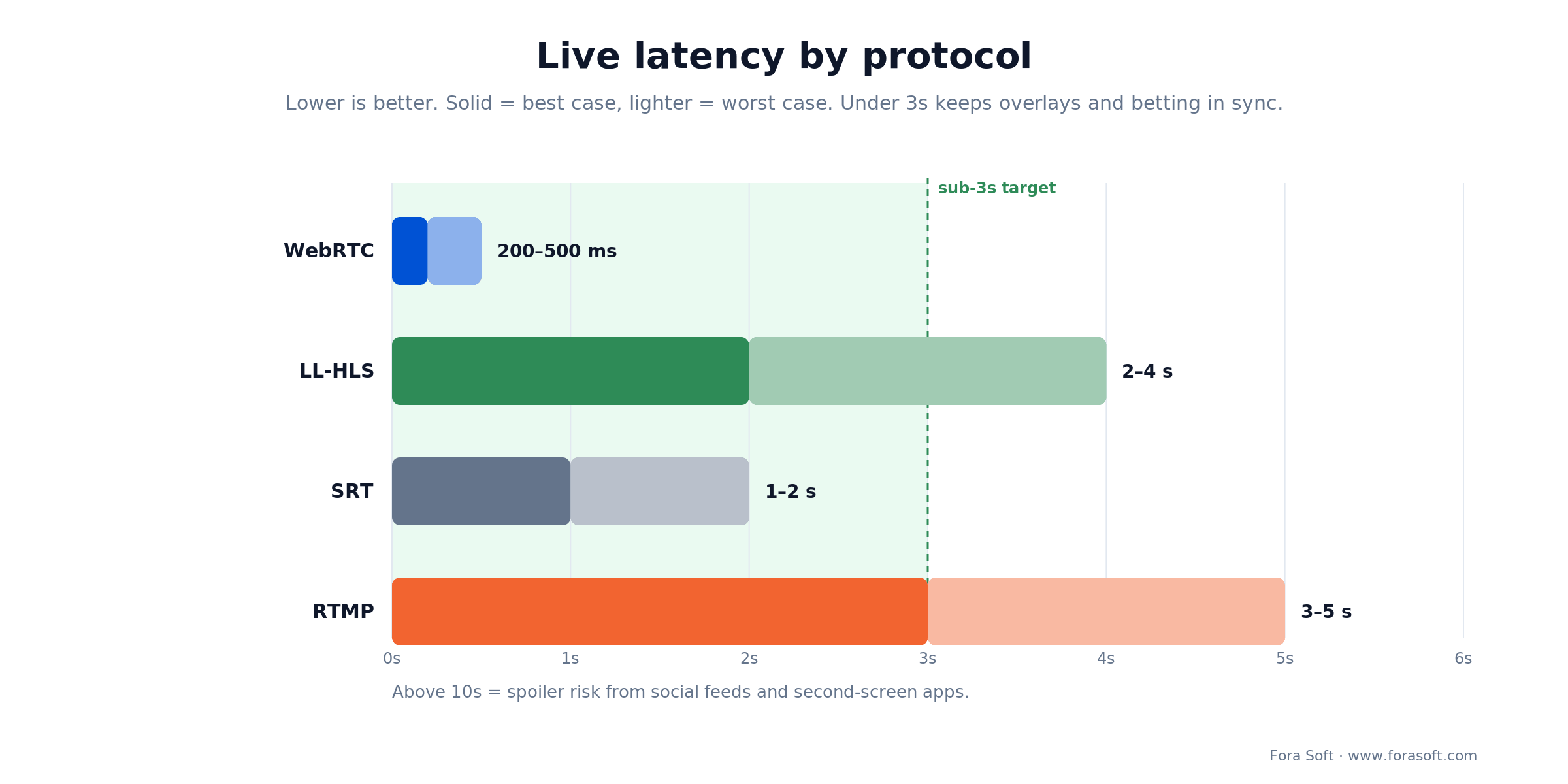
Figure 2. Latency by protocol, anchored to zero. Under 3 seconds keeps overlays, predictions and in-play betting in sync with the play.
WHIP is now a published IETF standard (RFC 9725), which is why the WebRTC route stopped being exotic: OBS, Cloudflare, AWS IVS and Mux all speak it. For mass concurrency you can still lean on a CDN partner; you own the player, the entitlements service and the geofencing, the CDN owns the bytes. If you are pushing to millions of concurrent viewers, our guide to sub-second latency for mass streams covers the origin and multi-CDN failover pattern.
Reach for sub-3-second latency when: the app includes second-screen overlays, in-app predictions, sponsored “guess the next” mechanics, or any betting integration where odds move with the play. If you only stream archive and highlights, LL-HLS at 4 seconds is fine and cheaper.
Feature 2 — Behind-the-scenes and docu-content
Behind-the-scenes and docu-style content is what keeps the app warm between matches. “All or Nothing”, Drive to Survive and Welcome to Wrexham all proved the appetite. The mistake clubs make is keeping that content on YouTube only. Mirror it inside the app, gate the premium episodes (player-cam, dressing-room footage, captain’s diary), and use them as the weekday hook. If a tactics breakdown is driven by real player tracking rather than a manual edit, that is a separate build with its own economics — see our guide to AI sports video analysis.
Production-wise, this is a VOD pipeline: ingest from a camera-ops file drop or Frame.io project, transcode to ABR ladders, push to CDN, expose through the same player as live. The hard part is editorial ops, not engineering. Plan a fixed weekly cadence and instrument completion rates so you can prune what does not land.
Reach for premium-tier BTS when: you have at least three exclusive series in the can before launch and a content contract that guarantees one new episode a week for the first season. Without that pipeline, the paywall protects an empty room.
Feature 3 — Gamification, predictions, fantasy
Gamification is what stretches a 90-minute match into 200 minutes of session time. Three formats consistently deliver: pre-match predictions (“who scores first?”), in-play micro-picks with no money (“next throw-in?”), and seasonal fantasy leagues. Simple to describe, subtle to ship — cheating, abuse and prize-rule exposure are the long tail. Poll response rates on interactive overlays reach up to 68% when the latency is tight, so the streaming decision and the gamification decision are the same decision.
A real-money or sweepstakes layer opens regulatory exposure (state-by-state in the US, gambling-licence triggers in the EU). Most clubs ship gamification non-monetary first — XP, season leaderboards, sponsor-supplied prizes — and add money-to-play later only if the legal cost clears. We shipped exactly this surface inside StreamLayer’s overlay stack. If your app will touch real odds, read our sportsbook platform development guide before you scope it.
Reach for in-play micro-prediction games when: your live latency is under 3 seconds, you have a clean event feed (Sportradar Push, Genius Sports), and your sponsor pipeline wants round-by-round branding. Below that latency bar, keep predictions pre-match only.
Feature 4 — Commerce, merch, ticket upsell
Direct commerce inside the app does two things: it catches the impulse window during goals and big moments, and it concentrates the season-ticket renewal funnel inside a property the club fully owns. The architectural fork is whether you embed a Shopify or Magento checkout in a web view, or run a native checkout wired to Stripe, Adyen or a regional PSP.
Native checkout pays off when commerce volume crosses roughly $300k a month, or when your sponsor inventory includes shoppable moments — drop a player’s match-worn shirt one minute after the final whistle behind a sponsored buy-now button. Below that volume, embedding the existing storefront is cheaper and ships in weeks, not quarters.
Reach for native in-app checkout when: shoppable moments and live drops are part of the sponsor brief, or commerce is on track to clear ~$3.5M a year. Otherwise embed the store you already run and spend the budget on engagement.
Feature 5 — Community and fan forums
A logged-in community is the cheapest retention mechanism you can build. The architecture is well-trodden: rooms and threads, real-time chat with moderation, reactions, a reputation score. The economic case is that community pulls weekly active users well above the churn baseline, which makes every other feature’s retention look better.
Moderation is the cost. Plan for a vendor (Hive, OpenAI moderation, or an equivalent) or an in-house ops team, a privacy regime that honours GDPR for European fans, and an abuse-reporting flow that resolves inside four hours during match windows. A toxic thread under a goal video is an existential brand risk, not a support ticket.
Feature 6 — Fan tokens, loyalty, MiCA reality
Fan tokens are the most-discussed and least-shipped feature on the list, and 2026 is the year the regulation caught up. Here is the short version before the detail: ship a non-token loyalty system on day one, architect the wallet in parallel but keep it dark behind a flag, and switch it on per market only after legal sign-off.
Are fan tokens legal in 2026?
In the EU they are legal but hard-gated. MiCA’s transitional grace period expired on 1 July 2026, and in the first week of the new era only 244 crypto-asset service providers were authorised across the entire bloc. Socios (the Chiliz platform) is the first and only MiCA-authorised sports digital-asset platform, licensed by the Malta Financial Services Authority; its operations moved to Socios Europe Services Ltd on 1 October 2025, and Chiliz filed MiCA-compliant white papers for CHZ and the club fan tokens with ESMA. To issue your own token in the EU you need the CASP path: register with a national authority, file a white paper, and run KYC on every holder. In the US there is no dedicated fan-token regime, but the broader posture toward utility tokens is hostile, so most US-facing programmes are paused or geo-blocked.
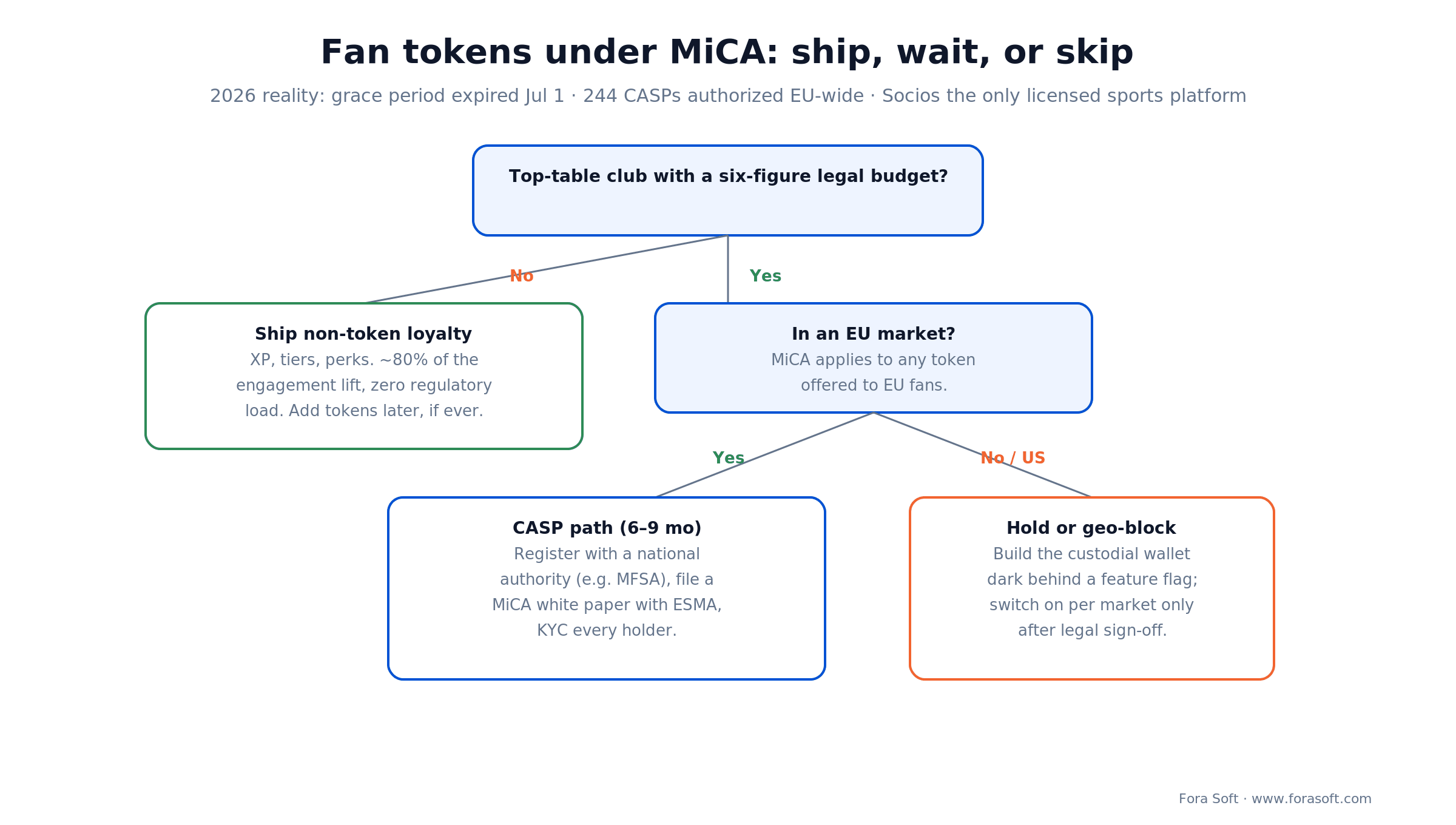
Figure 5. The 2026 fan-token decision. Grace period expired 1 July, 244 CASPs authorised EU-wide, Socios the only licensed sports platform.
We treat the wallet as an engineering-plus-compliance build because we have shipped one. WatchFun, a Solana raffle platform we built, runs provably-fair on-chain draws with a custodial wallet and a code-free admin panel. The plumbing is not the hard part; the KYC, the white paper and the per-market legal track are. The token P&L only works for top-table clubs; everyone else gets 80% of the engagement lift from a non-token loyalty programme with zero regulatory load.
Reach for fan tokens when: you run a top-six club in a major European market, you have a six-figure legal budget, and your commercial team can pre-sell tokenised access tiers to a sponsor. Otherwise ship XP tiers and perks, and revisit tokens next season.
Feature 7 — AR and on-stream overlays
Overlays are the differentiator that turns the app from a player into an experience. And 2026 changed the received wisdom here. The classic “second screen” thesis — fan watches on TV, interacts on the phone — is quietly losing to single-screen overlays rendered on the viewing surface itself. QR-code hand-offs during broadcasts convert in the low single digits, which is why StreamLayer, whose engineering we built, now argues that on-stream interactivity is eating the second screen.
There are three patterns worth shipping. Companion overlays sync lineups, stats, predictions and sponsor activations to a match the fan watches elsewhere. On-stream overlays render the same interactivity directly on the in-app feed. Stadium AR overlays player names, stats and sponsored effects when the fan points the phone at the pitch. The context is real: 86% of internet users use a second device while watching TV and 77% of fans multitask during games (Stats Perform), and fans who touch interactive content watch 33% longer. Companion plus on-stream is the season-one bet; stadium AR is the brand halo.
Reach for on-stream overlays over classic second screen when: you control the in-app feed and want the interaction where the eyes already are. Keep a companion mode for fans watching the match on linear TV, but do not bet the roadmap on QR hand-offs.
Reference architecture for a fan app
The seven features collapse into six product layers on a shared data spine, under one compliance umbrella. Each layer has a clear ownership boundary and a clear failure mode, which is what makes the build-vs-buy call tractable per layer instead of per app.

Figure 3. Six product layers on one data spine, under a single compliance umbrella. Buy the layers with a data moat, build the ones that carry your brand.
The data spine matters as much as any layer. A fan app generates millions of events per match — impressions, votes, prediction submissions, watch time, commerce intents. Pipe them into a customer data platform (Segment, mParticle) and a warehouse (BigQuery, Snowflake) on day one. Without that spine you cannot prove sponsor-activation ROI, you cannot measure feature engagement, and you cannot defend next year’s budget.
The fan-engagement platforms compared
You do not have to build everything. A mature market of engagement platforms will hand you polls, predictions and overlays as an SDK. The trade is data ownership, brand control and a per-MAU or revenue-share fee against speed. Here is how the main options line up, including the ones ranking above this article when you search for a fan engagement platform.
| Platform | Best for | Model | Where it wins | Where it breaks |
|---|---|---|---|---|
| Custom build (Fora Soft) | Top-flight clubs, leagues, operators | Own IP, one-time build | Full UX + data + margin, any feature | Highest up-front cost, needs a product team |
| StreamLayer | Broadcasters, streaming operators | Native SDK + SGAI | On-stream overlays, ad insertion, betting | Engagement layer, not a full app |
| LiveLike | Live match engagement | Engagement SDK, quote | Polls, trivia, predictions, watch parties | Per-MAU fees, vendor roadmap |
| Monterosa | Clubs wanting ready mini-apps | Platform, licence | 40+ mini-apps, event centres, fast | Templated UX, shared data model |
| Genius Sports Engage | Data-led activation, betting | Bundled with data rights | Official tracking data, AR, targeting | Ties you to their data contract |
| Qualifio | Marketing / first-party data | Campaign SaaS | Quizzes, contests, consent capture | Marketing tool, not a live-match app |
| Sportradar 4Sight | Sportsbook operators | Streaming + data bundle | Low-latency feed + odds + engagement | Betting-first, not fan-brand-first |
The pattern: buy the engagement SDK to validate season one, own the shell and the data from the start, and plan a migration to custom once your MAU and sponsor inventory justify the fee you are paying a vendor to rent your own audience.
Sponsorship integration patterns
Sponsorship is what turns the app from a cost centre into a revenue line. Three patterns work in 2026.
1. In-stream insertion. Sponsor logos, lower-thirds and L-shape banners on the live feed via SCTE-35 markers and server-side ad insertion. We built exactly this for Mangomolo — a custom Wowza module that recognises SCTE-35 markers in the live stream and inserts the right ad in real time, across a platform doing over a billion streams a month. It is measurable at viewable-impression level and ships in months on vendor stacks (Harmonic, AWS Elemental MediaTailor).
2. Branded engagement. Sponsor-titled predictions (“man of the match, presented by…”), sponsor-branded leaderboards, sponsor-prize fantasy weeks. This is the highest-value inventory because it ties the sponsor to a fan action, not a passive impression.
3. Shoppable moments. A sponsor-gated drop tied to a live event — a goal triggers a 60-second flash sale on the scorer’s shirt, a card triggers a jurisdiction-limited free-bet promo. This is where commerce, gamification and sponsorship collide, and where StreamLayer’s overlay tech earns its keep.
Need a sponsor-inventory architecture for next season?
Free 30-minute scoping. We’ll map your sponsor brief to in-stream, branded-engagement and shoppable inventory, with named vendors and a build plan.
Rights, geofencing, blackouts
The biggest legal hazard in a fan app is rights enforcement. Each match carries a matrix of windows: live in market A, delayed in market B, blocked in market C, archive-only after season end. Get it wrong and you breach the broadcast contract that pays the club’s bills.
Architecturally, every entitlement check passes through a per-user country resolver (a GeoIP service with VPN detection), a per-match rights matrix maintained by the rights-ops team, and an override layer for sponsor-gated access. Cache aggressively, invalidate on any rights-matrix change. Blackouts are the loudest fan-experience cost, so soften them with crystal-clear pre-match messaging and sponsor-branded access paths where the deal allows.
Cost model: what a top-tier team app costs
A fully-loaded, top-tier team app with all seven features and an in-house product team runs $1.4M–$2.5M to build over 10–14 months, then $600k–$1.3M a year to run once you add streaming, event-data feeds and the product team. The picture below breaks the one-time build across the three paths; the table underneath adds the recurring lines. These are conservative — we estimate with Agent Engineering, which makes our numbers faster and cheaper than the market, and where we are unsure of a figure we leave it out.
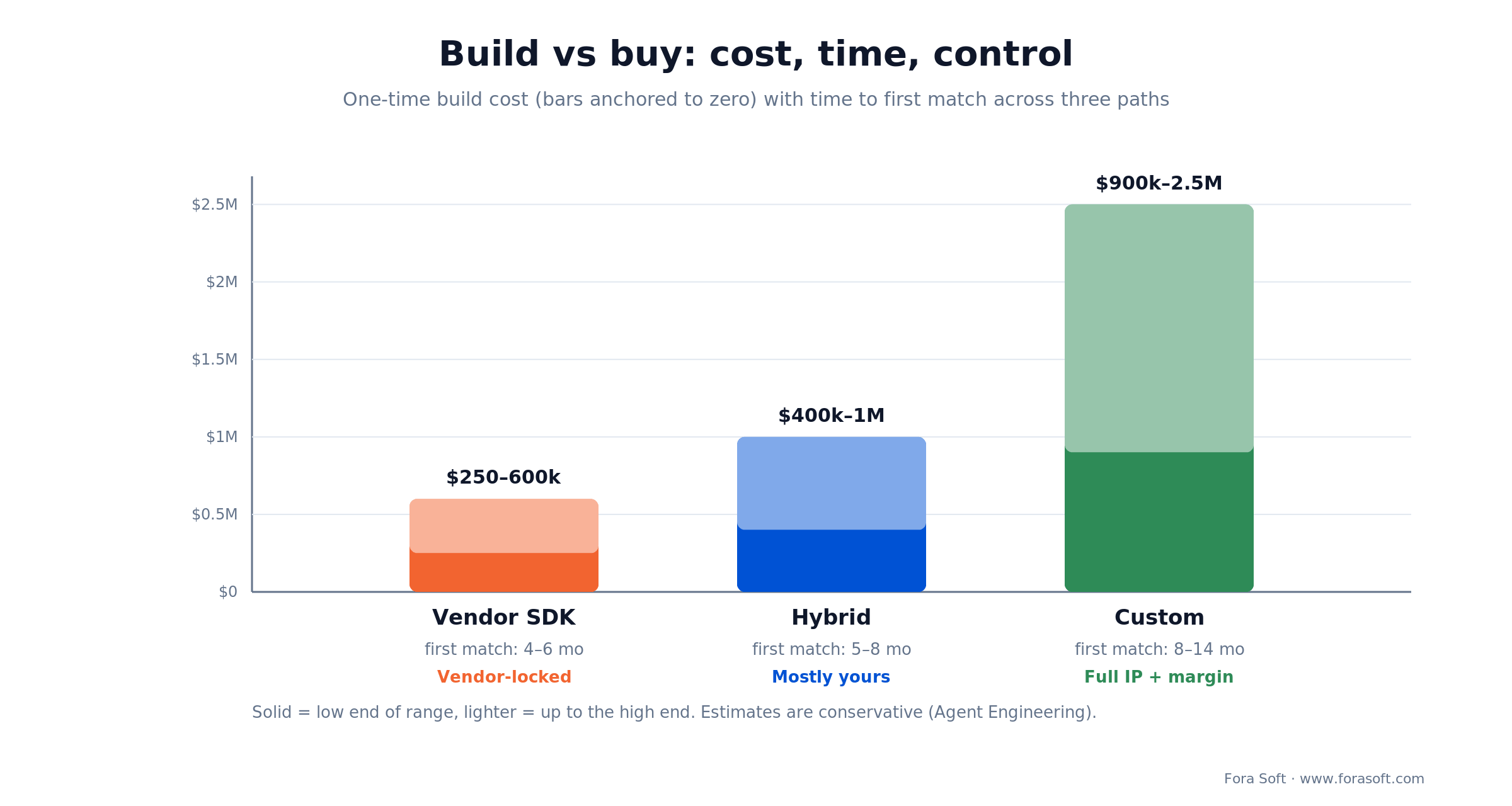
Figure 4. One-time build cost and time to first match across the three paths. Solid bar = low end, lighter = up to the high end.
| Layer / line | Vendor SDK stitch-up | Hybrid (shell + SDKs) | Custom build |
|---|---|---|---|
| Build (one-time) | $250k–$600k | $400k–$1M | $900k–$2.5M |
| Time to first match | 4–6 months | 5–8 months | 8–14 months |
| Streaming & CDN (yr 1) | $80k–$200k | $60k–$180k | $50k–$160k |
| Event data feeds (yr 1) | $120k–$280k | $120k–$280k | $120k–$280k |
| Engagement / overlay SDK | $70k–$160k recurring | $40k–$110k recurring | $0 (in-house) |
| Run + product team (yr 1) | $120k–$220k | $220k–$420k | $420k–$900k |
| Margin / IP control | Vendor-locked | Mostly yours | Full IP, full margin |
Two takeaways. The SDK stitch-up looks cheap to build, but the revenue share or per-MAU fee creeps up fast past 200k MAU. And the gap between hybrid and custom is mostly product staffing, not engineering — which is why we recommend hybrid for season one and a planned migration to custom once MAU clears 500k.
Build vs buy: vendor SDKs vs custom
The vendor market splits cleanly across the seven features. Buy the layers where the data moat or compliance bar is too high to replicate; build the layers where UX and brand differentiation live. Our build-vs-buy decision framework applies layer by layer.
Buy: event data (Sportradar, Genius Sports — the rights are exclusive); CDN and ad insertion (Akamai, Cloudflare, AWS Elemental); KYC for wallet (Sumsub, Onfido); content moderation (Hive, OpenAI).
Build: the app shell and navigation (your brand); the engagement loop (your fans behave differently from anyone else’s); the commerce checkout past the volume threshold; the data spine.
Either: the streaming player (start with a vendor, own it later); the community surface (vendor until you clear 1M+ MAU).
Mini case: football club fan app, before / after
A European top-flight club we audited had a vendor-built app from 2021: a thin wrapper around a Brightcove player, a static news feed and a shop redirect. Push opt-in was 14%. Match-day session length was 8 minutes; on non-match days, 28 seconds. Sponsor inventory inside the app delivered five figures a year against a commitment meant to clear $1.2M.
We re-architected over 16 weeks. Streaming moved to LL-HLS with sub-3-second latency on the premium tier. We added on-stream overlays (predictions, lineup tracker, a sponsor-branded man-of-the-match vote), a weekly captain’s-diary series, native commerce for shoppable goal moments, and a non-token loyalty programme with tiered rewards. Identity moved off the legacy CMS onto an entitlement service feeding paywall, geofence and sponsor overrides.
After one season: push opt-in 41%, match-day session length 23 minutes, non-match-day 5 minutes 40 seconds, in-app commerce up 6.2x, and in-app sponsor inventory cleared $1.1M against the same commitment. Want a similar audit and a 16-week plan? Book a 30-minute call.
A decision framework in five questions
Before we scope an engagement, we run five questions with the digital director. The answers decide whether the right path is vendor-stitched, hybrid or custom.
1. What rights do you control? Only secondary windows (training, academy, archive)? A managed CDN and a commodity player ship fast and cheap. Primary live windows in any market? Build the streaming layer right from day one.
2. How big is your sponsorship commitment? Below $400k of digital activation, a vendor SDK is the right call. Between $400k and $1.5M, hybrid. Above $1.5M, custom — the inventory is too valuable to lock into a revenue share.
3. Where are your fans? If 70% sit in one country, ship and iterate fast. Global audiences add geofencing, payments, language and content-ops complexity that bumps the timeline by roughly 30%.
4. Do you have a content engine? An app without a weekly content cadence is a paywalled player. Confirm the editorial machine before you commit to a feature stack; the most beautiful app dies on a content desert.
5. Who owns the data? In every contract, confirm that event data, user data and engagement telemetry stay the club’s property and exit cleanly. We have seen clubs pay seven figures to recover their own audience after a vendor migration.
Pitfalls to avoid
1. Treating the app as a marketing project, not a product. Marketing ships campaigns; products ship daily. A fan app needs a product owner, an engineering pod and a content desk on one line of accountability, not three suppliers reporting to different commercial directors.
2. Underestimating moderation. A community of 200k logged-in users produces abuse and goal-moment toxicity at a scale most clubs have never operated. Plan a 24/7 rota with vendor plus human review and a one-tap safeguarding path in chat.
3. Ignoring rights for the overlay. Some leagues forbid overlays showing live ball-position data without an explicit licence (the NFL is famously aggressive). Audit the sub-license exposure before shipping any overlay built on ball-tracking or lineup data.
4. Launching fan tokens without a legal track. The MiCA white paper, CASP registration and KYC obligations cost real time and money. Several Tier-2 European clubs soft-launched and quietly retracted tokens when the legal posture caught up. Plan it as a parallel six-month track or skip it.
5. No data spine. Without per-event analytics piped to a warehouse on day one, you cannot prove sponsor ROI or measure engagement. The CFO squeezes the budget next year and the app starves. Instrument before you launch.
KPIs to measure
Quality KPIs. Match-day playback start under 1.5 s at the 95th percentile, rebuffer rate under 0.6% of session minutes, end-to-end live latency under 3 s where rights allow, push opt-in above 35% of registered users.
Business KPIs. Match-day session minutes per DAU above 18, non-match-day above 4, in-app commerce above $5 per MAU per month, sponsor fill rate above 90% of premium slots, renewal-funnel completion 25% above the legacy web flow.
Reliability KPIs. Live-stream uptime above 99.95% during match windows, identity and paywall p99 under 250 ms, payment success above 97% across gateways and markets, incident response inside SLA, zero rights-breach incidents in the season.
Building or rebuilding your team app this year?
Free 30-minute audit. We’ll benchmark your current app on the 14 KPIs above and hand back a punch list ranked by ROI. No deck, no fluff.
When not to build a fan engagement platform
Honesty sells better than a pitch. Do not commission a full fan engagement platform if you hold no live rights and have no plan to acquire any — a well-run website and a newsletter will serve a highlights-and-news audience for a fraction of the cost. Do not build if you cannot staff a weekly content cadence, because the app will look abandoned by month three. And do not start with a custom build if you have never run a product team; take the hybrid path, learn what your fans actually do, then migrate the layers that earn it. If your entire goal is one-off first-party data capture for a marketing campaign, a campaign SaaS like Qualifio is the cheaper, faster answer, and we will tell you so on the call.
FAQ
What does a top-tier team fan app cost to build in 2026?
Custom, all seven features, 10–14 months: $1.4M–$2.5M one-time, plus roughly $600k–$1.3M a year to run (streaming and CDN, event-data feeds, and the product team). Vendor-stitched is roughly half the build cost, but the revenue share or per-MAU fee crowds out margin past 200k MAU. Hybrid is the common middle path at $400k–$1M.
Can a mid-table club afford a fan engagement platform?
Yes, by going hybrid and deferring features. A $400k–$700k hybrid with vendor streaming, a native shell, an in-house engagement loop and non-token loyalty delivers 70–80% of the engagement lift of the bigger builds. Add token plumbing only when MAU clears 250k and a legal budget exists.
Are fan tokens legal in 2026?
In the EU they are legal but hard-gated under MiCA: register as or with a crypto-asset service provider, file a white paper with ESMA, and run KYC on holders. The grace period expired on 1 July 2026 and only 244 CASPs are authorised EU-wide, with Socios the only licensed sports platform. In the US there is no dedicated regime and the utility-token posture is hostile, so most US programmes are paused or geo-blocked.
Is a second-screen app still the right bet, or on-stream overlays?
Build for on-stream overlays first and keep a companion second-screen mode for fans watching on linear TV. QR hand-offs during broadcasts convert in the low single digits, and the industry is moving interactivity onto the viewing surface. 86% of viewers already use a second device during TV, so the companion mode still matters — just do not bet the roadmap on it.
Do we need our own streaming infrastructure or can we use a CDN partner?
For most clubs a CDN partner (Akamai, Cloudflare, AWS Elemental) is right. You should own the player, the entitlements service and the geofencing; the CDN owns the bytes. The exception is primary-rights scale with millions of concurrent viewers, where a managed origin with multi-CDN failover earns its keep.
How long does the first version take to ship?
Vendor-stitched MVP with streaming, paywall, news and predictions: 4–6 months. Hybrid with a native shell, 2–3 SDKs and a custom engagement loop: 5–8 months. Custom with all seven features: 8–14 months. Always plan a parallel six-month rights, legal and sponsor-inventory track that engineering cannot accelerate.
Which fan engagement platform is best — build or buy?
Buy an SDK (LiveLike, StreamLayer, Monterosa) to validate season one; own the shell and the data from day one; migrate to custom once your MAU and sponsor inventory justify the fee. Qualifio and campaign tools are for marketing data capture, not live-match apps. There is no single best platform — there is the right layer-by-layer mix for your rights and budget.
Can we re-use one app across multiple teams in a federation?
Yes. A multi-tenant fan-app platform is a viable federation play and we have shipped the pattern (an Australian sports-broadcasting app). One shared platform, themed per team, with shared streaming, commerce and identity, but per-team brand and per-team sponsor inventory. Cost amortises across the federation; product velocity stays in one team.
What to read next
Sister pillar
Interactive sports streaming platform development
The streaming-side spine of every fan app: latency budgets, overlay sync, multi-CDN failover.
Streaming stack
WHIP / WHEP replaces RTMP for live streaming
Why your low-latency tier should ship on WebRTC, not the RTMP-era stack you started with.
Adjacent vertical
Sportsbook platform development: odds to KYC
If your fan app touches betting, the operator-side stack and the jurisdiction matrix you live inside.
Decision tool
Build vs buy: the video-SDK decision framework
Layer-by-layer build-vs-buy logic for streaming, chat and engagement, applied per fan-app feature.
For CTOs
CTO software project estimation guide
How to size, scope and de-risk a fan-app build before the board approves the budget.
Ready to ship a fan app worth the install?
A 2026 fan engagement platform is not a streaming player with a crest on it. It is a seven-feature media product that catches the unbundled rights, captures first-party data, and delivers measurable sponsor activation. Get the architecture right, plan the rights and token work in parallel, build the data spine on day one, and the app stops being a marketing line item and becomes a P&L line.
We have shipped this surface for StreamLayer (NBC, CBS, Red Bull, Chelsea FC), Mangomolo, WatchFun and an Australian sports federation. The patterns in this guide are the ones we re-use. Want a fan-app blueprint mapped to your rights, your sponsor pipeline and your fan size? Explore our video and audio streaming software development work, or the wider video streaming knowledge base, and book a call — we can have a 16-week plan in your inbox within 48 hours.
Send your team brief, get a 16-week plan
Free 30-minute consult. We’ll come back with a feature map inspired by StreamLayer, a vendor short-list and a delivery plan. No deck, no fluff.