

Key takeaways
• A sportsbook is five financial-grade systems pretending to be one. Odds engine, risk management, KYC + AML, regulated wallet, and per-jurisdiction reporting all have to be production-grade from day one. The "fun" part — the betting UI — is the thinnest layer.
• Three viable paths. Buy turnkey (BetConstruct, SoftSwiss, EveryMatrix — 60–90 days, $200–$500k setup, 8–15 % revenue share). White-label a B2B platform (faster, less control). Build custom (12–18 months, $1.2–$3M, full margin and IP). Operators with $50M+ GGR ambition end up custom; smaller launches survive on turnkey.
• You will not build your own odds. Sportradar, Genius Sports and Stats Perform have exclusive data deals with the leagues. DIY odds compilation is uneconomic outside niche events — one in-play feed for an NFL season is roughly $1–$3M depending on rights.
• Jurisdiction is the moat and the trap. US state-by-state, UK Gambling Commission, Malta MGA, Curacao DGE, Brazil SPA, Ontario AGCO — each has separate licensing, technical certification (GLI-19/33), responsible-gambling, and reporting. Plan jurisdiction work as a parallel multi-month track per market, not a Phase 5 line item.
• The differentiator in 2026 is in-play and second-screen, not pre-match odds. Sub-second WebSocket odds, micro-markets (next-pitch, next-corner), and live-stream + bet integration are where margin and engagement live. StreamLayer built the streaming side of this for NBC, CBS, Red Bull, Chelsea FC; the operator-side complement is what this playbook covers.
Why Fora Soft wrote this playbook
Fora Soft built the engineering behind StreamLayer — the second-screen / overlay layer that lights up live sports broadcasts for NBC, CBS, Red Bull, Chelsea FC, and the New York Mets. The technical surface area — sub-second event sync to millions of fans, integration with multiple data providers, latency budgets that match the live feed, regulated payment flows for fan-engagement promotions — is the same surface area an operator-side sportsbook has to land on the in-play side. We have spent the last six years inside that surface.
Through 2024–2026 we audited two sportsbook platforms in pre-Series-B diligence and shipped a regulated wallet integration for a betting-adjacent operator. The patterns in this guide come from those engagements plus public references — the FanDuel and DraftKings post-IPO tech disclosures, the UK Gambling Commission’s LCCP technical-standards document, the GLI-19 game-server technical standard, BetConstruct and SoftSwiss vendor materials, and the Sportradar / Genius Sports / Stats Perform data-rights filings.
If you are a casino operator adding a sportsbook, a fantasy or DFS company expanding into real-money sports betting, or a sports-streaming product moving toward bet-integrated experiences, this guide gives you the architecture, the build-vs-buy maths, the jurisdiction reality, and the 14-week launch plan we use with our own clients.
Launching a sportsbook in a new state or country?
Free 30-minute jurisdiction-compliance pre-flight. We’ll list the certifications you need, the integrations you can reuse, and the timeline we have actually delivered.
What a sportsbook actually is — five platforms in one
Founders pitching a sportsbook usually describe one product: an app where users bet on sports. The reality, when you ship it, is five regulated systems running in parallel, plus an operations org that monitors all of them in real time. Mistake the surface for the system and you under-budget by an order of magnitude.
1. A market-maker. The odds engine sets prices for every market on every event. It has to update faster than competitors, manage liability when one side of the market gets hammered, and detect arbitrage and sharp-money attempts. This is a financial-trading platform with sport-specific input.
2. A regulated payment institution. Wallet, deposits, withdrawals, chargebacks, dormant-account handling, source-of-funds checks. Operators in the UK, Malta, and most US states are subject to anti-money-laundering rules that match a small bank’s.
3. An identity verification system. KYC tier one at signup, tier two at withdrawal threshold, ongoing screening against PEP and sanctions lists, age verification per jurisdiction, location verification (US states require geolocation tied to per-bet placement).
4. A reporting and audit platform. Per-jurisdiction GGR (gross gaming revenue) and NGR (net gaming revenue) reporting, daily player-activity files for the regulator, immutable audit log, technical conformance evidence for GLI-19 / GLI-33 audits.
5. A consumer product. The web and mobile UI that users actually touch. The thinnest layer in engineering effort, and the one founders fixate on. Get the other four wrong and the consumer product cannot ship.
The six layers of a modern sportsbook
The reference architecture we ship has six layers. Each one has a clear ownership boundary and a clear failure mode.
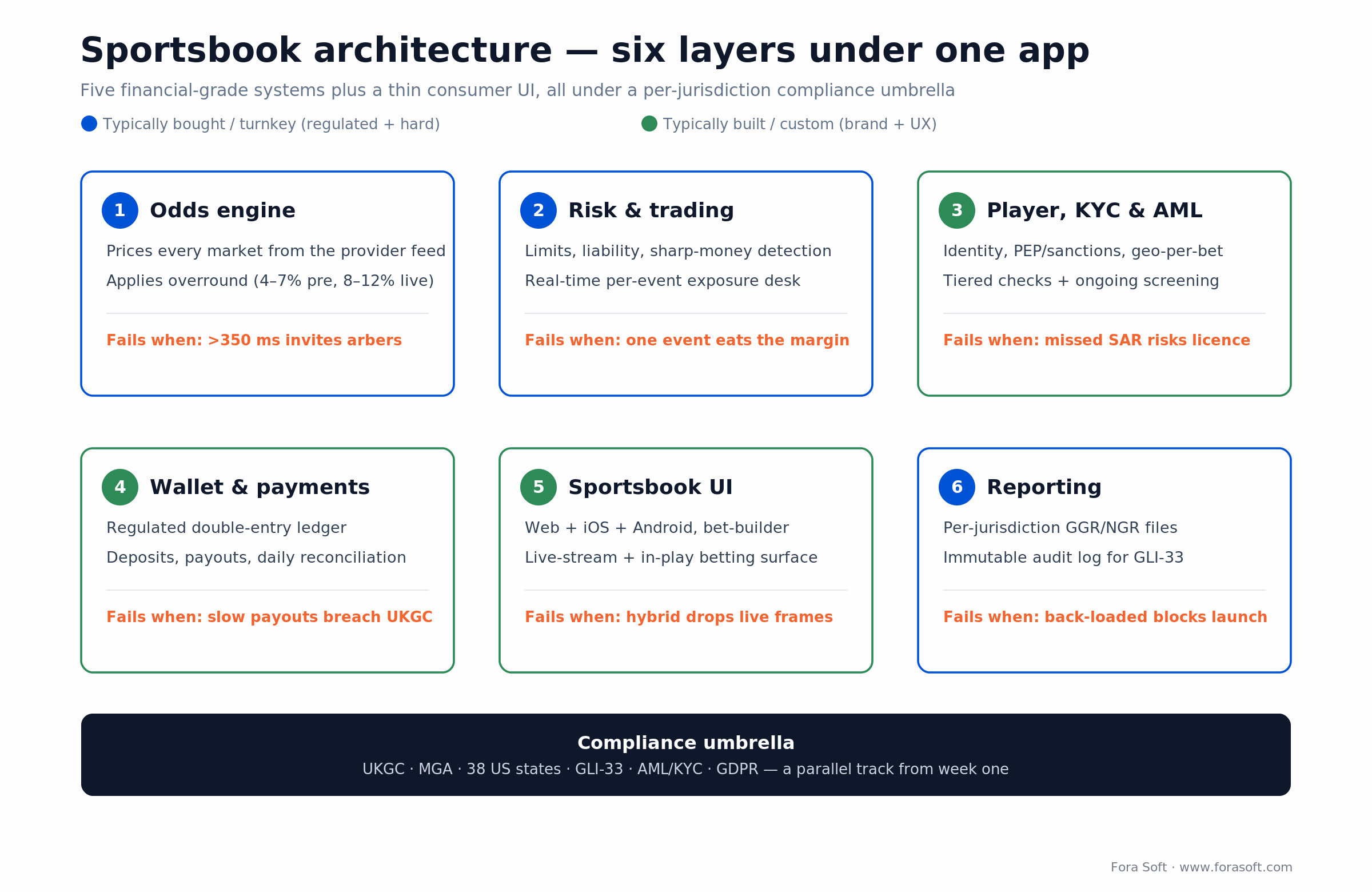
Figure 1. The six layers of a modern sportsbook. Blue layers are usually bought; green layers are usually built in-house.
Layer 1 — Odds engine and trader workstation
The odds engine is the part founders most often want to "build themselves." Almost no operator should. Sportradar, Genius Sports and Stats Perform have exclusive multi-year rights deals with the major leagues; you cannot collect official primary data on NBA, NFL, Premier League, Champions League, or top-tier cricket without going through them. The trader workstation, however, you can and should own.
Odds-feed architecture. The data provider streams odds and event updates over WebSocket or Kafka. Your engine ingests them, applies your margin (typically 4–7 % on pre-match, 8–12 % on in-play), publishes the resulting prices to your UI through your own WebSocket fan-out. End-to-end latency budget from upstream data to user’s screen: under 350 ms p95 for in-play. Read our low-latency streaming primer for the latency-budget model that transfers cleanly here.
Trader workstation. A real-time desktop app for the operator’s in-house trading team. They override the model on edge cases (key player injury, weather), set per-market limits, suspend markets on ambiguous incidents, push manual price corrections. The workstation talks to the odds engine over the same publish bus your UI uses, with elevated permissions.
Margin model. Sportsbook margin is set, not earned. The book bakes in the overround — the sum of implied probabilities across a market exceeds 100 %. A 5 % overround on a moneyline market is industry-standard for major leagues; in-play markets carry 8–12 % to compensate for higher variance. Your engine has to compute and adjust overround on every price update; getting it wrong is how books lose money on otherwise winning seasons.
Reach for own odds compilation when: you are operating in niche markets (esports, regional football leagues, women’s sports, virtual sports) where data rights are unclaimed and you have a quant team that can model the sport from public statistics.
Layer 2 — Risk management and liability
Risk management is the engine that keeps the book solvent. It runs continuously in the background, sets per-bet, per-market, per-customer, per-event limits, and triggers price moves or market suspensions when liability spikes.
Per-customer limits. New accounts get conservative limits ($200/bet, $1k/day). Limits relax on KYC tier two completion and clean activity history. Sharp-money detection — clusters of large bets at the same market price across multiple accounts — triggers automatic limit reduction.
Per-event liability monitoring. The risk dashboard shows real-time exposure on every event — how much the book pays out under each possible outcome. When exposure on one outcome crosses a threshold, the engine moves the price against that side until the imbalance corrects.
Bonus abuse detection. Welcome bonuses and free bets attract bonus-abuse rings — coordinated accounts, shared payment instruments, geometry attacks on bonus-conversion rules. ML-driven anomaly detection plus manual review queue. Without it, your acquisition spend funds the abusers’ profit margin.
Reach for outsourced trading services when: your annual handle is under $20M, you do not have an in-house quant team, and you are operating in a single-jurisdiction market where the data provider’s managed-trading service can run your book competently.
Layer 3 — Player accounts, KYC, AML
Identity is the other regulated-payments-grade system. The KYC and AML pipeline determines who can bet, how much, and when you have to file a suspicious-activity report.
Tier one KYC. At signup. Name, address, date of birth, government-issued ID, document upload. Verification provider runs OCR plus liveness check (selfie video, blink detection). Onfido, Veriff, Sumsub, IDnow, Jumio are the dominant providers; tier-one verification typically resolves in 30–120 seconds and costs $0.80–$2.50 per check. If you’re building that verification layer rather than renting it, our guide to video KYC solution development breaks down liveness detection, document checks, and the build-vs-buy math.
Tier two KYC. At first withdrawal or deposit threshold (often $2.5k cumulative). Source-of-funds documentation, bank statement, sometimes employer reference. Manual review by your compliance team, supported by the same provider’s document-classification API.
Ongoing screening. Daily checks against PEP (politically exposed persons) and sanctions lists (OFAC, EU consolidated, UK HMT, UN). Adverse-media screening for high-net-worth accounts. Tools: ComplyAdvantage, Refinitiv World-Check, Dow Jones Risk & Compliance.
Geolocation per bet. US states require that a bet placed under a state’s licence has been geographically placed inside that state. GeoComply is the de-facto provider; their SDK runs on the player’s device and produces a signed assertion the regulator accepts. Costs: $0.05–$0.20 per geo-check; budget for a check per bet.
Self-exclusion and responsible gambling. Mandatory across UKGC, MGA, every US licensed state. Player can set deposit limits, loss limits, time-out periods, full self-exclusion. Some jurisdictions require integration with a national self-exclusion register (UK GAMSTOP; in the US, state-run voluntary self-exclusion programs).
Layer 4 — Wallet and payments
The wallet is a regulated ledger. Every deposit, bet, settlement, withdrawal, bonus, refund, and chargeback is a posted transaction with double-entry balancing. Reconciliation against the payment processor and the bank runs daily.
Deposit rails. Cards (Visa, Mastercard) carry MCC 7995 (gambling) which many issuers decline by default; conversion is 60–75 % in mature markets. Bank transfer (Trustly, Open Banking) hits 90 %+ but adds 30–90 seconds of friction. PayPal, Apple Pay, Google Pay are jurisdiction-dependent. In the US, ACH is the dominant rail; in Brazil, Pix; in India, UPI; in Nigeria, USSD bank rails.
Withdrawal flow. KYC tier two complete, AML cleared, source-of-funds documentation on file, payout against the original deposit method (anti-money-laundering best practice). Same-day withdrawal is the 2026 expectation; UKGC has effectively made it a regulatory floor through guidance on dark patterns in withdrawal friction.
Crypto. Allowed in some jurisdictions (Curacao, parts of Latin America, some US tribal markets), banned in others (UKGC restricts; most US states prohibit). If you support crypto, do it through a regulated on-ramp (Fireblocks, BitGo) with on-chain analytics (Chainalysis, Elliptic) for source-of-funds and sanction screening.
Reach for multi-provider KYC redundancy when: single-vendor outage during a major-event window costs more than the second integration. Above $50M annual handle this is reliably true and dual-vendor with auto-failover pays for itself within months.
Layer 5 — Sportsbook UI (web + mobile)
Web. Server-rendered React (Next.js) with server-driven WebSocket for odds. Static surfaces (event detail, sport landing pages) are SEO-optimised — sportsbook landing-page SEO drives 30–45 % of acquisition cost in mature markets.
Mobile. Native iOS and Android. Hybrid frameworks (React Native, Flutter) work for the betslip flow but struggle with the event-list and live-streaming surfaces where 60 fps scrolling and embedded video matter. Native is the default for top-tier operators.
Bet-builder. Same-game parlays, multi-leg bets, custom prop combinations — the highest-margin product surface in 2026. Engineering complexity: every leg has correlations to every other leg (same player scoring affects both anytime-scorer and team-total markets), requiring conditional probability models that re-price the parlay in real time.
Live-stream + bet integration. Embed the league’s live stream where rights allow, overlay micro-markets on the stream, sub-second odds updates synced to the stream timeline. This is where the StreamLayer-style second-screen pattern becomes table-stakes — we cover the technical integration in our interactive sports streaming guide.
Layer 6 — Compliance reporting per jurisdiction
Every regulator wants different files in different formats on different schedules. The compliance reporting layer is a separate ETL pipeline that takes the canonical betting and wallet event log and produces per-jurisdiction artefacts.
UKGC. LCCP technical-standards reporting, monthly regulatory return, daily transparency reports on responsible-gambling metrics. The Single Customer View consultation, when it lands, will require interoperable customer-risk data sharing across operators.
MGA Malta. Monthly player liability report, quarterly licence-fee return, ongoing technical conformance. MGA Sandbox available for new product types.
US states. Each state has its own gaming-control board (Nevada GCB, New Jersey DGE, Pennsylvania PGCB, Michigan MGCB, etc.). Daily player-activity files in state-specific schema, weekly tax filings, monthly GGR reporting. GLI-19 and GLI-33 technical certifications mandatory before launch.
Odds feeds — Sportradar vs Genius vs DIY
| Provider | Strength | Pricing shape | When to pick |
|---|---|---|---|
| Sportradar | Broadest global coverage, NBA official data (2023–24+) | Tiered + revenue share | Default for global operators |
| Genius Sports | NFL official, EPL, EuroLeague | Tiered + minimum commit | US-focused, NFL-heavy |
| Stats Perform (Opta) | Football data depth, model-grade | Per-feed + analytics fee | Football-first, analytics-heavy |
| BetGenius (now Genius) | Trading services bundle | Bundle pricing | Operators outsourcing trading |
| DIY (own quant team) | Niche markets only | Quant team cost | Esports, virtuals, regional sports |
Jurisdiction matrix — US states, UK GC, MGA, Curacao
UK Gambling Commission. Mature, strict, expensive. LCCP technical standards, GAMSTOP integration, advertising restrictions. Licence application takes 4–8 months. Annual fees scale with GGR. The benchmark for compliance posture; most other regulators borrow from UKGC text.
MGA Malta. EU passportable, sandbox-friendly, mid-tier strict. Licence application 3–6 months. Strong choice for serving multiple EU markets under one regulatory umbrella; not all member states accept the passport now.
US states. 38 states have legalised some form of sports betting as of 2026. Each is a separate licence, often a separate technology platform, separate tax regime, separate testing labs. New Jersey, Pennsylvania, Michigan are the most operator-friendly mature markets; New York, Illinois carry punitive tax rates that crush operator margins.
Curacao DGE. Lowest barrier to entry, lowest reputational ceiling. Useful for early-stage operators serving lightly-regulated markets while applying for higher-tier licences. Cannot be used to serve UK, US licensed states, or most EU.
Brazil SPA. Federal law 14.790/2023; SPA (Secretariat of Prizes and Bets) licensing and the regulated market effective 1 January 2025, with mandatory .bet.br domains. Major opportunity, complex application, strict responsible-gambling and tax provisions. Several international operators committed during the 2025 application window; outcomes still unfolding.
Ontario AGCO. Open private market since 2022. Mid-tier strict, allows free-for-all operator competition under iGaming Ontario. Strong launchpad for North-American expansion outside the US state-by-state path.
In-play / live betting infrastructure
In-play betting is where the 2026 margin lives. Pre-match volume is commodity; in-play volume carries 8–12 % margin and 3× the stickiness. The infrastructure is hard, which is why challenger operators get filtered out at this layer. The real-time delivery stack mirrors low-latency live video — our video streaming learn hub breaks down the transport trade-offs (WebRTC, LL-HLS, WebSocket) that set your odds-update latency.
Latency budget. Upstream data provider 80–150 ms. Engine processing 30–80 ms. WebSocket fan-out to user 50–120 ms. Total odds-update-to-user-screen budget: under 350 ms p95. Anything slower and arbitrageurs front-run you.

Figure 2. The in-play latency budget: worst-case additive delay must stay under the 350 ms p95 ceiling or arbers front-run you.
Bet acceptance window. User taps "place bet" with the price they saw. By the time the click reaches the server the market may have moved. Three policies: reject bets at materially different price, accept up to N % slippage, accept always (cost the operator). UKGC pushes operators toward "accept up to N" as the consumer-fair pattern.
Market suspension. Goal scored, red card, ambiguous incident. The trader workstation suspends affected markets within 200 ms. Engine refuses any bet placed on a suspended market regardless of slippage policy.
Cash-out. User locks in a partial settlement before the event ends. Engine prices cash-out using current implied probabilities and the original bet’s liability. High-margin product surface, requires the same low-latency stack as in-play pricing.
Reach for hybrid (turnkey + custom) when: you need brand differentiation on the consumer surface (UI, wallet, KYC flow) but cannot justify the 12–18 month custom build of the regulated engine + risk + reporting layers in your first 24 months.
Need a second opinion on turnkey vs custom?
We will model the 36-month TCO for your jurisdiction set and projected GGR, and tell you the break-even at which custom beats turnkey on margin.
Cost model — turnkey vs custom
Turnkey. $200–$500k setup, $50k/month minimum platform fee, 8–15 % revenue share to the platform vendor (BetConstruct, SoftSwiss, EveryMatrix, Altenar). 60–90 day go-live in mature jurisdictions where the vendor is pre-certified. Total 36-month spend at a 5 %-of-handle book doing $50M GGR/year: roughly $10M.
White-label. $80–$250k setup, 10–25 % revenue share, less brand control, faster launch. The platform owns the licence, you operate under their licence as a sub-brand. Useful for early-stage operators testing markets; outgrown by mid-stage.
Custom. $1.2–$3M build, 12–18 month timeline to first jurisdiction, $300k–$1M/year ongoing engineering. Per-jurisdiction certification adds $150–$400k each. Total 36-month spend at $50M GGR/year: roughly $5–$8M, including ongoing margin retention. Custom break-even versus turnkey is roughly $30–$40M annual GGR depending on jurisdictions. Building those regulated layers is exactly what our custom software development team does for operators.
Hybrid. The 2026 emerging pattern: turnkey for layers 1, 2, 6 (odds engine + risk + reporting), custom for layers 3, 4, 5 (KYC, wallet, UI). You buy the regulated and the hard, you build the brand and the user experience. Read our build-vs-buy decision framework for the same maths applied to video infra.

Figure 3. 36-month TCO: turnkey’s revenue share overtakes custom’s fixed build cost in the $30–$40M GGR band.
Build vs white-label vs custom — decision framework
Q1. Projected 36-month GGR? Under $30M: turnkey. $30–$80M: hybrid. Over $80M with multi-jurisdiction footprint: custom.
Q2. Jurisdiction count and complexity? Single Curacao: white-label or turnkey. Five US states + UK + Ontario: hybrid or custom because turnkey vendors charge per-jurisdiction setup that compounds.
Q3. Brand and product differentiation? Standard sportsbook UX competing on bonus and price: turnkey. Differentiated UX (live-stream-first, micro-betting, vertical-niche audience): custom or hybrid because turnkey UI is white-labelled across competitors.
Q4. In-play centrality? Pre-match focus, casual user base: turnkey is fine. In-play and bet-builder are core: hybrid or custom because turnkey latency and bet-builder depth lag.
Q5. Engineering bench? No in-house engineering: turnkey is the only viable option. 5–10 senior engineers + risk/quant resource: hybrid. 25+ engineers + dedicated trading desk: custom is the path the IPO-scale operators have all walked.
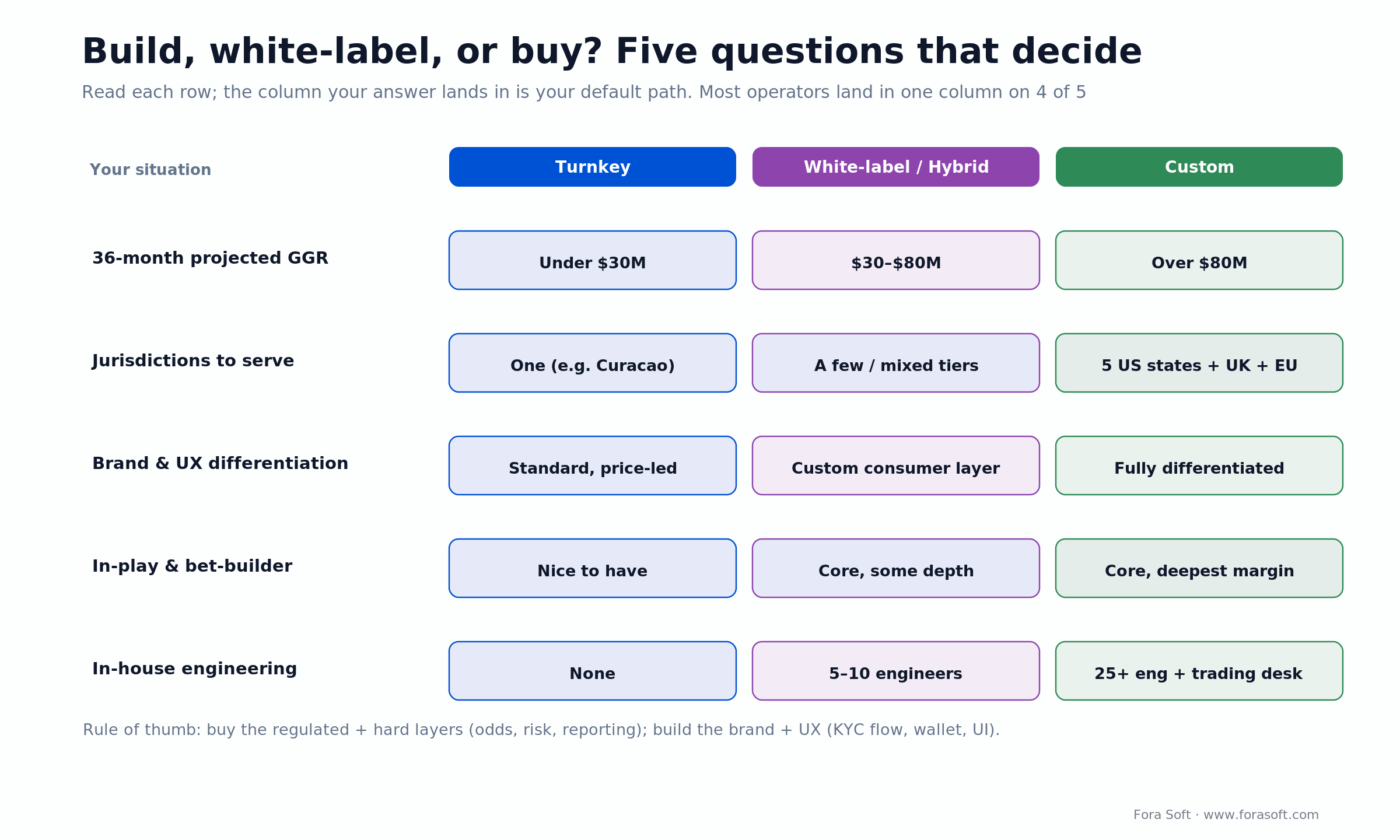
Figure 4. Five questions that sort an operator into turnkey, white-label/hybrid, or custom.
Mini case — jurisdiction expansion in 14 weeks
A LatAm-licensed operator approached us in 2025 with a problem: their turnkey platform vendor quoted six months and $480k to add a new high-priority jurisdiction. The clock was political — the regulatory window was scheduled to close inside that timeline, and a competitor would be first-to-market under the same licence. They had a custom mid-layer (wallet, UI) and used the vendor only for layers 1, 2, 6.
The 14-week plan. Weeks 1–2: jurisdiction-specific compliance reporting schema, GeoComply integration for the new geography, KYC provider expansion to support local document types. Weeks 3–6: regulatory reporting ETL adjusted to the new state’s daily player-activity file format, responsible-gambling integrations with the local self-exclusion register. Weeks 7–10: parallel certification workstream with a GLI-equivalent local lab; engineering fixes for two technical findings (RNG audit-trail format, transaction-receipt timestamp resolution). Weeks 11–13: integration testing with three local payment rails the existing wallet did not support, plus PEP screening provider switch for local-list coverage. Week 14: regulator submission, soft launch with limited markets and per-customer caps.
Outcome. Live in jurisdiction 14 weeks after kick-off, three days inside the political window. First-quarter handle was 3.2× the operator’s pre-launch projection because they captured the early-mover bonus-acquisition cycle the competitor missed. Per-jurisdiction engineering investment came in at $310k versus the vendor’s $480k turnkey quote, and the operator retained the entire margin instead of sharing 12 %. Book a 30-min call for a similar jurisdiction sprint.
Pitfalls to avoid
1. Treating jurisdiction work as a Phase 5 line item. Compliance, certification, and regulator reporting must run in parallel from week one. Operators who back-load it ship the platform but cannot launch.
2. Building your own odds. The data rights are exclusive. The economics do not work outside niche markets. Buy the feed, build the engine on top.
3. Underbudgeting risk and trading. The trader desk is a first-class product surface, not an admin panel. Without a real-time risk dashboard your liability runs unchecked and a single popular event can take half a season’s margin.
4. Friction in withdrawals. UKGC publicly enforces against withdrawal-friction dark patterns. Same-day withdrawal is the 2026 floor. Operators who throttle payouts to manage cashflow burn brand and trigger regulator action.
5. Skipping responsible-gambling design. Mandatory in every regulated market. Beyond compliance, the operators with strong RG features outperform on lifetime value because they retain healthy customers longer. Read our NFR checklist for the full surface area.
KPIs to measure
Quality KPIs. Odds-update-to-screen latency under 350 ms p95. Bet acceptance success rate above 97 %. Same-day withdrawal completion rate above 95 %. KYC tier-one resolution under 120 seconds median.
Business KPIs. Hold percentage (target: 5–7 % pre-match, 8–12 % in-play). GGR per active player per month. Bonus-cost ratio under 30 % of gross win in mature markets. Player lifetime value above 12× CAC.
Reliability KPIs. 99.95 % platform uptime during major-event windows. Zero unscheduled odds-engine restarts during live events. Reconciliation breaks closed within 24 hours. Regulatory reporting submission rate 100 %.
FAQ
How long to launch a sportsbook in a new market?
Turnkey in a pre-certified jurisdiction: 60–90 days. Custom platform first market: 12–18 months. New jurisdiction on an existing custom platform: 8–14 weeks. Licence application timelines run in parallel and are often the binding constraint — UKGC 4–8 months, MGA 3–6 months, US states 4–9 months.
Should we build our own odds?
No, except in niche markets where data rights are unclaimed (esports tier-2, regional leagues, virtual sports, women’s sports below top tier). Sportradar, Genius Sports and Stats Perform have exclusive deals with the major leagues; you cannot legally serve official primary data without going through them.
Turnkey vs custom — what is the break-even?
Roughly $30–$40M annual GGR depending on jurisdiction count and revenue-share rate. Below that, turnkey wins on TCO. Above it, custom wins on margin retention plus differentiation, and the upfront engineering investment pays back inside 24 months.
What does GLI-19 certification involve?
Independent test-lab evaluation of your game and platform for randomness, fairness, audit trails, and player-protection controls. GLI-19 covers interactive gaming systems; GLI-33 covers event wagering. 6–14 weeks per jurisdiction depending on findings, $40–$120k per cert, much faster on subsequent jurisdictions because most of the evidence is reusable.
What is the cost of running a single in-play feed?
For a top-tier league (NFL, NBA, EPL, Champions League) one official in-play feed for the season runs $1–$3M depending on rights tier and territory. Tier-2 leagues are $100–$400k. Niche markets and esports are typically below $100k or pay-as-you-go API.
Which KYC provider should we pick?
Onfido for global default, Veriff for European-document depth, Sumsub for emerging-markets coverage and crypto, Jumio for US-heavy enterprise deployments. We typically integrate two providers with auto-failover — sportsbook scale exposes single-vendor outages quickly.
Do we need our own trading team?
Above $20M annual handle, yes. Below, the data provider’s managed-trading service (BetGenius / Sportradar Managed Trading Services) is more cost-effective and operationally simpler. The break-point is when manual override on edge cases starts to be a daily-recurring need.
Is crypto allowed in regulated markets?
Curacao and parts of Latin America: yes. UKGC: heavily restricted. Most US licensed states: prohibited. Malta: regulated framework via VFA Act. If you support crypto, do it through a regulated on-ramp with on-chain analytics for source-of-funds and sanctions screening.
What to Read Next
Streaming
Interactive Sports Streaming
Live-stream + bet integration architecture.
Build vs Buy
Build vs Buy Decision Framework
Same maths applied to video infra.
Latency
WHIP / WHEP Low-Latency
Latency budget primer that transfers to in-play odds.
NFR
NFR Checklist
Reliability, audit, retention NFRs for regulated systems.
Estimation
CTO’s Estimation Guide
Sportsbook MVP estimation worked example.
Ready to ship a 2026-grade sportsbook?
Sportsbook is five regulated platforms running together. The fun consumer surface sits on top of an odds engine, a risk and trading desk, a KYC and AML pipeline, a regulated wallet, and a per-jurisdiction reporting ETL. Buy the feed, build the engine, and treat compliance as a parallel multi-month track from week one.
Turnkey wins below $30M GGR and one-jurisdiction launches. Custom wins above $80M GGR or multi-state US plus UK plus EU. Hybrid — turnkey for layers 1, 2, 6, custom for the consumer-facing layers 3, 4, 5 — is the 2026 emerging pattern that captures most of the margin retention without the 18-month custom build. Our StreamLayer engineering provides the in-play and second-screen depth you need to compete with the IPO-scale incumbents on the surface that actually matters.
Want a 14-week sportsbook launch plan?
Send your jurisdictions, projected GGR, and current vendor (or none). We will return architecture, build-vs-turnkey TCO, and shipping plan in 48 hours, free.