

Key takeaways
• Intercom software is a stack, not a feature list. Video, audio, SIP, WebRTC, edge AI, smart locks, multi-tenant routing, and an audit trail all have to line up. Skip one layer and you get the 2 a.m. building-lockout class of bug.
• Edge AI moved the design center to the doorstep. A Hailo-10H does 40 TOPS at about 2.5 W and runs a small on-device model, so face, package, and plate detection happen locally — which fixes both the GDPR problem and the “cloud is offline” problem at once.
• Openness is the test that disqualifies vendors. SIP (RFC 3261), ONVIF Profile T, and standards-based locks (Aliro 1.0, Matter/Thread) keep the door open. A single-brand hardware lock is three years of vendor lock-in you signed up for by accident.
• Multi-tenant support is the make-or-break for buildings. Per-unit routing, sub-account scopes, and bulk provisioning are what separate a doorbell from a 100-unit platform. Most consumer products fail this line on the first residential RFP.
• Compliance is architecture, decided before hardware. GDPR Articles 6/9, the EU AI Act (enforcement from 2 Aug 2026), CCPA, NDAA Section 889 for US federal sites, HIPAA for healthcare, and EN 81-28 for lift intercoms each change what you can ship.
Why Fora Soft wrote this playbook
We’ve been building multimedia and IP-camera software since 2005 — 250+ delivered products across two decades. The intercom-adjacent work is where this guide comes from: VALT, a video-surveillance platform we’ve been the sole dev team on for 10+ years, now running across 770+ US organizations and 50,000+ users under HIPAA; Netcam Studio, IP-camera software with ONVIF discovery, PTZ, and rule-based motion detection; and ProVideoMeeting, WebRTC video conferencing on a FreeSWITCH SIP core.
Those projects taught us what separates an intercom feature list from an intercom product: the SIP and WebRTC plumbing, the multi-tenant data model, the smart-lock and property-system integrations, the audit trail, and how the whole thing behaves when the internet drops. The gap between a doorbell demo and a 100-unit rollout is wide, and it’s where most projects quietly fail.
This is the playbook we hand founders and product owners who are specifying or buying intercom software in 2026. It’s opinionated, ordered by what holds up after the contract is signed, and grounded in the trade-offs we actually use when we scope a build.
Specifying an intercom platform and not sure which features are table-stakes?
Tell us your unit count, region, and integration list. We’ll come back with a two-page feature scorecard and a realistic estimate.
What counts as intercom software in 2026
Intercom software is the layer that turns a door station into a building product: it handles the video and audio call, routes it to the right resident or desk, decides who gets in, releases the door, and logs every event. In 2026 the good implementations run the safety-critical parts — call setup, echo cancellation, detection, entry decisions — on the device at the door, and use the cloud for storage, analytics, and remote answering rather than for opening the door.
One naming trap worth clearing up first: “Intercom” is also a well-known customer-service chat product. This guide is about the other kind — door and building intercom software: video door stations, IP intercom, and the multi-tenant platforms behind apartment, hospitality, healthcare, and commercial entrances. Everything below is scoped to that world.
Reach for serious intercom software when: your roadmap crosses 100 units, multi-tenant routing, smart locks, or any biometric AI. Below that line, an off-the-shelf consumer doorbell (Ring, Nest) is usually the right call and this whole guide is overkill.
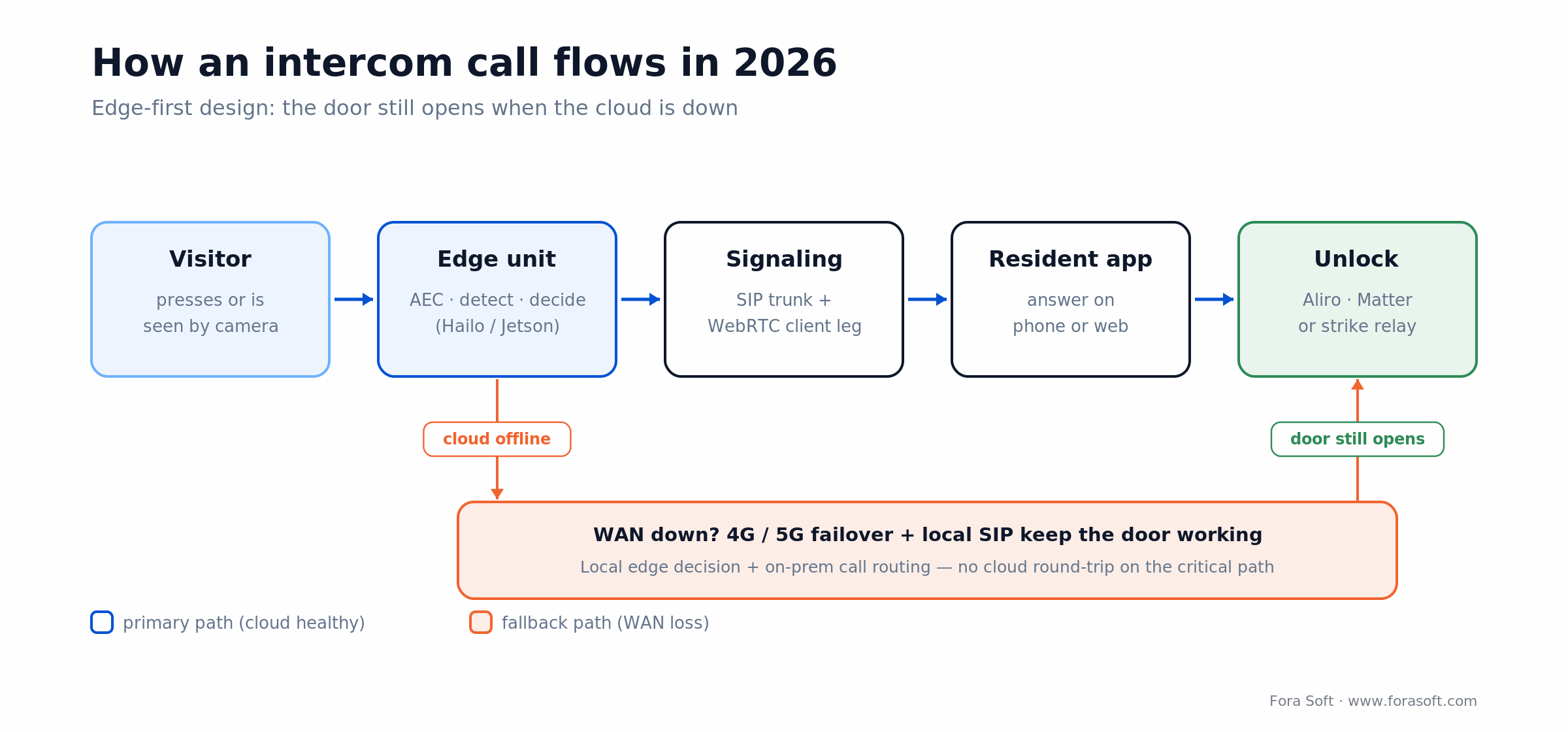
Figure 1. The critical path runs on the doorstep. When the WAN drops, a 4G/5G failover and local SIP keep the call and the door working — no cloud round-trip required to let someone in.
The 2026 intercom market: numbers worth scoping against
Market sizing for video and IP intercom is genuinely messy — estimates run from a couple of billion dollars to tens of billions depending on whether a firm counts devices, software, or whole systems. The signal underneath the noise is consistent: it’s a multi-billion-dollar market growing in the low-to-high teens percent a year, and the analog-to-IP shift is the engine. As of 2026, MarketsandMarkets pegs the IP-intercom segment near $3.8B, independent trackers put IP-based systems at roughly two-thirds of the video-intercom market, and mid-teens CAGRs are common across sources.
Three shifts reset feature priorities this year. Affordable 5G-class connectivity makes cellular fallback cheap enough to spec by default. Edge AI silicon (Hailo, NVIDIA Jetson, Google Coral) makes local face, package, and plate inference practical on a door unit. And the EU AI Act plus GDPR Article 9 make cloud-only biometrics a legal liability rather than a convenience. If you’re buying for a multi-dwelling-unit (MDU) or hospitality portfolio, those three are the reason a 2022 spec sheet is already out of date.
A 60-second decision matrix
Match your deployment to the right kind of platform before you start scoring features. This table saves the two-to-three weeks of vendor demos most teams burn to reach the same conclusion.
| Deployment | Reach for | Why |
|---|---|---|
| Single-family residential | Consumer doorbell (Ring, Nest, DoorBird) | Hardware $100–$400, under $10/month, sub-day install. |
| MDU residential 50–500 units | Custom platform on 2N / Akuvox + property system | SIP / ONVIF, per-unit routing, bulk provisioning, PMS sync. |
| Hospitality | Akuvox / 2N + PMS API | Mobile key, smart-lock integration, audit trail by stay. |
| Healthcare | 2N / custom + HIPAA | BAA-bound cloud, encrypted recording, role-based access. |
| US federal / sensitive sites | NDAA-compliant hardware (Aiphone, 2N) | No Hikvision / Dahua / ZTE / Huawei components allowed. |
| Commercial high-security | Custom platform + biometrics | Face + fingerprint, vandal-proof, tamper detect, full audit. |
Feature 1: Video — resolution, HDR, low-light, field of view
Video is where demos win and installations fail. The boundary conditions — a backlit afternoon porch, a midnight package thief, fog — are what separate a usable system from one that produces footage nobody can act on.
1. Resolution. 1080p at 15–30 FPS is the cost-conscious baseline; 4K (3840×2160) is now standard on premium and commercial units. Resolution above 1080p only earns its keep with HDR and a lens that actually resolves to it — otherwise it’s a spec-sheet number.
2. HDR. Non-negotiable for any door facing direct sun or a backlit interior. Without it, faces wash out and plates blow to white at exactly the moment you need them.
3. Low-light / starlight. 0.1 lux is the spec point to hold vendors to. IR cut-filter switching and dual-sensor color-at-night designs are common above the $400 mark and worth it wherever the entrance is unlit.
4. Wide-angle lens. A 160–180° horizontal field of view mimics human peripheral vision and kills the “crouched below the camera” blind spot. Watch for fish-eye distortion eating recognition accuracy at the edges.
Feature 2: Audio — codecs, echo cancellation, noise suppression
Two-way audio is what makes an intercom an intercom. Get it wrong and your beautiful 4K product still feels broken to the person standing at the door.
1. Codecs. Opus (RFC 6716) is the modern default for low-bandwidth two-way, adaptive from about 8 to 128 kbps. G.711 covers legacy SIP interop, G.722 gives wideband over IP. Be wary of any platform that ships G.711 only.
2. Acoustic echo cancellation. WebRTC-native AEC, Krisp, or Dolby Voice. Without it, every call doubles back as a feedback loop — the single most common reason consumer doorbells get returned.
3. Noise suppression. Wind, HVAC, traffic, lobby chatter. Modern ML-based denoisers buy 6–15 dB of SNR improvement, which is the difference between an intelligible outdoor call and a shouting match.
Reach for ML-based denoising when: the unit sits outdoors, near a busy street, or in a multi-residential lobby. Plain DSP-only echo cancellation falls apart on real wind and crowd noise.
Feature 3: SIP, ONVIF, and WebRTC — the openness layer
Three protocols separate a real platform from a vendor-locked toy. If a product can’t speak them, you’re buying its roadmap, not just its box.
1. SIP (RFC 3261). Lets the intercom register with any compliant PBX — Asterisk, FreeSWITCH, Kamailio, or a hosted carrier like Twilio or Vonage. No SIP means you’re tied to the vendor’s app and cloud forever.
2. ONVIF Profile T. The interoperability standard for IP video devices — H.264/H.265 streaming, motion alarms, PTZ. Access-control functions live in ONVIF Profiles A and C. If a vendor can’t hand you a conformance certificate, treat that as the answer. Our ONVIF profiles decision guide walks through which profile buys you what.
3. WebRTC. The right way to answer a door call from a phone or web client — sub-second setup, native in every browser, no app install required. SIP is the trunk leg; WebRTC is the client leg; production stacks ship both. Our 12 must-have video intercom features breaks the protocol layer down further.
Reach for a full SIP + ONVIF stack when: you plan to mix hardware brands, integrate a PBX or property system, or expect to expand the building later. A closed app is fine for five doors and a trap at fifty.
Feature 4: Edge AI — face, package, animal, license plate
In 2026, detection runs on the doorstep, not in the cloud. Edge silicon got cheap and capable enough that any commercial-grade unit can ship with an accelerator: a Hailo-8 does 26 TOPS at about 2.5 W, a Hailo-10H reaches 40 TOPS and can host a small on-device model, and an NVIDIA Jetson Orin Nano hits 40 TOPS at 5–15 W. Our on-camera edge AI guide covers the engineering trade-offs.
1. Face detection vs face recognition. Detection (“there is a face”) sits under GDPR Article 6. Recognition (“this is a specific person”) is biometric processing under Article 9 and needs explicit consent or a narrow exemption. Bake that difference into the data model on day one, not after legal review.
2. Package detection. Parcel and box classification is standard at the $300+ price point. It cuts porch-piracy disputes and drives smart notifications residents actually want.
3. Animal classification. Dog, cat, wildlife. It suppresses 60–80% of false alarms in suburban deployments, which is the difference between an app people keep and one they mute.
4. License-plate recognition. 85–92% accuracy in good light; useful for visitor-parking analytics and watchlist matching. Worth the build for any commercial site with a parking surface.
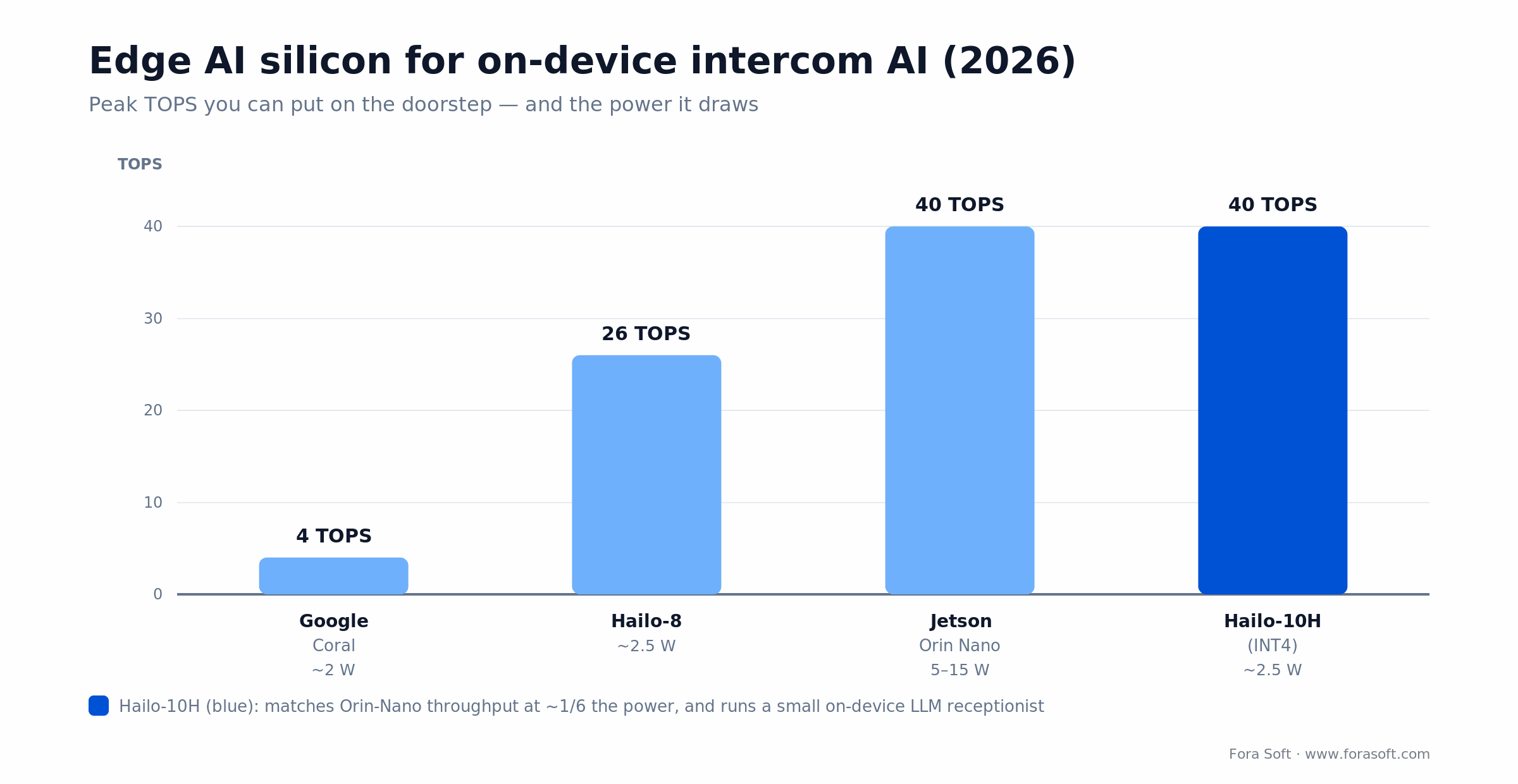
Figure 2. Peak throughput per chip against power draw. The Hailo-10H matches Jetson Orin Nano’s 40 TOPS at roughly a sixth of the power, and has enough headroom to run a small on-device model for the receptionist layer.
Reach for edge AI when: your privacy posture or latency budget can’t tolerate cloud-only inference, or the building’s WAN is unreliable. In 2026 both are the norm, not the exception.
Feature 5: Visitor management — QR, PIN, mobile keys
Visitor management is what turns an intercom from a doorbell into a building product with a workflow behind it.
1. One-time PINs and QR codes. Time-bound entry codes texted or emailed to a guest, contractor, or delivery driver. They should expire by both time and use count, and every use lands in the audit log.
2. Mobile keys (BLE / NFC). The convenience pillar for hospitality and premium MDU. This is where standards-based access earns its keep — more on Aliro and Matter in Feature 7.
3. Property-system integration. AppFolio, Yardi, and hospitality PMS APIs turn the intercom into part of check-in for hotels and part of the lease workflow for residential. Without it, staff re-key the same data twice.
Feature 6: Multi-tenant (MDU) support — the make-or-break
Most consumer platforms can’t do MDU at all. This is the single feature that disqualifies the largest number of products on a residential RFP, so test it first.
1. Per-unit call routing. Apartment 101 rings 101’s residents, not the front desk. It sounds obvious; plenty of systems still hub-and-spoke everything through one account.
2. Shared-area policies. Lobby and garage cameras follow rule-based dispatch by office hours, after hours, holidays, and emergencies — not one static ring group.
3. Sub-account permissions. Unit owner, tenant, building staff, and guest each get a distinct scope. Role-based, not a shared email list that leaks access on every move-out.
4. Bulk provisioning. Hundreds of units onboarded by CSV or API in hours, not weeks. This is the biggest single cost saver in an MDU rollout and the first thing to demo live.
Reach for MDU-grade software when: you cross 20+ units, have staff and tenants on different scopes, or expect turnover. Consumer-grade software bleeds staff time on every single move-in.
Feature 7: Smart-lock integration — Aliro, Matter, Z-Wave
The intercom calls the door and then has to open it. Lock integration is the bridge that turns a screen experience into a real entry workflow, and 2026 finally gave it a standard.
1. Aliro (new in 2026). The Connectivity Standards Alliance — the same group behind Matter — published the Aliro 1.0 spec in February 2026. It does for locks and keys what Matter did for smart-home devices: a common credential with NFC tap-to-access plus BLE and UWB ranging, stored in Apple, Google, and Samsung wallets, backed by Apple, Samsung, Qualcomm, STMicroelectronics, and ASSA ABLOY. For any new build, ask vendors where they are on Aliro.
2. Matter / Thread. IP-based and vendor-neutral, supported by Apple Home, Google Home, Alexa, and SmartThings. Thread is the low-power mesh; Matter is the app layer. It’s the safe default for the smart-home side of a residential deployment.
3. Z-Wave (S2) and Zigbee 3.0. Mature, dense lock ecosystems — Yale, Schlage, August. Still the pragmatic choice for current-year deployments where the device catalog matters more than the newest standard.
4. Direct strike control. A SIP message with a specific action header, or a relay output on the intercom unit, drives the electric strike directly. Required for most commercial installs and the fallback when there’s no smart lock at all.
Feature 8: Cloud + edge dual mode and WAN fallback
A door has to work when the internet doesn’t. Two patterns make that true instead of aspirational.
1. Edge-first inference and call setup. Run detection, echo cancellation, and basic call routing locally. The cloud is for storage, analytics, and remote answering — never on the critical path that lets a resident in.
2. PoE plus cellular fallback. 802.3at PoE+ as primary power and data, with a 4G/5G modem that wakes on WAN loss. It adds roughly $80–$150 per unit and buys you out of the building-lockout incident that ends up on the property manager’s desk. For the broader pattern, see our secure cloud video management guide.
Feature 9: Voice AI — the LLM receptionist
The AI receptionist is where the 2025–2026 product wave actually landed. LLMs are now production-ready for call screening and routing, and with a Hailo-10H-class accelerator, a small model can even run on the door unit itself.
1. Smart greeting. “Building open 9 to 5. Say who you’re here to see, or press 1 for reception.” A decent greeting-and-routing layer cuts misroutes by 40–60% in commercial and hospitality settings.
2. Context-aware routing. A delivery driver asking for “101” rings 101 directly instead of the desk, pulling from the property system and the building schedule to decide what’s allowed right now.
3. Voicemail transcription and summary. Deepgram, AssemblyAI, or Whisper turn a no-one-listens voicemail box into a searchable archive with a one-line summary per call.
Already have intercom hardware and need the software layer to make it real?
We build SIP, WebRTC, and edge-AI software on top of 2N, Akuvox, DoorBird, Aiphone, and ONVIF-compliant units. Bring your hardware and unit count and we’ll diagnose where the gaps are.
Reference architecture for a 2026 intercom platform
A serious intercom platform has eight layers. The pattern is the same whether you build on 2N, Akuvox, or roll fully custom — only the specific components shift. The one rule that never moves: the door’s critical path stays on the edge, so a cloud outage never becomes a lockout.
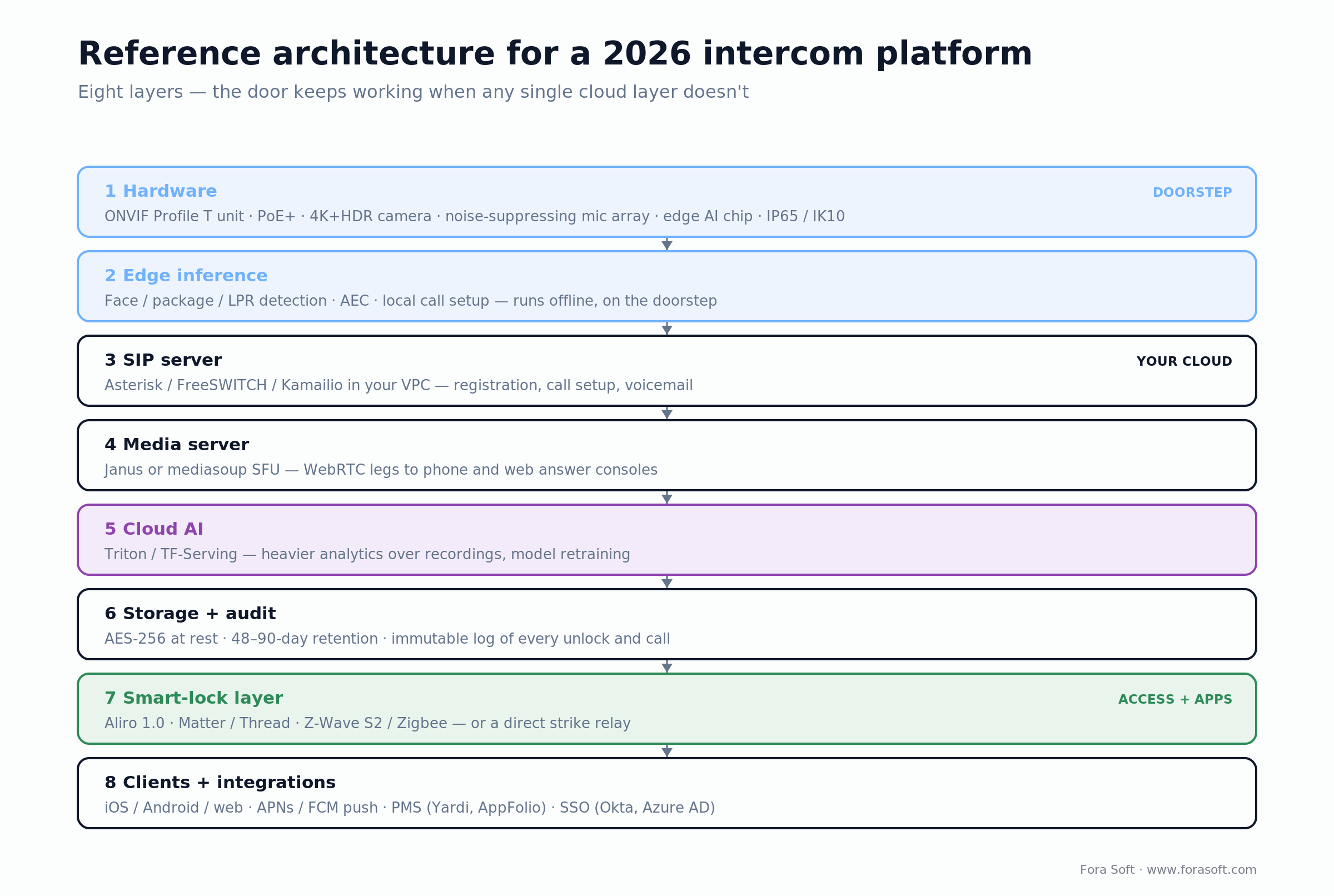
Figure 3. The eight layers, grouped into doorstep, your cloud, and access-plus-apps. Layers 1–2 run offline; layers 3–6 live in your VPC; the door release and clients sit on top.
1. Hardware. An ONVIF Profile T outdoor unit with PoE+, a 4K + HDR camera, a noise-suppressing mic array, an IP65/IK10 rating, and an edge AI accelerator on board.
2. Edge inference. Face, package, and plate detection, echo cancellation, and local call setup — the parts that must survive a WAN outage.
3–4. SIP and media servers. Asterisk, FreeSWITCH, or Kamailio for registration and call setup; Janus or mediasoup as the SFU for WebRTC client legs, hosted in your VPC.
5–6. Cloud AI and storage. Heavier analytics over recordings, plus AES-256-at-rest storage, 48–90-day retention, and an immutable log of every entry and call.
7–8. Smart-lock layer and clients. Aliro, Matter/Thread, Z-Wave/Zigbee, or a strike relay; then native iOS/Android and web clients, push, property-system and SSO integrations. For the mobile side, see our Android smart intercom guide.
Vendor comparison matrix (2026)
An indicative side-by-side of the hardware and platforms most custom intercom software integrates with. Verify pricing on each vendor’s site before you commit; the ranges below are typical street prices, not quotes.
| Vendor | SIP / ONVIF | AI on edge | Hardware $ | Cloud $/door/mo | Best for |
|---|---|---|---|---|---|
| 2N (Axis) | Yes / Yes | Optional | $350–$650 | $8–$15 | Enterprise / MDU, open API |
| Akuvox | Yes / Yes | Yes (face / package) | $120–$350 | $6–$12 | Small–mid buildings |
| DoorBird | Yes / Yes | Limited | $180–$400 | $0–$10 | Premium retrofit |
| Aiphone (IX/IXG) | Yes (newer SKUs) | Limited | $250–$700 | Varies | US federal (NDAA-safe) |
| Swiftlane / ButterflyMX | Partial (cloud-first) | Yes (cloud) | $300–$1,000 | $5–$13 | Turnkey multifamily SaaS |
| Ring / Nest / Eufy | No / No | Yes (cloud) | $100–$300 | $4–$10 | Single-family residential |
Reach for turnkey SaaS (Swiftlane, ButterflyMX) when: you want a finished product and can live inside its cloud. Reach for a custom platform on open hardware (2N, Akuvox) when you need to own the data, mix brands, or integrate systems the SaaS won’t.
Cost model: a 100-unit MDU rollout in 2026
A 100-unit residential building is the line where custom intercom software starts to pay back. Here’s the back-of-envelope using 2026 list prices, with real arithmetic rather than a single made-up total.
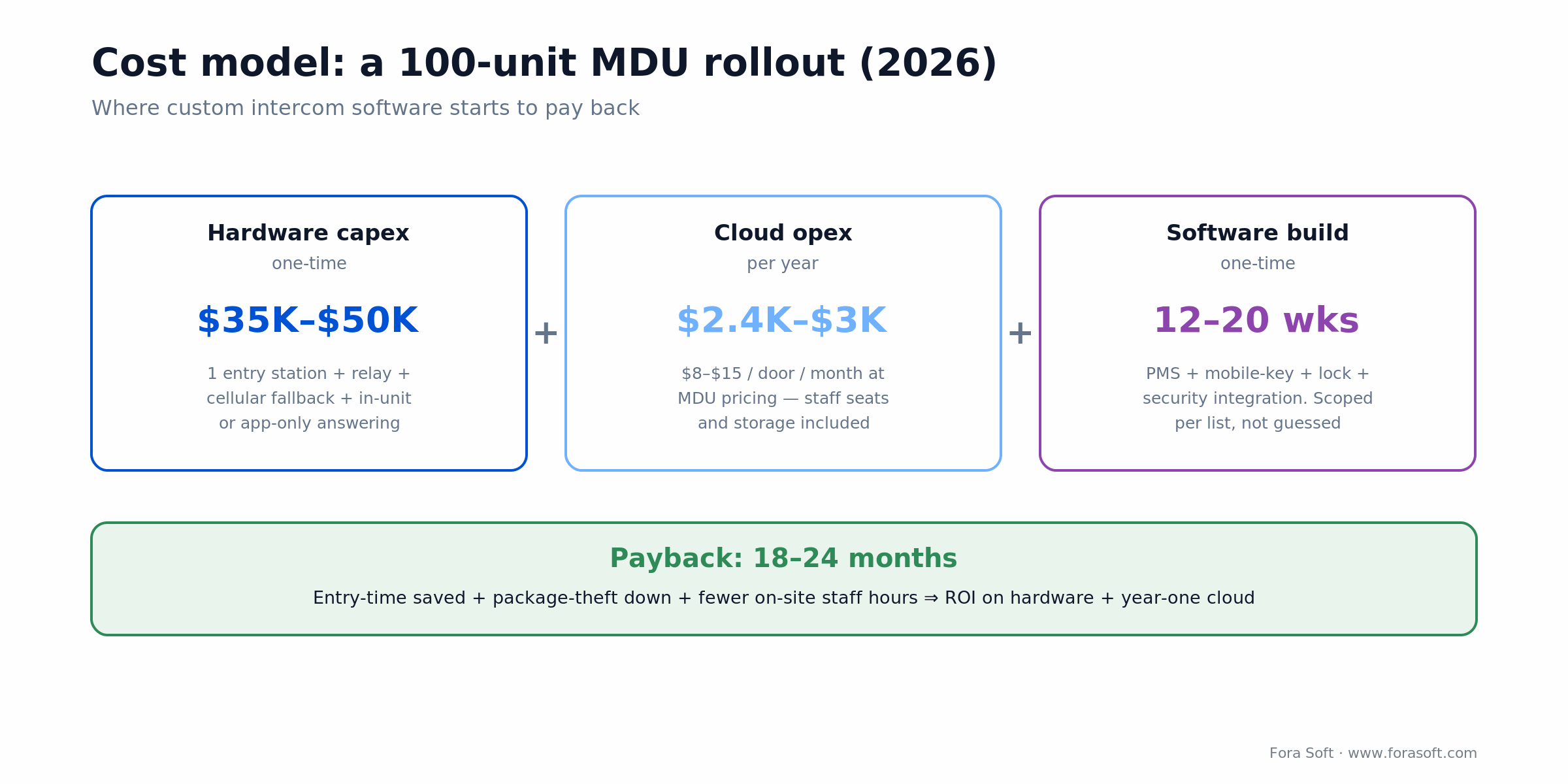
Figure 4. The three cost buckets for a 100-unit building and where they pay back. Hardware is one-time, cloud is a small yearly line, and the build is scoped per integration list rather than guessed.
1. Hardware. One outdoor entry station, a relay box, cellular fallback, plus in-unit answer screens or app-only answering. A mid-market spec lands around $35K–$50K of one-time hardware for the building.
2. Cloud subscription. At $8–$15 per door per month on MDU pricing, a 100-unit building runs roughly $200–$250 a month once you include staff seats and storage — about $2.4K–$3K a year.
3. Custom software layer. A platform that ties into the property system, mobile keys, smart locks, and the building’s existing security stack typically runs 12–20 weeks of build. We don’t put a number on it without the integration list — any range here would be off by 40% in one direction or the other. Our Agent Engineering loop compresses that build, so we usually come in below legacy benchmarks.
4. Payback. Faster entry, fewer package-theft claims, and reclaimed on-site staff hours typically return the hardware and first-year cloud spend in 18–24 months.
Mini case: rebuilding an IP-camera platform with Netcam Studio
Our work on Netcam Studio ran into the classic problem behind every intercom platform: dozens of camera vendors, uneven ONVIF behavior, and a desktop-grade interface that fell over as camera counts grew.
We built the web version and redesigned the interface: a normalized ONVIF discovery flow across mixed-vendor cameras, a grid multi-camera dashboard, and rule-based motion and sound detection that fires email, SMS, and recording actions. The product is known in its community for low CPU use next to competing NVR software — the same efficiency discipline that matters when a building runs dozens of door and hallway streams at once.
The lessons carried straight into MDU intercom work: normalize the ONVIF layer so mixed hardware behaves, route per tenant, and design an interface staff can run after a 30-minute handover rather than a week of training. Want a similar audit of your current intercom stack?
A decision framework — pick your platform in five questions
Five questions take you from a single door to a custom MDU platform. Answer them in order and the shortlist writes itself.
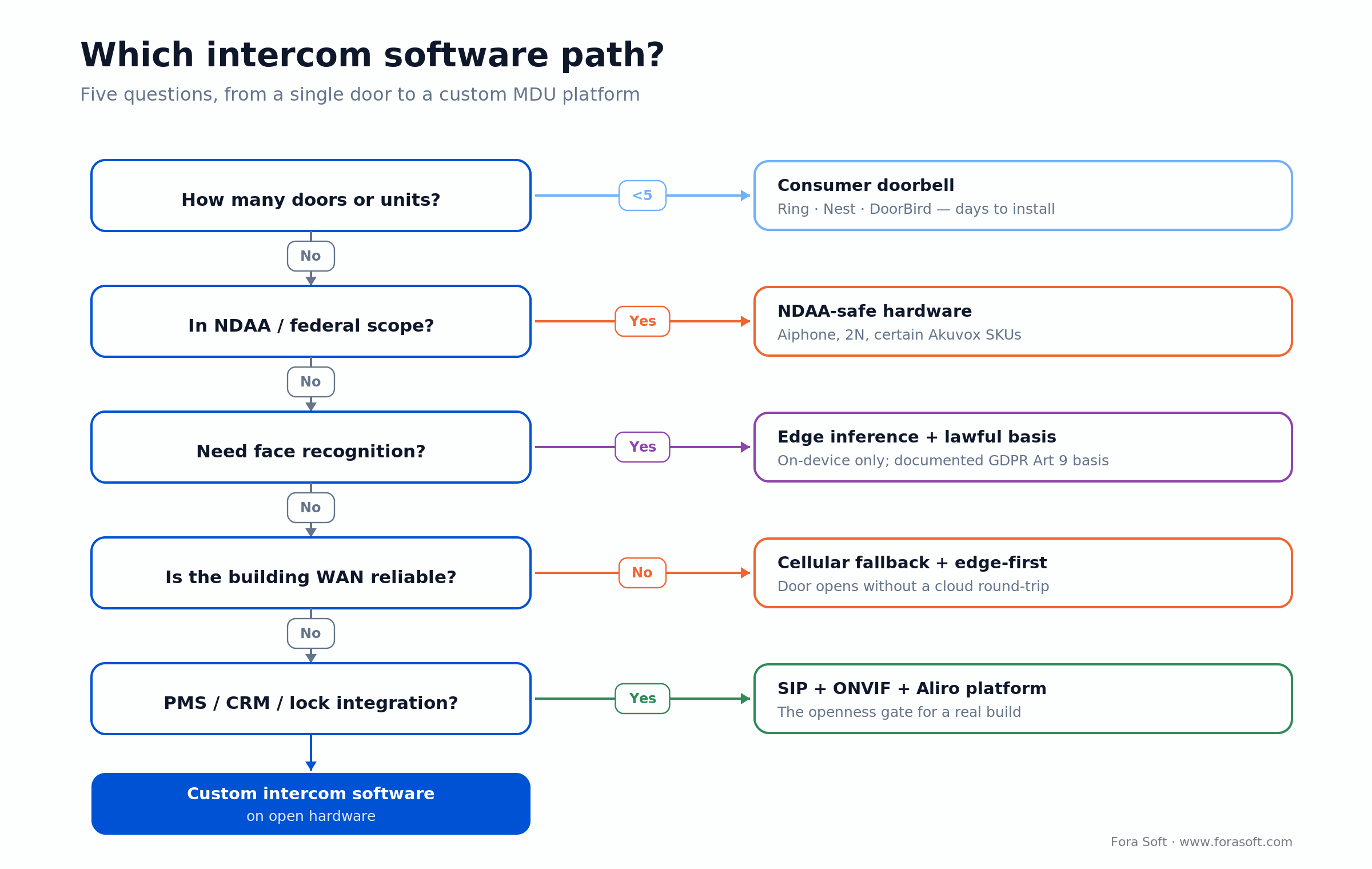
Figure 5. Follow the “No” branch down the stem; each “Yes” peels off a decision. Anything that reaches the bottom is a custom software build on open hardware.
Q1. How many doors or units? Under 5, a consumer doorbell. 5–50, commercial-grade hardware with light SaaS. 50–500, an MDU platform with property-system integration. 500+, custom software on commercial hardware.
Q2. Are you in NDAA / federal scope? Yes means Aiphone, 2N, or certain Akuvox SKUs. No opens the full vendor universe.
Q3. Do you need face recognition? Yes means on-device inference and a documented GDPR Article 9 basis. No means face detection only, which keeps you under Article 6.
Q4. Is the building’s WAN reliable? Yes and cloud-first is fine. No and you demand cellular fallback plus edge-first call setup.
Q5. Do you need property-system, CRM, or smart-lock integration? Yes and SIP + ONVIF + Aliro is the openness gate. No and a closed consumer platform can work.
Five pitfalls that kill intercom projects
1. Single-vendor lock. Proprietary protocol, proprietary cloud, proprietary app. Fine for a five-door deployment, lethal for a 500-unit one. Insist on SIP and ONVIF interoperability from the start.
2. No WAN fallback. The building loses internet and residents can’t get in. Every multi-tenant deployment must specify cellular backup or local-only call routing as a fallback path.
3. Weak encryption. TLS 1.3 on signaling, SRTP on media, AES-256 on storage. Anything older is a 2026 audit failure waiting to happen.
4. No audit trail. Every entry, every call, every override has to be logged immutably. Compliance regulators will ask, and so will an insurer after the first incident.
5. NDAA blind spot. Hikvision, Dahua, ZTE, and Huawei components disqualify a system from US federal sites and a growing list of state deployments. Verify the supply chain before you commit.
KPIs to track from the first sprint
Quality KPIs. Call-setup p95 (target under 2 seconds), false-alarm rate (target under 1 per door per day), face/package detection precision (target at or above 0.9), and audio clarity MOS (target 4.0 or better).
Business KPIs. Average answer time (target under 15 seconds), package-theft incidents (target 30%+ reduction), staff hours per move-in and move-out, and monthly active users on the resident app.
Reliability KPIs. Door uptime (target 99.95%+), WAN-fallback activations per month, cellular failover success rate (target 99%+), and tamper-event response time.
Compliance: GDPR, EU AI Act, NDAA, HIPAA, EN 81-28
1. GDPR Articles 6 and 9. Article 6 covers the lawful basis — legitimate interest is typical for building access. Article 9 restricts biometric processing for identification without explicit consent or a narrow exemption. Face recognition almost always lands under Article 9; face detection usually doesn’t.
2. EU AI Act. The Act is in force, with the AI Office and member states enforcing from 2 August 2026. Under the May 2026 “Digital Omnibus” deal, standalone high-risk obligations for biometric systems were pushed to 2 December 2027, and real-time remote biometric identification stays restricted to narrow, notified law-enforcement uses. Plan documentation and human-oversight now; see the European Commission’s AI Act page.
3. CCPA. California residents get a privacy notice and a right to delete; visitor footage counts as personal information.
4. NDAA Section 889. US federal contracts forbid covered Chinese-origin components. Vet the hardware bill of materials before, not after, the award.
5. HIPAA and EU safety standards. Healthcare facilities need a Business Associate Agreement with any cloud processor and encryption at rest. In Europe, a lift car’s emergency communication follows EN 81-28, and building voice-alarm and evacuation systems follow EN 54-16 and EN 50849 (which replaced the older IEC/EN 60849) — both relevant wherever the intercom ties into a regulated lift or fire panel.
When NOT to build a custom intercom platform
Three situations where buying off-the-shelf is the honest answer.
1. Single-family or small-business doors. Ring, Nest, DoorBird, and Eufy ship in days for under $10 a month. Custom is overkill and you’ll feel it in the invoice.
2. Standardized hospitality with an existing ecosystem. Major hotel groups already have intercom-and-mobile-key partners. Plug into the existing property system rather than rebuilding a platform they won’t certify.
3. No team for ongoing ops. Intercom platforms drift — firmware, integrations, model updates. Without a DevOps and MLOps cycle, a clean launch degrades within six months. If you can’t commit the team, partner with someone who can, or buy SaaS instead.
Ready to ship a smart intercom platform that holds up in production?
Two decades of multimedia delivery, 250+ shipped products, deep work in VALT, Netcam Studio, and ProVideoMeeting. Tell us your unit count and integration list and we’ll bring an architecture diagram to the first call. We also run the surrounding video-surveillance and AI-integration work.
FAQ
What is intercom software, and how is it different from an intercom system?
Intercom software is the layer that handles the call, routes it, decides who gets in, releases the door, and logs the event. The intercom system is the whole package — door station, wiring, and software together. In 2026 the software is where the value sits: SIP/WebRTC calling, edge-AI detection, multi-tenant routing, and smart-lock integration.
Is 4K worth it, or is 1080p enough?
Pick 4K only if the hardware also ships HDR and a lens that resolves to it. Without HDR, 1080p is more useful for face and plate identification. Pixel count without HDR is a marketing number.
Is SIP still relevant for a cloud or WebRTC-only platform?
Yes, even more so. SIP lets the intercom interoperate with the building’s PBX, with hosted carriers like Twilio, and with third-party systems. WebRTC handles the client leg; SIP handles the trunk leg. Most production stacks ship both.
Should AI inference run on the device or in the cloud?
On-device for face, package, animal, and plate detection — latency, privacy, and offline resilience all favor the edge. The cloud is the right place for heavier analytics over recordings, model retraining, and aggregated reporting. The hybrid split is now the default.
What is Aliro, and does it replace Matter or Z-Wave for locks?
Aliro is a 2026 access-control standard from the group behind Matter, giving locks a common credential that lives in Apple, Google, and Samsung wallets with NFC, BLE, and UWB. It doesn’t replace Matter or Z-Wave overnight — it standardizes the phone-as-key experience. For a new build, ask vendors for their Aliro roadmap; for current deployments, Z-Wave and Matter are still the pragmatic choices.
Can we still use Hikvision or Dahua intercom hardware?
For US federal contracts, no — NDAA Section 889 prohibits covered components. Outside the US most regulators still allow it, but state-level rules are tightening. We usually recommend NDAA-safe hardware (Aiphone, 2N, certain Akuvox SKUs) to keep the expansion path open.
What’s the cheapest viable intercom stack for an MVP?
A DoorBird or Akuvox unit, a hosted SIP trunk (Twilio), and a thin custom mobile app. Hardware under $400 a unit, hosted SIP under $50 a month, plus the app. Move to a self-hosted media server only when concurrent answer volume justifies it.
Do AI receptionists actually save time at the front desk?
In commercial and hospitality deployments, an LLM-backed greeting and routing layer cuts misroutes by 40–60% and frees staff for higher-value work. The savings are smaller in pure residential. Pilot with one building and measure before rolling out fleet-wide.
What to read next
Features
12 Must-Have Video Intercom Features in 2026
A deeper dive into the protocol-by-protocol feature set with a security focus.
AI & IoT
Smart Intercom Systems 2026: AI, IoT, Software Architecture
Where AI and IoT push intercom design over the next 24 months.
Android
Ultimate Guide: Android Smart Intercom Systems
Building the Android side of a smart intercom platform end to end.
Analytics
Data Analytics in Smart Intercoms
KPIs, architecture, and compliance for the analytics behind the door.
VMS
12 Essential Features of Modern VMS Software
The VMS layer the intercom plugs into for recording and analytics.
Ready to ship intercom software customers actually trust?
Pick by deployment shape, not by feature poster. Single-family lives on Ring or Nest. MDU and hospitality demand SIP, ONVIF, Aliro, edge AI, multi-tenant routing, property-system integration, and a real audit trail. Healthcare and US federal add HIPAA and NDAA on top. The platform is always a stack, never a single product.
Plan for cellular WAN fallback, edge inference, and a compliance posture that survives GDPR Article 9, CCPA, NDAA, and the EU AI Act. Optimize for door uptime and resident answer time, not for a cloud feature checklist. If you want a partner that has shipped exactly this combination — across 770+ surveillance organizations, with Agent Engineering compressing the build — that’s what we built Fora Soft to do.
Want a two-page architecture brief and a real estimate?
Send us your unit count, region, integration list, and compliance footprint. We’ll come back within two business days with a hardware shortlist, a software architecture, and a realistic price range.

