

Key takeaways
• Secure cloud video management in 2026 is a layered architecture problem. Edge encryption + TLS 1.3 transport + at-rest AES-256 + RBAC + audit logs — miss any layer and you have a vulnerability.
• EU AI Act biometric rules are already in force. Real-time public biometric ID is banned outright (Article 5, since 2025); other biometric ID on a VMS is high-risk, with those duties deferred to 2 December 2027 by the 2026 Digital Omnibus. Fines reach €35M or 7% of global turnover.
• HIPAA, GDPR, FERPA, and BIPA each shape the data plane differently. Vendors who can’t map your jurisdiction list to a documented compliance posture will leak data.
• Custom secure cloud VMS builds run $80–280k MVP with Agent Engineering compression, plus 15–20% ops per year. Verkada and Genetec licensing usually undercut that for <250 cameras and lose past 500.
• Use this article as a buyer’s checklist. Real architecture, real numbers, the VALT 12-year case study, and a 5-question framework for picking a partner who actually ships secure systems.
If you’re scoping a secure cloud video management system in 2026 — for retail, schools, healthcare, courts, banking, smart cities, or critical infrastructure — the security architecture is the project. Treat it as an afterthought and you’ll either fail an audit or breach. Treat it as the central design constraint and you’ll ship a system that earns trust from day one. This rewrite is the briefing we hand new clients on day one of a secure cloud VMS engagement.
We’re Fora Soft. Since 2005 we’ve shipped 250+ video and surveillance products for clients including VALT (770+ US organizations, 50,000+ users, recognised by US police, courts, and child advocacy centres) and Mindbox (50+ deployments since 2020, 99.5%+ face ID with anti-spoofing, 500,000+ ANPR plates a day across India). Both run secure cloud VMS plumbing in production. Numbers below come from those builds.
Why Fora Soft wrote this secure cloud VMS playbook
VALT is a HIPAA-compliant cloud VMS used by US police forensic interview rooms, child advocacy centres, and medical institutions. It’s an audit-grade system that can’t leak. Mindbox is its AI-augmented sibling: face ID, ANPR, anomaly detection layered into a multi-tenant VMS for smart-city and retail security. Together they cover the credible spectrum of secure cloud VMS use cases. The lessons we share below come from more than a decade of audits, breaches narrowly avoided, and the kind of regulatory paperwork that sharpens an architecture team.
Companion reads we maintain on this surface: the AI video surveillance software development playbook, our 2025 surveillance vendor matrix, the ONVIF profiles deep-dive, and the custom video surveillance solutions guide.
Need a secure cloud VMS partner with audit-grade pedigree?
Tell us your jurisdiction list, camera count, and compliance scope. We’ll quote a fixed range, document the compliance posture, and walk you through VALT-class security architecture in 30 minutes.
Cloud VMS fundamentals: what you’re actually buying
A modern cloud video management system has five functional layers: camera ingest (typically ONVIF Profile S/T over RTSP), edge processing (Jetson Orin / Hailo / on-camera firmware), cloud control plane (signaling, recording, indexing), VMS application (live view, search, playback, alerts), and integration layer (access control, alarm panels, SIEM, analytics). Each layer has its own security requirements; treating them as a single “cloud VMS” without breaking the layers down is how compliance gaps creep in.
The cloud part is what makes the system useful: centralised management, remote viewing, multi-site dashboards, search across thousands of cameras. The cloud part is also what makes it dangerous: data egress, multi-tenant attack surface, and a thicket of compliance regimes (HIPAA, GDPR, FERPA, BIPA, EU AI Act, SOC 2). The right architecture treats every cloud-touching surface as a potential breach point and instruments it accordingly.
Reach for cloud VMS over on-prem when: you have multiple sites, distributed admins, mobile/web access requirements, or AI features that benefit from cloud GPU. For single-site, air-gapped deployments, on-prem VMS still wins on simplicity and cost.
The 2026 secure cloud VMS security framework
A defensible secure cloud VMS in 2026 layers eight security controls. Skip any one of them and you have a documented vulnerability that auditors will catch.
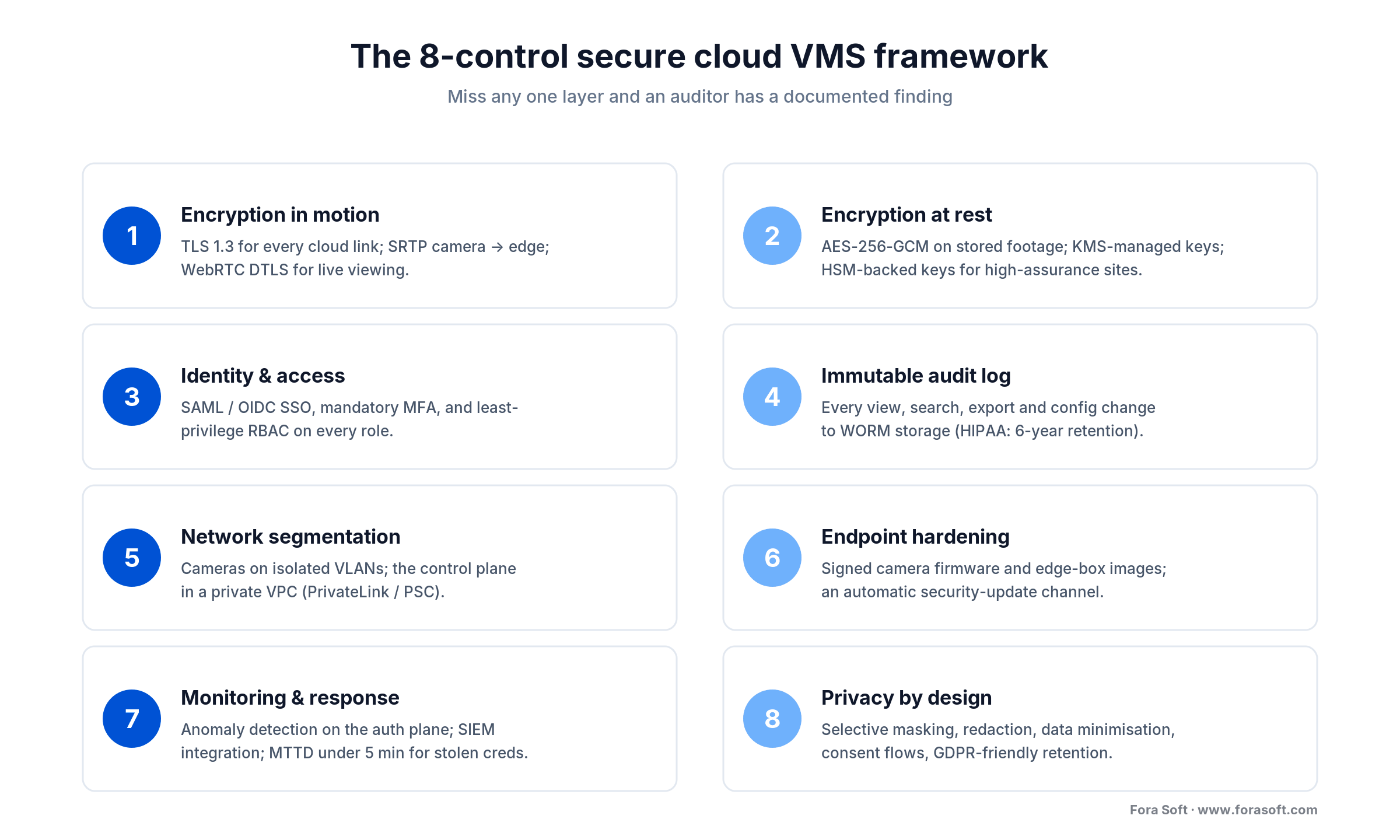
Figure 1. The eight controls a 2026 audit expects to see — skip one and it becomes a documented finding.
1. Encryption in motion. TLS 1.3 for every cloud connection. SRTP for camera-to-edge. WebRTC DTLS for live viewing.
2. Encryption at rest. AES-256 on all stored footage. KMS-managed keys (AWS KMS, GCP KMS, Azure Key Vault). Hardware Security Modules for high-assurance deployments.
3. Identity and access management. SAML/OIDC SSO, multi-factor authentication mandatory, role-based access control with principle of least privilege.
4. Audit logging. Immutable audit trail of every view, search, export, and configuration change. WORM-storage retention per regulatory regime (HIPAA: 6 years).
5. Network segmentation. Cameras on isolated VLANs, edge boxes behind firewalls, cloud control plane in dedicated VPC with private connectivity (AWS PrivateLink, GCP Private Service Connect).
6. Endpoint hardening. Hardened camera firmware, signed edge-box images, automatic security update channel.
7. Monitoring and incident response. Real-time anomaly detection on the auth and access plane, SIEM integration, on-call playbooks, MTTD <5 min for credential abuse.
8. Privacy by design. Selective masking, redaction tooling, data minimisation, consent flows where required, GDPR-friendly retention schedules.
Compliance regimes: HIPAA, GDPR, FERPA, BIPA, EU AI Act
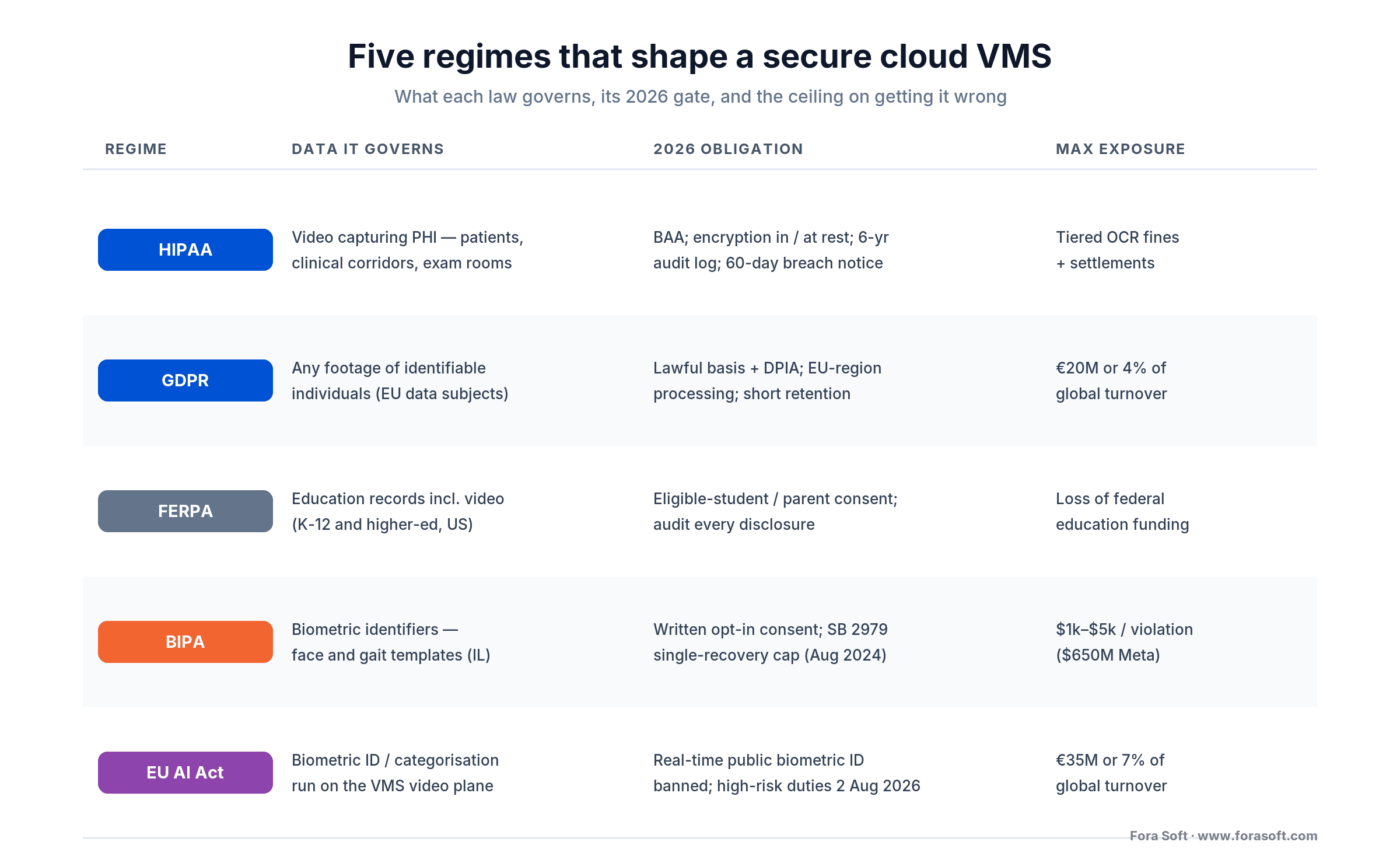
Figure 2. Five regimes, what each governs, its 2026 obligation, and the ceiling on penalties.
HIPAA. Video that captures PHI (patient interactions, hospital corridors with identifiable patients) requires a Business Associate Agreement, encryption in motion and at rest, audit logs with 6-year retention, breach notification within 60 days. We default to AWS HIPAA-eligible services and a written architecture review.
GDPR. Video footage of identifiable individuals is personal data. Lawful basis (consent, legitimate interest, legal obligation) must be documented. Cross-border data transfer triggers adequacy questions. EU regulators push for on-prem processing or EU-region cloud, 30-day default retention windows, and Data Protection Impact Assessments (DPIAs) before deployment.
FERPA. Educational records in K-12 and higher-ed include video. Parental consent for minors, student consent for over-18s, encrypted access logs, audit trails for every viewing.
BIPA (Illinois). Biometric identifiers (face, gait) require written opt-in consent, a public retention schedule, and audits. Statutory damages are $1,000 (negligent) or $5,000 (reckless) per violation; the 2024 SB 2979 amendment limits repeat scans of the same person to a single recovery (the 7th Circuit held it retroactive in April 2026). Landmark settlements have reached $650M (Meta) and $100M (Google).
EU AI Act. Real-time remote biometric identification in public spaces for law enforcement is prohibited under Article 5 (in force since February 2025, narrow exceptions only). Other remote biometric ID and biometric categorisation are high-risk under Annex III: documented risk mitigation, human oversight, audit trails, post-market monitoring, and technical documentation under Article 11. The 2026 Digital Omnibus (Council-approved 29 June 2026) deferred those high-risk obligations from 2 August 2026 to 2 December 2027 — but the Article 5 prohibitions still apply today. Fines run to €35M or 7% of global turnover for prohibited uses, €15M or 3% for other breaches.
Reach for a documented compliance posture review when: the deployment touches any of HIPAA, GDPR, FERPA, BIPA, or EU AI Act. Vendors who treat compliance as a checkbox list will produce a system that fails audit on day 60.
Reference architecture for a 2026 secure cloud VMS
The architecture below is the same shape we run for VALT and Mindbox. It scales from 50 cameras to 50,000 with predictable cost, and it is the backbone of our video surveillance software development.
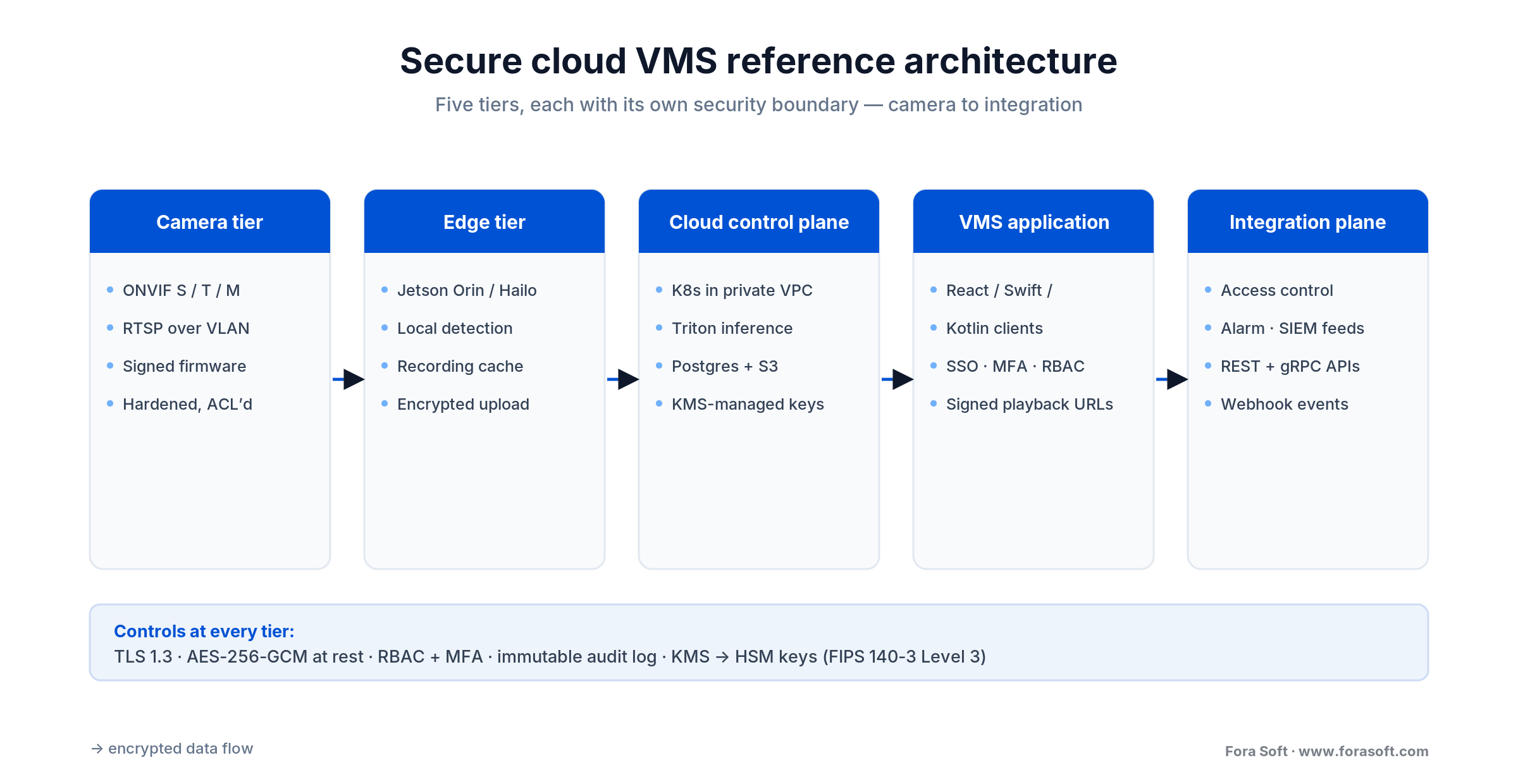
Figure 3. The five-tier reference architecture we run for VALT and Mindbox, with a security boundary at each tier.
Camera tier. ONVIF Profile S/T/M cameras over RTSP. ACL on the camera VLAN. Hardened firmware with signed update channel. We covered the protocols in our ONVIF profiles guide.
Edge tier. Jetson Orin Nano or Hailo-8 boxes co-located with the camera switch. Local detection (object, anomaly), local recording cache, encrypted upload triggers to the cloud. Compromised edge boxes can’t reach beyond the camera VLAN.
Cloud control plane. Kubernetes cluster on AWS / GCP / Azure with private connectivity. Triton Inference Server for AI. PostgreSQL for metadata, Elasticsearch for event search, S3-compatible object storage with bucket-level encryption and lifecycle policies. KMS-managed keys.
VMS application. Web (React) and mobile (Swift/Kotlin) clients. SAML/OIDC SSO, MFA, RBAC. WebRTC for live view, signed URLs for playback. Watermarked exports for chain-of-custody.
Integration plane. REST and gRPC APIs to access control (HID, Lenel), alarm panels, SIEM (Splunk, Datadog), MCP servers for AI agents. Webhook-driven event flows.
Want this architecture diagrammed against your scope?
Send us your camera count, jurisdictions, and integration list. We’ll walk through the security controls, compliance posture, and quote a fixed-range estimate in 30 minutes.
Encryption and key management deep-dive
Encryption is the most-quoted security control and the most often misimplemented. The pattern that works in 2026: TLS 1.3 with strong ciphers (AES-GCM, ChaCha20-Poly1305) for every cloud connection; AES-256-GCM for stored footage with KMS-managed keys; envelope encryption (data key wrapped by master key) so master keys never leave the HSM. AWS KMS delivers FIPS 140-3 Level 3 keys behind a clean API (it reached 140-3 in February 2025); GCP Cloud HSM and Azure Managed HSM provide FIPS 140-2 Level 3 tiers.
For high-assurance scenarios (banking, courts, intelligence), step up to dedicated HSMs (CloudHSM, Thales, nCipher) and customer-managed keys with documented rotation schedules. Client-side encryption is valuable when you don’t trust the cloud provider's threat model — the trade-off is you lose server-side search and analytics.
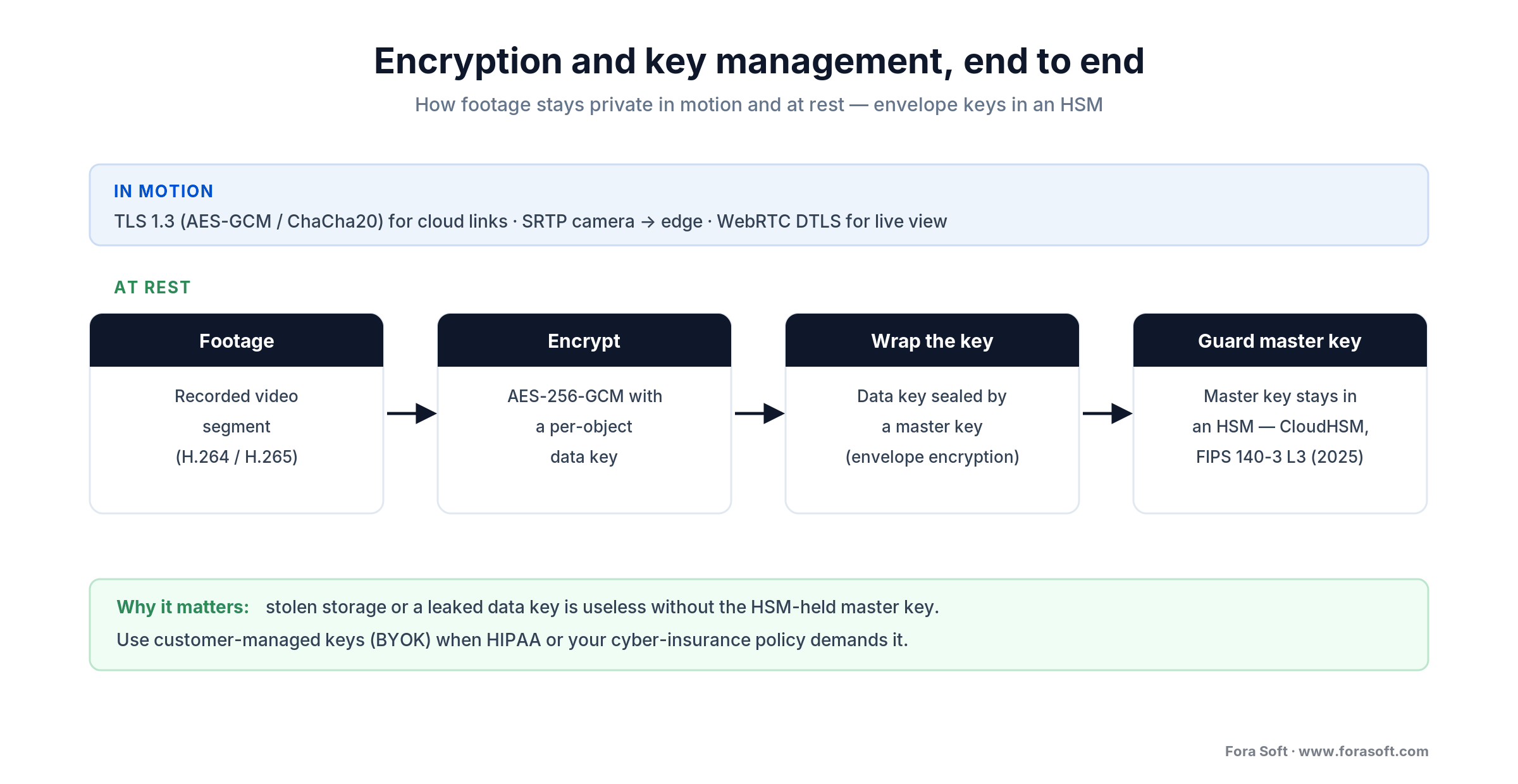
Figure 4. Encryption in motion and at rest, with envelope keys guarded by a FIPS 140-3 Level 3 HSM.
Reach for customer-managed keys when: regulatory regime explicitly requires it (HIPAA, certain GDPR member-state interpretations) or your insurance carrier’s cyber policy demands it. Otherwise KMS-managed keys are the right default.
Vendor matrix: secure cloud VMS options in 2026
| Vendor | Best for | Compliance posture | Watch-outs |
|---|---|---|---|
| Verkada | SMB / mid-market multi-site | SOC 2; HIPAA on enterprise | Hardware lock-in; subscription tax |
| Genetec Security Center | Enterprise multi-system | Strong compliance program | Heavy install; per-camera licensing |
| Milestone XProtect | Camera-agnostic VMS | Maturity; broad regulatory work | UI dated; AI add-ons fragmented |
| Eagle Eye Networks | Cloud-managed multi-site | SOC 2; HIPAA-eligible plans | AI features lighter than peers |
| Custom (Fora Soft VALT/Mindbox) | Branded, regulated, large fleets | Tailored: HIPAA / FERPA / GDPR / EU AI Act | Higher upfront; needs ops |
AI integration into a secure cloud VMS
2026 buyers expect AI on top of the secure VMS plane: object detection, anomaly detection, face / plate recognition, natural-language search via CLIP, automated summarisation via VLMs. Each AI feature adds compliance vectors (BIPA for biometrics, EU AI Act high-risk for biometric ID, GDPR consent flows for face templates). Architect them in from day one or pay later.
The pattern we use in Mindbox: AI inference in segregated cloud GPU pools with KMS-encrypted model artifacts; face-template storage in a separate database with its own access controls and retention; opt-in consent flows wired into the camera registration step; documented EU AI Act risk mitigation per deployment. Adding AI to an existing secure cloud VMS typically runs $40–90k for the analytics pipeline plus $10–30k for the compliance scaffolding. For the model side — detectors, trackers, OCR, anomaly nets — see our AI for video engineering guide; wiring it into a VMS is our AI integration work.
Cost model: what a secure cloud VMS actually costs in 2026
| Build shape | MVP cost | Timeline | Notes |
|---|---|---|---|
| Cloud VMS for 50–100 cameras (single tenant) | $80–160k | 12–18 weeks | Web + mobile + recording + RBAC |
| Multi-tenant SaaS VMS | $160–320k | 18–28 weeks | Branded, white-label, multi-org |
| HIPAA cloud VMS | $110–220k | 14–22 weeks | BAA, audit trail, HIPAA AWS |
| EU AI Act high-risk biometric | $140–280k | 16–26 weeks | DPIA + audit + human oversight |
| VMS frontend over Genetec/Milestone | $40–90k | 10–14 weeks | When licensing makes sense |
Numbers run ~25–30% under 2024 baselines because Agent Engineering compresses the secure scaffolding (auth, audit, RBAC, encryption plumbing) we used to write by hand. Steady-state ops typically lands at 15–20% of build cost per year.
Build vs buy: when does custom secure cloud VMS pay back?
A simplified five-year TCO comparison for a 200-camera secure cloud VMS deployment. We assume Verkada-class subscription at ~$30/camera/month for the platform plus storage tier (~$72k/year), vs a custom build (~$300k) with steady-state ops at ~$8/camera/month equivalent (~$20k/year). These are illustrative figures, not a quote.
Year 1: SaaS $72k; custom $300k build + $20k ops = $320k — SaaS wins decisively. Year 3: SaaS $216k, custom $360k. Year 5: SaaS $360k, custom $400k — near parity. The lines cross around year 6 ($300k + $20k×n = $72k×n solves at n ≈ 5.8), and from there custom is cheaper and owns the IP. At 500 cameras the subscription scales linearly to ~$180k/year while custom ops grows slowly, so breakeven drops to about year 3.
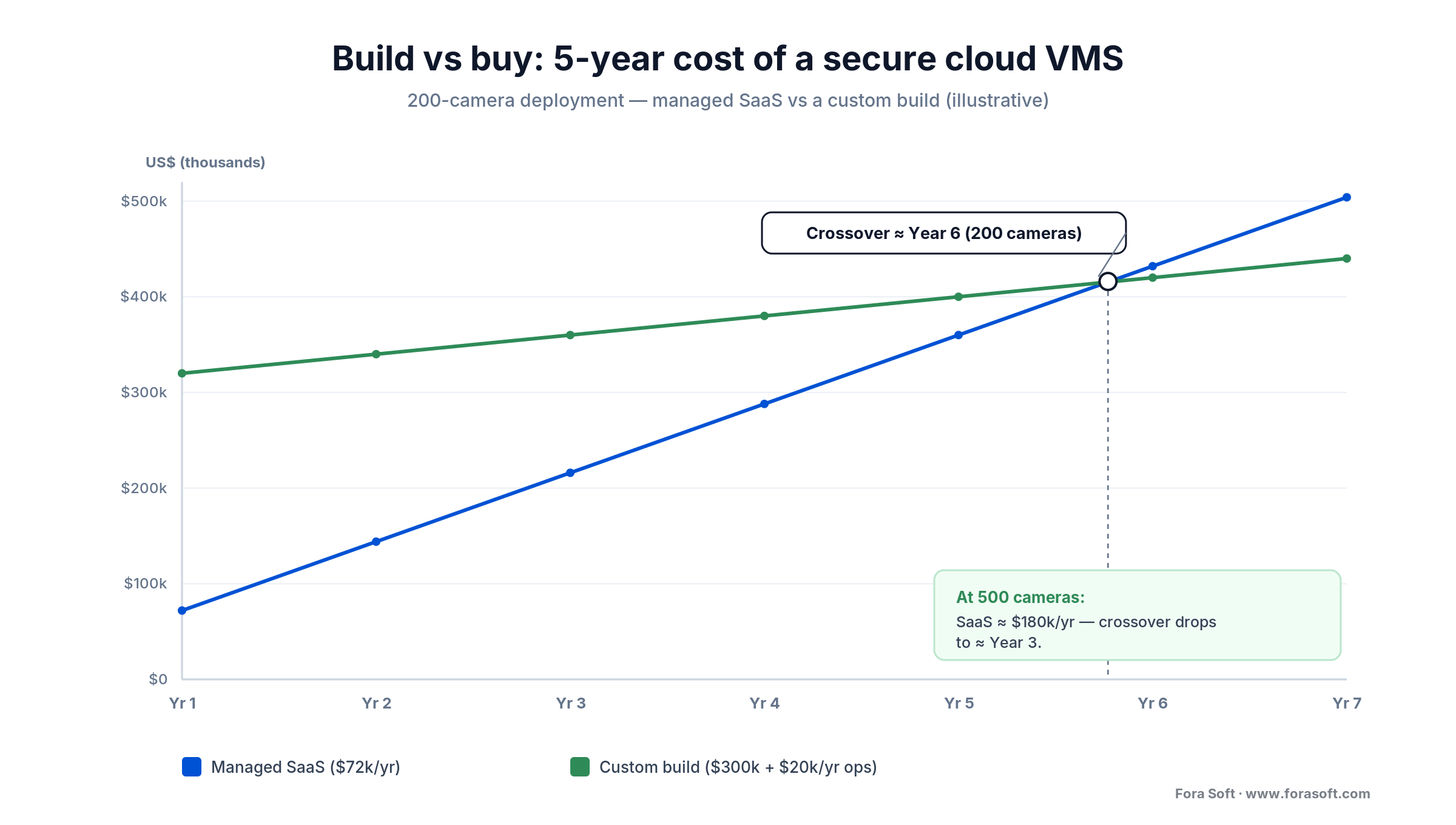
Figure 5. A 200-camera cost model — managed SaaS crosses over a custom build around year six (illustrative).
Add the compliance dimension: if EU AI Act, BIPA, or jurisdiction-specific data residency rule out cloud SaaS, custom is the only path regardless of cost. We’ve seen multiple Verkada-evaluating buyers move to custom solely because Verkada’s data residency couldn’t satisfy a German DPA review.
VALT: a decade of secure cloud VMS in production
VALT is our long-running secure cloud VMS used by US police, courts, child advocacy centres, and medical institutions. First-party stats: 770+ US organizations, 50,000+ users, HIPAA/GDPR-compliant, with our team as sole developers for 10+ years. VALT grew from $1M in revenue its launch year to $8M within five years, was named the 4th fastest-growing tech company in Wisconsin in 2019, and shipped VALT 6.5 in 2025. The architecture: HD camera ingest, hybrid cloud + on-prem deployment, HIPAA-friendly stack, watermarked exports for chain-of-custody, immutable audit trail. The use cases are precisely the ones where a security failure has career-ending consequences for the operator — forensic interviews, child protective services, medical evidence.
What 12 years of running this product taught us: the compliance posture is the architecture, not a feature. Encryption in motion, encryption at rest, MFA, RBAC, immutable audit trail — these aren’t add-ons. They’re the spine. On VALT we haven’t had a breach or failed an audit, and we keep adding features (text-search via STT, AI-assisted indexing, automated chain-of-custody) on the same secure foundation. See the VALT project page and the full VALT retrospective.
Mini case: Mindbox — AI-augmented secure cloud VMS at city scale
Mindbox layers AI on top of the secure cloud VMS pattern: 99.5%+ face ID accuracy with anti-spoofing, ~95% ANPR accuracy on 500,000+ plates a day across 50+ deployments (transport, pharma, gated communities) since 2020, and real-time anomaly detection. The security architecture is the same VALT-derived stack, with additional controls for the biometric layer: opt-in consent flows, BIPA-aware logging, EU AI Act-ready compliance documentation, segregated face-template storage with KMS-managed keys.
The lesson: AI augmentation doesn’t weaken the security posture if you architect it from the start. It does add new compliance vectors (BIPA, EU AI Act high-risk), each of which needs documented mitigation. Want a similar architecture session against your scope? The deeper write-up is in our Mindbox playbook.
A decision framework: pick a secure cloud VMS partner in five questions
1. What’s your camera count, sites, and tenant model? Below 250 cameras / single tenant, Verkada or Eagle Eye usually wins. Above 500 cameras or multi-tenant SaaS, custom on a VALT-class stack pays back inside 18–24 months.
2. Which compliance regimes apply? HIPAA, GDPR, FERPA, BIPA, EU AI Act, SOC 2 — each one shapes the architecture. Vendors who can’t produce a written compliance posture per deployment aren’t credible.
3. Cloud, on-prem, or hybrid? Hybrid wins for most multi-site deployments. Pure cloud wins for low-camera-count remote organisations. Pure on-prem wins for air-gapped, ultra-sensitive scenarios.
4. What’s the integration footprint? Access control, alarm panels, SIEM, IoT sensors, AI agents via MCP. If the partner can’t draw the integration plane on day one, you’ll pay for it on month three.
5. Have they passed an audit on a comparable system? SOC 2 Type II, HIPAA security risk analysis, GDPR DPIA — ask for redacted audit reports. Studios that haven’t done this before will learn on your project.
Want our scoring against those five questions?
VALT, Mindbox, NetCam — we’ll walk through shipped deployments, audit history, and quote a fixed-range estimate against your scope in 30 minutes.
How to spot a real secure cloud VMS partner
Generalists fail at secure cloud VMS because the engineering, security, and compliance muscles all need to fire at once. The on-call test we use:
1. Show me a redacted SOC 2 audit report or HIPAA risk analysis. If they don’t have one, they’ll learn on your project — and your audit fails.
2. Walk me through your KMS / HSM setup. Encryption at rest claims are everywhere; documented key management is rare. The right answer mentions envelope encryption, rotation schedule, and BYOK options.
3. Draw the EU AI Act compliance flow. Annex III high-risk classification, documented risk mitigation, human oversight, audit trails, post-market monitoring. The diagram either exists or doesn’t.
4. Show me the audit log schema. Every view, search, export, configuration change must be logged immutably. If the schema doesn’t exist, the audit log doesn’t either.
5. Name three regulated deployments they’ve passed audit on. Specifics, not aspirations. VALT’s 12-year track record across police, courts, and CACs is the kind of answer you want.
Reach for a security-first specialist when: the deployment touches regulated data. Generalists are fine for marketing video; they’re a liability for any system that needs to pass an audit.
Five pitfalls in secure cloud VMS development
1. Treating compliance as a feature. HIPAA, GDPR, EU AI Act — these shape the architecture. Bolting them on at the end always fails an audit.
2. Skipping immutable audit logs. Without WORM-storage audit trails, you can’t prove access patterns. Every regulated regime requires this.
3. Default-permitting access. RBAC must be principle-of-least-privilege. Default-allow access patterns leak via insider threats.
4. Cloud-only architecture for latency-sensitive sites. Industrial PPE, retail loss prevention, smart-city ANPR all benefit from edge-first. Round-tripping every frame to the cloud breaks the use case.
5. Forgetting export chain of custody. Watermarked exports, signed playback URLs, retention schedules — the moment a clip leaves the platform, it must be traceable — the job of a dedicated digital evidence management system. We’ve seen prosecutions fall apart on this point.
KPIs to track once you ship
Quality KPIs. Camera uptime (target ≥99.5%), VMS recording-success rate (≥99.9%), face/plate accuracy on site-specific validation set (≥95%), false-alarm rate per camera per day (<3).
Business KPIs. Mean-time-to-incident-resolution (target 25–40% below pre-AI baseline), cost per camera per month (target <$15 cloud-managed, <$8 hybrid), forensic-search time (target <5 s for natural-language queries).
Reliability + security KPIs. SOC 2 controls passed (target 100%), failed authentication attempts triaged (<5 min MTTD), data egress anomalies detected (<5 min), incident MTTR (target <1 hour for security incidents).
When NOT to use cloud VMS
If your camera count stays under ~50 at a single site, your network has limited upstream bandwidth, and remote viewing isn’t a use case, on-prem VMS still wins on simplicity and cost. Air-gapped scenarios (intelligence, military, high-secure forensics) explicitly forbid cloud connectivity. Some EU jurisdictions require on-prem processing for personal-data-heavy workloads.
Where cloud VMS truly pays off is multi-site deployments, mobile/web access, AI-augmented analytics, and any scenario where centralised audit logging is a regulatory requirement. Our custom software development services page maps the scope.
FAQ
What does a secure cloud VMS actually cost in 2026?
A focused 100-camera secure cloud VMS lands in the $80–160k range over 12–18 weeks. Multi-tenant SaaS variants run $160–320k. HIPAA adds $30–60k for the compliance scaffolding and audit. Steady-state ops at 15–20% of build cost per year. Numbers run ~25–30% under 2024 baselines because Agent Engineering compresses the secure scaffolding.
Is HIPAA possible on a cloud VMS?
Yes. We’ve run HIPAA-compliant cloud VMS through VALT for 12 years across police forensic units, child advocacy centres, and medical institutions. The pattern: AWS HIPAA-eligible services with a BAA, encryption in motion and at rest, KMS-managed keys, immutable audit logs with 6-year retention, breach-notification playbook, signed BAA chain through every subprocessor.
How does Verkada compare to a custom secure cloud VMS?
Verkada wins under ~250 cameras and single-tenant deployments on speed-to-deploy. Custom wins past 500 cameras, multi-tenant SaaS, brand-owned firmware, or specific regulatory regimes Verkada doesn’t support cleanly. The TCO crossover is usually 18–24 months. Custom also avoids hardware lock-in — you can run any ONVIF camera, not just Verkada’s.
What encryption should I require?
TLS 1.3 in motion, AES-256 at rest, SRTP for camera-to-edge, WebRTC DTLS for live view, KMS-managed keys (AWS KMS, GCP KMS, Azure Key Vault), HSM-backed keys for high-assurance scenarios. Client-side encryption optional but valuable for certain workflows. Vendors who can’t describe each layer in their architecture aren’t mature enough for regulated builds.
How do I prove chain of custody for video evidence?
Watermarked exports tied to user identity, signed playback URLs, immutable audit log of every view/search/export, hash-based integrity checks, and a documented retention schedule. The audit trail must be WORM (write-once-read-many) storage. We use this pattern in VALT for police forensic interview rooms.
What does EU AI Act compliance require for biometric VMS?
Real-time remote biometric ID in public spaces for law enforcement is prohibited under Article 5 (in force since February 2025); other biometric ID and categorisation are high-risk under Annex III. The 2026 Digital Omnibus deferred those high-risk obligations to 2 December 2027 (from 2 August 2026), though the Article 5 prohibitions apply today. You need documented risk mitigation, human oversight, post-market monitoring, audit trails, technical documentation under Article 11, and a conformity assessment. Fines run to €35M or 7% of global turnover for prohibited uses, €15M or 3% for other breaches. Vendors without a written posture aren’t credible bidders.
Cloud, on-prem, or hybrid?
Hybrid wins for most multi-site deployments — edge boxes for primary detection and recording, cloud for cross-site correlation, search, and reporting. Pure cloud is fine for <50 cameras at low traffic. Pure on-prem only for air-gapped scenarios (intelligence, classified). The hybrid pattern reduces bandwidth cost by 60–80% vs cloud-everything.
How does Fora Soft price a secure cloud VMS?
Most projects land in the cost-table ranges above with a fixed-bid milestone structure. We use Agent Engineering to compress velocity, but every PR still goes through a senior human reviewer and a privacy/security review. Book a scoping call and we’ll quote a specific range against your spec.
What to read next
Case study
VALT — 12-Year Surveillance Case Study
770+ US orgs, 50,000+ users, recognised by US police and courts.
Case study
Mindbox — AI Smart Surveillance
99.5% face ID, 500k+ daily ANPR, 50+ deployments.
Buyer’s playbook
AI Video Surveillance Software Development
Architecture, vendors, compliance, cost in 2026.
Camera ingest
ONVIF Profiles in Security
How Profile S/T/M shape your interop story.
Vendor matrix
Top Surveillance Software Companies
Verkada, Genetec, Milestone, Spot AI — the buyer’s map.
Ready to ship a secure cloud VMS that survives audit?
Secure cloud video management in 2026 is mature on the technology side and exacting on the compliance side. Encryption, MFA, RBAC, audit logs, and integration discipline are table stakes; the regulatory regimes — HIPAA, GDPR, FERPA, BIPA, EU AI Act — are what separate a credible build from a liability. The architecture is well understood; the vendor selection determines whether your team will have an audit-grade system or a year of catch-up work.
If you’re scoping a secure cloud VMS in 2026 — healthcare, education, courts, banking, retail, smart city, critical infrastructure — we can show you VALT and Mindbox as production reference points, walk through the security architecture diagram against your jurisdictions, and quote a fixed range in 30 minutes.
Ship a secure cloud VMS that survives audit — with a partner who’s done it for 12 years
30 minutes, real engineering opinions, no slides, a fixed-range estimate at the end.

