

Key takeaways
• Mindbox is a working intelligent video management system, not a slide deck. Fora Soft built it from scratch in 2020 and it now runs in 50+ enterprise deployments across transport, pharma, and gated communities, with 99.5%+ facial-recognition accuracy and 500,000+ ANPR vehicle reads per day across India.
• Real-time incident detection is mostly a pipeline problem. The hard parts are RTSP/ONVIF ingest, sub-2-second end-to-end alert latency, false-positive control, and a media stack (Kurento + WebRTC) that survives flaky networks — not the choice of YOLO checkpoint.
• The market is moving fast and the buy-side is messy. AI video surveillance is a $6.5B→$28.8B market growing 30.6% CAGR (Grand View Research), but SaaS pricing is opaque, vendor lock-in is real, and biometric regulation (EU AI Act, BIPA, UK ICO) is reshaping what you can ship.
• Custom is now competitive on price, not just fit. Off-the-shelf SaaS lands $2–15 per camera per month with 3–5-year lock-in; a custom AI VMS MVP from a focused team like Fora Soft typically ships in 12–16 weeks and pays back inside year two on 100+ camera fleets.
• Compliance is now a project killer, not a checkbox. The EU AI Act classifies most biometric video as high-risk; Illinois BIPA carries $1,000–5,000 statutory damages per violation. You design the consent, retention, and deletion flow on day one or you pay for it on go-live.
Why Fora Soft wrote this playbook
Fora Soft is a software development company that’s built video, streaming, and AI products since 2005 — 250+ projects across 20+ years. Mindbox is one of the systems we’re most proud of, and one we keep using as a reference whenever a buyer says “we want something like Verkada, but custom.” We designed and built the platform from scratch starting in 2020 for Mindbox Analytics, an AI-driven video-analytics company. Today the system runs in 50+ enterprise deployments across transport, pharmaceuticals, and gated communities, with custom neural networks delivering 99.5%+ facial-recognition accuracy on customer-controlled enrollment sets and an ANPR module that reads 500,000+ license plates per day across India at roughly 95% accuracy.
If you’re considering a real-time incident-detection product — whether for retail loss prevention, a campus, an industrial site, or a multi-tenant property — this article walks through how Mindbox actually works, what we’d do the same and what we’d change if we started today, and how that maps to a 2026 build-vs-buy decision. Browse the live Mindbox project page alongside this guide for screenshots and the full case write-up, skim our video surveillance software development service for the wider engineering context, and keep our video surveillance engineering hub open as a companion reference.
Scoping a Mindbox-style platform of your own?
Send us a one-paragraph brief. We’ll come back inside 48 hours with a realistic budget range, a model-and-stack recommendation, and the regulatory hot spots you’ll need to clear — free, no obligation.
What Mindbox actually does
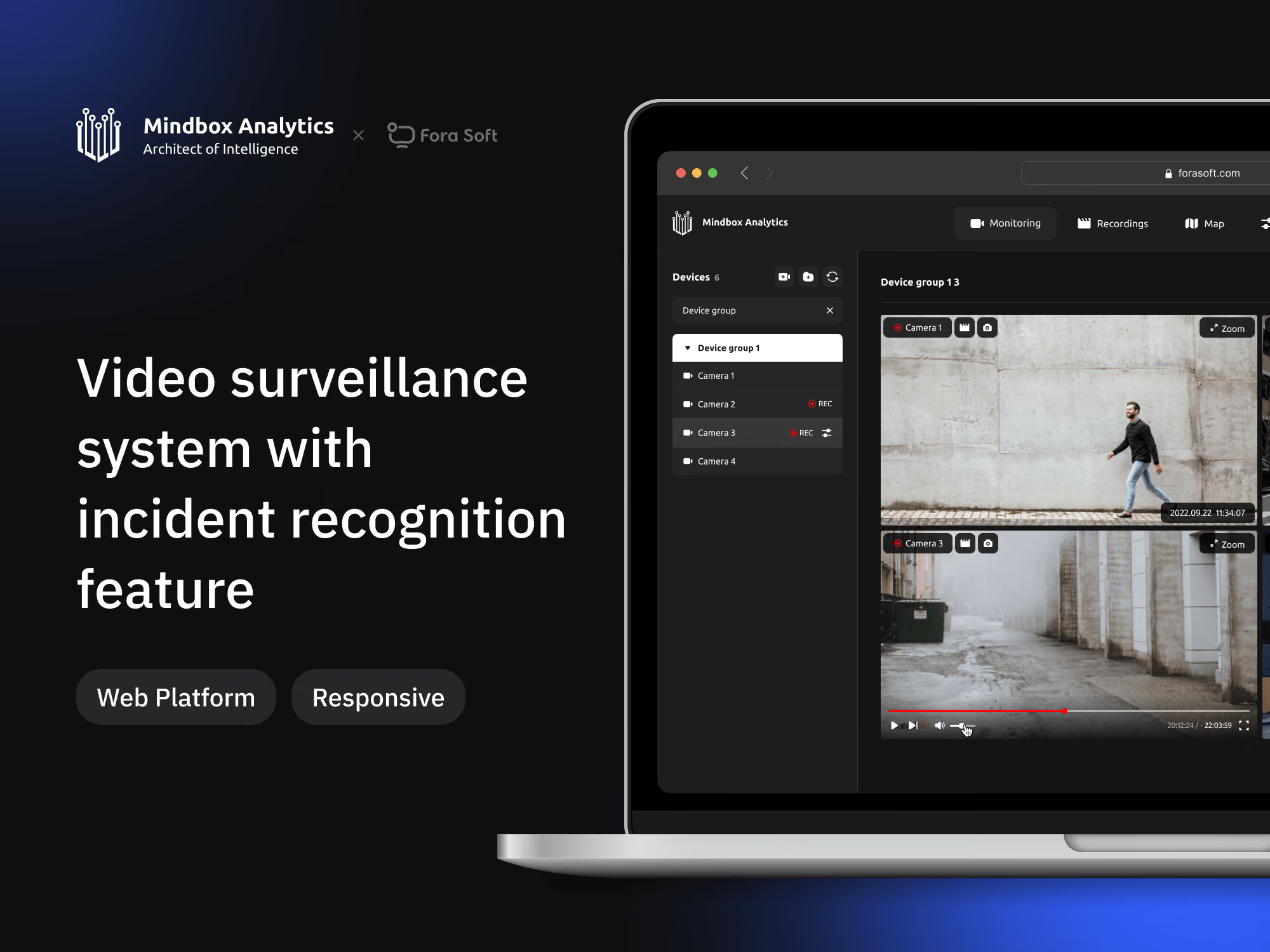
At a product level Mindbox is an Intelligent Video Management System (IVMS): an operator console plus an admin panel sitting on top of an AI inference layer that watches every connected camera and pushes alerts the moment something interesting happens. Three things separate it from a vanilla VMS: it triggers on incidents instead of motion, it ships with biometric and ANPR analytics out of the box, and it lets a single operator handle hundreds of streams because the system surfaces only what matters.
The real-time event taxonomy includes weapon detection, falls, loitering, unauthorized access, perimeter intrusion, helmet and mask (PPE) compliance, crowd density, vehicle ingress and egress, red-light and speeding violations, and two-way voice escalation. Operators can pan-tilt-zoom (PTZ) any IP camera remotely, adjust brightness, contrast, and sharpness, and run a Smart Forensic Search across hours of recorded footage to find a specific person, vehicle, or event — the difference between “we’ll review the tapes” and “here’s the clip in 12 seconds.”
Administrators get an interactive room map showing every camera and its live status, role-based access control, recording schedules per camera, retention policy per zone, and a REST API/SDK for third-party integration with access-control panels, fire alarms, and ERP systems. The whole platform is multi-site by design: a single tenant can manage dozens of sites and thousands of cameras from one dashboard.
The 2026 market signal — why this category is now mandatory
Three numbers explain why every multi-site operator now has “AI video” on their roadmap. Grand View Research sizes the AI video surveillance market at $6.51B in 2024, projected to reach $28.76B by 2030 — a 30.6% CAGR. MarketsandMarkets is more conservative at $3.9B→$12.46B by 2030 (21.3% CAGR), but the trajectory is the same. And retail shrink in the US runs around $112B a year (NRF’s National Retail Security Survey), roughly 1.6% of sales — exactly the loss AI loss-prevention gets bought to bend.
In other words: human-only monitoring is no longer competitive. The classic Sandia National Labs finding is that after about 20 minutes of staring at monitors an operator misses the large majority of on-screen activity, and industry data has long put 94–99% of traditional alarm-system calls to police in the false-positive column. Real-time incident detection is the only way to bend that curve, and it’s why mid-market buyers who used to standardise on a basic NVR are now writing RFPs for an AI-driven intelligent video management system.
Reach for an AI VMS like Mindbox when: you operate 50+ cameras across two or more sites, your operators chase more than 100 alerts per shift, and a single missed incident costs more than $25,000 in shrink, liability, or downtime.
Reference architecture — how Mindbox is wired
Mindbox follows a layered pipeline that any serious AI VMS converges on. Cameras stream over RTSP/ONVIF into a media server that handles transcoding and low-latency distribution. A frame extractor pulls keyframes at a controlled rate (typically 4–10 FPS per analytics stream, not the full 30) and pushes them into the inference layer. Detected events fan out through a real-time event bus to the operator console and into the recorder, which writes only the windows of footage that matter.
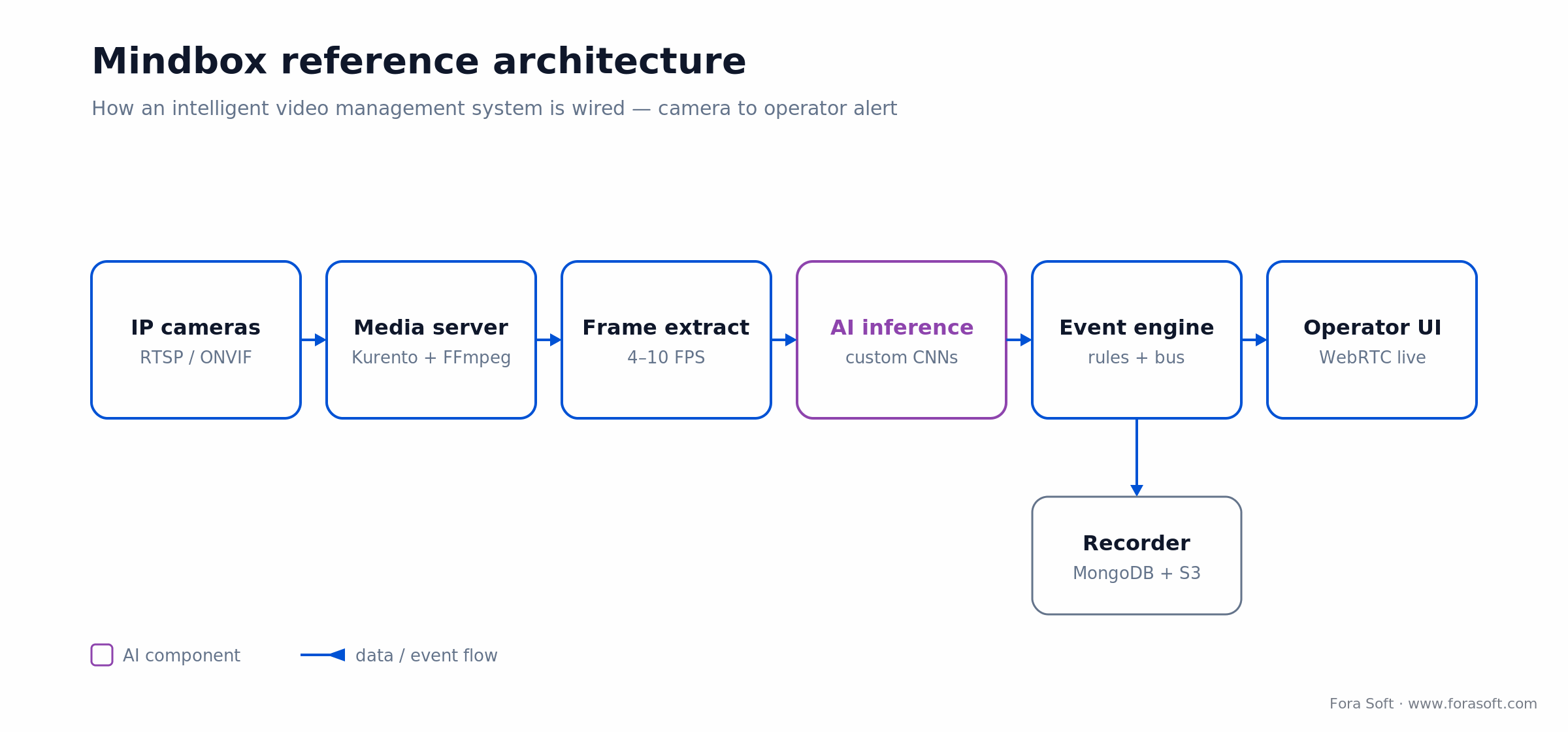
Figure 1. The Mindbox reference architecture — seven layers from ONVIF camera ingest to the operator console, with the recorder writing only event windows.
The Mindbox stack, layer by layer
| Layer | Mindbox choice | Why we picked it | 2026 alternative |
|---|---|---|---|
| Camera ingest | RTSP / ONVIF | Vendor-neutral; Profile T covers PTZ; works with Hikvision, Dahua, Axis, Hanwha | SRT for unreliable WAN, GB28181 for China |
| Media server | Kurento (+ FFmpeg) | WebRTC media server with RTSP pull and FFmpeg-driven HLS fallback; the pragmatic 2020 choice | MediaMTX, AntMedia, LiveKit Egress, OvenMediaEngine |
| Inference | Custom CNNs on TensorFlow + OpenCV (Python) | Domain-tuned models hit 99.5%+ on faces, 95% on plates — off-the-shelf doesn’t | YOLO11 / YOLO26, RT-DETR, Detectron2, Triton Inference Server |
| Event bus | socket.io over Node.js | Browser-friendly, sub-200ms fan-out to operators, simple to scale horizontally | Redis Streams, NATS JetStream, Kafka for >10k events/s |
| App backend | Node.js + Express.js | Same JS skill set as the frontend, rich ecosystem for media glue code | NestJS, Go (chi/fiber), Rust (axum) for hot paths |
| Frontend | Next.js (React) | Server-render the dashboards, hydrate the live grid, easy auth and routing | Remix, Astro, SolidStart for lower JS bundles |
| Storage | MongoDB + S3-compatible blob | Flexible schema for events, S3 for video; cheap to scale | Postgres + TimescaleDB for events, Wasabi/Backblaze B2 for cold video |
| Payments & billing | Stripe | Per-camera and per-site billing in 30 days, not three months | Paddle, Lago for usage-based metering |
A few opinionated notes on the table. Back in 2020 we built Mindbox on Kurento because it gave sub-second WebRTC playback to the operator console and pulled RTSP straight off the cameras without forcing vendors to do anything special. If we were starting today we’d reach for MediaMTX, AntMedia, or a LiveKit egress instead — Kurento is largely legacy now — but the low-latency logic is the same one we lay out in our scalable VMS engineering decisions guide. Custom CNNs, not off-the-shelf, are how we got to 99.5% face accuracy on Mindbox; the public benchmarks rarely survive production lighting and angles.
The real-time incident pipeline, end to end
A useful way to design any AI VMS is to budget the latency from event-on-camera to operator-alert at 2 seconds, then divide it among the layers. Here is how Mindbox spends those 2 seconds in a typical 1080p deployment.
| Stage | Typical budget | Where it goes wrong |
|---|---|---|
| Frame capture | 0–33 ms | Camera B-frames; force IDR every second |
| RTSP → media server | 100–300 ms | TCP interleave on flaky links, WAN jitter |
| Decode + frame extract | 20–80 ms | CPU decoding instead of NVDEC |
| Inference (YOLO-class) | 50–500 ms | Wrong batch size, model too big for the GPU |
| Event & rule engine | 20–100 ms | DB write in the hot path |
| Notify operator (socket.io) | 50–200 ms | Long-poll fallback; chatty payloads |
| WebRTC live preview | 100–400 ms | Symmetric NAT; missing TURN over TLS |
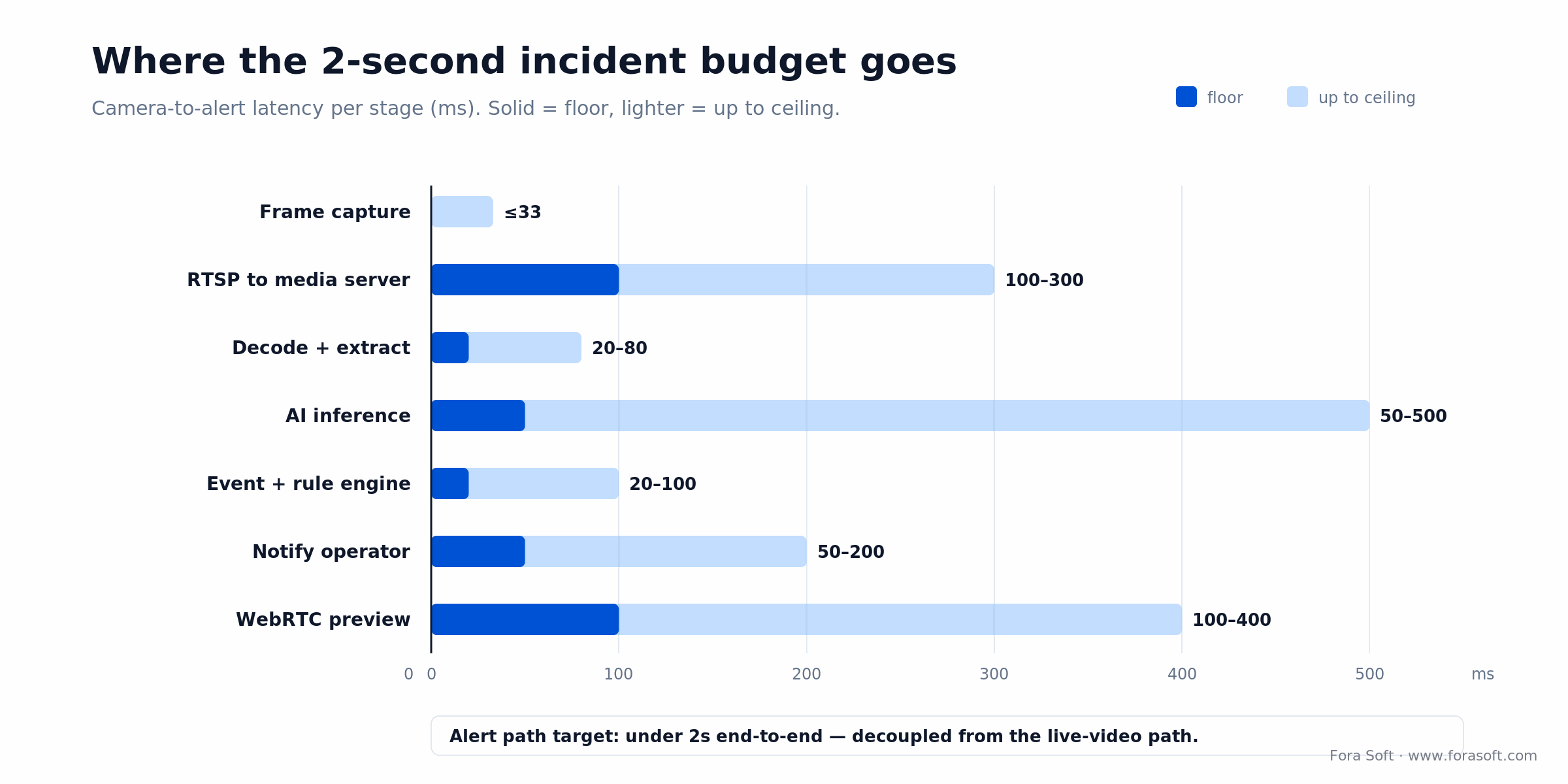
Figure 2. How the sub-2-second alert budget is spent across the pipeline. Inference and WebRTC preview dominate; the alert path stays decoupled from live video.
Two facts most buyers miss. First, you don’t need 30 FPS analytics — for fights, falls, loitering and crowding, 4–10 FPS is enough and cuts your GPU bill by 3–7×. Second, the operator alert has to arrive on a phone push or a desktop banner inside 2 seconds, even if the live video preview takes longer to come up. Decoupling the alert path from the playback path is the single most important architectural decision in this pipeline. The same principle drives our broader work on integrating video analytics with surveillance.
AI models that earn their keep in 2026
Mindbox runs a constellation of specialised models, not one monolith. Each is tuned to one job and feeds a downstream rule engine that decides whether the operator sees an alert. The 2026 menu is well-mapped now and most projects converge on similar choices.
1. Object & weapon detection. YOLO11 is the workhorse and YOLO26 (Ultralytics, Jan 2026) is the new default — it drops NMS for end-to-end inference and runs meaningfully faster on edge and CPU, which is why Ultralytics now steers production users to YOLO11 or YOLO26 over the attention-heavy YOLOv12. Published precision/recall on weapon classes is roughly 0.87/0.83 in controlled settings; expect 70–90% in production. Detectron2 and RT-DETR are alternatives if you need amodal segmentation or transformer features.
2. Fall and slip detection. A pose-based model (YOLO-Pose, Detectron2 keypoints) plus temporal logic outperforms image-only classifiers. SDES-YOLO (Scientific Reports, 2025) reported 85.1% mAP@0.5, with 9.48% higher precision than RT-DETR-R18 at about 85% fewer parameters. That’s a real edge-deployment win.
3. Facial recognition. ArcFace/AdaFace embeddings on FaceNet-class backbones, plus a watchlist with strict consent gates. Mindbox’s 99.5%+ comes from custom training on customer-controlled enrollment sets, not from a bigger model.
4. ANPR / license plates. Two-stage pipelines (plate detector → OCR) still beat end-to-end. Mindbox’s ANPR module runs 500K+ Indian plates daily at ~95% accuracy. Open baselines like OpenALPR sit around 78–93% depending on conditions; commercial PlateRecognizer is roughly 90% on clean plates and drops below 70% on motion blur.
5. Crowd density & PPE compliance. Density estimation networks (CSRNet, MCNN family) for crowding; multi-class detectors for helmet, mask, hi-vis vest, safety glasses. Industrial buyers care about this almost more than weapons.
Reach for custom models when: off-the-shelf detectors miss your specific incident class (knife in low light, abandoned baggage in a transit hub, two-wheeler in a no-ride zone) by more than five precision points. Otherwise YOLO11 fine-tuned on a thousand of your own frames is enough.
For the deeper math behind anomaly detection — reconstruction loss, isolation forests, 3D CNNs — we wrote a separate piece on machine learning algorithms for anomaly detection, and a complementary deep-dive on anomaly-detection models specifically for video surveillance. Our engineering hub also carries a model-by-model AI security-camera analytics playbook.
GPU sizing and infrastructure budget
The single biggest cost in any AI VMS is GPU inference. The right answer depends on stream count, model size, FPS, and where the camera lives. Use this table as a starting point.
| GPU profile | Concurrent 1080p streams (4–10 FPS analytics) | Cloud cost ballpark | Best fit |
|---|---|---|---|
| Coral TPU (edge) | 2–4 | $30–100 capex once | Single-site, <10 cameras |
| NVIDIA T4 (cloud) | 15–25 | ~$0.35–0.75/hr | Entry cloud multi-tenant |
| RTX 4090 (on-prem) | 40–70 | $1.8K–2K capex + power | Single warehouse or factory box |
| A10 / A10G (cloud) | 60–110 | ~$1.00–1.80/hr | Heavy mix (face + ANPR) |
| NVIDIA L4 (cloud) | 100–160 | ~$0.80–1.20/hr | High-density cloud analytics |
Rule of thumb: budget about $6–15 per camera per month for cloud GPU at 4–10 FPS analytics — a dense, video-optimized L4 sits at the low end, a smaller T4 at the high end — double it for 4K, halve it for low-resolution overview cameras. Storage is usually a bigger surprise than inference: continuous 1080p H.264 at 4 Mbps is about 1.3 TB per camera per month, so 90-day 24/7 retention is roughly 3.9 TB per camera. Event-based recording and cold tiering — which most deployments use — pull that down to about $4–10 per camera per month at S3-compatible pricing.
Build vs buy in 2026 — the honest comparison
There are three credible paths and they look very different on a five-year TCO chart.
| Path | Time to value | Total cost (3-yr, 100 cams) | Strengths | Trade-offs |
|---|---|---|---|---|
| Off-the-shelf SaaS (Verkada, Avigilon Alta, Eagle Eye, Spot AI, Solink, Rhombus) | Days to weeks | ~$120K–540K (incl. cameras) | Fast deploy, vendor support, predictable per-camera billing | 3–5-yr lock-in, opaque pricing, limited custom analytics, biometrics features often gated |
| Open-source self-host (Frigate / Shinobi / Viseron + Coral / GPU) | 2–6 weeks (DIY) | ~$30K–90K (mostly hardware + ops) | No license fees, full data control, plug-in detectors | No multi-site console, no SLA, you own the on-call |
| Custom build (Mindbox-style, e.g. Fora Soft) | 12–16 weeks to MVP | Custom MVP starts in the low six figures + ops | Tuned to your verticals, no per-camera tax forever, IP and data stay yours | You carry a small ops budget and a roadmap |
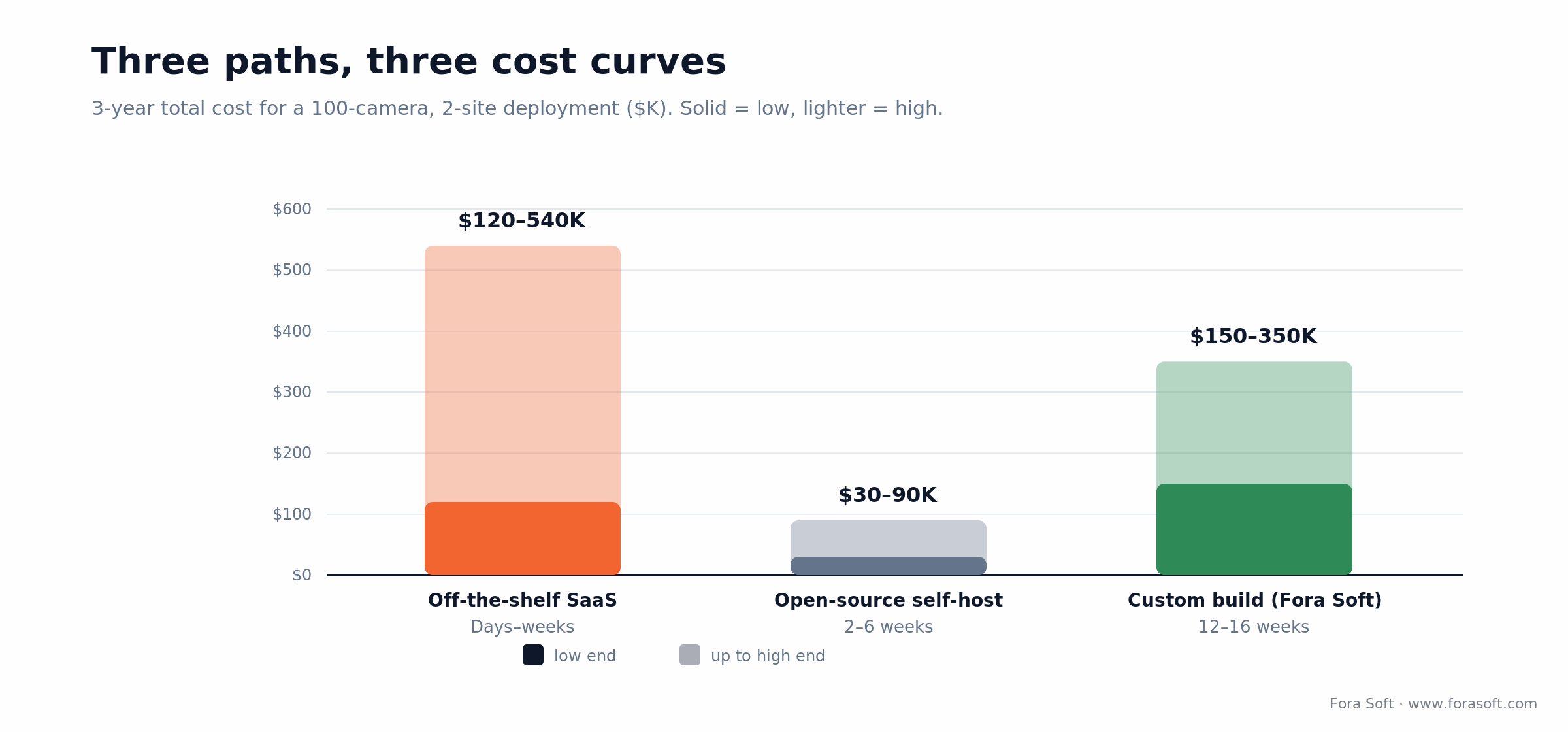
Figure 3. Three-year TCO for a 100-camera, two-site deployment. SaaS front-loads convenience; a custom build wins on year-two economics at scale.
A specific number we trust: a Mindbox-class custom build that previously took 9–12 months a few years ago now ships in roughly 12–16 weeks because we use spec-driven agentic engineering internally. That changes the math: the SaaS cushion that used to come from “custom is too slow” has shrunk dramatically. We’d still tell a 5-camera dental practice to buy SaaS; for 100+ cameras across two or more sites, custom usually wins on year-2 TCO.
Reach for SaaS when: you need a 50-camera deployment live in three weeks, you don’t care about analytics customisation, and your CFO prefers a per-camera OpEx line item. Otherwise scope a custom build — the lock-in tax compounds.
Vendor matrix — who buyers actually compare
Use this matrix as a sanity check when an RFP lands on your desk. None of these vendors publish list pricing; the ranges below are 2024–2026 buyer-reported averages.
| Vendor | Model | Strength | Weakness | Typical price shape |
|---|---|---|---|---|
| Verkada | Hybrid SaaS + own cameras | Slick UI, multi-site dashboard, fast deploy | Camera lock-in, cloud-only, license per camera | $200–600/cam capex + $50–250/cam/yr |
| Avigilon Alta (Motorola) | Cloud SaaS | Enterprise scale, ALPR, search, public-safety pedigree | Premium pricing, complex sales | Quote-based, $8–20/cam/mo |
| Genetec Security Center | On-prem + SaaS | Open platform, broad access-control integrations | IT-heavy, steep learning curve | Per-connection license + maintenance |
| Milestone XProtect | On-prem (cloud add-on) | 14k+ device integrations, BriefCam analytics plug-in | No native SaaS, on-prem ops burden | Per-device perpetual + SUP |
| Eagle Eye Networks | Cloud SaaS (open camera) | Bring-your-own camera, scaling, banking-grade audits | Limited on-prem, AI add-ons priced separately | ~$2–8/cam/mo + storage |
| Spot AI | Cloud SaaS | Retail loss prevention focus, easy install | Narrow vertical, smaller model library | ~$3–10/cam/mo |
| Ambient.ai | Edge + cloud hybrid | Privacy-first on-device inference, real-time signal | Edge hardware capex, narrow camera support | $5–15/cam/mo + appliance |
| Custom (Mindbox / Fora Soft) | Custom self-host or hybrid | 99.5% face accuracy, ANPR at India scale, no per-camera tax | You own the roadmap and on-call | Project-based + small ops retainer |
For an even broader sweep, our team maintains a curated list of video surveillance development companies to watch and a comparison of enterprise-grade video analytics solutions that we update each quarter.
Stuck between Verkada lock-in and a custom rebuild?
We’ve done both sides. Bring us the cameras, the rough headcount, and the verticals you serve — we’ll lay out a 12-week MVP plan and show you the year-2 TCO before you commit to anything.
Operator and admin UX — the part most vendors botch
Plenty of AI VMS projects deliver a model that works and a UI that doesn’t. The console is where 100% of the value lands, and operators are unforgiving. Mindbox got the UX right because we obsessed over four screens.
The four screens that matter
1. Live wall. A grid that scales from 4 to 64 streams without melting the laptop. WebRTC playback first, HLS fallback. PTZ on hover, no modals.
2. Alert inbox. A reverse-chronological list of incidents grouped by site and class, each with a 5-second clip preview, “dismiss / escalate / log” in two clicks, and severity. No browser tab switching.
3. Forensic search. Filter by time, camera, person attribute, vehicle plate, or event type and scrub through hours in seconds. Mindbox’s Smart Forensic Search is the feature customers say they couldn’t go back from.
4. Site map. Floor plans with camera markers turning amber and red on incidents. One click on a marker drops the operator into the live feed.
Admins get a separate console with role-based access (operator, supervisor, auditor, admin), per-camera recording schedules, retention policies per zone, audit logs, and a REST API. The split between operator and admin matters because they have different mental models and different mistakes.
Security and compliance — the part that kills projects
Smart surveillance went from “legal” to “legally tricky” in a single year. The EU AI Act entered into force in August 2024, and its first bans (including live remote biometric identification in public spaces by law enforcement, with narrow exceptions) began applying in February 2025; most other biometric video is classed high-risk, carrying mandatory risk management, data governance, human oversight, and EU AI database registration. The UK ICO’s 2023–2025 guidance on facial recognition mirrors GDPR Article 9 and adds proportionality and DPIA requirements. In the US, Illinois BIPA carries $1,000–5,000 per-violation statutory damages with a private right of action; Texas and Washington have similar rules without the private suits.
Practically, this means three things you bake in on day one. First, every biometric flow needs explicit consent, retention SLA, and deletion endpoint. Second, audio recording in workplace break rooms or restrooms is off-limits in most jurisdictions and inviting NLRB and ECPA trouble in others. Third, schools (FERPA), healthcare (HIPAA), and financial sites have additional retention and disclosure rules that change the storage and audit shape of the system.
Reach for a privacy-first edge architecture when: you operate in the EU, in Illinois, or anywhere with active biometric privacy enforcement, and want to keep raw faces and plates on-prem rather than streaming them to the cloud.
A worked cost model for a 100-camera deployment
Buyers ask for “the cost” and we always push back on the framing — but here’s a defensible mid-case for a 100-camera, two-site, 90-day-retention deployment with weapon, fall, loitering, ANPR, and forensic search.
| Line item | SaaS path | Custom path (Fora Soft) |
|---|---|---|
| Cameras (BYO ONVIF) | $0 (existing) or $30K (new mix) | $0 (existing) or $30K (new mix) |
| Software / build | $8–20K/mo per-camera SaaS | 12–16-week MVP build, low-six-figure capex |
| Cloud GPU + infra | Bundled in SaaS | $6–15/cam/mo (~$600–1,500/mo total) |
| Storage (90-day, 1080p) | Bundled in SaaS | $4–10/cam/mo (event-based) |
| Ops / on-call | Vendor SLA | Small managed retainer or in-house DevOps |
| 3-year TCO ballpark | $280–720K (license-driven) | Lower mid-six figures; payback typically inside year 2 |
The exact custom number depends on which models you need (ANPR adds the most), how many sites, and how strict the compliance regime is. We’d rather quote conservatively after a discovery session than throw a single headline number into a blog post; if you want a defensible range for your shape of business, our project discovery process turns it into one in 1–2 weeks.
Mini case — Mindbox in production
Situation. Mindbox Analytics needed an Intelligent Video Management System that could detect anomalies (unauthorized access, loitering, safety violations) in real time, layer in facial recognition and vehicle tracking, scale across multiple sites, and ship with an interface operators and administrators would actually use. They came to us in 2020.
What we shipped. A scalable AI-powered platform running 24/7 under high load: custom TensorFlow + OpenCV neural networks for face, object, and anomaly detection; an ANPR module with red-light and speed-violation rules; Smart Forensic Search across hours of footage; PTZ control with image filters; an interactive site map; and an admin panel with role-based access, recording schedules, analytics, and a REST API/SDK. The media stack — Kurento + WebRTC + socket.io — gave operators sub-second live preview and sub-2-second alerts.
Outcome. Since 2020 the platform has been deployed in 50+ enterprise locations across transportation, pharmaceuticals, and gated communities. The face-recognition module hits 99.5%+ on customer-controlled enrollment sets, with anti-spoofing that resists photo and video replay attacks. The ANPR pipeline reads 500,000+ vehicle plates per day across India at roughly 95% accuracy, powering automated red-light and speed-violation enforcement. Want a similar assessment of your own setup? Book a scoping call.
A decision framework — pick your AI VMS path in five questions
Q1. How many cameras and how many sites? Under 30 cameras at one site, SaaS or open-source self-host wins on time-to-value. Above 100 cameras across 2+ sites, custom usually wins by year 2.
Q2. Do you need biometrics or ANPR? If yes, you’re shopping in a smaller pool; many SaaS vendors gate these features behind enterprise tiers and won’t share model accuracy on your verticals. A custom build lets you tune to your data.
Q3. Where can the data live? If GDPR, BIPA, or FERPA forces on-prem or in-region storage, hybrid (edge inference, central admin) is the architecture; cloud-only SaaS gets harder.
Q4. How much custom analytics do you actually need? If you need three off-the-shelf classes (loitering, weapon, fall) you can buy. If you need PPE compliance, abandoned object, two-wheeler in no-ride zone, or vertical-specific safety violations, custom catches up fast.
Q5. Who owns the IP? SaaS keeps you renting forever. Custom (with a clean MIT-style contract) hands you the IP and lets you spin up a sister product, a white-label, or a sale.
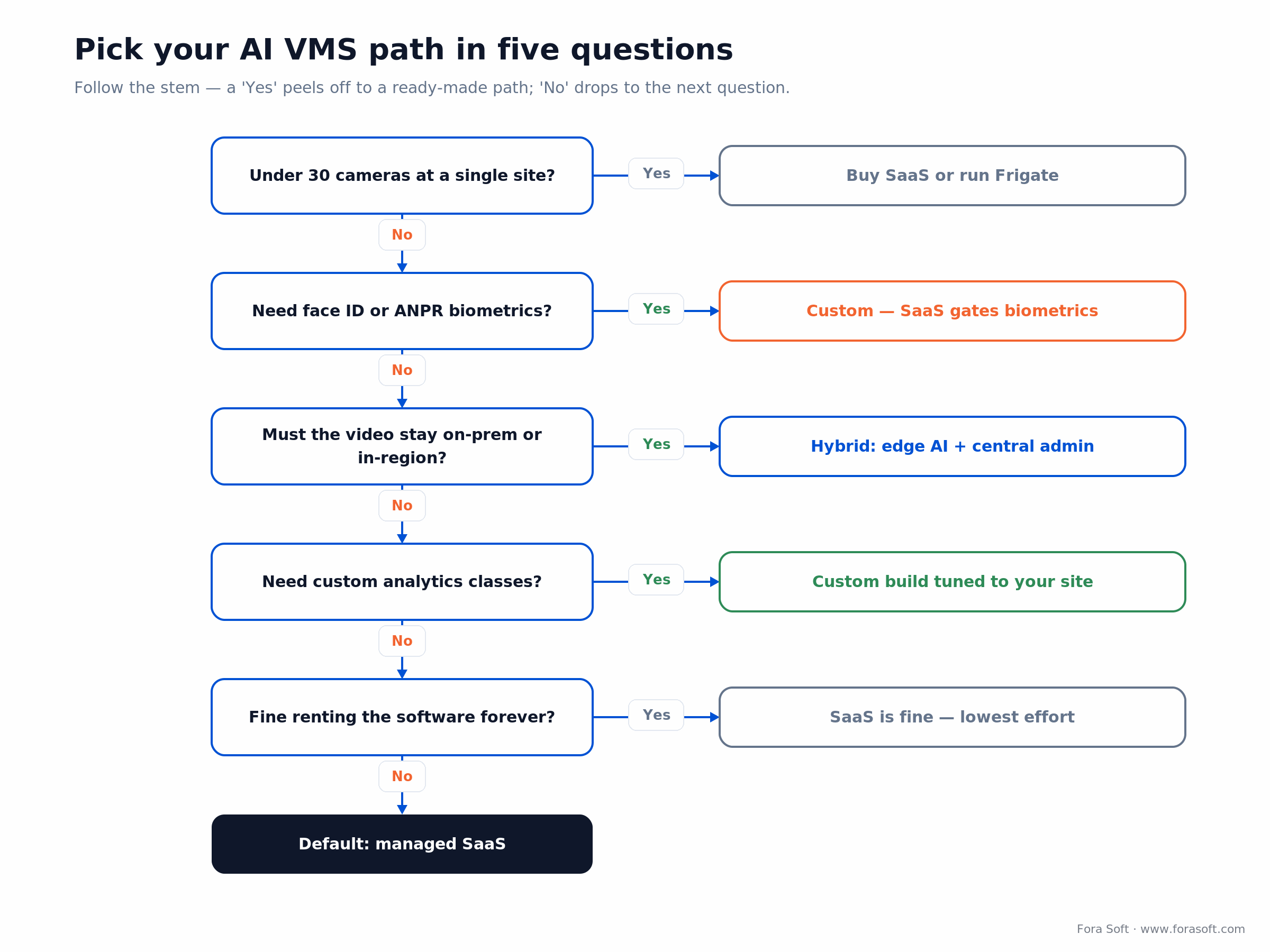
Figure 4. A five-question path to the right AI VMS model — SaaS, open-source, hybrid, or a custom Mindbox-style build.
Five pitfalls we see kill smart-surveillance projects
1. Alert fatigue. An untuned model fires 50 false positives an hour, the operator turns notifications off, and the system is dead inside a month. Fix: per-zone confidence thresholds, motion-aware ROI masking, time-of-day rules, and a feedback loop where dismissed alerts retrain the model weekly.
2. RTSP brittleness. Cameras drop, NAT eats packets, RTSP-over-TCP interleave breaks under load. Fix: a media server like AntMedia or MediaMTX that owns reconnect logic, plus health metrics per camera so you find dead streams before customers do.
3. Retention spiral. “Just keep everything for a year” turns into a monthly bill that exceeds the inference cost. Fix: tiered retention (90 days hot, 365 days cold), event-only retention for low-importance cameras, and a retention policy per zone, not per system.
4. Biometric scope creep. Faces and plates show up in scope at week 8 because a stakeholder thought of a new use case, blowing through the consent and retention plan you didn’t make. Fix: assume biometrics from day one, even if you launch without them, and design the consent and deletion endpoints up front.
5. Model drift. Lighting changes, seasons turn, new uniforms get introduced, and accuracy quietly drops 10–30% in three months. Fix: a continuous evaluation suite with golden test sets per site, plus monthly retraining on flagged frames.
KPIs — what to measure once you launch
Quality KPIs. Recall ≥ 0.90 and precision ≥ 0.85 on your top three incident classes. False-positive rate per camera per day < 5. Mean time to detect (MTTD) < 2 seconds end-to-end. Forensic search latency < 5 seconds for a 24-hour window per camera.
Business KPIs. Operator-handled cameras per shift up 3–5× vs. unaided monitoring. Incident-handling time down 50–80%. Loss-prevention or liability cost down 15–30% in year one. SaaS-replacement payback inside 18–24 months for 100+ camera fleets.
Reliability KPIs. Stream uptime ≥ 99.5%. Inference availability ≥ 99.9% over the rolling 30-day window. Recovery from a media-server failover < 90 seconds. Storage cost variance < 10% month-on-month.
When NOT to build a custom AI VMS
Custom is not always the answer and we’ll tell you so on the first call. If you have fewer than 30 cameras at a single site, no biometric or ANPR needs, and the feature set you want is already on a Verkada or Eagle Eye datasheet — buy SaaS. If your IT team is one person and they don’t want a midnight on-call rotation, buy SaaS. If you’re a research project that wants to test “does AI surveillance even work for our use case”, start with Frigate plus a Coral TPU on a $400 budget and find out before you commit.
The signal that custom pays off is when the SaaS pricing line, the lock-in tax, or the missing analytics feature becomes the gating constraint on growth. Until then, it’s premature optimisation.
Ready to scope an AI surveillance product like Mindbox?
We’ll review your camera fleet, verticals, compliance regime, and target latency and come back with a 12–16-week MVP plan, a stack, and a defensible budget — free, no obligation.
FAQ
How accurate is real-time weapon detection in 2026?
State-of-the-art YOLO-class models hit roughly 0.83 recall and 0.87 precision on weapon classes in controlled tests. Real-world numbers are more like 70–90% precision because lighting, occlusion, and distance hurt every model. That’s why production systems route every weapon alert through a human operator in under two seconds rather than auto-actioning.
Do I have to replace my IP cameras to add AI analytics?
Almost never. Any ONVIF Profile S/T camera under three years old works fine over RTSP. Adding analytics costs $3–15 per camera per month in cloud GPU. Replacing with AI-native cameras is $500–2,000 per camera capex, so a retrofit pays for itself almost immediately on existing fleets.
ONVIF or proprietary cameras — does it really matter?
Yes. ONVIF Profile T (PTZ) and Profile S (streaming) keep you vendor-neutral and let you mix Hikvision, Dahua, Axis, Hanwha, and others. Proprietary stacks (e.g. Verkada or Avigilon-only cameras) lock you to one VMS vendor for years. Our deeper take is in the ONVIF profiles in security systems guide.
Can I self-host on-prem instead of using the cloud?
Yes — and we often recommend hybrid (edge inference, central admin) where compliance demands it. Frigate, Shinobi, and Viseron are credible open-source starting points for <20 cameras. Above that scale, a custom hybrid stack typically beats both pure SaaS and pure self-host on operational headache.
What does data retention realistically cost?
Continuous 1080p H.264 at 4 Mbps is about 1.3 TB per camera per month, so 90 days of 24/7 footage is roughly 3.9 TB. Most teams don’t store it all: event-based recording plus hot/cold tiering typically lands storage around $4–10 per camera per month on S3-compatible storage. Doubling retention roughly doubles the bill, so keep only event windows on less-critical cameras.
Is facial recognition legal where I operate?
It depends. The EU AI Act tightly restricts live biometric ID in public spaces and classifies most other biometric video as high-risk. Illinois, Texas, and Washington have biometric privacy laws; Illinois BIPA carries $1,000–5,000 statutory damages per violation. The right answer is almost always: explicit consent, narrow purpose, short retention, deletion endpoint, regular DPIA — and a lawyer in the kickoff meeting.
What latency from incident to alert is realistic?
A well-tuned pipeline lands the alert in 500ms–2s end-to-end: capture (33ms) + ingest (100–300ms) + decode (20–80ms) + inference (50–500ms) + bus (20–100ms) + notify (50–200ms). Live video preview can take a bit longer; decoupling the alert path from the playback path is the architectural move.
How long does a Mindbox-style MVP take to ship?
12–16 weeks for a focused MVP — ingest, live wall, three core analytics classes, alerts, basic forensic search, and an admin panel. We get there faster than the industry baseline because we use spec-driven agentic engineering to compress the discovery, scaffolding, and review loops. Adding ANPR, biometrics, or multi-site role-based admin is typically another 4–8 weeks.
What to Read Next
Foundations
AI and Anomaly Detection in Video Surveillance
The complete guide to anomaly detection theory, models, and the pipeline that powers smart VMS deployments.
Architecture
Scalable Video Management Systems in 2026
The five engineering decisions that decide whether your VMS scales past 500 cameras — architecture, storage, costs.
Models
Top 7 Anomaly Detection Models for Video Surveillance
A comparison of YOLO, RT-DETR, Detectron2, and reconstruction-based models for real-world surveillance footage.
Buyer’s guide
12 Essential Features of Modern VMS Software in 2026
A scoreable shortlist of features any AI VMS should have before it gets onto your RFP.
Vendors
Top Video Surveillance Development Companies
A vendor watchlist updated quarterly, with strengths, weaknesses, and the right shortlist by deal size.
Ready to ship a smarter surveillance system?
Mindbox is what a real-time incident-detection platform looks like when you take cameras seriously, take latency seriously, and take operators seriously. The architecture is reproducible: ONVIF ingest, a WebRTC media server (Kurento in 2020, MediaMTX or AntMedia today) for sub-second video, custom CNNs that beat off-the-shelf on your data, socket.io for fast alerts, MongoDB plus S3 for the long tail. The bigger lesson is that the model is only one of seven layers, and the layers you ignore (alert UX, retention, biometric consent, NAT/STUN) are the ones that kill projects.
If your operators are missing incidents, your SaaS bill is creeping past the cost of a custom build, or your roadmap needs an analytics class your current vendor doesn’t support, that’s the moment to talk. We’ll bring the Mindbox playbook, our agent-engineering workflow, and 20+ years of shipping real-time video products. You bring the cameras and the constraints.
Want a Mindbox-style platform — without the lock-in?
Tell us about your camera fleet, verticals, and target latency. Inside 48 hours we’ll send back a budget range, a 12–16-week MVP plan, and the compliance hot spots you’ll need to clear — free, no obligation.

