

.avif)
Key takeaways
• Well-scoped AI surveillance deployments usually pay back inside 12 months. That is what we see on client projects and what vendor case studies report. The six benefits below each map to a hard metric you can baseline before you buy.
• False alarms drop 70–90%. Traditional motion sensors fire false alarms more than 97% of the time. Modern AI detectors (Axis, Hanwha, Rhombus, Verkada, BriefCam) cut that by an order of magnitude, and cut the human cost of responding to noise.
• Retail theft is shifting from shoplifting to fraud and repeat offenders. The NRF’s 2026 theft report (July 2026) shows shoplifting incidents down 12.4% in 2025, while repeat offenders, organized retail crime, and walkout theft kept rising. Vendors of AI behavioral analytics at self-checkout and high-risk aisles report up to 40% less theft in targeted zones; Target’s TruScan at self-checkout is one public example.
• Forensic investigation collapses from days to minutes. “Find the blue van with the damaged bumper between 14:00 and 17:00 on Tuesday” is a 90-second query on an AI VMS — vs. 20 hours of scrubbing on a legacy DVR.
• A 50-camera site goes live in 2–4 weeks on a cloud-managed stack; 200 cameras in 4–8. Agent engineering cuts custom integration time (POS, HRIS, CRM, access-control) by another 30–40%. The 2024-era six-month rollout is a 2026 six-week one.
Updated October 2026: per-camera pricing models with Verkada’s August 2026 list prices, NRF’s 2026 theft data, and the EU AI Act Omnibus now in force as Regulation (EU) 2026/1744.
Why Fora Soft wrote this playbook
Fora Soft is a software development company that has built video and AI products since 2005. That’s 21 years and 250+ projects delivered, at 99% Job Success on Upwork, Top Rated Plus. On the surveillance and video-analytics side specifically, we ship in production: MindBox is an enterprise AI VMS running across 50+ deployments with 99.5% facial recognition and ANPR handling 500,000+ vehicles a day; V.A.L.T is a video surveillance system recognized and used by US law enforcement; Netcam was one of the earliest widely adopted IP-camera management platforms.
This article is the business-case version of the conversation we have with COOs, security directors, facilities leads, and CFOs who are being asked to approve an AI surveillance budget. The technical playbook lives in our AI video analytics security guide; this piece is for the exec who needs to justify the spend.
The straight-talk version: in 2026, AI video surveillance is no longer a futurist bet. Deployments are hitting payback inside 12 months, edge-AI hardware costs have dropped sharply since 2023 (a 40-TOPS Hailo-10H board now sells for $130), and the big VMS vendors are shipping natural-language search into mainstream products. The question is which benefits matter for your business and how to scope the rollout. When the answer points to a custom build, our computer vision team for video surveillance deploys detection and tracking on NVIDIA Jetson at the edge, with sub-200 ms inference.
Building a business case for AI surveillance?
30 minutes with a senior Fora Soft engineer — we’ll sanity-check the vendor shortlist, camera density, and the ROI math before you go to the board.
What AI-powered video surveillance actually is in 2026
In one sentence: AI video surveillance is a camera system where software watches the footage for you, flags what matters, and answers forensic questions in natural language. The hardware pieces — IP cameras, NVRs, PoE switches — are the same as 10 years ago. What’s new is the brain: computer-vision models running either on-camera, on a local server, or in the cloud, turning pixels into events.
The practical difference for a business: your security team stops watching 100 monitors and starts responding to prioritized alerts. Your loss-prevention team stops reviewing footage at 4× and starts searching it with a sentence. Your insurer starts looking at your incident and false-alarm data when setting premiums, not just at your policy limits.
How big is the AI in video surveillance market? Between $4B and $7B in 2026, depending on scope. MarketsandMarkets (May 2026) sizes it at $4.04B in 2026, rising to $10.88B by 2032 (17.9% CAGR), with generative AI the fastest segment at 25–30% CAGR. Mordor Intelligence puts it at $6.83B in 2026 and $13.26B by 2031 (14.2% CAGR), with software (17.9%) and cloud/hybrid (22.1%) growing fastest. Both rank Asia-Pacific as the largest region. Treat any single headline as a scope choice; the direction is unanimous, and the named driver is falling edge-AI chip cost.
Demand is moving from pilots to budgets. Genetec’s 2026 State of Physical Security report (7,300+ respondents, December 2025) found end-user interest in AI more than doubled in a year and AI ranked next to access control and video surveillance as a top 2026 project, while 70% of respondents voiced concerns about how AI systems use data. In March 2026 Milestone announced natural-language AI Search, generative video summaries, and vision-language models fine-tuned on NVIDIA Cosmos Reason; the company has said AI Search will be available by the end of 2026.
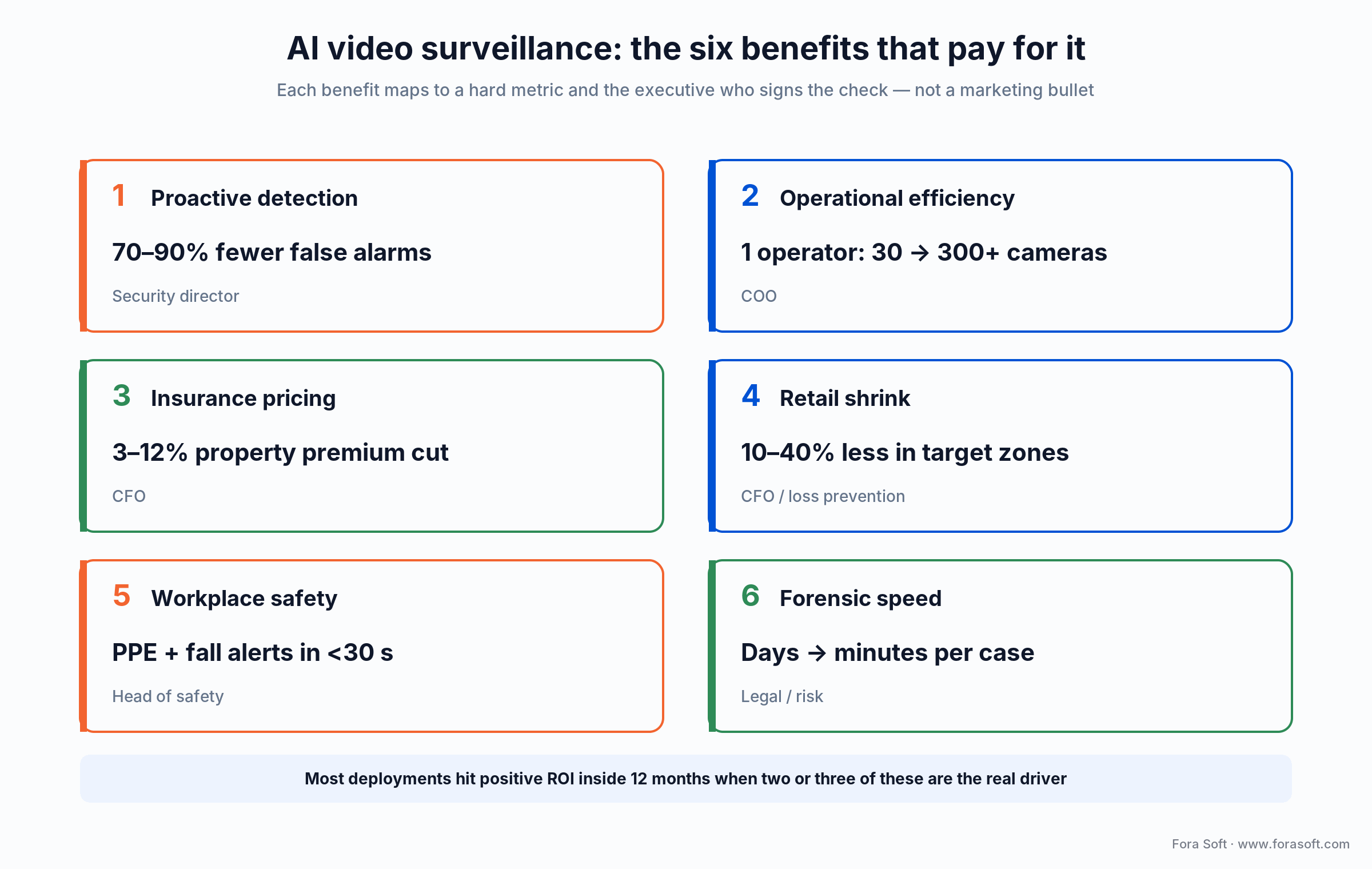
Figure 1. The six benefits that justify an AI video surveillance budget — each tied to a hard metric, not a claim.
Benefit 1 — Proactive threat detection (and the end of false alarms)
Traditional motion-based alerts fire falsely more than 97% of the time: a cat, a branch, a shadow, a windblown bag. Your guards stop trusting the alerts within a month. AI detection (YOLO26, RT-DETR, pose and behavioral models) distinguishes a person from a raccoon, a delivery driver from an intruder, and a slip from a stumble.
Published numbers. Axis Communications and Hanwha Vision systems consistently report 70–90% false-alarm reduction post-deployment. Live AI verification services (Noonlight-class) drop K-12 campus false alarms by 90%. Time-to-first-alert drops from ~20 minutes of manual watchkeeping to under 30 seconds on a modern stack.
Why this matters to the CFO. Every false alarm costs guard time (and sometimes police dispatch fees; some cities fine repeat false alarms $25–$250). A 200-camera site running 10× fewer false alarms saves a body or more of guard shift per week. That’s real payroll.
Reach for threat-detection analytics first when: your current false-alarm rate is above 3 alerts per camera per day, your guards admit they ignore most alerts, or you’ve had a real incident that was missed because of noise. This benefit has the fastest payback of the six.
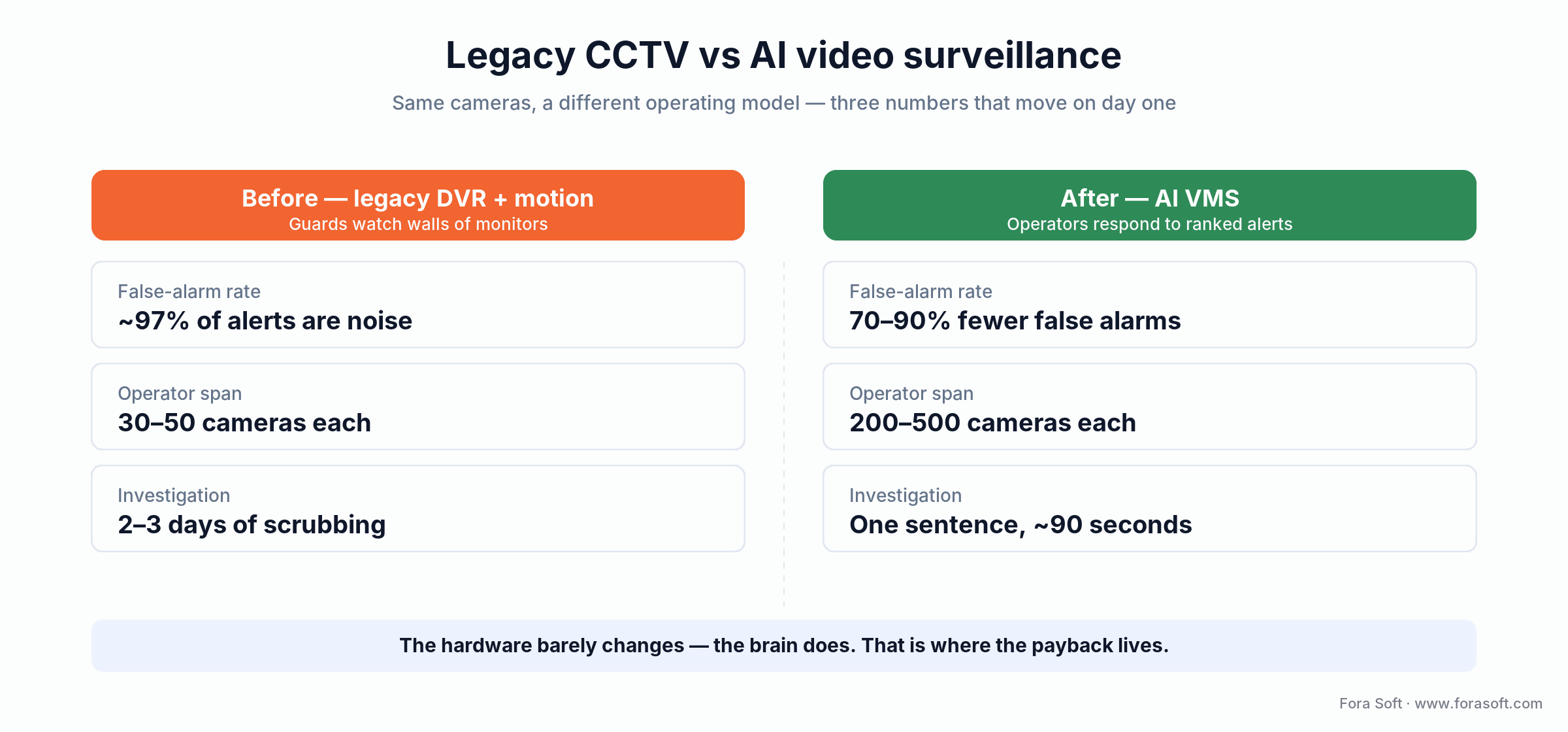
Figure 2. Before vs after AI — the cameras barely change; false alarms, operator span, and investigation time do.
Benefit 2 — Operational efficiency that protects your payroll
AI surveillance doesn’t replace your security team. It makes the team you have 3–5× more effective. A single operator with a well-built AI VMS monitors 200–500 cameras instead of 30–50. Automated PPE checks, attendance gates, and perimeter patrols replace the walk-arounds that your guards dislike most.
Published numbers. A US distribution-center case study published by an AI-safety vendor reports a 60% drop in PPE violations within three months. A warehouse hour of downtime costs $10,000–$50,000 depending on sector; AI coverage of entry/exit cycles shortens incident response from 15 minutes to <3.
Why this matters to the COO. You’re not hiring more guards to cover expanding footprint or longer hours. The AI layer absorbs the load. The same team takes on a new wing, a new shift, or a new site.
Benefit 3 — Insurance premiums that reward good data
The telematics precedent is instructive: auto insurers already price driving data into premiums through usage-based programs. Commercial property carriers move the same way, only more slowly: underwriters increasingly want to know how alarms are verified, how fast incidents are dispatched, and whether the camera network is patched.
Published numbers. None yet. As of October 2026 no major carrier publishes a standard discount for AI-verified surveillance; any concession is negotiated per account at renewal. Treat it as upside, not as the line that pays back the project.
Why this matters to the CFO. Even a modest negotiated reduction, say 5% on a $400K annual commercial-property premium, is $20K a year. Bring your false-alarm and response-time data to the broker as part of the RFP; don’t wait until renewal.
Benefit 4 — Retail shrink goes from accepted to solvable
Here’s the honest version of the number everyone quotes: the National Retail Federation retired its single shrink figure in 2024 over methodology concerns; its last official number was $112.1B in 2022 (1.6% of sales). Its newest report, The Impact of Retail Theft & Violence 2026 (30 July 2026), shows shoplifting incidents fell 12.4% in 2025 and merchandise theft 8.1%, while retailers saw more repeat offenders (50%), organized retail crime incidents (40%), and walkout or pushout theft (37%). About a third of shrink is external theft; the rest is employee theft, administrative loss, and process error. All are addressable with AI surveillance, but the theft categories are where the highest-margin gains live.
What’s in production. Target’s TruScan detects missed scans at self-checkout. Mid-market retailers run Everseen, AiFi, and Sensormatic analytics on their existing cameras. Because the 2026 threat mix leans toward walkouts and repeat offenders, the analytics that pay back fastest now are entrance and exit event detection, POS-to-video exception reports, and repeat-visitor alerts where biometric law allows them.
Published numbers. Behavioral analytics platforms publish up to 40% shrink reduction in targeted zones. The full-chain number is more modest (10–20% of the shrink line item) because administrative and employee-theft categories need companion process changes.
Why this matters to the CFO. For a retailer with $500M annual revenue and a 1.6% shrink ratio ($8M), a 15% shrink reduction is $1.2M recovered, at near-100% margin contribution. The AI surveillance CapEx + OpEx for that chain runs $200–400K/year. The payback is obvious.
Shrink hurting your P&L?
30 minutes with our loss-prevention architects — we’ll map the analytics stack, camera placement, and integration to your POS and WMS that actually cuts the shrink line.
Benefit 5 — Workplace safety from PPE to slip-and-fall
Industrial sites, logistics yards, construction projects, and food-processing plants have been the fastest adopters of AI surveillance because the ROI is unambiguous: every PPE violation caught early is an avoided OSHA citation, and every slip-and-fall detected in real time is a shorter recovery window, a better incident record, and a cleaner insurance story.
What’s in production. Object detectors (YOLO-class models trained on PPE classes) flag missing hard-hats, high-visibility vests, and fall-protection gear in real time, while pose-estimation models (YOLO-Pose, MediaPipe) track body posture for falls and unsafe lifting. Slip-and-fall detectors watch for the telltale motion signature of a fall and cross-check ground contact duration — a person still on the floor after 10 seconds gets an alert to supervisors and, optionally, an autodialer to EMS.
Published numbers. Chemical-plant deployments have shown double-digit improvements in PPE compliance inside 60 days. The distribution center case study mentioned earlier: 60% reduction in PPE violations in 90 days. Slip-and-fall response times drop from “whenever the next shift checks” to under 30 seconds.
Why this matters to the Head of Safety. OSHA penalties reach $16,550 per serious violation and $165,514 per willful or repeat one. Those 2025 amounts stay in effect for 2026: OSHA confirmed in May 2026 that the annual inflation increase was cancelled. Slip-and-fall injuries are among the costliest workers’ comp categories and keep the injured worker out for weeks. A system that helps avoid one willful-violation citation in a year pays for the whole deployment. For plants, yards, and warehouses specifically, our industrial video surveillance AI guide covers detection reliability and camera placement in depth.
Benefit 6 — Forensic investigation that takes minutes, not days
The “after the incident” workflow is where AI surveillance stops being a vitamin and becomes a painkiller. On a legacy DVR, reviewing 72 hours of footage from 20 cameras is a 2–3 day job for an investigator. On an AI VMS, the same investigation is a sentence: “show me all people in red jackets near the east loading bay between 14:00 and 17:00 on Tuesday.” Results in 90 seconds.
Published numbers. BriefCam, Avigilon, Milestone’s XProtect Rapid REVIEW, and the analytics modules inside Verkada and Rhombus all collapse hour-of-footage-reviewed-per-minute ratios by 10–20×. Enterprise case studies publish “investigations that took three days now take under an hour.” Police and compliance audits are the beneficiaries.
Why this matters to Legal and Risk. Discovery response to a subpoena, a workers’ comp investigation, or a customer-incident complaint no longer blocks operations for days. Your outside counsel bills fewer hours; your ops team stops being pulled in for legal support.
AI surveillance platforms compared: the 2026 buyer’s matrix
Seven platforms we’ve integrated, evaluated, or benchmarked against on client work. Pricing signals are public list prices where the vendor publishes one, and our estimates from client projects where it doesn’t. Your negotiated rate will differ.
| Vendor | Model | Pricing signal | Best for | Watch out for |
|---|---|---|---|---|
| Verkada | Proprietary cloud + cameras | Cameras $899–$4,299 MSRP + 5-year license $1,099/camera (≈$220/yr; Aug 2026 list) | Mid-market multi-site with IT-light ops | Locked-in cameras; expensive at 1,000+ devices |
| Rhombus | Cloud + branded cameras | Quote-based: branded cameras + per-camera license term | Hospitality, education, retail multi-unit | Less mature analytics depth than Milestone |
| Milestone XProtect | On-prem VMS + plugin ecosystem | Per-camera license, ≈$75–$500/camera (our estimate) + analytics | Enterprise, compliance-sensitive, custom analytics | Heavy integration lift; needs an SI partner |
| Genetec Security Center | Unified platform (VMS + ACS + LPR) | Quote-based enterprise license per camera and door | Airports, critical infra, municipalities | Enterprise pricing; needs a certified integrator |
| Eagle Eye Networks | Cloud VMS, agnostic cameras | ≈$15–$50/camera/mo (not published; third-party estimates) | Distributed fleets, MSP partners | Analytics via partners, not native |
| BriefCam | Add-on analytics (on top of VMS) | Enterprise license, 5–6 fig deployments | Forensic search, transit, large-campus | Needs host VMS; not a standalone |
| Fora Soft custom (MindBox pattern) | On-prem or hybrid, open-model | Build cost $150K–$600K; ~$5K/mo infra | Specialized needs, data sovereignty, ISV white-label | Internal ops + eval rig required |
AI video surveillance pricing models: what you pay per camera in 2026
Short answer: in 2026 AI video surveillance is priced per camera, in one of four main ways: a cloud subscription of roughly $15–$60 per camera per month, a multi-year cloud license bought with the vendor’s cameras (Verkada’s 5-year camera license lists at $1,099, about $220 a year), a perpetual on-prem VMS license per channel plus annual care, or an analytics add-on of roughly $10–$30 per camera per month on top of the VMS you already run. Hardware, installation, and integration sit on top of all four.
| Pricing model | How it’s billed | 2026 price signal | Typically included | Fits |
|---|---|---|---|---|
| Cloud VMS subscription | Per camera per month; the retention tier drives the price | ≈$15–$60/camera/mo across vendors; Eagle Eye ≈$15–$45 typical, up to ≈$50 with long retention (third-party estimates, no public list) | Hosting, storage for the chosen retention, updates, basic AI search; on-site bridge billed separately | Distributed sites, thin IT |
| Cameras + multi-year cloud license | Hardware MSRP plus a 1-, 3-, 5- or 10-year license per device | Verkada: cameras $899–$4,299; 5-year camera license $1,099 (≈$220/yr); multisensor $1,999–$3,249 (Aug 2026 list) | Cloud management, analytics, unlimited users, support | IT-light mid-market fleets |
| On-prem VMS license | Per camera or channel, one-off, plus an annual care plan | Quote-based (Milestone XProtect, Genetec); we budget ≈$75–$500 per camera by edition and analytics | Recording, live view, rules engine; analytics extra | Single large sites, data sovereignty |
| Analytics add-on | Per stream license or per camera per month on top of your VMS | ≈$10–$30/camera/mo in our projects; forensic suites (BriefCam) run five to six figures | One capability set: search, LPR, face, PPE, counting | Estates that already run a VMS |
| Generative AI and agent features | Per site, per query volume, or a premium tier; mostly quote-based in 2026 | Not standardized yet: Milestone has said AI Search will be available by the end of 2026 | Natural-language search, video summaries, AI alarm verification | Budget as a line item to revisit yearly |
| Custom build | Project fee plus your own infrastructure | $150K–$600K build; ≈$5K/mo infra (our MindBox-pattern numbers) | Owned IP, any model, data residency | ISVs, niche analytics |
What to expect per camera. For budgeting, plan on $180–$720 per camera per year for a cloud VMS ($15–$60 a month), or $300–$1,080 with an analytics add-on, plus cameras amortized over five years. Ask every vendor what the per-camera price includes: retention days, number of analytics per stream, cloud backup, and support tier are where two “$30 a month” quotes stop being comparable. Verkada, for example, sells extended cloud backup separately at $749 per camera for five years per extra 30 days.
Airports and transit stations. The usual shortlist is Genetec Security Center (VMS, access control, and LPR in one platform), Milestone XProtect with BriefCam for forensic search, and Avigilon from Motorola Solutions, with edge analytics on Axis or Hanwha cameras. These programs price at the 1,000-camera tier below, roughly $800K–$2.8M in year one, and any biometric identification falls under EU AI Act high-risk rules in Europe.
Building your own platform instead of buying? The engineering side, from the pipeline and model shortlist to a five-year build TCO for 200 cameras, lives in our AI video surveillance architecture and cost guide. When no vendor’s analytics fit your cameras or rules, our AI video recognition software team builds the detection, tracking, face, and ANPR layer and scopes it as a fixed project.
Cost model: what AI surveillance actually costs at 50, 200, and 1,000 cameras
Short answer: a first-year AI surveillance deployment costs roughly $45K–$150K for 50 cameras, $170K–$560K for 200, and $800K–$2.8M for 1,000, all-in. The headline figures below blend hardware CapEx, software OpEx, installation, and integration. Hardware spans $250–$1,200 per IP camera in 2026 for open ONVIF models (cloud-branded cameras such as Verkada list at $899–$4,299); cloud-managed VMS runs $20–$60 per camera per month in our budgets (entry tiers start near $15); dedicated analytics add-ons add $10–$30 per camera per month. Licensed on-prem VMS flips CapEx and OpEx shapes.
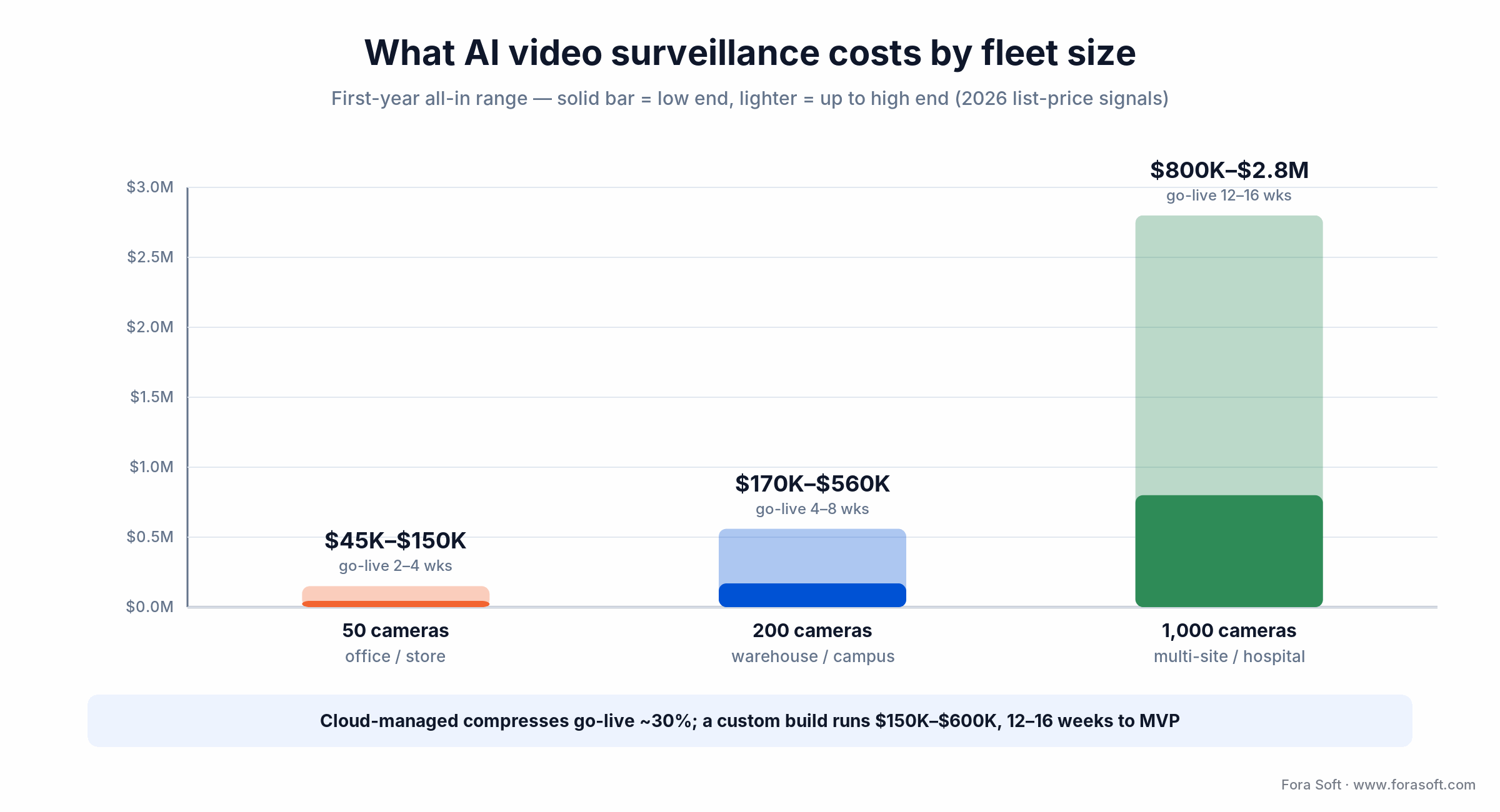
Figure 3. First-year all-in cost by fleet size, with typical go-live windows — cloud-managed compresses the timeline.
50-camera site (office, retail store, small facility)
Hardware $12,500–$60,000; installation $15,000–$30,000; cloud VMS $12,000–$36,000/yr; analytics $6,000–$18,000/yr. First-year total: roughly $45K–$150K. Ongoing years: $18K–$54K. 2–4 weeks to go live on a cloud-native stack.
200-camera site (warehouse, campus, large retail)
Hardware $50,000–$240,000; installation $50,000–$100,000; cloud VMS $48,000–$144,000/yr; analytics $24,000–$72,000/yr. First-year total: roughly $170K–$560K. 4–8 weeks go-live including network cutover.
1,000-camera site (multi-site retail, hospital system, airport)
Hardware $250K–$1.2M; installation $200K–$500K; cloud VMS $240K–$720K/yr (or on-prem license $200K–$500K one-off + $50K/yr maintenance); analytics $120K–$360K/yr. First-year total: roughly $800K–$2.8M. 12–16 weeks for full deployment; analytics tuning runs another quarter.
Reach for pure-cloud (Verkada, Rhombus, Eagle Eye) when: IT staff is thin, multi-site management matters, and you accept roughly 1.7–2.5× the five-year TCO of on-prem at 500+ cameras in exchange for speed-to-value and vendor support SLAs.
Reach for on-prem VMS (Milestone, Genetec) when: you have a data-sovereignty requirement, a specialist SI partner, or an existing infrastructure team that can own the stack. Five-year TCO is 40–60% of pure-cloud at 500+ cameras.
Reach for a custom build (our MindBox pattern) when: you’re an ISV white-labeling surveillance to your own customers, you have specialized analytics (industry-specific, niche compliance), or no off-the-shelf product fits your data model. Build cost $150K–$600K; 12–16 weeks to MVP with agent engineering.
Reach for hybrid (cloud dashboard, on-prem recording) when: bandwidth is limited at remote sites, compliance mandates local retention, or you want the cloud UX without the cloud egress bill. This is the default we ship on MindBox-class projects.
Reference architecture: what we deploy in production
The architecture we ship for a 50–1,000 camera deployment is intentionally boring. Boring means it will still work at the 5-year mark.

Figure 4. The reference stack we ship — edge does the sub-200 ms hot paths; the cloud does search, retention, and governance.
Cameras. ONVIF Profile S/T conformance-tested IP cameras (Axis, Hanwha, Hikvision-alternatives, Bosch). 4K for forensic value, 1080p on the bulk of the fleet, fish-eye or multi-sensor for wide coverage. PoE+ switches for power + network. For sites with bandwidth limits, on-camera H.265 encoding is the compromise of choice.
Edge compute. A Hailo-10H (40 TOPS INT4 at ~2.5 W, shipping since mid-2025) or Jetson Orin NX per 8–16 cameras runs the hot analytics — intrusion, PPE, slip-and-fall, loitering — on a YOLO26-class detector at <200 ms alert latency. The edge tier takes 60–80% of the inference load off the central cluster. The model-embedding internals sit in our AI-for-video-engineering learn track.
Central pipeline. Kafka ingest, NVIDIA Triton inference on L4/L40S pods for heavy models (ArcFace embeddings, OSNet re-ID, license-plate recognition). pgvector or Milvus stores embeddings for forensic search. Grafana + Prometheus for ops observability.
Integrations. SSO via Okta or Microsoft Entra ID. POS/WMS webhooks for retail and warehouse use cases. Access-control (HID, Genetec Synergis) for correlated-event detection. Incident-management export to ServiceNow or Jira for ops workflow. Alerting via PagerDuty or Slack.
Governance. Role-based access controls, tamper-evident audit log, encrypted at rest, retention policy mapped to regulatory class (HIPAA, BIPA, CCPA, GDPR, EU AI Act). This is the layer we see enterprises underinvest in and regret in year two. It is the backbone of our video surveillance development practice.
Mini case: MindBox — 99.5% face recognition at enterprise scale
Situation. MindBox is the AI VMS we’ve evolved across 50+ enterprise deployments over multiple years. The fleet runs across corporate campuses, logistics hubs, and gated developments. The product brief: one unified VMS that does people-counting, facial recognition, ANPR, and forensic search with enterprise-grade compliance.
12-week plan. Weeks 1–3: ONVIF camera audit and network cutover across existing fleet. Weeks 4–7: analytics stack rollout — ArcFace face-recognition pipeline, OSNet re-identification, LPR for 500K+ vehicles a day at the campus gates. Weeks 8–10: forensic search UX, incident playback, audit-log hardening, GDPR retention controls. Weeks 11–12: integrations to the customer’s HRIS, access control, and ticket system; cutover training for operators.
Outcome. 99.5% facial-recognition accuracy on enrolled workforce, ANPR running at ~500K vehicles a day at gate-level sub-200ms latency, 50+ deployments live on the same platform. Want a similar assessment for your surveillance estate? Book a 30-min review and we’ll map the camera + analytics + governance path for your sites.
5 pitfalls that kill AI surveillance programs
1. Skipping the false-alarm baseline. You can’t show a 70% improvement if you never measured the 1,000 false alarms per week you had before. Run a two-week baseline on the existing system; the ROI math depends on it.
2. Buying cameras before deciding the analytics. Facial recognition needs identification-grade pixel density at the face (IEC 62676-4 sets 250 pixels per metre at the target); LPR needs specific angle/exposure/shutter settings; PPE detection tolerates lower res. Pick the analytics first, then spec the cameras.
3. Treating compliance as a last-sprint task. EU AI Act, BIPA, CUBI, CCPA, GDPR — the rules around biometric and behavioral analytics are real. Design the consent flow, retention policy, and audit log in sprint one. Retrofitting costs 3–5× more.
4. No eval rig. If you can’t regression-test the analytics on a known-good clip set, you can’t swap models when a better one ships. Build a 200–500 clip eval set in the first month and rerun it every release.
5. Ignoring the operator experience. The best analytics in the world don’t help if the security operator can’t triage alerts in under 10 seconds. Budget UX engineering, not just ML engineering. Your operators are the feature.
KPIs: how to tell if the AI surveillance investment is actually working
Quality KPIs. False-positive rate under 5% on your most-used analytic. False-negative rate measured against labeled incidents at under 10%. Facial recognition Rank-1 accuracy above 95% on enrolled subjects. LPR accuracy above 92% on open-air plates, above 85% on angled plates. Alert latency under 1 second on edge analytics, under 5 seconds on cloud analytics.
Business KPIs. Incident count year-over-year (should drop 20–40% in year one on sites with legacy surveillance). Time-to-dispatch for real incidents under 60 seconds. Shrink reduction (retail) above 10% in year one on targeted categories. Insurance-premium negotiation position at renewal — document the KPIs to your broker.
Reliability KPIs. Camera uptime above 99.5% (healthy fleet), video-loss events under 0.1% of hours recorded, analytics pipeline availability above 99.9%. Mean time to recovery under 15 minutes on edge failures. Zero unaudited access to footage. This is a compliance KPI and it’s binary.
Building the KPI dashboard for your board?
30 minutes with our analytics engineers — we’ll share the baseline schema we use on MindBox and V.A.L.T deployments so you don’t build from zero.
Security, privacy, and compliance: the 2026 rulebook
EU AI Act. The Article 5 prohibitions have applied since 2 February 2025: no untargeted scraping of facial images from CCTV, and tight limits on real-time remote biometric ID in public spaces, with fines up to €35M or 7% of global turnover. Transparency duties (Article 50) have applied since 2 August 2026. The high-risk obligations a biometric surveillance system triggers moved under the Digital Omnibus on AI, Regulation (EU) 2026/1744, published in the Official Journal on 24 July 2026 and in force since 27 July: Annex III stand-alone systems now apply from 2 December 2027, Annex I embedded systems from 2 August 2028. If Europe is a material market, treat the risk classification as a sprint-one product requirement, not a legal afterthought.
BIPA (Illinois) and CUBI (Texas). Biometric identifiers require written consent, retention-policy disclosure, and destruction schedules. BIPA keeps its private right of action at $1,000 per negligent and $5,000 per intentional violation, but its August 2024 amendment caps recovery at one per person instead of one per scan, and on 1 April 2026 the Seventh Circuit (Clay v. Union Pacific) held that the cap also applies to cases already pending. Exposure is smaller than in the per-scan era, not gone.
GDPR / CCPA / LGPD / PIPEDA. Video of identifiable individuals is personal data. Retention periods, subject-access rights, data processing agreements with your VMS vendor, and breach-notification obligations all apply. CCTV signage at every entrance is the bare minimum.
Sector-specific. Healthcare triggers HIPAA for any video of patient areas; finance triggers PCI DSS for any camera covering cardholder data; education triggers FERPA; unionized workplaces trigger NLRA labor-law negotiation if surveillance is introduced unilaterally.
Insurance implications. Cyber policies now ask about surveillance-system patching cadence and credential hygiene. A breached CCTV network is a reportable event in most cyber policies and sometimes in primary property too. Include your VMS in your patch SLA.
When NOT to roll out AI surveillance
Three cases where we’d recommend pausing or staging. First, under 25 cameras and no specialized analytics need. The fixed cost of an AI VMS license plus integration doesn’t clear the value bar; a classic cloud VMS with motion alerts is enough until you grow.
Second, when you haven’t resolved the union or labor-law question. Introducing surveillance analytics in a unionized workplace without negotiating first is a Board-level exposure. Do the legal work before the RFP.
Third, when your IT team is under-resourced to own the pipeline. A cloud-managed product (Verkada, Rhombus) is the right move. Don’t buy a Milestone+BriefCam+Genetec stack that your team can’t operate. We’ve seen $500K deployments sit idle because nobody owned the operator training. If you do have the team and the scale and want to own the system, our build-vs-buy guide to custom video surveillance solutions runs the build math for 50, 500 and 5,000 cameras.
A decision framework — pick your stack in five questions
Q1. Which benefits actually matter? If it’s shrink, go retail-analytics-first (Everseen, AiFi, Sensormatic, BriefCam). If it’s safety, go PPE and slip-and-fall (Visionify, viAct, Intenseye, custom). If it’s perimeter, go edge-intrusion (Axis, Hanwha, Rhombus). Don’t buy the bundle you don’t need.
Q2. How many sites and how distributed? Single site >200 cameras: on-prem VMS likely wins TCO. 5+ distributed sites: cloud-managed wins on ops simplicity. Mixed: hybrid, cloud dashboard + local recording.
Q3. What’s the compliance posture? EU/UK sites: EU AI Act + GDPR — on-prem or EU-region cloud. Illinois/Texas/California: BIPA/CUBI/CCPA — careful on biometrics. Healthcare/finance: HIPAA/PCI — segmented network, BAAs with every vendor.
Q4. What’s the integration ambition? Standalone VMS is off-the-shelf. POS/WMS/HRIS/ACS integration is SI territory. Custom analytics or ISV white-label is a build (MindBox pattern).
Q5. Who owns the pipeline after go-live? If the answer is “no one dedicated,” buy cloud-managed. If you have a two-person security-ops team, on-prem is realistic. If you’re staffing a platform engineering team, custom is the ceiling.
Integration playbook: the 12-week path
The plan below is what we run for a typical 200–500 camera deployment combining cloud VMS with a custom analytics layer. Pure cloud-managed deployments compress this by 30%; greenfield multi-site builds expand by 30–50%.
| Weeks | Workstream | Deliverable |
|---|---|---|
| 1–2 | Discovery, baseline, camera audit | Baseline false-alarm + incident stats, camera ONVIF audit, analytics shortlist |
| 3–4 | Network + storage foundation | Dedicated VLANs, PoE upgrades, retention-tier object storage ready |
| 5–7 | VMS + core analytics rollout | Cameras live, intrusion + PPE + LPR running, operator UX shipped |
| 8–9 | Integrations (POS, WMS, ACS, HRIS) | Correlated-event workflows live, incident export to ServiceNow/Jira |
| 10–11 | Compliance & governance | Retention policy live, audit log, BIPA/GDPR consent flows, RBAC |
| 12 | Training, handover, KPI launch | Operator training, KPI dashboard live, Q2 review scheduled |
Agent engineering compresses weeks 5–9 by 30–40% when we’re writing custom integrations — frontier coding agents scaffold Terraform, pipeline glue, and migration scripts faster than hand-coding, with senior review replacing authorship. That’s the biggest process change between our 2024 and 2026 playbooks.
Where AI surveillance is heading in 2026–2027
Multimodal models native to video. Frontier multimodal models from Google, Anthropic, and OpenAI accept video input, and VMS vendors now fine-tune vision-language models for security work (Milestone’s VLMs on NVIDIA Cosmos Reason, announced March 2026). Over the next 18 months, “ask the system in English” becomes the default operator interface, not a feature layered on top. Expect voice-query support alongside text.
Generative AI moves onto the camera. The Hailo-10H already runs on-device LLMs and VLMs at ~2.5 W (the Raspberry Pi AI HAT+ 2 went on sale on 15 January 2026 for $130, with 40 TOPS and 8 GB on board). That pushes analytics that live in the cloud today (OSNet re-ID, ArcFace, even natural-language scene descriptions) to the camera-local tier, cutting bandwidth and improving privacy at once.
Insurance-grade KPIs become contractual. We expect the first “commit to a false-alarm SLA, get a premium cut” deals in 2027; as of October 2026 no major carrier publishes one. Carriers already ask for the data; the contracting machinery is catching up.
Regulation gets sharper. The EU AI Act’s transparency duties have applied since August 2026, and high-risk biometric obligations follow from December 2027 under Regulation (EU) 2026/1744. US state biometric and privacy laws keep expanding beyond Illinois and Texas. The compliance layer becomes a product feature, not a checklist.
Agentic incident response. “AI watched an incident, summarized it, paged the right team, pulled the footage, opened the ticket, notified the insurer.” We’re shipping the first version of this on MindBox-class projects today. In 2027 it will be the default workflow.
FAQ
Will AI surveillance replace our security guards?
No — it amplifies them. A security operator with an AI VMS monitors 200–500 cameras instead of 30–50 and spends time on real events, not monitor fatigue. Most programs grow footprint without growing headcount. We have never seen a deployment that eliminated the security team.
How accurate is facial recognition in 2026?
On well-lit, head-on 1080p+ frames, modern face-embedding systems (ArcFace, InsightFace) hit 98–99.5% Rank-1 accuracy on enrolled subjects. Accuracy drops sharply on angled, low-light, or masked faces, and legal use is increasingly restricted. Build the privacy controls before the model.
Can we use our existing cameras or do we need to replace them?
Usually a mix. ONVIF Profile S/T cameras under 5 years old on 1080p+ generally work. Older analog / sub-720p cameras usually get replaced during the rollout. Budget 20–40% replacement on most enterprise fleets.
Is cloud or on-prem better for AI surveillance?
Cloud wins on speed-to-value and multi-site ops; on-prem wins on five-year TCO at 500+ cameras and on data sovereignty. Most enterprise deployments end up hybrid: cloud dashboard, on-prem recording, edge analytics where the latency or bandwidth demands it.
How long does a typical deployment take?
50 cameras on cloud-managed: 2–4 weeks. 200 cameras with basic analytics: 4–8 weeks. 1,000 cameras with integrations and compliance work: 12–16 weeks. Agent engineering compresses custom integration work by 30–40%.
What about EU AI Act and BIPA compliance?
Both are real. The EU AI Act’s Article 5 biometric prohibitions have applied since February 2025; transparency duties have applied since August 2026, and the high-risk obligations for biometric surveillance apply from 2 December 2027 (Annex III, under the Digital Omnibus, Regulation (EU) 2026/1744). BIPA has driven class-action settlements in the eight figures; since the 2024 amendment, damages are capped at one recovery per person. Design consent, retention, and audit logging in sprint one, because retrofitting costs 3–5× more than designing in.
How do we negotiate premium discounts with insurers?
Start the conversation with your broker three months before renewal. Share baseline and post-deployment false-alarm rates, incident counts, and response times. No major carrier publishes a standard AI-surveillance discount as of October 2026, so the outcome is negotiated per account; documented KPIs are what move it.
What if we need custom analytics no vendor offers?
That’s our MindBox pattern: open-model stack (YOLO26, ArcFace, OSNet) with your own rules and UX, hosted on-prem or in your cloud. 12–16 weeks to MVP with a senior team; a lean ops team to run it. Worth it for specialized compliance, niche verticals, or white-label surveillance ISVs.
What does “edge AI” mean in video surveillance?
Edge AI means the detection model runs on a small accelerator at or beside the camera — a Hailo-10H, a Jetson Orin, or an AI-capable camera SoC — instead of streaming every frame to a server. The payoff is sub-200 ms alerts on hot rules (intrusion, PPE, falls), far less bandwidth, and privacy: sensitive frames can be analyzed and discarded without ever leaving the building. Forensic search and retraining still live centrally; edge and cloud split the work.
What’s the best AI video surveillance system?
There isn’t one winner — it depends on scale and control. For IT-light multi-site fleets, cloud-managed Verkada or Rhombus win on speed. For enterprises with mixed cameras and their own ops team, Milestone XProtect or Genetec. For banks, ISVs, or anyone needing custom analytics and data residency, a custom build (our MindBox pattern) is usually the better fit. Match the system to who owns the pipeline after go-live, not to a feature checklist.
How much does AI video analytics cost per camera in 2026?
Usually $10–$30 per camera per month as an add-on to a VMS you already run, or $15–$60 per camera per month for a cloud VMS with AI built in. Multi-year licenses work out cheaper per year: Verkada’s 5-year camera license lists at $1,099 (about $220 a year) in its August 2026 price list. The price typically includes hosting, a retention tier, analytics updates, and support; cameras, bridges, installation, and integrations are extra.
How big is the AI in video surveillance market?
$4.04B in 2026, rising to $10.88B by 2032, per MarketsandMarkets (May 2026); $6.83B in 2026, rising to $13.26B by 2031, per Mordor Intelligence. The gap is scope. Both put growth at 14–18% a year, with software and cloud deployments growing fastest.
What are the benefits of AI in cloud video surveillance?
Cloud AI surveillance goes live fastest (2–4 weeks for 50 cameras), manages many sites from one dashboard, ships analytics and natural-language search as updates instead of upgrade projects, and turns CapEx into a per-camera subscription. The trade-offs are egress and retention costs at scale and data-residency limits, which is why most enterprises end up hybrid: cloud dashboard and search, on-prem recording, edge analytics.
What to read next
Deep Dive
AI-Powered Video Analytics: The 2026 Security Playbook
Our full architecture and cost playbook for CTOs and security engineers.
Models
Top 7 Anomaly Detection Models for Video Surveillance
The models that catch what matters across hundreds of camera feeds.
Ethics
2026 AI Surveillance: Trust, Data Quality & Ethics
How to build trust, data-quality discipline, and ethical guardrails into your program.
AI Strategy
Generative AI and Contextual Video Intelligence
From detection to understanding intent in video AI.
Services
AI Integration Services at Fora Soft
How we ship AI into existing platforms in 8–16 weeks.
Ready to turn your cameras into a business-grade intelligence layer?
The short version: AI surveillance in 2026 is no longer a technology question. It’s an operational one. False alarms go down 70–90%. Retail shrink drops 10–40% where the analytics are deployed. PPE compliance improves 60% within a quarter. Forensic investigations shrink from days to minutes. Insurers don’t publish discounts yet, but documented KPIs give you a negotiating position at renewal. ROI lands under 12 months in the majority of published deployments.
The choices are about fit, not category. Cloud for speed and multi-site. On-prem for scale and sovereignty. Custom for ISV white-label or niche analytics. Pick the two or three benefits that matter most for your business, start with a 50–200 camera pilot, instrument the KPIs, then scale. The compliance, the vendor selection, and the operator UX are the places programs succeed or fail — design for them from sprint one.



The handbook · 7 volumes
Fora Soft Video Engineering Handbook
The business case in this article rests on what the cameras can recognize and how fast. Our seven-volume handbook covers the video stack behind it, from encoding to delivery, audio and AI. Security leaders and their engineers can start with Volume 6 on detection and tracking, then Volume 7 on EU AI Act and biometrics rules, and Volume 1 on compression for long retention. Written by Nikolay Sapunov, CEO at Fora Soft.
Browse the handbook on Amazon →7 volumes · 9,000+ pages · Kindle & paperback
Want our opinion on your AI surveillance roadmap?
30 minutes with a senior Fora Soft engineer — we’ll map the stack, compliance path, cost model, and 12-week deployment plan for your sites before you commit a sprint.

